I’m REALLY MEAN when I teach at Pennsic and only give out outlines when I teach my classes. There’s multiple reasons for this:
1: You can’t show up, jack a handout, and then not stick around for my class thus shorting the people who stay a handout.
2: It’s harder to plagiarize me. Yes, it’s happened. Really people, just cite me in your work.
3: It makes you become more engaged in what I’m teaching by following my outline, and taking your own notes for your own benefit. I do pass around supplemental materials and draw pretty pictures on the whiteboard and I want you to pay attention.
4: IT SAVES TREES. If I printed everything I needed for a 2 hour class, it would be a small booklet, and cost me a lot.
However, this has a downfall. Those that want to go to my classes and then can’t get shafted. So I was thinking to myself, “How do I make this easier for folks who can’t make it? You can’t learn much from a boring old handout.”
DING. SOCIAL MEDIA.
I understand that not everyone has Facebook, I apologize, but not everyone has Google + either, and I find the Facebook group interface a bit better for discussion anyway. Therefore, I created a group on Facebook that I plan to fill with all of my class goodies after war, so everyone can jump in, ask questions, and engage in a sorta online class. This is pretty beta, and I hope it works out. If it doesn’t, I’ll just can it.
So I was able to get some calcium carbonate (natural chalk) from a brewing supply store, and decided to, you know, put it on my face with the other questionable materials I’ve been using.
DISCLAIMER: NOT APPROVED BY THE FDA, NOT APPROVED FOR COSMETICS, YADDA YADDA CANCERFACE YADDA YADDA DO THIS AT YOUR OWN RISK.
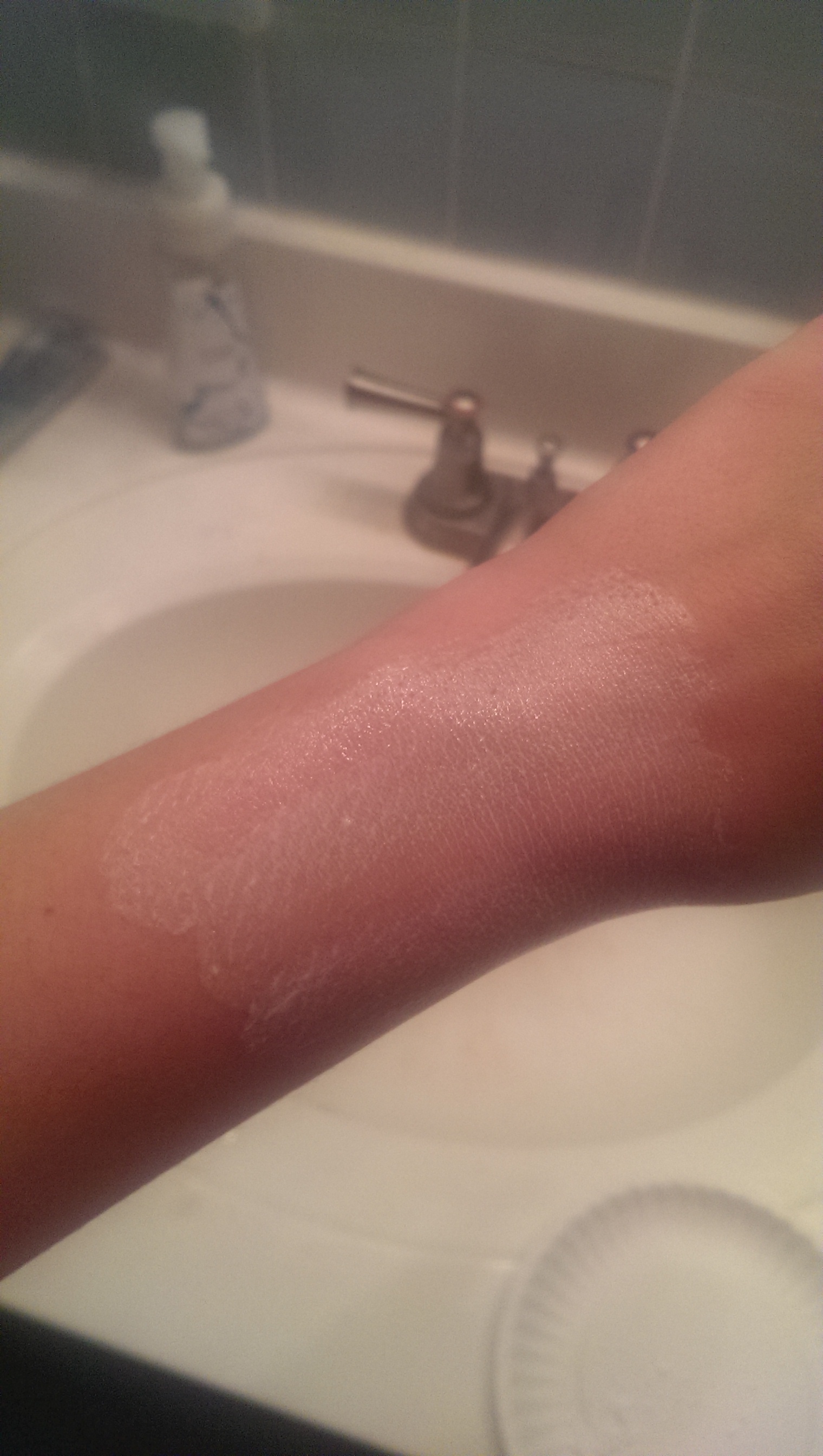
Okay, so…the article I’m using as a basis for this starter kit said that the chalk was mixed with vinegar. So, I raided my kitchen for white wine vinegar that I typically use to make sekanjabin or oxymel, and combined the two in a plastic cup. This immediately caused the fizzies due to the reaction of the acetic acid releasing the carbon, much like what would happen with sodium bicarbonate (baking soda) but not nearly as explosive. This intrigued me and worried me, but it seemed too thin, so I added more chalk to get a paste that was more reminiscent of a modern liquid foundation. I slathered it on my arm for a patch test, and let it dry. It didn’t look so bad or cause a reaction, so…
…I slathered it on my face… As you can see, it was a bit…paste-like, and didn’t blend well. It clung to every wrinkle and scar or zit on my face, and I immediately remembered I was in my 30s. So I washed it off with soap and water and it came off quite easily. (Note, it’s not in my hair, that’s my Rogue stripe.)
So I thinned the paste with more vinegar, and got a more powdery, fast drying finish. It was still lightening my skin, but not the consistency of glue.
Quickly, it was evident that thin layers would do the trick. It’s not an emulsion like a modern foundation, and therefore the mineral can be displaced and clump easily, as you can see on my eyebrow and cheek. I did apply it with a modern cosmetics brush as well, so I need to do more research into period applicators, that should also help.
Well, there was only thing left to do: PUT THE WHOLE FACE ON. I went lighter on the red ochre this time, since I haven’t yet made my balm for it as planned. I should do that, oh, tonight.
I applied the lamp black to my eyebrows and as eyeliner using the olive oil mixture from my first post. (I also patch tested this. ALWAYS PATCH TEST!) I went a bit crazy with it on the eyebrows, I need better brushes to tone it down. Eyeliner was done by toothpick.
This side was a bit heavier, and I look even less glamorous:
Of course, now I had to take this stuff OFF. Modern soap and water worked fine for the chalk and the ochre, but the carbon?
.
.
. Not so much. (I had to.)
I was able to remove it using the olive oil mixture it was applied with, to a point, and then with a non-oil based modern makeup remover, which helped but wasn’t great. The oil is needed to break up the black. It’s very staining, and I wasn’t able to remove it completely, so I think a modern oil-based remover would do the job nicely.
So, I now have the beginnings of a basic Roman makeup kit which should make my A&S display this weekend at Palio di Stonemarche an interesting one. I hope to have something more to show come Pennsic.
I’ve decided that since my Kingdom thought I was good enough to get a Maunche (and I got to write OM after my name on a class handout coming up. WEIRD!) I needed to step up my game and get down and dirty. Since I’m really good at making a mess, I decided to jump into the dangerous, but interesting world of ROMAN COSMETICS.
Here it is, my disclaimer: What I do here is at my own risk. Please, for the love of Hades and all that is holy, do not try this at home if you feel that you may react to any of these cosmetics or their contents make you feel unsafe. Although I am working with non-toxic ingredients, some of them can be a bit scary.
The Romans (in this case, we are including the Byzantines, as they SHOULD be included) were fond of personal hygiene and their appearance, so there’s a great deal of information on what they used for makeup, face creams, depilatories, and the like, so it’s something I’ve been kicking around for a bit. After talking a bit with Mistress Aife who has done similar things with Irish cosmetics, I decided, “Oh hell, why not? As long as it’s not lead and mercury I should be fiiiiiiiine.”
So I decided to start with the famous kohl eyeliner that was all the rage in the Levantine civilizations, and the early 1990’s. I’m a pretty heavy eyeliner wearer when I DO wear makeup (see also, 1990’s) so I always have some on when I have court garb on, but if I want to be authentic, I should take the next step.
For the most part, kohl was made (and is still made in some countries) with galena, which is lead sulfide. This is baaaaaad. So, I looked for alternatives. Immediately, I found that both in period and in modern preparations, lamp black is used with some sort of medium to spread it on the eyes. In Roman times, this is a scented oil or water, and in modern times, it’s ghee, a clarified butter. So, here I was getting all excited about this fun new exciting way to make sexy eyeliner when my med school friend Margaret down in Meridies nearly beheaded me on my Facebook page. Come to find out, soot and lamp black have something called polycyclic aromatic hydrocarbons, and these such things are a carcinogen. Who knew? She did, and then I got a bummer, but I was determined to make some anyway for science and display purposes. I have no intention of putting this stuff on my face, but I needed to find an alternative. So, in some skimming today of a couple of articles, I found that they also used charcoals and ashes, basically anything that could smear black. Saffron was suggested, and I happened to have some I could, well, reasonably part with. So I made 3 batches of kohl, lamp black, willow charcoal, and saffron ash, and a scented oil carrier that’s simply olive oil with a few drops of frankinscense and myrrh. Here are my observations:
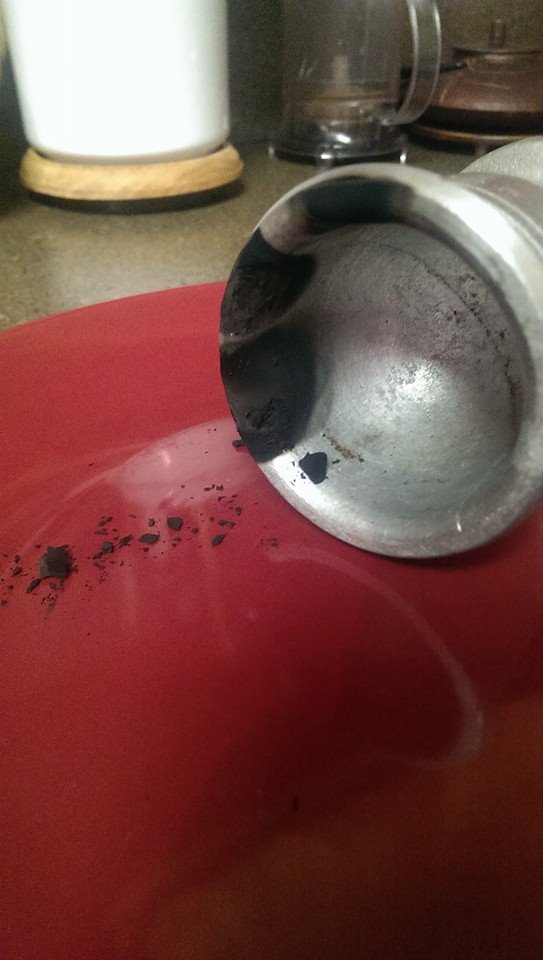
Lamp black: This stuff is great. If it wasn’t for the fact it could give me cancerface (that’s a thing now, I just made it up) I would rock this. Why? It’s smooth and already somewhat creamy from the oil content from my burning lamp. It made a beautifully dark line on my wrist that didn’t wash off easily. I’m really tempted to use it on my eyes, just once, but my better judgement is getting the best of me. As you can see, I used my Roman lamp from Claybaby Pottery, with a wick I braided myself out of fustian and olive oil, and collected the soot in a lead-free pewter mortar.
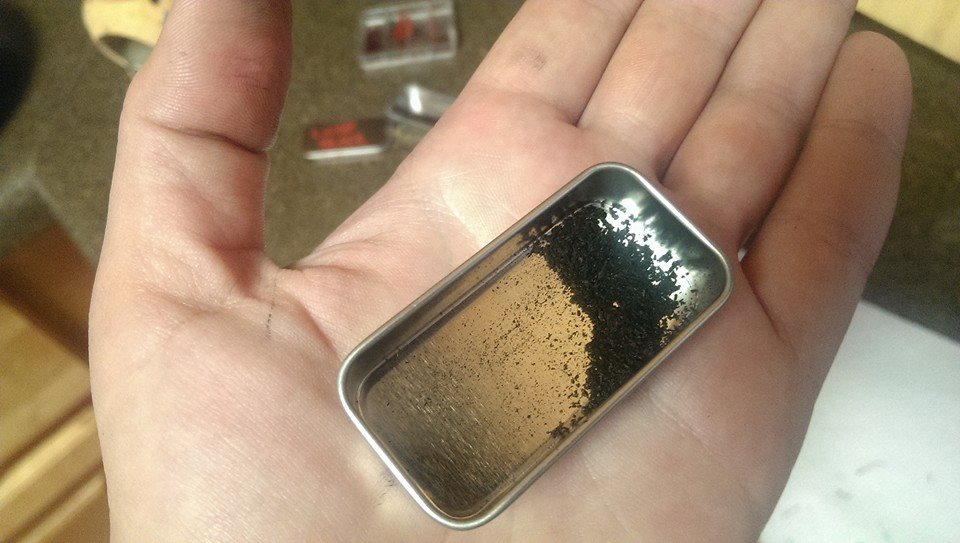
Willow charcoal: I have lots of charcoal sticks around the house, so I picked one from a natural source and got to smash it up in a mortar and pestle. This was great fun and a great mess. I wish I could grind it a bit better, but it did give me a decent line once I got the balance between kohl and oil down. Easy, readily available ingredients that are affordable, and charcoal eyeliners are already prevalent in the modern market. And one stick of charcoal filled my tin. I’ll have eyeliner forever! I want to try to apply this using modern eyeliner brush and water.
Saffron ashes: I was hoping this would be better, I really did. I need to figure out a better way to carbonize the saffron, because at first I tried to burn it on an incense burner/oil warmer. That didn’t work well, though my house smelled lovely. So I resorted to just getting impatient and setting it on fire with my lighter in a metal jar lid. This burned it, and I was able to get ash from it, but it does not carry well as a liner at all. It was suggested by both Geoffrey and a friend on the Romans of the SCA page to treat it as if I was making charcloth. So basically, I need to put it in a metal container and bake it until it turns to ashes. Yes, I’m basically cremating saffron…I’m going to need to buy more I’m not afraid to waste for this project to do this. The bit I burned did not yield much.
Here’s a picture of my filthy arm, top to bottom is lamp black, saffron, and charcoal:
I will be re-trying the saffron kohl sometime this week, as well as making my face whitener and blush. Once I conclude this project I’ll provide a list of sources I’ve compiled.
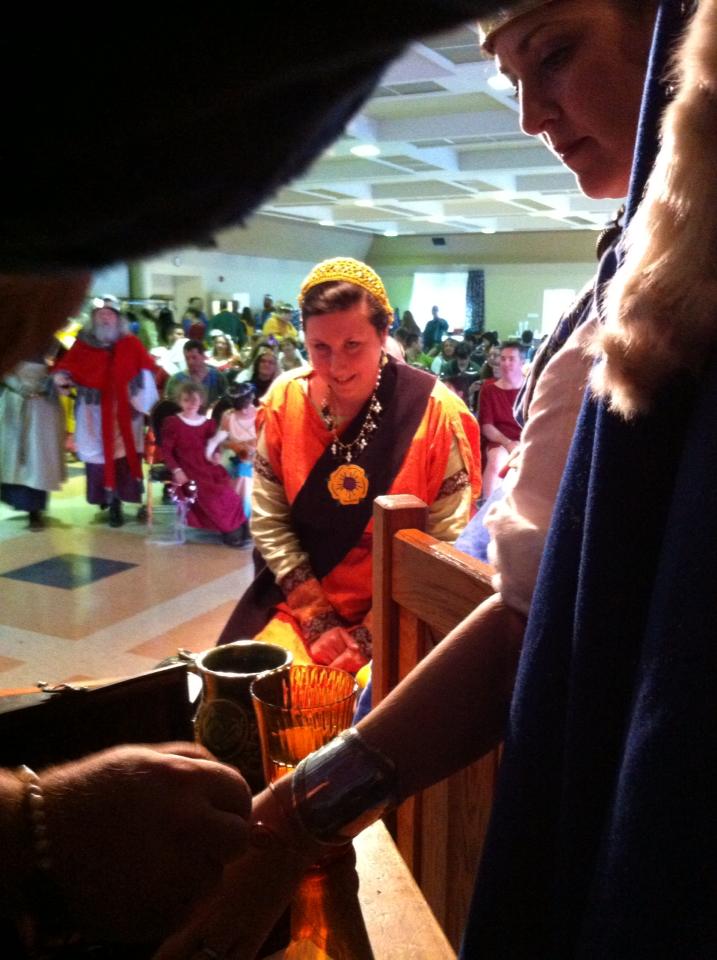
Although I do have substantive posts actually planned, I suppose I reserve the right to brag that yesterday at Crown Tourney in the Montreal area, I was inducted into the Order of the Maunche, which is the highest honor given in the East Kingdom in arts and sciences. I received it for my research and teaching of Roman and Byzantine clothing.
I was so tired at court (seriously guzzled coffee as fast as possible before I stood watch as Queen’s Guard) that I apparently didn’t show much emotion, but I do remember going, “Ahhhh, I can kneel for a bit.” Priorities. -.- So, for those that were like, “Wow, she seems out of it.” I kind of was, but I was very excited, and still am. Thank you all for the recognition, and I hope to do my best to represent the order. 🙂
An official #betweenthethronesie by Ryan McWhyte. Har. Oh hey look, my Bamberger Gunthertuch stola.
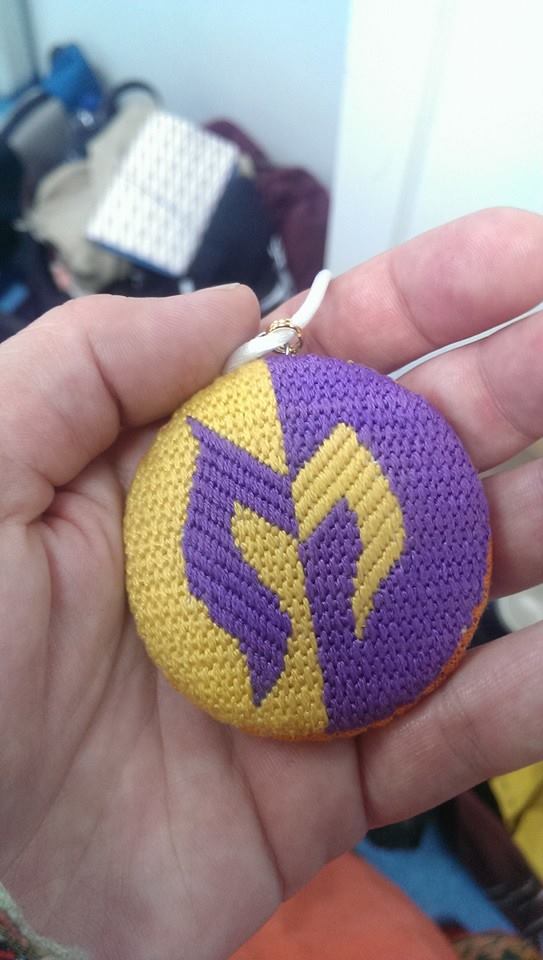
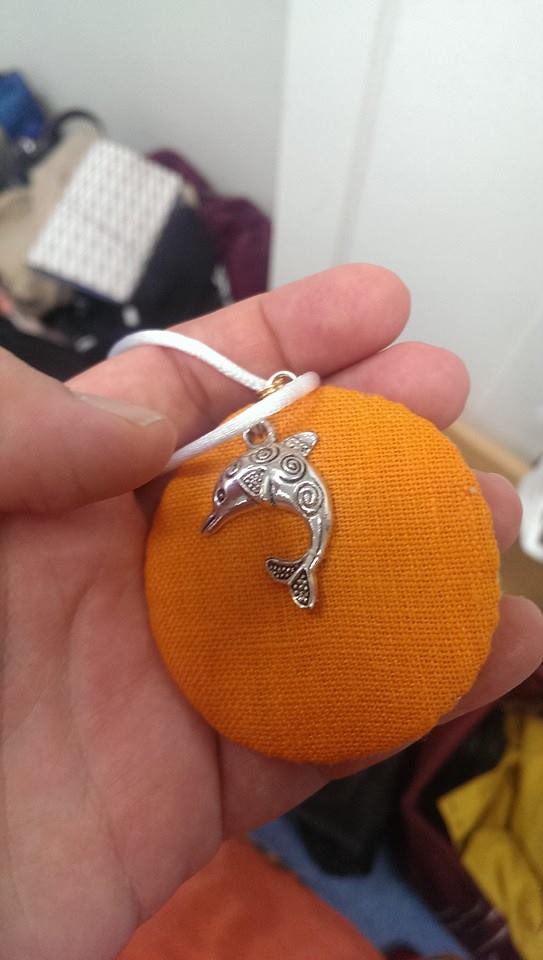
My medallion, made by my laurel, Mistress Clotilde von der Insel…which was backed with the orange fabric leftover from my Bucs dress. That was carefully acquired (see also: asked for) by Geoffrey, and snuck down to Rhode Island. EVIL!
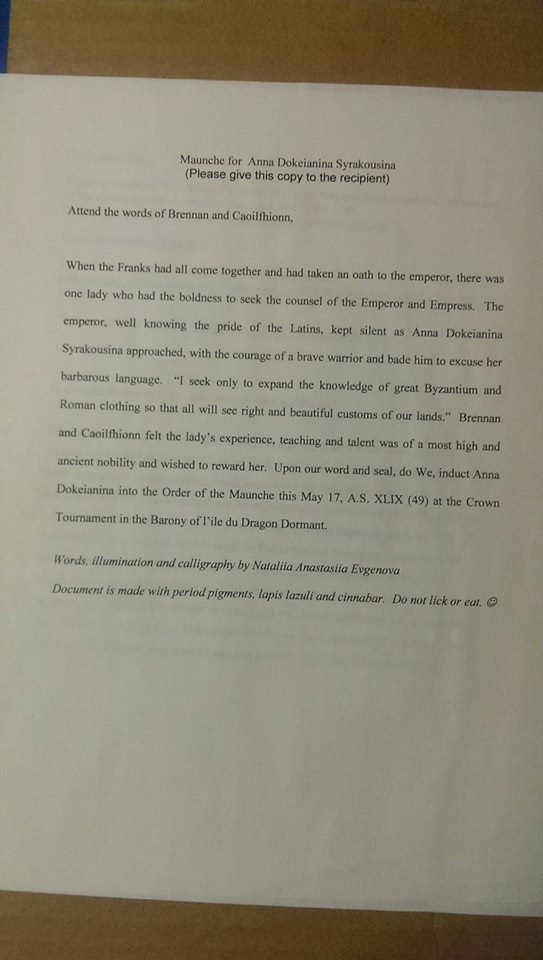
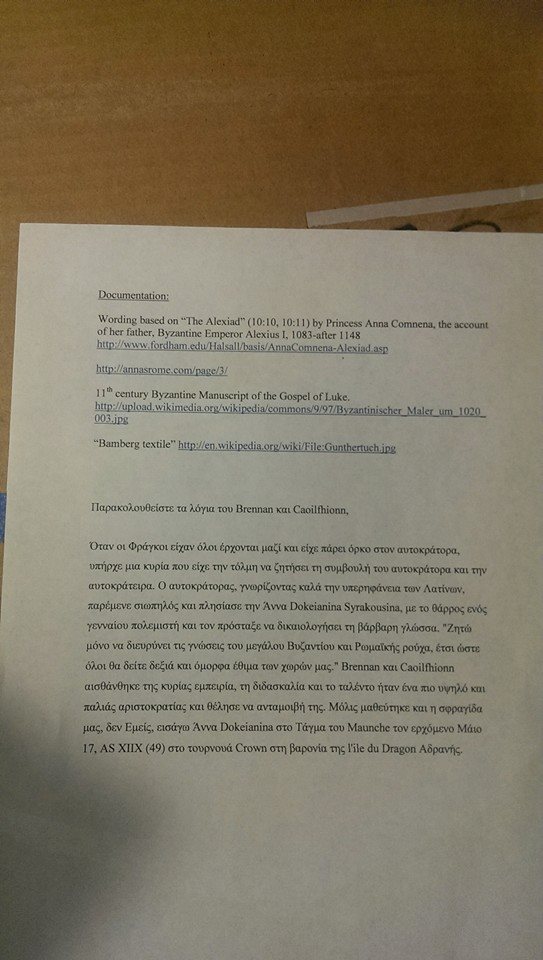
My scroll and wording, done by Mistress Nataliia Anastasiia Evgenova, who also did my AoA. The wording is based on The Alexiad.
I had the pleasure of attending a great new costuming symposium in the Midwest this last weekend: Figments and Filaments, in Independence, MO. It was certainly a long way from home, but worth the traveling. I’ve never been to Missouri, and I have plenty of friends in the Kansas City area who were more than happy to give me crash space. Naturally, fellow Byzanteamster Konstantia Kaleothina was my host, and with our powers combined with Andrixos, we were the Byzanteam! Taking the fashion show by storm!
I taught 2 classes: My Historical Costuming for Cosplayers one, and my 2 hour long Roman dress one, and we actually got to the Byzantine part, hurray!
It’s so odd watching yourself on screen.
I also took the train there and back, you know, to do something different (and it was cheaper.) I will definitely take the train long distance again. That was fun, and everybody should do it at least once.
I have so much wonderful things to say about this convention, I don’t even know where to start. Yes, it was small, and it was its first year, but it ran well, and everyone seemed to have had a really great time. Even this slightly aggressive Easterner. 😉 They want me back for next year, so I’ll be planning that return trip shortly.
Check out their website at Figmentsandfilaments.com, and the respective Facebook groups and pages.
Since I had so much time on my hands on the train, I stared at the Bamberg Textile again for a while, and now another blog is cooking while I start planning to turn a piece of red-orange linen into a short stola. Mwahahaha.
There’s a great deal that I could say about what goes on behind the scenes at events. I’m unsure how in-depth other kingdoms go, but here in the East, we like to be rather grandiose with coronations. I’ve autocratted royal progress events before, but I’ve never really been apart of the research and development strike team, so to speak, so this is a summarized post of my experience working on the spring coronation here in the East Kingdom.
Several months ago, I was approached by Master Steffan ap Kennydd about aiding him in designing a unique coronation ordo for the incoming heirs. It was going to be wildly anachronistic, as we were replacing 7th Century Saxons with 1st Century Romano-Hibernians, and I agreed, knowing that this could be a lot of fun.
I’m not too well-versed in early Irish culture, in fact, the Romans did not really interact with the Hibernians that often, and described them as basically crazy, so I knew that this was going to be tricky. Initially, I was brought in to help Steffan with the Latin, and things ballooned from there. We needed a story, we needed a good reason for Kenric II to abdicate, because court schtick is the best schtick. This involved a secret Facebook group, a Google document, and a conference call. Lots of discussion was had to be able to pull this together between about 8 people. @_@
Since Kenric II is the cousin of the martyred Kenric I, who was killed mysteriously by an archer bearing black arrows, visions of this sainted king have been plaguing his cousin. We had the benefit of working with 3 very superstitious cultures, so this was going to work. It would be far-fetched and as anachronistic as we could muster transitioning smoothly between time periods without a TARDIS, but this was going to rock.
Mistress Aife was brought in to help with the Irish, and I focused on the Roman. What else could we do to make this work? Steffan came up with the idea of taking it a dark route, and bringing in seers to proclaim Kenric’s doom during court. Aife wrote up a doom as follows, that we translated into Gaelic and Latin:
“King of the East! I speak your wyrd.
I see it in the flight of birds,
in the rising smoke, in the curling clouds.
King of the East, I speak your wyrd.
The wolf is coming, cloaked in splendor.
The eagles scream above his stride.
King of the East, I speak your wyrd.
The pale horse falls from the high place,
the victorious wolf hard at his heels.
King of the East, I speak your wyrd.
The three pale moons crowned by courage
are swallowed by the shadow of the wolf bearing the eagle.
King of the East, your wyrd is spoken.”
“Wyrd” from what I understand, is a very Anglo-Saxon concept, so is the white horse. The Irish revered wolves, while the Saxons found them to be bad omens. In this case, the wolf is also in Brennan’s arms, so it worked. The Eagle of course, is Rome. So Brennan essentially became, “The wolf bearing the eagle.” The “three pale moons” are Kenric’s arms. It’s vague, it’s spooky, and it was perfect.
Steffan and I translated it into Latin, and this was the result:
“Rex Orientis, fatum tuum dico.
Video in volatum avum, in fumo oriente, in nubibus volventibus.
Rex Orientis, fatum tuum dico.
Lupus venit, palliatus fulgore. Aquilae clangunt super passibus suis.
Rex Orientis, fatum tuum dico.
Equus albus descendit de loco alto, lupo victorioso vincendo.
Rex Orientis, fatum tuum dico.
Tres lunae pallidae virtute coronatae umbra lupi aquilam ferentis voratae sunt.
Rex Orientis, fatum tuum dictum est!”
This was more of a geek-fest for us rather than everyone else, but we enjoyed it.
Next came the performance aspect. Aife and myself were conscripted into duty as the seeresses, and I took on the role of a Vestal Virgin, the most well-known and recognizable Roman priestess. I’m hardly virginal material *cough* but for the day, it would be well worth the project.
Vestal garb is relatively simple, with some twists. I reached out to Maestra Julia Sempronia of An Tir, who had recently received her Laurel while donning the robes of the Vestal, and she was a great source of help, as well as others from the Romans of the SCA Facebook page.
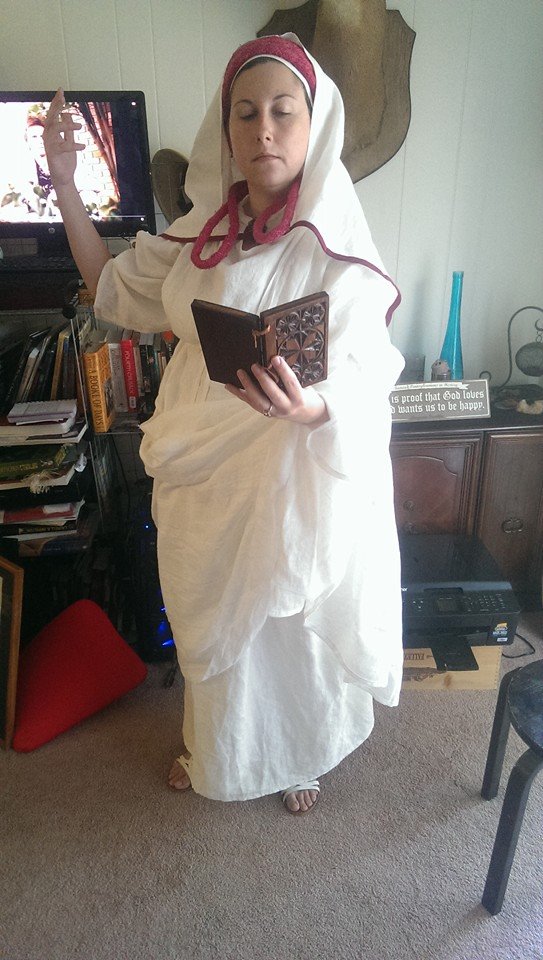
In addition to wearing all white, the most important part of the Vestal was the headwear, the infula (fillet) and suffibulum (veil.) Other than that, I needed white sandals, a white chiton, and a white palla. Those pretty much took care of themselves. However, I need to proudly display my sandals for a bit, because even though they’re modern, I found a pair that had a trinity knot as part of the design. So not only was I Roman, I was wearing what could be considered a rather Irish symbol, that could easily stand for all three cultures represented in the ceremony: Saxon, Irish, and Roman. Gods, I’m a NERD.
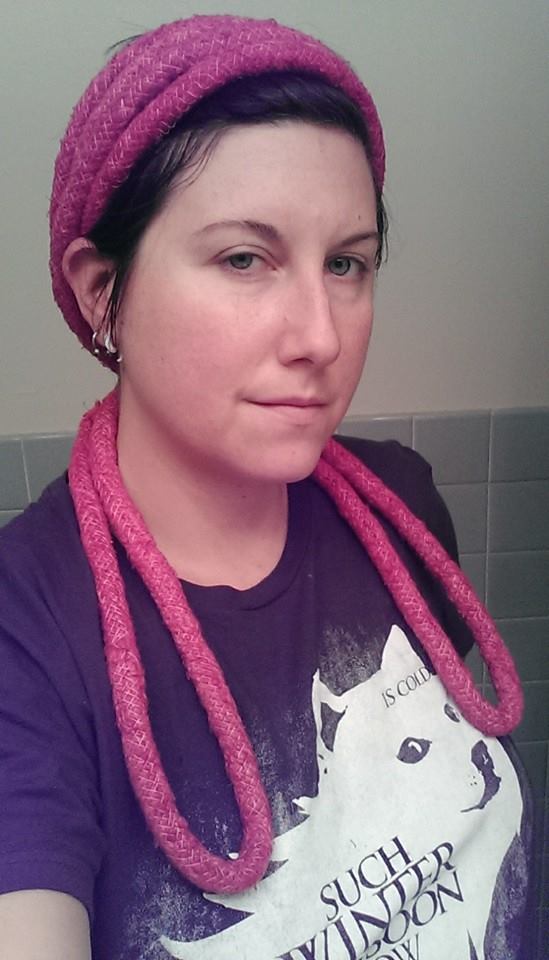
Back to the headwear. The infula was going to be the worst part. I needed to make funky round bands of funkiness in red, long enough to wrap around my head 5 times and have 2 loops over my shoulders. What I did on Maestra Julia’s suggestion was purchase cotton cording used to edge pillows, and dyed it red. It took me two dye baths to get it the right shade, and the dying process did leave the cotton looking a bit weathered and raggy, almost like felted wool. So I got the right look. It even faded just a bit like period red dyes do.
I posted this as-is on Facebook. Imagine the responses.
The final result:
I was still missing pieces to the puzzle. The infula slipped off of my short hair very easily, so I was reminded that I needed a vitta, or a plain white fillet to keep it in place. I simply cut and hemmed a small rectangle of white linen, and that did the job. Next was the suffibulum, or veil. This took a bit more troubleshooting than I thought it would. I needed to get the right shape to have it drape across my shoulders evenly. I tried a few rectangles, and then had a moment of pure “derp” when it was suggested by Domina Vestia on the Romans of the SCA page that it should be semi-circular. That did the trick. I trimmed it in deep reddish-purple bias tape, and made a brooch out of a huge shank button I found at Joann’s, and the headwear problem was solved.
I put together the whole kit, scared Lord Geoffrey, and made him take pictures:
Looks about right.
Of course, that was just the beginning, now the fun began. We had the words, we had the garb. I couldn’t memorize the lines entirely, so I cheated and taped them into my wax tablet. It did the job. Let’s spook the Eastern Populace.
Wyrd up.
But wait, there’s more!
You can’t have a victorious emperor of Rome come into court without showing off! It was my idea that Brennan and Caoilfhionn have a Triumph to begin their First Court. And although I couldn’t convince his Imperial Majesty to paint his face red, what resulted was an epic, and I do mean EPIC parade of regalia and pomp into court unlike anything I think the East has ever seen. Brennan paraded in after the kingdom champions, and I stood behind him, holding one of the Eastern crowns over his head, and chanting, “Respice post te, hominem te memento.” This translates to, “Look behind you and remember that you are but a man.” This was done typically by a slave with a laurel wreath, on the triumphator’s quadriga (4 horse chariot.) It reminded the emperor or general that they were still mortal, and not a god, and to control their hubris and pride. I have several reports that I gave members of the populace chills by doing this.
Her Imperial Majesty Caoilfhionn was carried in on a lectica, surrounded by the artifacts and relics of the East Kingdom, as well as amazing displays of heraldry as Roman vexillae. I missed the second half of the show because as soon as I got to the dais, I bolted to the royal room to change into less…conspicuous clothing so that I could enjoy court and be called upon as a member of the Queen’s Guard.
In closing, thank you everyone who came to Coronation and enjoyed our little performance. Thank you to their Majesties Brennan and Caoilfhionn, and their Graces Kenric and Avelina for playing along with our crazy idea. I’m looking forward to a nice, Roman summer. 🙂
Addendum: For those interested, here is the doom in Klingon. Generously translated by a poster on the Romans of the SCA Facebook page:
Because of the impending doom, er, Coronation, I’ve been getting pinged a lot here in the East on how I tie my chiton and get my Roman clothing to drape properly. So, I made this handy dandy 10 minute vid to help explain my method, as well as give a brief look at my new dark blue stola. I hope it helps.
Isn’t he adorable? 😀 He looks so amused for a highly displaced 11th Century Norman!
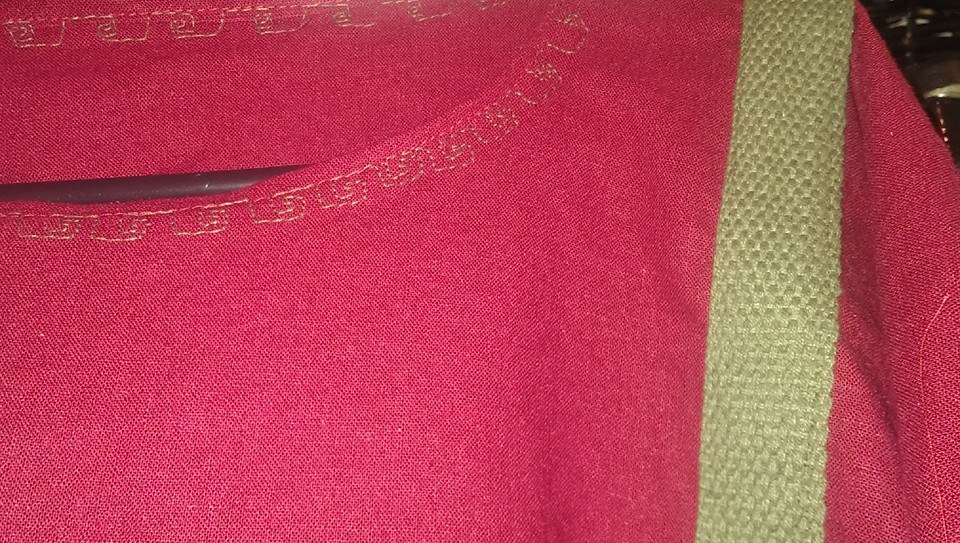
Our upcoming coronation here in the East Kingdom is Roman-themed, so naturally, I needed to make sure that we were both properly attired. Rufus here (I’m calling him that because of his lovely ginger hair, good cognomen) is wearing a basic man’s tunic with green clavii and some machine embroidered Greek key on his hems, his kidney belt for fighting, sandals we found at Salvation Army (real caligae will be coming in the future since he’s quite bent on being authentic) and a 6 yard toga in the semi-circular cut. Nice and lightweight and easy for someone not familiar with the feeling. He still says he feels naked. 😉
The Muscat is in the fridge. The Conditum Paradoxum is upright and settling out. (It clarified while cellared.) I will need to re-rack it before Great Northeastern War this weekend. I am EXTREMELY excited about my first chance to panel in the East Kingdom Brewer’s Guild. I’ve been dabbling with my local guild: The Smokingbridge Guild of Libation Brewers, for a while now, but I never thought to bring it to the Kingdom level until I got these beverages done. I will be paneling my Conditum Paradoxum along side a short mead, rose and lavender cordial, and my pomegranate balsamic sekanjabin if there are enough slots open for all 4. I’d like to thank Mistress Bess Darnley for taking a moment to look over my documentation and providing feedback.
The next panel I’ll probably make will be at Birka in January, and these shinies will be good to go:
YES! The Rosatum and Retsina are done and bottled and delicious! I can’t wait til these age. They’re going to be remarkable.

















 Anna's New Rome
You must be logged in to post a comment.