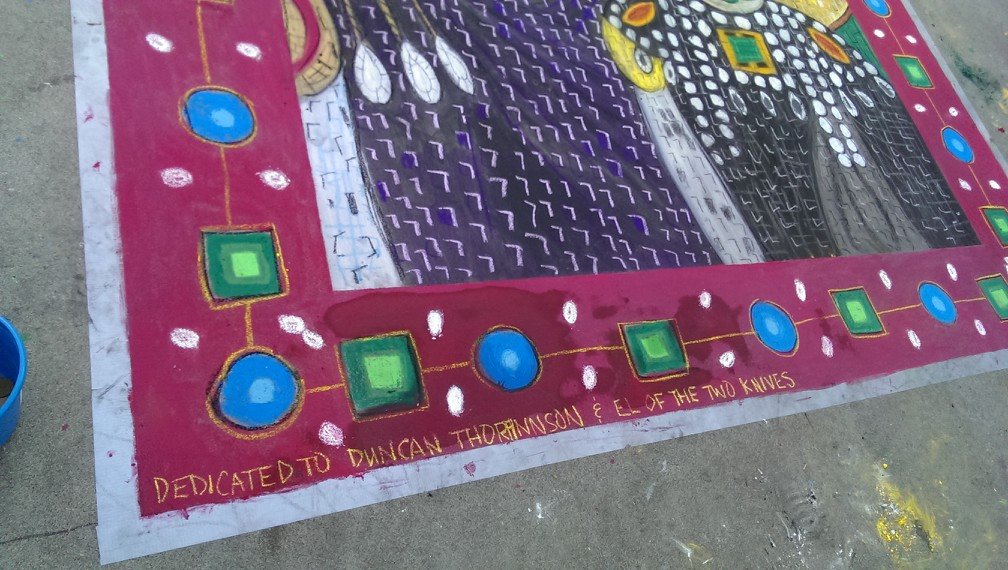
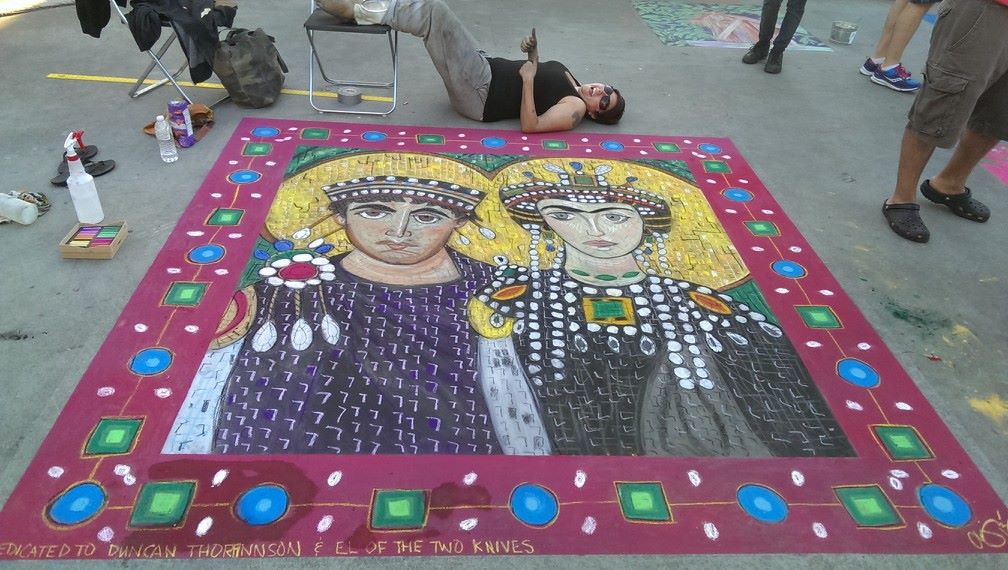
…And they got me.

Although I do have substantive posts actually planned, I suppose I reserve the right to brag that yesterday at Crown Tourney in the Montreal area, I was inducted into the Order of the Maunche, which is the highest honor given in the East Kingdom in arts and sciences. I received it for my research and teaching of Roman and Byzantine clothing.

I was so tired at court (seriously guzzled coffee as fast as possible before I stood watch as Queen’s Guard) that I apparently didn’t show much emotion, but I do remember going, “Ahhhh, I can kneel for a bit.” Priorities. -.-  So, for those that were like, “Wow, she seems out of it.” I kind of was, but I was very excited, and still am. Thank you all for the recognition, and I hope to do my best to represent the order. 🙂

thronsie
An official #betweenthethronesie by Ryan McWhyte. Har. Oh hey look, my Bamberger Gunthertuch stola.

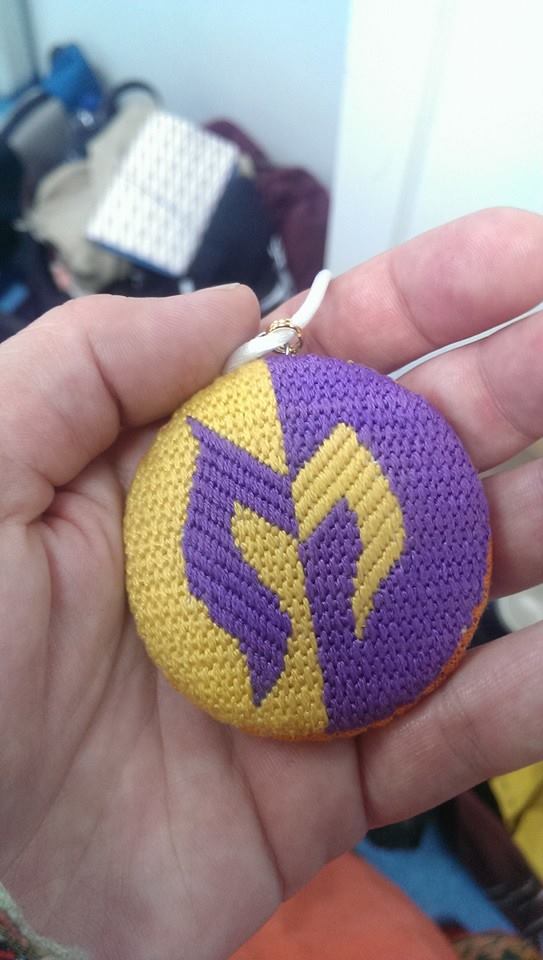
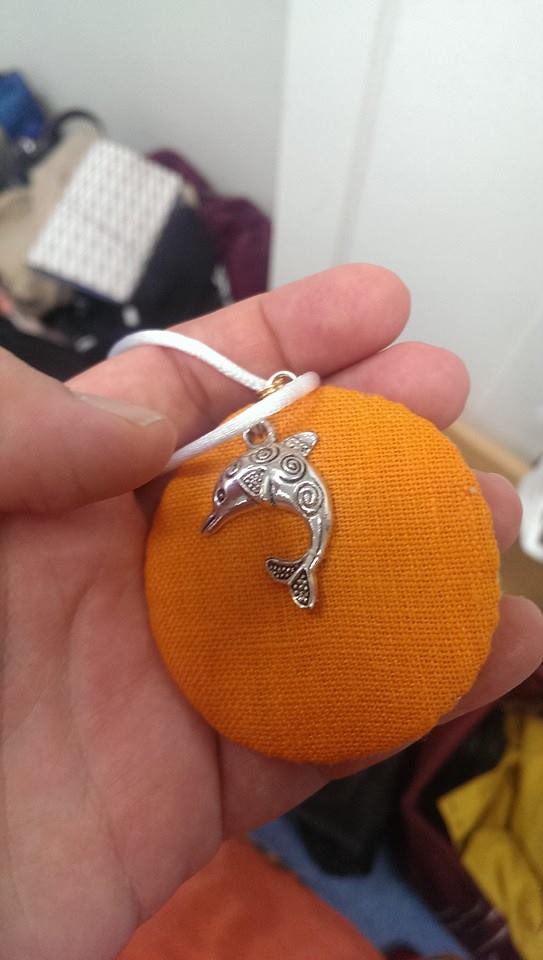
My medallion, made by my laurel, Mistress Clotilde von der Insel…which was backed with the orange fabric leftover from my Bucs dress. That was carefully acquired (see also: asked for) by Geoffrey, and snuck down to Rhode Island. EVIL!


maunche1

maunche2


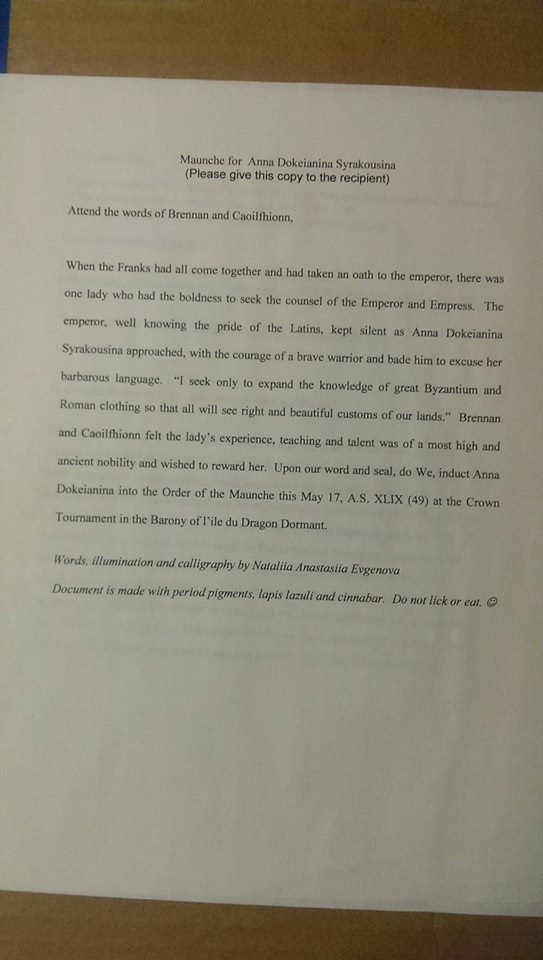
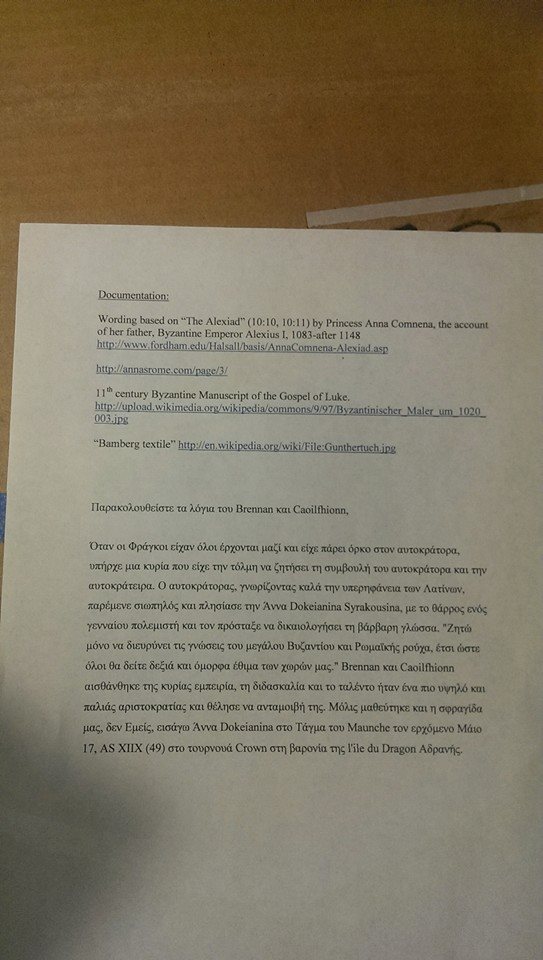
My scroll and wording, done by Mistress Nataliia Anastasiia Evgenova, who also did my AoA. The wording is based on The Alexiad.

scroll1 scroll2 scroll3

Well played, East Kingdom, well played…

Back from Figments and Filaments

I had the pleasure of attending a great new costuming symposium in the Midwest this last weekend: Figments and Filaments, in Independence, MO. It was certainly a long way from home, but worth the traveling. I’ve never been to Missouri, and I have plenty of friends in the Kansas City area who were more than happy to give me crash space. Naturally, fellow Byzanteamster Konstantia Kaleothina was my host, and with our powers combined with Andrixos, we were the Byzanteam! Taking the fashion show by storm!


1601014_10152179204243143_5509178103081433576_n

I taught 2 classes: My Historical Costuming for Cosplayers one, and my 2 hour long Roman dress one, and we actually got to the Byzantine part, hurray!

10295765_10100327932772715_5921746939977233169_n
It’s so odd watching yourself on screen.


I also took the train there and back, you know, to do something different (and it was cheaper.) I will definitely take the train long distance again. That was fun, and everybody should do it at least once.

I have so much wonderful things to say about this convention, I don’t even know where to start. Yes, it was small, and it was its first year, but it ran well, and everyone seemed to have had a really great time. Even this slightly aggressive Easterner. 😉 They want me back for next year, so I’ll be planning that return trip shortly.

Check out their website at Figmentsandfilaments.com, and the respective Facebook groups and pages.


Since I had so much time on my hands on the train, I stared at the Bamberg Textile again for a while, and now another blog is cooking while I start planning to turn a piece of red-orange linen into a short stola. Mwahahaha.

Icon the Third.

Let me tell you all how hard it is to paint very light gray hair.

Also learned: Sometimes, your egg tempera medium just blows, and doesn’t work well. I had a really rough time dealing with my yellow ochre and vine black pigments this project, and I’m unsure why. Apparently it could do with the temperature of the medium (using it right out of the fridge) or my ratio of egg to wine.

This is an icon of St. Kenric I of Warwick, late King of the East. His martyrdom is signified by the wearing of a red cloak, and his death by black arrow is immortalized. This is a great schtick we have going in the East Kingdom right now as we try to discover the murderer of our former king. This icon is a donation to the Silent Auction we are running this weekend at the Coronation of Brennan and Caoilfhoinn to benefit the Royal War Chest Coffers.

I based this particular one off of an icon of Christ, and tried to mimic the earlier Orthodox church’s designs from the 6th and 7th Century, hence the freeform inscription, which reads, KENRIC BASILEUS ANATOLIKIS. “Kenric, King of the East.”

As you can see, I’m getting better, but not great yet. This was a great opportunity for practice, and man did it take some time.

kenriciconfinished

I’ll be making a page for my iconography soon. I figure it’s the best way to document my journey through the art form rather than scattered blog posts.

JACKPOT.

I recently joined Academia.edu to see what I can maybe dig up there. It didn’t take me long. Holy chao!

https://ucy.academia.edu/MariaParani

Her profile is LOADED with sources on Byzantine dress from ceremonial garments of military to bridal costume to even eunuchs! I nearly fell off my couch! They’re RECENT also, and free! FREE. I had to share! The only way Byzantine personae in the SCA will grow is by the continued research and study of the subject. Bamf. You’re welcome. Now if you excuse me, I need to go download all the things to my Kindle Fire. ❤


…Now I need a eunuch to dress. Please.

Byzantine patterns! THEY ARE HERE!

They aren’t scanned fabulously, but heck, you get how they work. These WILL be posted on my Eastern Roman Garb page as well, but I wanted to get these on a blog page and tagged for searchability as I plan a better layout for the current page, but this is a huge step in the content direction.

HERE GOES.

Also, let’s try to start using the Greek terms, Kamision and Delmatikion, for Tunica and Dalmatica respectively to help disseminate Greek over Latin.

Anna’s Quick n’ Dirty Byzantine Kamision (tunica) and Delmatikion (dalmatica) Patterns!

These patterns are pretty self-explanatory for folks that are used to basic medieval clothing. Byzantine garb is basically all t-tunics, with only a few minor twists. The biggest issue is really the width of your fabric allowing for the nice curved underarm seam, that’s about it. These blocks are not the be-all-end-all ways to make these garments, but rather one interpretation to show you the pieces needed. Once you get a handle on the basic construction, all that’s left is embellishment and sleeve variations.

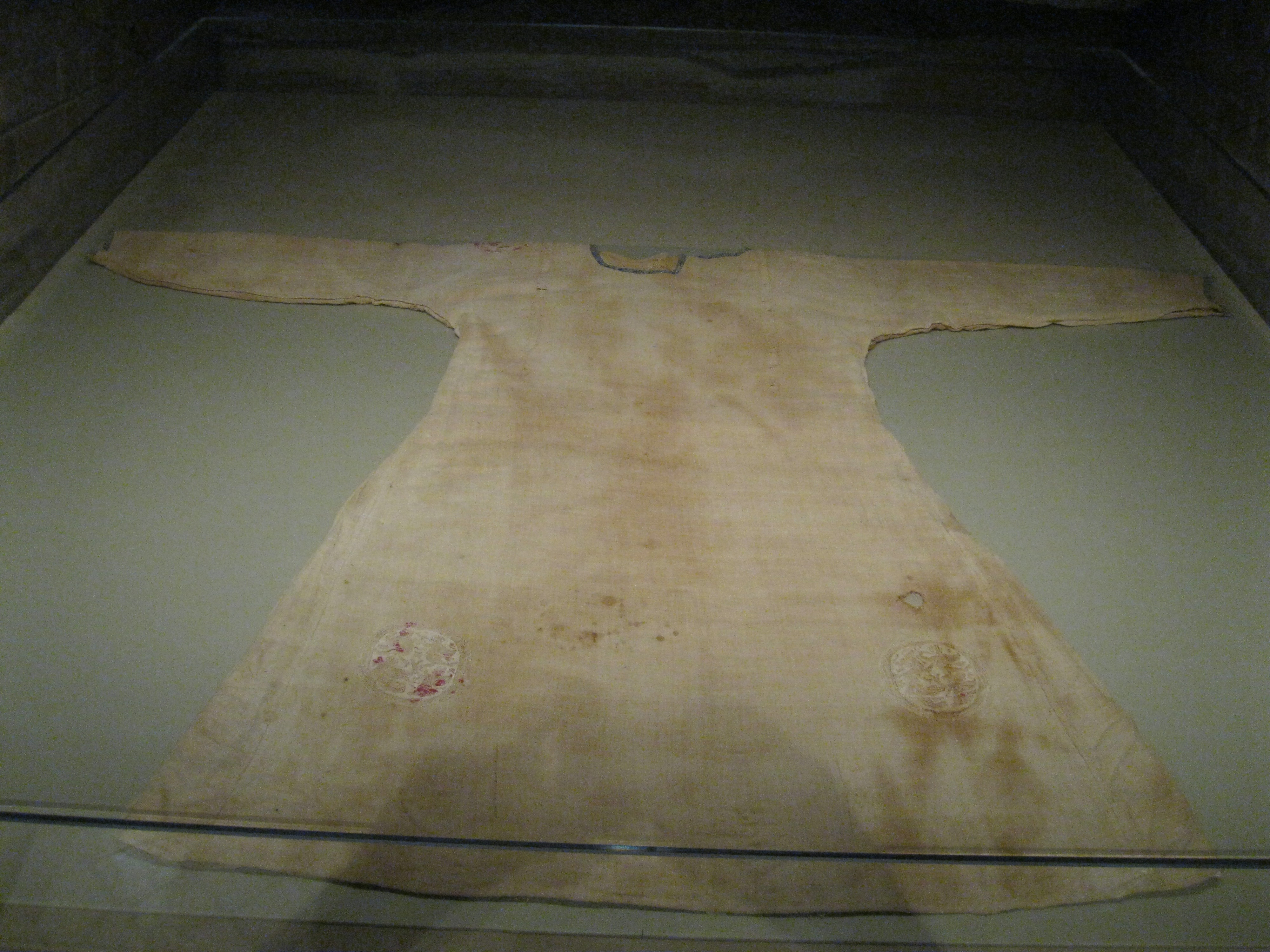
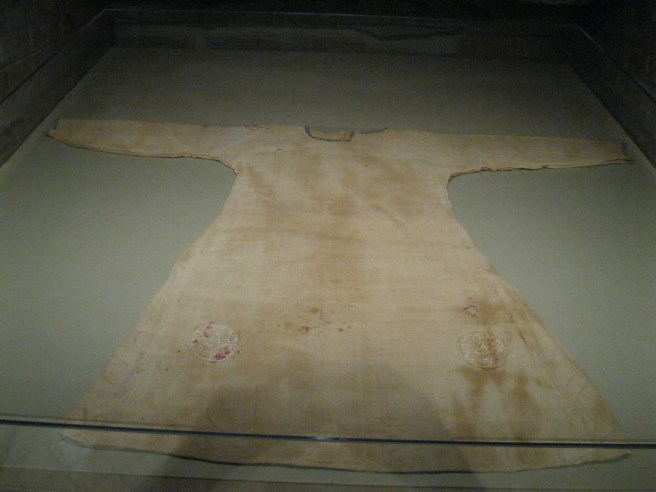
My pattern is based off of the 7th Century tunic in the permanent collection “Under the Stairs” at the Metropolitan Museum of Art in New York City.
IMG_1882

Kamision (Tunica) instructions:

Recommended fabric: linen or very light wool
Recommended yardage: 4 yards of 60” wide

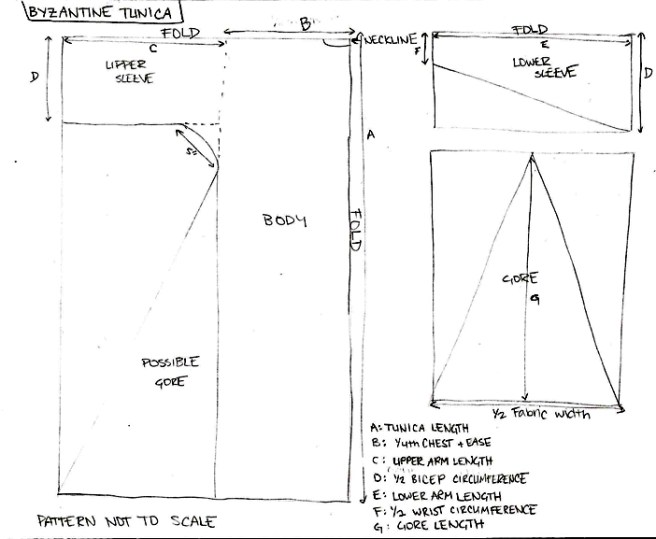
First, assess your fabric, and see if you can use this pattern layout, note the positions of the folds. This pattern is not to scale, and the average sized person may not have enough extra fabric on the sides to warrant the inclusion of the gores. This is okay, as they can be cut separately.

A breakdown of the measurements you will need as laid out in the patterns, they DO NOT include seam allowance:

A: Tunica length. Measure from the nape of your neck to where you want the tunic to end.
B: 1/4th Chest measurement + ease. Typically what I do is take a chest measurement, divide it by 2, add 2 inches, and divide again by 2. That is your number.
C: Upper arm length has everything to do with the width of your fabric and not your arm. If you can fit the length of your upper arm (shoulder to elbow) here, that’s awesome, but it’s not necessary, you will want at least to the half-way point between your joints, otherwise your underarm will not fit.
D: ½ Bicep measurement. Remember your fabric is on the fold at the top for your sleeves here, so you don’t want this to be very wide against your body. Tunicae were fitted as dalmaticae were not, so you will want to adjust ease here as necessary.
E: Lower arm length is the difference from where your upper arm length ends to your wrist.
F: ½ Wrist circumference is actually ½ the measurement you get around a closed fist. You want to get your hand into your sleeve, after all.
G: Gore length is the measurement from the top of your hip to the desired hem of the tunic. Now, if you have a fine derriere, so to speak, feel free to elongate that gore to your waist, but the original tunic’s gore comes off the hip.
tunica1

There’s a variety of formulas out there to make a neckline. I have a small neck at 13”, so my go-to cut is 4” from the center point on each side, with a 1” dip in the back and 3” dip in the front, but a 2” dip in the back and a 4” dip in the front should fit most people. A boatneck, or basically just a slit, is also a common style for this period. The tunica at the Met has a keyhole neckline with the opening on shoulder seam. I’ve done that before as well. I recommend finishing your neckline with bias tape or a narrow hem before moving on.

Before any piecing of the pattern takes place: GET YOUR EMBELLISHMENT DONE. There is no way to apply clavii to a tunica once those side seams are in place. Get any roundels or segmentae you want on as well. It’s just easier to handle at this point.

tunica2

Follow the diagram on the piecing. If you are going with the smaller gores if you were able to cut it from the folded fabric, follow the illustration at top, if you cut gores from a separate piece, follow the bottom. Apply trim over the seams where the upper sleeve joins the lower sleeve.  This is definitely something else you want to do before you sew up the side seams.

Now all that is left is to join the front to the back along the side seams, hem the sleeves and bottom, and finish trims, and you’re done!

tunica3

Delmatikion (Dalmatica) instructions:

Recommended fabric: Linen, silk, damasks/brocades, light to medium weight wool
Recommended  yardage: 5 yards of 60” wide

Think of the Dalmatica as an oversized tunica, but as the tunica can be worn by itself as one layer, the dalmatica is an overtunic only. This is a unisex garment, and sometimes for women you may see it referred to as a “gunna.” Either way, this is where you really get to jazz up your wardrobe. They can be floor length or short enough to show off your tunica embellishments.

Sleeves can be short, long, or extra-wide as was the style in the 11th and 12th centuries when my persona lived. The only real difference is that typically the dalmatica was cut from one piece of fabric, including the skirt width, whereas the tunica had gores. However, gores are still a perfectly period option in the event of a smaller bolt width. Follow the instructions as laid out above for the tunica, and you should be in good shape. As far as embellishments go, the best way to go about this is to follow some period examples.  Clavii didn’t seem as popular on dalmaticae as the centuries progressed, and richness was displayed not so much with embroidered bands of trim but rather in the heavy silk damasks and brocades that were in fashion. My drawings including clavii to better illustrate how to embellish.
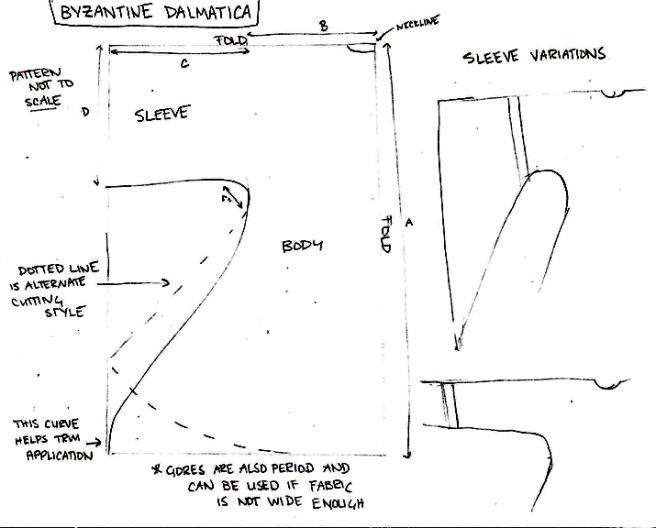
dalmatica1

Note that I included a curve at the edge of the skirt portion in order to better facilitate trim application on the dalmatica’s hem. This is optional, especially if separate gores are chosen, but note that wide trims will require careful piecing and pleating to better conform to the hem.

Just like in the Tunica instructions, remember you NEED to add any embellishment such as clavii and other appliques BEFORE you close the side seams.
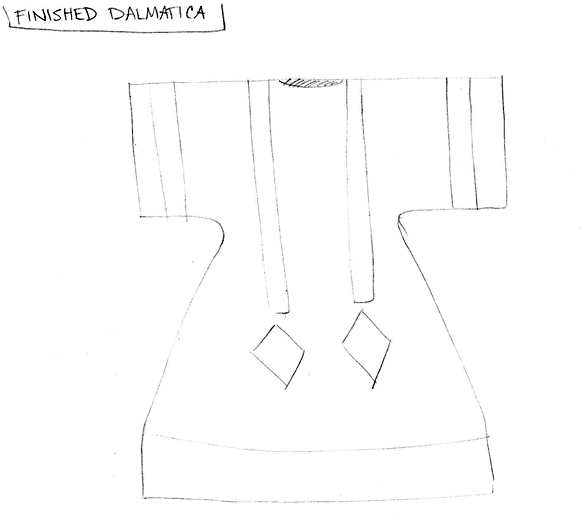
dalmatica3
Once your garments are completely sewn, then it’s time to go in and add all the really rich goodies to your pieces, such as hundreds of pearls and other gemstones. 🙂
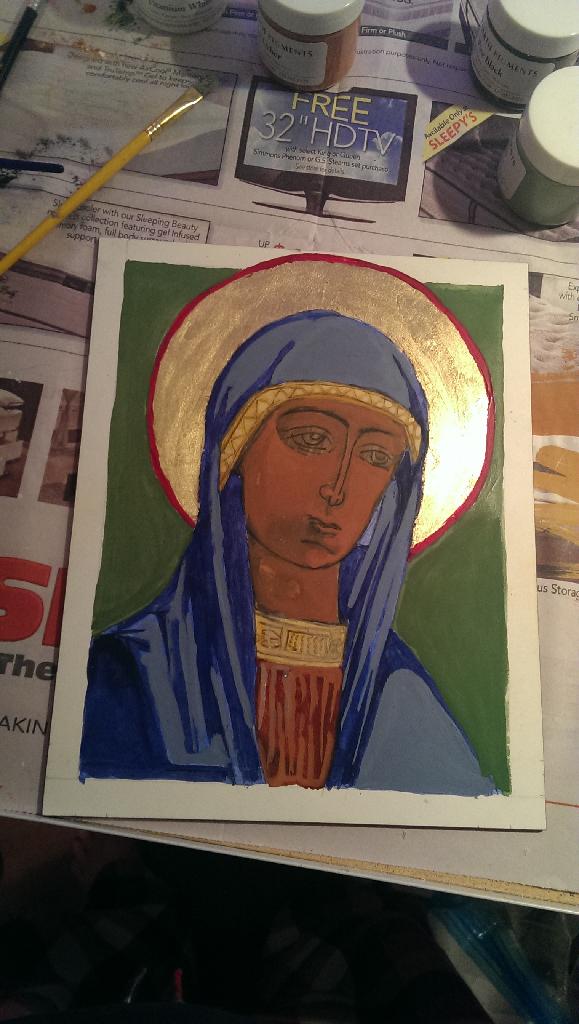
Another icon – The Virgin Mary

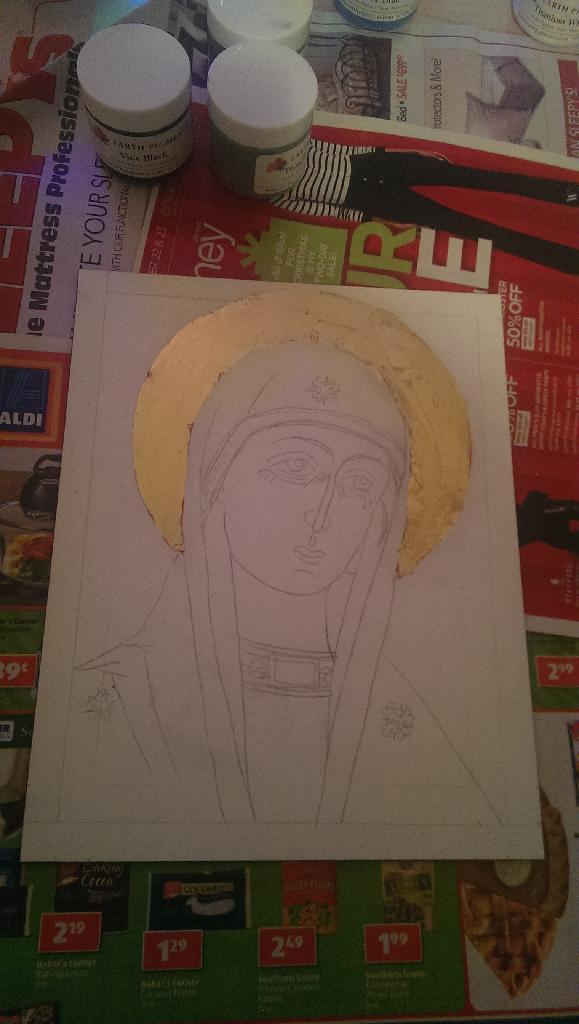
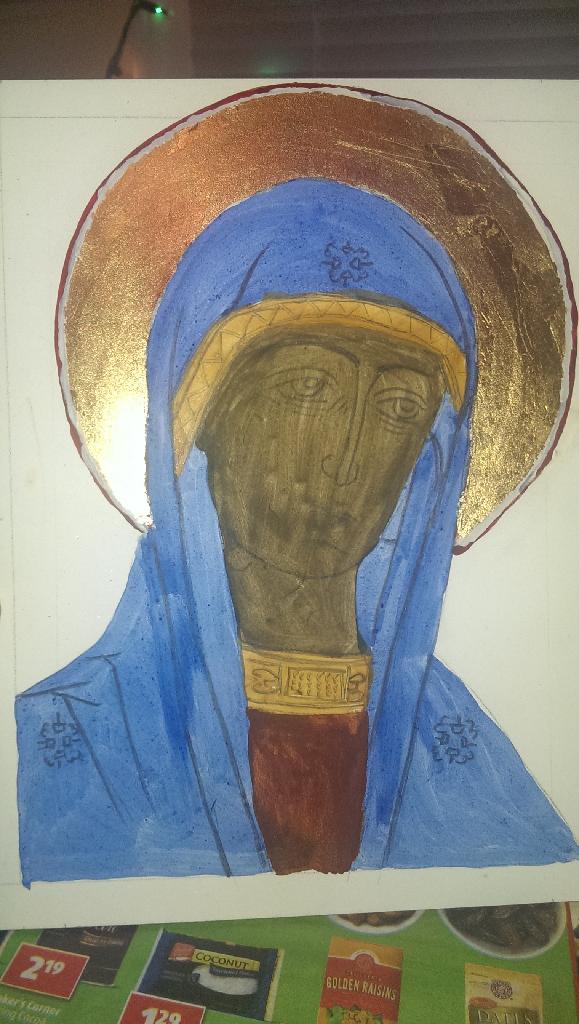
I made this specifically for my friend in the East Kingdom Artisanal Exchange for this fall. Typically, Mary would be in red, but since this was based on an in-joke between the recipient and her friends, I put her in blue. Aside from that, I can happily say that my skills have improved since my last attempt. Egg tempera is a tricky medium.

mary1mary2mary3mary_highlight1mary_finished

The illusive Dover dress debunked.

I can’t tell you how many times I’ve seen people emulating this look from the “Byzantine Fashions” Dover Coloring Book by Tom Tierney and “Ancient Greek, Roman, and Byzantine Costume” by Mary G. Houston.

dover1 dover2

First of all, I want to say I have no issue with the images presented by Dover. They usually do a good job, but they have a hard time backing up their sources. When asked about that particular clothing style, especially the belt, I had no idea what their source was, and upon asking others, I got a lot of shrugs and odd statements such as, “Oh, the book says it’s a princess/prostitute/ancient Roman goddess.” Which only led to me getting more confused.

I’ve had the Tierney books for a while, both “Byzantine Fashions” coloring book and the paper dolls of Justinian and Theodora, which are adorable. They do provide a pretty solid idea of Byzantine styles based on artistic record. So don’t knock them, but don’t run off with them as a primo source, either.

This particular style intrigues me. Mostly because it’s almost always done with a V-neck. This seems wasteful, especially for the opulent, fabric hoarding Byzantines. So, I ran a brief Google search on “Bamberg textile” and…

Gunthertuch

Well that wasn’t very difficult to find. I yanked it right from Wikipedia. The note on the image reads:

The so-called “Bamberger Gunthertuch“, a Byzantine silk tapestry depicting a Byzantine emperor on his triumphant return from a campaign. He is crowned, bears the labarum and rides a white horse. Originally identified as Basil II (by A. Grabar), it is now accepted that he represents John I Tzimiskes on his return from the campaign against the Rus’ in Bulgaria. He is flanked by two female tychae, who personify Constantinople’s two demoi, the Blues and the Greens. The one on the right offers [possibly] a crown, and the one on the left a triumphal toupha headdress. The silk was acquired by Gunther, bishop of Bamberg, in 1064-5, and re-discovered on 22 December 1830 in his grave. The silk is now on display in the treasury of the Bamberg Cathedral.

Well, there you have it. They aren’t princesses, they’re political parties.

Facepalm_227785

Now, moving on. What are we looking at here as far as clothing goes? This is 10th Century, so it’s 100 years prior to my period (not that it’s ever really stopped me or anyone else in the SCA about being anachronistic with their anachronism.) And what I see, instead of any sort of fitted short sleeveless tunic, is the trusty stola. A woman’s garment that was somewhat carried over from the Classical period, only cut like a classical tunica, or “Roman Rectangle” as my friends and I like to call it. Here’s a Coptic-Byzantine stola:

stola2


You’re looking at an insanely simple garment. Almost tabard-like in nature, with minimal decoration. The ones depicted by the ladies in the textile fragment only have trim on the bottom, and it’s short enough to show off ornately decorated tunicae underneath, which seemed to be a popular look. This would explain the heavily gathered appearance on the Bamberg piece.  After trying a stola for myself before, I can see why women would rather opt for the look portrayed in the Dover books, it’s a lot more flattering. Yeesh.

As far as that double hanging belt thing goes…uh…it doesn’t look like anything depicted in the textile at all. The woman to the right is wearing a belt, but that looks more like the end of a buckled belt than any extra ornamentation, and they certainly don’t have the spacing shown in the Dover illustrations. So that’s something that is certainly open to interpretation as far as design goes.  I also really like the pink pallas, as I have a pink palla. 😉

It’s hard to say exactly if this was a commonly worn fashion. Much like the sideless surcoat debate, it may have been something only worn for ceremony and therefore depicted in art, or, as is common with Byzantine motifs, it’s hearkening back to the classical period of Rome. Either way, I hope that women looking for more information on this dress style have at least been able to get what they’re looking for from this little blurb. 🙂

I’m asking for money…again

I’ve officially started my Kickstarter for the next book! I know I tried that IndieGoGo back in the summer, but it didn’t work, because I think I was asking for too much at once. This is a more solvent project, just for the book, to get me through the initial production costs while I’m still a poor student. I’m shooting for an August release. Just in time for Pennsic War! If you liked “Of Summer and Winter” you’re gonna LOVE “The Overcast of Autumn.”

http://www.kickstarter.com/projects/kaousuu/the-overcast-of-autumn-sequel-to-of-summer-and-win


What’s that? You don’t have a copy of my first book?
http://www.amazon.com/Of-Summer-Winter-Angela-Costello/dp/1480083968/ref=cm_cr_pr_product_top