Egg Tempera is a great medium, but it takes some getting used to. As far as iconography has gone, I have never used a ready-made paint. I have always used dry pigments mixed with egg binder, even in my not-so-great early pieces. I’ve since learned the quirks of it, but I still have a bit to go.
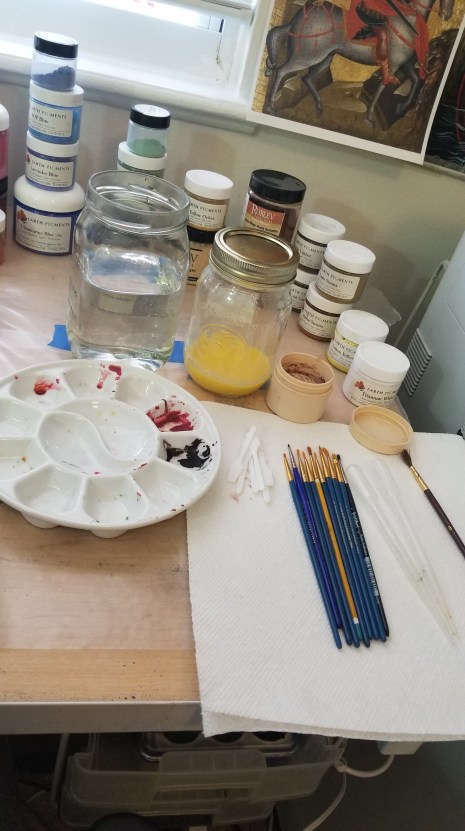
The binder is easy to make: egg yolk and white wine. The wine is optional, but it helps emulsify the egg a bit, as well as act as a preservative. Still, you only get a week, tops, with this stuff in the fridge after a day on your table.
First, gather your supplies! The wine name made you giggle.
My mixture this go around was 2 yolks and about “that much” of white wine. I’ve gotten to the point of knowing the color I want for the right mixture. You can separate the yolk from the white by transferring the goop back and forth between the broken eggshell halves. Then you pop the yolk with a folk, and let it slowly drain into the jar, catching the membrane in the process. If the membrane goes in, it’s not a huge deal, but you just need to make sure you don’t suck it up in the dropper later.
As you can see, it’s not a ton of liquid in a standard size mason jar, but a little goes a long way. You use drops, not tablespoons.
Once I get the magic liquid made, I go ahead and set up my table. I already had most of this out when the gilding started, but here you can see my collection of pigments, and that I taped wax paper down to protect my work surface. All of my pigments are from Earth Pigments or Natural Pigments, are are 100% natural earth or mineral colors. Mostly oxides, but also some crystals. The bagged jars are my quarantined toxic vermilion (mercury sulfide) and minium (red lead) pigments.
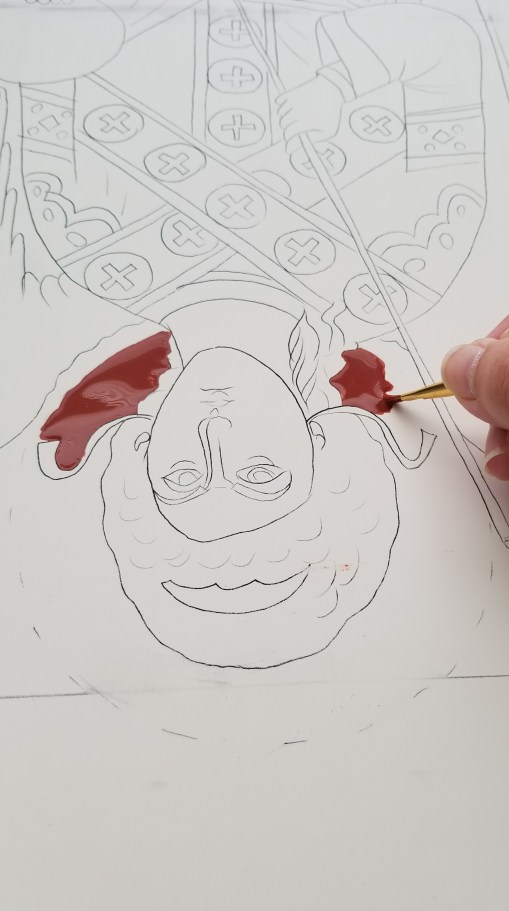
Egg tempera is backward from watercolor, you start dark and then add highlight layers. It seems weird, but it works. In iconography symbolism, you continue to “play God”, and build the paint up from the protoplasm, into a glowing, holy image.
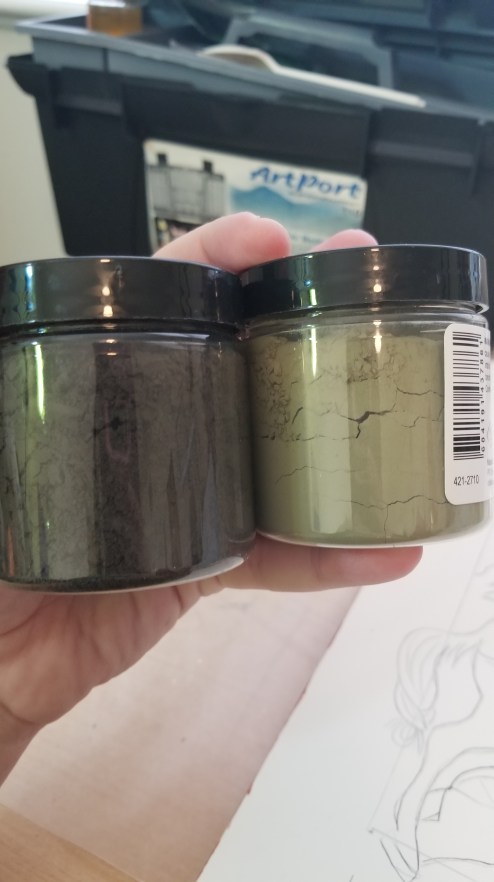
Starting with the sankir, or base skin tone first. I mixed Antica Green Earth, and Roman Black. Think about the skin color of the Greeks and Middle Eastern people where this artform originated: olive based. Again, start dark, build up to light.
Dry Antica Green Earth.
Egg tempera can be fickle depending on how fine some of the pigments are ground, the material they’re made from, and how much moisture they suck up. Antica green is fickle and kind of grainy, so I had to adjust as I went along with more pigment, egg, or water, depending on my needs.
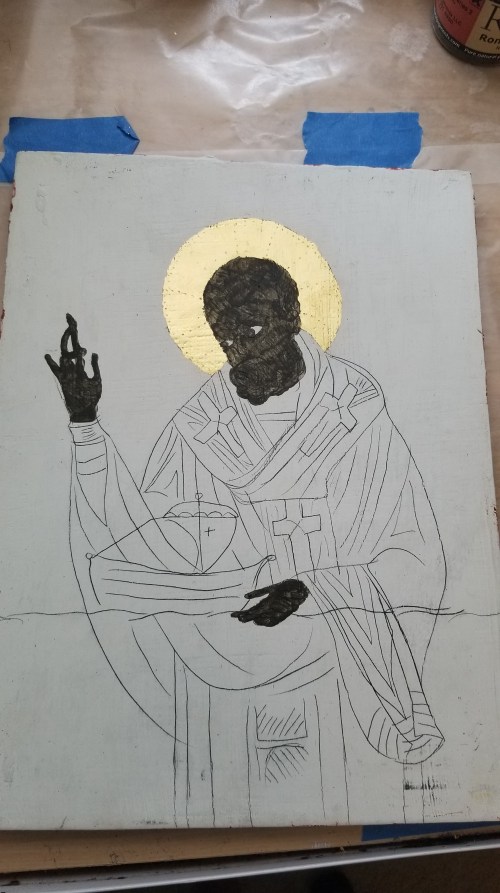
I made a ton of sankir, so I painted all three icons with it. This isn’t always the best approach and it sort of busted my flow for the rest of the day, but they all have the same base mix, which is good. The rest of this icon-a-long will be for St. Martin.
I don’t have pictures of work on Martin, because, well, I was painting. It’s a time consuming process, and it takes hours. Total amount of work today alone was about 4 hours.
You work the paint in tiny brush strokes from a small drop on the board, rather than long strokes.
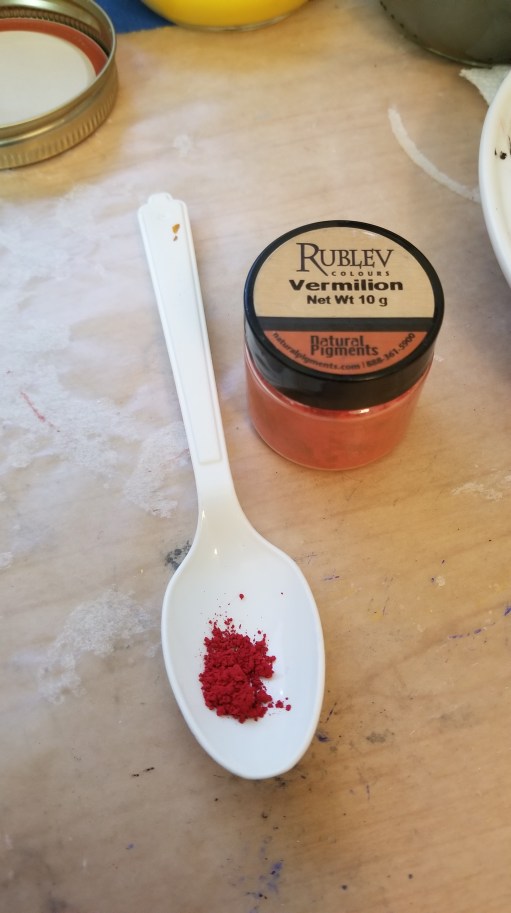
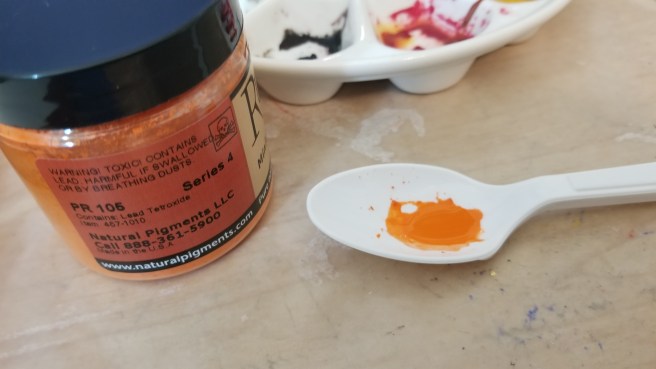
The perfect cloak red in icons comes from vermilion, real vermilion. I have a few different reds, but nothing paints like the real thing. So the real thing needs precautions. I keep it quarantined in its own baggy, with its own tools. Instead of using one of my palettes, or shells (I do have shells, the porcelain is just easier to clean) I use a plastic spoon that I can keep separate. While vermilion is considered inert once painted, the dry form is still toxic, it is still mercury, and needs to be controlled.
Of course, once I got started with it, a warm fuzzy thing decided to distract me.
That’s Harald Hardrada, Varangian kitty, King of Norway, Maine Coon superfoof.That red, though.
I had to use a tiny bit of the minium as well. It’s one of my favorite colors. As shocking orange as you can get, and a fully period color.
After getting tired, taking a break halfway for dinner, and coming back to it, and still getting tired while finishing up the background, which is okay, because more coats will make it more opaque, but I’m bushed. I know it looks super weird, but over the next few days, the icon should “appear” as I add the highlights.
So. Part of blogging a process as you go along means it’s harder to hide mistakes. Mistakes are a natural process of life, and as such, I hate them. But, as part of a learning process, I’m not sugar coating this post. I made some booboos, and learned that Florida humidity is unkind to the icon gilding process.
The icon process is pretty specific. You breathe an open-mouthed hot breath on the bole to create condensation, and the loose gold will adhere. It’s basically a form of water gilding with mouth moisture. (ewww.) But, this is symbolic of the breath of God, it’s also super period. After yesterday, I may have to cheat for the few years I’m down here.
I grew up in Florida, so the heat and humidity aren’t any sort of surprise. I don’t think I’m as tolerant of it as I used to be after living in New England and experiencing seasons, and living in perfect-almost-all-the-time Southern California. I learned how to gild in New England. I used fake composite gold in Rhode Island, but had graduated to real gold in New Hampshire. In retrospect, all of my icon work up there was during the winter. In California, I only gilded the halo of St. Nicholas, but I remember it being almost too perfect.
And now, I’ve returned to Hell Incarnate, and failed to prepare myself for the difficulty that awaited me. Anyways, here’s some pictures.
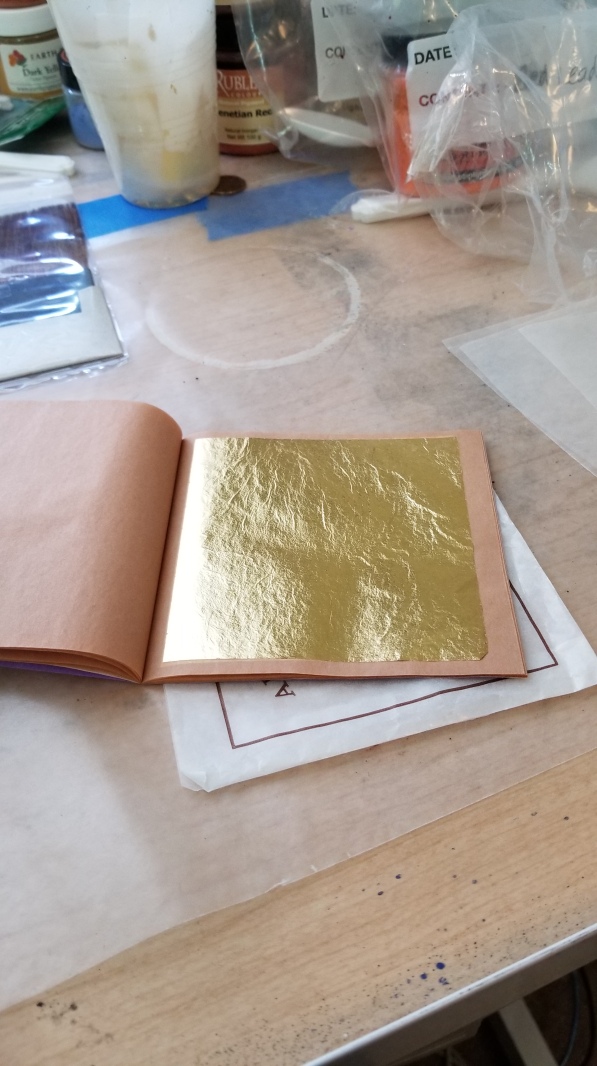
Avengers assemble! 2 burnishers, some 23kt double gold loose leaf, and cut wax paper.
First thing first, I burnished the bole on the halos to a high sheen. I screwed up here. Twice, on both icons. I either pushed too hard, or it wasn’t set up right, because I ripped up spots of bole on each one and had to put more down, and let it set. This would bite me for the rest of the day.
Michael’s halo partially burnished to a high shine.Burnishing Martin’s halo. This takes time. If you go too hard or too fast, you WILL rip up the bole.
Once I succeeded, I prepared the gold leaf. The easiest way to do this is to use wax paper to catch the leaf versus trying to use a gilders knife. At least, that’s the way I was taught?
So shiny!Wax on…Wax off.You can cut the leaf once it’s on the wax paper with ordinary scissors. No cushion or knife required.
Once the gold was transferred to the wax paper and cut, all I had to do was breathe some hot air and slap it down, right? No. The first piece I used didn’t adhere at all. Naturally, I don’t have pictures of this part, since I was super perplexed, and then it became a fight. Then war was declared. And what is supposed to be a meditative, relaxing art for me turned into digging into the trenches and not coming out of the room until I had this gold down, dammit.
This was probably not the best approach. What I SHOULD have done, was troubleshoot via the internet and the scribal community.
This is Martin, as I’m fighting to get coverage on one side of the halo after the first layer bombed. You can see the layers of leaf I was using to get it to stick, and how it wasn’t TOUCHING a few spots. Pinholes are normal, gaping holes are not. Layers are normal, layers that don’t cover gaping holes are not.
While I was getting frustrated, I must have spittled on the icon a bit, or too much condensation built up, and gold went down ONTO MARTIN’S FACE.
I honestly assumed that with the extra humidity, regardless of central AC, that the gold would be wanting to stick to literally everything, and I would have had the opposite problem. It wanted nothing to do with it. The equilibrium between the temperature of my breath and the board, or the amount of water in the air and my breath, must have been off. Boards do absorb water, which leads them to warp with age, so it was suggested after my Facebook venting by a Trimarian scribe that I should put the board in the fridge for a while next time, to see if I can dehydrate it and cool it off, and get more condensation.
Michael’s first layer. I was flabbergasted.
After the first round. I went downstairs, had some tea, and attempted to re-center myself. I didn’t take pictures of the gold on the wax paper, I wish I had: It was terribly patchy. And while it’s normal for it to come off in smaller pieces if I’m focusing on an area, it was doing that the whole time. I was getting bubbles and oxidation I had never seen before.
After my break, I figured enough time had passed for me to go ahead and burnish Martin’s halo. NOPE. It started great, and then the leaf just started coming right up, and exposed the bole. I gave up, regilded his whole halo, and decided that was enough handling of that icon for the time being.
Shiny enough to reflect my phone and then…ACK!3 sheets of gold later: Those nice forehead smudges. I should be able to sand it down and paint over it, but that’s not the point.
I went back to Michael with a new plan of attack: Tenting the halo with the wax paper as I breathed on it, and then slamming the gold down quickly. It seemed a bit violent, but it worked. I didn’t dare attempt to burnish.
There’s still some exposed spots and pinholes, but I’ve decided to fix that with shell gold, and the painted halo outline.
For comparison, here’s Nicholas, who I gilded in California. Practically no blemishes, and a thickness nice enough to press a design into even on my rough, homemade board.
I went downstairs after all of this, and had a stiff drink. This was 4 solid hours of work from start to finish. While one should take their time, that seems a bit excessive for simple gilding. The gold is down for these guys, but I need to reassess my approach now that I’m living in the swamp again.
Painting is up next. Let’s hope the threat of cockroaches eating fresh egg tempera doesn’t come true.
This post shows you the deepest darkest secret of iconography: the patterning process.
This is tongue in cheek for obvious reasons. Why?
I will let you all stop screaming.
No, really. While many iconographers draw their own images, the vast majority of them are made from patterns that have existed since the Middle Ages or Early-Modern period. You can go on Amazon right now and find dozens of books of icon patterns and line art for this purpose. Copying is period. In fact, I was able to see an actual medieval icon pattern in person, once. I was unable to take a picture, but it was made of animal skin, and had the image punched into it so the iconographer could transfer it over onto their panel with a stylus. How else do you think so many icons look identical, save details and color?
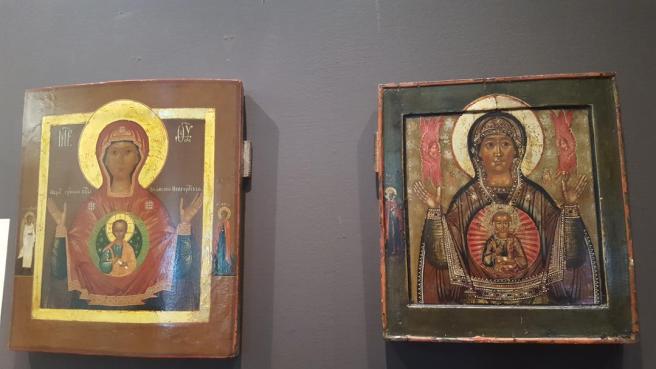
Two icons of “Sign, Mother of God” at the Museum of Russian Icons, Clinton, MA. The same pattern, but with different colors and embellishments. Note the position of the halo on each with the border and kovcheg.
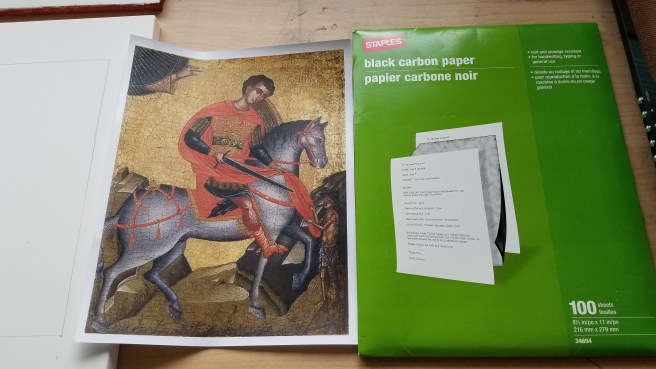
I’m too poor to afford skins I can dedicate to patterns, but I can use the modern method of carbon paper, which is how most schools today teach it. (I do believe carbon paper, or a form of it, is period, but let’s not grasp at straws for stunt documentation.)
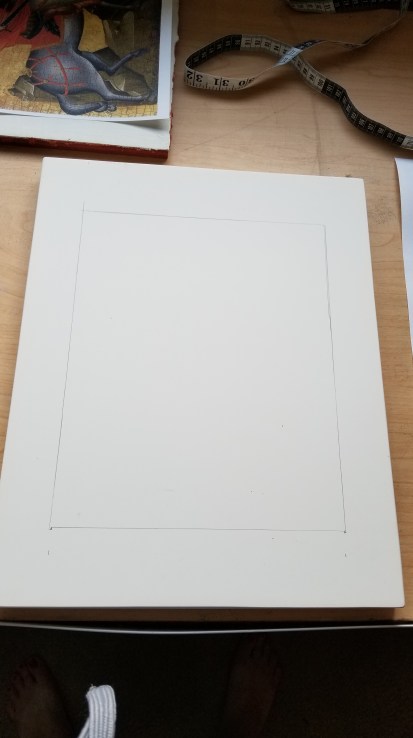
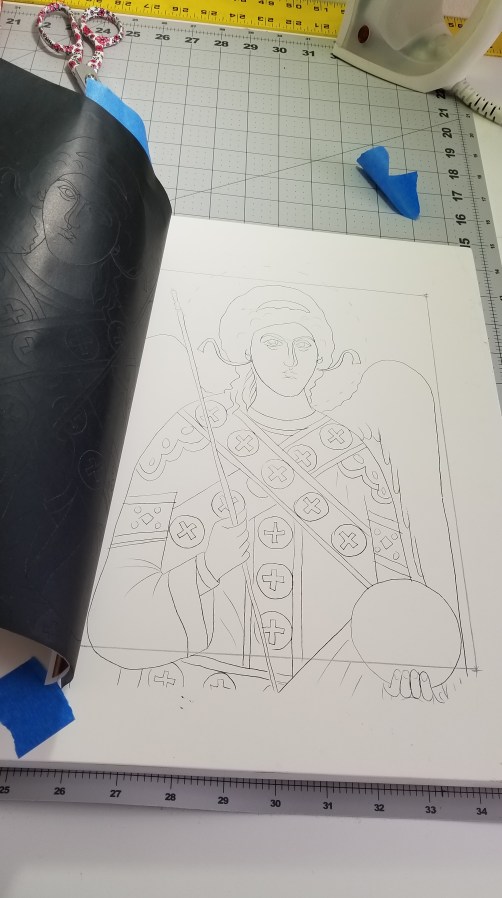
So, the way to do this is fairly straight forward. I’m using an 11×14 panel for an 8×10 printout, so I need to measure that out to create my border. Then I play the corner matching game and tape the image with the carbon paper down to the panel with painters tape. After that, using a dull pencil or a ballpoint pen, I go ahead and trace over the lines I need to create the line art. No need to get too detailed, because I learned early on you do too much work on the pattern, and paint over and lose all those detail lines. That’s all work you do on top of the base layers.
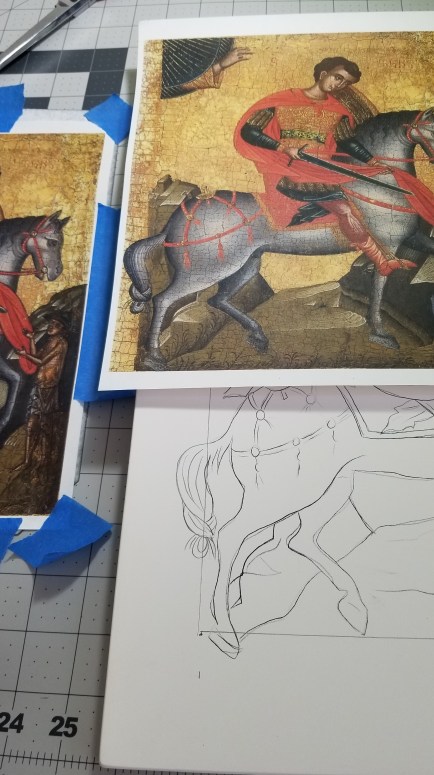
Drawing the guidelines.Taping on the stencil.Finished cartoon.
After you get a successful trace, go back in with a graphite pencil and fix some details and missed lines.
Notice how the original icon has the horse tail coming out of the border. I did the same.
After you have your line art, it’s time to prep for gilding.
Always get your gold down before painting. Gold will stick to all the things, so it’s important that you get it to stick to the only thing you want for the time being, and that’s a substance called bole.
I’ve mentioned this before in my previous icon posts, but bole is a mixture of red clay and hide glue. I’ve made it before, but I also like buying it ready made from Pandora because it make my house not smell gross and my stove and floors not get stained. Since I live in military housing, paying for others to do this for me is a great convenience.
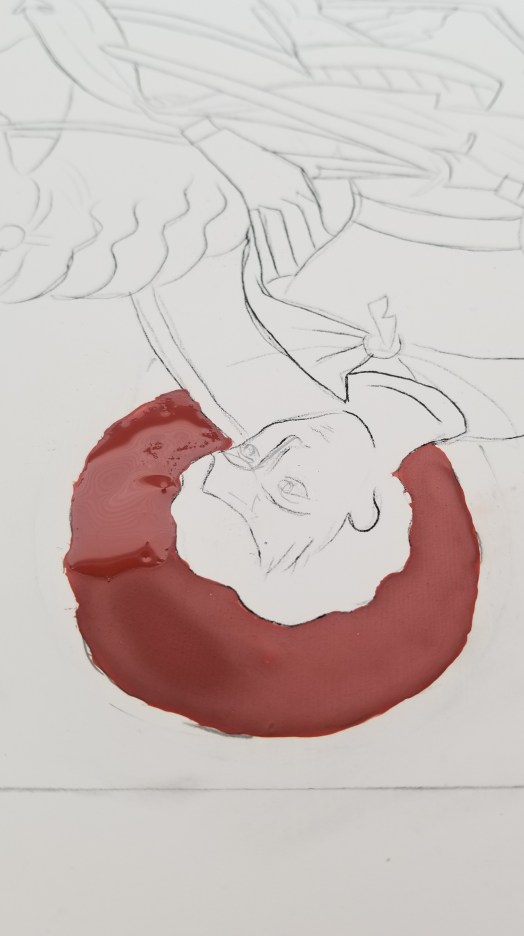
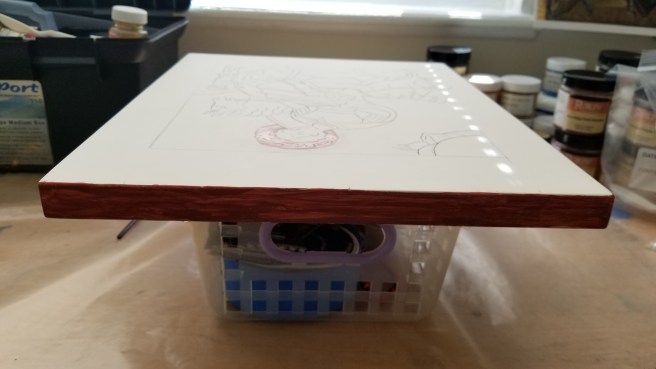
I put two thick layers of bole down on the halo, and then a rough, thin layer on the edge of the board. This is highly symbolic in the icon process, but also important: the bole provides a cushion for the gold to have a design engraved into it if desired, and the layer on the edge helps protect the board while it’s being handled. In icon speak, it’s the base of earth from which God shone the divine light at creation (halo), and the edges are symbolic of the roughness and mortality of the artist. It’s kind of dark, and I love it. Because I paint these as an historical art in a secular manner, versus something that will be used for actual veneration, I don’t dwell too much on the sanctity of the process, but it makes a great mnemonic for the process, because the order of operations matters for a practical reason, as well as spiritual.
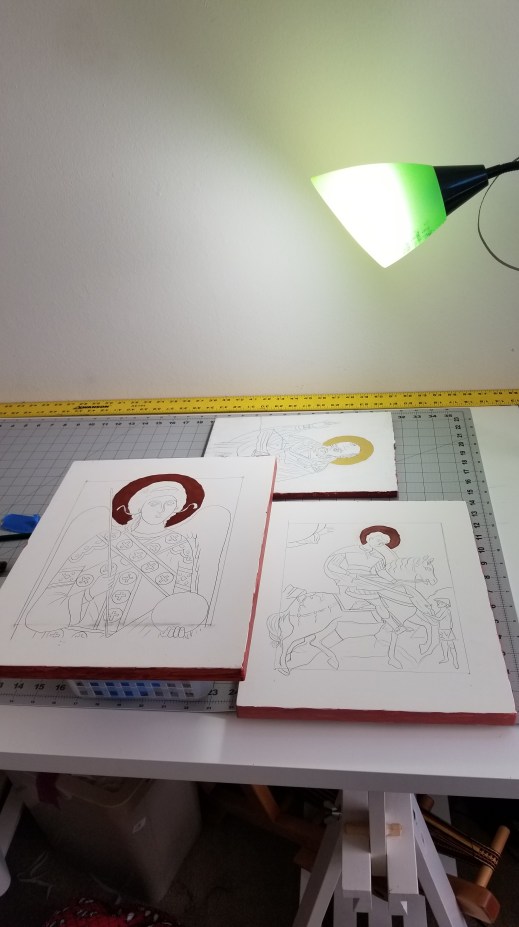
Thick layer of wet bole on the icon of St. Martin.While that dried, I patterned Archangel Michael. Don’t worry about the guidelines, they can be erased and re-drawn.Putting bole down on Michael’s halo.Second thick layer of bole on St. Martin. It’s important to be mindful of air bubbles, which can ruin the smoothness of gold adhesion.Coating the edges.Ready to dry overnight and take on gold leaf.
After the bole cures, I’ll use an agate burnisher to smooth it out, but that will have to wait until tomorrow morning. If all goes well, I’ll be able to get the gold leaf down, and the first layer of egg tempera on all three icons.
To put things in perspective before painting, here’s the three brushes I use most of the time.
I have a few commissions coming up, and I decided I wanted to blog(ish) the process rather than keep it under wraps, since they aren’t gifts. I had to decided if I was going to do it on Facebook between my personal account, or my SCA persona page (which I rarely post on), and decided that I should just put it here, so it’s more accessible for those that don’t spend their day on social media as much as I do. It will also help me be more accountable in making regular updates.
So, to begin, let’s talk about the actual surface on which to be painted.
Icon boards, in their most simplest, are layers of gesso (calcium carbonate and hide glue) on a sanded and prepped wooden surface. Well-made boards have a layer of linen glued to the surface of the board before application of the gesso. In early period, this was mostly basswood. In early-modern and modern icons, it’s typically poplar. Both woods are still available today, of course. Basswood is not that durable, it’s a soft wood used for wooden models. I do have a panel of it somewhere I plan to paint someday, but until then, I spend money and have other people do this for me.
I have made my own panels. They are not good, but I did it. Using pre-sanded and drilled birch panels from an art store, I had a heck of a time applying gesso and sanding. This is not the job for me. And that’s okay, because the creation of icon boards is an artform in its own right, and was probably done by a different person in period than the actual painter. The Norman has more experience with woodworking and patience than I do, so my own boards are on the horizon, just not imminently so.
I purchase my high-end boards commercially. And by “commercially”, I mean, from Pandora Icon Supplies, which is a subsidiary of the Prosopon School based here in the states. They are not “manufactured”, because, much like high end papers for the C&I community, it requires a level of craftsmanship, and the price reflects this, so I’d call them more of a purveyor of fine art supplies. I just recently made an order after scrimping and saving for 2 years just to buy new materials, but they’re worth every penny. Sometimes there’s a turnaround time, sometimes they ship right away. These are handcrafted, so you have to anticipate some leeway. Pandora offers a lower-cost alternative in the form of the birch gessoed panel, which is still professional grade, but does not have the same thickness or carved surface of the fine icon board. Their larger fine board will have the slats in the back to help control the inevitable warping over time. Smaller boards, like the one I have below, do not. I can’t currently justify the cost of a larger, high-end board until I use up my supply on hand. I already want to start hoarding these like fabric.
Basswood, poplar, and birch are all Old World AND New World woods. In Europe, “linden” is the name of basswood, and “aspen” is used for some poplar variants. Black poplar is probably the one that was used most for boards in period, and that also grows here in North America. The taxonomic differences are probably minimal, which means that if someone were to go to a hardwood supplier here in the states, they would get wood suitable for making panels, without having to spend an exorbitant amount of money importing something we don’t have.
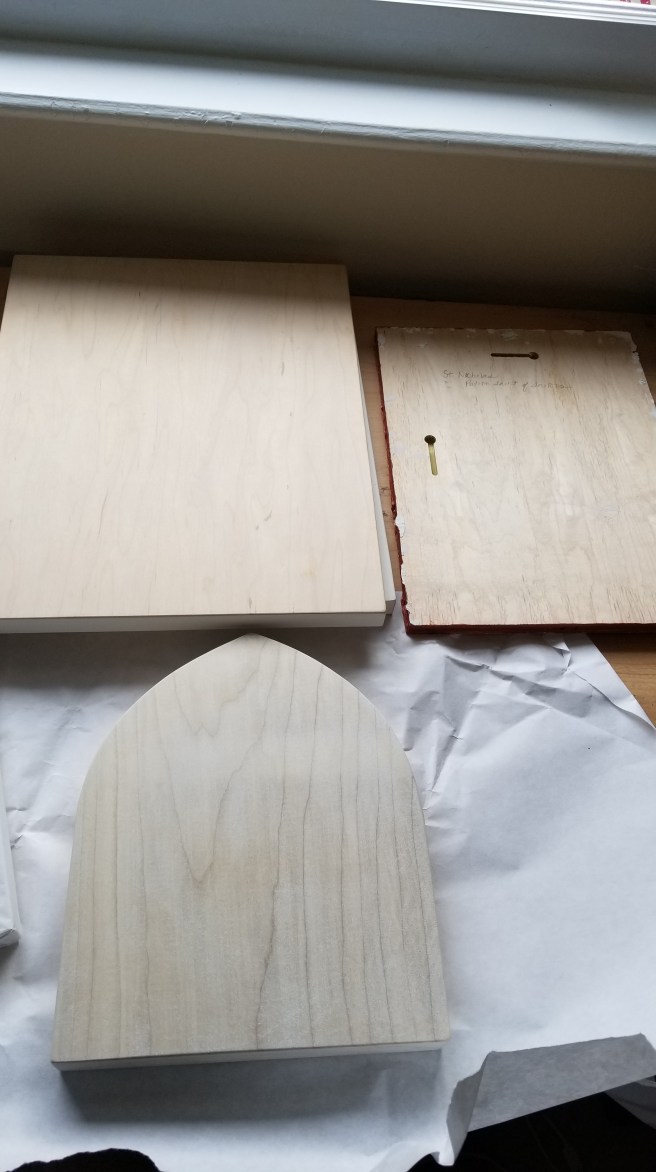
My current collection. The top row I have 2 11″x14″ Pandora “BGP” (Birch Gessoed Panels), which is a more affordable way to invest in a well-made board without breaking the bank, next to my own smaller panel that is currently getting worked on with St. Nicholas. At the bottom, you have a larger 10×15″ BGP still wrapped in paper, and a fine, 8″x10″ poplar panel with a kovcheg (recess). The BGPs pictured here were $60 a piece, and the fine board was $80. My 8″x10″ panel was like $20 of supplies a lot of swearing.
The backs of the board so you can see the exposed grain of the wood. The birch is nice, but the poplar is mesmerizing.
My upcoming projects are a commission of St. Martin of Tours, and St. Michael the Archangel for myself, because I need to start keeping some art. St. Nicholas of Myra as the patron saint of sailors is for my husband.
Coming next: Patterning the icon, and preparing the surface for gilding.
I barely sew men’s Byzantine clothing. I know where to look, where to point friends, but for the most part, I personally haven’t touched it. My husband is a Norman. He wears riding tunics, and basic linen gored tunics with keyhole necklines. He likes them, and looks good in them. His complexion and appearance echoes Anna Komnene’s description of Bohemond I of Antioch in the Alexiad almost verbatim. It’s disgusting how Norman he is.
But we have a deal: I sew it, and he wears it.
Up until this project, I’ve made him 1 “SCA Byzantine™” tunic, made from lovely wine colored thick linen with potamia and fancy cuffs, but it’s sewn to his usual Northern European tunic style, versus anything actually Byzantine. I’ve also made him exactly one Roman tunic, and one later Roman dalmatica with clavii stripes for when the weather is stupid hot. He mostly stays in his period, with long sleeves on in warm weather because he’s very fair. Lightweight linen is his friend.
I’ve been meaning to try this pattern for a while, so, one day, I decided to sew things, and that he was going to deal with it.
The mummies of the Manazan Cave City date from the 9th-13th Century, though I believe more recent studies are putting it at the end of this period. Manazan is located in the region of Cappadocia, in Anatolia, present day Turkey. This shirt is based on the mummy at the Karaman Museum.
They haven’t updated their site since 2014, but if you’re reading this, thank you, Christobel and Peter, you helped me figure out pieces to my mental puzzle in constructing this based on Dawson’s descriptions.
I haven’t really ever seen this done in the SCA. At least not in my parts, aside from a member of my household, who I think I may have given the link to. I knew that the standing collar was seen in some Byzantine art, but I always kind of avoided it, since I hate being choked and didn’t know what was going on. After finally making a series of these for my husband, I gained a better understanding of how the shirt works, and feel like a ditz for not trying it sooner.
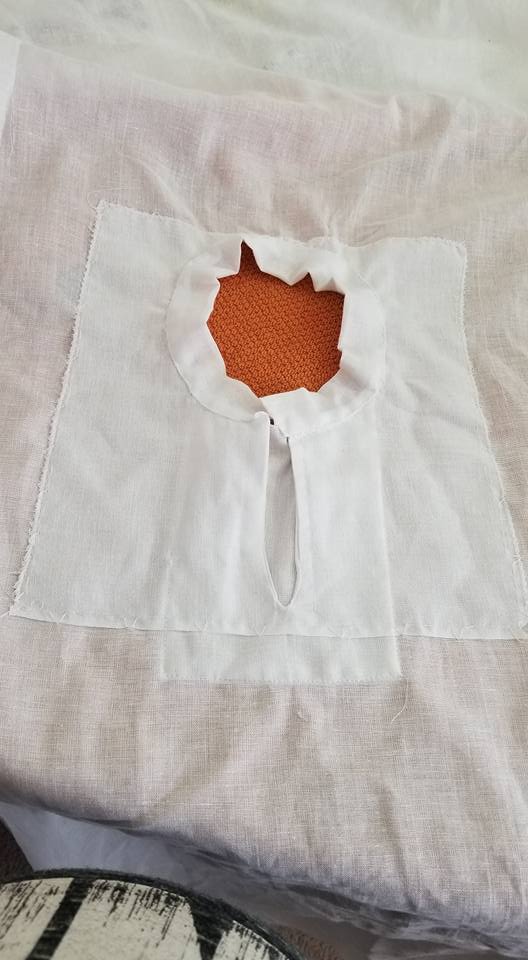
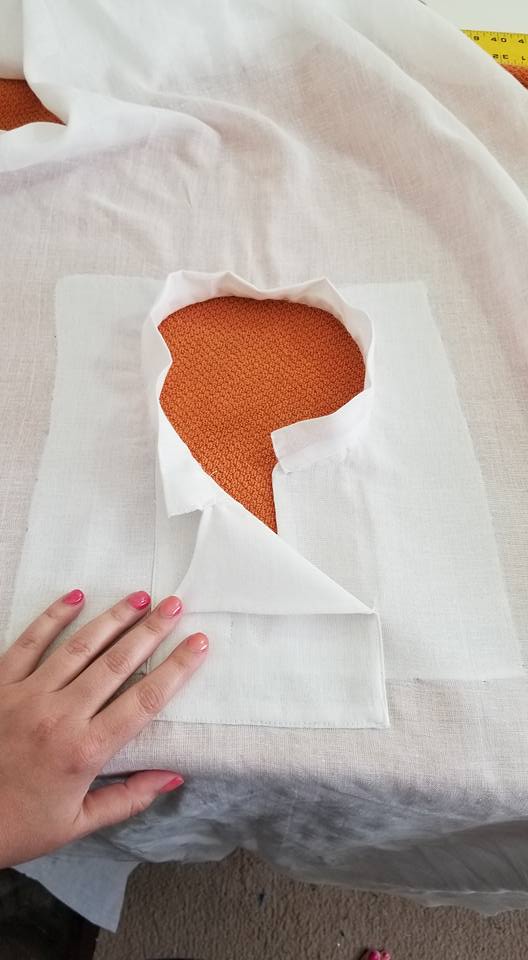
The Manazan tunic is, on the most basic level,a keyhole neckline with a placket over it. That’s it! Once you get that in your head, you look at the picture and go, “Oh.” Trust me, this is way easier than it looks at a first glance.
I made him three types, in this order: An indigo linen version, without the standing collar, knee length.
A white linen version as an esoforion/undershirt, with the collar, knee length. A swanky silk version as a court garment, ankle length.
I had a surplus of weird, secondhand linens I wasn’t afraid to screw up something on, so I decided that the first version would be out of a mid-weight linen with a rich indigo color that straight up reminds me of blue jeans. (In retrospect, I’m pretty sure it’s real indigo dye, talk about a luck out.) I like the idea of wearable mockups. If it doesn’t work, then it doesn’t work, but if it does, then you have a finished garment.
The way it works, is that the collar has to be completed before attaching the sleeves and side gores. The dark linen makes it hard to see details here, but here’s some photos of the construction.
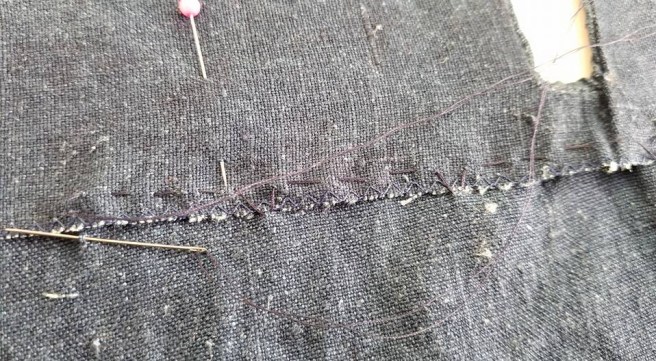
Placket closed.Placket open.Kind of a weird closeup, but when I attach facings on the inside, I use a hand invisible hem stitch. This stops the bold lines of machine sewing being visible on the front, and tacks it down securely. The machine zigzag is lazy finishing on the edge of the facing.Finished and laid out on my table so you can see how high the gores go under the arm.On the Norman. Following the instructions of the pattern to determine measurements gave us a very wide tunic, but when you see period garments, they are rather baggy, if not “bulbous” on men’s figures.
Adjustments made after the first tunic:
-Take in the measurements a couple of inches on each panel
-Re-calibrate the neckline gauge for a tighter fit (I added a half inch when I didn’t need to.)
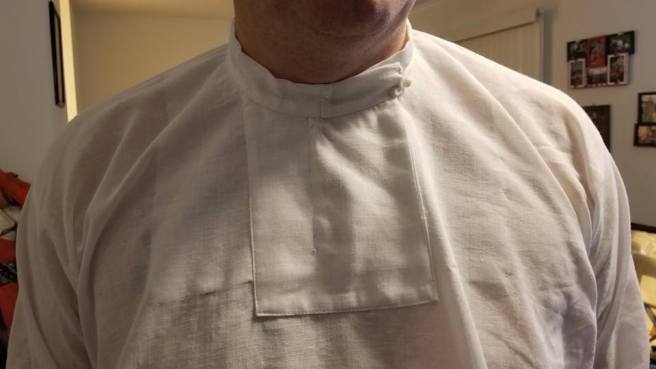
Onto the full construction with the band collar out of crisp, white linen that took me 6 washes to get it usable. The white allows a more visible depth to the layers on the collar, so I have more pictures.
There really is no easy way to avoid handsewing on this pattern. You can if you want, but it won’t look right. After I attached the facing inside with the blind hem as seen above on the indigo tunic, I also attached the band collar to the inside by hand. You can do a machine running stitch when you initially attach it at the base, but when you flip it up and close it to the inside, hand is necessary, otherwise the outside will look ugly. I’m planning on handsewing a whole one for myself.View from the inside looking out, so you can see the keyhole neckline, the facing, the placket, and the collar.The same view from the outside.Let’s face it, this is basically Byzantine Han Solo.
I actually screwed up. I made the band too short because I read the pattern wrong. I repaired this by adding another length of band, versus taking the whole thing off and starting again. My husband destroys collars because his sweat contains amine, a chemical used on submarines to purify the air that also dyes everything a gross shade of rust, so he kills tunics and bedsheets by the dozen. I’ll replace it once it gets gross.
On the board, puffy before ironing, with the repaired collar.Actually on. I used a small white glass bead to make the toggle. Doesn’t it look so much more crisp than a normal keyhole?
Things learned from the full construction:
-Taking in the couple of inches doesn’t matter, this is a wide tunic.
-Pay attention to the taper on the sleeves, men have forearms that women don’t typically have. I made them a little snug, but not uncomfortably so.
For the grand finale, I wanted to see how I could really jazz it up. I had 3 yards of beautiful silk broadcloth in my stash reserved for when Gieffrei decided to dress like civilized folk, as well as my usual stack of dupioni remnants for trim, and a brocade I had stashed from when Sartor had a sale last year.
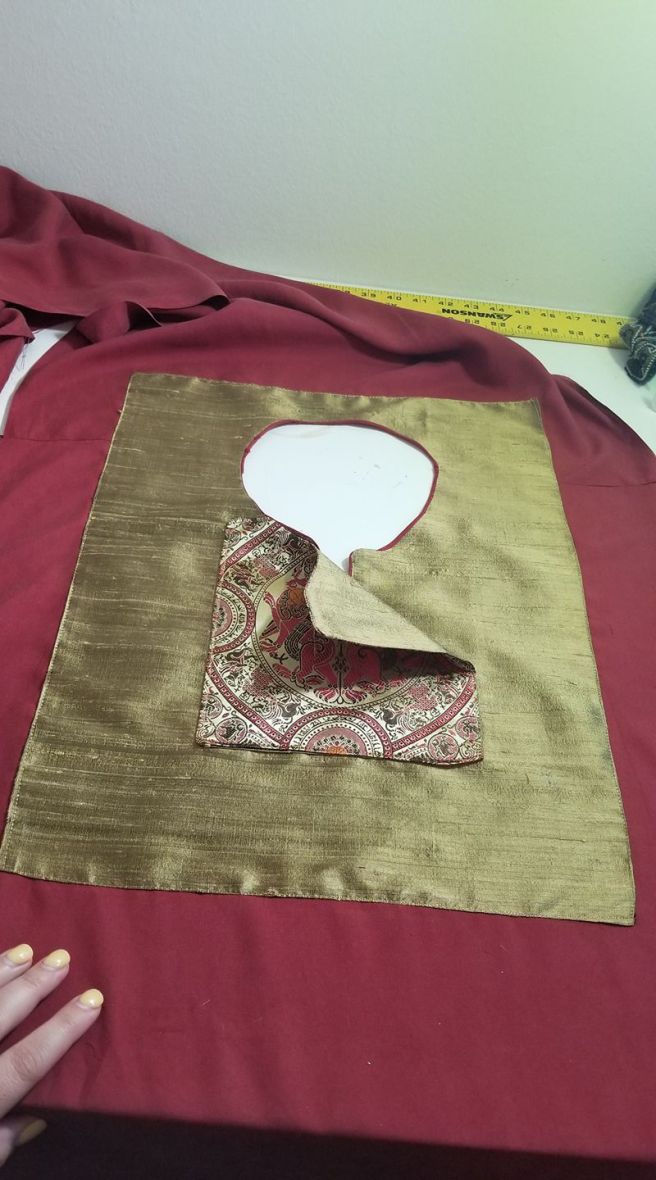
The broadcloth was narrower than the panels I had used on the blue tunic, and just about where I cut them on the white one, so I lucked out. I was nervous that the longer length would screw with his stride, but it did not. Instead of putting the facing on the inside, I put it on the outside for some pizazz, and made the placket from the brocade. Added some cuffs with the dupioni, and bottom trim with the brocade, and voila.
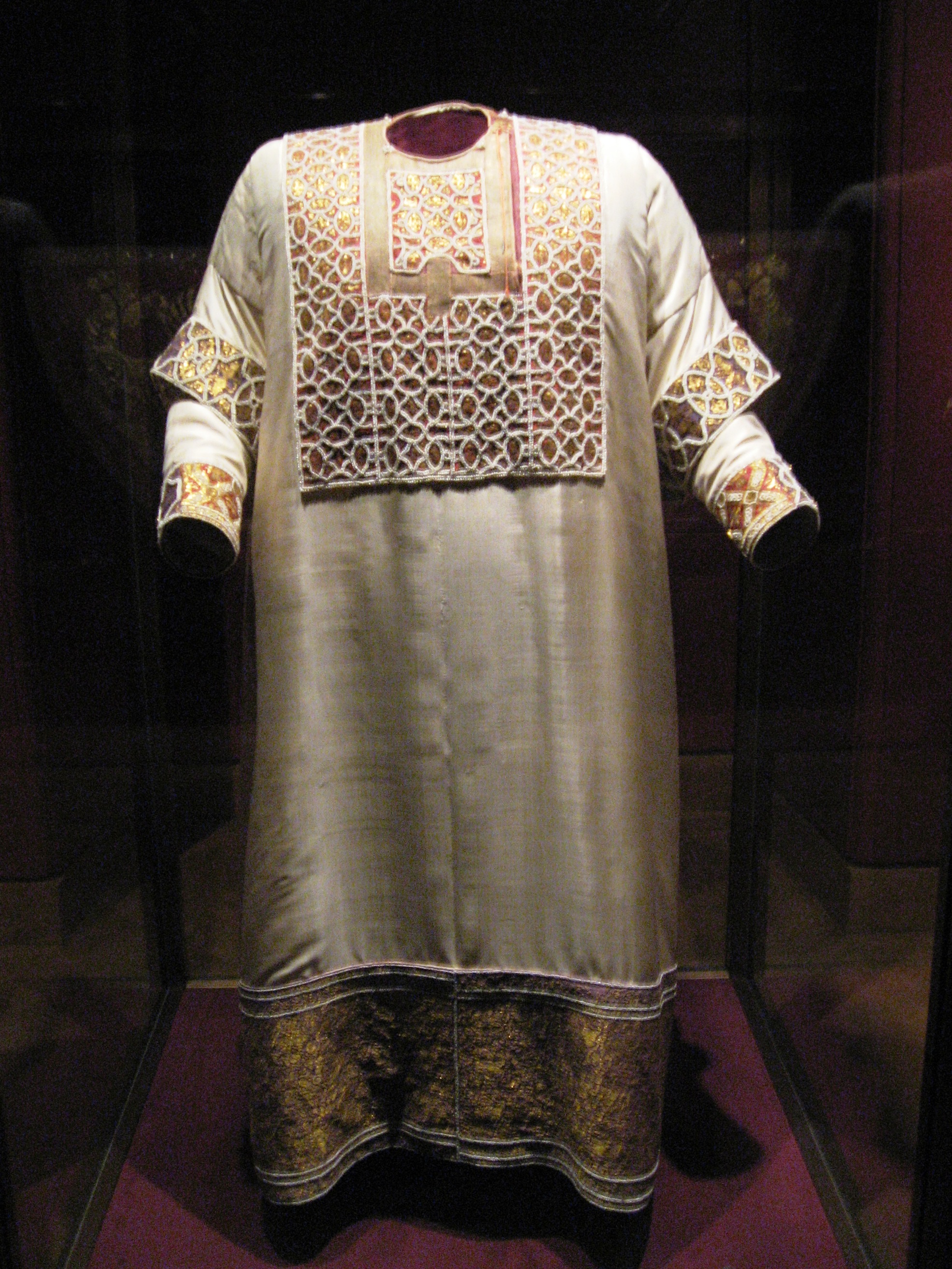
The alb of the Holy Roman Empire was my inspiration for his look, only sans all the pearls. (I did buy pearls, I just haven’t sat down and gotten busy with them yet.)
Alb of the Holy Roman EmpireKamision of the Holy Norman Jeff.Detail on the neckline before I finished it.
I don’t have good pictures of him fully dressed head to toe, that’s next on the agenda.
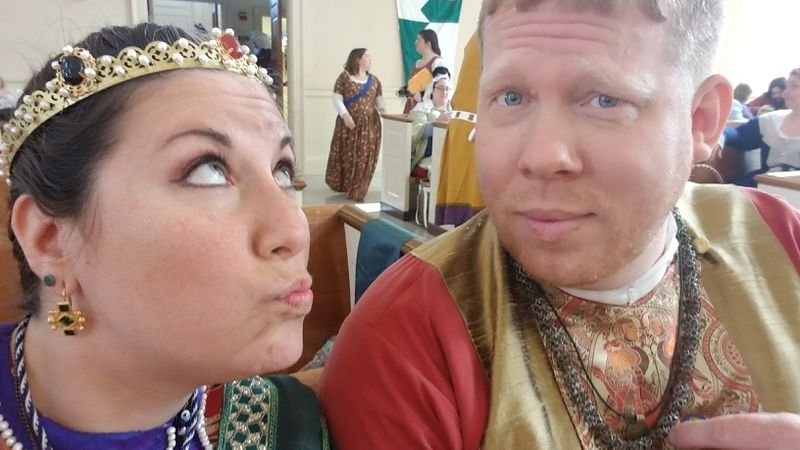
Here’s an extremely flattering shot of us both at East Kingdom Coronation, where you can see the band collar peeking out. The chain is tarnishing and already ruined it, so, I get to replace it sooner than him sweating amine, I guess. Boys are gross.
In November, I was asked (or rather, crashed a Facebook convo) regarding the new Eastern heirs coronation wishes. Byzantine!
Having worked with the couple before for their first coronation (wherein I was a spooky Vestal Virgin reading a scary prophecy) I knew that their love of display and theater is something that I had missed dearly living in Caid. At the time, the Norman still had orders back to the East Kingdom, so we were planning on being around for the spring coronation anyway. I didn’t hesitate in agreeing to help build them their wish. Even after the orders were changed, I decided I wouldn’t drop the project, and that we would find a way to make the pilgrimage back home to the East Kingdom for one event.
Since I was most familiar with the source materials, I would develop the coronation ceremony, as well as ensure that the kingdom looked as fabulous as possible, despite my distance. So in January, after our move across the country, I sat in the library for a few hours and pecked away at the page here on my site to help folks get dressed. Once I was finally able to get internet installed, I located the primary source for the Coronation, and began my work in writing the modus.
I had several personal goals in mind:
– The ceremony had to be based on authentic period procedure.
– The ceremony had to be secularized and welcoming, but still “sacred”.
– The ceremony had to contain the traditions and relics of the East Kingdom.
The first two I could do, but the third I called in the reserves, and reached out to Master Steffan ap Kennydd, who I had worked with before, for his knowledge of ceremony and the needs of an East Kingdom-specific ordo.
The source depended on what period their royal highnesses desired. Both the 6th and 10th Centuries were brought up, and after some gentle nudging toward the later option, I was able to go forward with working with De Cerimoniis/The Book of Ceremonies by Constantine VII Pophryogennetos. Drafted in the mid 10th Century as a court manual for his heir, the book contains a collection of various ceremonies pertaining to the Byzantine court: coronations of the emperor, the empress, how to address foreign dignitaries, how to invest an officer of the court, and what to wear to the emperor’s birthday dinner. I knew that the coronation ceremony was available online here, but after some eyelash-batting toward the husband following our tax return, I purchased the full paperback copy that was available through Brill Publishing, in an updated translation that would help me pick up anything that was missed, including the separate coronation ceremony of the empress. (as of April 10th, 2018, I’m not seeing the print version available. Just the ebook here: http://booksandjournals.brillonline.com/content/books/9789004344921 )
It took me a good week to really get my first draft where I wanted it to be. And then, the Facebook chats began. I’m not really sure how other kingdoms work, but at least in the East, being that the coronations are often a production, so there’s a lot of moving parts after just the ceremony. My work was far from over. I made sure Steffan saw it first, and then passed it on to their highnesses, and Brigantia Principal Herald, Malcolm. For the sake of brevity, I’m not going to go into much detail on what was discussed, but mostly it was taking what I had written, plugging in the East Kingdom ceremonies, and figuring out logistics on music, and the performance of the demes (circus factions) leading the acclamations.
Mistress Margretha reached out to me to help with the music, and we decided that a processional hymn would be ideal. I pinged Martyn Halliwell and Mistress Aneleda for demoi assist, and Martyn just took it and ran with it. We were getting close, and my confidence was waning, if it wasn’t for Margretha and Martyn, I have no idea how I could have pulled it off. Margretha, a Greek native, knew what we needed for a hymn, so she secularized the Christmas Kontakion into a chant, and formed the “manly wall of sound” as she referred to it. Byzantine hymns very rarely have soprano or alto notes, so singing recruitment was a challenge for her. However, she nailed it, as you will see in the videos below.
Here is a link to her source material:
And her hymn:
Greek:
Το Βασίλειον σήμερον άνακτας νέους λαμβάνει
Βασιλέαν ανίκητον, Βασίλισσάν τε ωραία
Αρχοντες μετα Μαϊστόρων ούτους υμνούσιν
Ρόδα δε μεθ’ Ιπποτών δοξολογούσιν
Δι’ημάς γαρ στεφθώσιν
Κολφίννη τε και Μπρένναν εξ Ανατολής
Anglicized:
To Vasilion simeron anaktas neous lamvani
Vasilean anikiton, Vasilissan te orean
Archontes meta Maistoron outous imnousin
Rodha dhe meth’ Ipoton doxologousin
Di’imas gar stefthosin
Kolfinni te ke Brennan ex Anatolis
Translation: The Kingdom today receives new Sovereigns Invincible King, Fair Queen Lords and Masters sing praise upon them Roses and Knights rejoice For they are crowned for us Caoilfhionn and Brennan of the East
Martyn knows how to wrangle a crowd. So rather than go with my original plan of having a chorus of Greens and Blues answering Brigantia, he got the factions to lead the populace, thanks to a handy print-out, and planting folks in the audience. It went off without a hitch the day of and sounded great.
The final piece, once Steffan had helped determine where we would place the traditional unction of water from the Bay of the Mists (San Francisco Bay), and the swearing of the coronation oaths, was actually writing the oaths. There’s not much in De Cerimoniis regarding this, believe it or not. In period, the patriarch performed the blessing and coronation, which is something that we do not do in the SCA. As far as East Kingdom tradition goes, the transfer of power is peaceful, and the previous royals crown the heirs, who then swear their oath on a relic vial of dirt, from the backyard of Diana Lystmaker where the society was founded. Brigantia performs the unction. The order of operations is fluid, but they have to be in there. Since investiture is also a part of the Byzantine coronation, where the rulers are clothed in the khlamys, that needed to go first. So cloaks, crowns, oaths, and unction are the order we decided on.
This is when Princess Caoilfhionn stepped in. I was at a loss at where to go for oaths. Baroness Konstantia had used a rather loquacious one when she stepped up as Gold Falcon Principal Herald in Calontir, but it seemed too informal for a coronation, as it was strictly an officer’s oath. Her now-Majesty found the missing puzzle pieces we needed in the Coronation of Anastasius I from the 5th Century. While it was earlier than De Cerimoniis, it provided the puzzle piece needed to complete the Eastern-specific ordo we wanted. Caoilfhionn wrote her own versions of the oaths, which are available here in their primary source form. Since we had acclamations already planned from De Cerimoniis, the ones here were removed. The secularized edit is in the ordo document linked at the conclusion of this entry.
EMPEROR. It is manifest that human power de pends on the will of the supreme Glory.
PEOPLE. Abundance to the world ! As thou hast lived, so rule. Incorrupt rulers for the world ! and so on.
EMP. Since the most serene Augusta Ariadne with the assent of the illustrious nobles and by the election of the glorious Senate and mighty armies, and the consent of the sacred people, have advanced me, though unwilling and hesitating, that I should assume the care of the Empire of the Romans, agree ably to the clemency of the Divine Trinity
PEO. Kyrie eleeson. Son of God, have mercy upon him. Anastasie Auguste, tti vincas ! God will keep the pious Emperor. God gave thee, God will keep thee ! and so on.
EMP. / am not ignorant hoiv great a weight is laid upon me for the common safety of all.
PEG. Worthy of the Empire ! Worthy of the Trinity! Worthy of the City. Out with the in formers. (This last is doubtless an unauthorised interpolation.)
EMP. / pray Almighty God that as ye hvped me to be, in this common choice of yours, so ye may find me to be in the conduct of affairs.
PEO. He in whom thou believest will save th#e. As thou hast lived, so reign. Piously hast thou lived, piously reign. Ariadne, thou conquerest ! Many be the years of the Augusta ! Restore the army, restore the forces. Have mercy on thy servants. As Marcian reigned, so do &>w…(and much more to the same effect).
EMP. Because of the happy festival of our Empire, I will bestow 5 solidi and a pound of silver on each man.
PEO. God will keep the. Christian Emperor. These are the prayers of all. These are the prayers of the whole world. Keep, Lord, the pious Emperor. Holy Lord, raise up thy world. The fortune of the Romans conquers. Anastasius Augustus, thou con querest ! Ariadne Augusta, thou conquerest! God hath given you, God will kesp you.
EMP. God be with you.”
Being at this point, about 2 weeks out from the event, things were as good as they were going to get. The husband and I hit the road 5 days before Coronation from Florida, making some mundane stops along the way. We arrived at our crash space for the evening, which doubled as the prep space for the dayboard, so we got to get some catching up in over balls of matzo dough, while the Norman did what he does: design and strike coins for the reign.
Gieffrei is nuts, it’s fine. I need to make him blog more.
But you didn’t come here for coins, you came here for the ceremony. So, here it is, is all of it’s splendiferous PDF form.
And Videos! These are taken with my phone, so professional they are not. Bear with some of the moving and the shaking.
The only hiccup we had is that the bridal tunnel utilized to get the procession where it needed to be created a bottleneck, and we had a backup. Just more time to listen to Margretha’s beautiful hymn, and set the Byzantine mood.
Enjoy!
Hymn:
Procession and Ceremony:
Acclamations:
PS: What about the garb? I had maybe 2% to do with that. Baroness Fortune St. Keyne has my trust implicitly, and I just helped her with some basic pointers on the shape of the divetesion, and color of the silk. (The orange was not me!)
[Yes, the woman who named her site after a VNV Nation song just dropped a Wu Tang reference. Not even sorry.]
My husband has a huge head and a normal neck. Those of us who sew know what this means, it means a gaping maw of a neckline that shows off the Norman’s delicate ginger skin. And while it’s nothing a nice brooch and a gallon of sunblock can’t fix, it’s not -right-.
I’ll be posting soonish on dressing my husband in Byzantine, (yes, really, men’s garb, you heard it hear first), as well as including a new page on Norman Garb here on my site (*faints*) but I needed to reassess my approach toward fit.
During my short time in Caid, I had a discussion with a friend about necklines. American reenactors and re-creators make our necklines too big. After her visit to Scandinavia and meeting with Viking reenactors in the land of Where This Stuff Actually Happened, she gave me some tips on how to fix my stupidity.
I’m sure that this technique is known to a few people and I’m going to get a “WELL, DUH!” Gibbs Slap in the comments, but knowing also that there’s some derpy sewers out there who probably make the same mistakes I do, this post is important.
For the longest time, I’ve been following a formula given to me a while ago: You draw your neckline 3-4″ each way from the center point, 2″ down in the back, 4″ down in the front, and add a keyhole slit. This gives a lopsided oval effect with a shorter back than front, which is essential for comfort, but it’s just too wide around the neck. My husband’s head is 26″, his neck is 17″. He’s not a jacked guy, but he’s tall and broad, so making garb that doesn’t choke him has been a challenge.
Here is my new hack: Neckline gauges.
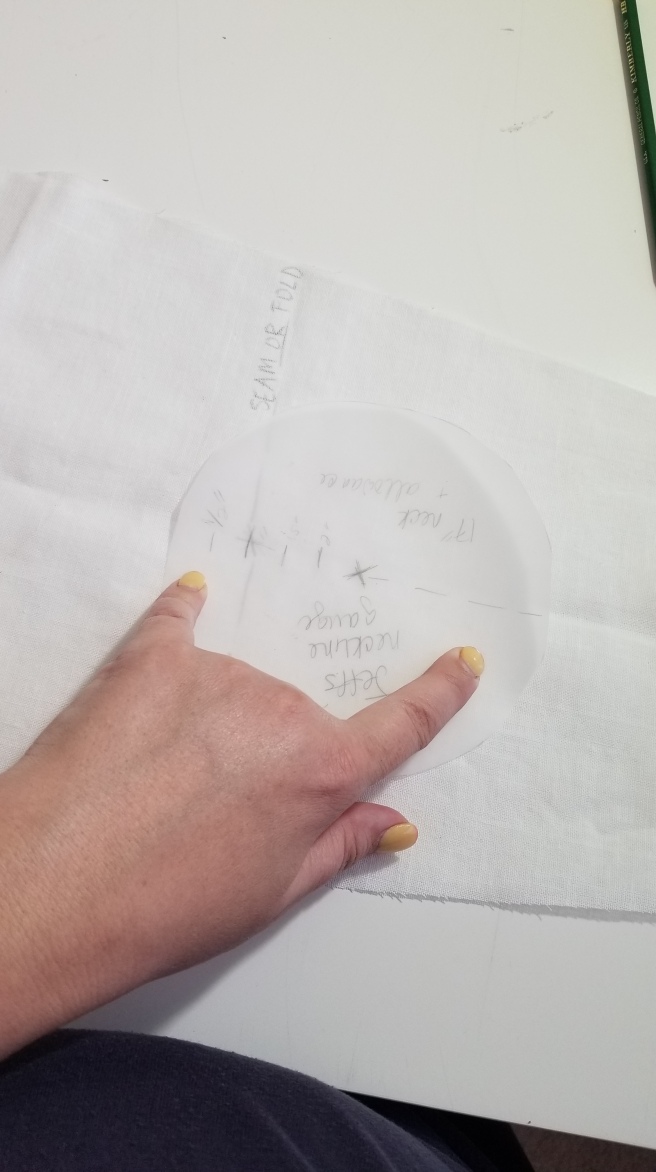
A true circle with the circumference of our necklines (13.5″ for me, 17″ for him), marked up showing increments of 1/2″ from the back toward the center mark. Ignore where it says “+ allowance”, I tried that and it made it too big. Just go with the regular neck measurement, the hem or facing will take care of that ease.
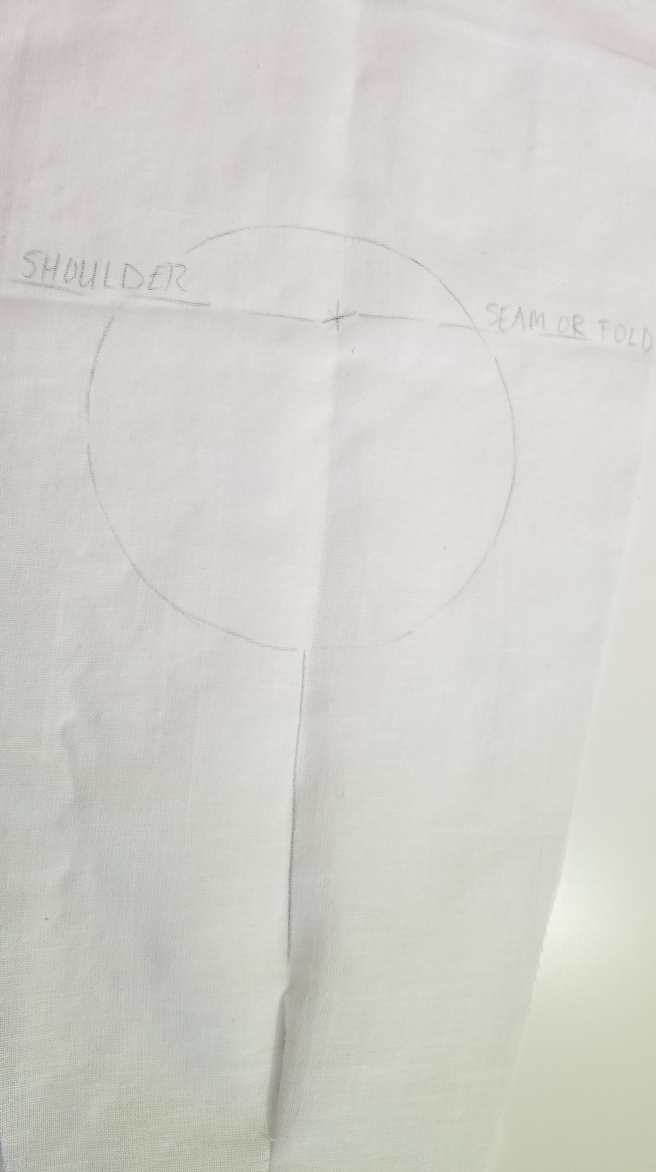
You place the gauge on the fabric, center mark matching to the dead center of where you want the neckline to be. Then, move it forward to where you want the depth of the back to be. I’ve done both 1″ and 1.5″ with good results. The dotted line helps you maintain the angle toward the front, and where you can mark your slit.
Here I am demonstrating it on a piece of scrap linen:
White on white was a horrible idea, but let’s pretend that fold in the scrap is our shoulder seam or fold.Place the gauge on the fabric, matching center points.Move it forward to how deep you want the neck to be. In this case, I’m leaving 1″ in the back, so I’m putting my 1″ mark over the center mark.Trace, and cut.
Give that a shot. Practice on a scrap and put it over your head. You should have a neckline that comes right up if not a bit above the clavicle, and looks more accurate. Voila!!
Clearly, a closed slit is vital to the tight necks in Byzantine artwork, but you never see the slit! What do we do?
I’ve constructed this for my husband with great results, both with, and without the band collar. This is also where I learned to NOT ADD A SEAM ALLOWANCE ON THE NECKLINE. I’ll be posting a better walkthrough once I’m done with his new collection of tunics so I can discuss my experience using the pattern above.
The other option is to put the slit off-center. The most common is just down the left side of the neck, as seen in the Alb of the Holy Roman Empire, and the Palermo Tunicella. While both not “Byzantine” garments, the Eastern influence is evident.
The Coronation Alb of the Holy Roman Empire. The left slit is closed with fingerloop braid. Click on this to see the larger image, it’s worth it.The Palermo Tunicella, with the deep slit off left on the neckline, surrounded by a band of brocaded trim.
So the next time you’re at a loss, looking at source artwork and wondering why your necks don’t look right, give this idea a shot and try a variation for a new fit. I know I’ve been totally converted.
Note that this is only a plausibly period approach with modern liberties. This is just a way to make good-looking, passable Byzantine garb on a budget for themed events, allow newcomers to try out a different style or persona, or make a low-cost “casual” wardrobe for when wearing fancier clothing is not appropriate (outdoor/warm weather events, wars, etc.)
This is a beginner/intermediate pattern. You will need to know how to do facings and have a basic idea of rectangular construction. You will still need a long sleeved undertunic, as well.
Pay no mind to my lack of makeup and phone acrobatics.
While Space Mom has little to do with the current Middle Ages, I’m using her activism, as well as the tradition of “feats of strength” on Festivus, on this last day of Saturnalia, to make a difficult post that I’ve been putting off as part of my psychotherapy.
Write about it. They always say to write about it. Write things down.
So, this post is going to tell you more about me than you ever really wanted. This is a vent, a way to open dialogue. This is not a cry for help, or a way to get attention. This is a necessary discussion that needs to happen, because I know I’m not alone.
My real name is Angela, and like so many others, I have clinical depression, with a chaser of generalized anxiety disorder. My brain decided chemicals are for losers around the same time my immune system decided my thyroid was a tasty snack, and and some sort of switch flipped from normal to batshit crazy. Or rather, somebody noticed that I was batshit, and that we needed to deal with it.
In January of 2014, I found myself a crying, broken mess in my now-husband’s barracks room. I was physically and mentally exhausted. An application to graduate school had been denied 2 weeks from the start of the semester, and my plans were suddenly on their head. The Norman’s solution?
“We should get married.”
My response was an expletive, but the rest was basically history. Two months later, I married the United States Navy. It was 13 degrees outside. I was accepted into graduate school the same month, and things appeared to be smoothing back over. Access to consistent healthcare now meant that my weird mood issues and lethargy could be addressed. I figured it was diabetes. Fortunately, I was wrong. Unfortunately, I was diagnosed with Hashimoto’s Disease, an autoimmune illness that effected my thyroid and would keep me on pills for the rest of my life. As far as AI diseases go, I got off lucky, guess, if there is such a thing. Hashimoto’s is very manageable. It does still knock me on my butt with flares, which usually happens after being extremely active or overstimulated for a few days, but I deal with those as they come. We figured that was the reason for my crankiness.
Healthcare is really only a fringe benefit to military life. I would soon find out it was a cornerstone of precious sanity in a world of pure, unadulterated chaos. In the last 3.75 years since we’ve been married, there was a move to NH, he made Chief, he was sent to Guam for three months, and the boat he was on got moved to San Diego. I moved to San Diego. He was deployed, and got extended. He came back, we tried to be normal for 2 minutes, and the hits just kept coming. I’ve was told it wouldn’t be this nuts. I’ve seen that it’s not always this nuts. In fact, it seems like we’re the only people that consistently get Eris at the detailer desk. Heck, my husband’s last sea duty started in Kuwait. Kuwait. He’s a ginger submariner, for freaking sake.
Sure, you’re sitting there reading this, going, “Well, you knew what you signed up for. Deal with it. This still has nothing to do with the SCA, why are you complaining about this? You didn’t have to marry him.” And all of that is correct. I’m setting the scene. Also: rude.
You see, the husband made Chief Petty Officer while we were AT Pennsic. This is when we knew that the balance between hobby and real life was a delicate one. Granted, Chief Season in itself is a special hell, and I got my first dose of going to events without him during the time we were a couple. It seems so normal now, that when he DOES go, it’s like a miracle. When he was in Guam, I kept myself busy with school and events. It was doable. The San Diego move was a little harder, but I still had my MA to complete, and events to go to. He couldn’t make my graduation, but at least got leave for my defense. He didn’t help me move to San Diego, and I didn’t see him until after being in the city for 3 weeks, alone. The SCA was my lifeline during this time. I went to an event, I met the people in Calafia. I was able to get advice on where to shop, where to eat, what to do. It proved to be more of a resource than you ever expect a silly club to me. The SCA saved my sanity during his extended deployment, and his first event home was Potrero War.
Between August 2015 and August 2017, I had spent probably about 4 months with him. We were eager for the break from this sea duty, returning to New England and the East Kingdom where our friends and family are. I was applying for jobs at some of the larger museums in the region and was eager to start my career back East. He got his orders to Connecticut in August, and by mid November, we were inspected, had a house, and were ready to go. Less than 2 weeks from our move date, those orders were canceled, and he was suddenly being sent to a sparsely populated corner of Georgia, and my brain split in half. I’ll come back to this in a bit.
I’ve known for some time that something wasn’t right upstairs. I was prone to ridiculous mood swings and moodiness as a teenager that was written off as being dramatic and, well, a teenager. High stress situations tended to make me flustered and upset beyond what seemed normal, and it didn’t take much for me to find a reason to lay on the couch and cry for weeks, overcome by muscle soreness, and by grief for seemingly nothing. While planning for the move to San Diego in the middle of writing my thesis, I started seeing a social worker at my university to help with stress management. She was concerned about my mood, and by things I was saying, and recommended I sit in front of the sun lamp (It was winter at the time), and said that even though she wasn’t a doctor, she was certain I was exhibiting signs of mental illness, probably anxiety and some kind of depression, maybe seasonal. She gave me therapy homework to help with my stress that ignored completely, and I just trucked through that last spring, living off of protein shakes, sadness, and Taco Bell. I should have taken her recommendation to seek out an actual psychologist, but I was busy, and felt embarrassed, because I was probably just stressed.
I should have paid more attention. My thought process prior to most events, especially big ones, tends to work like this:
-If I wear this, then XYZ. -If I wear this, then ABC. -I don’t even know why we do this. -What will they thing if I display this? -What will people say if I show up at this class? -What will people say about MY class? -I wonder if I’m going to be heckled again, what do I do? -Do I know my stuff well enough? -Ugh, I’m not going.
Like textbook impostor syndrome, right? Of course it is. Extroverted, talkative, strong women like me don’t have anxiety. That makes no sense.
I flew out to Pennsic from California that summer, and realized that I was wrong. I caught myself having anxiety attacks over and over for seemingly dumb reasons. My thought processes were a mess, and where I was once excited about the event, and seeing my friends, instead I found myself questioning everything I did.
– Do they even still want me around? – Will I make people mad for sitting with Caid for A&S? – Why is my household treating me like this? – I am an extrovert, why do I want to have nothing to do with this vigil in my camp? What is going on?
It was also dangerously hot, and my constant worrying about opinions of me make it easy for me to forget to take care of myself. This came to a head, and I ended up leaving war on an early flight back. It took weeks for me to want to go to an event again. I felt cowardly, tired, and depressed over Pennsic. Gieffrei finally dragged me out, and I ended up winning Queen’s Champion of A&S when I did. What the hell was going on with me? This wasn’t right.
I had another meltdown during his deployment when I fell, broke my computer, and hurt my knee. Chalking it up to stress again, I just let the waterworks fly, and let myself feel like ass for weeks until it blew over.
This last one? It was the last straw. Not just for me, but for my husband as well.
Back to my brain ripping in half, I felt as if I had ran into a hard glass wall. The life we had set up for ourselves was suddenly out of reach, but we could still see it. My job? Gone. Our house in CT? Gone. The SCA? Gone. Each thread of happiness I had got cut, and I found myself laying on the floor in the living room, wondering if it was worth it to end it all. Not a normal, rational reaction to dealing with a sudden change in your life. While the husband was trying to snap me out of it, and discussed making a plan to deal with the new move, my mind wouldn’t budge. It was still moving to CT. It was still going back to see our friends and family, into the house we had just secured. We were going to 12th Night and Ice Weasel and East Kingdom 50th Year, and I was doing research for the Byzantine Coronation in April. No, I was not moving to Georgia. There wasn’t even a stronghold at this base, no Meridies presence at all. The nearest group was an hour away, in Jacksonville, FL, in Trimaris, but I didn’t want to deal with another kingdom. I started in Trimaris ages ago, but I had a negative experience at fight practice, when I was driven off the field by aggressive men who didn’t want women in armor. I wanted the East back, and if I couldn’t have the East, I was staying in Caid. This wasn’t fair. It was ridiculous, and he needed to try to fight it. We were moving in 12 days. A neighbor ran over when she found out I wasn’t doing well, and, doing her best to make me laugh, insisted that I accept this fate by naming myself Queen of the Alligators. I would sit on my front porch with a tiara and a pretty dress, and hold a court of crocodilians while crushing a flat of cheap beer. Admit it, the concept has promise.
And fight we did. After he had his own explosion quelled, he dragged me to see a counselor on base, but I felt talked down to, like I was a kid throwing a tantrum. I was told that my feelings were valid, but I needed to nut up and shut up, we needed to make our plan for the new move. I left feeling less than sensational, but a small piece of my brain feigned acceptance, and suggested we put up the Saturnalia tree since we clearly weren’t leaving, even if I was still grasping at a glimmer of hope this was all just a misunderstanding that would be fixed.
I should have known better, we were warned by another SCAdian serviceperson who had done their share of voluntold traveling the world. Don’t be so optimistic that you’re going where you want to go. No orders are final until his ass is in the chair. Get ready to spend the rest of his career being transient SCA nobodies.
A week later, despite the local command doing what they could to overcome Navy bureaucracy, he got the official paper orders. Kings Bay it was. I was shattered. I was unable to function enough to even think straight about what to do next. Gieffrei had to leave work early (which he was fine with, considering his own mood) and had to take me to the ER since I decided I wanted to disappear rather than deal with anything else. This accomplished nothing but putting me in 2 hospital johnnies and a pair of socks, in a cold room for hours, being questioned by three different MDs. This wasn’t me, this wasn’t normal, and yet, it was such an oddly familiar feeling. It was brought to my realization that I’m so used to being sad, angry, and stressed, that finding the bright side to anything was not possible. I was given a list of numbers to call, it was time to make an appointment. These were the hardest phone calls and emails I’ve ever made in my life, ones that should have been done years ago.
I bawled during my first therapy session, blubbering about everything from having to call to cancel the lease on our house in Connecticut to being unable to even look at homes in Georgia. To having to explain to a stranger that I was a weird nerd who did medieval things and that all of my people are in one place, and there was nobody near this new place. I expected to get some weird reactions, but I did not. I expected to be told to put it aside to focus on my “real life”, I did not. My therapist was in my brain better than I was, but of course, that was their job. My hobbies mattered. The SCA mattered, the 501st mattered, my drawing and painting and sewing and comic books, this all mattered. I wasn’t treated like a child. I was allowed to be upset, frustrated, and overwhelmed. I was allowed to believe that life wasn’t fair. Even as I type this, I’m welling up, because I certainly wasn’t fixed immediately.
The diagnosis, after a long chat besides my current situation, was clinical depression, and anxiety. I was broken. Great. I had reasons for my behavior, but now I had that fear of whispers behind my back. What would people think of me, now?
“Oh, there goes crazy Anna, it’s fine. She just cries all the time. I don’t even know why she comes to events anymore.”
You see that? That’s what anxiety does to you. I can’t get rid of that thought now.
Not that it matters, you have no friends in that part of Meridies or that part of Trimaris. You may as well quit.
I wish I wasn’t having these thoughts, but they’re real.
Right now, the prescription is just therapy. Having to move makes it hard on me to explore psychiatric evaluation and medication, since such things need to be monitored. I don’t even want to talk about this. I want to pretend it isn’t real, and that I’m still just a ball of stress, and this too, will pass, but, it’s not passing. There’s still that plexiglass wall, with my normal life on the side, and I’m pounding at it, crying my eyes out and wondering what the hell we did to deserve this.
The latest development is that we decided to live in Florida versus Georgia. I grew up there, albeit far from Jacksonville in the Tampa Bay area, but at the very least, my immediate family is within a 4 hour drive. We’ll be in an active barony, which was part of the sell, but honestly, I’m not sure how active -we’ll- be. Still, it’s better than living just across the border, and having not even a local A&S night or fight practice to socialize at. My husband will have an hour commute, and I feel like it’s my fault, because he decided it was best for me to be in civilization. As civilized as Jacksonville can be, anyway. (Hey, I’m from Tampa, I have to jab.)
There’s still too much we have to do. We were supposed to be here in Caid until February, but now we’re moving mid-January. I need to get a job, relatively fast, and we’re down a car. We still have to go to New Hampshire to get our stuff in storage, including our large pavilion, and can’t do that until the spring. Needless to say, we won’t be at Gulf Wars, so please do not push it as a platitude. Our spring trip to New England will include East Kingdom Coronation, so I can fulfill their highness’ wishes for a Byzantine theme. We will be at Pennsic, or at least, Gieffrei says we will. We are not making plans for Trimarian or Meridian events at this time until we get over this shock, and I can become employed, because we’re gonna be flat broke if I don’t.
Things will work themselves out because they have to. Not because I want them to, or because I’m looking for a bright spot. I’ll get a job, I’ll live in misery in the sweaty corner of the country, back in the Motherstate, and then who the hell knows what we have next. Acceptance is going slowly, and there is still the option of me taking off for a job with some merit elsewhere. There’s too many variables, and it’s eating my brain like candy. This was the worst time for me to come to terms with my mental illness. The Holidays don’t help.
I found solace in the idea of being Queen of the Alligators. Of course, being queen without being a consort in crown doesn’t work in the SCA, so I can’t really call myself that in a SCAdian context without getting chastised, even in jest. But, as a baroness, I can wear a coronet, so I went on Etsy, and found brass alligators, six of them, and this will be happening. I also found woven trim, but it hasn’t come in yet.
Alligators are New World, but crocodiles are Old World, and a heraldic charge, so I’m also looking into registering one as a badge. Though, I’m sure if I dug into enough information about the settling of St. Augustine, I could probably find a reference to an alligator within SCA period. It does matter, after all, they look different, and alligators tend to be cuter since they have a broader snout, but I digress. Once a Florida girl, always a Florida girl, even when we try to run.
A crocodile tergiant, or. Well, it really looks more like a caiman with that snoot, but whatever.
I wish I could give a more positive answer in conclusion, other than sticking it to the Navy while creating novelty in the SCA with large reptiles, but right now, it’s the single thread of happiness I have, even in its absurdity. I think Space Mom would approve. I don’t know what the eventual step toward psychoactive medication will do, but I’m sure it’ll be interesting to feel like a nice, normally functioning, adult human being.
Kittens!
And this disjointed nightmare is how I tell the internet that I’m moving back to Trimaris after 15 years.
Baroness Anna Dokeianina Syrakousina, Lady of the Alligators
Conch Republic of the Early Disaster
No, really. Somehow, it ended up in a box of our holiday decorations because that’s how military packers and movers roll.
We aren’t pros, we have a basic know-how of the art thanks to a couple classes at Pennsic, and dropped a few hundred dollars on supplies because it sounded like a good idea at the time and then FORGOT ALL ABOUT IT.
So we decided to fire it up and see what kind of horrible we could make. We have a Sutton Hoo-era Coronation for our last hurrah here in Caid, so might as well go all out with some Anglian enameled jewelry. Sure, we could totally do this.
Oh yeah, no sweat. (This is a shoulder clasp from Sutton Hoo.)
Deciding that we were going to turn our early Anglian garb into Founders Era Harry Potter subtle SCA cosplays of Rowena Ravenclaw and Godric Gryffindor (Yes, I know that they founded the school in the 10th Century and not the 6th, but they were Anglo-Saxon so bear with my madness, please, we go any later and my Norman husband will declare war on himself and things get messy) I started planning stuff out, since I’d be doing most of the work, anyway. I needed brooches, but since I’m Ravenclaw, I needed some house pride. I’m really unsure if the plethora of bird brooches used between the Anglo-Saxon, Frankish/Merovingian, and Gothic cultures were used on the peplos dresses, but I decided to take that risk for my impression.
Now, there’s some REALLY IMPRESSIVE enameled and inset stone eagle fibulae out there. Way beyond what I can do, so I needed to keep it simple. I found that Quiet Press had a style I could possibly emulate, only in red, but I wanted to find his source before being a jerk and ripping off a respectable merchant I buy from frequently. I have no intention of selling my enameling work, or even attempting to compete in the reenactment jewelry market, ever, so I used that thought as a soothing mechanism, and reminded myself I was still learning. I still sought to find a few other birds I could work from for my “eagles.” (Let’s face it, they all look like Gonzo.)
This guy is from a lot at Christie’s, and I decided I liked the wire work for the cloisonne and the inclusion of the pearl. As you can see, red garnets were the thing for this period, but it didn’t work with the color scheme I’m going for.
Gonzo.
Two Gonzos. Ah Ah!An opposite-facing pair of Gonzos, which I wanted to find to support my own Gonzos.
Finding enough supporting evidence for my Gonzos and some line variants, I went ahead and made my shape, and the Norman cut them out of copper, which was chosen for the type of enamel we have. They do make enamels for bronze, brass, gold, silver, etc, but we have the copper kit. I sat, watching some bad television, and filed the edges of my birds down while the kiln warmed up. It went pretty fast.
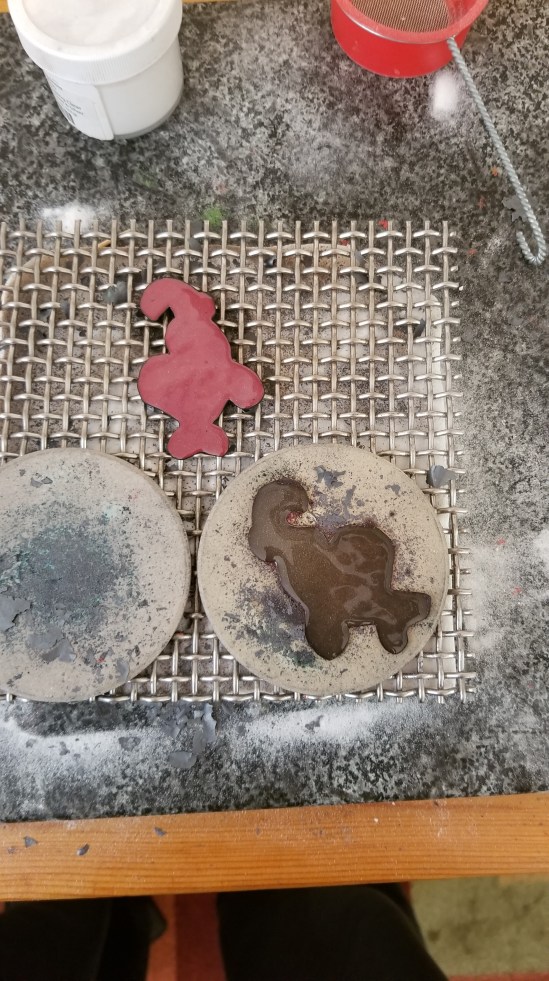
Once things got hot, I went ahead and prepped the pieces with the clear base coat:
And fired them:
Top bird is “cooled”, the one on the pizza stone is scorching hot. The base coat cools to a pleasant deep red.
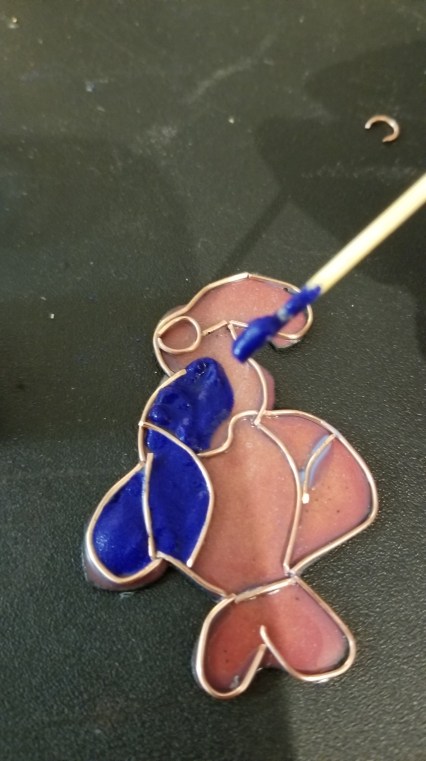
Once they were fully cooled, I started the wire work. A note about the temp: this is not a “fresh out of the oven” hot, this is surface of the sun hot. You will get severely injured if you are not cautious. This is 20g copper wire. It took me quite a bit of time, and I used Thompson Blue Stic glue to keep it down. I am unsure if any adhesive was used in period, but I assure you, it’s a pain if your wires move. It’s also a lot easier to work with smaller cuts of wire, as I found out almost immediately. Hopefully as I improve, I can handle manipulating larger pieces.
Once the glue was dried, completely (this is not a “fast” art), I put down the blue enamel, emulsified in water.
Fire! You can see how red-hot the stones get.
And cooling down to the blue. I had to do a second coat with the enamel since I had some coverage issues.
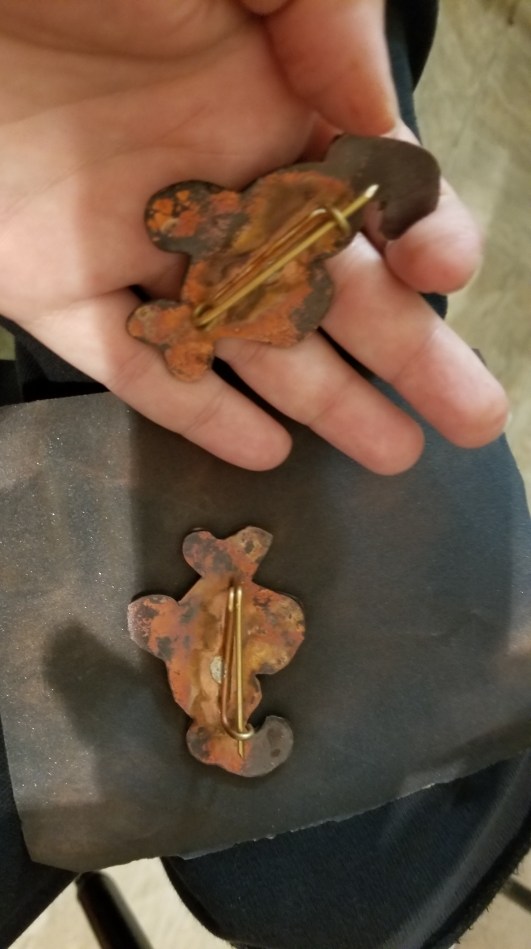
Husband made some fibulae pins from brass wire, and he showed me how to solder them on in about 5 minutes. Again, HOT. LET COOL. OMG. SO EASY TO REALLY BURN YOURSELF.
And then the sanding. This is how you get your wires to show up again, after oxidizing in the kiln. During the process, one of the brooches popped some air bubbles in the enamel. This upset me, but I’ve seen period pieces with similar imperfections. Part of the learning curve, I suppose. I was still pretty pleased (see also, hooting, hollering, and down right ECSTATIC over how these were coming out.)
For the finishing touch…pearl eyes. We gently sawed a couple pearls in half to get the right size, and glued them in the eye sockets. The period technique would have them set in, but I’m not really there as a jeweler, and probably never will be, but Gieffrei insisted I do this almost entirely myself, so…E6000 it was.
But seriously though…they aren’t museum quality works of art, but I am insanely proud of this project. Behold, Rowena Ravenclaw’s Gonzo, I mean, Eagle, fibulae!
I have a long way to go before I’m ready to do intricate Byzantine style enamels, but it certainly beats my “warm-up” project from the day before.
Uh. Well, that’s something.
I learned a lot. I think I learned how to do some troubleshooting on the appearance of the enamel, but this is going to take some time to really get into. I have some great friends in the East Kingdom that do enameling, so next I see them, I’ll have to see what kind of tips they can give to work with the minimal tools we own. I don’t know if we’re going to invest in a larger kit just yet, because it’s not our primary art form, but rather another corner of the Middle Ages that have entered our home. Or rather the entirety of our dining room. In fact, we had a ton of friends over on Saturday to give it a try with us, and we had a ton of fun with great results just after 2 little projects.
Well, I suppose Godric Gryffindor needs some kind of lions next. Stay tuned for the next segment of our Anglian Experience.






















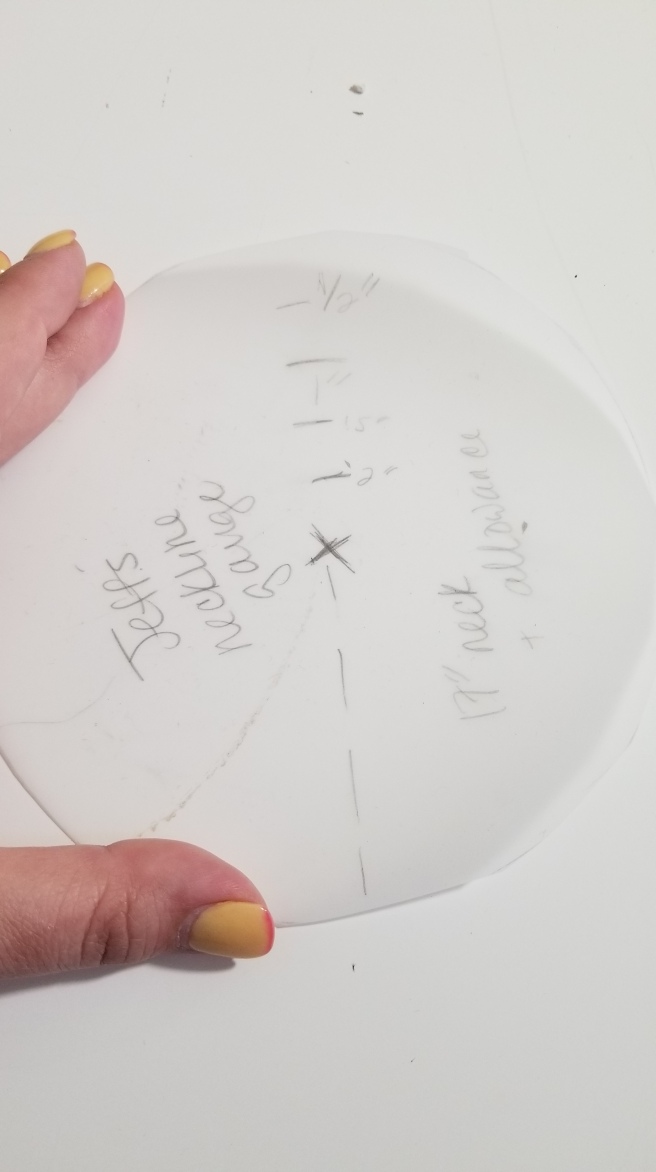 You place the gauge on the fabric, center mark matching to the dead center of where you want the neckline to be. Then, move it forward to where you want the depth of the back to be. I’ve done both 1″ and 1.5″ with good results. The dotted line helps you maintain the angle toward the front, and where you can mark your slit.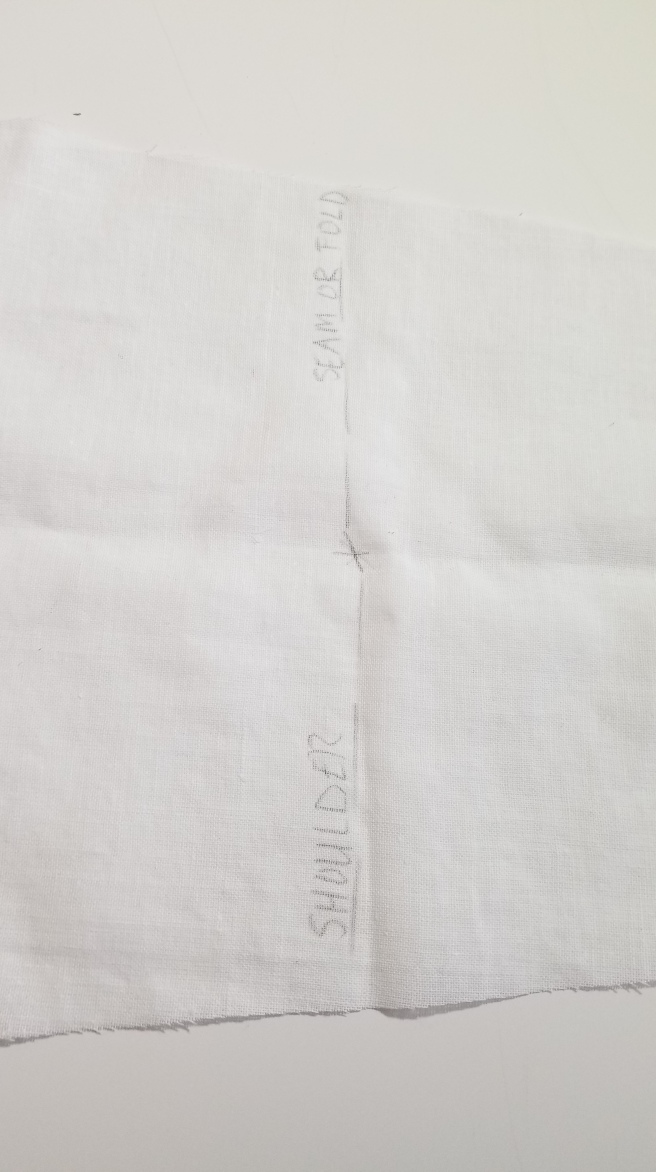









 Anna's New Rome
You must be logged in to post a comment.