Anachronistic and Impulsive: A View of Classical Civilization and Byzantium in the Current Middle Ages

The Propoloma: A headdress of the Zoste Patrikia and other high ranking women in the courts of Eastern Rome
Kyria Anna Dokeianina Syrakousina, OM, OBT
One of the more difficult aspects of studying Eastern Roman dress for the SCA is locating suitable headwear outside of the typical veil and circlet that seems common place, and easily mimicked from iconographic depictions of female saints, and especially the Virgin Mary. I have just started to scratch the surface of ceremonial Roman dress, but so far I have been able to uncover some rather unique pieces that may begin to open the door into more complex appearances for Eastern Roman personae to try.
The zoste patrikia was a title held by the chief attendant or lady in waiting to the Eastern Roman Empress. It literally translates to “girded-lady patrician” but is often translated into English as “Mistress of the Robes.” It appears to have been given only to extremely high ranking ladies in direct service to the empress.[1] She was not only the head retainer for the empress, but also the head of the court of ladies, the wives of other high ranking patrician men in the court of Byzantium.[2]
As was tradition with the Eastern Romans, ceremony heavily accompanied any augmentation in rank, and with ceremony, came elaborate new costume. Ioannis Spatharakis, in his monograph, The Portrait in Byzantine Illuminated Manuscripts, gives a detailed footnote of the ceremony, as described by Constantine Porphyrogénnētos in De Cerimoniis in Latin, while explaining the details of a manuscript depicting the installation of Anicia Juliana as patrician:
“In the church of the Theotocos of Pharos she received from the despotes a delmatikion [dalmatica], a thorakion [ecclesiastical pallium, similar to a chasuble], and a white maphorion [hooded veil]. In the Pantheon, wearing the thorakion and the delmatikion and carrying the loros [heavy gold wrap] and the propoloma [trapezoid hat], she received from the enthroned emperors the kodikellia [codex], which were later blessed by the patriarch. Because she was wearing the loros and the propoloma, she was not able to prostrate and kiss the feet of the despotai, as she did when she received her costume, but she bent slightly and kissed their knees.” [3] (The available text of De Cerimoniis is only in Latin or Greek. I did my best to translate the footnote and verify it with the original 1830 publication.)
This article will focus on the design of and wearing of the propoloma. This particular style of the hat is described as being in use as early as the 10th Century, but appeared to have had its heyday during the 11th and 12th Centuries, which allows it to fit perfectly into my persona. It appears to have taken the shape of a trapezoid, or upside down cone sewn shut on all but one side for the head. It may have been covered in silk, and then decorated in a variety of ways.[4]


Dawson seems to have done most of the legwork on this hat, as there is not an English translation of De Ceremoniis available to do primary source research from Constantine’s perspective. He discusses that although the hats were usually white, it appears that in one manuscript, purple ones were seen. This may indicate that these women may have been members of the extended royal family.[6] He also brings into account on his Levantia website that the padded headroll seen in earlier artwork, including the Ravenna mosaics, may have been the predecessor to the trapezoid propoloma.[7] So for those who have an earlier period persona, we simply need to take a look at the bust of Anicia Juliana to get a glimpse at the earlier hat style.


(Photos taken by me at the Metropolitan Museum of Art in March of 2014.)
Anicia was born in 462, which puts her occupation of zoste patrikia during the reign of Anastasius I, two reigns prior to Justinian I. So it is arguable that her attire could be considered that of late Antiquity of the very late Roman Empire, rather than “Byzantine” in nature. However, a similar style was worn by Theodora’s court in the mosaics at Ravenna:

The first thing I noticed immediately on this particular bust was not the layered look at the top, but the gathering in the back at the base of the skull. This reminded me immediately of the Cap of St. Birgitta, a style that was popular in the 14th century:


Naturally, there is no reason why this cap could not be older in origin, and this marble bust may just show a similar cap being in use as early as the 5th century. At least for the over cap, the under cap is a bit more perplexing, especially with the pucker going on at the top of the head. It is highly unlikely that is a hair part, considering the detail given to the rest of the statue, in addition to the same look of the layered “turbans” on the mosaic, so my belief is that it was two separate pieces, but how they created that gather on the top is still a mystery to me. It is something I do plan on exploring later to help those with early period personae.
But how does a re-creator or reenactor transfer the wearing of this type of hat into their hobby? Well for one, this is a hat of station and rank. In the SCA, some kingdoms have sumptuary laws, the East Kingdom, where I reside, does not. However, I like to take into account the “what would my persona do?” clause when it comes to my clothing choices. My persona is well-developed, but not everybody else’s is, nor should they have to be. It is absolutely a personal choice on how much thought you want to put into your persona, and what you want them to wear. In the case of portraying a persona from a culture that has strong sumptuary laws, such as the Eastern Roman Empire, and especially if you reside in a kingdom that has laws about what one can wear on their head regarding their own rank, this is when the re-creator needs to take into account what he or she wants to wear, or should be wearing, for the holder of their awards.
In the case of the propoloma, I would recommend that nobody holding anything less than an Award of Arms wear this hat. A woman who would have received this hat would have already been of high patrician rank, and even though the title of lady may or may not convey this, it would be unfair to say that only peers or grant holders/court baronesses would be permitted to wear it as well as far as the game we play goes. I made my first one from looking at the Tom Tierney coloring books, which have proven to be rather inaccurate the more that my studies continue before understanding that it was a hat of rank. However, I feel that it would make an excellent choice for something akin to a cap of maintenance for a Pelican, or wreath for a Laurel, as the SCA simply does not hold a candle to the intense pomp of Eastern Roman ceremony. But by bringing pieces of these ceremonies into the SCA, bit by bit, we can help enrich our game even more, and introduce others to a new and exciting part of Roman culture they may have never otherwise known about.
Please visit http://www.1186-583.org/Headgears-Headdress-and-Jewellery for Eudocia Kinnamos Dallassene’s research into this same hat. (Site is predominately in French.)

Edit 11/9/2014: My new wool and silk Propoloma, visit my walkthrough here:

Bibliography:
Constantine Porphyrogénnētos, De Cerimoniis aulae Byzantinae libri duo. London: Oxford. 1830.
Kazhdan, Alexander. The Oxford Dictionary of Byzantium. New York: Oxford 1991.
Garland, Lynda. Byzantine Empresses: Women and Power in Byzantium, AD 527-1204. Abington: Routledge 1999.
Spatharakis, Ioannis. “The Portrait in Byzantine Illuminated Manuscripts,” Byzantina Neerlandica 6 (1976): 145.
Dawson, Timothy. “Women’s Dress in Byzantium” In Byzantine Women: Varieties of Experience 800-1200, edited by, Lynda Garland, 47. London: Ashgate, 2006.
Dawson, Timothy. A Woman of the High Aristocracy,” accessed August 13, 2014. http://www.levantia.com.au/clothing/zoste.html.
Footnotes:
[1] Alexander Kazhdan, The Oxford Dictionary of Byzantium, (New York: Oxford 1991), 2231.
[2] Lynda Garland, Byzantine Empresses: Women and Power in Byzantium, AD 527-1204, (Abington: Routledge 1999), 5, 245, 264.
[3] Ioannis Spatharakis, “The Portrait in Byzantine Illuminated Manuscripts”, Byzantina Neerlandica 6, (1976): 145.
[4] Timothy Dawson, “Women’s Dress in Byzantium” in Byzantine Women: Varieties of Experience 800-1200. Ed. Lynda Garland (London: Ashgate, 2006), 47. Dawson cites De Cerimoniis by Constantine Porphyrogénnētos, the 1837 Latin edition, which I am currently translating into English.
[5] Ibid.
[6] Ibid. 48.
[7] “A Woman of the High Aristocracy,” Timothy Dawson, accessed August 13, 2014, http://www.levantia.com.au/clothing/zoste.html. Also gives his interpretation of what a complete outfit may have looked like.
In between sewing way too much, and horrifying Pre-Pennsic Panic (tears, there are tears. I know I’m not the only one.) I’ve made a couple things that have been totally new to me, and therefore I feel the need to share them with people looking for Roman and Byzantine stuff here, that aren’t going to find it in this post. (Sorry.) However, I do hope you find inspiration for working outside of your comfort zone and exploring new projects.
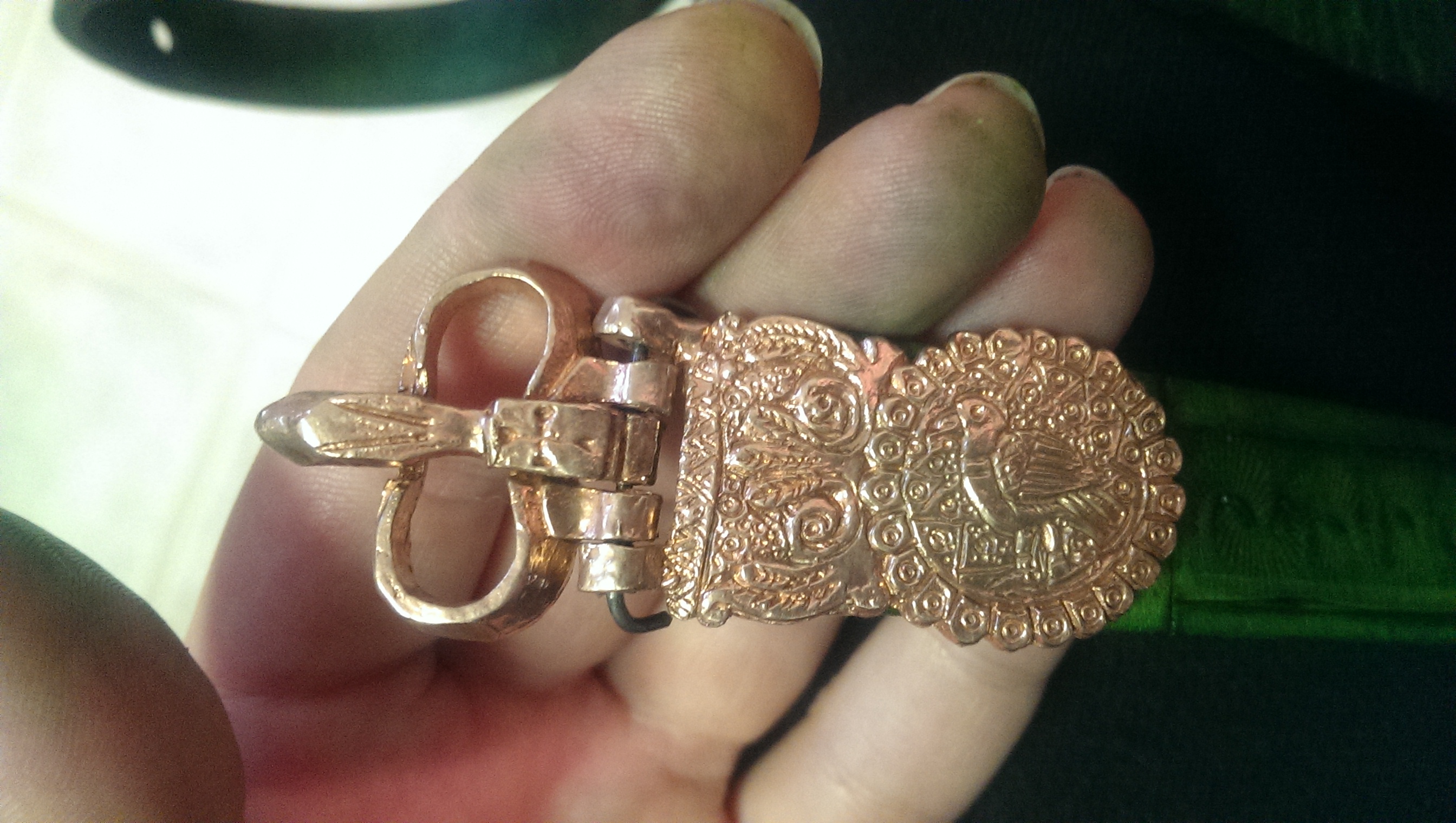
First thing: I made a belt. Seriously! I have an apprentice sash I made from faux silk and fancy stitches, but I can’t wear that all the time, so I needed a sturdier leather belt for times I need to carry a pouch or bum around not in Byzantine. This was an adventure. My husband has leather working experience, and I figured he would just do it for me. NOPE. He made me do it while fielding a tapestry of profanity so thick it’s probably seen as smog over the Boston area. Here are some pics of my experience.
I started with a 3/4″ belt blank from Tandy, and an 8th Century Syrian belt buckle from Raymond’s Quiet Press…got green dye and Geoffrey’s basic tools and designed a pattern that I felt could work. This was my first time tooling leather, ever, so I just kept telling myself that straight lines were for sissies, mistakes are period, and if anyone needs to get that close to my belt to see my mistakes, they need to buy me dinner, first.

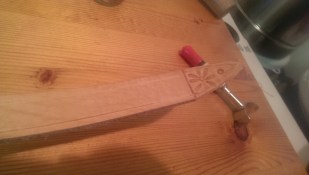 Practicing with the tools and my thingy at the end of the belt.
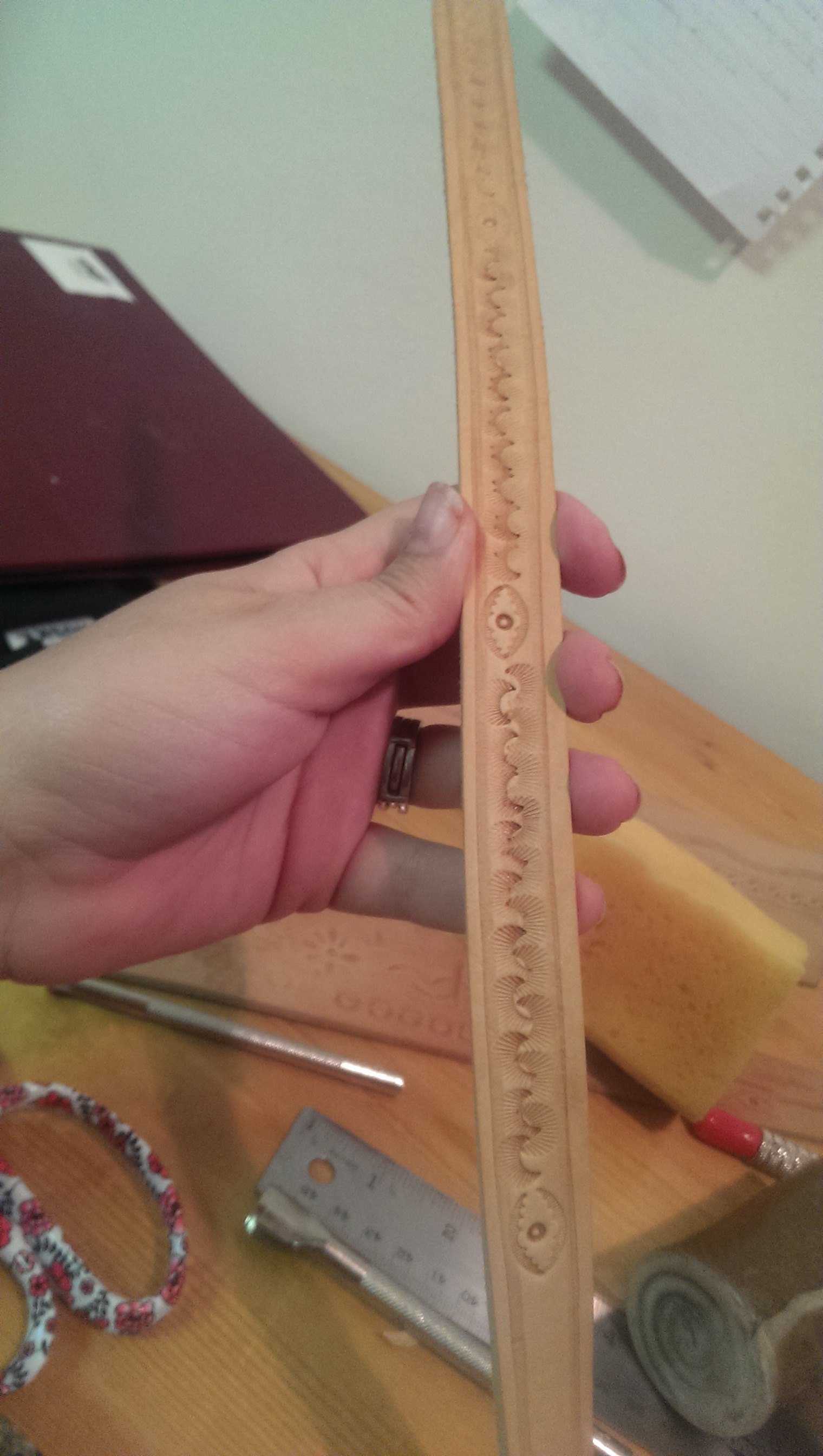

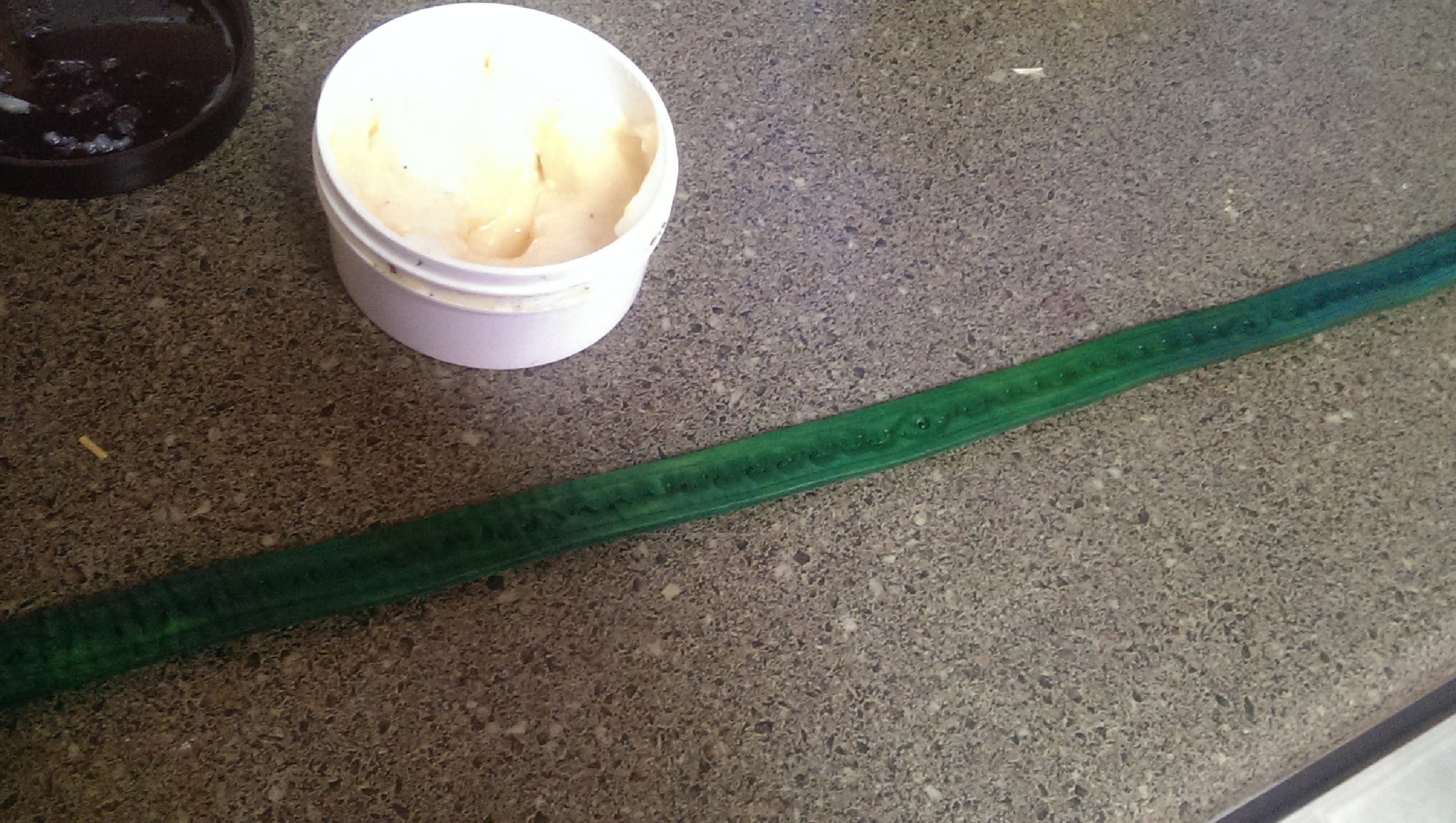
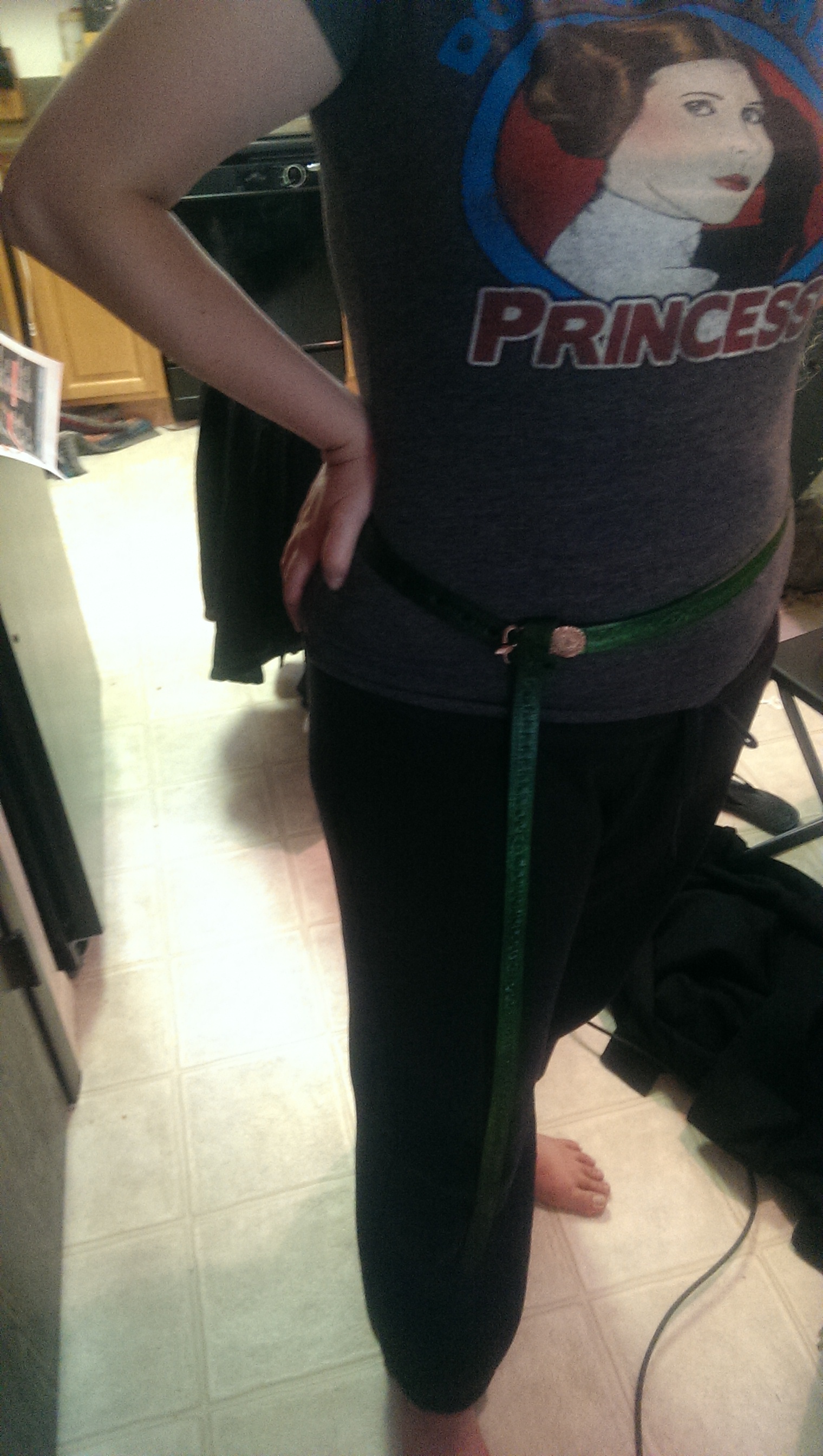
BUT WAIT, THERE’S MORE! I ALSO PAINTED A SILK BANNER FOR MY PAVILION!
I have no idea where I find the time for this stuff, but Geoffrey made this pretty finial for the Green Monstah, and said we needed a banner. After me giving him a dirty look for a solid minute, I agreed, and ordered the supplies from Dharma. Fortunately I have friends who have done silk painting before, and the concept overall is very simple. It’s controlling the dye that’s tricky, and understanding that mistakes do happen and not to care that much since it will be up on a pole.
Here is the Green Monstah. It’s in Geoffrey’s colors. I am not a Red Sox fan and hate all things Boston, and he doesn’t watch baseball, but the name was apropo:

So we had to go all out with a war standard. Now, there are rules that need to be followed for displaying heraldry, but the SCA tends to be different than the real world, so the order I did is perfectly fine. Most importantly, your country or kingdom needs to be on the hoist, which is the pole, and then you work out from there. In this case, mine is East Kingdom (populace badge), The Northern Army, Geoff’s Arms, and then mine. When marshalling married arms, the lady is always RIGHT. This means my dolphin is way at the end, but hopefully the breeze catches it enough.


All I have to do now is wait for it to dry, rinse it to remove the resist and excess dye, and then toss it in the dryer. Oh, and attach it onto the pole, of course. It will be sewn onto the casing part of the red linen flag in the above picture so it fits properly.
So there you have it, folks. Anna did stuff she doesn’t normally do and did not kill or maim anyone in the process. I definitely want to try another silk banner with better brushes and gutta, I think it will make a difference in controlling the dyes.
Now if you excuse me, I need drink 3 more cups of coffee, and start sewing even more stuff. We leave on Saturday morning. ~_~
I’m REALLY MEAN when I teach at Pennsic and only give out outlines when I teach my classes. There’s multiple reasons for this:
1: You can’t show up, jack a handout, and then not stick around for my class thus shorting the people who stay a handout.
2: It’s harder to plagiarize me. Yes, it’s happened. Really people, just cite me in your work.
3: It makes you become more engaged in what I’m teaching by following my outline, and taking your own notes for your own benefit. I do pass around supplemental materials and draw pretty pictures on the whiteboard and I want you to pay attention.
4: IT SAVES TREES. If I printed everything I needed for a 2 hour class, it would be a small booklet, and cost me a lot.
However, this has a downfall. Those that want to go to my classes and then can’t get shafted. So I was thinking to myself, “How do I make this easier for folks who can’t make it? You can’t learn much from a boring old handout.”
DING. SOCIAL MEDIA.
I understand that not everyone has Facebook, I apologize, but not everyone has Google + either, and I find the Facebook group interface a bit better for discussion anyway. Therefore, I created a group on Facebook that I plan to fill with all of my class goodies after war, so everyone can jump in, ask questions, and engage in a sorta online class. This is pretty beta, and I hope it works out. If it doesn’t, I’ll just can it.
Group link:
AΔΣ’s Pennsic Classes
https://www.facebook.com/groups/1448455932095583/
Please feel free to join in advance for when the fun begins.
In more of my pre-Pennsic Procrastination, additional thoughts have chopped their way into, “gee, I should be sewing right now” time.
Namely, this:

No! I mean THIS:

That is the shade of what is known as Tyrian, or Murex Purple. The imperial purple of Rome. As you can see, it is NOT indigo, it’s closer to a magenta-red, and it’s actually quite nice.
This was brought up because right now I have enough free linen points over at Fabrics-store.com to do some damage, and wildcherry, a color similar to this purple is on sale. This put me in a conundrum. Do I spend the money and being haughty and make a lovely purple piece of garbery, or, do I let it slide and stay within my persona? The East Kingdom has no sumptuary laws, especially when it comes to the wearing of colors, so I could wear this without any issue on the game side of of things. However, on the Anna side of things is where I question it. Would my persona be in the purple? As an imperial with the rank of lady, it’s likely I could have afforded it, and sumptuary laws did change over time to make it more available…IF you could afford it.
However, I feel like the wearing of purple, to me, as a Romanian (Byzantine), is being presumptuous in rank. If I was bestowed the gift of purple from someone of a higher station, that’s different. If someone won crown for me (highly unlikely situation) then well, yes, definitely. But the purchasing, sewing, and wearing of a purple garment would make me feel like I cheated. Yes, even though I hold the rank of lady, and I have seen period imagery of ranked women wearing SOME purple in their embellishment, they were never clad in it fully like the actual emperor and empress. So even though I may hold a position that allows me to wear it, and I could probably afford the dye, I would limit my purple to embellishment only, rather that entire garments.
Instead, I will play with words. Purpura, in both Latin and Greek, is a funny word. It means both purple AND red, so it’s hard to assume which color was being worn unless modifiers are being given, which they sometimes aren’t. And a good red color, like kermes derived from crushing little insects into dye, was just as expensive as milking murex snails. So I will gladly spend all of my persona’s invisible money on quality crimson and not feel like I’m placing myself higher than I should be while still dressing as a diva. 😉 Problem SOLVED. HOMERUN!
This of course doesn’t mean a thing outside of my own persona and kingdom. If you want to wear purple, and can wear the purple, rock that purple.
I need to get work done.
This last weekend at Palio, and on Facebook, I’ve been asked on what’s the best way to clothe thyself for 2 weeks of camping on the Allegheny. After my last couple Pennsics, I’ve started to create a system of clothing that works for me. I used to bring everything I own, which ensured not running out of clean clothes, but I realized I was still wearing a lot of the same things over again in rotation than wearing, well, everything, so this is what I’ve been contemplating. Note that everybody has their own unique system, and there’s no real right or wrong way to do Pennsic, okay, well, there’s plenty of wrong ways, but here’s assuming everyone comes prepared. The only way you’ll really figure out what works for you is trial and error.
In the Anna Method, you have 3 categories of Pennsic garb, not including the mandatory outerwear like cloaks because you’ll need one: 1: Court/Nice event garb. 2. Casual stuff. 3: Camp slop. Some things will carry over a bit depending on the day, how hot, how cold, etc. I always go for the full 2 weeks, so I tend to need more. The issue is that a lot of my stuff takes up some bulk, and there’s only so much room in the car. Space Bags are a wonderful invention and help a lot, but it’s not infallible to reduce space once you get there. So rather than bringing everything in your closet, put more thought into what you’re actually going to wear.
For example, here’s my thought process:
Court wear: No bliaut, it drags on the ground. Turkish has pants, good for cooler party nights, Bamberger Gunthertuch outfit is a yes, bring the gold dalmatica just in case and also something to bead on. Ghawazee coat outfit for hitting the Bog with. No apron dress this year, focus on being in persona.
Casual wear (remember this stuff can double for court wear if conditions are questionable): Blue beaded Byz, Rose Byz, Blue chiton, white chiton for layering, blue stola, rust peplos and Northern Army peplos. Green faux silk chiton if layered over white only because it sticks to my skin like ew. Beige tunic dress and sideless surcoat. Sari and choli for when it’s oppressive and you have to go to court…
Camp slop: Make 2 new Party Saxons (what I call ugly plaid bog dresses) since you gave some to a friend, flannel tunic dress, maybe one more of those for chilly nights, ugly cotton tunic dress with the short sleeves, purple pants, tank tops for grunt work. Sleep dresses.
Fight garb: Fencing entari, Fencing caftan, stripey pants, salwar, tunics.
Shoes: Flip flops, Crocs (you can hose them off, BIG.) Roman sandals, China flats, fight boots.
Outerwear: Cloak, Birka coat, Skaramangion if finished.
Now, this isn’t everything that will be on my final list, but it gives an idea of how I try to mentally place my garb, and reduce my bulk, and there’s also things that I can share with Geoffrey, though I tend to prefer dresses over pant or braies. There’s some camp garb I won’t leave camp in, and there’s some I will stroll around the merchants in if I don’t particularly care who I run into, which is often. This is my vacation, and if you can’t deal with seeing me at my worst, you don’t deserve to see me at my best. I’ll be honest, there are days in camp I just need to put on mundane yoga pants and hide from the world. There are days when I’m just in a tank top and a broomstick skirt, and 99% of the time, I’m barefoot. This is okay, your camp is your space, and your tent is your house. Wear what makes you feel relaxed and comfortable, but still able to do the necessary chores.
Now, the number one consideration isn’t the amount that you bring, it’s planning for what Pennsic will throw at you weather-wise. As somebody who lives in New England, where we are fortunate enough to have all 4 seasons, we tend to plan for all the weathers. Not everyone in the country has seasons, and as someone who grew up in the balmy tropics of Florida, I know half the stuff I wear up here wouldn’t see the light of day down there. You need to be prepared for the extremes, I am not kidding. My first Pennsic, it rained the entire time. It’s been over 100 degrees and dry, there have been tornadoes and microbursts that can severely damage camps, and there can be bitterly cold nights that result in frost on the grass. The majority of the time, you can expect warm temperatures in the 80s and 90s, with a consistent chance of rain. Wet and dry conditions result in lots of mud and dust. The sight is usually good about helping control the dust levels by wetting the roads, but mud is unavoidable, and the ground is saturated in natural iron that gives everything a staining rusty tinge that’s impossible to get out of garb. This is where you need to plan well.
My persona is high Byzantine. I’d be damned if I’m going to wear one of my white tunicae after a rainstorm. Nope. No way. I highly applaud the folks who dress in their persona the entire time, especially the women in late period, because your balls are bigger than mine. I have no qualms with being a slob if it means saving my good clothing. This is why I wear a lot of classical Roman in the summer to begin with. That, and I tend to get very warm in long sleeves.
Another thing to consider greatly is your sensitivity to the sun. I’m blessed with Italian and Black Irish (Irish folks descending from the moors and Iberian Celts) heritage, so I tan well and have a lower risk for sunburn. Therefore, exposed arms and legs aren’t as dangerous to me as say, my Lord Geoffrey, who is as Northern European as the white cliffs of Dover. So where I can go as Roman or in generic bog dress #42, he has to cover. He’s a Norman persona anyway, so this helps, but we’ve also decided to put him in generic Middle Eastern kaftans made from ugly striped linen like this:
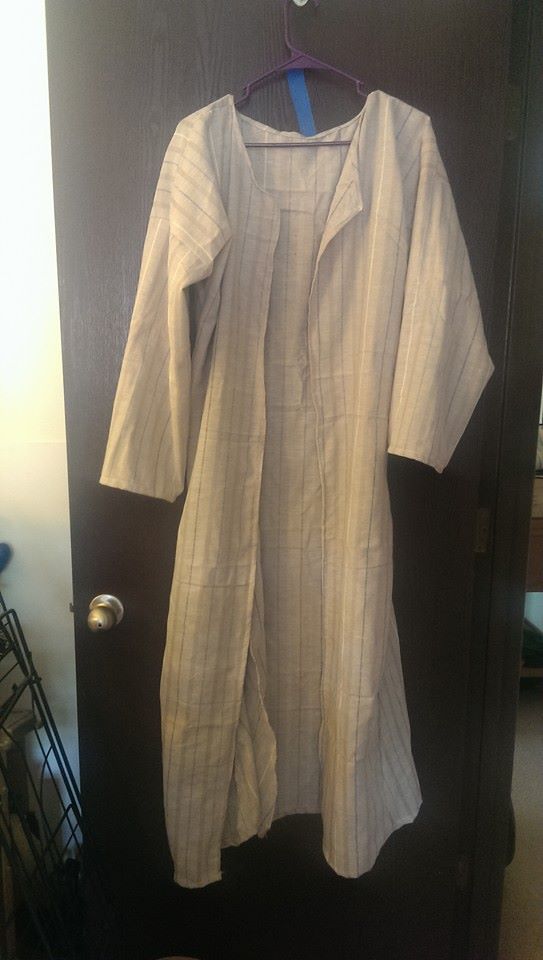
Because he can still wear short sleeves under it, as well as straight pants with sandals to control body temperature, without sacrificing his skin to Helios. Sunblock is still needed, of course, but not by the gallon.
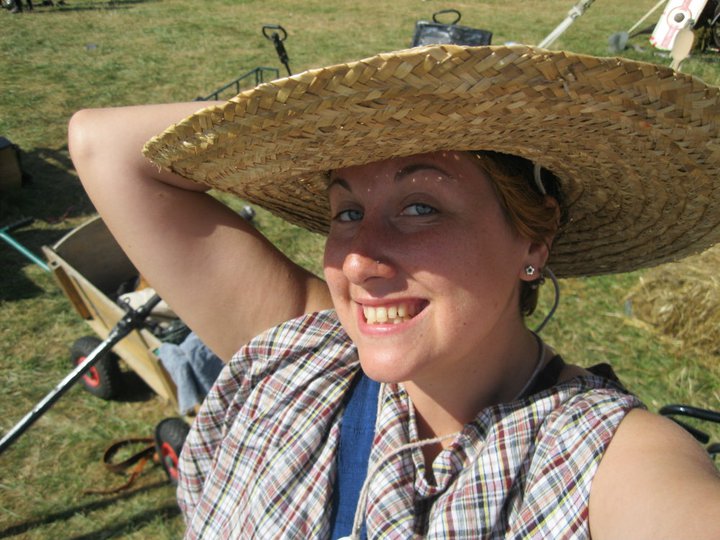
Also, hat. All the hats. If not a hat, then a veil or some sort of cap. Not only is it period, but it’s period for a reason: Your face and your scalp are going to cook. They sell big straw hats at war for about $5 each. They will last you the event, and you’ll look goofy, but it’s better than sun poisoning on your noggin and helps eliminate the need for sunglasses.
Garb “hacks”:
Here’s some ways to “cheat” at garb for Pennsic to make it a more affordable and comfortable experience.
-Sew/purchase your garb in natural fibers only. That means linen, wool, and cotton. Linen above all, because it will keep you cool, keep you warm, take a beating and wash well. Wool will keep you warm but doesn’t wash as well. Cotton is good depending on the weave, but it won’t take a beating. Quilting broadcloth is garbage, avoid it if you can and spend the money on better quality fabrics like homespun cottons, or, you know, linen. However, flannel tunics are a great way to have snuggly warm dresses and tunics for the chilly nights in camp
-Bandeau bras under bog dresses and classical garb. I got a pack of them from Amazon for like $15. No straps, and tight enough support to hold the girls in without the dreaded Roman sideboob. I have a 36D bra size and they still fit.
-Shorts. Yes, ladies, I’m looking at you. Not everyone has a thigh gap, and I myself am an accomplished victor of chub rub chafing which ruined a war for me. You need bike shorts or compression shorts under your dresses. You could make short braies, also, which I’ve done, but seriously…protect your thighs. Shorts and Gold Bond after a shower. Don’t ignore this advice. I’ve also heard that Body Glide is a great product to help with this (and under the boobs) as well as an antiperspirant, which doesn’t work for me. Ripping up your thighs is a great way to ruin your event.
-PJ pants. This is a great way for guys (and ladies!) To have legwear for cooler nights and days without wearing jeans or making tons of pants. They’re usually cheap at stores like Target and come in colors and all sorts of fun plaids that could pass off as something Celtic or Viking, even though everybody knows you’re in PJs, because a lot of people do it. These make great “camp slop” for when you want to save your nice stripey pants for a higher profile day. Scrub pants can also work, but don’t wear blue scrubs, that’s what the Cooper’s staff wears.
-Crocs. I think they’re ugly, too, but after I watched campmates hose off their shoes after a muddy night and before they got in the car to go home, I became a believer. My winter boots are Crocs, and they’ve worn lots of mud here in the spring events. Plus, Crocs come in other styles that aren’t so…Croc-like. This doesn’t mean don’t bring better shoes for nights you want to go out, or for court and such, but after I’ve destroyed, and I do mean DESTROYED, flip flops and China flats at war, I’d rather just invest in these ugly things and have my feet look like duck’s feet if I can hose them off.
-Buy packs of underwear and socks when you get there, you’re going to need these because you may throw out more pairs of socks than you think. I don’t care how much you pack from home, BUY MORE.
-Leave a bag of clean mundane clothing, shoes, and undies in the car. You’ll thank me later.
Okay, what the heck is a Bog Dress?
A bog dress is a peplos, plain and simple. Just like the Romans made them. They were worn throughout Bronze Age and Iron Age Europe and they’re an excellent way to make cheap hot weather garb. I separate my Roman dresses from bog dresses by calling them my Party Saxons, mostly because I’m wanton to pick out the most horrific plaid homespun cottons at Joann’s for them and blinding my camp. This of course, isn’t necessary, and I’m just not terribly a nice person. 🙂 I do recommend making them out of the homespuns though, even if they’re horrific, because you’re only paying $4 a yard, don’t need much fabric, and if they get wrecked beyond a washing machine or repair, oops, into the dumpster they go. You can also make them shorter and feel like Artemis for those extra sloggy days.
There’s a couple different ways to make them, usually you’ll see the traditional style with the flaps in the front and back, but I’m starting to move away from that and just making a tube to pin at the shoulders to conserve fabric, as my Roman ones take up the entire bolt width and cut lengths. I also found this great pattern by Alfrun online, and she pleats the tops to make it more fitted and use less fabric. I’m going to try this style for this year’s war: http://awanderingelf.weebly.com/a-wandering-elfs-journey/sca-standards-the-bog-dress
But what about stuff other than garb?
I have a friend of mine who I camp with who has done this way more than I have. So quite a few years ago, she made a site, called Pennsic 101, that will get you through the basics. It is dated and does go back to before cellphones were the norm, but it’s still a great starting point.
http://www.angelfire.com/folk/pennsic101/
There’s also plenty of other guides available to check out, just by running a search.
Here’s Master Liam St. Liam’s guide on 10 must-do things at your first Pennsic:
So as you can see, there’s no shortage of information out there to help newcomers. I hope I was at least able to give an idea on how to plan your clothing.
Wait, what?
This weekend is my [new] barony’s annual Palio, or civic competition. Stonemarche is broken up into 3 rival contrade, or districts, that compete in games and tournament to determine a winner. Originally, I wasn’t planning on going, since this weekend has always been reserved for Vinland Raids down on Cape Cod. Unfortunately that event is on hiatus, so, off to Palio di Stonemarche to roll some cheese we go!
Then I thought, “I should wear something red and yellow for the Hippocampo Contrada!” And figure I had some stuff that would work.
…and then I basically got garb challenged. I had 2 weeks to make a new outfit for this event. Ugh, why do I get myself into these things?! So I settled on 16th century Italian working class pretty quickly. Because I’m broke, I pillaged my old garb piles, and decided to kill the old red stola I had that was way too big and I never wore anyway. This would be my dress material. I found an old chunk of blackworked cotton from when I actually pretended to be Late Period for a while, and some white linen for sleeves and…
 + =
+ = 
Nailed it.
I kind of feel like Ronald McDonald, but considering it was thrown together from a box of scraps and bias tape, I can’t complain. The pattern drafting instructions I had from my collected old notes back from when my persona WAS 16th Century working class Italian that I never did anything with, and I finally made a damn Campi-style dress. Not without tons of flaws, mind you, considering the materials at hand, and I probably wouldn’t have done it at all if it wasn’t for the fact that my machine has an automated buttonhole feature. Other then that, after I got through the hiccups of fitting the bodice, the rest went together insanely easily. The camicia’s collar is also just white hem facing. Hey, I did say, “box of scraps” didn’t I? The skirt isn’t as full as it should be, but it’s not as slim as it appears in the pic, either. I’m also glad that 2 layers of linen and some interfacing in the front is apparently enough to control my figure without boning or a heavier interlining.
At least I can wear this again next year at the event! And once I do move back south, I plan to give the dress to the barony so another can enjoy it.
I basically just sewed what I saw. I’m sure there’s more tailoring that should be going into this, but this isn’t for an A&S project, or persona development, this was made for 100% fun, unlike my orange traffic cone, which took me almost a month’s worth of work and did require some actual research. But still, this is what happens when I get challenged to make garb. I am the reason why we can’t have nice things.
Here’s some other pics circa 1580’s I used for reference:
Rolled Sleeves:

Front lacing:
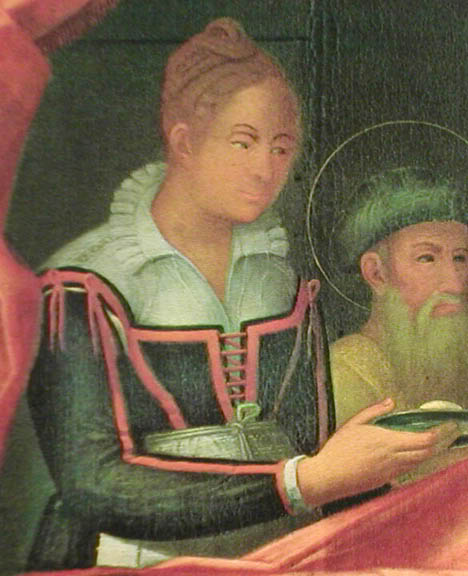
Blackworked camicia:

That’s 2 late period outfits in a year, as opposed to when I claimed to be late period, and had like, none. Wow, Anna. WOW.
I do have some much more interesting Byzantine stuff coming up soon. I just need to get through my rush at work before Pennsic, my Pennsic classes, and whatever other curveballs before I start posting more research relevant to the site. Until then, enjoy my ghetto fabulous Italian Ren dress.
As frequent readers may recall, I have a post here entitled, “The Illusive Dover Dress Debunked.” Wherein I was determined to set the record straight from badly interpreted secondary source material using the primary source. I have created what I think is the look portrayed in the silk fragment. At least the start, anyway. Let’s review.
Here’s the look most often emulated in the SCA:

Which was taken from this interpretational sketch from the 1980’s:
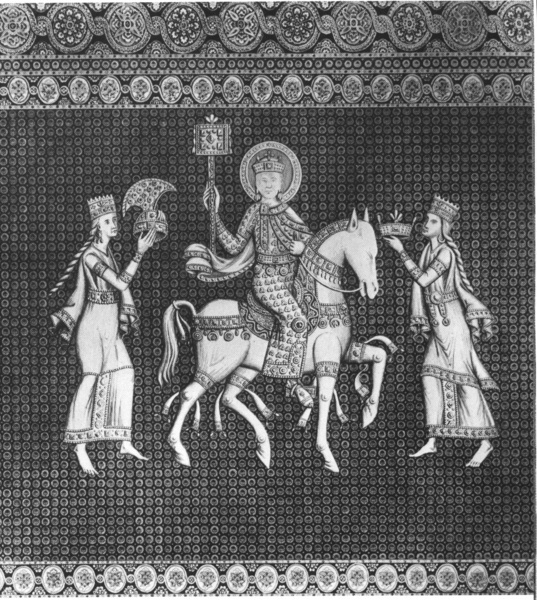
Here’s the actual source:

Here’s the Anna, zoning off as Queen’s Guard (hence rose baldric) at Crown Tourney (I was so tired.):

Yes, it’s a very simple style to emulate. I often wonder if Elizabethan personae come to my page and sneer at my untailored, baggy linen glory. 😉 However, lets see if we can break this down and determine what we’re looking at, and how I did.
First, the women portrayed in the tapestry are both Tyche, the goddess of fortune and prosperity, taking on the shape of the Blue and Green Demoi, the two main political associations in the Eastern Roman Empire. They are supporting a figure that seems to be Emperor John I Tzimiskes on his triumph over Bulgaria in the late 10th Century.
The women are first and foremost, deities. Even though the Byzantines were extremely pious Orthodox Christians, they were proud of their Hellenistic and Roman roots, and often displayed images from classical mythology and literature as part of their way to connect themselves to the splendor of the ancient empires.
The dead giveaway on the divinity of the subject is that they are barefoot. In the Greco-Roman culture, only the divine could be portrayed as barefoot. That does not mean that people could not and did not go barefoot in real life, but as far as artistic record goes, this was reserved for the gods. I am not barefoot for a few reasons. 1: I am a high lady of the court. Barefoot would mean I couldn’t afford shoes. 2: It was Crown Tourney, ew, gross. I am actually wear a pair of red China flats, since red shoes were all the rage for women during the period. One day, I will make nice, period shoes, but I digress…
Another odd observation is that they have bare arms and appear to be wearing cuffs of some sort. This boggles me. The Blue is wearing a tunica that appears to be almost-flesh colored, but the Green, in her minty green tunica, definitely has bare arms. What I have determined off the cuff (*rimshot*) is that this is another classical throwback, or, the weaver really screwed up. Screwing up is period, we see it all the time, which would make some sense. I don’t understand the placement of the cuffs on the arm when they look like trim that matches the garments. If you’ve ever worn a wide cuff on the upper arm, you know how uncomfortable they can be. However, to me, the dead giveaway that this was an error is if you look at the woven pattern on the wrists of both demoi, you see that the trim matches that of their tunicae. Jewelry wouldn’t match embroidery, and their headwear doesn’t match their dresses, and they’re both different. I suppose the only way to really tell is to see the textile in person, which will probably never happen unless I get to go frolic about cathedrals in Germany sometime soon.
EDIT 5-21-14: I did find this small scan of a book about the textile, and it looks like there may be a touch of green left on her shoulder, so fading could also be a culprit.

Of course, if this WAS intentional, my guess would be that the artist was trying to emulate the sleeveless fashions of the classical period.
Or, they could be dancers. I’ve seen a great deal of sleeveless “Byzantine Dancer” interpretations in the SCA and other re-creation groups around on the web, but I did find this image from the Paris Psalter very quickly on Wikipedia with a fast search. This also dates to the 10th Century and has connections to Basil II/John I Tzimiskes period as the textile.

These women are definitely dancers, and the painted style of this is most interesting in the layering of the colors. They are definitely wearing what could be considered the classical stola on it’s own, and the men are wearing the clothing of Late Antiquity and do look more Western Roman rather than Byzantine. This is a curious piece to work from as far as clothing styles go. However, looking directly at the women, you can tell the dresses are one piece and woven or dyed into different colors, and the actively dancing woman is still wearing some sort of sandal on her feet, so she’s not totally barefoot like the demoi are. However, the sleeveless style is there for a dancer. This link that shows a modern woman reenactor gives a source as being in the Biblioteca Marciana, or the Library of St. Mark’s in Venice. I went to check it out on the Biblioteca Marciana digital library, but the back-end of their Java encoding is broken, and couldn’t view their manuscripts, not to mention the reference given is so vague, I’m unsure of which manuscript it’s actually in.
EDIT 5-21-2014: somebody on the SCA Garb Page on Facebook has found it for me, HURRAY!
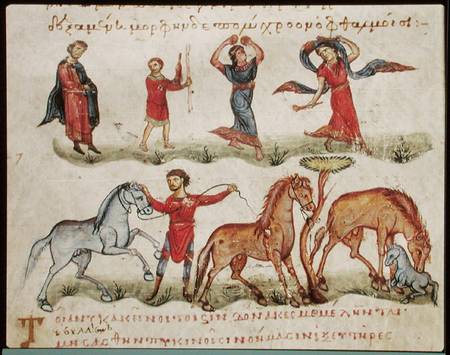
Those dancers may be similar, but the lack of ornamentation, and the weird flounces at the bottom of the skirt don’t mesh with the Tyches in the tapestry.
My big red X over this hypothesis is that the job of a dancer in the Byzantine Empire was THE LOWEST OF THE LOW. They did have court dances, and ritual dances, but for entertainment purposes, especially the showing of the arms and legs? You’re a harlot. Plain and simple. This is seem all too well in the opinion Procopius had of the Empress Theodora in his “Secret History.” Granted, he was a bit of a gossiper, but she was portrayed as the absolute dregs of society before she was married to Justinian. This was not a wanted profession. Why would 2 images of a divine person be dressed as dancers? That sounds insulting to the goddess Tyche. It would be almost satirical in nature for the demoi (remember, political parties) to be dressed as such, but not in the way that the silk is portrayed. They’re supporting figures for a conquering emperor, and not there as jokes.
For now, I will stick with the idea that the sleeveless-appearing Green Tyche was done in error on the weaver’s part, considering the Blue Tyche has the cream colored tunica. If it is an attempt at classical Roman revival, the stola should be to the floor, as the two layer look is strictly a Byzantine fashion style. The weaver was emulating Byzantine fashion, not Roman.
Moving onto discussing my interpretation, I created the stola from about 3 yards of red-orange linen. As shown in my previous post on this style, the Byzantine woman’s stola would have looked similar to the Roman stola (see my Ancient Roman costuming page for more info on that) but closer in cut to the men’s Roman tunica, as seen in this Coptic example:

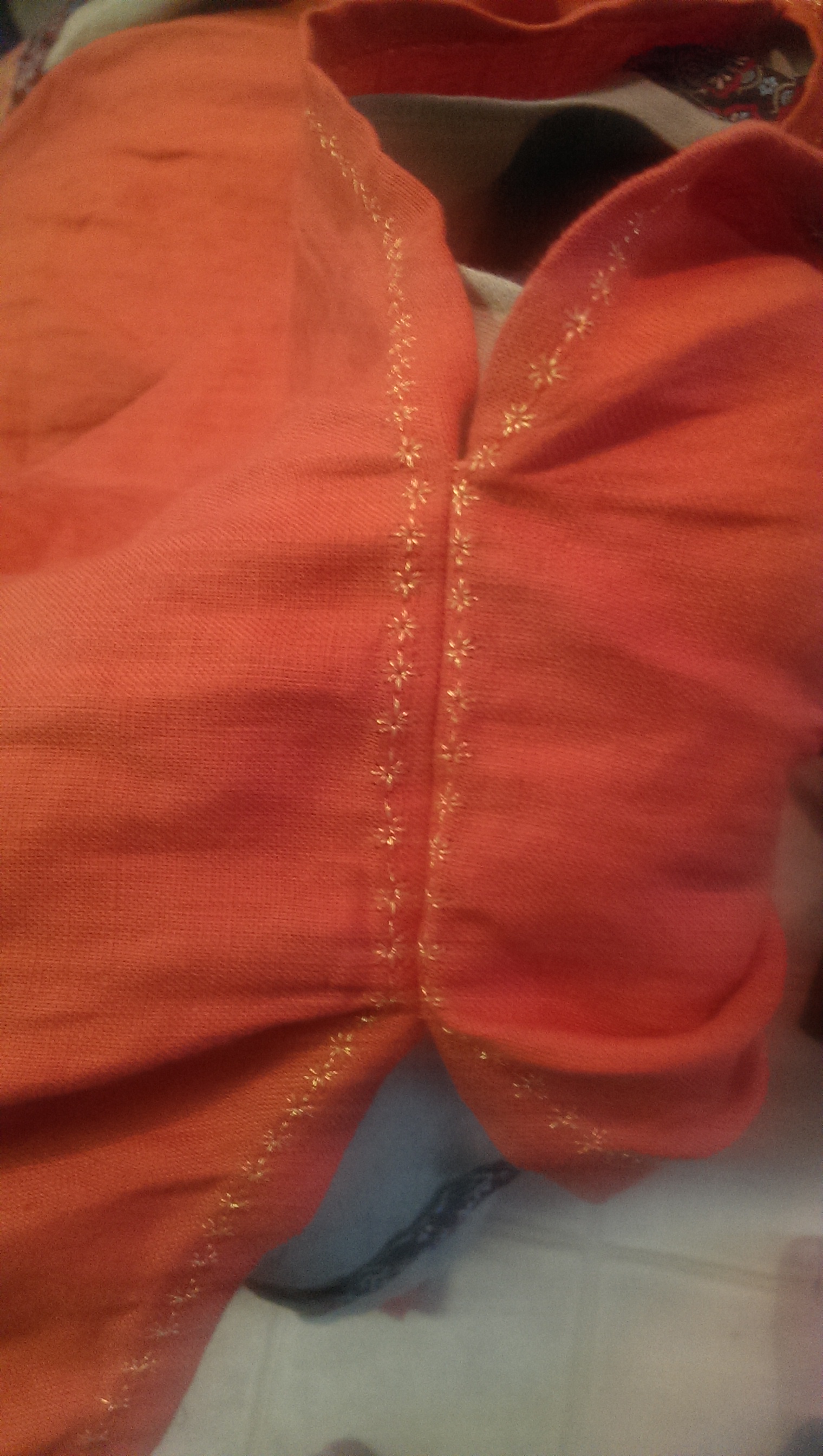
I opted to play with this idea with the “pinching” method of the Roman stola, that is, bringing in the top seam a bit to achieve straps, and provide a more comfortable neckline. The textile shows the women wearing a relatively high neck, as opposed to the deep V-necked style of antiquity. Easy enough. The trick of course is to fit the neck to yourself over and over again with pins to get the look you want. Here is the illustration of mine:

Here’s some pictures of the finished product to help give a better understanding, you can see how I already finished the neck and shoulders before I attached the straps. The embroidery is done by machine and I’m just a fan of that aesthetic. Similar bands are shown in some artwork, but I just wanted a little bling. Also, pardon the icky bathroom mirror:
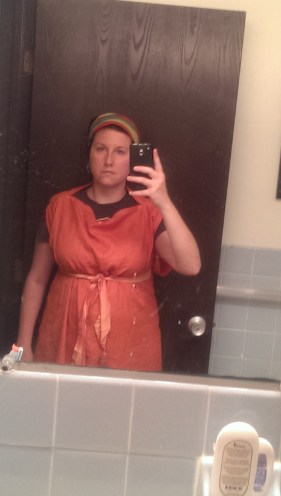
And here’s an action shot of me receiving my Maunche, which I was actually happy to see so I could see how the sleeve openings looked, and they look comparatively well against the original source material. There is no large gap as shown in the Dover artwork at the top, and the draping against my shoulders looks fantastic and flattering. If I would have left the fabric any wider, it would have been frumpy, and any smaller it would have been too tight. So 40″ wide is the magic number for me and stolas. Your mileage will vary depending on the person.
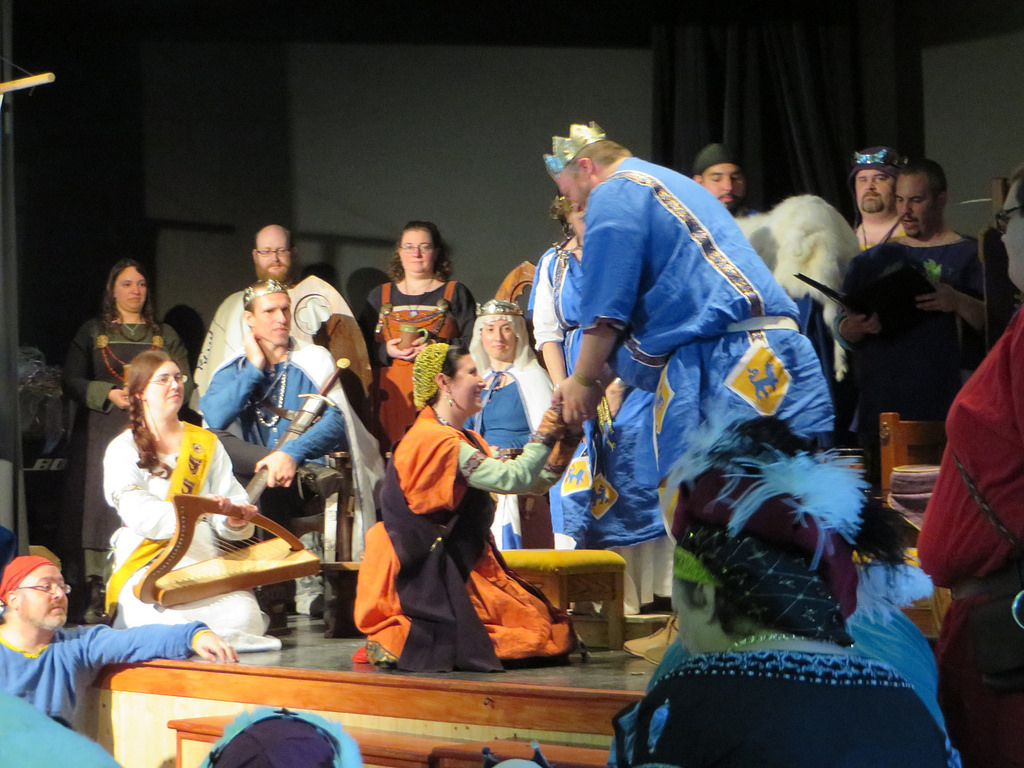
I guess the next thing on my list is to make a tunica with the solid stripe in the front as opposed to the clavii, and take pictures with my turret hat and a palla in such a way that mimics Tyche. I still love my overdramatic dalmatica style of the 11th Century, but this is a comfortable option for warmer events, and it was relatively warm indoors. Hence the lack of hat and palla. I did have it with me, but they made me toasty. It’s also hard to guard thy queen while being immobilized by your garb. 😉
It’s pretty much safe to say that this particular short stola was worn from the period of Justinian and Theodora in the 6th Century as seen in the Ravenna mosaics, and through the 10th Century as seen in the Bamberger Gunthertuch.

I hope this little simple project of mine helped those who were scratching their heads over the Dover illustrations. I feel that this is the correct form of the garment worn, and that more women will be interested in trying this unique style of the Byzantines. 🙂
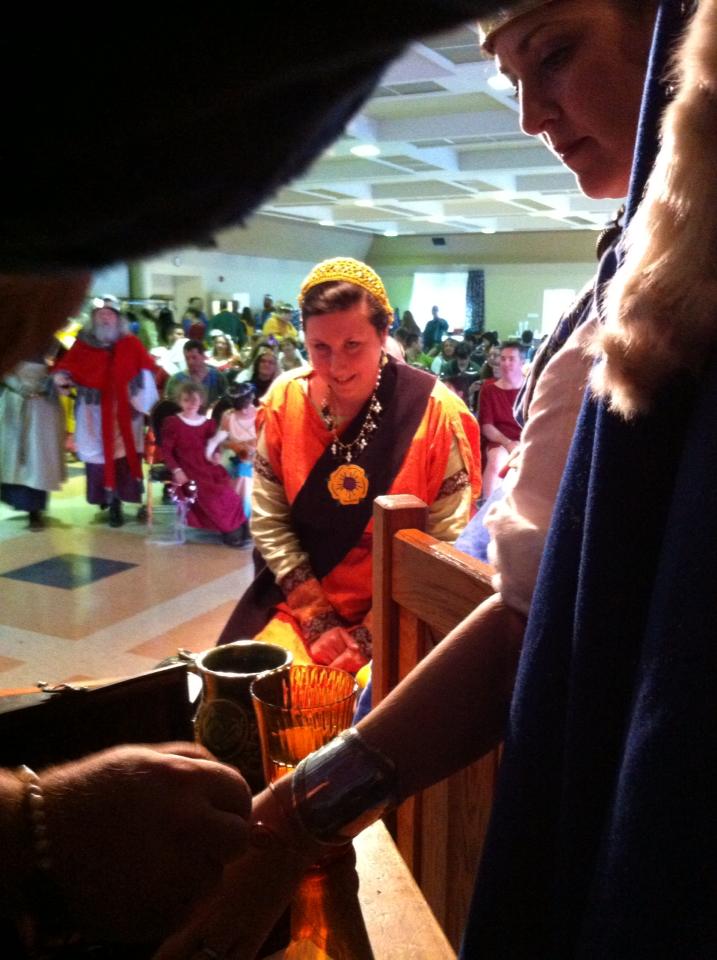
Although I do have substantive posts actually planned, I suppose I reserve the right to brag that yesterday at Crown Tourney in the Montreal area, I was inducted into the Order of the Maunche, which is the highest honor given in the East Kingdom in arts and sciences. I received it for my research and teaching of Roman and Byzantine clothing.
I was so tired at court (seriously guzzled coffee as fast as possible before I stood watch as Queen’s Guard) that I apparently didn’t show much emotion, but I do remember going, “Ahhhh, I can kneel for a bit.” Priorities. -.- So, for those that were like, “Wow, she seems out of it.” I kind of was, but I was very excited, and still am. Thank you all for the recognition, and I hope to do my best to represent the order. 🙂
My medallion, made by my laurel, Mistress Clotilde von der Insel…which was backed with the orange fabric leftover from my Bucs dress. That was carefully acquired (see also: asked for) by Geoffrey, and snuck down to Rhode Island. EVIL!
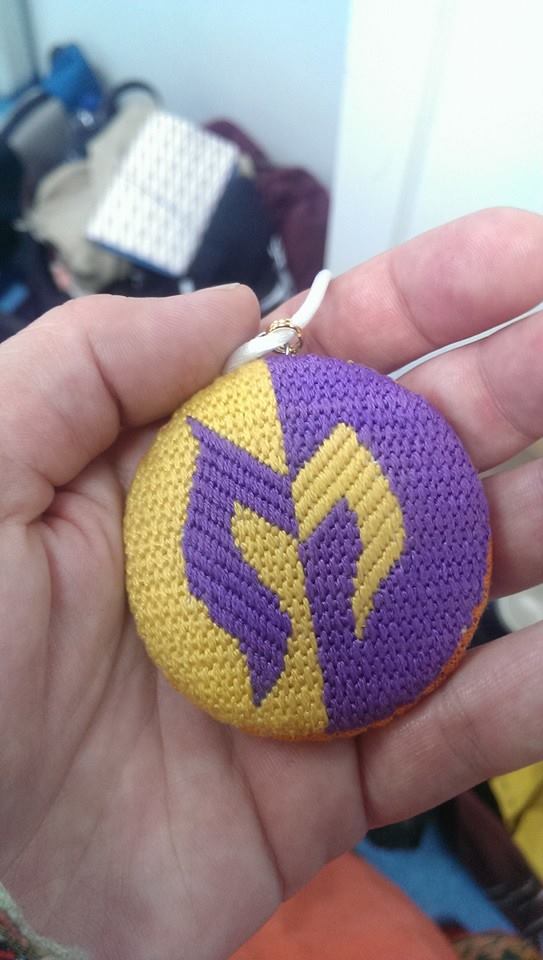
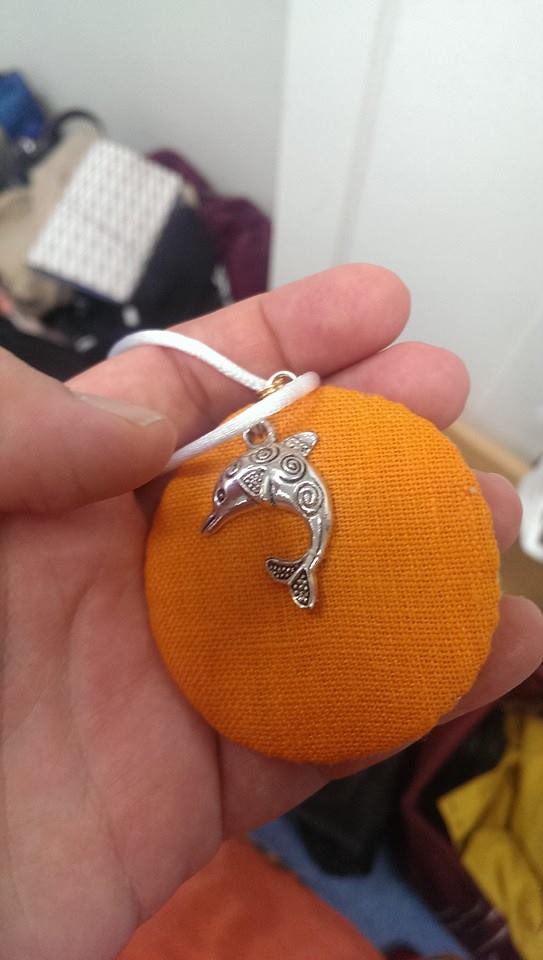
My scroll and wording, done by Mistress Nataliia Anastasiia Evgenova, who also did my AoA. The wording is based on The Alexiad.

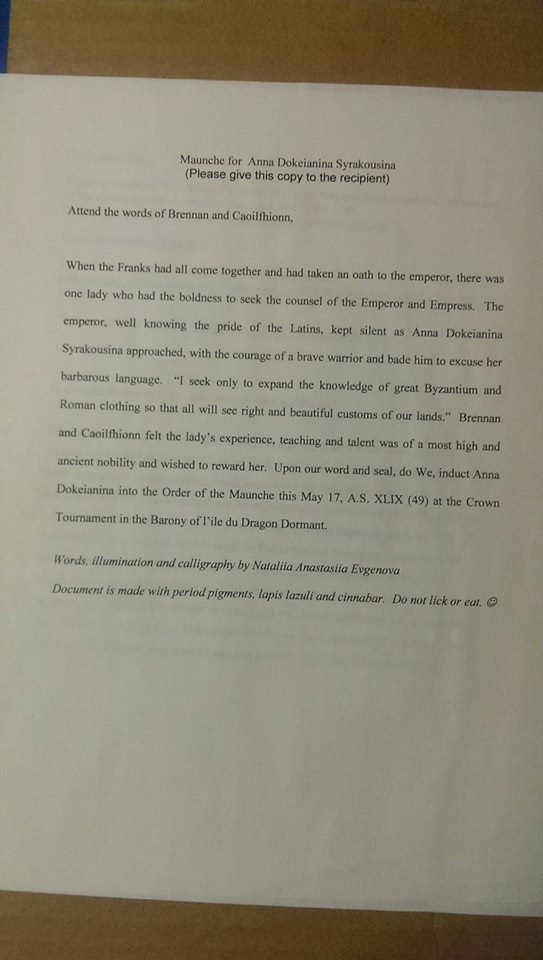
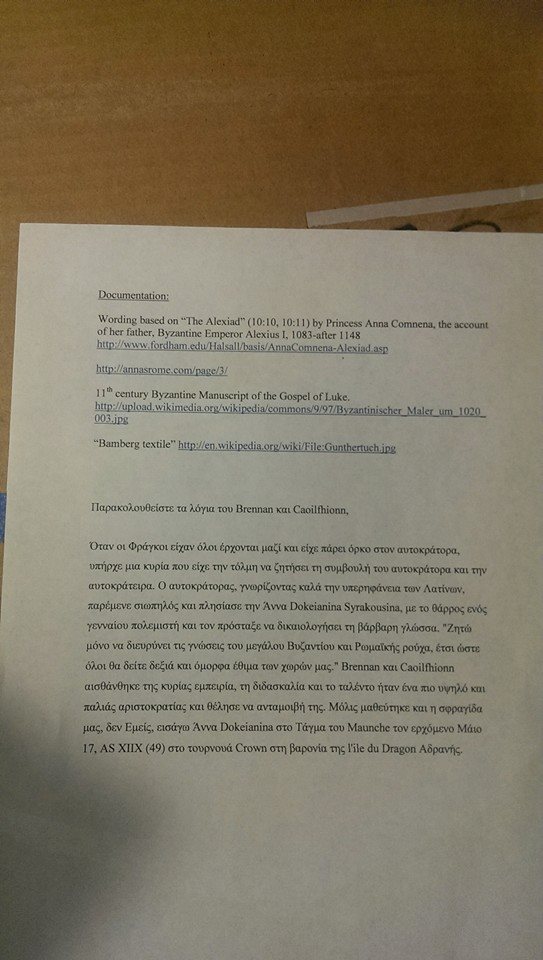
Well played, East Kingdom, well played…
I had the pleasure of attending a great new costuming symposium in the Midwest this last weekend: Figments and Filaments, in Independence, MO. It was certainly a long way from home, but worth the traveling. I’ve never been to Missouri, and I have plenty of friends in the Kansas City area who were more than happy to give me crash space. Naturally, fellow Byzanteamster Konstantia Kaleothina was my host, and with our powers combined with Andrixos, we were the Byzanteam! Taking the fashion show by storm!

I taught 2 classes: My Historical Costuming for Cosplayers one, and my 2 hour long Roman dress one, and we actually got to the Byzantine part, hurray!

I also took the train there and back, you know, to do something different (and it was cheaper.) I will definitely take the train long distance again. That was fun, and everybody should do it at least once.
I have so much wonderful things to say about this convention, I don’t even know where to start. Yes, it was small, and it was its first year, but it ran well, and everyone seemed to have had a really great time. Even this slightly aggressive Easterner. 😉 They want me back for next year, so I’ll be planning that return trip shortly.
Check out their website at Figmentsandfilaments.com, and the respective Facebook groups and pages.
Since I had so much time on my hands on the train, I stared at the Bamberg Textile again for a while, and now another blog is cooking while I start planning to turn a piece of red-orange linen into a short stola. Mwahahaha.
 Anna's New Rome
You must be logged in to post a comment.