In more of my pre-Pennsic Procrastination, additional thoughts have chopped their way into, “gee, I should be sewing right now” time.
Namely, this:
No! I mean THIS:
That is the shade of what is known as Tyrian, or Murex Purple. The imperial purple of Rome. As you can see, it is NOT indigo, it’s closer to a magenta-red, and it’s actually quite nice.
This was brought up because right now I have enough free linen points over at Fabrics-store.com to do some damage, and wildcherry, a color similar to this purple is on sale. This put me in a conundrum. Do I spend the money and being haughty and make a lovely purple piece of garbery, or, do I let it slide and stay within my persona? The East Kingdom has no sumptuary laws, especially when it comes to the wearing of colors, so I could wear this without any issue on the game side of of things. However, on the Anna side of things is where I question it. Would my persona be in the purple? As an imperial with the rank of lady, it’s likely I could have afforded it, and sumptuary laws did change over time to make it more available…IF you could afford it.
However, I feel like the wearing of purple, to me, as a Romanian (Byzantine), is being presumptuous in rank. If I was bestowed the gift of purple from someone of a higher station, that’s different. If someone won crown for me (highly unlikely situation) then well, yes, definitely. But the purchasing, sewing, and wearing of a purple garment would make me feel like I cheated. Yes, even though I hold the rank of lady, and I have seen period imagery of ranked women wearing SOME purple in their embellishment, they were never clad in it fully like the actual emperor and empress. So even though I may hold a position that allows me to wear it, and I could probably afford the dye, I would limit my purple to embellishment only, rather that entire garments.
Instead, I will play with words. Purpura, in both Latin and Greek, is a funny word. It means both purple AND red, so it’s hard to assume which color was being worn unless modifiers are being given, which they sometimes aren’t. And a good red color, like kermes derived from crushing little insects into dye, was just as expensive as milking murex snails. So I will gladly spend all of my persona’s invisible money on quality crimson and not feel like I’m placing myself higher than I should be while still dressing as a diva. 😉 Problem SOLVED. HOMERUN!
This of course doesn’t mean a thing outside of my own persona and kingdom. If you want to wear purple, and can wear the purple, rock that purple.
This last weekend at Palio, and on Facebook, I’ve been asked on what’s the best way to clothe thyself for 2 weeks of camping on the Allegheny. After my last couple Pennsics, I’ve started to create a system of clothing that works for me. I used to bring everything I own, which ensured not running out of clean clothes, but I realized I was still wearing a lot of the same things over again in rotation than wearing, well, everything, so this is what I’ve been contemplating. Note that everybody has their own unique system, and there’s no real right or wrong way to do Pennsic, okay, well, there’s plenty of wrong ways, but here’s assuming everyone comes prepared. The only way you’ll really figure out what works for you is trial and error.
In the Anna Method, you have 3 categories of Pennsic garb, not including the mandatory outerwear like cloaks because you’ll need one: 1: Court/Nice event garb. 2. Casual stuff. 3: Camp slop. Some things will carry over a bit depending on the day, how hot, how cold, etc. I always go for the full 2 weeks, so I tend to need more. The issue is that a lot of my stuff takes up some bulk, and there’s only so much room in the car. Space Bags are a wonderful invention and help a lot, but it’s not infallible to reduce space once you get there. So rather than bringing everything in your closet, put more thought into what you’re actually going to wear.
For example, here’s my thought process:
Court wear: No bliaut, it drags on the ground. Turkish has pants, good for cooler party nights, Bamberger Gunthertuch outfit is a yes, bring the gold dalmatica just in case and also something to bead on. Ghawazee coat outfit for hitting the Bog with. No apron dress this year, focus on being in persona.
Casual wear (remember this stuff can double for court wear if conditions are questionable): Blue beaded Byz, Rose Byz, Blue chiton, white chiton for layering, blue stola, rust peplos and Northern Army peplos. Green faux silk chiton if layered over white only because it sticks to my skin like ew. Beige tunic dress and sideless surcoat. Sari and choli for when it’s oppressive and you have to go to court…
Camp slop: Make 2 new Party Saxons (what I call ugly plaid bog dresses) since you gave some to a friend, flannel tunic dress, maybe one more of those for chilly nights, ugly cotton tunic dress with the short sleeves, purple pants, tank tops for grunt work. Sleep dresses.
Shoes: Flip flops, Crocs (you can hose them off, BIG.) Roman sandals, China flats, fight boots.
Outerwear: Cloak, Birka coat, Skaramangion if finished.
Now, this isn’t everything that will be on my final list, but it gives an idea of how I try to mentally place my garb, and reduce my bulk, and there’s also things that I can share with Geoffrey, though I tend to prefer dresses over pant or braies. There’s some camp garb I won’t leave camp in, and there’s some I will stroll around the merchants in if I don’t particularly care who I run into, which is often. This is my vacation, and if you can’t deal with seeing me at my worst, you don’t deserve to see me at my best. I’ll be honest, there are days in camp I just need to put on mundane yoga pants and hide from the world. There are days when I’m just in a tank top and a broomstick skirt, and 99% of the time, I’m barefoot. This is okay, your camp is your space, and your tent is your house. Wear what makes you feel relaxed and comfortable, but still able to do the necessary chores.
Now, the number one consideration isn’t the amount that you bring, it’s planning for what Pennsic will throw at you weather-wise. As somebody who lives in New England, where we are fortunate enough to have all 4 seasons, we tend to plan for all the weathers. Not everyone in the country has seasons, and as someone who grew up in the balmy tropics of Florida, I know half the stuff I wear up here wouldn’t see the light of day down there. You need to be prepared for the extremes, I am not kidding. My first Pennsic, it rained the entire time. It’s been over 100 degrees and dry, there have been tornadoes and microbursts that can severely damage camps, and there can be bitterly cold nights that result in frost on the grass. The majority of the time, you can expect warm temperatures in the 80s and 90s, with a consistent chance of rain. Wet and dry conditions result in lots of mud and dust. The sight is usually good about helping control the dust levels by wetting the roads, but mud is unavoidable, and the ground is saturated in natural iron that gives everything a staining rusty tinge that’s impossible to get out of garb. This is where you need to plan well.
My persona is high Byzantine. I’d be damned if I’m going to wear one of my white tunicae after a rainstorm. Nope. No way. I highly applaud the folks who dress in their persona the entire time, especially the women in late period, because your balls are bigger than mine. I have no qualms with being a slob if it means saving my good clothing. This is why I wear a lot of classical Roman in the summer to begin with. That, and I tend to get very warm in long sleeves.
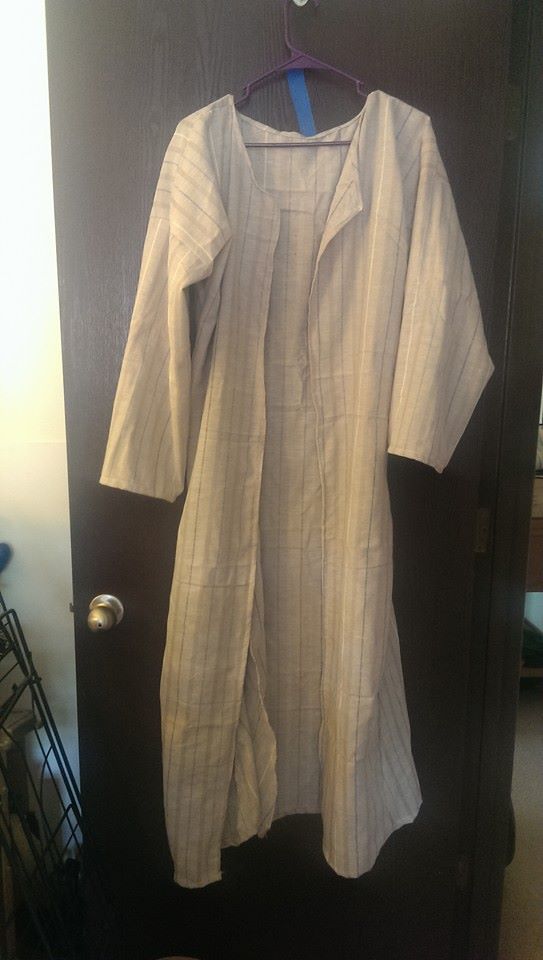
Another thing to consider greatly is your sensitivity to the sun. I’m blessed with Italian and Black Irish (Irish folks descending from the moors and Iberian Celts) heritage, so I tan well and have a lower risk for sunburn. Therefore, exposed arms and legs aren’t as dangerous to me as say, my Lord Geoffrey, who is as Northern European as the white cliffs of Dover. So where I can go as Roman or in generic bog dress #42, he has to cover. He’s a Norman persona anyway, so this helps, but we’ve also decided to put him in generic Middle Eastern kaftans made from ugly striped linen like this:
Make an oversized T-tunic with the front split. Done. Instant coverup “kaftan”.
Because he can still wear short sleeves under it, as well as straight pants with sandals to control body temperature, without sacrificing his skin to Helios. Sunblock is still needed, of course, but not by the gallon.
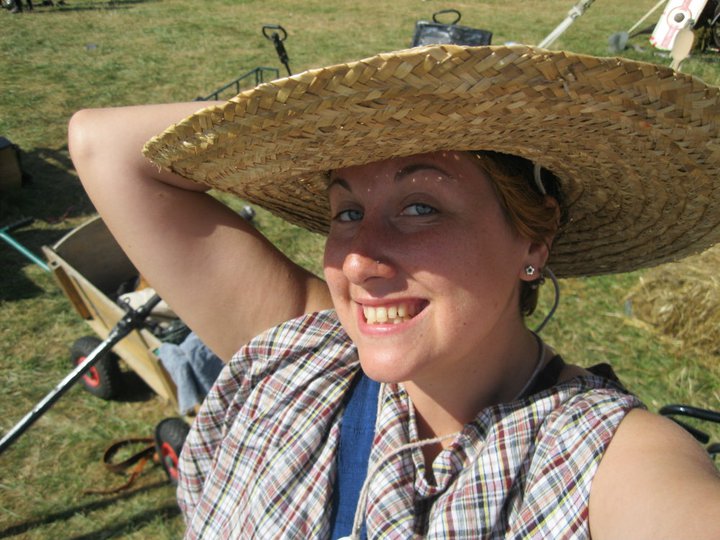
Also, hat. All the hats. If not a hat, then a veil or some sort of cap. Not only is it period, but it’s period for a reason: Your face and your scalp are going to cook. They sell big straw hats at war for about $5 each. They will last you the event, and you’ll look goofy, but it’s better than sun poisoning on your noggin and helps eliminate the need for sunglasses.
Here I am waterbearing at Pennsic XL: Ugly Bog Dress and floppy hat.
Garb “hacks”:
Here’s some ways to “cheat” at garb for Pennsic to make it a more affordable and comfortable experience.
-Sew/purchase your garb in natural fibers only. That means linen, wool, and cotton. Linen above all, because it will keep you cool, keep you warm, take a beating and wash well. Wool will keep you warm but doesn’t wash as well. Cotton is good depending on the weave, but it won’t take a beating. Quilting broadcloth is garbage, avoid it if you can and spend the money on better quality fabrics like homespun cottons, or, you know, linen. However, flannel tunics are a great way to have snuggly warm dresses and tunics for the chilly nights in camp
-Bandeau bras under bog dresses and classical garb. I got a pack of them from Amazon for like $15. No straps, and tight enough support to hold the girls in without the dreaded Roman sideboob. I have a 36D bra size and they still fit.
-Shorts. Yes, ladies, I’m looking at you. Not everyone has a thigh gap, and I myself am an accomplished victor of chub rub chafing which ruined a war for me. You need bike shorts or compression shorts under your dresses. You could make short braies, also, which I’ve done, but seriously…protect your thighs. Shorts and Gold Bond after a shower. Don’t ignore this advice. I’ve also heard that Body Glide is a great product to help with this (and under the boobs) as well as an antiperspirant, which doesn’t work for me. Ripping up your thighs is a great way to ruin your event.
-PJ pants. This is a great way for guys (and ladies!) To have legwear for cooler nights and days without wearing jeans or making tons of pants. They’re usually cheap at stores like Target and come in colors and all sorts of fun plaids that could pass off as something Celtic or Viking, even though everybody knows you’re in PJs, because a lot of people do it. These make great “camp slop” for when you want to save your nice stripey pants for a higher profile day. Scrub pants can also work, but don’t wear blue scrubs, that’s what the Cooper’s staff wears.
-Crocs. I think they’re ugly, too, but after I watched campmates hose off their shoes after a muddy night and before they got in the car to go home, I became a believer. My winter boots are Crocs, and they’ve worn lots of mud here in the spring events. Plus, Crocs come in other styles that aren’t so…Croc-like. This doesn’t mean don’t bring better shoes for nights you want to go out, or for court and such, but after I’ve destroyed, and I do mean DESTROYED, flip flops and China flats at war, I’d rather just invest in these ugly things and have my feet look like duck’s feet if I can hose them off.
-Buy packs of underwear and socks when you get there, you’re going to need these because you may throw out more pairs of socks than you think. I don’t care how much you pack from home, BUY MORE.
-Leave a bag of clean mundane clothing, shoes, and undies in the car. You’ll thank me later.
Okay, what the heck is a Bog Dress?
A bog dress is a peplos, plain and simple. Just like the Romans made them. They were worn throughout Bronze Age and Iron Age Europe and they’re an excellent way to make cheap hot weather garb. I separate my Roman dresses from bog dresses by calling them my Party Saxons, mostly because I’m wanton to pick out the most horrific plaid homespun cottons at Joann’s for them and blinding my camp. This of course, isn’t necessary, and I’m just not terribly a nice person. 🙂 I do recommend making them out of the homespuns though, even if they’re horrific, because you’re only paying $4 a yard, don’t need much fabric, and if they get wrecked beyond a washing machine or repair, oops, into the dumpster they go. You can also make them shorter and feel like Artemis for those extra sloggy days.
There’s a couple different ways to make them, usually you’ll see the traditional style with the flaps in the front and back, but I’m starting to move away from that and just making a tube to pin at the shoulders to conserve fabric, as my Roman ones take up the entire bolt width and cut lengths. I also found this great pattern by Alfrun online, and she pleats the tops to make it more fitted and use less fabric. I’m going to try this style for this year’s war: http://awanderingelf.weebly.com/a-wandering-elfs-journey/sca-standards-the-bog-dress
But what about stuff other than garb?
I have a friend of mine who I camp with who has done this way more than I have. So quite a few years ago, she made a site, called Pennsic 101, that will get you through the basics. It is dated and does go back to before cellphones were the norm, but it’s still a great starting point.
So as you can see, there’s no shortage of information out there to help newcomers. I hope I was at least able to give an idea on how to plan your clothing.
This weekend is my [new] barony’s annual Palio, or civic competition. Stonemarche is broken up into 3 rival contrade, or districts, that compete in games and tournament to determine a winner. Originally, I wasn’t planning on going, since this weekend has always been reserved for Vinland Raids down on Cape Cod. Unfortunately that event is on hiatus, so, off to Palio di Stonemarche to roll some cheese we go!
Then I thought, “I should wear something red and yellow for the Hippocampo Contrada!” And figure I had some stuff that would work.
…and then I basically got garb challenged. I had 2 weeks to make a new outfit for this event. Ugh, why do I get myself into these things?! So I settled on 16th century Italian working class pretty quickly. Because I’m broke, I pillaged my old garb piles, and decided to kill the old red stola I had that was way too big and I never wore anyway. This would be my dress material. I found an old chunk of blackworked cotton from when I actually pretended to be Late Period for a while, and some white linen for sleeves and…
+ =
Nailed it.
I kind of feel like Ronald McDonald, but considering it was thrown together from a box of scraps and bias tape, I can’t complain. The pattern drafting instructions I had from my collected old notes back from when my persona WAS 16th Century working class Italian that I never did anything with, and I finally made a damn Campi-style dress. Not without tons of flaws, mind you, considering the materials at hand, and I probably wouldn’t have done it at all if it wasn’t for the fact that my machine has an automated buttonhole feature. Other then that, after I got through the hiccups of fitting the bodice, the rest went together insanely easily. The camicia’s collar is also just white hem facing. Hey, I did say, “box of scraps” didn’t I? The skirt isn’t as full as it should be, but it’s not as slim as it appears in the pic, either. I’m also glad that 2 layers of linen and some interfacing in the front is apparently enough to control my figure without boning or a heavier interlining.
At least I can wear this again next year at the event! And once I do move back south, I plan to give the dress to the barony so another can enjoy it.
I basically just sewed what I saw. I’m sure there’s more tailoring that should be going into this, but this isn’t for an A&S project, or persona development, this was made for 100% fun, unlike my orange traffic cone, which took me almost a month’s worth of work and did require some actual research. But still, this is what happens when I get challenged to make garb. I am the reason why we can’t have nice things.
Here’s some other pics circa 1580’s I used for reference:
Rolled Sleeves:
Front lacing:
Blackworked camicia:
That’s 2 late period outfits in a year, as opposed to when I claimed to be late period, and had like, none. Wow, Anna. WOW.
I do have some much more interesting Byzantine stuff coming up soon. I just need to get through my rush at work before Pennsic, my Pennsic classes, and whatever other curveballs before I start posting more research relevant to the site. Until then, enjoy my ghetto fabulous Italian Ren dress.
So I was able to get some calcium carbonate (natural chalk) from a brewing supply store, and decided to, you know, put it on my face with the other questionable materials I’ve been using.
DISCLAIMER: NOT APPROVED BY THE FDA, NOT APPROVED FOR COSMETICS, YADDA YADDA CANCERFACE YADDA YADDA DO THIS AT YOUR OWN RISK.
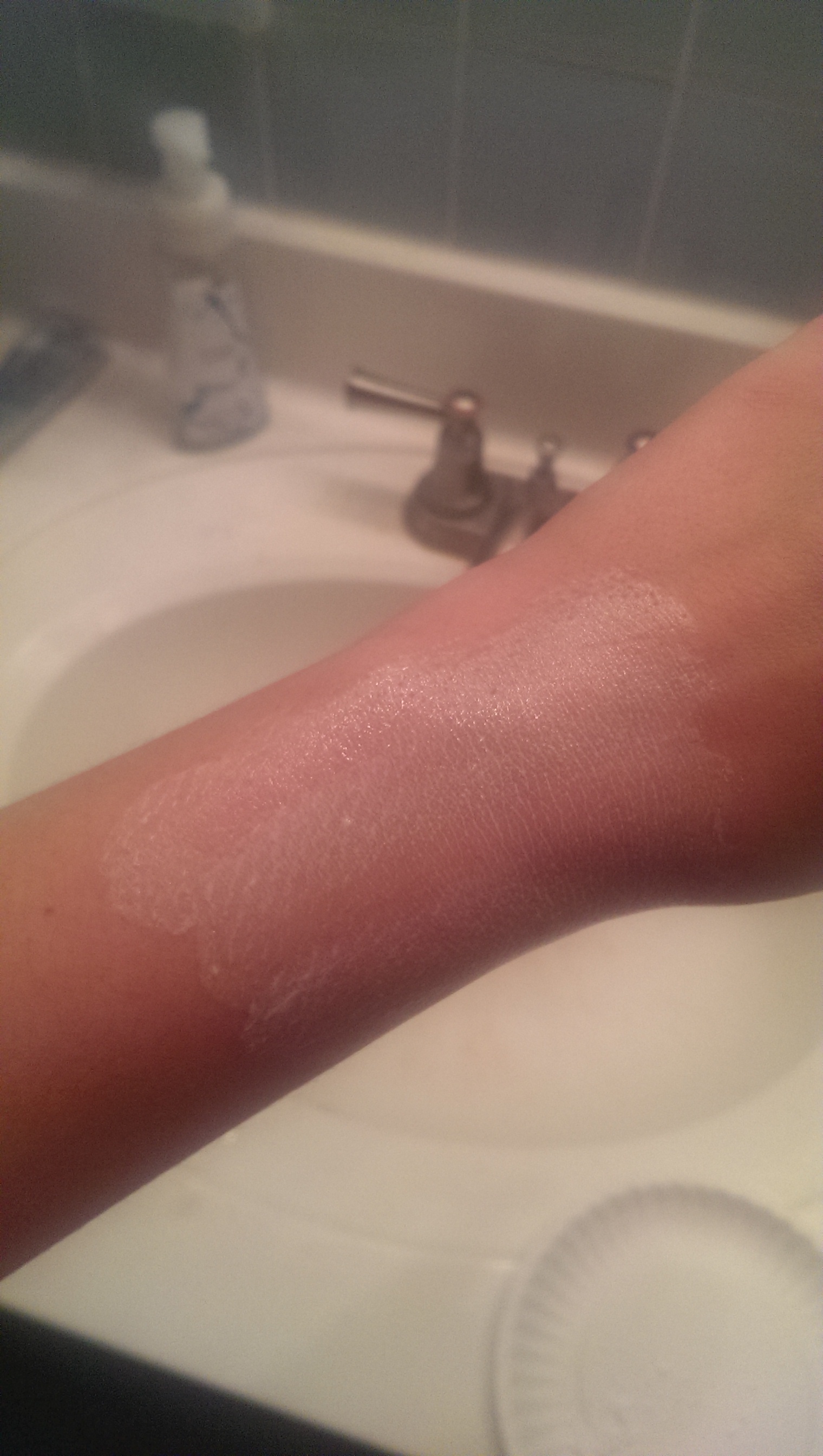
Okay, so…the article I’m using as a basis for this starter kit said that the chalk was mixed with vinegar. So, I raided my kitchen for white wine vinegar that I typically use to make sekanjabin or oxymel, and combined the two in a plastic cup. This immediately caused the fizzies due to the reaction of the acetic acid releasing the carbon, much like what would happen with sodium bicarbonate (baking soda) but not nearly as explosive. This intrigued me and worried me, but it seemed too thin, so I added more chalk to get a paste that was more reminiscent of a modern liquid foundation. I slathered it on my arm for a patch test, and let it dry. It didn’t look so bad or cause a reaction, so…
…I slathered it on my face… As you can see, it was a bit…paste-like, and didn’t blend well. It clung to every wrinkle and scar or zit on my face, and I immediately remembered I was in my 30s. So I washed it off with soap and water and it came off quite easily. (Note, it’s not in my hair, that’s my Rogue stripe.)
So I thinned the paste with more vinegar, and got a more powdery, fast drying finish. It was still lightening my skin, but not the consistency of glue.
Quickly, it was evident that thin layers would do the trick. It’s not an emulsion like a modern foundation, and therefore the mineral can be displaced and clump easily, as you can see on my eyebrow and cheek. I did apply it with a modern cosmetics brush as well, so I need to do more research into period applicators, that should also help.
Well, there was only thing left to do: PUT THE WHOLE FACE ON. I went lighter on the red ochre this time, since I haven’t yet made my balm for it as planned. I should do that, oh, tonight.
I applied the lamp black to my eyebrows and as eyeliner using the olive oil mixture from my first post. (I also patch tested this. ALWAYS PATCH TEST!) I went a bit crazy with it on the eyebrows, I need better brushes to tone it down. Eyeliner was done by toothpick.
This side was a bit heavier, and I look even less glamorous:
Of course, now I had to take this stuff OFF. Modern soap and water worked fine for the chalk and the ochre, but the carbon?
.
.
. Not so much. (I had to.)
I was able to remove it using the olive oil mixture it was applied with, to a point, and then with a non-oil based modern makeup remover, which helped but wasn’t great. The oil is needed to break up the black. It’s very staining, and I wasn’t able to remove it completely, so I think a modern oil-based remover would do the job nicely.
So, I now have the beginnings of a basic Roman makeup kit which should make my A&S display this weekend at Palio di Stonemarche an interesting one. I hope to have something more to show come Pennsic.
A pigment used for blush and lip stain from Egypt through Byzantium was red ochre. This is a very safe, non-toxic pigment that is derived naturally from iron oxide (rust) and hematite. It’s been used in artwork since the cave paintings in France, so we know it’s been around for a very long time, so use in cosmetics would make sense.
Like I mentioned, it was used as a blush, and a lip gloss. The Roman women were known for going a bit…overboard with their rouge, so sayeth Martial, who was convinced their faces would melt. Well, here’s my face, complete with annoying duck face (I HAD TO) slathered in rust. Really. Note my bathroom light for whatever reason makes my black hair look purple. It is not. It is black, but other than the the pigment looks correct.
This is 100% natural red ochre pigment that I use for my icons from Earth Pigments. I applied it to my face using a modern angled blush brush.
My right cheek I applied the pigment straight on with knocking the brush a couple times to remove excess. The resulted in…OH MY GOD. ORANGE CHEEK, with next to no fall out.
My left cheek I used the brush after I had used it on my right, and it gave a nice bronzing effect. This would have been a lovely healthy glow that I think the Egyptians prized, but Roman ladies apparently were a bit more bold with their color usage.
I applied the pigment to my lips using a Q-tip soaked in olive oil. The pigment still dried my lips out quickly, but it did not burn.
I assume once I get the chalk and vinegar face paste on there, it will look even more ridiculous. I will be making that up once I find powdered calcium carbonate, which is true chalk, versus the gypsum chalkboard “chalk” used today. I should be able to locate it in a vitamin store or a brew store.
I’ve decided that since my Kingdom thought I was good enough to get a Maunche (and I got to write OM after my name on a class handout coming up. WEIRD!) I needed to step up my game and get down and dirty. Since I’m really good at making a mess, I decided to jump into the dangerous, but interesting world of ROMAN COSMETICS.
Here it is, my disclaimer: What I do here is at my own risk. Please, for the love of Hades and all that is holy, do not try this at home if you feel that you may react to any of these cosmetics or their contents make you feel unsafe. Although I am working with non-toxic ingredients, some of them can be a bit scary.
The Romans (in this case, we are including the Byzantines, as they SHOULD be included) were fond of personal hygiene and their appearance, so there’s a great deal of information on what they used for makeup, face creams, depilatories, and the like, so it’s something I’ve been kicking around for a bit. After talking a bit with Mistress Aife who has done similar things with Irish cosmetics, I decided, “Oh hell, why not? As long as it’s not lead and mercury I should be fiiiiiiiine.”
So I decided to start with the famous kohl eyeliner that was all the rage in the Levantine civilizations, and the early 1990’s. I’m a pretty heavy eyeliner wearer when I DO wear makeup (see also, 1990’s) so I always have some on when I have court garb on, but if I want to be authentic, I should take the next step.
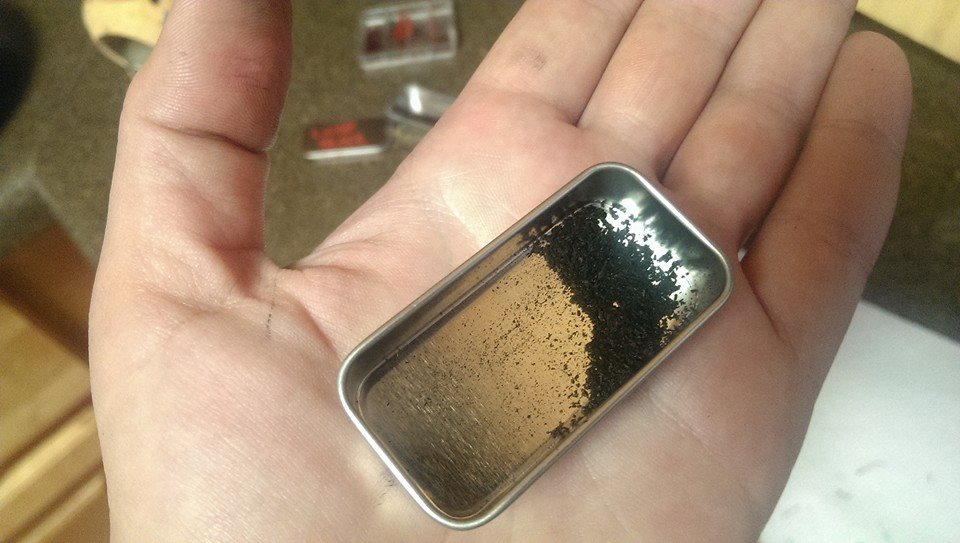
For the most part, kohl was made (and is still made in some countries) with galena, which is lead sulfide. This is baaaaaad. So, I looked for alternatives. Immediately, I found that both in period and in modern preparations, lamp black is used with some sort of medium to spread it on the eyes. In Roman times, this is a scented oil or water, and in modern times, it’s ghee, a clarified butter. So, here I was getting all excited about this fun new exciting way to make sexy eyeliner when my med school friend Margaret down in Meridies nearly beheaded me on my Facebook page. Come to find out, soot and lamp black have something called polycyclic aromatic hydrocarbons, and these such things are a carcinogen. Who knew? She did, and then I got a bummer, but I was determined to make some anyway for science and display purposes. I have no intention of putting this stuff on my face, but I needed to find an alternative. So, in some skimming today of a couple of articles, I found that they also used charcoals and ashes, basically anything that could smear black. Saffron was suggested, and I happened to have some I could, well, reasonably part with. So I made 3 batches of kohl, lamp black, willow charcoal, and saffron ash, and a scented oil carrier that’s simply olive oil with a few drops of frankinscense and myrrh. Here are my observations:
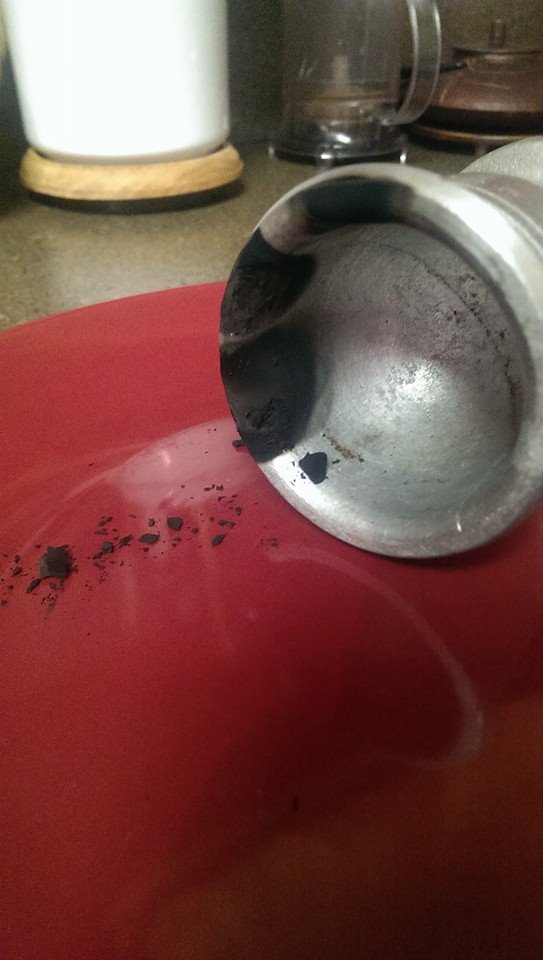
Lamp black: This stuff is great. If it wasn’t for the fact it could give me cancerface (that’s a thing now, I just made it up) I would rock this. Why? It’s smooth and already somewhat creamy from the oil content from my burning lamp. It made a beautifully dark line on my wrist that didn’t wash off easily. I’m really tempted to use it on my eyes, just once, but my better judgement is getting the best of me. As you can see, I used my Roman lamp from Claybaby Pottery, with a wick I braided myself out of fustian and olive oil, and collected the soot in a lead-free pewter mortar.
Willow charcoal: I have lots of charcoal sticks around the house, so I picked one from a natural source and got to smash it up in a mortar and pestle. This was great fun and a great mess. I wish I could grind it a bit better, but it did give me a decent line once I got the balance between kohl and oil down. Easy, readily available ingredients that are affordable, and charcoal eyeliners are already prevalent in the modern market. And one stick of charcoal filled my tin. I’ll have eyeliner forever! I want to try to apply this using modern eyeliner brush and water.
Saffron ashes: I was hoping this would be better, I really did. I need to figure out a better way to carbonize the saffron, because at first I tried to burn it on an incense burner/oil warmer. That didn’t work well, though my house smelled lovely. So I resorted to just getting impatient and setting it on fire with my lighter in a metal jar lid. This burned it, and I was able to get ash from it, but it does not carry well as a liner at all. It was suggested by both Geoffrey and a friend on the Romans of the SCA page to treat it as if I was making charcloth. So basically, I need to put it in a metal container and bake it until it turns to ashes. Yes, I’m basically cremating saffron…I’m going to need to buy more I’m not afraid to waste for this project to do this. The bit I burned did not yield much.
Here’s a picture of my filthy arm, top to bottom is lamp black, saffron, and charcoal:
I will be re-trying the saffron kohl sometime this week, as well as making my face whitener and blush. Once I conclude this project I’ll provide a list of sources I’ve compiled.
As frequent readers may recall, I have a post here entitled, “The Illusive Dover Dress Debunked.” Wherein I was determined to set the record straight from badly interpreted secondary source material using the primary source. I have created what I think is the look portrayed in the silk fragment. At least the start, anyway. Let’s review.
Here’s the look most often emulated in the SCA:
Which was taken from this interpretational sketch from the 1980’s:
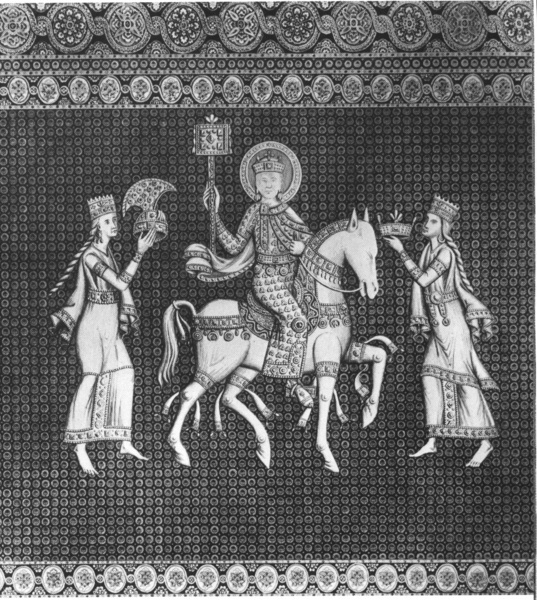
Here’s the actual source:
Here’s the Anna, zoning off as Queen’s Guard (hence rose baldric) at Crown Tourney (I was so tired.):
Yes, it’s a very simple style to emulate. I often wonder if Elizabethan personae come to my page and sneer at my untailored, baggy linen glory. 😉 However, lets see if we can break this down and determine what we’re looking at, and how I did.
First, the women portrayed in the tapestry are both Tyche, the goddess of fortune and prosperity, taking on the shape of the Blue and Green Demoi, the two main political associations in the Eastern Roman Empire. They are supporting a figure that seems to be Emperor John I Tzimiskes on his triumph over Bulgaria in the late 10th Century.
The women are first and foremost, deities. Even though the Byzantines were extremely pious Orthodox Christians, they were proud of their Hellenistic and Roman roots, and often displayed images from classical mythology and literature as part of their way to connect themselves to the splendor of the ancient empires.
The dead giveaway on the divinity of the subject is that they are barefoot. In the Greco-Roman culture, only the divine could be portrayed as barefoot. That does not mean that people could not and did not go barefoot in real life, but as far as artistic record goes, this was reserved for the gods. I am not barefoot for a few reasons. 1: I am a high lady of the court. Barefoot would mean I couldn’t afford shoes. 2: It was Crown Tourney, ew, gross. I am actually wear a pair of red China flats, since red shoes were all the rage for women during the period. One day, I will make nice, period shoes, but I digress…
Another odd observation is that they have bare arms and appear to be wearing cuffs of some sort. This boggles me. The Blue is wearing a tunica that appears to be almost-flesh colored, but the Green, in her minty green tunica, definitely has bare arms. What I have determined off the cuff (*rimshot*) is that this is another classical throwback, or, the weaver really screwed up. Screwing up is period, we see it all the time, which would make some sense. I don’t understand the placement of the cuffs on the arm when they look like trim that matches the garments. If you’ve ever worn a wide cuff on the upper arm, you know how uncomfortable they can be. However, to me, the dead giveaway that this was an error is if you look at the woven pattern on the wrists of both demoi, you see that the trim matches that of their tunicae. Jewelry wouldn’t match embroidery, and their headwear doesn’t match their dresses, and they’re both different. I suppose the only way to really tell is to see the textile in person, which will probably never happen unless I get to go frolic about cathedrals in Germany sometime soon.
EDIT 5-21-14: I did find this small scan of a book about the textile, and it looks like there may be a touch of green left on her shoulder, so fading could also be a culprit.
Of course, if this WAS intentional, my guess would be that the artist was trying to emulate the sleeveless fashions of the classical period.
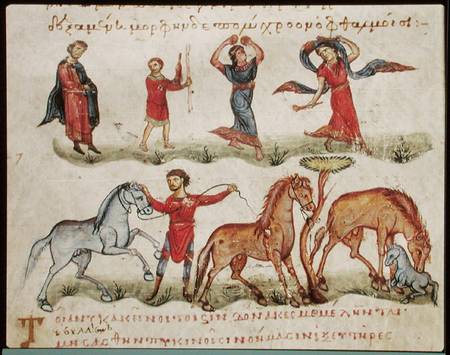
Or, they could be dancers. I’ve seen a great deal of sleeveless “Byzantine Dancer” interpretations in the SCA and other re-creation groups around on the web, but I did find this image from the Paris Psalter very quickly on Wikipedia with a fast search. This also dates to the 10th Century and has connections to Basil II/John I Tzimiskes period as the textile.
From Wikipedia, “David Glorified by the Women of Israel.”
These women are definitely dancers, and the painted style of this is most interesting in the layering of the colors. They are definitely wearing what could be considered the classical stola on it’s own, and the men are wearing the clothing of Late Antiquity and do look more Western Roman rather than Byzantine. This is a curious piece to work from as far as clothing styles go. However, looking directly at the women, you can tell the dresses are one piece and woven or dyed into different colors, and the actively dancing woman is still wearing some sort of sandal on her feet, so she’s not totally barefoot like the demoi are. However, the sleeveless style is there for a dancer. This link that shows a modern woman reenactor gives a source as being in the Biblioteca Marciana, or the Library of St. Mark’s in Venice. I went to check it out on the Biblioteca Marciana digital library, but the back-end of their Java encoding is broken, and couldn’t view their manuscripts, not to mention the reference given is so vague, I’m unsure of which manuscript it’s actually in.
EDIT 5-21-2014: somebody on the SCA Garb Page on Facebook has found it for me, HURRAY!
Those dancers may be similar, but the lack of ornamentation, and the weird flounces at the bottom of the skirt don’t mesh with the Tyches in the tapestry.
My big red X over this hypothesis is that the job of a dancer in the Byzantine Empire was THE LOWEST OF THE LOW. They did have court dances, and ritual dances, but for entertainment purposes, especially the showing of the arms and legs? You’re a harlot. Plain and simple. This is seem all too well in the opinion Procopius had of the Empress Theodora in his “Secret History.” Granted, he was a bit of a gossiper, but she was portrayed as the absolute dregs of society before she was married to Justinian. This was not a wanted profession. Why would 2 images of a divine person be dressed as dancers? That sounds insulting to the goddess Tyche. It would be almost satirical in nature for the demoi (remember, political parties) to be dressed as such, but not in the way that the silk is portrayed. They’re supporting figures for a conquering emperor, and not there as jokes.
For now, I will stick with the idea that the sleeveless-appearing Green Tyche was done in error on the weaver’s part, considering the Blue Tyche has the cream colored tunica. If it is an attempt at classical Roman revival, the stola should be to the floor, as the two layer look is strictly a Byzantine fashion style. The weaver was emulating Byzantine fashion, not Roman.
Moving onto discussing my interpretation, I created the stola from about 3 yards of red-orange linen. As shown in my previous post on this style, the Byzantine woman’s stola would have looked similar to the Roman stola (see my Ancient Roman costuming page for more info on that) but closer in cut to the men’s Roman tunica, as seen in this Coptic example:
I opted to play with this idea with the “pinching” method of the Roman stola, that is, bringing in the top seam a bit to achieve straps, and provide a more comfortable neckline. The textile shows the women wearing a relatively high neck, as opposed to the deep V-necked style of antiquity. Easy enough. The trick of course is to fit the neck to yourself over and over again with pins to get the look you want. Here is the illustration of mine:
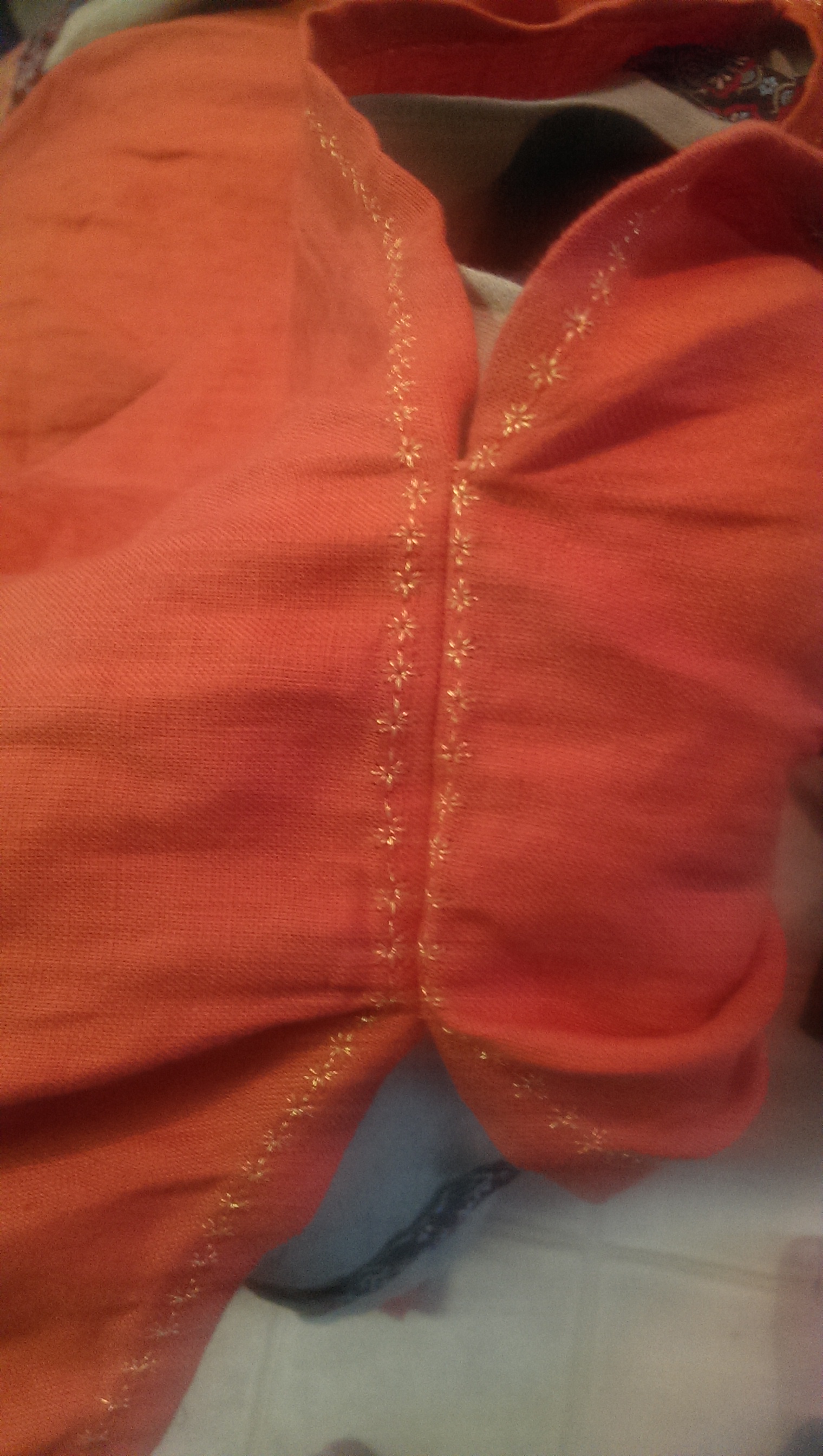
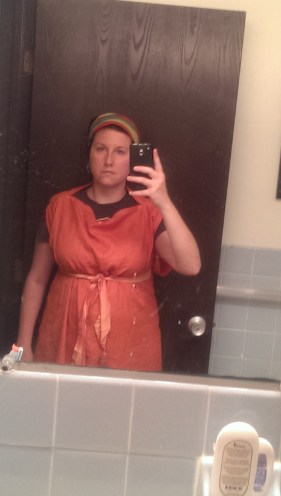
Here’s some pictures of the finished product to help give a better understanding, you can see how I already finished the neck and shoulders before I attached the straps. The embroidery is done by machine and I’m just a fan of that aesthetic. Similar bands are shown in some artwork, but I just wanted a little bling. Also, pardon the icky bathroom mirror:
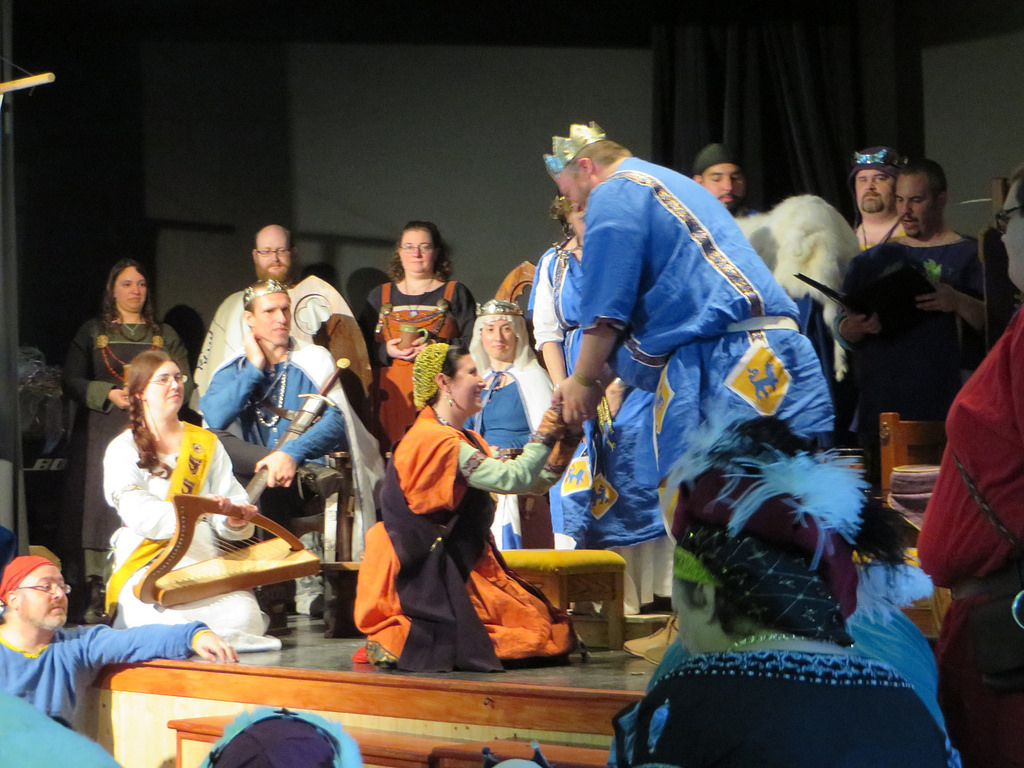
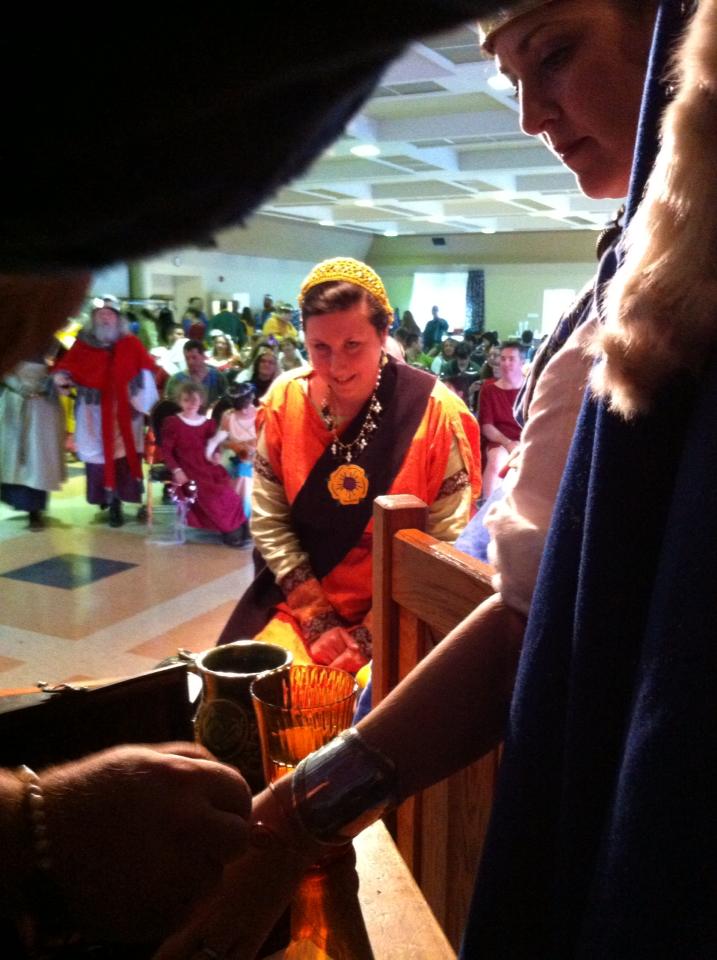
And here’s an action shot of me receiving my Maunche, which I was actually happy to see so I could see how the sleeve openings looked, and they look comparatively well against the original source material. There is no large gap as shown in the Dover artwork at the top, and the draping against my shoulders looks fantastic and flattering. If I would have left the fabric any wider, it would have been frumpy, and any smaller it would have been too tight. So 40″ wide is the magic number for me and stolas. Your mileage will vary depending on the person.
I guess the next thing on my list is to make a tunica with the solid stripe in the front as opposed to the clavii, and take pictures with my turret hat and a palla in such a way that mimics Tyche. I still love my overdramatic dalmatica style of the 11th Century, but this is a comfortable option for warmer events, and it was relatively warm indoors. Hence the lack of hat and palla. I did have it with me, but they made me toasty. It’s also hard to guard thy queen while being immobilized by your garb. 😉
It’s pretty much safe to say that this particular short stola was worn from the period of Justinian and Theodora in the 6th Century as seen in the Ravenna mosaics, and through the 10th Century as seen in the Bamberger Gunthertuch.
From Ravenna: Possibly stolas, possibly tighter dalmaticae, the hems are tucked up, not cut on an angle.
I hope this little simple project of mine helped those who were scratching their heads over the Dover illustrations. I feel that this is the correct form of the garment worn, and that more women will be interested in trying this unique style of the Byzantines. 🙂
Although I do have substantive posts actually planned, I suppose I reserve the right to brag that yesterday at Crown Tourney in the Montreal area, I was inducted into the Order of the Maunche, which is the highest honor given in the East Kingdom in arts and sciences. I received it for my research and teaching of Roman and Byzantine clothing.
I was so tired at court (seriously guzzled coffee as fast as possible before I stood watch as Queen’s Guard) that I apparently didn’t show much emotion, but I do remember going, “Ahhhh, I can kneel for a bit.” Priorities. -.- So, for those that were like, “Wow, she seems out of it.” I kind of was, but I was very excited, and still am. Thank you all for the recognition, and I hope to do my best to represent the order. 🙂
An official #betweenthethronesie by Ryan McWhyte. Har. Oh hey look, my Bamberger Gunthertuch stola.
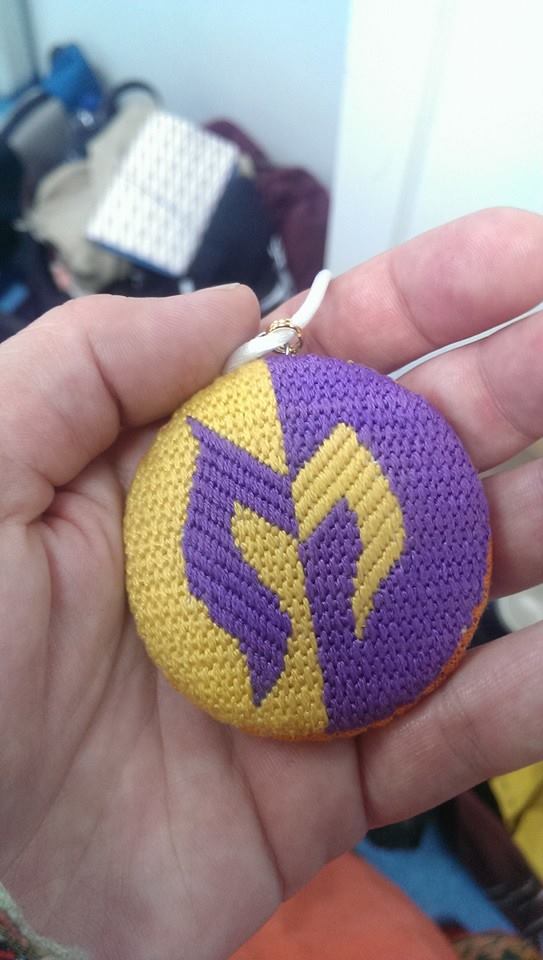
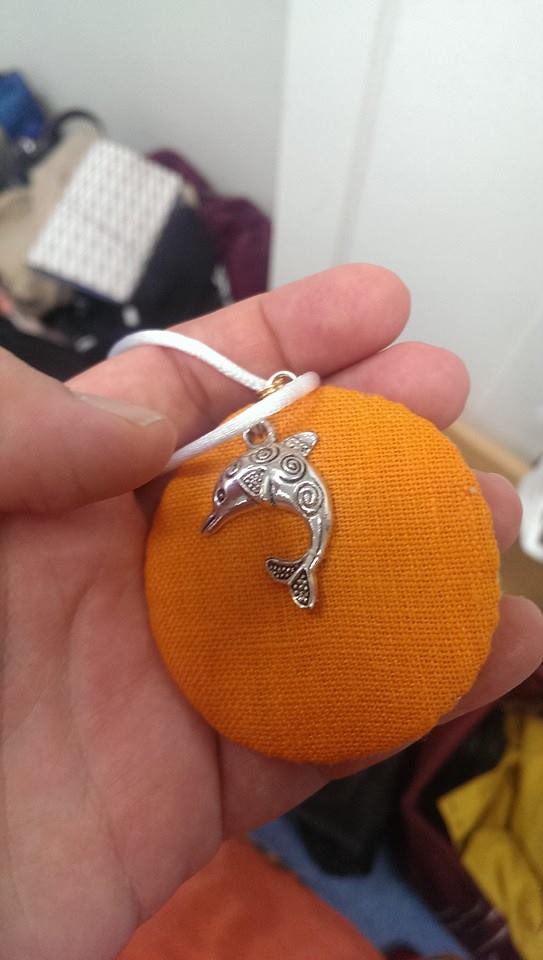
My medallion, made by my laurel, Mistress Clotilde von der Insel…which was backed with the orange fabric leftover from my Bucs dress. That was carefully acquired (see also: asked for) by Geoffrey, and snuck down to Rhode Island. EVIL!
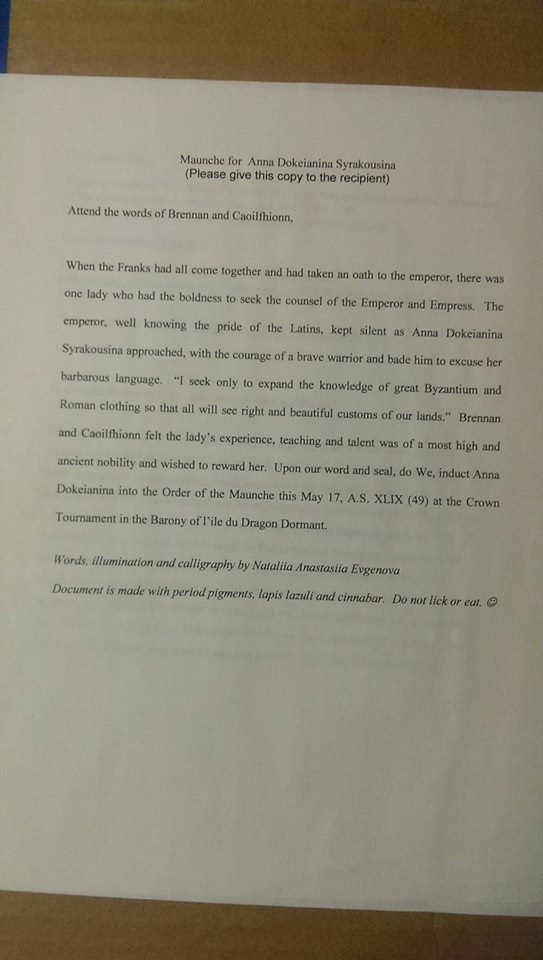
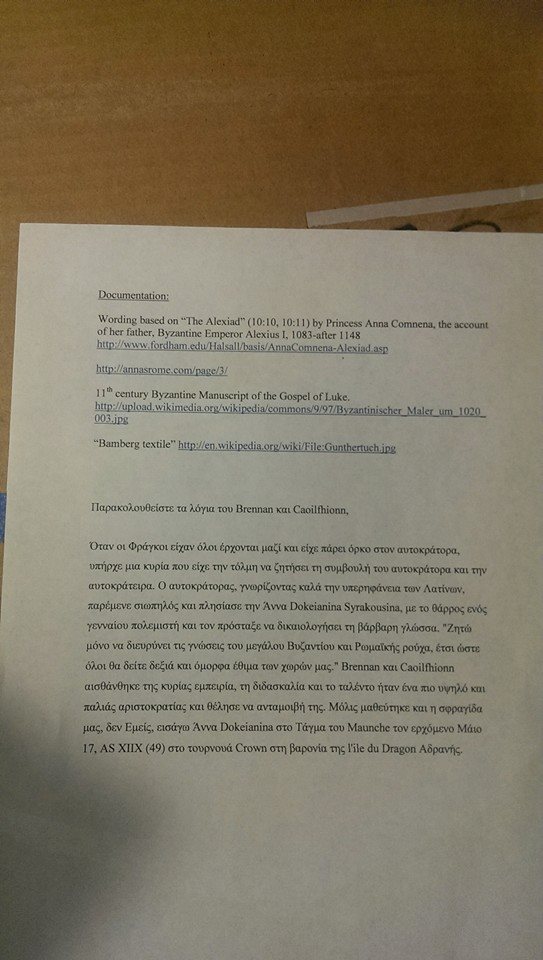
My scroll and wording, done by Mistress Nataliia Anastasiia Evgenova, who also did my AoA. The wording is based on The Alexiad.
I entered the historical reenactment costume contest over at Fabrics-Store.com, which has taken more of my money than I care to mention. Please, if you have the time…every day…for the next 16 days…to vote for my entries once per day, please do!
There’s a great deal that I could say about what goes on behind the scenes at events. I’m unsure how in-depth other kingdoms go, but here in the East, we like to be rather grandiose with coronations. I’ve autocratted royal progress events before, but I’ve never really been apart of the research and development strike team, so to speak, so this is a summarized post of my experience working on the spring coronation here in the East Kingdom.
Several months ago, I was approached by Master Steffan ap Kennydd about aiding him in designing a unique coronation ordo for the incoming heirs. It was going to be wildly anachronistic, as we were replacing 7th Century Saxons with 1st Century Romano-Hibernians, and I agreed, knowing that this could be a lot of fun.
I’m not too well-versed in early Irish culture, in fact, the Romans did not really interact with the Hibernians that often, and described them as basically crazy, so I knew that this was going to be tricky. Initially, I was brought in to help Steffan with the Latin, and things ballooned from there. We needed a story, we needed a good reason for Kenric II to abdicate, because court schtick is the best schtick. This involved a secret Facebook group, a Google document, and a conference call. Lots of discussion was had to be able to pull this together between about 8 people. @_@
Since Kenric II is the cousin of the martyred Kenric I, who was killed mysteriously by an archer bearing black arrows, visions of this sainted king have been plaguing his cousin. We had the benefit of working with 3 very superstitious cultures, so this was going to work. It would be far-fetched and as anachronistic as we could muster transitioning smoothly between time periods without a TARDIS, but this was going to rock.
Mistress Aife was brought in to help with the Irish, and I focused on the Roman. What else could we do to make this work? Steffan came up with the idea of taking it a dark route, and bringing in seers to proclaim Kenric’s doom during court. Aife wrote up a doom as follows, that we translated into Gaelic and Latin:
“King of the East! I speak your wyrd.
I see it in the flight of birds,
in the rising smoke, in the curling clouds.
King of the East, I speak your wyrd.
The wolf is coming, cloaked in splendor.
The eagles scream above his stride.
King of the East, I speak your wyrd.
The pale horse falls from the high place,
the victorious wolf hard at his heels.
King of the East, I speak your wyrd.
The three pale moons crowned by courage
are swallowed by the shadow of the wolf bearing the eagle.
King of the East, your wyrd is spoken.”
“Wyrd” from what I understand, is a very Anglo-Saxon concept, so is the white horse. The Irish revered wolves, while the Saxons found them to be bad omens. In this case, the wolf is also in Brennan’s arms, so it worked. The Eagle of course, is Rome. So Brennan essentially became, “The wolf bearing the eagle.” The “three pale moons” are Kenric’s arms. It’s vague, it’s spooky, and it was perfect.
Steffan and I translated it into Latin, and this was the result:
“Rex Orientis, fatum tuum dico.
Video in volatum avum, in fumo oriente, in nubibus volventibus.
Rex Orientis, fatum tuum dico.
Lupus venit, palliatus fulgore. Aquilae clangunt super passibus suis.
Rex Orientis, fatum tuum dico.
Equus albus descendit de loco alto, lupo victorioso vincendo.
Rex Orientis, fatum tuum dico.
Tres lunae pallidae virtute coronatae umbra lupi aquilam ferentis voratae sunt.
Rex Orientis, fatum tuum dictum est!”
This was more of a geek-fest for us rather than everyone else, but we enjoyed it.
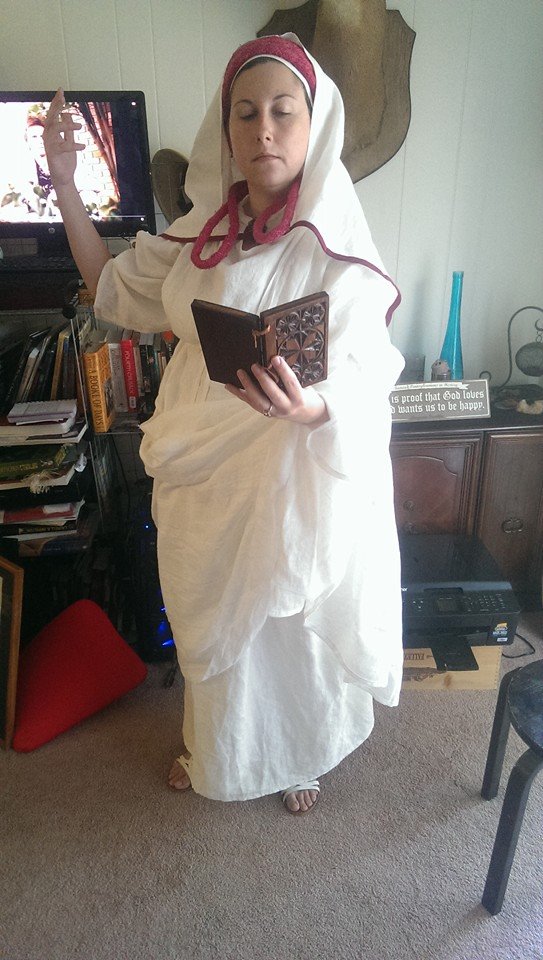
Next came the performance aspect. Aife and myself were conscripted into duty as the seeresses, and I took on the role of a Vestal Virgin, the most well-known and recognizable Roman priestess. I’m hardly virginal material *cough* but for the day, it would be well worth the project.
Vestal garb is relatively simple, with some twists. I reached out to Maestra Julia Sempronia of An Tir, who had recently received her Laurel while donning the robes of the Vestal, and she was a great source of help, as well as others from the Romans of the SCA Facebook page.
In addition to wearing all white, the most important part of the Vestal was the headwear, the infula (fillet) and suffibulum (veil.) Other than that, I needed white sandals, a white chiton, and a white palla. Those pretty much took care of themselves. However, I need to proudly display my sandals for a bit, because even though they’re modern, I found a pair that had a trinity knot as part of the design. So not only was I Roman, I was wearing what could be considered a rather Irish symbol, that could easily stand for all three cultures represented in the ceremony: Saxon, Irish, and Roman. Gods, I’m a NERD.
Back to the headwear. The infula was going to be the worst part. I needed to make funky round bands of funkiness in red, long enough to wrap around my head 5 times and have 2 loops over my shoulders. What I did on Maestra Julia’s suggestion was purchase cotton cording used to edge pillows, and dyed it red. It took me two dye baths to get it the right shade, and the dying process did leave the cotton looking a bit weathered and raggy, almost like felted wool. So I got the right look. It even faded just a bit like period red dyes do.
I posted this as-is on Facebook. Imagine the responses.
The final result:
I was still missing pieces to the puzzle. The infula slipped off of my short hair very easily, so I was reminded that I needed a vitta, or a plain white fillet to keep it in place. I simply cut and hemmed a small rectangle of white linen, and that did the job. Next was the suffibulum, or veil. This took a bit more troubleshooting than I thought it would. I needed to get the right shape to have it drape across my shoulders evenly. I tried a few rectangles, and then had a moment of pure “derp” when it was suggested by Domina Vestia on the Romans of the SCA page that it should be semi-circular. That did the trick. I trimmed it in deep reddish-purple bias tape, and made a brooch out of a huge shank button I found at Joann’s, and the headwear problem was solved.
I put together the whole kit, scared Lord Geoffrey, and made him take pictures:
Looks about right.
Of course, that was just the beginning, now the fun began. We had the words, we had the garb. I couldn’t memorize the lines entirely, so I cheated and taped them into my wax tablet. It did the job. Let’s spook the Eastern Populace.
Wyrd up.
But wait, there’s more!
You can’t have a victorious emperor of Rome come into court without showing off! It was my idea that Brennan and Caoilfhionn have a Triumph to begin their First Court. And although I couldn’t convince his Imperial Majesty to paint his face red, what resulted was an epic, and I do mean EPIC parade of regalia and pomp into court unlike anything I think the East has ever seen. Brennan paraded in after the kingdom champions, and I stood behind him, holding one of the Eastern crowns over his head, and chanting, “Respice post te, hominem te memento.” This translates to, “Look behind you and remember that you are but a man.” This was done typically by a slave with a laurel wreath, on the triumphator’s quadriga (4 horse chariot.) It reminded the emperor or general that they were still mortal, and not a god, and to control their hubris and pride. I have several reports that I gave members of the populace chills by doing this.
Her Imperial Majesty Caoilfhionn was carried in on a lectica, surrounded by the artifacts and relics of the East Kingdom, as well as amazing displays of heraldry as Roman vexillae. I missed the second half of the show because as soon as I got to the dais, I bolted to the royal room to change into less…conspicuous clothing so that I could enjoy court and be called upon as a member of the Queen’s Guard.
In closing, thank you everyone who came to Coronation and enjoyed our little performance. Thank you to their Majesties Brennan and Caoilfhionn, and their Graces Kenric and Avelina for playing along with our crazy idea. I’m looking forward to a nice, Roman summer. 🙂
Addendum: For those interested, here is the doom in Klingon. Generously translated by a poster on the Romans of the SCA Facebook page:


























 Anna's New Rome
You must be logged in to post a comment.