I managed to get back to the Met last month, and spend a whopping six hours there, never getting off the first floor. Again. Well, except for the Roman study rooms, but I digress. They have a really neat exhibit right now under the stairs in the Jaharis vault (where my favorite tunic was) that shows off some very cool painted liturgical linens from the late Roman/early Byzantine Egyptian period.
I’m going to start trying the technique, as it doesn’t look too daunting, it’s just egg tempera on linen, either pure white or dyed indigo. I figure if I can frame the fabric in an embroidery apparatus, it should work. As far as I know, the fabric wasn’t sized or gessoed prior to painting, at least it didn’t seem that way, so this could turn into a big mess. Should I succeed, I see a very nifty, period way to display heraldry indoors.
So I totally lied about doing updates over winter break. I am working on some sewing, but for the most part, I wanted to give my poor burned out brain some time to unwind after a particularly difficult semester.
Here’s a few important and interesting updates:
In June I will be relocating from the East Kingdom to the Kingdom of Caid. This will be a short-term relocation with an inevitable return to the East due to my husband’s naval career, but it will definitely affect my attendance at events to teach. I am planning on Pennsic this coming summer by flying into Pittsburgh, but I will NOT be at 50 Year. As much as I’d love to go, the timing with the move is making it impossible, and there is no way around this, as mundane life comes first. However, I am looking forward to infiltrating, I mean, attending, new events on the West Coast for the short period of time we will be out there. I will know more about schedules and such after the move and once my own employment is sorted out. Right now the ultimate goal is to secure temporary work as adjunct faculty within the San Diego Community College District, but there is no guarantee I will be offered a teaching appointment. But this blog isn’t about mundane stuffs…
The cool news is that this is the semester of The Thesis:
For my final project of my master’s degree, I am exploring the material culture of the Last Will and Testament of Kale Pakouriane, an 11th Century patrikia who entered a convent upon being widowed. I will be making a selection of her things.
MAKING THINGS. BYZANTINE THINGS. FOR THE SCHOOL LEARNIN’S.
I have not settled on which things yet, her inventory was impressive and I have three months. The primary goal of the project, in addition to making things, is actually attempting a reconstruction of her life from this inventory. This obviously includes her wealth, but also tangible goods, why she made the bequests that she did, and how class structure affected her decisions to leave lower household members with significant inheritances from her estate. I’m very excited about this project, and the bulk of my upcoming posts will be regarding this. I’m considering making a mundane blog for it, but I need to go over requirements with my academic committee first to see what they recommend. Either way, anything posted on a separate page will be mirrored here for the benefit of the SCA. Once completed, I’m going to submit it for publication in the form of a Compleat Anachronist.
I also have a short research paper on the Perception of Women during the Ancient Greek periods that will be published on the East Kingdom Gazette this week. Once that goes live, I will re-press it here.
I hope everybody is having a splendid New Year so far, and I look forward to sharing my progress on this epic project!
This is what happens when I catch a cold, miss an event, and decide to not do homework. When I’m sick, I get bored, and when I’m bored and hopped up on cold medicine, well…I needed to tinker.
Edited on 9-28-2015 to add finished pictures.
PROJECT ONE: WEAVING THINGS.
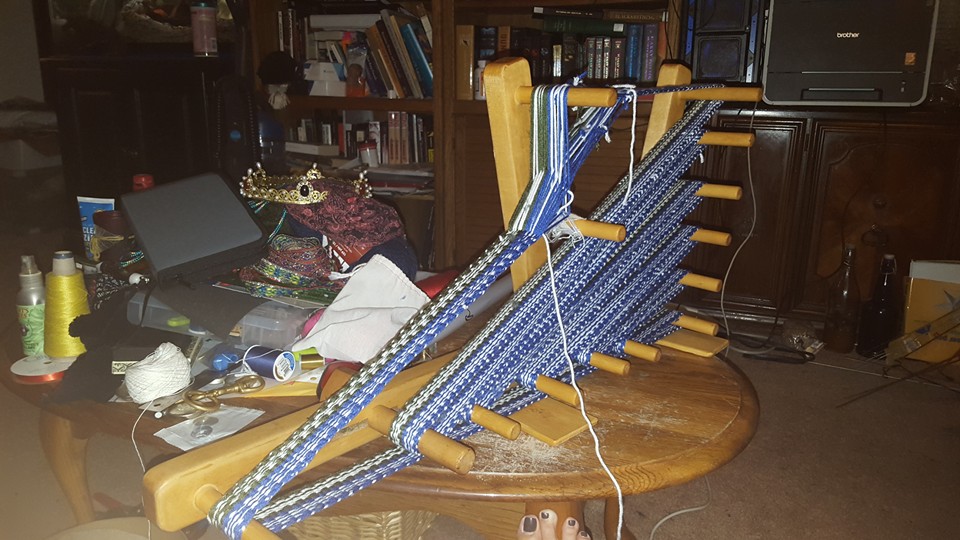
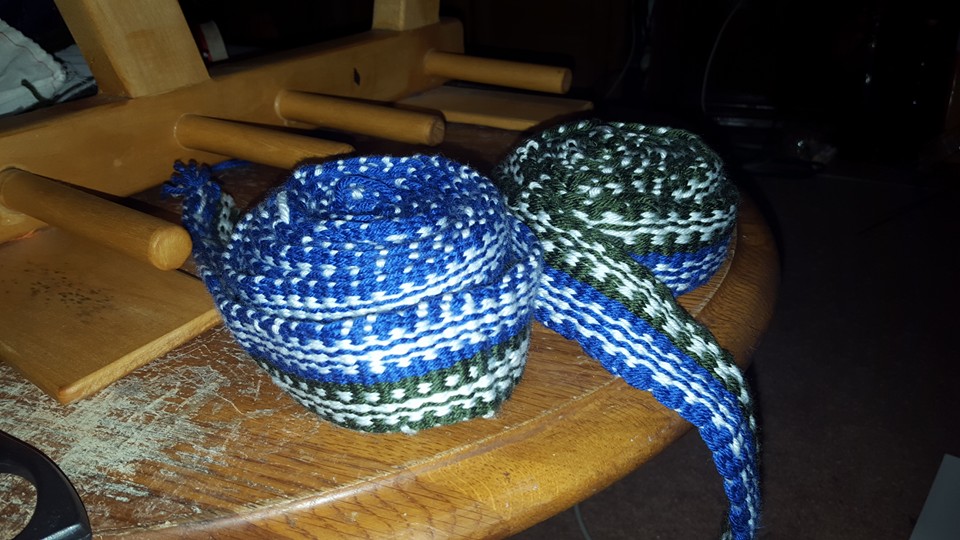
Well, I started by warping up the inkle loom and making the Norman husband a pair of leg wrappings in his heraldic colors. They’re pretty crappy in some places, and hence, leg wrappings, rather than trim. This is the first full 6 yard band I’ve ever made! Material is acrylic yarn, because I wanted them thick,washable, and low-cost in case of it turning into a cat toy. I did okay though, so now I’m more confident in trying wool yarns for the next batch. I finished this in a day. I warped it Saturday night and by Sunday night the band was complete. I was a MACHINE.
The pattern when I hit my stride.
FULL LOOM! And a coffee table full of craft supplies.
BOOM! A pair of leg wraps at 3 yards each, about 2.5″ wide.
PROJECT TWO: SHINY THINGS.
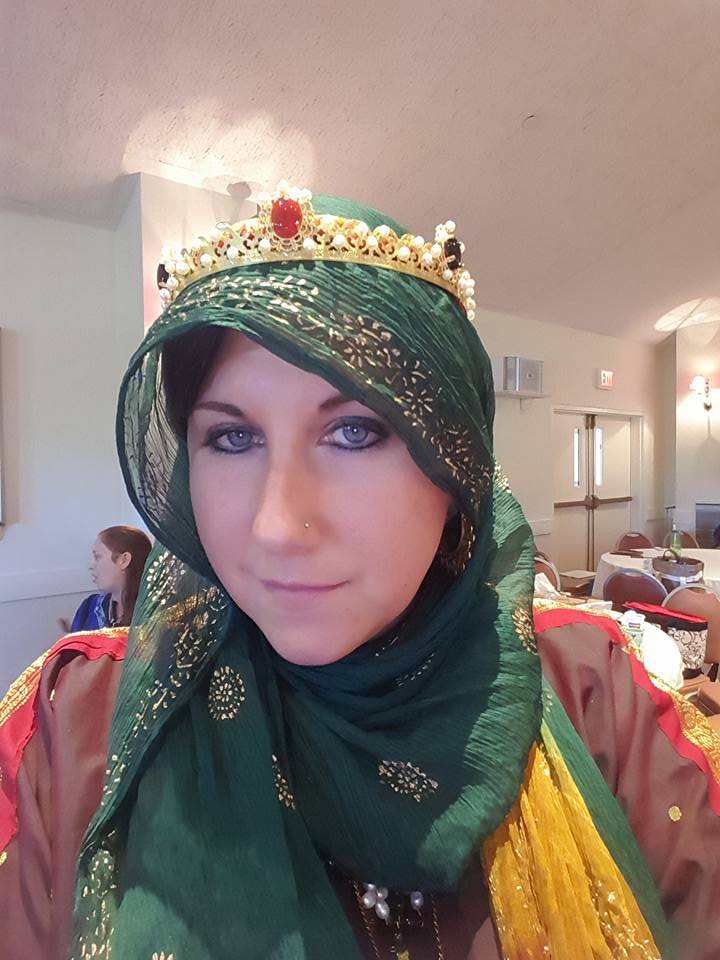
Oh yeah, see that coronet on the table? I made that too. Norman Husband challenged me to make a coronet with him out playing Navy. Him not around left with me NO METALWORKING SUPPLIES. So, I had to play, and go buy a new beading pliers set. And JB Weld. I could NOT have done this without clear 2-part epoxy. G-S Hypo Cement did not cut it except for gluing the band itself together and the cabochons onto the settings. It did not hold the settings onto the band. I’m still not 100% finished with it, when I am I’ll post finished pics.
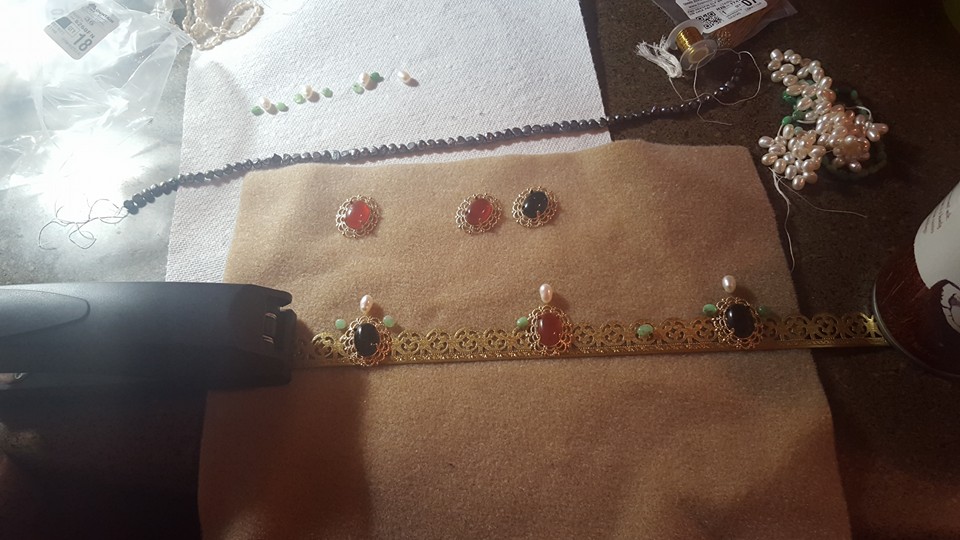
I set up a “coronet bar” on my kitchen counter, because it’s high enough for me to not hunch, and I have great lighting. Findings are just some vintage brass lamp banding and shiny bits from Fire Mountain. Stones are real carnelian and onyx, and pearls. Lots and lots of freshwater pearls. Not only very period, but also my heraldic colors.
Epoxying the cabs on the band.
It didn’t look so bad the way it was, but you know, Byzantine…
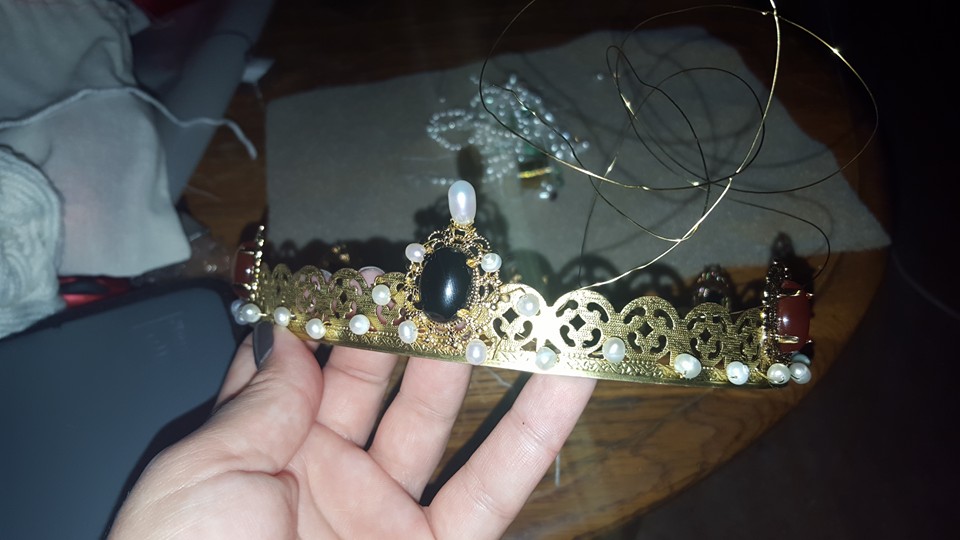
Lotsa Byzantine. I’m just attaching the pearls by weaving wire through openings in the brass.
I marathoned the original Star Wars Trilogy while I worked on this. It gives you an idea of how long it took. Here it is almost done with some Darth Vader.
Here it is on my head. I think the top pearls make it look too Western (boo hiss), so I’m going to cut them off, and replace them with round pearls. I could have gone WAY OVER THE TOP with this, and wanted to, but I was talked out of it, and I’m glad.
I added rings on each side near my temples for a pair of pendilla to hang from. I don’t have the pendilla made yet, and I don’t ALWAYS have to wear them.
Finished coronet as of one week after I made it, after removing the top pearls, replacing them with smaller ones, and lining it with orange velvet:
Notes after wearing for an event: Too much padding, it didn’t want to stay put. I know coronets are jewelry and not a headband, but still. I’m going to try a different method before I wear it next. Also, I got a lot of compliments on my veil. All it is, is a green/yellow/red ombre dyed Indian dupatta. It still smells like batik. I wrapped it and tucked it into my belt in the front based on some icons and manuscripts I’ve seen.
No, using vintage lamp brass and epoxy aren’t exactly period techniques, but it creates the illusion for now until Norman Husband completes the Hagia Sophia of Coronets he’s promising me. Plus, this is dainty and clocking in at 1 3/4″ at the tallest, so it works for periods I wear that AREN’T Byzantine. I’m not a jeweler, and especially not a hat maker, so even three days later my hands are KILLING ME.
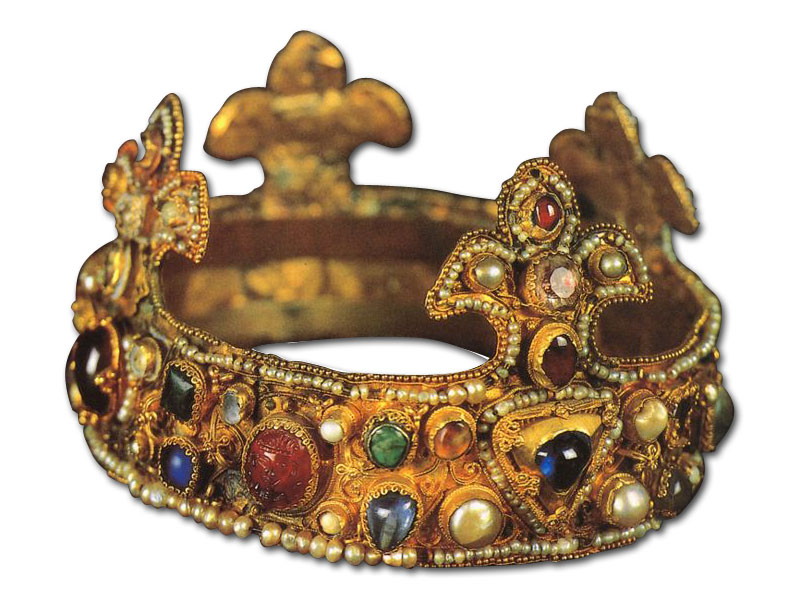
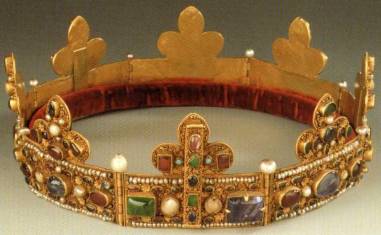
Here’s a couple of Byzantine crowns that I pulled some [vague] inspiration from. They didn’t always wear votive crowns and massive tall hinged plaque things of doom.
PROJECT THREE: MODIFYING THINGS.
And last but not least, OMG SHOES.
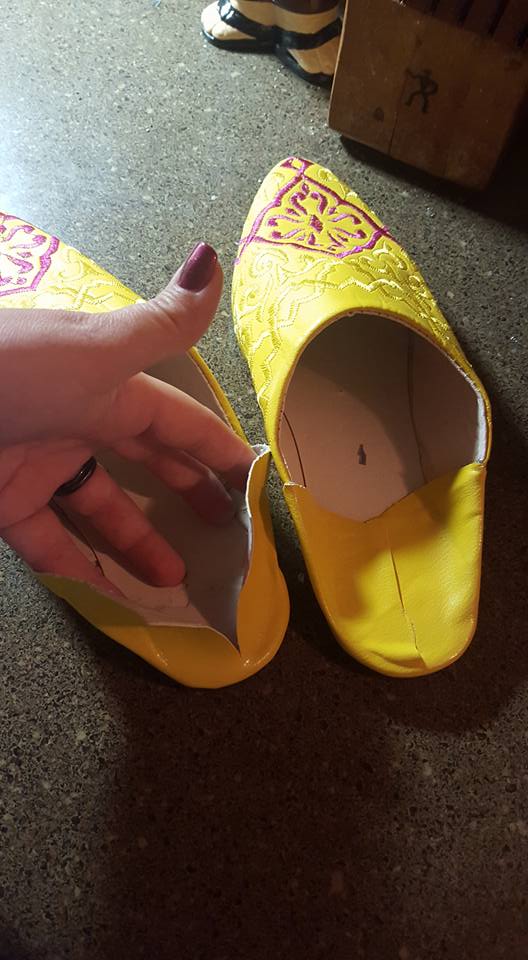
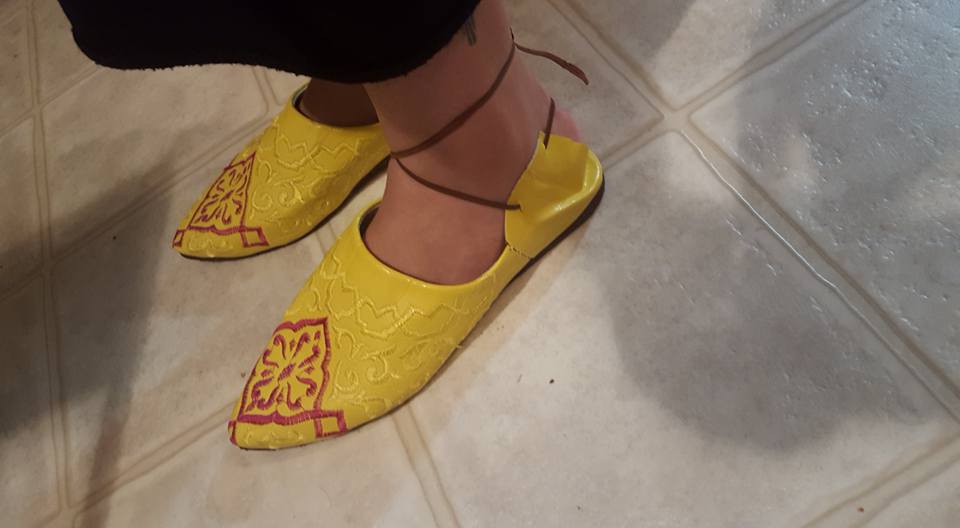
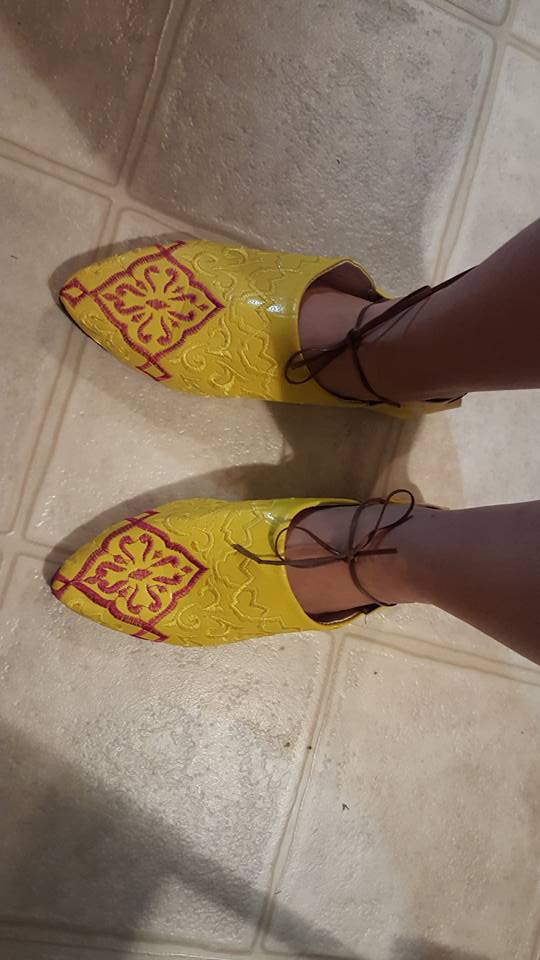
If you read my previous post, I made a blurb about what color shoes are appropriate for a Byzantine persona. As a court baroness, I could get away with yellow, so, I wanted to see if I could invest in a pair of proper Eastern looking shoes. Unfortunately, most medieval cordwainers don’t make Byzantine or Middle Eastern shoes (that’s a hint, folks) so I had to improvise. I hate HATE HATE wearing Pakistani/Indian Khussa, because they eat my feet alive. Even if I shower with them on, or wet my feet, they just never break in, and rip me up. That’s no fun. So some searches yielded Moroccan Babouches. These are actually pretty perfect, except that they’re backless. Now, extant mules have been found, and are still worn in Turkey today, but I hate backless shoes, mostly because as you can see in these pics, my feet and ankles are very narrow. It makes mundane boot shopping a crappy experience when the material just pools around my ankles.
I found these super awesome embroidered babouches on Etsy. They look very…Calontir.
I ripped the backs up to find that they’re designed in a way that you cannot fit your foot in comfortably, so, I split them down the back.
Cut holes with scissors on cutting board, because husband brought leather tools with him while playing Navy. Find random leather strap in his leftover stuff, and lace.
Experiment with lacing.
Walk around and immediately get blister.
Tie them in the front. Ah, that’s better.
Side view, they don’t look horrible. However, taking pics of your own feet is kind of tricky.
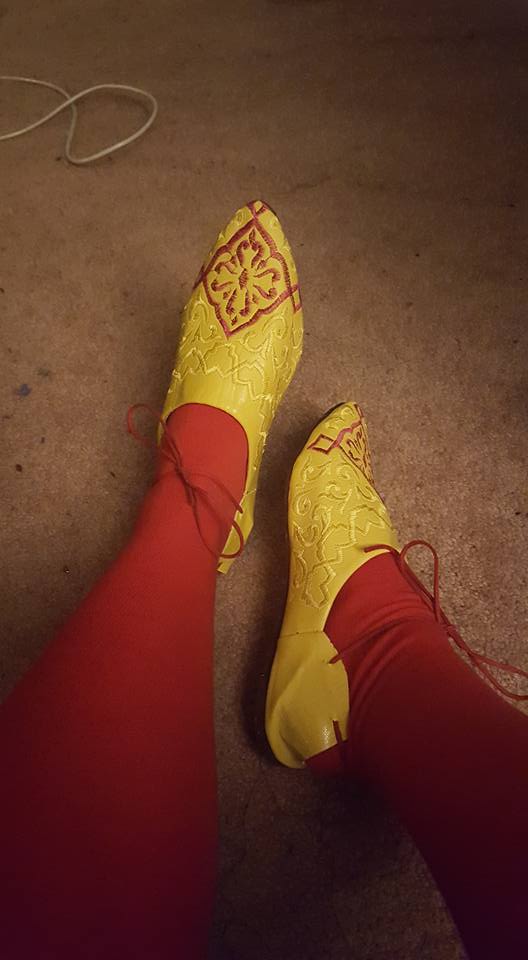
Shoes with better lacing and my red stockings:
I just felt so damn sassy.
Period shoes that gave me this horrible idea:
We called these the “Byzantine Chuck Taylors” on Facebook. No, the backs aren’t open. I know. I know. I IMPROVISED, OKAY?
A pair of Byzantine Mules dated to 300-700 from Panopolis. Here’s that backless option for those that aren’t afraid of flat tires and don’t have feet that fall out of everything like I do.
The ones I made are clearly going to be “inside event” shoes. I’ll wear them with stockings in hopes to combat some of that extra width while the lacing will stop my feet from falling out. The best part that is if I want to, I can pull the lacing out of my shoes and flatten the backs again into mules.
Again, like the coronet, I’m creating an illusion from modern materials. Once I’m done with my master’s degree and move across the country, I’ll have time to work on making an actual pair of period leather shoes with gold leafing that WON’T be too wide for my feet and involve kitchen surgery. And maybe I’ll learn some metalworking so I can help my husband in making a proper hinged 11th Century coronet, but until then, it doesn’t hurt to use your imagination in the little game we play.
Oh red shoes. Byzantines and red shoes. Wear ALL the red shoes, but…should we be wearing the red shoes?
In the SCA, we’re all playing nobility, but we still have a hierarchy. Granted, it’s nothing like a true feudal system, but we still have ranks and titles that come with it certain privileges in dress. A knight or master of arms is a fine example with their right to wear a white belt or baldric. In the case of the Eastern Romans, shoes played a huge part in who you were and what job you did.
Red shoes are imperial in nature. Done. Story over.
This is me getting my dreams shattered.
This started because I was pondering joining the Red Shoe Club under the urgings of a duchess friend from Artemisia. Prompted for documentation that women wore them, I turned to my favorite, expensive source on the matter: Reconstructing the Reality of Images by Maria Parani. (Best $300 I ever spent on one book.) I seriously refer to it as my Book of Armaments.
Oh Lord, bless this my book of Byzantine goodness so that I may dress snazzily, with thy mercy!
Parani pulls no punches in that she states that documentation for women wearing the red shoes is scarce (pg. 30.). I have yet to follow up her footnotes, but she cites Michael Psellos on the fact that the Empresses did wear the red shoes, and then Anna Komnene on that women wearing them in the absence of a male heir was rare. Veering away from shoes momentarily, this is something I’m noticing a lot in the ways of court dress and titles: the women often wore what their husband were wearing. They took their titles, and they took their clothing privileges. So in the case of a solitary female ruler, she may not wear the red shoes in the lack of a male consort. We look at this now as incredibly misogynistic, but this is how the world worked for centuries.
In period, I would have a husband, and he would be the hypatos (consul), therefore, as hypatissa, I would be allowed to mimic his clothing and regalia for court functions. In the SCA, my husband is not a baron, so I stand alone as a baroness. This is common in the game we play. So this is when you need to think with your persona, versus thinking as a SCAdian. Of course, if I really thought as my persona, I wouldn’t be in Byzantine dress most of the time anyway, I would be in Norman dress. Gross. But I digress.
So, if red shoes aren’t an option unless you’re on the throne (and consequently, a royal peer having already been ON the throne and have in excess a wardrobe of royal lovelies) what choices do you have?
Parani herself seems to uncover several color options. In addition to the Imperial red, there’s yellow, blue, and green. Like all things Byzantine, these change over the course of history depending on what the emperor ate for lunch. There is one citation she gives in which in a manuscript dated to the 10th Century, Pontius Pilate is seen wearing red shoes. (pg 82.) Is this evidence that non-imperials were wearing red? Hard to say. Personally as somebody who’s been reading up on iconography, such things could be used as symbolism. Perhaps to this artist, Pilate had feigned imperial power?
The general information I can compile (without just regurgitating Parani’s words, which is uncool anyway) at least for the re-enactor/re-creators looking for shoe ideas, is the following:
Yellow: Prefects, and then later the panhypersebastos (patrikoi within high favor of the Imperial Family) (pg. 71-72, 82.)
Blue: The Kaisar and Sebastokrator, usually immediate family members to the Emperor and maybe in line for the throne. In the Palailogos Dynasty, the Sebastokrator would have eagles embroidered on them. (pg. 71-72)
Green:Protovestiarios, the head eunuch in charge of finances. (pg. 71-72)
Red and White with eagle embroideries: The Despotes, title of the heir-apparent during the Palailogos Dynasty. (pg. 72)
One red, one black: Chronicled by Arab geographer Ibn Hauqal as being worn by the Prefect in the 10th Century. (pg. 71 n. 83.)
That doesn’t leave a lot of options for SCAdians looking to stay in their persona. It would make sense for the Prince and Princess to wear blue, and I don’t know many eunuchs (not that they’d tell me anyway.)
So this really narrows it down to well, yellow. But who would wear it? Well, in some definitions, prefects were regional governors. In Greek the term is Eparch. From what I can gather, an eparchy was more of a district than the themata, which were ruled by the anthypatoi, or proconsuls.
But in the SCA, who would we place in these positions? My previous post discussed the equivalence of the anthypatoi with landed baronage, and hypatoi with court baronage. A barony is still an administrative area that was governed. But is this something that should be limited to just the SCA baronage? Ehhhh…maybe? I think this is going to be one of those “let your persona do the walking” things. I have yet to see a kingdom in our game that has sumptuary laws on shoes. Your best bet would be to study your own period and come up with who you want to be. Nobody is going to stop you as a lord or lady from wearing red shoes, but do you personally want to feign claim to the throne? Impostors got blinded in period. That doesn’t sound like much fun. And as far as the panhypersebastoi are concerned, that was any family that was in high favor of the Imperials in the mid 12th Century. So if you’re a later persona, that’s an option, especially if you’re in a kingdom where populace swearing fealty is common. If you’re in an office that swears fealty, absolutely.
On that note, I’m going yellow shoe shopping.
Friendly note: Historians love to argue, and this is information from ONE source. Although Doctor Parani’s work is very thorough and well cited, there are possibly other historians that disagree with her and have their own evidence. Don’t take this as the gospel truth, and feel free to explore other resources.
Yesterday, their Majesties of the East sought to award me the title of Baroness of the Court. Not only am I greatly humbled by this, but it really couldn’t come at a better time research-wise.
Myself, as well as Ioannes Dalassenos from Ansteorra, and Konstantia Kaloethina, currently Gold Falcon Herald of Calontir, are in the process of compiling alternate titles that may better suit the Byzantine persona with the ultimate goal of approval through the College of Heralds. Once the research paper (yes, paper) is ready, I’ll make a special tab for it here on my blog so it’s always easily accessible, but until then, here’s a little sneak peek.
The Eastern Roman Empire (As well as the Holy Roman Empire, which as all of us REAL ROMANS know, was not Holy, Nor Roman, and questionably an Empire) did in fact bestow honorary court titles like we do the court barony in the SCA in lieu of the landed titles. In the case of Byzantium, they were still using the classic titles of consul and proconsul, only, you know, in Greek. In this case, hypatos and anthypatos, hypatissa and anthypatissa respectfully for the feminine form. Some records show that the title of hypatos (consul) was given honorarily, and that anthypatos was used for governors over themata, or states within the empire.
So, as far as the SCA structure goes, a court baron/baroness could totally use the titles hypatos/hypatissa while they’re landed counterparts could be anthypatos/anthypatissa!
We really can’t wait to share this research with everybody, and hope that the new ideas catch on. Using titles actually from the periods we are portraying are one of the little things we can do to help up the authenticity of our game. Everybody should give it a shot.
In service, Hypatissa Anna Dokeianina Syrakousina. Say that sucker 3x fast.
I’m so classy, the culprit of coronet crafting: Lord Geoffrey, is sitting behind me.
As always, I have posted my class materials on Google Drive. Don’t forget to visit my Classes tab to access handouts and modules from previous classes.
Thanks to Conal Mór MacNachtan for this beautiful achievement of arms!
SCA work for me has slowed down a bit in the last couple of months while I focused on my real job and school and 18th Century history. Expect things to be on the upswing shortly!
***NOTE: AS OF JANUARY 2016, THE TUNIC IS NO LONGER IN THE GALLERY. THEY HAVE ANOTHER EXHIBIT ON PAINTED LINEN WHICH IS VERY COOL AND YOU SHOULD GO SEE ANYWAY.***
***OH LOOK, ANOTHER NOTE: AS OF FEBRUARY 2016, THE PATTERN I MADE IS INCORRECT AND WILL BE UPDATED THANKS TO SOME KEEN OBSERVATIONS BY SOUTH-RUS.ORG, WHO HAVE BEEN NICE ENOUGH TO SHARE THEIR VIEWS WITH ME. THIS IS STILL A PLAUSIBLY CORRECT PATTERN THAT MAY WORK BETTER WITH MODERN FABRIC WIDTHS ANYWAY, SO DON’T THROW OUT ANYTHING YOU’VE MADE SO FAR! JUST GET READY FOR THE NEXT VERSION. 🙂 ***
This is a class I’m teaching this weekend at East Kingdom University, and will also be giving at Pennsic. So if none of this stuff makes sense, find me in the meatspace at these locations, and I can explain a method to my madness. ❤
[All photos on this page were taken by me on my last trip to the Met in 2012, except otherwise noted.]
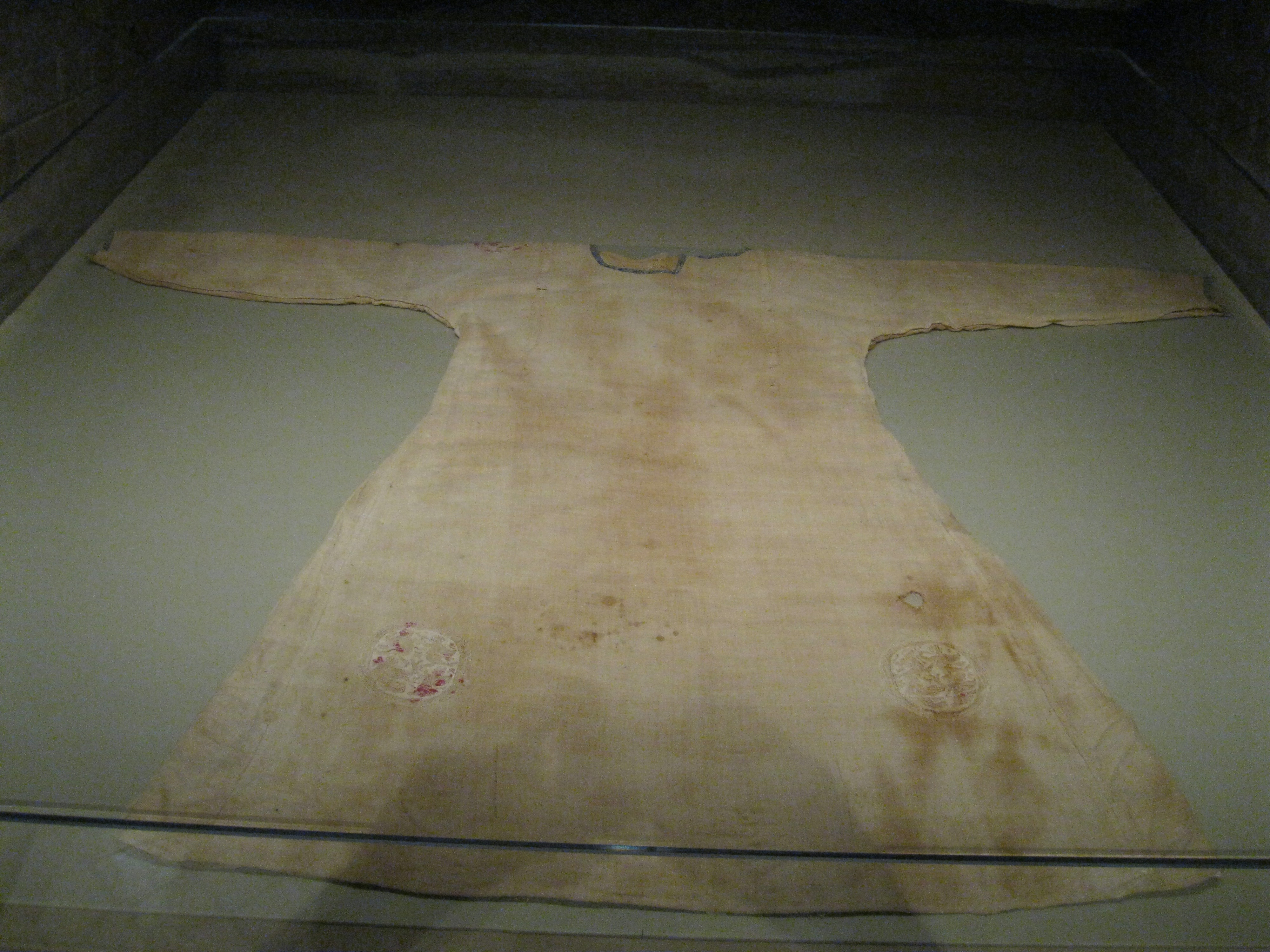
This tunic is a part of the permanent exhibit in the small Byzantine gallery in the Metropolitan Museum of Art. It is, as the title of this class details, directly beneath the Grand Staircase of the museum, and sort of nestled in its own special world of Coptic shinies. It is dated to 7th Century Egypt, and boasts a unique method of tailoring brought to the West via the Sassanian Persian Empire. This particular style of “fit and flare” tunic may have been what influenced later examples in Medieval Europe.
The first thing I’m going to invite everyone to take a look at is the overall construction. It’s not too dissimilar from what we’ve come to know as a Birka tunic in the SCA, sans the underarm gussets that are commonplace in that design. There are side gores to widen the bottom for ease of movement, and the sleeves taper gently toward the wrist. The neckline is heavily influenced by Asiatic designs, and boasts keyhole design that fastens on the shoulder. The neckline and sleeves are finished with a blue and cream patterned silk tape, and the garment’s primary embellishments follow the traditional Roman-influenced patterns of the time. The roundels and clavii (vertical stripes) are woven from red colored wool, and appliqued onto the white linen tunic.
First: Some terms!
Clavii (Singular: Clavus. Greek: Potamion/a.) The vertical stripes that are seen on late Roman/early Byzantine tunics. Originally denoting rank, but later becoming simply decorative.
Coptic: The Copts were and still are native Christians to Egypt. Some believe it to be the Church of Mark the Evangelist. (Catholic is Peter, Orthodox is Paul.) We use the term “Coptic” to denote anything coming out of the Byzantine-occupied Egypt and parts of Ethiopian prior to the Fatimid Muslims taking over in the 8th Century. It’s really kind of a misnomer to use it for clothing, since a lot of the styles involved heavy influences of Hellenistic Greece, including pagan imagery.
Roundel: A round applique or embroidered design on a garment.
Sassanian Persia: The last Persian Empire prior to the spread of Islam by the Seljuk Turks. 224CE-651CE. Were a huge influence culturally on the Roman Empire.
Now let’s break it down…
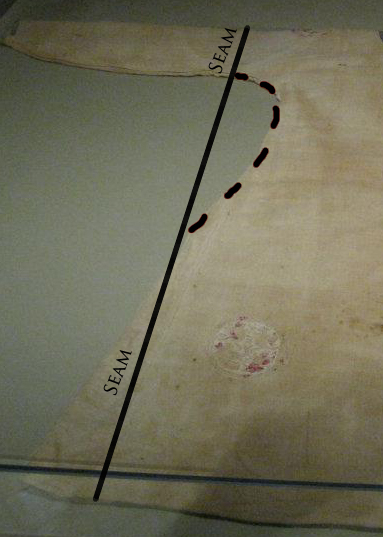
Check out that curved underarm!
A term you’ll probably hear me use a lot during this class is “conspicuous consumption.” Nothing in this pattern shows attention to conserve fabric. The underarms are deliberately cut in an arc to make it more comfortable and reduce bunching, versus inserting a gusset. This provides a smoother fit but does not really conserve material, as the body needs to be cut to accommodate this. A teardrop shape is cut out of the rectangle to create the curvature of the underarm and slight flare at the bottom.
The sleeve is attached around mid-upper arm, and it tapers toward the wrist. There is trim covering this joint, and some additional embellishment at the lower arm closer to the wrist. There is also a roundel on the shoulder between the clavus and this joint.
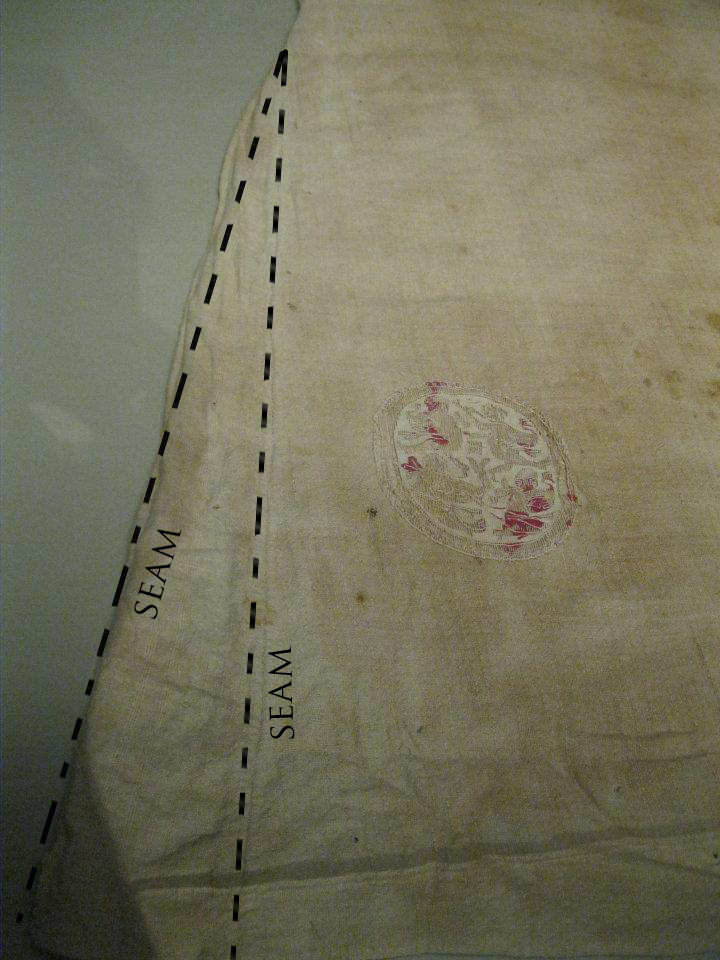
Those tiny side gores!
I was thrilled to discover a Byzantine-period tunic with gores than really worrying about the size of them in question, as such things can be easily adjusted. This garment was tailored for somebody much smaller than the average person today. In fact, even my 5’2” size 0 jeans sister could not fit in this. But it’s not much of a secret that people 1500 years ago were smaller than we are today. I still like this though, because it shows that a wider flare for movement was still necessary, and it eliminated the bunching of the traditional rectangle tunic for wearing under layers. Unlike a solid gore that we see in some tunic patterns, this one is actually two small right triangles, individually sewn to the bottom already-flared skirt portion of the garment, and then connected via the side seam. The gores are set in lower on the hip, than rather on the waist.
Let’s talk the pretty parts (or what’s left of them, anyway.):
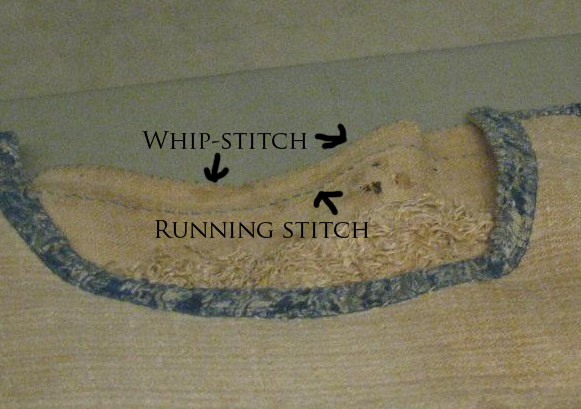
As previously mentioned, the embellishments on this are pretty standard for the Roman influence left in Egypt at the time. First we’ll take a look at the silk tape. Here’s another instance of conspicuous consumption, where the wearer is affluent enough to have a touch of Chinese silk on the hems and collar of their garment. Although silk is more comfy against the skin than wool, these are also the parts of the tunic that will see the most wear and tear. The maker of this probably knew that silk, although more expensive, was arguably more durable, but at the same time, more difficult to launder. The only think I really noted on this was how it was attached to the garment.
It is not a folded bias tape that goes over and protects the raw edge, but a trim added as a facing on the outside of the garment, The hem was created from whip-stitching the top of the tape to the raw garment edge, which was folded in toward the inside of the tape. The bottom of the silk is attached with a running stitch. There are some visible larger whip-stitches in a white thread on the outside, but my guess is that this was a later repair work to keep the silk tacked down where the original stitches may have disintegrated. It does not run the entire neckline. The sleeve treatment is the same method.
As far as the neckline closure goes, there is nothing remaining that suggests what type of fastener was used. It could have been a simple toggle and loop or a tie mechanism that was ripped off ages ago. Some modern Orthodox Christian ecclesiastical garments do still have ties on the shoulder, but the Chinese-style toggle or button being in use is just as plausible, considering the Persian origin of the garment.
Unlike the silk tape, the roundels and clavii appear to be tacked down using JUST a whip-stitch.
The seam treatments used on the overall construction of the garment appear to be a mystery. I saw no evidence of flat felling or thickness that would indicate a French seam. The conservators at the museum appeared to have pressed the seams flat, at least the ones joining the side gores, but that’s all I could really notice. There is a seam repair on the bottom of the right sleeve (photo left) that shows the same chunky whip-stitches present on the neckline, so my guess is that it is also later repair work. Seam finishes weren’t always used in period, so it’s okay to assume that it could be raw linen edges. I do not suggest leaving a modern interpretation this way, our fabrics are made differently, and mainly because a washing machine will rip it to shreds.
So, what does this tunic mean?
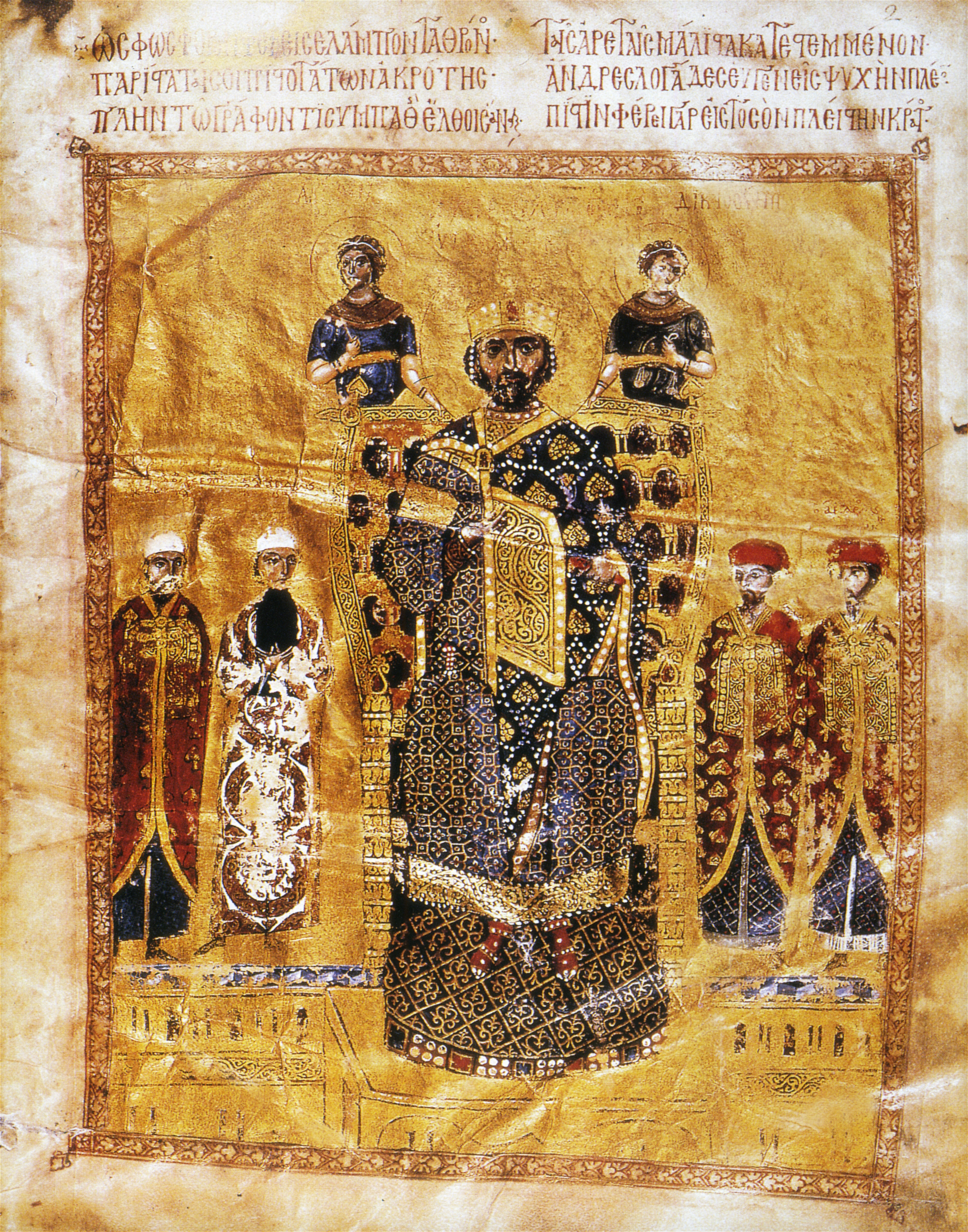
My overall interpretation is that this tunic is a transitional garment. It deviates enough from the blocky earlier Roman design into a more tailored fit. This would eventually make its way into the European continent and evolve into the “standard” for hundreds of years. Compare this other style tunic, contemporary to the one above. I definitely prefer a more tailored fit than wanting to deal with the bulk and folds that this rectangular cut would create.
Tunic photo courtesy of the Metropolitan Museum of Art.
I know it’s not like me to not post for a month, so here’s a little recap.
Last weekend my Lord Geoffrey and I competed at King’s and Queen’s Arts and Sciences in Montreal, Quebec. It’s always a treat to visit Canada, as the Principality of Tir Mara here in the East always knows how to put on a good event. Plus, poutine and beer. If you haven’t eaten your way across Montreal, I recommend it. I mean, there’s way more than poutine and smoked meat, but you at least get poutine, and smoked meat, or both at the same time. Like I did. For those that don’t live anywhere near Canada, poutine is a comfort food that basically consists of French fries smothered in a specific type of brown gravy and fresh cheese curds. It’s any dieter’s nightmare, and that’s okay. It’s sort of a Quebecois staple, but I know it’s quite popular in Ontario and the Maritimes as well, and trickling down into the Northern US. No, it’s not Disco Fries, which is a Pittsburgh thing.
Poutine with Montreal smoked meat. Yes, this happened.
Oh hey, this was our collective displays. As you can see, I wrote another icon, this time of Anne and Mary, so I’ll be adding pics of that in my next post.
Other than that hullabaloo, my semester is focusing on the material culture of Early New England, so I haven’t really had too much time to stay in Byzantium as much as I wanted. I’m interning at a historic house here in my town, and planning to dig this summer at an American site, so my overall material culture focus has completely shifted right now to a period I don’t particular know a lot about, so as I’m focusing on that, a lot of my SCA stuff is getting pushed aside. As it should, because GPA before SCA.
My thesis, however, has been preliminarily approved by my advisor, and will have to do with Byzantium, as it should, because I should play my strengths, not my weaknesses. Once I get that in full swing, I can discuss more about it, but do to the nature of academic research for a grade versus research for the betterment of a re-creation group, I can’t really share too many details just yet. But it will have me developing patterns and sewing through the summer and fall.
I’m not giving up completely, though, I do have my CLASSES SCHEDULED for East Kingdom University and Pennsic War.
At EKU, I will be giving my primary source class, as well as a class on how I broke down the Tunic Under the Stairs (another post coming, probably this week while I’m in Florida on spring break) to get my pattern that I use for my garb. For Pennsic, I will be giving that tunic class again, as well as one on Persian influences in Byzantine Dress. I am only teaching those 2 classes at war this year, since 4 really takes a lot out of me, and neither of them are 2 hours long (my poor voice last war!) So this will leave me plenty of time to do other things. Especially if I don’t sprain my ankle this time.
With that said, I’m on my way to Florida. I need to see some [effective] sun after this crappy winter we’ve had in New England.
I mean, I have one, it’s a basic generic black wool with a lined hood and shoulder seams. I made it about 10 years ago and it’s still going strong. There’s nothing wrong with it, but it’s also not any particular period. Since I’ve been digging into Byzantine outerwear, I’m trying to discover what my persona would have worn, as well as other options in cloaking and coating for both men and women. It does snow in Constantinople, not a lot, but it does, as seen in this modern photograph of the Hagia Sophia from Wikipedia:
Meanwhile, in New Hampshire:
This is actually the balcony of my apartment after the 2nd snowstorm this month. Today we’re getting the 4th foot+ blast. I want to cry.
Outerwear is important, just as much then as it was now. I plan on keeping my first cloak for outside use when the weather is exceptionally foul, but to have one for nicer occasions outside in the cold or inside cold venues will help complete my look as a properly dressed 11th Century Eastern Roman woman.
This post serves as a cautionary tale into how looking for a simple garment can turn into a whirlwind of research that you didn’t expect. This is the method to my madness.
First I picked up the Byzantine cloak clasp offered by Raymond’s Quiet Press, you can buy your own by clicking on the pic.
In addition to some wool and trim, I had the materials necessary to get started.
I never intended on this to become any sort of research project, I just wanted a cloak. So a fast search on the internet came up first with what I always refer to as the paludamentum in Latin, or a chlamys in Greek, a male cloak fastened at one shoulder, such as in the mosaic of Justinian and his entourage at Ravenna, but the women in Theodora’s mosaic are wearing wrapped shawls, EXCEPT for the Empress herself, who is also in a chlamys. I haven’t seen too many images from the 11th Century in which these are worn by anybody other than the imperials. It seemed to have evolved from daily wear of even lower office holders (for men!) into ceremonial dress for high court functions. This theory is supported by Maria Parani in Reconstructing the Reality of Images: Byzantine Material Culture and Religious Iconography 11th-15th Centuries, which I was able to snag on interlibrary loan to begin preliminary research on my Master’s Thesis.
Michael VII Doukas wearing the chlamys, while his attendants wear mandyas, or front closed cloaks. From Coislin 79, f. 2r. Shown in Parani, page 11.
Parani discusses briefly in her chapter on the Imperial Costume that the empress was invested in the chlamys, but probably did not wear it otherwise.[1] So as tempting and shiny as the garment is, unless you are the queen of your SCA kingdom and it’s your coronation, or some extremely important court event, you probably should avoid wearing this garment. Even for men, if you’re middle period (10-12th century) Byzantine and not a king, I’d skip this. It’s just too presumptuous.
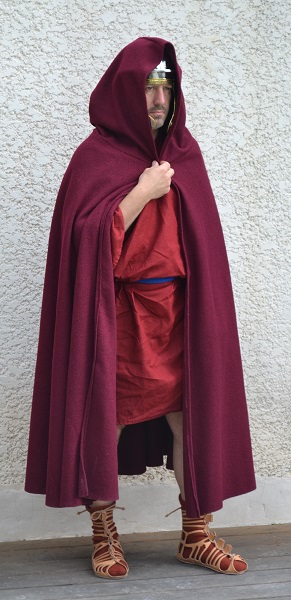
Moving away from this idea, there’s the paenula, which is the traditional Roman hooded cloak that dates from antiquity.
Image found in a search online with the search page Hedgy.com, but it would not load.
The only time you see this worn by a woman in any art is by the Virgin Mary and other ecclesiastical women in icons. Avoid this one too. Not only was it out of style pretty early on for both genders, and you wouldn’t want to commit the sin of wearing such an outdated fashion, but the Romans had a very high regard for their iconographic imagery, and this is another one of those things you should just avoid wearing.
Timothy Dawson argues that the practicality of such a garment would be useful, but evidence of its wear in period in scarce[2]. I agree with him here, though I assert that the reason for such scarcity would be the connection to the Virgin, and therefore making the garment a symbol of her own connection to the past. For women who wish to cover their heads in a simple, demure fashion both indoors and out, a veil or wrapped shawl/palla works just fine.
Moving away from the chlamys and paenula, the other option would be the half-circle cloak.
The same images on Dawson’s website over at Levantia.com.au are also in his article within the Varieties of Experience book cited above. So went to myself, “Oh look, there’s a cloak. Sold.”
Finally, a design that was easy and period, and above all, not being presumptuous in rank, all I really need. It’s not like I wanted to put in more research that I really needed for a cloak, but I do like to check the primary sources to get ideas for embellishments and the like. So Plate 10 in “Woman’s Dress in Byzantium” matches the same that he has on the page for “A Typical Middle Byzantine Outfit” here: http://www.levantia.com.au/clothing/reddress.html.[3] This is where my confusion set in. On his page, Dawson refers to this as a mantion, and cites a page from the 1839 edition of De Ceremoniis for the source on this. Fair enough.
I dig up the ebook on Google Books, and begin translating the ecclesiastical Latin of Reiske’s commentary on the page cited, and found that there was nothing of the sort there, in fact, it’s about pyrotechnics, Persians, and contains a great deal of commentary on a primary source in Arabic. It is unclear from Dawson’s footnote if this is volume one or two, and since two is the only one I can ever find copies of, I went with that. Just to be sure, I searched the document on Google Books for the Greek spelling of mantion, μάντιον, as Dawson suggested on his page, and found nothing. So then turned back to “Women’s Dress in Byzantium” and found that his research was inconsistent in the section where he discussed cloaks and mantles on page 48. In the actual printed article, the word “mantion” isn’t even mentioned, and instead he uses “mandyas,” and supports this through several citations of manuscripts. The book may be a few years older than the webpage, which was last modified in November 2013 according to the page info, but I’m still not 100% sure on why Dawson changed the name between publications. If I can locate the correct supporting evidence in De Ceremoniis, I will know for sure. Until then, I’m chalking it up to a simple error in the footnote that is leaving the source vague. Parani supports the use of mandyas as the correct term.[4]
Now, a mandyas I know is the modern ecclesiastical cloak of the same cut. It’s basically a half circle ornamented in a variety of ways, draped over the shoulder and pinned in front. That’s it. The design is frankly, timeless.
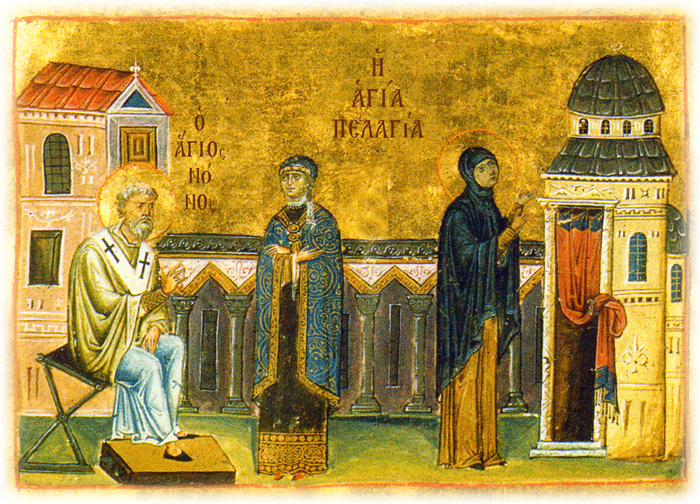
I did some searching for Dawson’s cited manuscripts and couldn’t locate most of them online. This is a common hurdle, as not all libraries have been digitized yet, but fortunately for all of us in the future, they will be. Even the Vatican is digitizing their manuscript library. Even though my initial searches were fruitless, I did find some neat sources for future perusing. I did have some luck with the Menologion of Basil II, which does have its own Wikipedia page for those seeking instant gratification, and found a couple of images, including the empress in a chlamys and a sainted nun in a paenula. What I needed though was evidence of women of aristocratic status wearing it, and folio 98 delivered. Both Dawson and Parani cited this image, and Parani included it in her book.[5]
St. Melania the Younger from the Menologion of Basil II. To me it looks like she’s in a paenula.Empress Theophano from the same manuscript. Notice how her chlamys is fastened on her right shoulder. A women wearing this in artwork signifies the empress.Folio 98 of the Menologion of Basil II, featuring St. Palagia before and after she is called to God.
This image above shows both a saint and a laywoman. The haloed saint Palagia wears the hooded paenula, while the woman in the middle, whom I’m assuming is Palagia repenting her sins before converting and devoting her life to God, is secular dress, and, tada! Wearing a mandyas.
Another image that supports the wearing of this style of mantle is one that I’ve previously shown during my research of the propoloma are the donor frescoes of Irene Gabras, and Anna Radene in its full form. The one of Radene shows the traditional thick trim outside, as well as an elaborate lining behind the magnificently large sleeves of her red 12th Century delmatikion.
Irene Gabras, image borrowed from 1186-583.org.Anna Radene from the church of Sts. Anargyroi in Kastoria, Macedonia. Image found on Surprisedbytime.blogspot.com, but the church also has a smaller image here: http://www.macedonian-heritage.gr/HellenicMacedonia/en/img_C252a.html
These three sources span the period from 1000-1180, so it’s safe to say that this garment was very much in style for probably a fair portion of the 10th Century, the duration of the entire 11th Century and into the 12th. All three are featured within Parani’s book.[6] Since my persona is a woman who could have served as a zoste patrikia such as the likes of Radene, it is safe to assume that wearing the mandyas in her style would not be presumptuous, and therefore the route I should take.
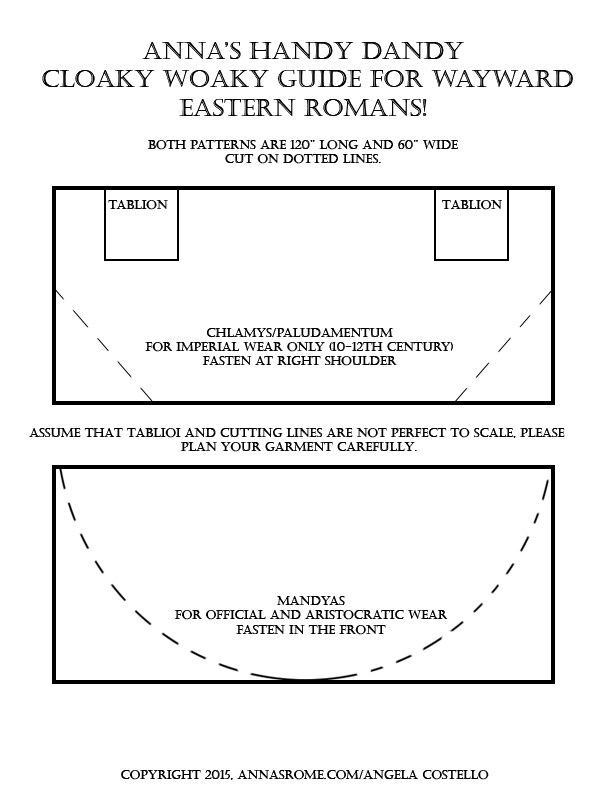
Now, I have already been asked, “What makes a mandyas different from a chlamys?”
This is a good question.
Both historians I have cited, primarily Parani as she has focused on the differences in both imperial and aristocratic dress, agree that the chlamys is absolutely imperial only. Descriptions lead me to believe that the broaching at the right shoulder, as well as the addition of the traditional ornamented panel, the tablion, are the single most important things one needs to pay attention to when making cloaks for themselves.[7] It was extremely ornate, and not practical in any sense of the word for wearing outside of high court ceremonies.[8] So in theory, this thing was probably so heavily laden down with jewels and metals that not only was it out of the price range of anything but the imperial family, but also its sheer weight was probably enough to keep the wearers indoors. I also believe that since the Roman paludamentum, which is essentially the same garment as the Byzantine chlamys, was trapezoidal (think rectangle with the two bottom corners cut off) and not semi-circular, that the imperials would have preferred to maintain the ancient shape, versus the easier to cut and trim half-circle counterpart.[9]
Note: If you see an icon of an angel or saint wearing a chlamys, remember that these figures are often in imperial ceremonial dress, as that is to be expected of all divine beings.
Here are patterns I just cooked up to give a better understanding:
As for how these can be embellished, if Anna Radene is any indication, the aristocracy did not slouch when it came to blinging their accoutrements. In Dawson’s article, he discusses the will of an aristocratic lady by the name of Kale Pakouriane in which she discusses her clothing items, including heavily embellished mandyai with silk, pearls, and gold bands.[10] Parani brings up this same document for different reasons, so now it’s on my “MUST FIND” list, so that I too, can get a glimpse into the belongings of a high ranking lady of this period.
Anyways, I’m cooked. This just goes to show you how much you can find about one garment in just 2 monographs and an afternoon to kill looking for images and writing a blog post. I will be planning and making my own mandyas this week.
Constantine Porphyrogénnētos, De Cerimoniis aulae Byzantinae libri duo. London: Oxford. 1830.
Dawson, Timothy. “Propriety, Practicality, and Pleasure: The Parameters of Women’s Dress in Byzantium, A. D. 1000-1200.” In Byzantine Women: Varieties of Experience AD 800-1200, edited by Lynda Garland. Hampshire; Burlington: Ashgate, 2006.
Goldman, Norma. “Reconstructing Roman Clothing.” in The World of Roman Costume. Edited by. Judith Lynn Sebesta and Larissa Bonfante. Madison: University of Wisconsin Press, 2001.
Parani, Maria. Reconstructing the Reality of Images: Byzantine Material Culture and Religious Iconography 11th-15th Centuries. Leiden;Boston: Brill, 2003.
[1] Maria Parani, Reconstructing the Reality of Images: Byzantine Material Culture and Religious Iconography 11th-15th Centuries, (Leiden;Boston: Brill, 2003.) 17-18.
[2] Timothy Dawson, “Propriety, Practicality, and Pleasure: The Parameters of Women’s Dress in Byzantium, A. D. 1000-1200.” In Byzantine Women: Varieties of Experience AD 800-1200, ed. Lynda Garland, (Hampshire; Burlington: Ashgate, 2006.) 48.
[4] Parani, 73. Here she’s citing the will of Kale Pakouriane, a lady of the middle Byzantine period who discusses clothing in her will. She also discusses it as being an alternative garment worn by the Emperor on pages 16 and 17.
[5] Parani, plate 80. Vat. Gr. 1613, f. 98 depicting St. Pelagia the Harlot
[9] Norma Goldman, “Reconstructing Roman Clothing,” in The World of Roman Costume, ed. Judith Lynn Sebesta and Larissa Bonfante, (Madison: University of Wisconsin Press, 2001.) 233.





























 Anna's New Rome
You must be logged in to post a comment.