Egg Tempera is a great medium, but it takes some getting used to. As far as iconography has gone, I have never used a ready-made paint. I have always used dry pigments mixed with egg binder, even in my not-so-great early pieces. I’ve since learned the quirks of it, but I still have a bit to go.
The binder is easy to make: egg yolk and white wine. The wine is optional, but it helps emulsify the egg a bit, as well as act as a preservative. Still, you only get a week, tops, with this stuff in the fridge after a day on your table.
First, gather your supplies! The wine name made you giggle.
My mixture this go around was 2 yolks and about “that much” of white wine. I’ve gotten to the point of knowing the color I want for the right mixture. You can separate the yolk from the white by transferring the goop back and forth between the broken eggshell halves. Then you pop the yolk with a folk, and let it slowly drain into the jar, catching the membrane in the process. If the membrane goes in, it’s not a huge deal, but you just need to make sure you don’t suck it up in the dropper later.
As you can see, it’s not a ton of liquid in a standard size mason jar, but a little goes a long way. You use drops, not tablespoons.
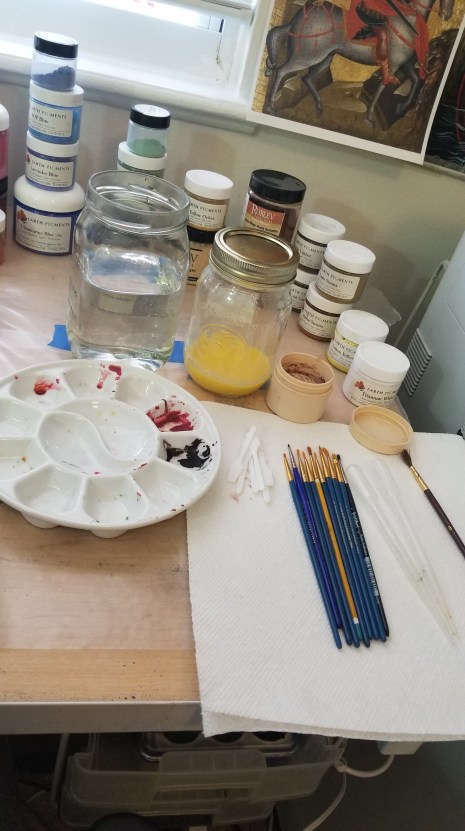
Once I get the magic liquid made, I go ahead and set up my table. I already had most of this out when the gilding started, but here you can see my collection of pigments, and that I taped wax paper down to protect my work surface. All of my pigments are from Earth Pigments or Natural Pigments, are are 100% natural earth or mineral colors. Mostly oxides, but also some crystals. The bagged jars are my quarantined toxic vermilion (mercury sulfide) and minium (red lead) pigments.
Egg tempera is backward from watercolor, you start dark and then add highlight layers. It seems weird, but it works. In iconography symbolism, you continue to “play God”, and build the paint up from the protoplasm, into a glowing, holy image.
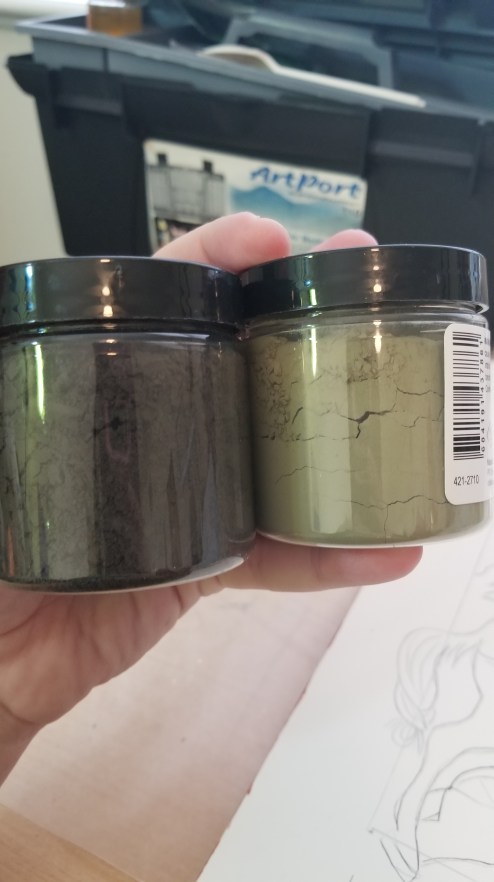
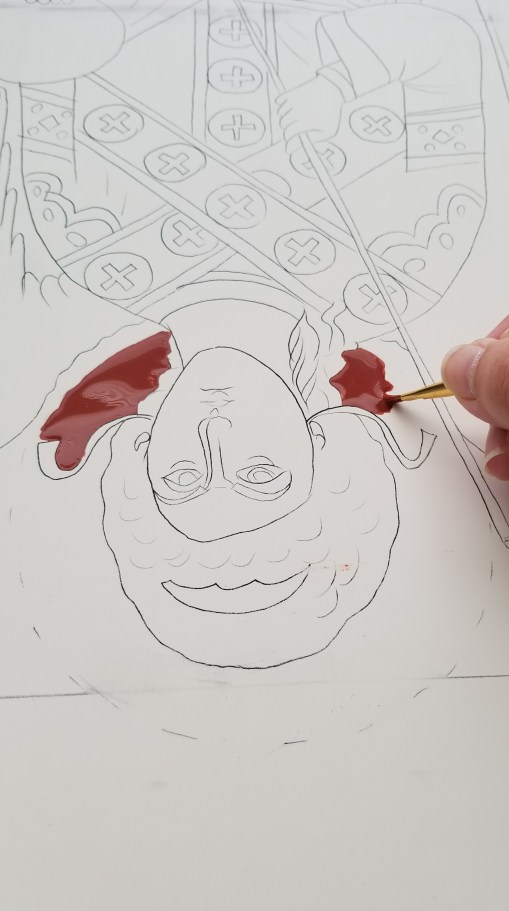
Starting with the sankir, or base skin tone first. I mixed Antica Green Earth, and Roman Black. Think about the skin color of the Greeks and Middle Eastern people where this artform originated: olive based. Again, start dark, build up to light.
Dry Antica Green Earth.
Egg tempera can be fickle depending on how fine some of the pigments are ground, the material they’re made from, and how much moisture they suck up. Antica green is fickle and kind of grainy, so I had to adjust as I went along with more pigment, egg, or water, depending on my needs.
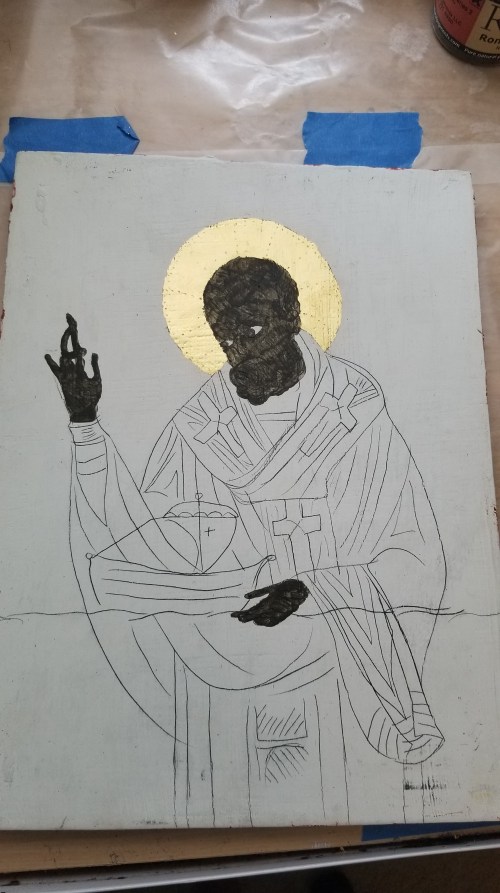
I made a ton of sankir, so I painted all three icons with it. This isn’t always the best approach and it sort of busted my flow for the rest of the day, but they all have the same base mix, which is good. The rest of this icon-a-long will be for St. Martin.
I don’t have pictures of work on Martin, because, well, I was painting. It’s a time consuming process, and it takes hours. Total amount of work today alone was about 4 hours.
You work the paint in tiny brush strokes from a small drop on the board, rather than long strokes.
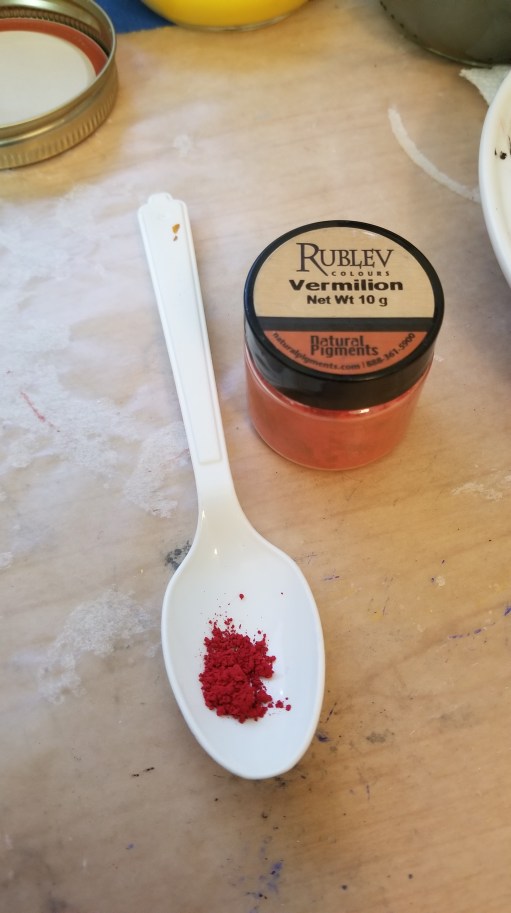
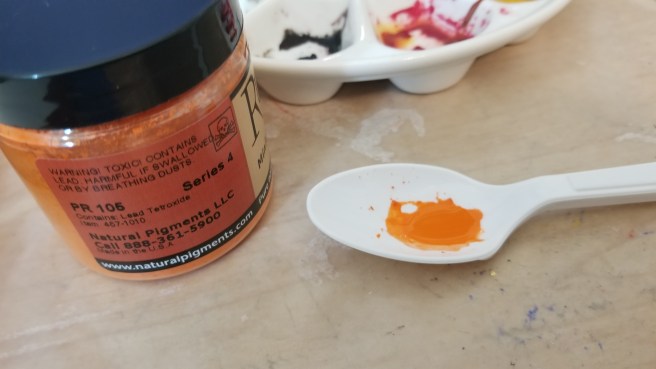
The perfect cloak red in icons comes from vermilion, real vermilion. I have a few different reds, but nothing paints like the real thing. So the real thing needs precautions. I keep it quarantined in its own baggy, with its own tools. Instead of using one of my palettes, or shells (I do have shells, the porcelain is just easier to clean) I use a plastic spoon that I can keep separate. While vermilion is considered inert once painted, the dry form is still toxic, it is still mercury, and needs to be controlled.
Of course, once I got started with it, a warm fuzzy thing decided to distract me.
That’s Harald Hardrada, Varangian kitty, King of Norway, Maine Coon superfoof.That red, though.
I had to use a tiny bit of the minium as well. It’s one of my favorite colors. As shocking orange as you can get, and a fully period color.
After getting tired, taking a break halfway for dinner, and coming back to it, and still getting tired while finishing up the background, which is okay, because more coats will make it more opaque, but I’m bushed. I know it looks super weird, but over the next few days, the icon should “appear” as I add the highlights.
So. Part of blogging a process as you go along means it’s harder to hide mistakes. Mistakes are a natural process of life, and as such, I hate them. But, as part of a learning process, I’m not sugar coating this post. I made some booboos, and learned that Florida humidity is unkind to the icon gilding process.
The icon process is pretty specific. You breathe an open-mouthed hot breath on the bole to create condensation, and the loose gold will adhere. It’s basically a form of water gilding with mouth moisture. (ewww.) But, this is symbolic of the breath of God, it’s also super period. After yesterday, I may have to cheat for the few years I’m down here.
I grew up in Florida, so the heat and humidity aren’t any sort of surprise. I don’t think I’m as tolerant of it as I used to be after living in New England and experiencing seasons, and living in perfect-almost-all-the-time Southern California. I learned how to gild in New England. I used fake composite gold in Rhode Island, but had graduated to real gold in New Hampshire. In retrospect, all of my icon work up there was during the winter. In California, I only gilded the halo of St. Nicholas, but I remember it being almost too perfect.
And now, I’ve returned to Hell Incarnate, and failed to prepare myself for the difficulty that awaited me. Anyways, here’s some pictures.
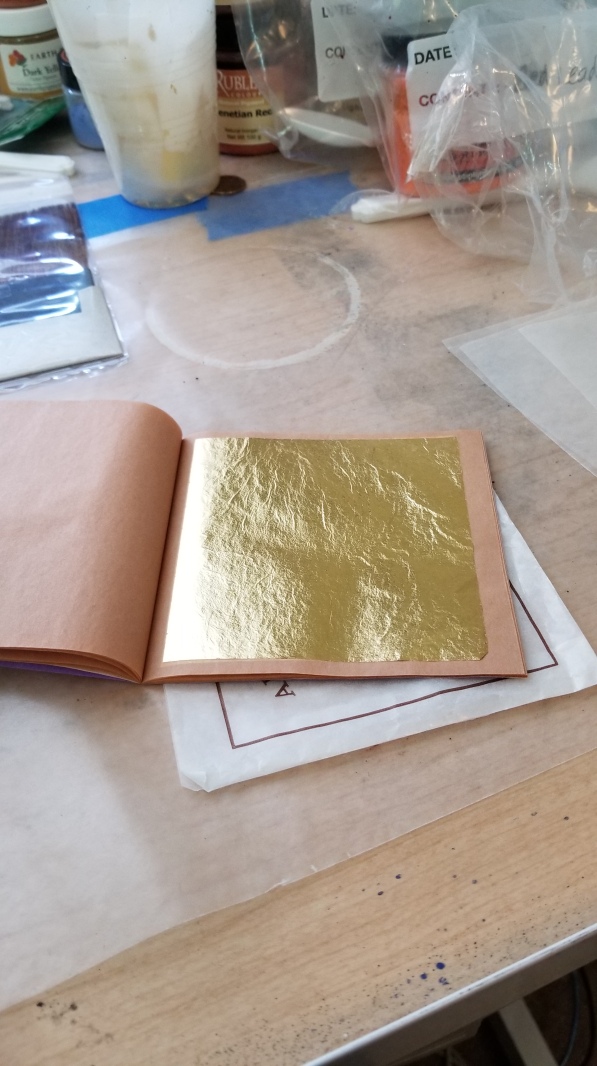
Avengers assemble! 2 burnishers, some 23kt double gold loose leaf, and cut wax paper.
First thing first, I burnished the bole on the halos to a high sheen. I screwed up here. Twice, on both icons. I either pushed too hard, or it wasn’t set up right, because I ripped up spots of bole on each one and had to put more down, and let it set. This would bite me for the rest of the day.
Michael’s halo partially burnished to a high shine.Burnishing Martin’s halo. This takes time. If you go too hard or too fast, you WILL rip up the bole.
Once I succeeded, I prepared the gold leaf. The easiest way to do this is to use wax paper to catch the leaf versus trying to use a gilders knife. At least, that’s the way I was taught?
So shiny!Wax on…Wax off.You can cut the leaf once it’s on the wax paper with ordinary scissors. No cushion or knife required.
Once the gold was transferred to the wax paper and cut, all I had to do was breathe some hot air and slap it down, right? No. The first piece I used didn’t adhere at all. Naturally, I don’t have pictures of this part, since I was super perplexed, and then it became a fight. Then war was declared. And what is supposed to be a meditative, relaxing art for me turned into digging into the trenches and not coming out of the room until I had this gold down, dammit.
This was probably not the best approach. What I SHOULD have done, was troubleshoot via the internet and the scribal community.
This is Martin, as I’m fighting to get coverage on one side of the halo after the first layer bombed. You can see the layers of leaf I was using to get it to stick, and how it wasn’t TOUCHING a few spots. Pinholes are normal, gaping holes are not. Layers are normal, layers that don’t cover gaping holes are not.
While I was getting frustrated, I must have spittled on the icon a bit, or too much condensation built up, and gold went down ONTO MARTIN’S FACE.
I honestly assumed that with the extra humidity, regardless of central AC, that the gold would be wanting to stick to literally everything, and I would have had the opposite problem. It wanted nothing to do with it. The equilibrium between the temperature of my breath and the board, or the amount of water in the air and my breath, must have been off. Boards do absorb water, which leads them to warp with age, so it was suggested after my Facebook venting by a Trimarian scribe that I should put the board in the fridge for a while next time, to see if I can dehydrate it and cool it off, and get more condensation.
Michael’s first layer. I was flabbergasted.
After the first round. I went downstairs, had some tea, and attempted to re-center myself. I didn’t take pictures of the gold on the wax paper, I wish I had: It was terribly patchy. And while it’s normal for it to come off in smaller pieces if I’m focusing on an area, it was doing that the whole time. I was getting bubbles and oxidation I had never seen before.
After my break, I figured enough time had passed for me to go ahead and burnish Martin’s halo. NOPE. It started great, and then the leaf just started coming right up, and exposed the bole. I gave up, regilded his whole halo, and decided that was enough handling of that icon for the time being.
Shiny enough to reflect my phone and then…ACK!3 sheets of gold later: Those nice forehead smudges. I should be able to sand it down and paint over it, but that’s not the point.
I went back to Michael with a new plan of attack: Tenting the halo with the wax paper as I breathed on it, and then slamming the gold down quickly. It seemed a bit violent, but it worked. I didn’t dare attempt to burnish.
There’s still some exposed spots and pinholes, but I’ve decided to fix that with shell gold, and the painted halo outline.
For comparison, here’s Nicholas, who I gilded in California. Practically no blemishes, and a thickness nice enough to press a design into even on my rough, homemade board.
I went downstairs after all of this, and had a stiff drink. This was 4 solid hours of work from start to finish. While one should take their time, that seems a bit excessive for simple gilding. The gold is down for these guys, but I need to reassess my approach now that I’m living in the swamp again.
Painting is up next. Let’s hope the threat of cockroaches eating fresh egg tempera doesn’t come true.
This post shows you the deepest darkest secret of iconography: the patterning process.
This is tongue in cheek for obvious reasons. Why?
I will let you all stop screaming.
No, really. While many iconographers draw their own images, the vast majority of them are made from patterns that have existed since the Middle Ages or Early-Modern period. You can go on Amazon right now and find dozens of books of icon patterns and line art for this purpose. Copying is period. In fact, I was able to see an actual medieval icon pattern in person, once. I was unable to take a picture, but it was made of animal skin, and had the image punched into it so the iconographer could transfer it over onto their panel with a stylus. How else do you think so many icons look identical, save details and color?
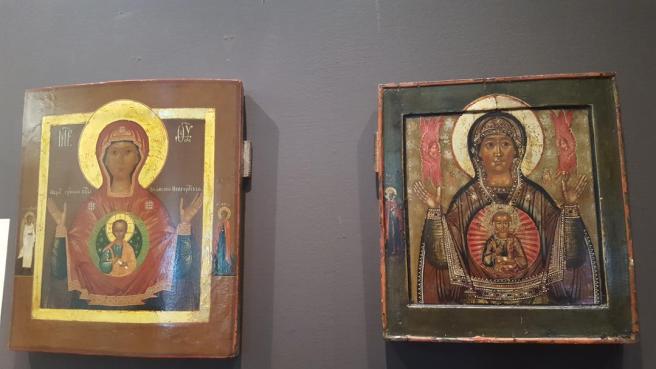
Two icons of “Sign, Mother of God” at the Museum of Russian Icons, Clinton, MA. The same pattern, but with different colors and embellishments. Note the position of the halo on each with the border and kovcheg.
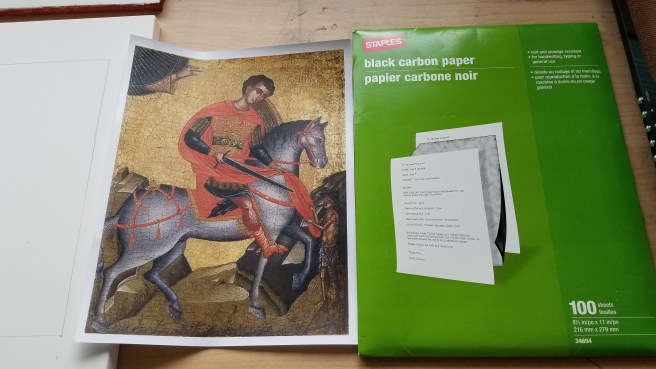
I’m too poor to afford skins I can dedicate to patterns, but I can use the modern method of carbon paper, which is how most schools today teach it. (I do believe carbon paper, or a form of it, is period, but let’s not grasp at straws for stunt documentation.)
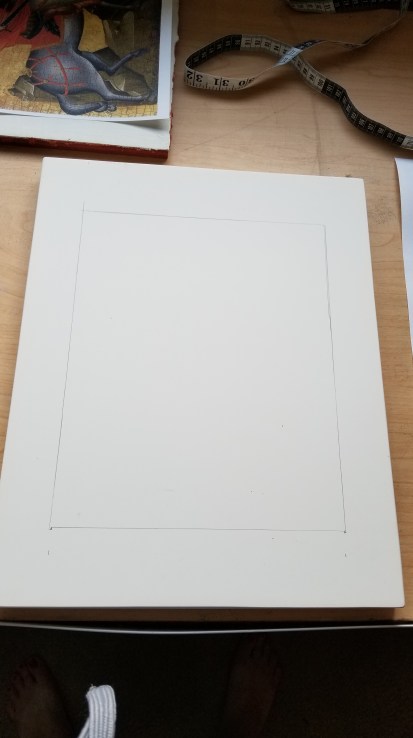
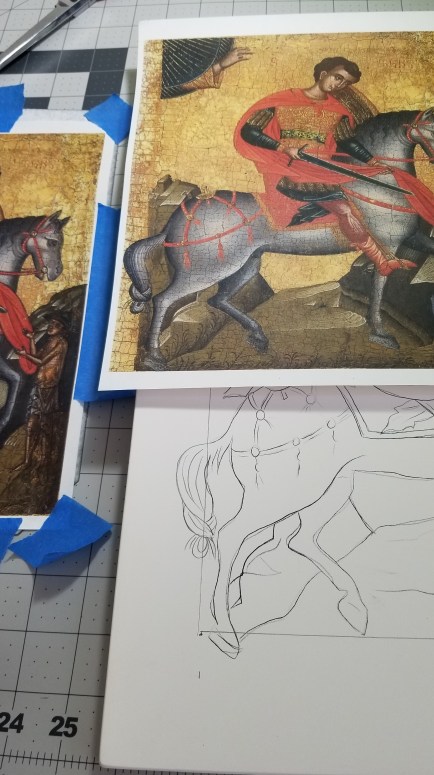
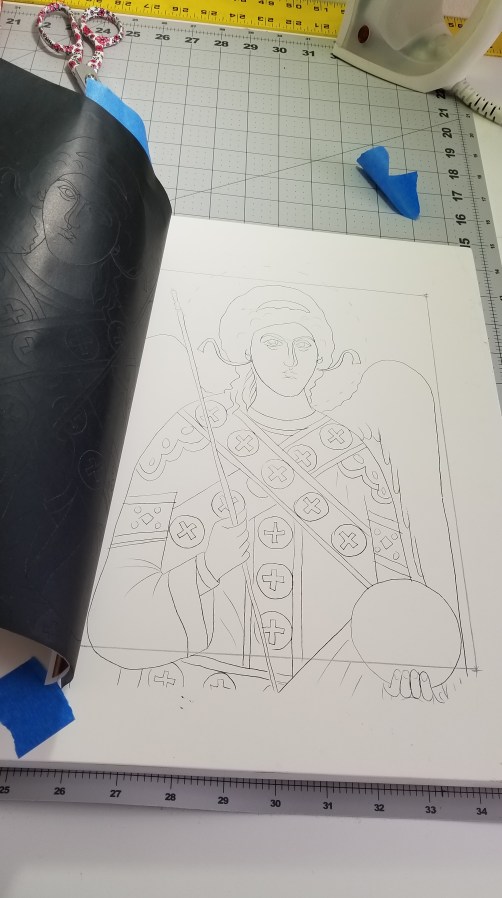
So, the way to do this is fairly straight forward. I’m using an 11×14 panel for an 8×10 printout, so I need to measure that out to create my border. Then I play the corner matching game and tape the image with the carbon paper down to the panel with painters tape. After that, using a dull pencil or a ballpoint pen, I go ahead and trace over the lines I need to create the line art. No need to get too detailed, because I learned early on you do too much work on the pattern, and paint over and lose all those detail lines. That’s all work you do on top of the base layers.
Drawing the guidelines.Taping on the stencil.Finished cartoon.
After you get a successful trace, go back in with a graphite pencil and fix some details and missed lines.
Notice how the original icon has the horse tail coming out of the border. I did the same.
After you have your line art, it’s time to prep for gilding.
Always get your gold down before painting. Gold will stick to all the things, so it’s important that you get it to stick to the only thing you want for the time being, and that’s a substance called bole.
I’ve mentioned this before in my previous icon posts, but bole is a mixture of red clay and hide glue. I’ve made it before, but I also like buying it ready made from Pandora because it make my house not smell gross and my stove and floors not get stained. Since I live in military housing, paying for others to do this for me is a great convenience.
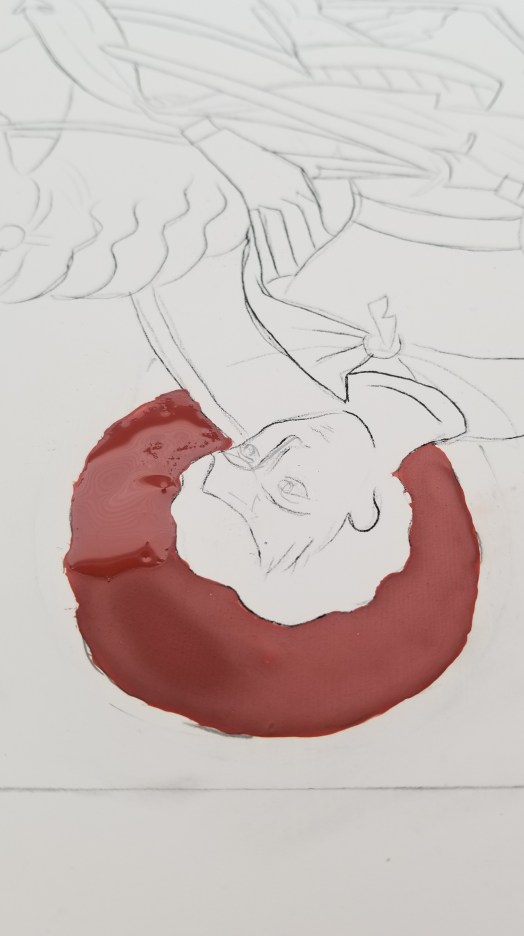
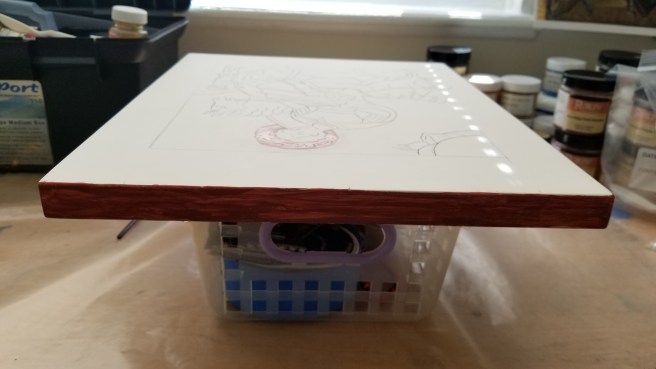
I put two thick layers of bole down on the halo, and then a rough, thin layer on the edge of the board. This is highly symbolic in the icon process, but also important: the bole provides a cushion for the gold to have a design engraved into it if desired, and the layer on the edge helps protect the board while it’s being handled. In icon speak, it’s the base of earth from which God shone the divine light at creation (halo), and the edges are symbolic of the roughness and mortality of the artist. It’s kind of dark, and I love it. Because I paint these as an historical art in a secular manner, versus something that will be used for actual veneration, I don’t dwell too much on the sanctity of the process, but it makes a great mnemonic for the process, because the order of operations matters for a practical reason, as well as spiritual.
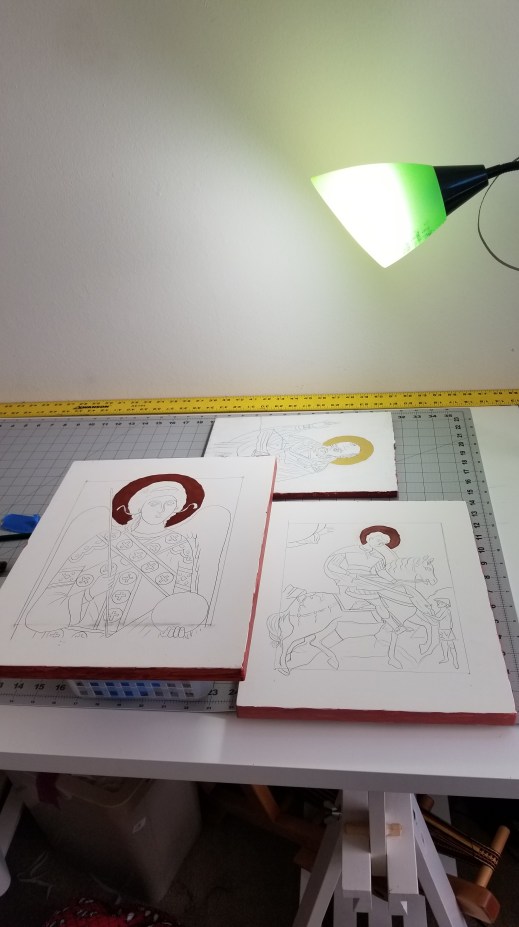
Thick layer of wet bole on the icon of St. Martin.While that dried, I patterned Archangel Michael. Don’t worry about the guidelines, they can be erased and re-drawn.Putting bole down on Michael’s halo.Second thick layer of bole on St. Martin. It’s important to be mindful of air bubbles, which can ruin the smoothness of gold adhesion.Coating the edges.Ready to dry overnight and take on gold leaf.
After the bole cures, I’ll use an agate burnisher to smooth it out, but that will have to wait until tomorrow morning. If all goes well, I’ll be able to get the gold leaf down, and the first layer of egg tempera on all three icons.
To put things in perspective before painting, here’s the three brushes I use most of the time.
I barely sew men’s Byzantine clothing. I know where to look, where to point friends, but for the most part, I personally haven’t touched it. My husband is a Norman. He wears riding tunics, and basic linen gored tunics with keyhole necklines. He likes them, and looks good in them. His complexion and appearance echoes Anna Komnene’s description of Bohemond I of Antioch in the Alexiad almost verbatim. It’s disgusting how Norman he is.
But we have a deal: I sew it, and he wears it.
Up until this project, I’ve made him 1 “SCA Byzantine™” tunic, made from lovely wine colored thick linen with potamia and fancy cuffs, but it’s sewn to his usual Northern European tunic style, versus anything actually Byzantine. I’ve also made him exactly one Roman tunic, and one later Roman dalmatica with clavii stripes for when the weather is stupid hot. He mostly stays in his period, with long sleeves on in warm weather because he’s very fair. Lightweight linen is his friend.
I’ve been meaning to try this pattern for a while, so, one day, I decided to sew things, and that he was going to deal with it.
The mummies of the Manazan Cave City date from the 9th-13th Century, though I believe more recent studies are putting it at the end of this period. Manazan is located in the region of Cappadocia, in Anatolia, present day Turkey. This shirt is based on the mummy at the Karaman Museum.
They haven’t updated their site since 2014, but if you’re reading this, thank you, Christobel and Peter, you helped me figure out pieces to my mental puzzle in constructing this based on Dawson’s descriptions.
I haven’t really ever seen this done in the SCA. At least not in my parts, aside from a member of my household, who I think I may have given the link to. I knew that the standing collar was seen in some Byzantine art, but I always kind of avoided it, since I hate being choked and didn’t know what was going on. After finally making a series of these for my husband, I gained a better understanding of how the shirt works, and feel like a ditz for not trying it sooner.
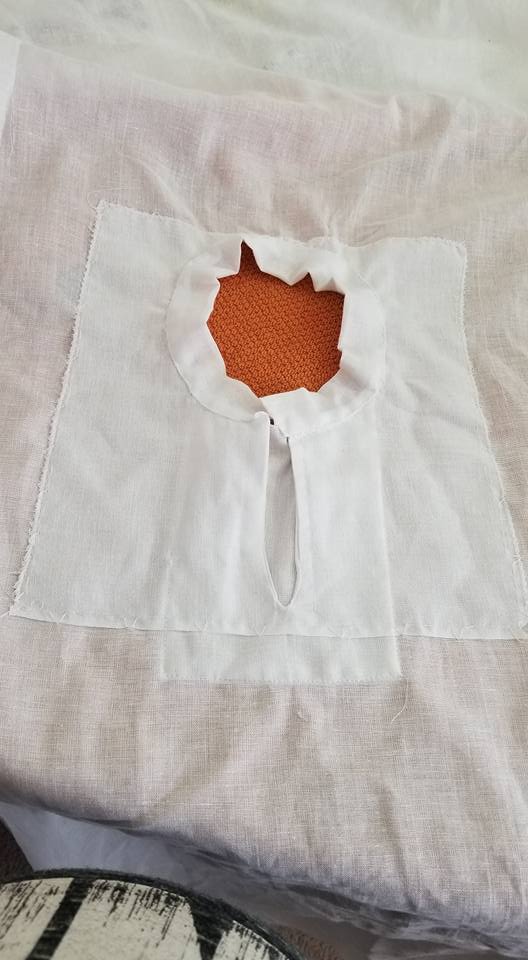
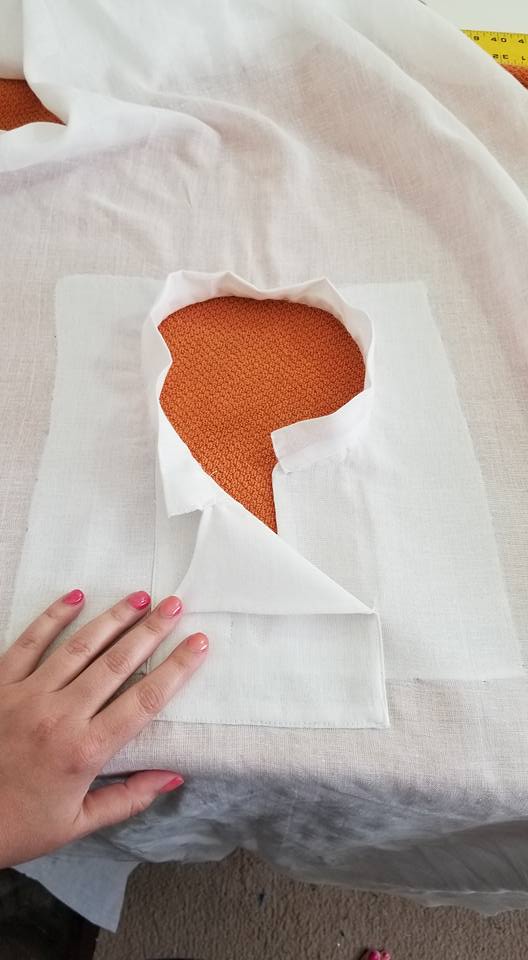
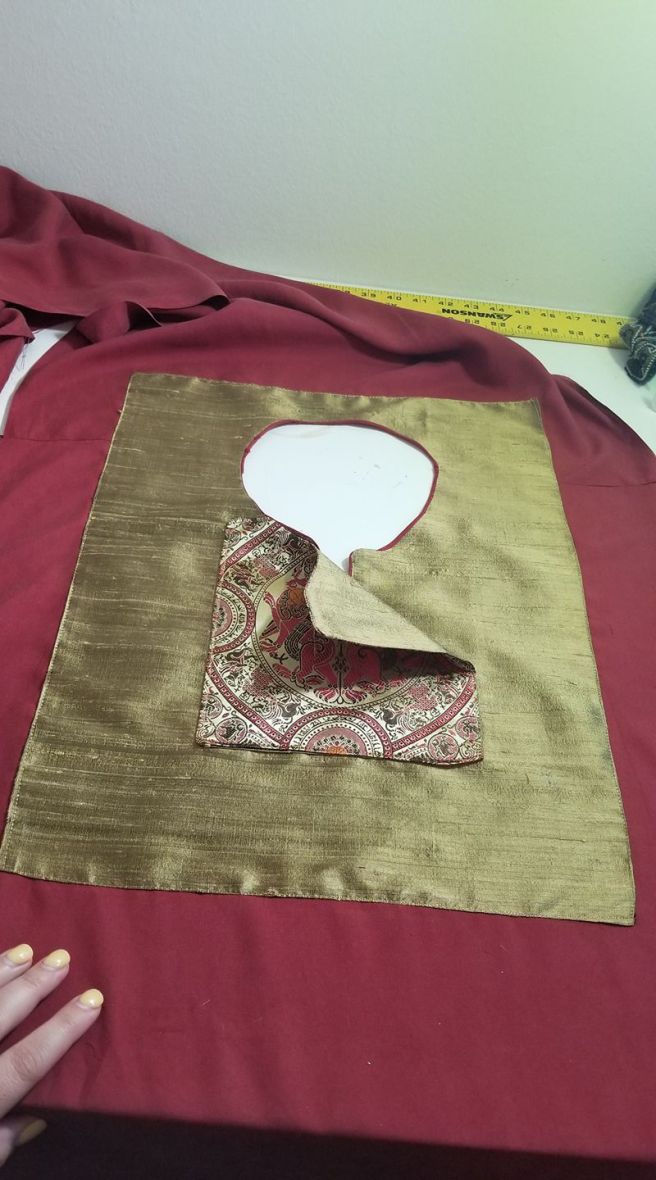
The Manazan tunic is, on the most basic level,a keyhole neckline with a placket over it. That’s it! Once you get that in your head, you look at the picture and go, “Oh.” Trust me, this is way easier than it looks at a first glance.
I made him three types, in this order: An indigo linen version, without the standing collar, knee length.
A white linen version as an esoforion/undershirt, with the collar, knee length. A swanky silk version as a court garment, ankle length.
I had a surplus of weird, secondhand linens I wasn’t afraid to screw up something on, so I decided that the first version would be out of a mid-weight linen with a rich indigo color that straight up reminds me of blue jeans. (In retrospect, I’m pretty sure it’s real indigo dye, talk about a luck out.) I like the idea of wearable mockups. If it doesn’t work, then it doesn’t work, but if it does, then you have a finished garment.
The way it works, is that the collar has to be completed before attaching the sleeves and side gores. The dark linen makes it hard to see details here, but here’s some photos of the construction.
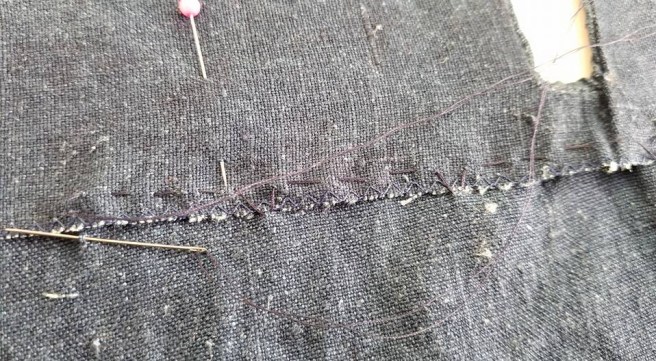
Placket closed.Placket open.Kind of a weird closeup, but when I attach facings on the inside, I use a hand invisible hem stitch. This stops the bold lines of machine sewing being visible on the front, and tacks it down securely. The machine zigzag is lazy finishing on the edge of the facing.Finished and laid out on my table so you can see how high the gores go under the arm.On the Norman. Following the instructions of the pattern to determine measurements gave us a very wide tunic, but when you see period garments, they are rather baggy, if not “bulbous” on men’s figures.
Adjustments made after the first tunic:
-Take in the measurements a couple of inches on each panel
-Re-calibrate the neckline gauge for a tighter fit (I added a half inch when I didn’t need to.)
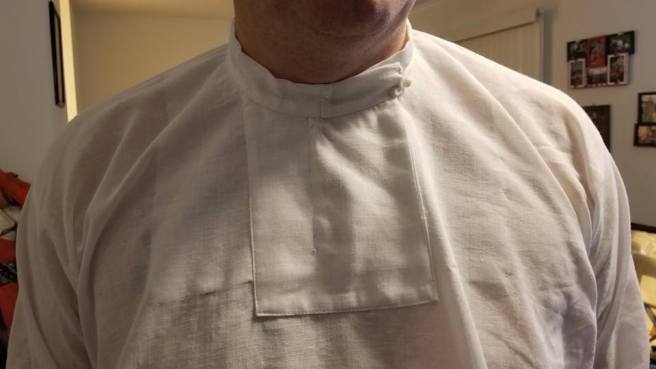
Onto the full construction with the band collar out of crisp, white linen that took me 6 washes to get it usable. The white allows a more visible depth to the layers on the collar, so I have more pictures.
There really is no easy way to avoid handsewing on this pattern. You can if you want, but it won’t look right. After I attached the facing inside with the blind hem as seen above on the indigo tunic, I also attached the band collar to the inside by hand. You can do a machine running stitch when you initially attach it at the base, but when you flip it up and close it to the inside, hand is necessary, otherwise the outside will look ugly. I’m planning on handsewing a whole one for myself.View from the inside looking out, so you can see the keyhole neckline, the facing, the placket, and the collar.The same view from the outside.Let’s face it, this is basically Byzantine Han Solo.
I actually screwed up. I made the band too short because I read the pattern wrong. I repaired this by adding another length of band, versus taking the whole thing off and starting again. My husband destroys collars because his sweat contains amine, a chemical used on submarines to purify the air that also dyes everything a gross shade of rust, so he kills tunics and bedsheets by the dozen. I’ll replace it once it gets gross.
On the board, puffy before ironing, with the repaired collar.Actually on. I used a small white glass bead to make the toggle. Doesn’t it look so much more crisp than a normal keyhole?
Things learned from the full construction:
-Taking in the couple of inches doesn’t matter, this is a wide tunic.
-Pay attention to the taper on the sleeves, men have forearms that women don’t typically have. I made them a little snug, but not uncomfortably so.
For the grand finale, I wanted to see how I could really jazz it up. I had 3 yards of beautiful silk broadcloth in my stash reserved for when Gieffrei decided to dress like civilized folk, as well as my usual stack of dupioni remnants for trim, and a brocade I had stashed from when Sartor had a sale last year.
The broadcloth was narrower than the panels I had used on the blue tunic, and just about where I cut them on the white one, so I lucked out. I was nervous that the longer length would screw with his stride, but it did not. Instead of putting the facing on the inside, I put it on the outside for some pizazz, and made the placket from the brocade. Added some cuffs with the dupioni, and bottom trim with the brocade, and voila.
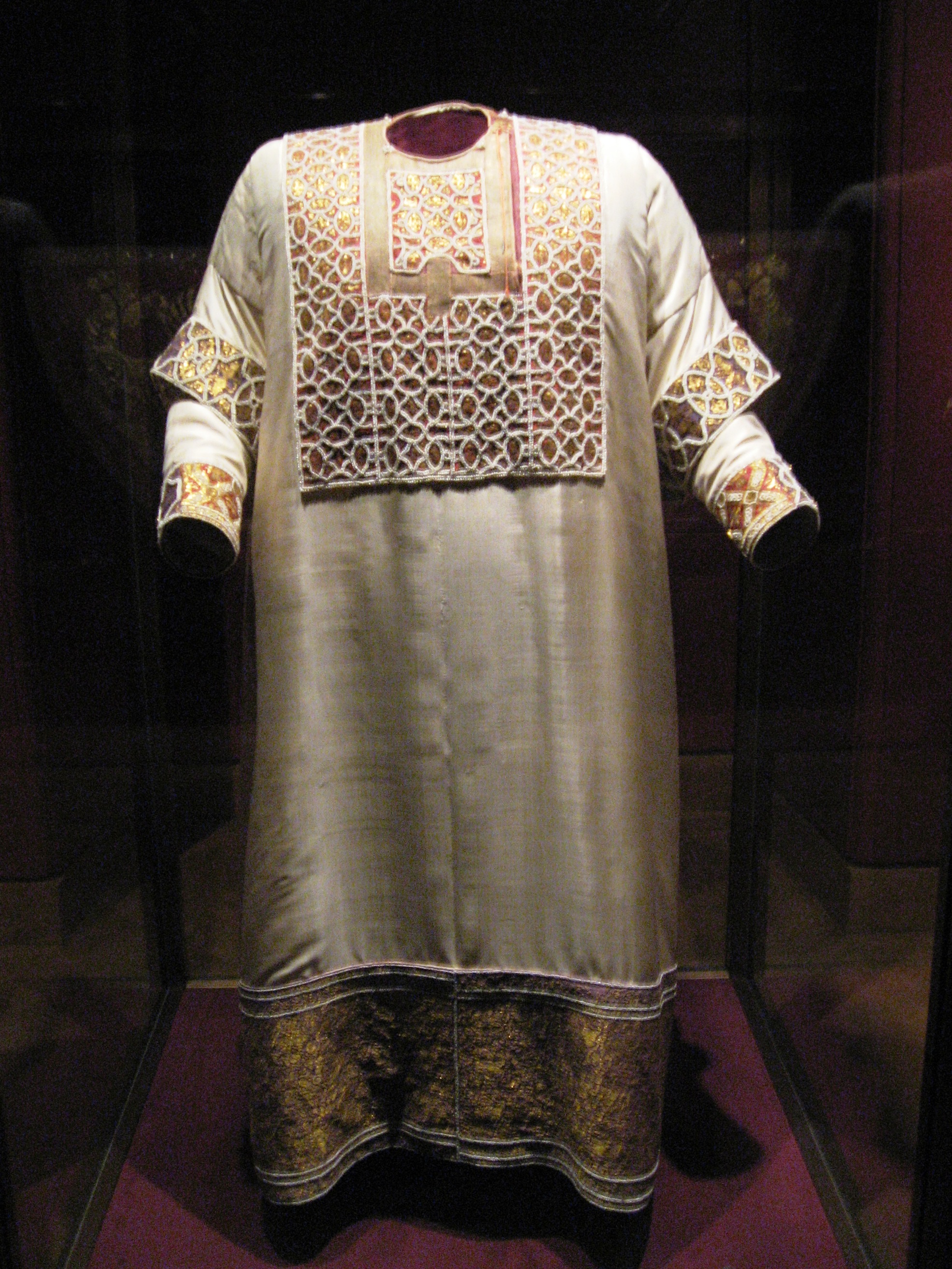
The alb of the Holy Roman Empire was my inspiration for his look, only sans all the pearls. (I did buy pearls, I just haven’t sat down and gotten busy with them yet.)
Alb of the Holy Roman EmpireKamision of the Holy Norman Jeff.Detail on the neckline before I finished it.
I don’t have good pictures of him fully dressed head to toe, that’s next on the agenda.
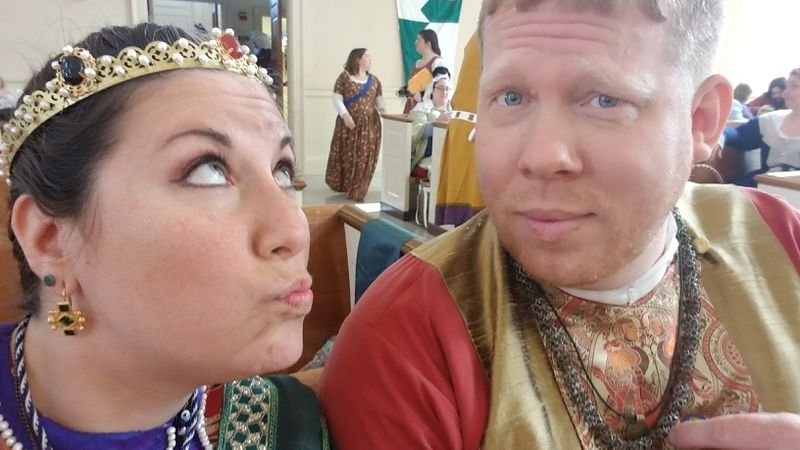
Here’s an extremely flattering shot of us both at East Kingdom Coronation, where you can see the band collar peeking out. The chain is tarnishing and already ruined it, so, I get to replace it sooner than him sweating amine, I guess. Boys are gross.
So I’m currently in the lead over at Fabrics-store.com’s Reenactment and Costume Contest, which is sort of funny, because I had to get my arm twisted to enter anyway. It’s even funnier than it’s our Norman garb, but I digress, I could use some votes to stay on top!
It’s simple! Just make an account (free!) and vote once every 24 hours for the next 2 days. The store doesn’t spam you with emails, and you can toggle that once you have an account. I would also appreciate a share or two on social media if you can spare the milliseconds and bandwidth.
I’ve posted previously on how using vintage cotton saris works for posh-looking classical garb on a budget. So, during my sari splurges, I picked up a few that I thought would work for Byzantine applications. It only took me a year to complete an unfinished early-period style dalmatica, but once I focused, I got it finished in a couple of hours for wearing at Calafia Anniversary.
I didn’t get any in-progress pictures, but here are the results:
The method:
Use the sari as fabric. It’s narrower than most modern bolt widths (around 36-42″ wide) so plan accordingly for what you need. I’m not that tiny, but it worked fine for my 42″ bust using the full width, and just cutting the garment into shape like and old-fashioned t-tunic with the Byzantine curved underarms. I didn’t add gores, but I did have enough left to consider putting in narrow ones if it came down to it. So this is a bit more slim-fitting than an actual period garment would be. I saved the extra to use as sleeve extensions instead, which I haven’t done yet. I may just keep the short sleeves, which is just the finished edges of the sari, thus eliminating the need for a hem or trim application.
The bottom embellishment is the pallu (decorative end) of the sari, applied as a facing to the bottom hem, and then covered with spangly trim to completely seal all raw edges. The weight on the bottom is essential, otherwise sari fabric is just too filmy and light for the proper fall of an over tunic. I should have done a facing on the neckline as well, but I ran out of steam.
Pros:
~Cheap
~Easy
~Good for outside events where there will be dirt, but you need to dress a bit nicer. I spend $17 on the sari. If it gets wrecked, all I do is remove the trim and throw it out, versus crying over potential damage to my nicer clothing.
~Great for newcomers, or those looking for a garb “one-shot” for a themed event, due to all of the above.
Cons:
~Too slim fitting for accuracy, and may not work well for fuller figures.
~Cotton is too filmy for a nice dalmatic/over tunic. This is a cotton/poly blend, so if it was a bit hotter, I could have risked being really uncomfortable. I did get chilly near the end of the day. I picked it because the pattern is actually quite period for early Byzantine, and decided to take the risk. 100% silk would be best, but then cost can become an issue.
~A lot of saris are “art silk”, which is not real silk, it’s short for artificial silk that is 100% dead dinosaur. A lot of these are far nicer than straight cotton ones, but it’s a great way to make yourself garb that doesn’t breathe, so shop carefully, or plan to wear it sparingly (and indoors!)
Conclusion:
I will probably make a couple more of these for Pennsic or other grubby camping events when I need to not look like a scrub, but I wouldn’t recommend filling a wardrobe with them.
Ironically, I was wearing this when I was summoned by their Majesties of Caid and gifted with their Lux Caidis, the Grant-level award for Arts and Sciences. It caught me completely off guard, because I had moved closer to see if one of the friends I had written in was receiving the award. Evidently, when they called my name, I made a velociraptor shriek of surprise.
Caid has been velociraptor-free for zero days.
Here’s a bad picture of the medallion on my chest, just above my Eastern Maunche, which carries the same precedence.
Unfortunately, with me returning to the East Kingdom in December, I feel like I have really no time to repay Caid for the precious gift, and it’s hard to put my honor into words.
Coming soon to a mailbox near you!
If you don’t have a subscription, I will post an update as soon as the stock clerk has them available on the SCA website. I plan to also purchase additional copies aside from my author copies, and have them available at Birka.
I know I haven’t been posting as much as I used to. I do have content coming, but I was focusing on getting this off the ground, and, preparing for another fun-filled exciting cross-country move back to the East Kingdom from Caid. I was hoping they’d give us another winter in SoCal, but nooooooo. 😦
Yet another find of women’s bones in a Norse gravesite, and the media blows up that she was a a fierce, Viking warrior before the archaeologists get her in the lab.
It seems like modern men and women, dazzled by the success of Vikings, really want to grasp at anything that comes across questionable websites as truth, that they forget that there’s plenty of evidence of women engaging in combat and more, aside from the legendary Norse shieldmaidens, who were, very much a real thing. Fauxhawks and Game of Thrones costume cast offs not required.
The higher the hair, the closer to Odin?
“Yeah, but did women really fight?”
I get this one a lot, being a medievalist and a SCAdian. Women absolute fight in the SCA, we have female knights and masters-of-arms. We’ve had Princesses and Queens that fought and won Coronet and Crown Tournaments in their own right. It definitely is a dream come true for many a girl and those identifying as such. It was, after all, drilled in through their childhood that women were nothing more than damsels in distress locked in towers, as their brave knightly husbands went off to fight the evil baron next fiefdom over.
Yeah, that’s utter crap, based on Victorian subjugation, leading to ideas of women should be seen and not heard. The romanticism of the Pre-Raphaelites fueled the fire of an idealized Middle Ages consisting of pointy hats and flowing gowns that fit perfectly over the hourglass corset that they clearly all wore. *eyeroll*
“Wait, are you saying that women went off to battle?”
You bet your bezants they did.
I mean, we all know about Eleanor of Aquitaine, right? Eleanor, the richest woman in Western Europe, married Louis VII of France, and went off on the Second Crusade with a parade of her ladies in waiting. Whether or not she actually rode in bare-breasted like an Amazon, of course, is disputed, but a fun legend, nonetheless. She came home, annulled Louie because she had the balls to leave him for Henry II, and ended up outliving all but one of her children.
Life goals. Even if it means getting locked in a tower til the king kicks it.
Niketas Choniates, in his O City of Byzantium, did compare her to the mythical Queen of the Amazons and had many nice things to say about her. What he said about other Frankish and German women coming in on horseback, fully armored, left little to be desired:
“…But while the emperor governed the empire in this fashion, a cloud of enemies, a dreadful and death-dealing pestilence, fell upon the Roman borders: I speak of the campaign of the Germans, joined by other kindred nations. Females were numbered among them, riding horseback in the manner of men, not on coverlets sidesaddle but unashamedly astride, and bearing lances and weapons and men do; dressed in masculine garb, they conveyed a wholly martial appearance, more mannish than the Amazons. One stood out from the rest as another Penthesilea, and from the embroidered gold with ran around the hem and fringes of her garment was called Goldfoot.” (Choniates, p35.)
So, while Eleanor paraded in like a queen, it seems that her ladies, or rather actual women soldiers, weren’t worthy of the title of Amazon. Ouch. It certainly sounds like there were an impressive amount of women outside of Eleanor’s retinue, as he seems to focus on the Germans, versus Franks. There was enough dealings between both the Germanic Holy Roman Empire, and France, to know they were separate kingdoms.
Of course, this is just the opinion of one man, who was an ecclesiastic, so conservatism was his middle name.
On the other hand, Anna Komnene seems to admire the feats of Sichelgaita, wife of Robert Guiscard, during the Battle of Dyrrhachium as she wrote in The Alexiad. So much, as a matter of fact, she compared her to Athena. (Alexiad, IV.6, page 121 in the Penguin edition.)
Timothy Dawson, in By the Emperors Hand, provides a brief description of women being involved in the defense of the Byzantine Empire in the 12th Century, including a female spy, as written by Theofanes, and archers and stonethrowers who garbed themselves as men, as written by Bishop Evstathios. (Dawson, Plate 8.)
And those are just Byzantine sources, and not even all of them.
According to Ramon Muntaner in his memoirs as part of the Catalan Grand Chronicles, a well-built Spanish woman donned armor to go fetch herbs outside of the walls of Perelada, when it was under Frankish control during the years of the Spanish March. She was attacked by a French knight on horseback. She unhorsed him with a lance, and forced him to yield. You can find his whole chronicle here: http://www.yorku.ca/inpar/muntaner_goodenough.pdf
Speaking of the Spanish, let’s not forget the Order of the Hatchet, an actual chivalric order for women from the town of Tortosa in Catalonia dated to 1149. Unfortunately there is not a lot on it, as it seems after the initial wave, no further members were added, and the order died with its members. The basis appears to be that women of the town donned men’s armor, and weapons, including hatchets, and basically went to town against the Moorish occupants. The Count of Barcelona was so impressed, he created the Order for the women that fought.
According to this site, the Order of the Garter’s bylaws from as early as the 17th Century, include the origin of the Order of the Hatchet. Velde also lists several other medieval orders for women, including The Order of the Glorious Saint Mary from 13th Century Italy. Martial prowess is not mentioned.
Badassery didn’t stop at just being able to fight, as being able to lead or even wield a pen was just as potent. So if you’re not a fighter, that doesn’t mean you can’t be fierce.
Yeah, we know Anna Komnene wrote her father’s biography (and frankly, she’s my Byzantine spirit animal), but have you heard of Christine de Pizan? Most medieval enthusiasts have, and I know that some students in AP European History had to read her, but if you haven’t, you should. She was well trained in writing and rhetoric, and served as a court writer for several French dukes.
She did no harm, but took no shit.
And I mean none.
In between writing for dukes, composing poetry and political treatises, she completed her magnum opus The Book of the City of Ladies, and its sequel, The Treasure of the City of Ladies. I haven’t read the latter, but the former is pretty well known.
Sure, I could go on and discuss the fabulous things that Christine talks about regarding an allegorical city of the greatest women in history, both real and mythological, but in actuality, The Book of the City of Ladies was written as a direct slap in the face to the men that opposed her, and the idea of women being educated in general.
“Not all men (and especially the wisest) share the opinion that it is bad for women to be educated. But it is very true that many foolish men have claimed this because it displeased them that women knew more than they did.”
I love that line. Because she makes it perfectly clear that she’s not mad at men. In fact, the overarching theme of the book is intellectual equality based on the practice of virtues, rather than feats of strength, and that the wisest men agree with her. Rather, she flat out attacks that its the fools, the uneducated men, that hate the idea of seeing women actually know things. Its as if nothing has changed since the 15th Century. (Yeah, I went there.)
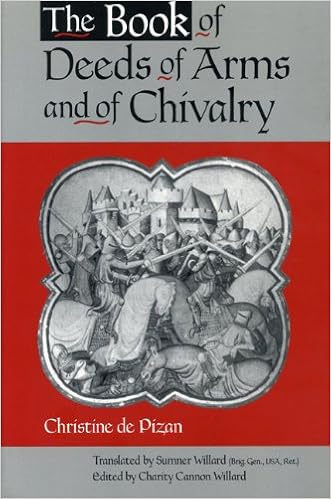
And for those that though Christine wrote just a bunch of feminist drivel (which it isn’t), she was also an authority on arms and warfare! (which you can find on Amazon, of course.)
And this is me just scratching the surface of the more well-known figures. I didn’t even get into the Renaissance yet, with Elizabeth I, Veronica Franco, Sofonisba Anguissola, etc.
You don’t have to wait for archaeological finds for proof. The information you need is already well documented. And while one day we will hit that gravesite or reliquary jackpot, we don’t have to sit on our hands until we do.
Now, go out and be badass, Ladies of the SCA. It’s period.
Thank you to everyone who contributed to keeping the page afloat! We are all set and ready to go for another year.
And now the good stuff:
Now that my crazy non-SCA costuming conventions and fun stuff are behind me, I can ease myself back from my Byzan-cation and start getting back to research. It’s always a good idea to let your brain cool for a bit and explore other things. I have another project coming up that isn’t Byzantine, but it’ll be fun to talk about.
I presented my master’s thesis on Kale Pakouriane’s clothing at the International Congress on Medieval Studies in Kalamazoo back in May. So there’s still plenty of Byzantine happening.
I went to Costume College! I taught at Costume College! I was pretty much the only medievalist there, hurray! Thanks to everyone who came to my classes at such inconvenient hours on Sunday. I am now totally inspired to sew all the things, but unfortunately, I can’t make it next year. Maybe the year after!
THL Gieffrei (The Norman Husband) and I are relocating back to the East Kingdom from Caid this coming winter. I swear, the Navy hates us. I’m not looking forward to that drive. Or facing the brunt of a New England winter after such a lovely respite in Southern California. 😦 On the bright side *snort*, I’ll be at Birka, barring no strange nuances of a military PCS.
That also means I will be at Pennsic.
There are some epic site updates coming. I’ve been working on re-writing some content of the fixed pages, and adding some new ones. That means a layout change soon, as well. I like changing themes every year or so anyway. It’s like changing socks, gotta keep things fresh. 😉
With that said, I got plenty of work to do. The whirlwind of events consisting of Star Wars Celebration, San Diego Comic-Con, and Costume College have WRECKED my house, and my poor workshop space. Time to get back to a status quo.
Sorry this took a bit, I was hoping to get a few more, but this is a good start.
I think I did myself, and everybody, a great disservice by saying I would help with general medieval information. I sat here and derped pretty hard, so, for future questions, please keep them limited to Roman/Byzantine only for my own sanity, and for the sake of the querents getting a decent answer. Questions can be sent to syrakousina -at- gmail.com. (remember to remove -at- and replace with @, no spaces.)
Libby: Do you know of a survey of band weaving finds from 13th century and earlier?
I’m afraid I do not. Since I don’t weave more than an inkle band here and there, it’s just not something I look for. If somebody else sees this, hopefully they can chime in down in the comments to get you where you need to go. You honestly will have better luck in a weaving group on Facebook than I can find you in 3 minutes of google searching.
Nicola: I am a fan of your blog and enjoy seeing your research and the work you do for your SCA persona and the community as a whole. I’m a LARPer over in the UK and was wondering how you keep the veils and layers of headdresses in place. The persona I’m currently playing is from medieval times but practical hints and tips would be very interesting to read about, if you’re willing to write about something a little more off topic.
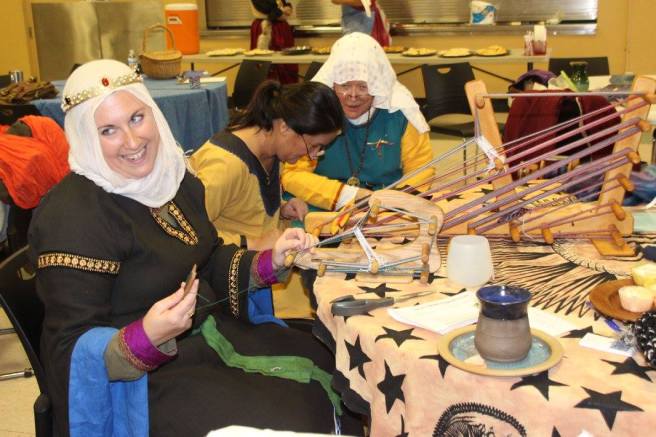
You need to use bands, and pin the veil to the band. This is a period method, and you can really impress your LARPer friends. I’ve used this guide now for years: http://www.virtue.to/articles/veils.html Now, I’ve made some adjustment since my hair was so short for years, but now I’m growing it out. I’ve found that in a pinch when my hair was in a pixie cut, white cotton headbands you can buy at the drugstore do the job since they really aren’t going to slide anywhere. Now that I have shoulder-length hair, I cap it up first. You can see it a bit here with my 11th Century veil. The cap beneath my veil holds back all of my hair, and then the silk veil is pinned over it, allowing my coronet to just sit on top and not have to be shoved onto my head, or cause more weight. The gentlewoman to my right in the veil is also wearing a cap beneath hers, and you can see the pins better.
Dyonisia: So I have been fascinated with hoods for a while now. I make them and end up giving them away. But i also want to get research information on them. My focus is from 1000-1600. I also am looking for any embroidery that are on those hoods. Any help would be wonderful.
I am also interested in shipping in the Mediterranean Sea. Looking at what was shipped and where they were going. I am looking at 1200-1600. Any resources ect. would help.
This is a really really REALLY broad topic that I feel could benefit from narrowing down into a specific time and place so you aren’t overwhelmed. Fashion changes a lot over the span of 500 years, and since you did not give a location, I’m going to tell you what I know regarding my area of expertise. I recommend breaking down your project and focusing on one hood from one place at a time, otherwise, you’re going to be overwhelmed and find nothing.
Disclaimer: I’m not an embroiderer, and as far as my personal scope of research goes, you won’t find much at least in the Byzantine area. They were more into woven designs that were appliqued on. As far as if this applied to hoods, I’m not sure. The Byzantines were not “hood wearers” like you see in the western part of the continent. The one hooded garment that you see commonly is called a “paenula”, a very simple hooded poncho that goes back to Roman times. After the 6th Century, you don’t see it too much outside of iconographic interpretation, which makes me think that maybe it fell out of style in the cosmopolitan areas during the early centuries, but maintained part of the traditional imagery we still have today. The climate in the Eastern Mediterranean is different than say, France, so hooded garments seemed to be pushed to the wayside for turbans, veils, and other headwear. Seeing gold work on turbans was common. The type of design is referred to as “grammata” in the original Greek, so basically golden letters, possibly pseudo-Kufic script. Of course, paenulae may have still been used in the countryside as a functional garment, but most depictions of working class Byzantines show little to no embellishment. Who the heck wants to clean mud off of expensive, time-consuming embroidery?
On the subject of your interest in shipping, again, you need to narrow this down. You have a 400-year timespan, and no specific culture or ports in mind. From 1200-1400, the crusades dominated the Eastern Mediterranean as well, with the Fourth Crusade wrecking the commerce of the Byzantine Empire for the remainder of its existence.
I do love your enthusiasm, but let me give you some helpful research tips to make your massive interests work a bit smoother in your favor. I feel like you really don’t know where to start, which is why you’ve asked me such broad questions, and that’s okay, we all have humble beginnings.
A good rule of thumb is: if your Google search isn’t coming back with anything, narrow it down until it does. “Medieval hoods 1000-1600” is going to probably give you a Pinterest, while “extant medieval hood” is going to give you images of stuff that is still around from museum databases. “Hoods worn in medieval France” is going to give you better answers. Head right to the Met or British Museum websites and look up their collections, they’re here to help! Same with your interest in shipping. This is where getting into the fun journal databases will be a huge advantage. You can even pop over to JSTOR and put in some search terms. I found this article first shot just typing in “medieval Mediterranean shipping”: http://www.jstor.org/stable/10.7722/j.ctt1kgqt6m Chances are, you have friends with JSTOR or library access that can help you get the material. If this is something you really want to focus on, it may be worthwhile to invest in an account. Who knows, you could end up getting enough material to write your own Compleat Anachronist! Good luck!
Marc: I found your blog via a search on Byzantine costuming – and noted that you’re up to answering questions about same.
Well, I have a perhaps atypical one: I’m finishing in the details of a story set in early 14th Century Trebizond, and I haven’t been able to put together visually a wedding dress for one of the legendary Trapezuntine princesses. I have some vague piecemeal ideas, shoulder panels covered with pearls, etc. and I can draw a little from Pisanello’s St. George and the Princess of Trebizond, but I really can’t imagine what a wedding gown at that level of Byzantine society would look like – particularly the colors.
Hopefully this gives you the answer you’re looking for. I could cite it, but having the whole article in your face is probably better than whatever I could blab. Good luck with your novel!





















 Anna's New Rome
You must be logged in to post a comment.