Surprise! Icon!

I took a break from iconography for a while because I felt like my art wasn’t up to snuff, and I was thinking of giving up. By the way: never give up. I had the pleasure of working at the Museum of Russian Icons over the fall semester of 2015, and I learned a lot while I was there, including getting the change to work with the entire inventory, and examine, and touch, period icons. While I was there, I went ahead and purchased some better accurate pigments and more gold, and decided it was time to get back into the swing of things. Initially, I was going to try my hand at turning an icon into my husband’s backlog scroll for the Order of the Silver Crescent, but then I got an offer I couldn’t refuse: Konstantia, my blue twin out in Calontir, was to receive her Herald Extraordinary, and the now-Gold Falcon Herald, Uji, invited me in on the shenanigans.

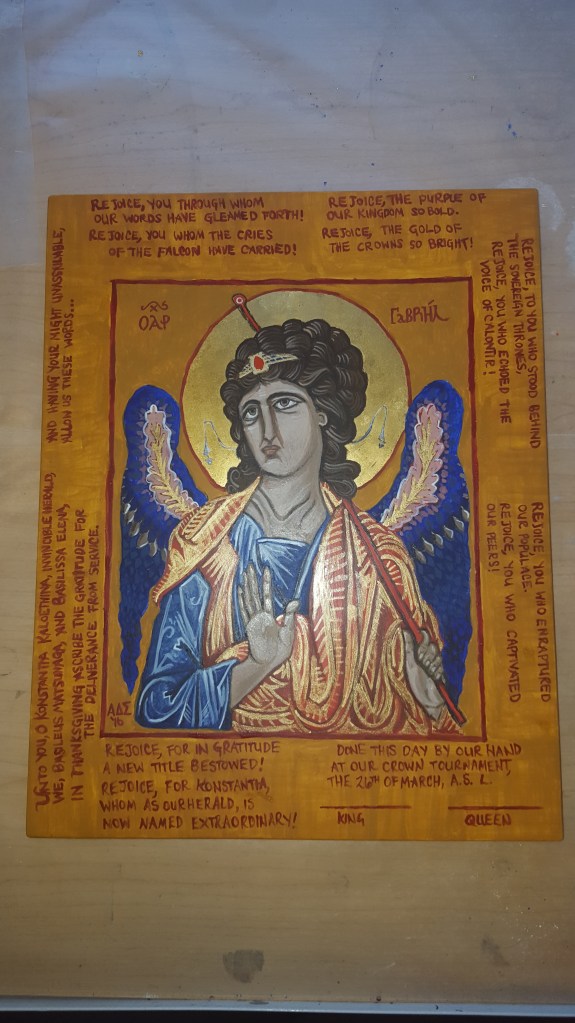
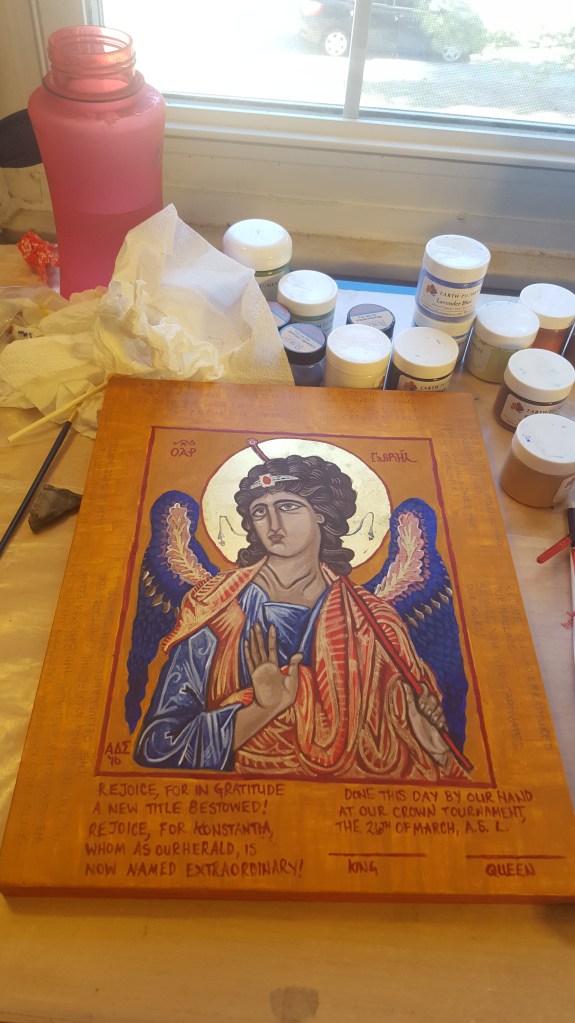
Initially, I was asked to just do the words. Here is what I came up with instead. Oops?

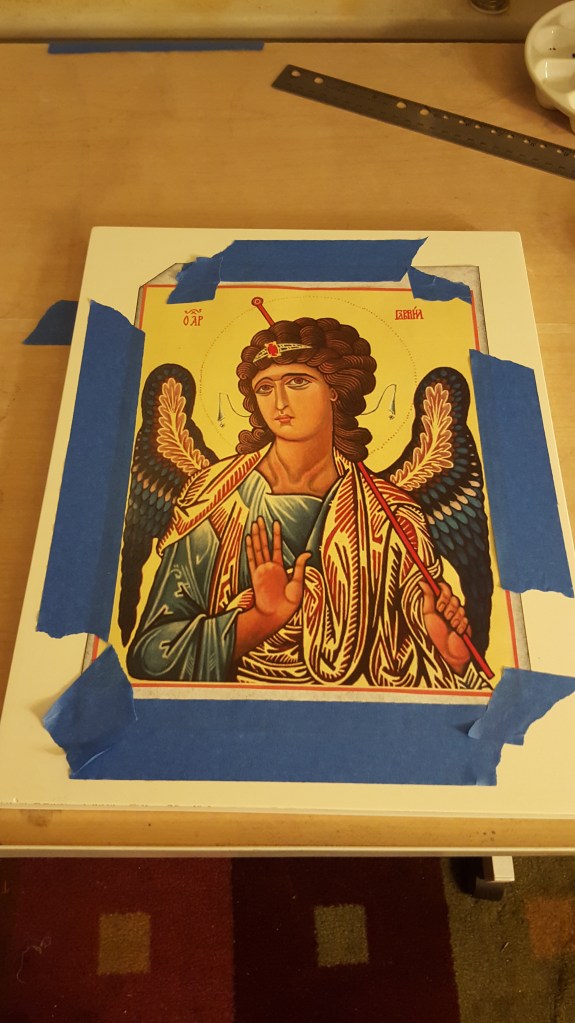
First, I purchased real icon boards from Pandora Iconography Supplies. It doesn’t have a kovcheg (recess), but that’s because those are expensive. Each 11×14″ board is $55 a piece as is, and custom made upon ordering.  I tried my hand at gessoing my own panels, and uh, yeah, nothing beats the real thing by the professionals, even at the price.

So I laid it out, as you do. The pattern is from an actual 13th Century icon of St. Gabriel the Archangel (Herald of God, and the end of the world, and stuff.) and is still popular today.
20160303_215856 20160303_222345

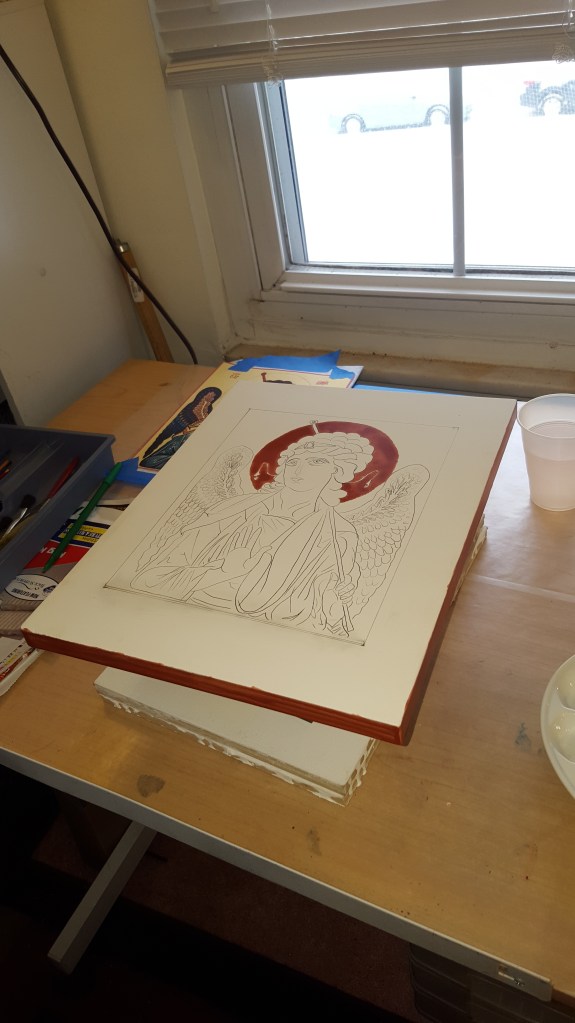
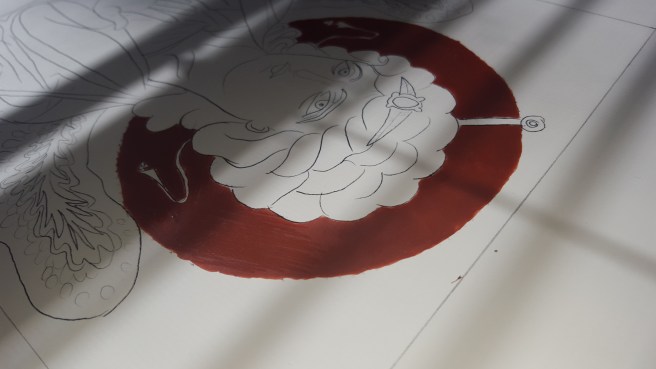
Then I prepared the halo for gilding with real red clay bole, which I also purchased from Pandora. As you can see this go around, I also bole’d the edges. This is something I learned at the museum. It symbolizes the artist being mortal, and rough around the edges, therefore, it doesn’t get sanded and burnished like the halo does.

20160304_102826 20160304_103611

Note the thickness of the application here. This is vital to a good leaf adherence. You literally just puddle the liquid bole on, try not to get air bubbles, and let it dry.

20160304_114444

After the nice thick layer of bole dried overnight, I burnished it with agate to bring out that blingy shine.

20160305_091713 20160305_091741

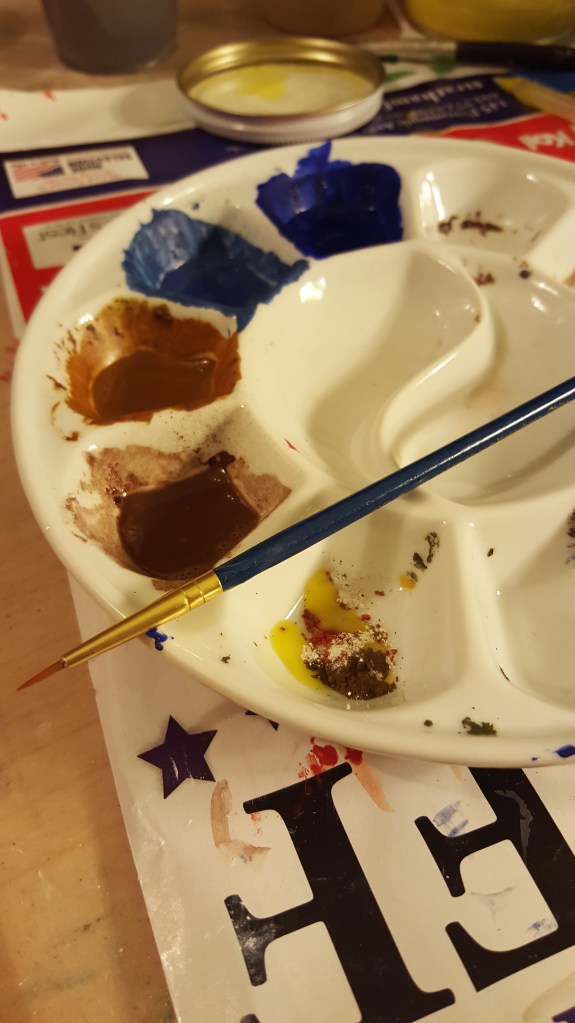
After the gold leaf (23kt double gold in this case) was down, the sankir and roskrish are applied, including real vermilion for the cloak. That’s mercury sulfide. You know, death in paint form. (To quote my  grad school classmate and fellow SCAdian Wilhelm: “Only in the Middle Ages could something so mundanely boring potentially kill you.”) The stuff was like painting on a cloud though, but at $18 for a smidgin, I don’t see myself using it all the time. This was a special occasion that warranted potentially poisoning myself.

20160307_190411

I tested the shell gold on the vermilion once it was dry to see how it would turn out, and decided yes.
20160309_093026

And the highlighting process begins, with poor Gabriel looking as if he literally can’t even.

20160309_094611 20160309_182718

Some hot dry pigment action:

20160309_184730

More highlighting:

20160309_195952

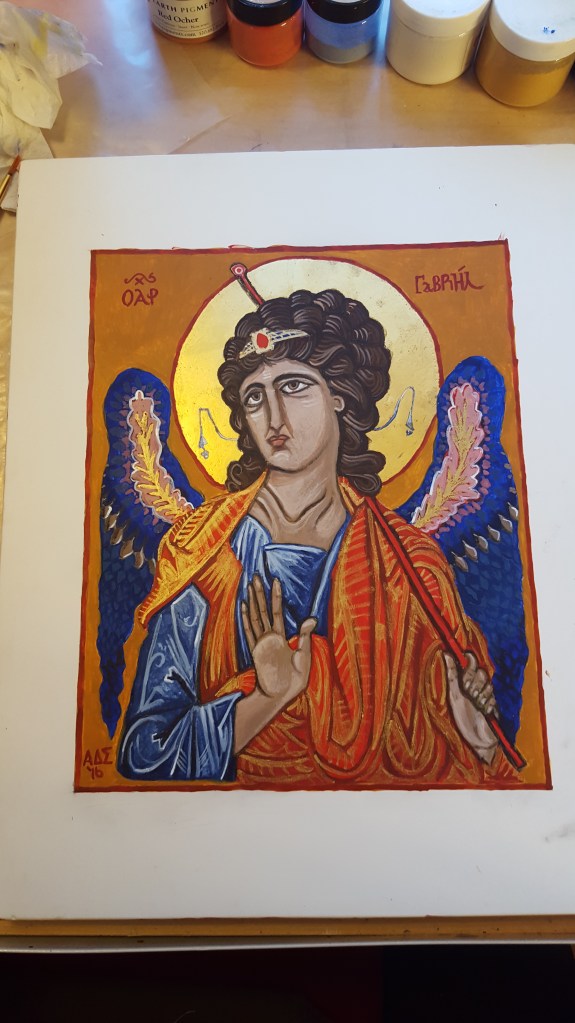
And then ALL THE SHELL GOLD. OMG, SO MUCH GOLD.

20160310_214102

*BLING!*

20160310_214110

Roll that beautiful inscription footage, ah yiss…
20160311_152625

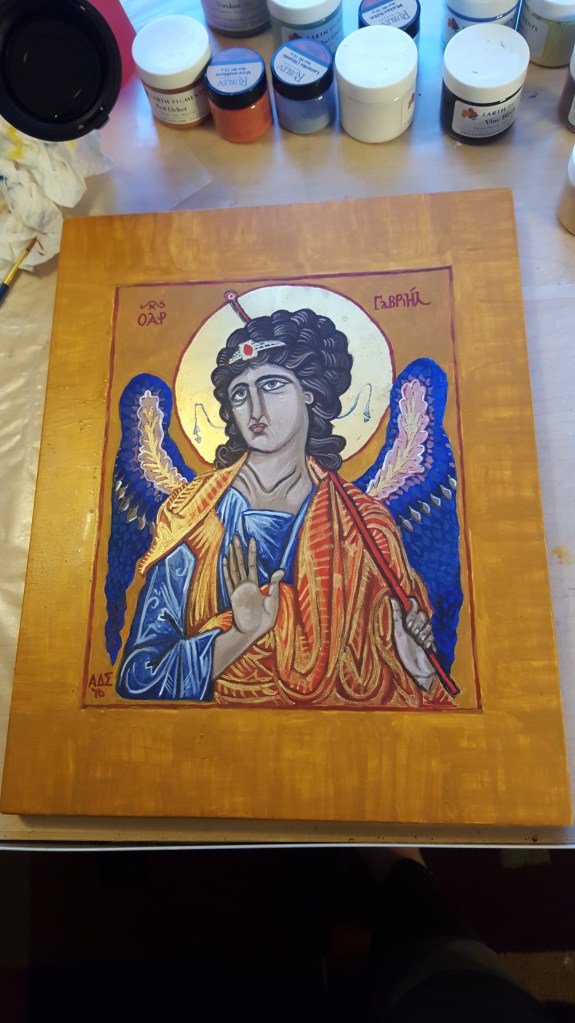
And then, the actual “scroll” wording needed to go down. I based this on some period examples of text included in the borders of icons. I need to work on my lettering, but I think I did a fair job, considering this is my first icon “scroll” ever. I kept with the plain yellow ochre border, as it was an extremely common choice in period. It’s also affordable and predictable.
20160311_155849 20160313_142629

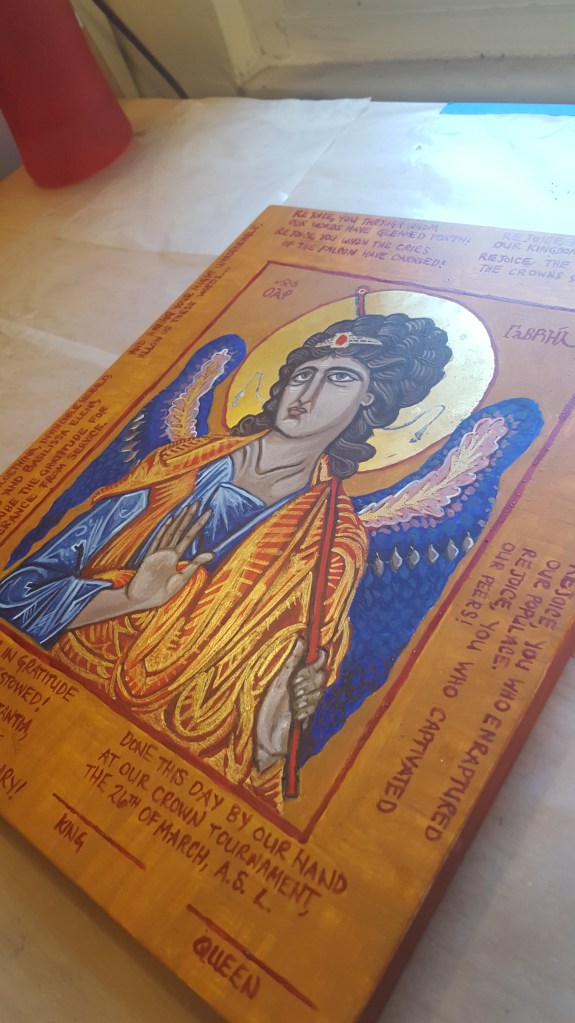
And DING! SCROLL IS DONE! Words are based on the Akathistos Hymn to Mary.

20160313_161427 20160313_161513

Gabriel can’t even. Literally.

20160313_161542 20160313_161609 20160313_161616

Obviously, I had to send it from the East to Calontir, and I managed to sneak it in the mail the day I left for Spring Break. Now that it’s signed, she needs to send it back so I can apply the oil varnish and make sure that it’s protected properly.

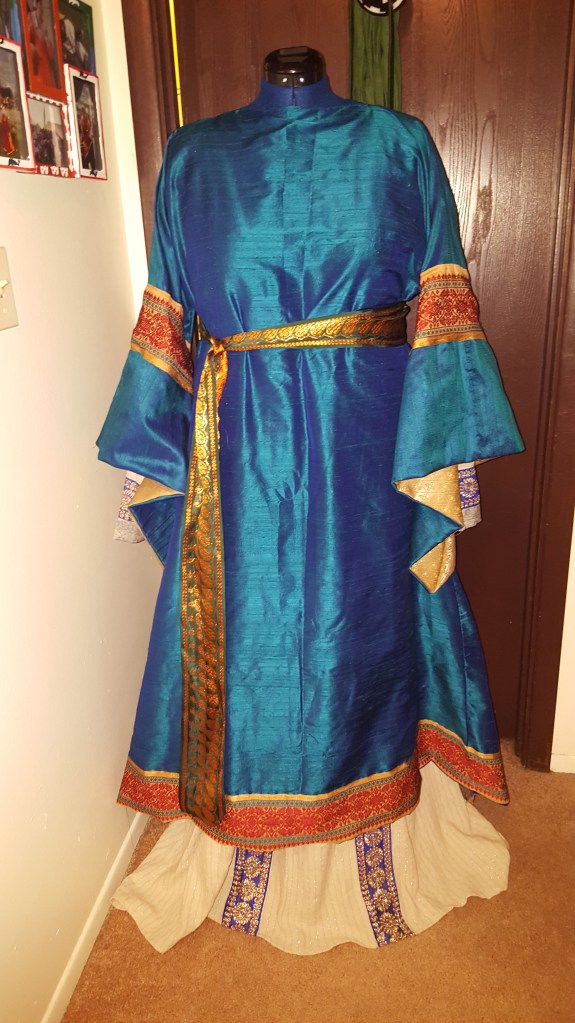
Oh, the kicker? I did her garb for her Stepping-Down from Gold Falcon, and surprise Herald Extraordinary bestowal as well. 😉 Which at least, she commissioned and knew was coming.
20160304_180521

I am so dead the next time I see her. *shifty eyes*

The Importance of Mantles in Middle Byzantine Fashion

This is a very short disorganized blurb, and I apologize, but I wanted to get some notes down from what I’m exploring as far as my thesis goes.

As I’ve mentioned previously, my master’s thesis is exploring the last will and testament of Kale Pakouriane from 1098. I’m going into her inventory and trying to reconstruct her life from her material culture. One thing that really sticks out is the amount of mantles she has.

There are three different words for “cloak” or “mantle” in her will: mandyas, which I’ve already written up as the semi-circle one last year. The sagion, which was evidently shorter, apparently knee-length versus ankle-length, this is something Parani points out in Reconstructing the Reality of Images, and then the one line where my translation was getting extremely confused because of words is a garment that was allegedly called the thalassa, or “sea”. It was another type of cloak, but according to Dawson in his article within Varieties of Experience, there’s only a few mentions of it in written history, namely De Cerimoniis, where Constantine Porphyrogennetos refers to it as a gift for royalty, and in Kale’s will. He’s not sure why it’s named this, but narrows it down to having to do with a particularly luxurious fabric that could vary from a specific shot silk from the Arabian peninsula, or a blue/green/gray dyed COTTON from Persia or Hindustan. We just don’t know, and may never know.What this does mean, however, is that it was particularly luxurious.

What this project has taught me so far was that these mantles were a way to show off wealth and probably protect your equally luxurious clothing. Kale had an impressive wardrobe. I just ordered the French translation of the will and the scans of the actual Greek document. $200 later. Academia is stupid.

I know this is going to raise a lot of questions, but I don’t have all the answers yet. Please be patient while I work on this. My mundane life and graduate degree must come before anything SCA. I just wanted to get this information out. These little nuances will greatly change how we should project ourselves in 11th Century Byzantine clothing.

Tonight’s post is being brought to you by the world “subtle,” and viewers like you.

I thought I would do something more fantastical for my 100th blog post, but no.

I’m sorry, I’m going a little thesis stir-crazy after a long day of frustrating research in three languages, and I need to let my brain leak out of my ears a bit.

So here’s a self-portrait:

byzantium

Fantastic updates will be coming soon! I just need to go through pages of handwritten OH GOD WHAT IS THAT and formulate a public post from it.

Painted linen wall hangings

I managed to get back to the Met last month, and spend a whopping six hours there, never getting off the first floor. Again. Well, except for the Roman study rooms, but I digress. They have a really neat exhibit right now under the stairs in the Jaharis vault (where my favorite tunic was) that shows off some very cool painted liturgical linens from the late Roman/early Byzantine Egyptian period.

I’m going to start trying the technique, as it doesn’t look too daunting, it’s just egg tempera on linen, either pure white or dyed indigo. I figure if I can frame the fabric in an embroidery apparatus, it should work. As far as I know, the fabric wasn’t sized or gessoed prior to painting, at least it didn’t seem that way, so this could turn into a big mess. Should I succeed, I see a very nifty, period way to display heraldry indoors.

Here are the photos that I took, but if you can, definitely get to the Met and see them in person. The exhibit link is here: http://www.metmuseum.org/exhibitions/listings/2015/new-discoveries


And for my next trick…

So I totally lied about doing updates over winter break. I am working on some sewing, but for the most part, I wanted to give my poor burned out brain some time to unwind after a particularly difficult semester.

Here’s a few important and interesting updates:

In June I will be relocating from the East Kingdom to the Kingdom of Caid. This will be a short-term relocation with an inevitable return to the East due to my husband’s naval career, but it will definitely affect my attendance at events to teach. I am planning on Pennsic this coming summer by flying into Pittsburgh, but I will NOT be at 50 Year. As much as I’d love to go, the timing with the move is making it impossible, and there is no way around this, as mundane life comes first.  However, I am looking forward to infiltrating, I mean, attending, new events on the West Coast for the short period of time we will be out there. I will know more about schedules and such after the move and once my own employment is sorted out. Right now the ultimate goal is to secure temporary work as adjunct faculty within the San Diego Community College District, but there is no guarantee I will be offered a teaching appointment. But this blog isn’t about mundane stuffs…

The cool news is that this is the semester of The Thesis:

thesis_defense

For my final project of my master’s degree, I am exploring the material culture of the Last Will and Testament of Kale Pakouriane, an 11th Century patrikia who entered a convent upon being widowed. I will be making a selection of her things.

MAKING THINGS. BYZANTINE THINGS. FOR THE SCHOOL LEARNIN’S.

I have not settled on which things yet, her inventory was impressive and I have three months. The primary goal of the project, in addition to making things, is actually attempting a reconstruction of her life from this inventory. This obviously includes her wealth, but also tangible goods, why she made the bequests that she did, and how class structure affected her decisions to leave lower household members with significant inheritances from her estate. I’m very excited about this project, and the bulk of my upcoming posts will be regarding this. I’m considering making a mundane blog for it, but I need to go over requirements with my academic committee first to see what they recommend. Either way, anything posted on a separate page will be mirrored here for the benefit of the SCA. Once completed, I’m going to submit it for publication in the form of a Compleat Anachronist.

I also have a short research paper on the Perception of Women during the Ancient Greek periods that will be published on the East Kingdom Gazette this week. Once that goes live, I will re-press it here.

I hope everybody is having a splendid New Year so far, and I look forward to sharing my progress on this epic project!


A very merry Anachronistic and Impulsive Arts and Crafts Weekend at Anna’s Rome!

This is what happens when I catch a cold, miss an event, and decide to not do homework. When I’m sick, I get bored, and when I’m bored and hopped up on cold medicine, well…I needed to tinker.

Edited on 9-28-2015 to add finished pictures.

PROJECT ONE: WEAVING THINGS.

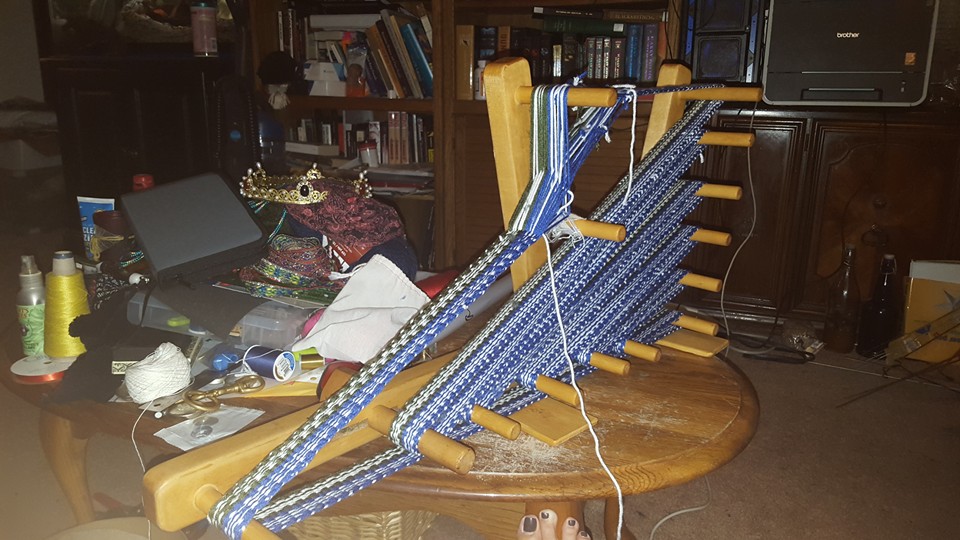
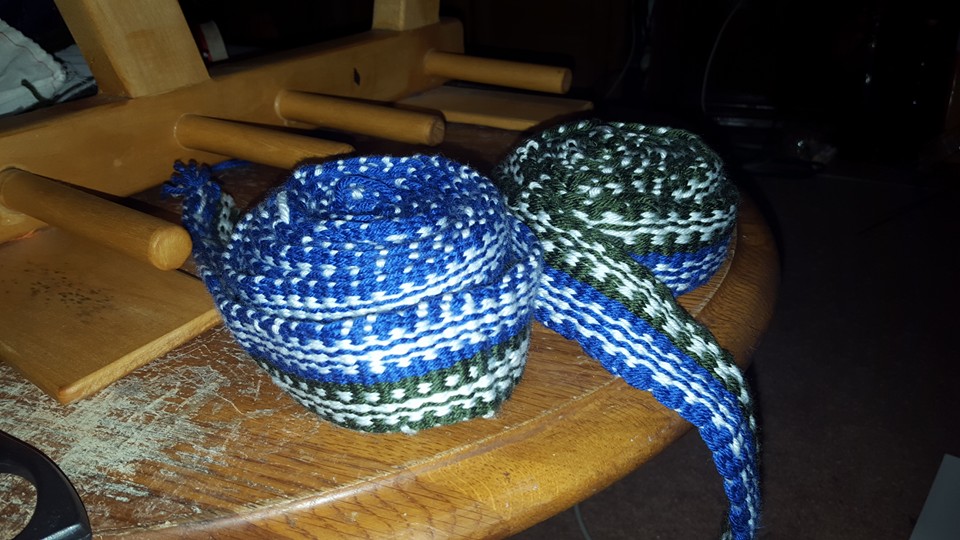
Well, I started by warping up the inkle loom and making the Norman husband a pair of leg wrappings in his heraldic colors. They’re pretty crappy in some places, and hence, leg wrappings, rather than trim.  This is the first full 6 yard band I’ve ever made!  Material is acrylic yarn, because I wanted them thick,washable, and low-cost in case of it turning into a cat toy. I did okay though, so now I’m more confident in trying wool yarns for the next batch. I finished this in a day. I warped it Saturday night and by Sunday night the band was complete. I was a MACHINE.

weaving1
The pattern when I hit my stride.


fullloom
FULL LOOM! And a coffee table full of craft supplies.


weavingdone
BOOM! A pair of leg wraps at 3 yards each, about 2.5″ wide.


PROJECT TWO:  SHINY THINGS.

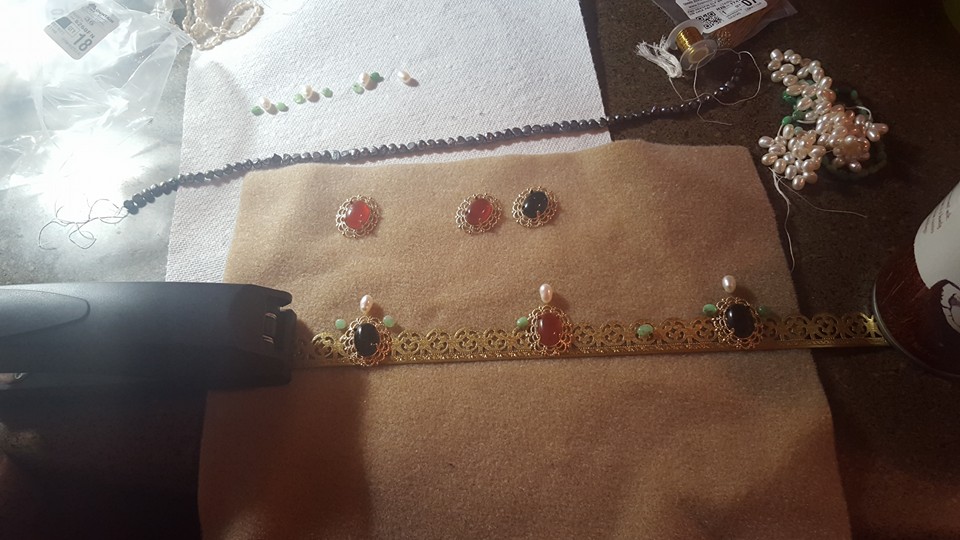
Oh yeah, see that coronet on the table? I made that too. Norman Husband challenged me to make a coronet with him out playing Navy. Him not around left with me NO METALWORKING SUPPLIES. So, I had to play, and go buy a new beading pliers set. And JB Weld. I could NOT have done this without clear 2-part epoxy. G-S Hypo Cement did not cut it except for gluing the band itself together and the cabochons onto the settings. It did not hold the settings onto the band. I’m still not 100% finished with it, when I am I’ll post finished pics.

coronet1
I set up a “coronet bar” on my kitchen counter, because it’s high enough for me to not hunch, and I have great lighting. Findings are just some vintage brass lamp banding and shiny bits from Fire Mountain. Stones are real carnelian and onyx, and pearls. Lots and lots of freshwater pearls. Not only very period, but also my heraldic colors.


coronet2
Epoxying the cabs on the band.


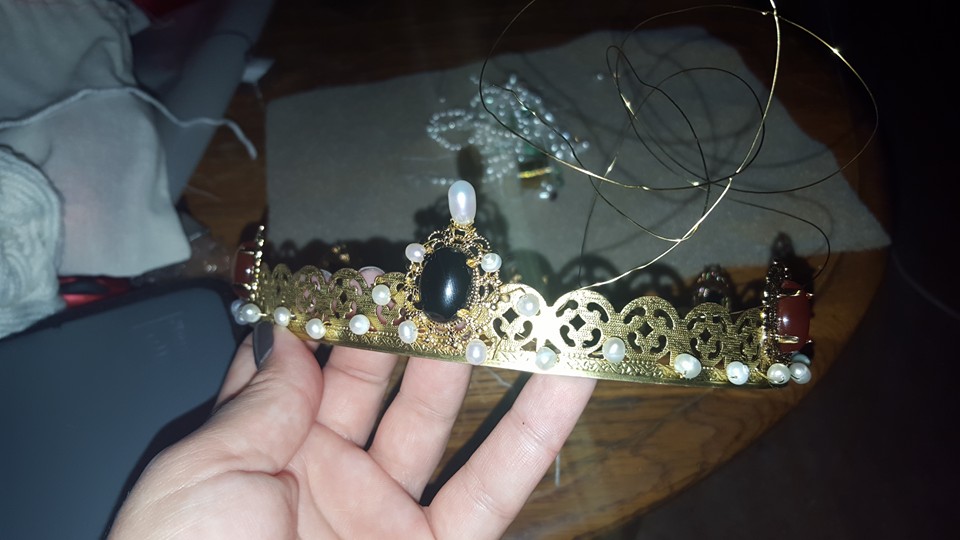
coronet4
It didn’t look so bad the way it was, but you know, Byzantine…


coronet5
Lotsa Byzantine. I’m just attaching the pearls by weaving wire through openings in the brass.


coronet6
I marathoned the original Star Wars Trilogy while I worked on this. It gives you an idea of how long it took. Here it is almost done with some Darth Vader.


coronetdone
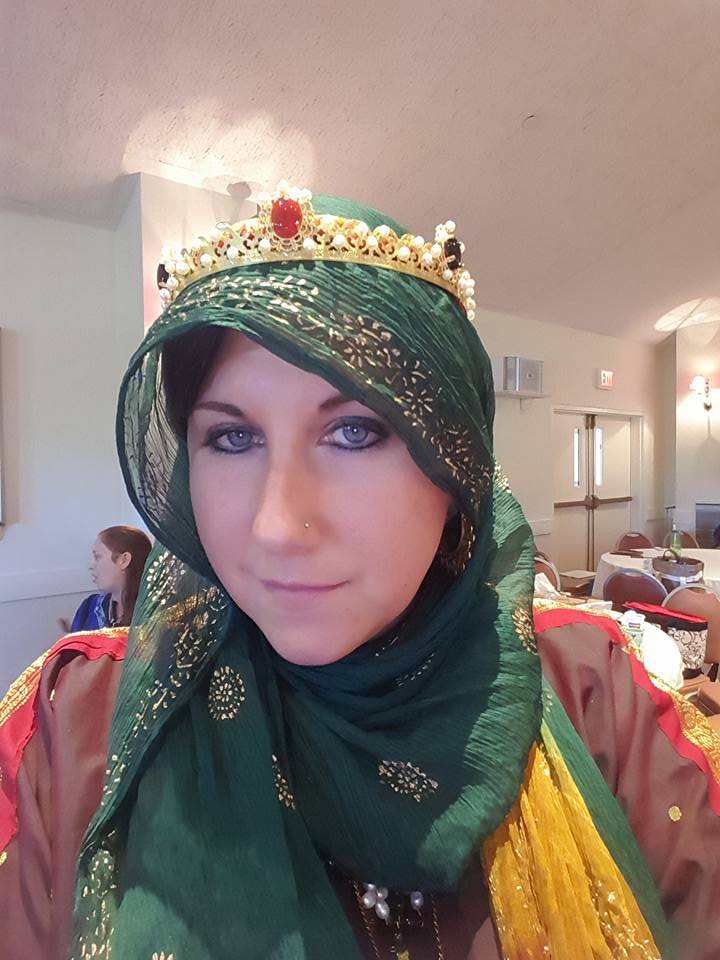
Here it is on my head. I think the top pearls make it look too Western (boo hiss), so I’m going to cut them off, and replace them with round pearls. I could have gone WAY OVER THE TOP with this, and wanted to, but I was talked out of it, and I’m glad.


coronet_pendilla
I added rings on each side near my temples for a pair of pendilla to hang from. I don’t have the pendilla made yet, and I don’t ALWAYS have to wear them.

Finished coronet as of one week after I made it, after removing the top pearls, replacing them with smaller ones, and lining it with orange velvet:

coronet_Finished1 coronet_finished2coronet_finished_on

Notes after wearing for an event: Too much padding, it didn’t want to stay put. I know coronets are jewelry and not a headband, but still. I’m going to try a different method before I wear it next. Also,  I got a lot of compliments on my veil. All it is, is a green/yellow/red ombre dyed Indian dupatta. It still smells like batik. I wrapped it and tucked it into my belt in the front based on some icons and manuscripts I’ve seen.

No, using vintage lamp brass and epoxy aren’t exactly period techniques, but it creates the illusion for now until Norman Husband completes the Hagia Sophia of Coronets he’s promising me. Plus, this is dainty and clocking in at 1 3/4″ at the tallest, so it works for periods I wear that AREN’T Byzantine.  I’m not a jeweler, and especially not a hat maker, so even three days later my hands are KILLING ME.

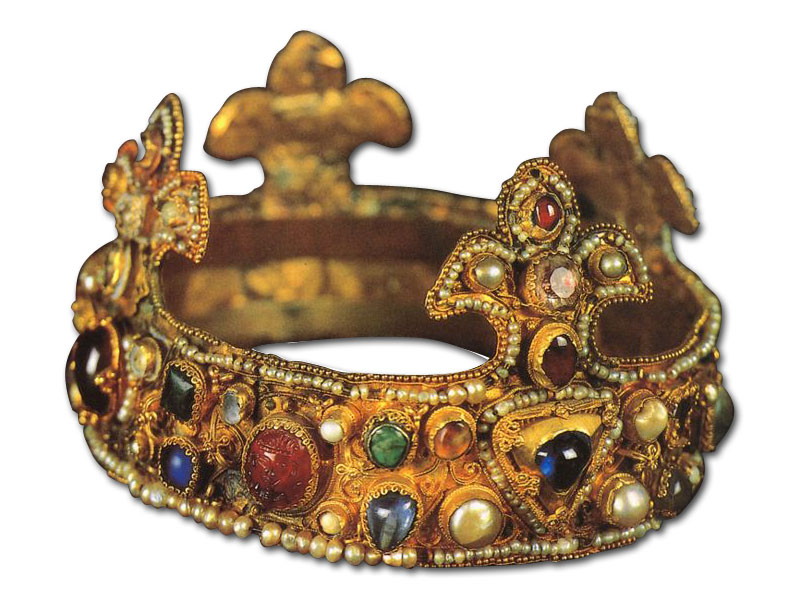
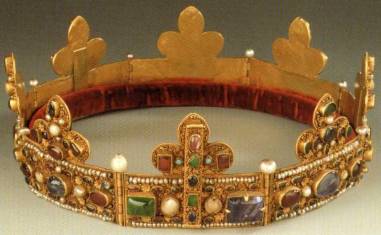
Here’s a couple of Byzantine crowns that I pulled some [vague] inspiration from. They didn’t always wear votive crowns and massive tall hinged plaque things of doom.

Romanesque_crown byzantine_crown1


PROJECT THREE: MODIFYING THINGS.

And last but not least, OMG SHOES.

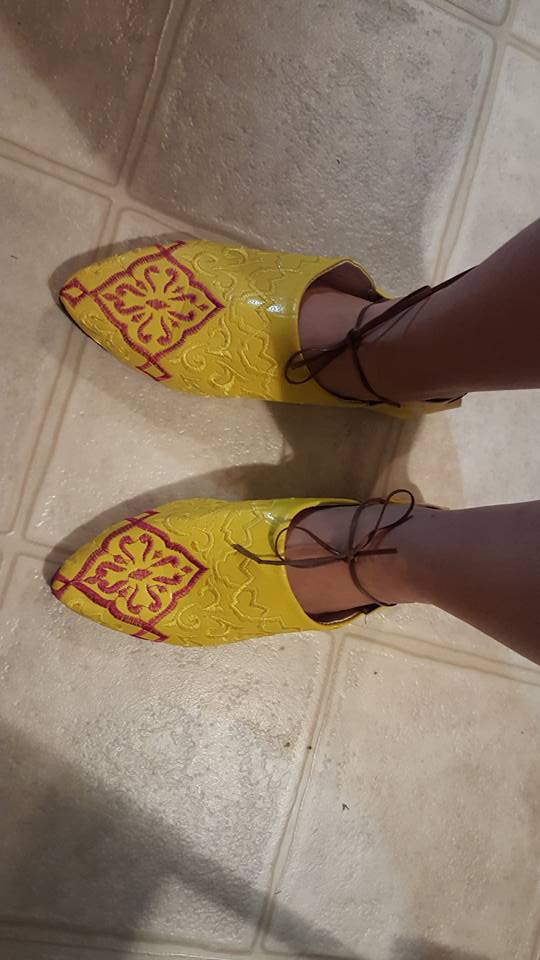
If you read my previous post, I made a blurb about what color shoes are appropriate for a Byzantine persona. As a court baroness, I could get away with yellow, so, I wanted to see if I could invest in a pair of proper Eastern looking shoes. Unfortunately, most medieval cordwainers don’t make Byzantine or Middle Eastern shoes (that’s a hint, folks) so I had to improvise. I hate HATE HATE wearing Pakistani/Indian Khussa, because they eat my feet alive. Even if I shower with them on, or wet my feet, they just never break in, and rip me up. That’s no fun. So some searches yielded Moroccan Babouches. These are actually pretty perfect, except that they’re  backless. Now, extant mules have been found, and are still worn in Turkey today, but I hate backless shoes, mostly because as you can see in these pics, my feet and ankles are very narrow. It makes mundane boot shopping a crappy experience when the material just pools around my ankles.

shoe1
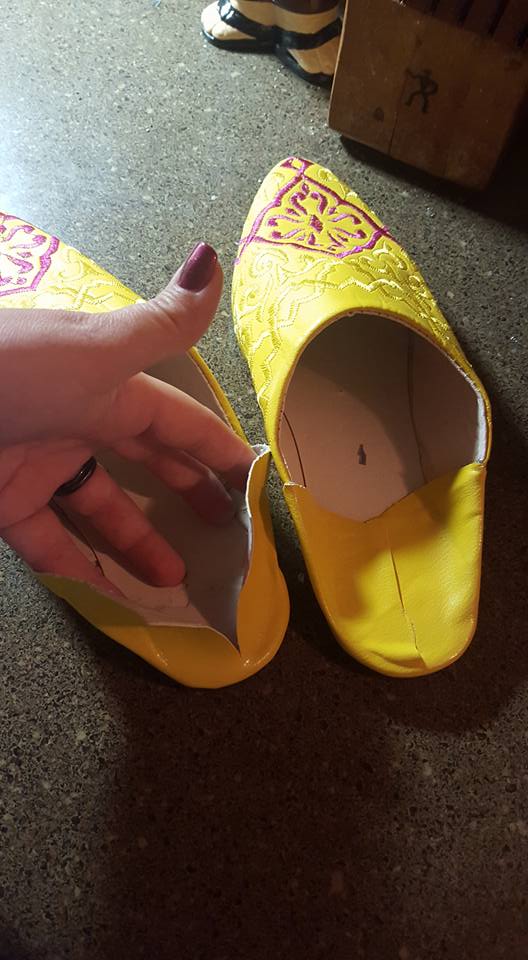
I found these super awesome embroidered babouches on Etsy. They look very…Calontir.


shoe2
I ripped the backs up to find that they’re designed in a way that you cannot fit your foot in comfortably, so, I split them down the back.


shoe3
Cut holes with scissors on cutting board, because husband brought leather tools with him while playing Navy. Find random leather strap in his leftover stuff, and lace.


shoe4
Experiment with lacing.


shoe7
Walk around and immediately get blister.


shoe8
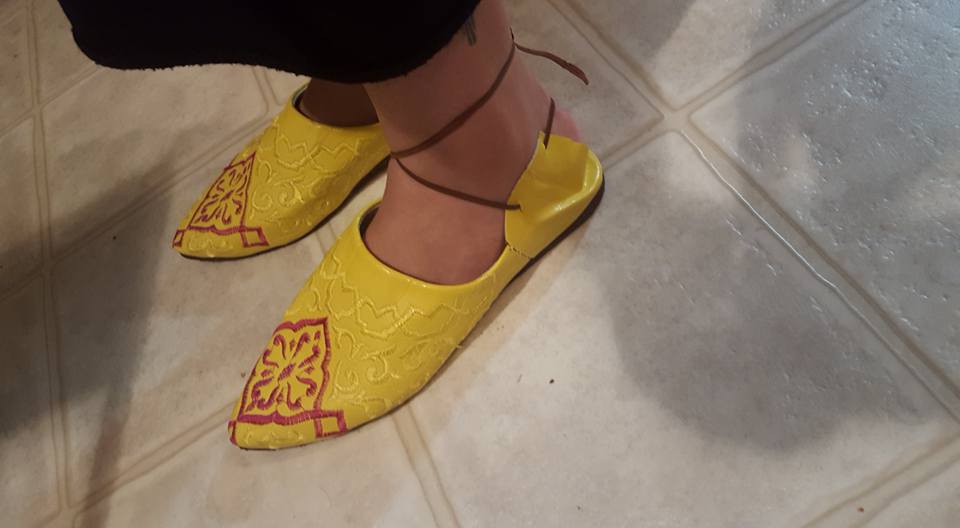
Tie them in the front. Ah, that’s better.


shoe9
Side view, they don’t look horrible. However, taking pics of your own feet is kind of tricky.

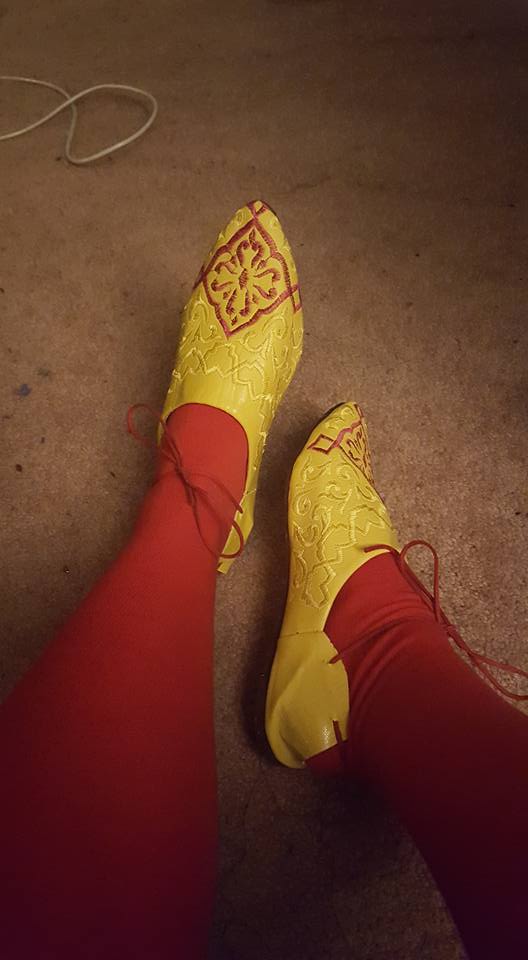
Shoes with better lacing and my red stockings:

shoes_stockings
I just felt so damn sassy.

Period shoes that gave me this horrible idea:

byzantinechucks
We called these the “Byzantine Chuck Taylors” on Facebook. No, the backs aren’t open. I know. I know. I IMPROVISED, OKAY?


byzantinemules
A pair of Byzantine Mules dated to 300-700 from Panopolis. Here’s that backless option for those that aren’t afraid of flat tires and don’t have feet that fall out of everything like I do.


The ones I made are clearly going to be “inside event” shoes. I’ll wear them with stockings in hopes to combat some of that extra width while the lacing will stop my feet from falling out. The best part that is if I want to, I can pull the lacing out of my shoes and flatten the backs again into mules.

Again, like the coronet, I’m creating an illusion from modern materials. Once I’m done with my master’s degree and move across the country, I’ll have time to work on making an actual pair of period leather shoes with gold leafing that WON’T be too wide for my feet and involve kitchen surgery. And maybe I’ll learn some metalworking so I can help my husband in making a proper hinged 11th Century coronet, but until then, it doesn’t hurt to use your imagination in the little game we play.

If the shoe fits, what color should they be ANYWAY?

Oh red shoes. Byzantines and red shoes. Wear ALL the red shoes, but…should we be wearing the red shoes?

In the SCA, we’re all playing nobility, but we still have a hierarchy. Granted, it’s nothing like a true feudal system, but we still have ranks and titles that come with it certain privileges in dress. A knight or master of arms is a fine example with their right to wear a white belt or baldric. In the case of the Eastern Romans, shoes played a huge part in who you were and what job you did.

Red shoes are imperial in nature. Done. Story over.

vader
This is me getting my dreams shattered.

This started because I was pondering joining the Red Shoe Club under the urgings of a duchess friend from Artemisia. Prompted for documentation that women wore them, I turned to my favorite, expensive source on the matter: Reconstructing the Reality of Images by Maria Parani. (Best $300 I ever spent on one book.) I seriously refer to it as my Book of Armaments.

grenade3
Oh Lord, bless this my book of Byzantine goodness so that I may dress snazzily, with thy mercy!

Parani pulls no punches in that she states that documentation for women wearing the red shoes is scarce (pg. 30.). I have yet to follow up her footnotes, but she cites Michael Psellos on the fact that the Empresses did wear the red shoes, and then Anna Komnene on that women wearing them in the absence of a male heir was rare.  Veering away from shoes momentarily, this is something I’m noticing a lot in the ways of court dress and titles: the women often wore what their husband were wearing. They took their titles, and they took their clothing privileges. So in the case of a solitary female ruler, she may not wear the red shoes in the lack of a male consort. We look at this now as incredibly misogynistic, but this is how the world worked for centuries.

In period, I would have a husband, and he would be the hypatos (consul), therefore, as hypatissa, I would be allowed to mimic his clothing and regalia for court functions. In the SCA, my husband is not a baron, so I stand alone as a baroness. This is common in the game we play. So this is when you need to think with your persona, versus thinking as a SCAdian. Of course, if I really thought as my persona, I wouldn’t be in Byzantine dress most of the time anyway, I would be in Norman dress.  Gross. But I digress.

So, if red shoes aren’t an option unless you’re on the throne (and consequently, a royal peer having already been ON the throne and have in excess a wardrobe of royal lovelies) what choices do you have?

Parani herself seems to uncover several color options. In addition to the Imperial red, there’s yellow, blue, and green. Like all things Byzantine, these change over the course of history depending on what the emperor ate for lunch.  There is one citation she gives in which in a manuscript dated to the 10th Century, Pontius Pilate is seen wearing red shoes. (pg 82.) Is this evidence that non-imperials were wearing red? Hard to say. Personally as somebody who’s been reading up on iconography, such things could be used as symbolism. Perhaps to this artist, Pilate had feigned imperial power?

The general information I can compile (without just regurgitating Parani’s words, which is uncool anyway) at least for the re-enactor/re-creators looking for shoe ideas, is the following:

Yellow: Prefects, and then later the panhypersebastos (patrikoi within high favor of the Imperial Family) (pg. 71-72, 82.)

Blue: The Kaisar and Sebastokrator, usually immediate family members to the Emperor and maybe in line for the throne. In the Palailogos Dynasty, the Sebastokrator would have eagles embroidered on them. (pg. 71-72)

Green: Protovestiarios, the head eunuch in charge of finances.  (pg. 71-72)

Red and White with eagle embroideries: The Despotes, title of the heir-apparent during the Palailogos Dynasty. (pg. 72)

One red, one black: Chronicled by Arab geographer Ibn Hauqal as being worn by the Prefect in the 10th Century. (pg. 71 n. 83.)

That doesn’t leave a lot of options for SCAdians looking to stay in their persona. It would make sense for the Prince and Princess to wear blue, and I don’t know many eunuchs (not that they’d tell me anyway.)

So this really narrows it down to well, yellow. But who would wear it? Well, in some definitions, prefects were regional governors. In Greek the term is Eparch. From what I can gather, an eparchy was more of a district than the themata, which were ruled by the anthypatoi, or proconsuls.

But in the SCA, who would we place in these positions? My previous post discussed the equivalence of the anthypatoi with landed baronage, and hypatoi with court baronage. A barony is still an administrative area that was governed. But is this something that should be limited to just the SCA baronage? Ehhhh…maybe? I think this is going to be one of those “let your persona do the walking” things. I have yet to see a kingdom in our game that has sumptuary laws on shoes. Your best bet would be to study your own period and come up with who you want to be. Nobody is going to stop you as a lord or lady from wearing red shoes, but do you personally want to feign claim to the throne? Impostors got blinded in period. That doesn’t sound like much fun. And as far as the panhypersebastoi are concerned, that was any family that was in high favor of the Imperials in the mid 12th Century. So if you’re a later persona, that’s an option, especially if you’re in a kingdom where populace swearing fealty is common. If you’re in an office that swears fealty, absolutely.

On that note, I’m going yellow shoe shopping.

Friendly note: Historians love to argue, and this is information from ONE source. Although Doctor Parani’s work is very thorough and well cited, there are possibly other historians that disagree with her and have their own evidence. Don’t take this as the gospel truth, and feel free to explore other resources.

How to Upgrade: Byzantine Style.

Yesterday, their Majesties of the East sought to award me the title of Baroness of the Court. Not only am I greatly humbled by this, but it really couldn’t come at a better time research-wise.

20789642116_9cfac7bb16_o

Myself, as well as Ioannes Dalassenos from Ansteorra, and Konstantia Kaloethina, currently Gold Falcon Herald of Calontir, are in the process of compiling alternate titles that may better suit the Byzantine persona with the ultimate goal of approval through the College of Heralds. Once the research paper (yes, paper) is ready, I’ll make a special tab for it here on my blog so it’s always easily accessible, but until then, here’s a little sneak peek.

The Eastern Roman Empire (As well as the Holy Roman Empire, which as all of us REAL ROMANS know, was not Holy, Nor Roman, and questionably an Empire) did in fact bestow honorary court titles like we do the court barony in the SCA in lieu of the landed titles. In the case of Byzantium, they were still using the classic titles of consul and proconsul, only, you know, in Greek. In this case, hypatos and anthypatos, hypatissa and anthypatissa respectfully for the feminine form. Some records show that the title of hypatos (consul) was given honorarily, and that anthypatos was used for governors over themata, or states within the empire.

So, as far as the SCA structure goes, a court baron/baroness could totally use the titles hypatos/hypatissa while they’re landed counterparts could be anthypatos/anthypatissa!

We really can’t wait to share this research with everybody, and hope that the new ideas catch on. Using titles actually from the periods we are portraying are one of the little things we can do to help up the authenticity of our game. Everybody should give it a shot.

In service,
Hypatissa Anna Dokeianina Syrakousina. Say that sucker 3x fast.

angjeff_equestrian
I’m so classy, the culprit of coronet crafting: Lord Geoffrey, is sitting behind me.

Further reading:

Bury, John Bagnell (1911). The Imperial Administrative System of the Ninth Century – With a Revised Text of the Kletorologion of Philotheos. https://archive.org/details/imperialadminist00buryrich

Kazhdan, Alexander P., ed. (1991). The Oxford Dictionary of Byzantium.

Pennsic class materials posted.

As always, I have posted my class materials on Google Drive. Don’t forget to visit my Classes tab to access handouts and modules from previous classes.

The Orient Express: Did the Byzantines wear Persian?: https://drive.google.com/file/d/0B4jf5ZhBMl5xY3phVU5FSFlyVlk/view?usp=sharing

Deconstructing the Metropolitan Museum of Art’s “Tunic Under the Stairs”: https://drive.google.com/open?id=0B4jf5ZhBMl5xWGVQSVNoWDBSejg

Color images: https://drive.google.com/file/d/0B4jf5ZhBMl5xazJuSHZDY0gwdUE/view?usp=sharing


If you would like a high (or higher) res image from the handouts, shoot me an email. 🙂