Anachronistic and Impulsive: A View of Classical Civilization and Byzantium in the Current Middle Ages

The Propoloma: A headdress of the Zoste Patrikia and other high ranking women in the courts of Eastern Rome
Kyria Anna Dokeianina Syrakousina, OM, OBT
One of the more difficult aspects of studying Eastern Roman dress for the SCA is locating suitable headwear outside of the typical veil and circlet that seems common place, and easily mimicked from iconographic depictions of female saints, and especially the Virgin Mary. I have just started to scratch the surface of ceremonial Roman dress, but so far I have been able to uncover some rather unique pieces that may begin to open the door into more complex appearances for Eastern Roman personae to try.
The zoste patrikia was a title held by the chief attendant or lady in waiting to the Eastern Roman Empress. It literally translates to “girded-lady patrician” but is often translated into English as “Mistress of the Robes.” It appears to have been given only to extremely high ranking ladies in direct service to the empress.[1] She was not only the head retainer for the empress, but also the head of the court of ladies, the wives of other high ranking patrician men in the court of Byzantium.[2]
As was tradition with the Eastern Romans, ceremony heavily accompanied any augmentation in rank, and with ceremony, came elaborate new costume. Ioannis Spatharakis, in his monograph, The Portrait in Byzantine Illuminated Manuscripts, gives a detailed footnote of the ceremony, as described by Constantine Porphyrogénnētos in De Cerimoniis in Latin, while explaining the details of a manuscript depicting the installation of Anicia Juliana as patrician:
“In the church of the Theotocos of Pharos she received from the despotes a delmatikion [dalmatica], a thorakion [ecclesiastical pallium, similar to a chasuble], and a white maphorion [hooded veil]. In the Pantheon, wearing the thorakion and the delmatikion and carrying the loros [heavy gold wrap] and the propoloma [trapezoid hat], she received from the enthroned emperors the kodikellia [codex], which were later blessed by the patriarch. Because she was wearing the loros and the propoloma, she was not able to prostrate and kiss the feet of the despotai, as she did when she received her costume, but she bent slightly and kissed their knees.” [3] (The available text of De Cerimoniis is only in Latin or Greek. I did my best to translate the footnote and verify it with the original 1830 publication.)
This article will focus on the design of and wearing of the propoloma. This particular style of the hat is described as being in use as early as the 10th Century, but appeared to have had its heyday during the 11th and 12th Centuries, which allows it to fit perfectly into my persona. It appears to have taken the shape of a trapezoid, or upside down cone sewn shut on all but one side for the head. It may have been covered in silk, and then decorated in a variety of ways.[4]


Dawson seems to have done most of the legwork on this hat, as there is not an English translation of De Ceremoniis available to do primary source research from Constantine’s perspective. He discusses that although the hats were usually white, it appears that in one manuscript, purple ones were seen. This may indicate that these women may have been members of the extended royal family.[6] He also brings into account on his Levantia website that the padded headroll seen in earlier artwork, including the Ravenna mosaics, may have been the predecessor to the trapezoid propoloma.[7] So for those who have an earlier period persona, we simply need to take a look at the bust of Anicia Juliana to get a glimpse at the earlier hat style.


(Photos taken by me at the Metropolitan Museum of Art in March of 2014.)
Anicia was born in 462, which puts her occupation of zoste patrikia during the reign of Anastasius I, two reigns prior to Justinian I. So it is arguable that her attire could be considered that of late Antiquity of the very late Roman Empire, rather than “Byzantine” in nature. However, a similar style was worn by Theodora’s court in the mosaics at Ravenna:

The first thing I noticed immediately on this particular bust was not the layered look at the top, but the gathering in the back at the base of the skull. This reminded me immediately of the Cap of St. Birgitta, a style that was popular in the 14th century:


Naturally, there is no reason why this cap could not be older in origin, and this marble bust may just show a similar cap being in use as early as the 5th century. At least for the over cap, the under cap is a bit more perplexing, especially with the pucker going on at the top of the head. It is highly unlikely that is a hair part, considering the detail given to the rest of the statue, in addition to the same look of the layered “turbans” on the mosaic, so my belief is that it was two separate pieces, but how they created that gather on the top is still a mystery to me. It is something I do plan on exploring later to help those with early period personae.
But how does a re-creator or reenactor transfer the wearing of this type of hat into their hobby? Well for one, this is a hat of station and rank. In the SCA, some kingdoms have sumptuary laws, the East Kingdom, where I reside, does not. However, I like to take into account the “what would my persona do?” clause when it comes to my clothing choices. My persona is well-developed, but not everybody else’s is, nor should they have to be. It is absolutely a personal choice on how much thought you want to put into your persona, and what you want them to wear. In the case of portraying a persona from a culture that has strong sumptuary laws, such as the Eastern Roman Empire, and especially if you reside in a kingdom that has laws about what one can wear on their head regarding their own rank, this is when the re-creator needs to take into account what he or she wants to wear, or should be wearing, for the holder of their awards.
In the case of the propoloma, I would recommend that nobody holding anything less than an Award of Arms wear this hat. A woman who would have received this hat would have already been of high patrician rank, and even though the title of lady may or may not convey this, it would be unfair to say that only peers or grant holders/court baronesses would be permitted to wear it as well as far as the game we play goes. I made my first one from looking at the Tom Tierney coloring books, which have proven to be rather inaccurate the more that my studies continue before understanding that it was a hat of rank. However, I feel that it would make an excellent choice for something akin to a cap of maintenance for a Pelican, or wreath for a Laurel, as the SCA simply does not hold a candle to the intense pomp of Eastern Roman ceremony. But by bringing pieces of these ceremonies into the SCA, bit by bit, we can help enrich our game even more, and introduce others to a new and exciting part of Roman culture they may have never otherwise known about.
Please visit http://www.1186-583.org/Headgears-Headdress-and-Jewellery for Eudocia Kinnamos Dallassene’s research into this same hat. (Site is predominately in French.)

Edit 11/9/2014: My new wool and silk Propoloma, visit my walkthrough here:

Bibliography:
Constantine Porphyrogénnētos, De Cerimoniis aulae Byzantinae libri duo. London: Oxford. 1830.
Kazhdan, Alexander. The Oxford Dictionary of Byzantium. New York: Oxford 1991.
Garland, Lynda. Byzantine Empresses: Women and Power in Byzantium, AD 527-1204. Abington: Routledge 1999.
Spatharakis, Ioannis. “The Portrait in Byzantine Illuminated Manuscripts,” Byzantina Neerlandica 6 (1976): 145.
Dawson, Timothy. “Women’s Dress in Byzantium” In Byzantine Women: Varieties of Experience 800-1200, edited by, Lynda Garland, 47. London: Ashgate, 2006.
Dawson, Timothy. A Woman of the High Aristocracy,” accessed August 13, 2014. http://www.levantia.com.au/clothing/zoste.html.
Footnotes:
[1] Alexander Kazhdan, The Oxford Dictionary of Byzantium, (New York: Oxford 1991), 2231.
[2] Lynda Garland, Byzantine Empresses: Women and Power in Byzantium, AD 527-1204, (Abington: Routledge 1999), 5, 245, 264.
[3] Ioannis Spatharakis, “The Portrait in Byzantine Illuminated Manuscripts”, Byzantina Neerlandica 6, (1976): 145.
[4] Timothy Dawson, “Women’s Dress in Byzantium” in Byzantine Women: Varieties of Experience 800-1200. Ed. Lynda Garland (London: Ashgate, 2006), 47. Dawson cites De Cerimoniis by Constantine Porphyrogénnētos, the 1837 Latin edition, which I am currently translating into English.
[5] Ibid.
[6] Ibid. 48.
[7] “A Woman of the High Aristocracy,” Timothy Dawson, accessed August 13, 2014, http://www.levantia.com.au/clothing/zoste.html. Also gives his interpretation of what a complete outfit may have looked like.
I’m REALLY MEAN when I teach at Pennsic and only give out outlines when I teach my classes. There’s multiple reasons for this:
1: You can’t show up, jack a handout, and then not stick around for my class thus shorting the people who stay a handout.
2: It’s harder to plagiarize me. Yes, it’s happened. Really people, just cite me in your work.
3: It makes you become more engaged in what I’m teaching by following my outline, and taking your own notes for your own benefit. I do pass around supplemental materials and draw pretty pictures on the whiteboard and I want you to pay attention.
4: IT SAVES TREES. If I printed everything I needed for a 2 hour class, it would be a small booklet, and cost me a lot.
However, this has a downfall. Those that want to go to my classes and then can’t get shafted. So I was thinking to myself, “How do I make this easier for folks who can’t make it? You can’t learn much from a boring old handout.”
DING. SOCIAL MEDIA.
I understand that not everyone has Facebook, I apologize, but not everyone has Google + either, and I find the Facebook group interface a bit better for discussion anyway. Therefore, I created a group on Facebook that I plan to fill with all of my class goodies after war, so everyone can jump in, ask questions, and engage in a sorta online class. This is pretty beta, and I hope it works out. If it doesn’t, I’ll just can it.
Group link:
AΔΣ’s Pennsic Classes
https://www.facebook.com/groups/1448455932095583/
Please feel free to join in advance for when the fun begins.
So I was able to get some calcium carbonate (natural chalk) from a brewing supply store, and decided to, you know, put it on my face with the other questionable materials I’ve been using.
DISCLAIMER: NOT APPROVED BY THE FDA, NOT APPROVED FOR COSMETICS, YADDA YADDA CANCERFACE YADDA YADDA DO THIS AT YOUR OWN RISK.
Okay, so…the article I’m using as a basis for this starter kit said that the chalk was mixed with vinegar. So, I raided my kitchen for white wine vinegar that I typically use to make sekanjabin or oxymel, and combined the two in a plastic cup. This immediately caused the fizzies due to the reaction of the acetic acid releasing the carbon, much like what would happen with sodium bicarbonate (baking soda) but not nearly as explosive. This intrigued me and worried me, but it seemed too thin, so I added more chalk to get a paste that was more reminiscent of a modern liquid foundation. I slathered it on my arm for a patch test, and let it dry. It didn’t look so bad or cause a reaction, so…


…I slathered it on my face… As you can see, it was a bit…paste-like, and didn’t blend well. It clung to every wrinkle and scar or zit on my face, and I immediately remembered I was in my 30s. So I washed it off with soap and water and it came off quite easily. (Note, it’s not in my hair, that’s my Rogue stripe.)
So I thinned the paste with more vinegar, and got a more powdery, fast drying finish. It was still lightening my skin, but not the consistency of glue.


Quickly, it was evident that thin layers would do the trick. It’s not an emulsion like a modern foundation, and therefore the mineral can be displaced and clump easily, as you can see on my eyebrow and cheek. I did apply it with a modern cosmetics brush as well, so I need to do more research into period applicators, that should also help.

Well, there was only thing left to do: PUT THE WHOLE FACE ON. I went lighter on the red ochre this time, since I haven’t yet made my balm for it as planned. I should do that, oh, tonight.
I applied the lamp black to my eyebrows and as eyeliner using the olive oil mixture from my first post. (I also patch tested this. ALWAYS PATCH TEST!) I went a bit crazy with it on the eyebrows, I need better brushes to tone it down. Eyeliner was done by toothpick.

This side was a bit heavier, and I look even less glamorous:

Of course, now I had to take this stuff OFF. Modern soap and water worked fine for the chalk and the ochre, but the carbon?
.
.
. Not so much. (I had to.)

I was able to remove it using the olive oil mixture it was applied with, to a point, and then with a non-oil based modern makeup remover, which helped but wasn’t great. The oil is needed to break up the black. It’s very staining, and I wasn’t able to remove it completely, so I think a modern oil-based remover would do the job nicely.
So, I now have the beginnings of a basic Roman makeup kit which should make my A&S display this weekend at Palio di Stonemarche an interesting one. I hope to have something more to show come Pennsic.
A pigment used for blush and lip stain from Egypt through Byzantium was red ochre. This is a very safe, non-toxic pigment that is derived naturally from iron oxide (rust) and hematite. It’s been used in artwork since the cave paintings in France, so we know it’s been around for a very long time, so use in cosmetics would make sense.
Like I mentioned, it was used as a blush, and a lip gloss. The Roman women were known for going a bit…overboard with their rouge, so sayeth Martial, who was convinced their faces would melt. Well, here’s my face, complete with annoying duck face (I HAD TO) slathered in rust. Really. Note my bathroom light for whatever reason makes my black hair look purple. It is not. It is black, but other than the the pigment looks correct.
This is 100% natural red ochre pigment that I use for my icons from Earth Pigments. I applied it to my face using a modern angled blush brush.

My right cheek I applied the pigment straight on with knocking the brush a couple times to remove excess. The resulted in…OH MY GOD. ORANGE CHEEK, with next to no fall out.

My left cheek I used the brush after I had used it on my right, and it gave a nice bronzing effect. This would have been a lovely healthy glow that I think the Egyptians prized, but Roman ladies apparently were a bit more bold with their color usage.

I applied the pigment to my lips using a Q-tip soaked in olive oil. The pigment still dried my lips out quickly, but it did not burn.
I assume once I get the chalk and vinegar face paste on there, it will look even more ridiculous. I will be making that up once I find powdered calcium carbonate, which is true chalk, versus the gypsum chalkboard “chalk” used today. I should be able to locate it in a vitamin store or a brew store.
Until then…rouge it up, ladies! *_*
I’ve decided that since my Kingdom thought I was good enough to get a Maunche (and I got to write OM after my name on a class handout coming up. WEIRD!) I needed to step up my game and get down and dirty. Since I’m really good at making a mess, I decided to jump into the dangerous, but interesting world of ROMAN COSMETICS.
Here it is, my disclaimer:
What I do here is at my own risk. Please, for the love of Hades and all that is holy, do not try this at home if you feel that you may react to any of these cosmetics or their contents make you feel unsafe. Although I am working with non-toxic ingredients, some of them can be a bit scary.
The Romans (in this case, we are including the Byzantines, as they SHOULD be included) were fond of personal hygiene and their appearance, so there’s a great deal of information on what they used for makeup, face creams, depilatories, and the like, so it’s something I’ve been kicking around for a bit. After talking a bit with Mistress Aife who has done similar things with Irish cosmetics, I decided, “Oh hell, why not? As long as it’s not lead and mercury I should be fiiiiiiiine.”
So I decided to start with the famous kohl eyeliner that was all the rage in the Levantine civilizations, and the early 1990’s. I’m a pretty heavy eyeliner wearer when I DO wear makeup (see also, 1990’s) so I always have some on when I have court garb on, but if I want to be authentic, I should take the next step.
For the most part, kohl was made (and is still made in some countries) with galena, which is lead sulfide. This is baaaaaad. So, I looked for alternatives. Immediately, I found that both in period and in modern preparations, lamp black is used with some sort of medium to spread it on the eyes. In Roman times, this is a scented oil or water, and in modern times, it’s ghee, a clarified butter. So, here I was getting all excited about this fun new exciting way to make sexy eyeliner when my med school friend Margaret down in Meridies nearly beheaded me on my Facebook page. Come to find out, soot and lamp black have something called polycyclic aromatic hydrocarbons, and these such things are a carcinogen. Who knew? She did, and then I got a bummer, but I was determined to make some anyway for science and display purposes. I have no intention of putting this stuff on my face, but I needed to find an alternative. So, in some skimming today of a couple of articles, I found that they also used charcoals and ashes, basically anything that could smear black. Saffron was suggested, and I happened to have some I could, well, reasonably part with. So I made 3 batches of kohl, lamp black, willow charcoal, and saffron ash, and a scented oil carrier that’s simply olive oil with a few drops of frankinscense and myrrh. Here are my observations:
Lamp black: This stuff is great. If it wasn’t for the fact it could give me cancerface (that’s a thing now, I just made it up) I would rock this. Why? It’s smooth and already somewhat creamy from the oil content from my burning lamp. It made a beautifully dark line on my wrist that didn’t wash off easily. I’m really tempted to use it on my eyes, just once, but my better judgement is getting the best of me. As you can see, I used my Roman lamp from Claybaby Pottery, with a wick I braided myself out of fustian and olive oil, and collected the soot in a lead-free pewter mortar.


Willow charcoal: I have lots of charcoal sticks around the house, so I picked one from a natural source and got to smash it up in a mortar and pestle. This was great fun and a great mess. I wish I could grind it a bit better, but it did give me a decent line once I got the balance between kohl and oil down. Easy, readily available ingredients that are affordable, and charcoal eyeliners are already prevalent in the modern market. And one stick of charcoal filled my tin. I’ll have eyeliner forever! I want to try to apply this using modern eyeliner brush and water.


Saffron ashes: I was hoping this would be better, I really did. I need to figure out a better way to carbonize the saffron, because at first I tried to burn it on an incense burner/oil warmer. That didn’t work well, though my house smelled lovely. So I resorted to just getting impatient and setting it on fire with my lighter in a metal jar lid. This burned it, and I was able to get ash from it, but it does not carry well as a liner at all. It was suggested by both Geoffrey and a friend on the Romans of the SCA page to treat it as if I was making charcloth. So basically, I need to put it in a metal container and bake it until it turns to ashes. Yes, I’m basically cremating saffron…I’m going to need to buy more I’m not afraid to waste for this project to do this. The bit I burned did not yield much.
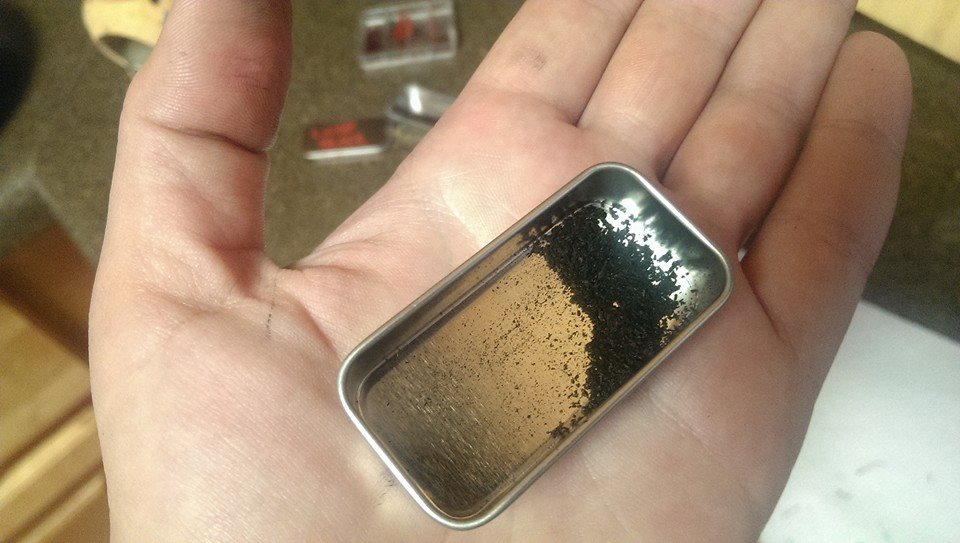
Here’s a picture of my filthy arm, top to bottom is lamp black, saffron, and charcoal:

I will be re-trying the saffron kohl sometime this week, as well as making my face whitener and blush. Once I conclude this project I’ll provide a list of sources I’ve compiled.
As frequent readers may recall, I have a post here entitled, “The Illusive Dover Dress Debunked.” Wherein I was determined to set the record straight from badly interpreted secondary source material using the primary source. I have created what I think is the look portrayed in the silk fragment. At least the start, anyway. Let’s review.
Here’s the look most often emulated in the SCA:

Which was taken from this interpretational sketch from the 1980’s:
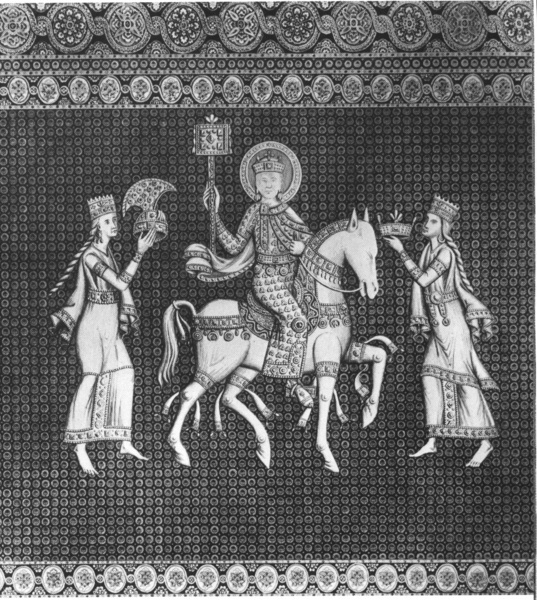
Here’s the actual source:

Here’s the Anna, zoning off as Queen’s Guard (hence rose baldric) at Crown Tourney (I was so tired.):

Yes, it’s a very simple style to emulate. I often wonder if Elizabethan personae come to my page and sneer at my untailored, baggy linen glory. 😉 However, lets see if we can break this down and determine what we’re looking at, and how I did.
First, the women portrayed in the tapestry are both Tyche, the goddess of fortune and prosperity, taking on the shape of the Blue and Green Demoi, the two main political associations in the Eastern Roman Empire. They are supporting a figure that seems to be Emperor John I Tzimiskes on his triumph over Bulgaria in the late 10th Century.
The women are first and foremost, deities. Even though the Byzantines were extremely pious Orthodox Christians, they were proud of their Hellenistic and Roman roots, and often displayed images from classical mythology and literature as part of their way to connect themselves to the splendor of the ancient empires.
The dead giveaway on the divinity of the subject is that they are barefoot. In the Greco-Roman culture, only the divine could be portrayed as barefoot. That does not mean that people could not and did not go barefoot in real life, but as far as artistic record goes, this was reserved for the gods. I am not barefoot for a few reasons. 1: I am a high lady of the court. Barefoot would mean I couldn’t afford shoes. 2: It was Crown Tourney, ew, gross. I am actually wear a pair of red China flats, since red shoes were all the rage for women during the period. One day, I will make nice, period shoes, but I digress…
Another odd observation is that they have bare arms and appear to be wearing cuffs of some sort. This boggles me. The Blue is wearing a tunica that appears to be almost-flesh colored, but the Green, in her minty green tunica, definitely has bare arms. What I have determined off the cuff (*rimshot*) is that this is another classical throwback, or, the weaver really screwed up. Screwing up is period, we see it all the time, which would make some sense. I don’t understand the placement of the cuffs on the arm when they look like trim that matches the garments. If you’ve ever worn a wide cuff on the upper arm, you know how uncomfortable they can be. However, to me, the dead giveaway that this was an error is if you look at the woven pattern on the wrists of both demoi, you see that the trim matches that of their tunicae. Jewelry wouldn’t match embroidery, and their headwear doesn’t match their dresses, and they’re both different. I suppose the only way to really tell is to see the textile in person, which will probably never happen unless I get to go frolic about cathedrals in Germany sometime soon.
EDIT 5-21-14: I did find this small scan of a book about the textile, and it looks like there may be a touch of green left on her shoulder, so fading could also be a culprit.

Of course, if this WAS intentional, my guess would be that the artist was trying to emulate the sleeveless fashions of the classical period.
Or, they could be dancers. I’ve seen a great deal of sleeveless “Byzantine Dancer” interpretations in the SCA and other re-creation groups around on the web, but I did find this image from the Paris Psalter very quickly on Wikipedia with a fast search. This also dates to the 10th Century and has connections to Basil II/John I Tzimiskes period as the textile.

These women are definitely dancers, and the painted style of this is most interesting in the layering of the colors. They are definitely wearing what could be considered the classical stola on it’s own, and the men are wearing the clothing of Late Antiquity and do look more Western Roman rather than Byzantine. This is a curious piece to work from as far as clothing styles go. However, looking directly at the women, you can tell the dresses are one piece and woven or dyed into different colors, and the actively dancing woman is still wearing some sort of sandal on her feet, so she’s not totally barefoot like the demoi are. However, the sleeveless style is there for a dancer. This link that shows a modern woman reenactor gives a source as being in the Biblioteca Marciana, or the Library of St. Mark’s in Venice. I went to check it out on the Biblioteca Marciana digital library, but the back-end of their Java encoding is broken, and couldn’t view their manuscripts, not to mention the reference given is so vague, I’m unsure of which manuscript it’s actually in.
EDIT 5-21-2014: somebody on the SCA Garb Page on Facebook has found it for me, HURRAY!
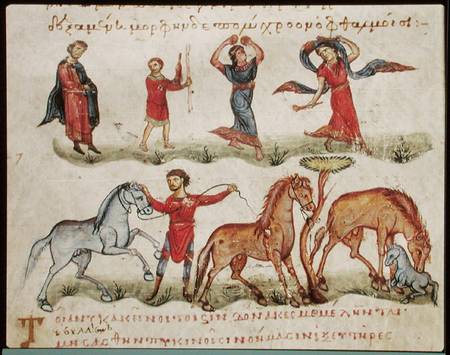
Those dancers may be similar, but the lack of ornamentation, and the weird flounces at the bottom of the skirt don’t mesh with the Tyches in the tapestry.
My big red X over this hypothesis is that the job of a dancer in the Byzantine Empire was THE LOWEST OF THE LOW. They did have court dances, and ritual dances, but for entertainment purposes, especially the showing of the arms and legs? You’re a harlot. Plain and simple. This is seem all too well in the opinion Procopius had of the Empress Theodora in his “Secret History.” Granted, he was a bit of a gossiper, but she was portrayed as the absolute dregs of society before she was married to Justinian. This was not a wanted profession. Why would 2 images of a divine person be dressed as dancers? That sounds insulting to the goddess Tyche. It would be almost satirical in nature for the demoi (remember, political parties) to be dressed as such, but not in the way that the silk is portrayed. They’re supporting figures for a conquering emperor, and not there as jokes.
For now, I will stick with the idea that the sleeveless-appearing Green Tyche was done in error on the weaver’s part, considering the Blue Tyche has the cream colored tunica. If it is an attempt at classical Roman revival, the stola should be to the floor, as the two layer look is strictly a Byzantine fashion style. The weaver was emulating Byzantine fashion, not Roman.
Moving onto discussing my interpretation, I created the stola from about 3 yards of red-orange linen. As shown in my previous post on this style, the Byzantine woman’s stola would have looked similar to the Roman stola (see my Ancient Roman costuming page for more info on that) but closer in cut to the men’s Roman tunica, as seen in this Coptic example:

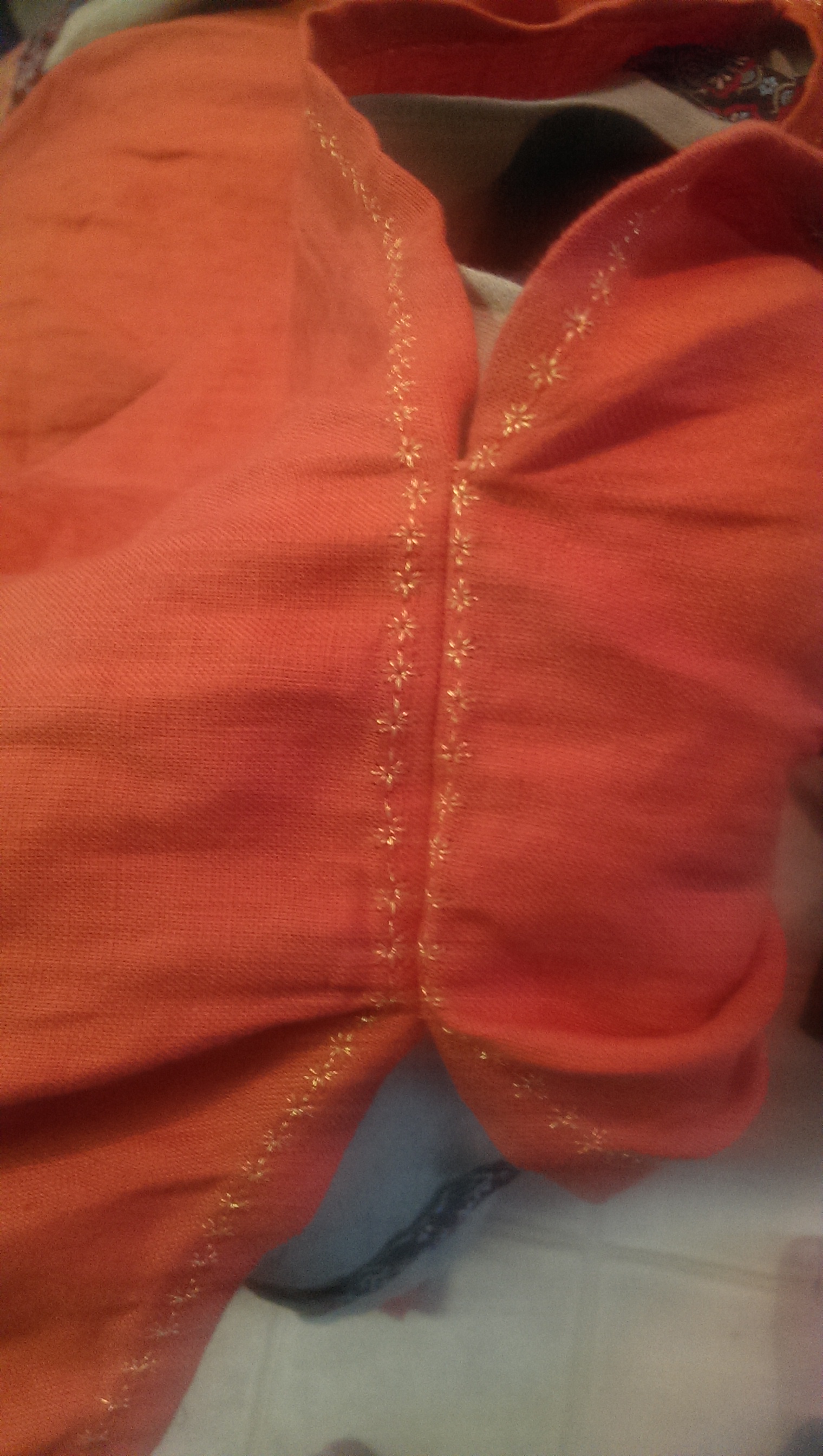
I opted to play with this idea with the “pinching” method of the Roman stola, that is, bringing in the top seam a bit to achieve straps, and provide a more comfortable neckline. The textile shows the women wearing a relatively high neck, as opposed to the deep V-necked style of antiquity. Easy enough. The trick of course is to fit the neck to yourself over and over again with pins to get the look you want. Here is the illustration of mine:

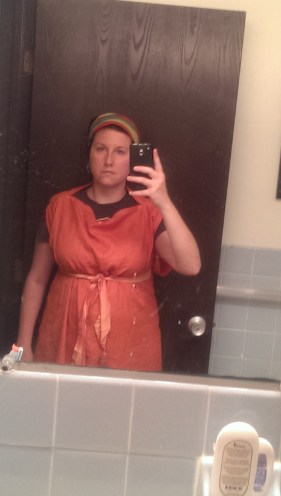
Here’s some pictures of the finished product to help give a better understanding, you can see how I already finished the neck and shoulders before I attached the straps. The embroidery is done by machine and I’m just a fan of that aesthetic. Similar bands are shown in some artwork, but I just wanted a little bling. Also, pardon the icky bathroom mirror:
And here’s an action shot of me receiving my Maunche, which I was actually happy to see so I could see how the sleeve openings looked, and they look comparatively well against the original source material. There is no large gap as shown in the Dover artwork at the top, and the draping against my shoulders looks fantastic and flattering. If I would have left the fabric any wider, it would have been frumpy, and any smaller it would have been too tight. So 40″ wide is the magic number for me and stolas. Your mileage will vary depending on the person.
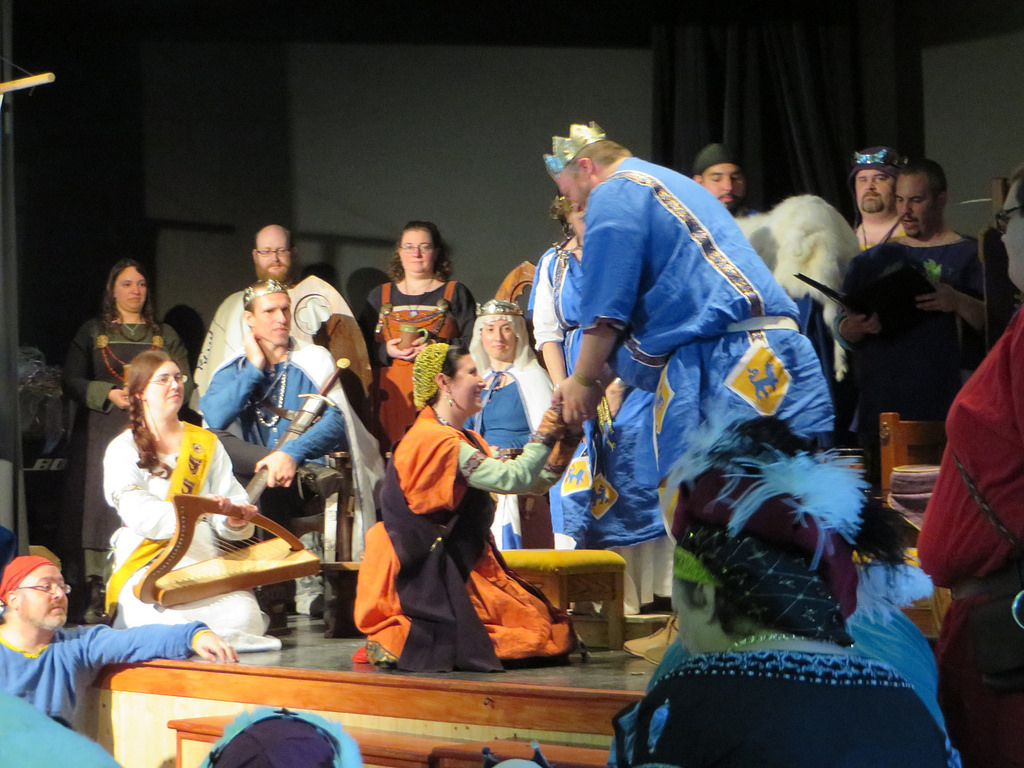
I guess the next thing on my list is to make a tunica with the solid stripe in the front as opposed to the clavii, and take pictures with my turret hat and a palla in such a way that mimics Tyche. I still love my overdramatic dalmatica style of the 11th Century, but this is a comfortable option for warmer events, and it was relatively warm indoors. Hence the lack of hat and palla. I did have it with me, but they made me toasty. It’s also hard to guard thy queen while being immobilized by your garb. 😉
It’s pretty much safe to say that this particular short stola was worn from the period of Justinian and Theodora in the 6th Century as seen in the Ravenna mosaics, and through the 10th Century as seen in the Bamberger Gunthertuch.

I hope this little simple project of mine helped those who were scratching their heads over the Dover illustrations. I feel that this is the correct form of the garment worn, and that more women will be interested in trying this unique style of the Byzantines. 🙂
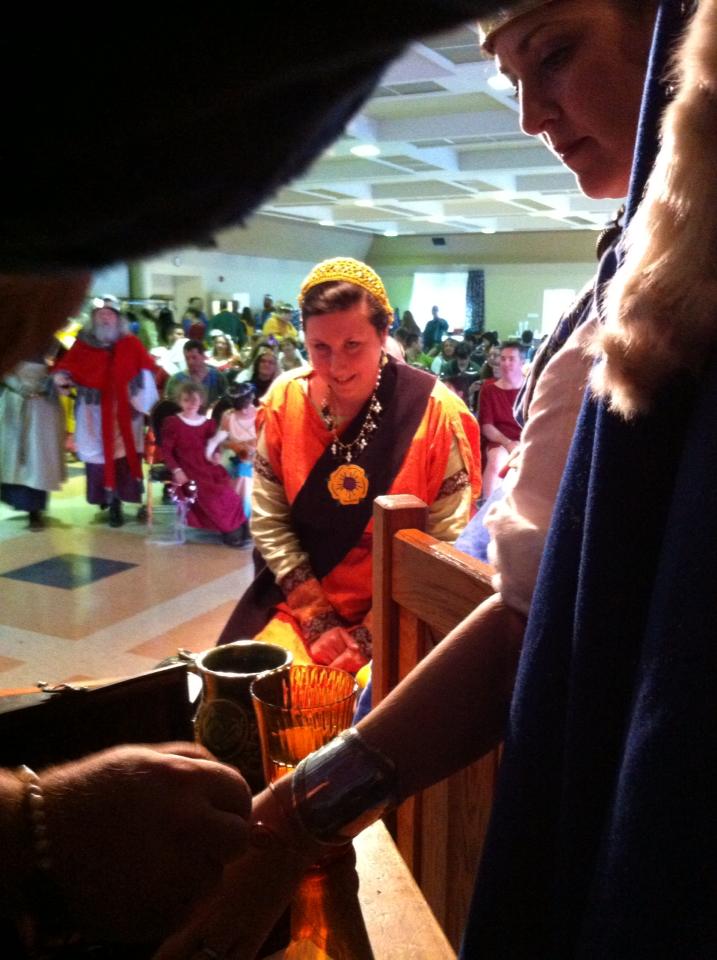
Although I do have substantive posts actually planned, I suppose I reserve the right to brag that yesterday at Crown Tourney in the Montreal area, I was inducted into the Order of the Maunche, which is the highest honor given in the East Kingdom in arts and sciences. I received it for my research and teaching of Roman and Byzantine clothing.
I was so tired at court (seriously guzzled coffee as fast as possible before I stood watch as Queen’s Guard) that I apparently didn’t show much emotion, but I do remember going, “Ahhhh, I can kneel for a bit.” Priorities. -.- So, for those that were like, “Wow, she seems out of it.” I kind of was, but I was very excited, and still am. Thank you all for the recognition, and I hope to do my best to represent the order. 🙂
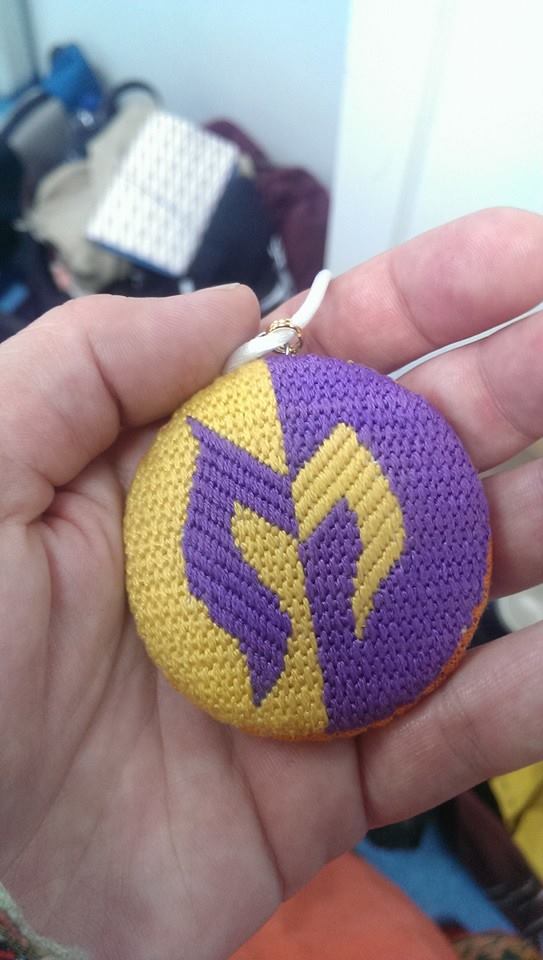
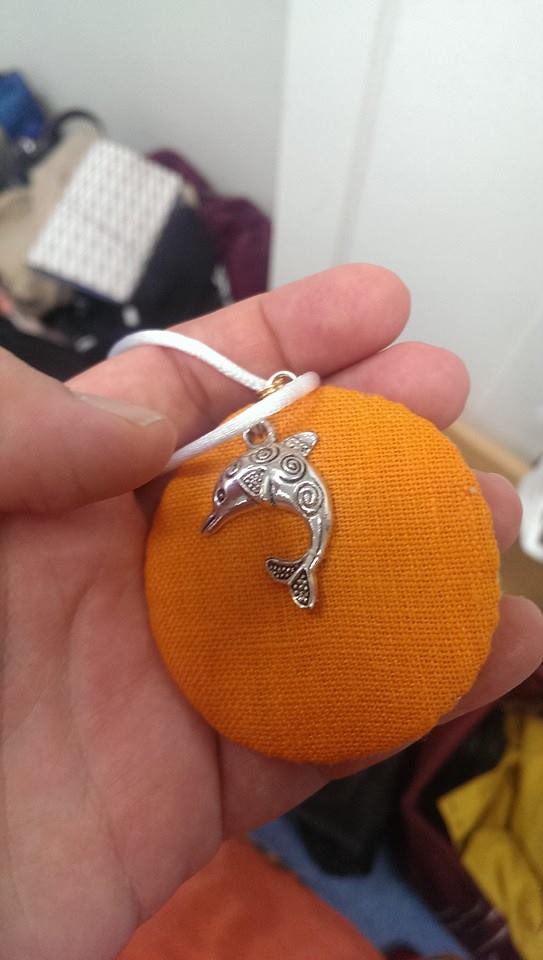
My medallion, made by my laurel, Mistress Clotilde von der Insel…which was backed with the orange fabric leftover from my Bucs dress. That was carefully acquired (see also: asked for) by Geoffrey, and snuck down to Rhode Island. EVIL!
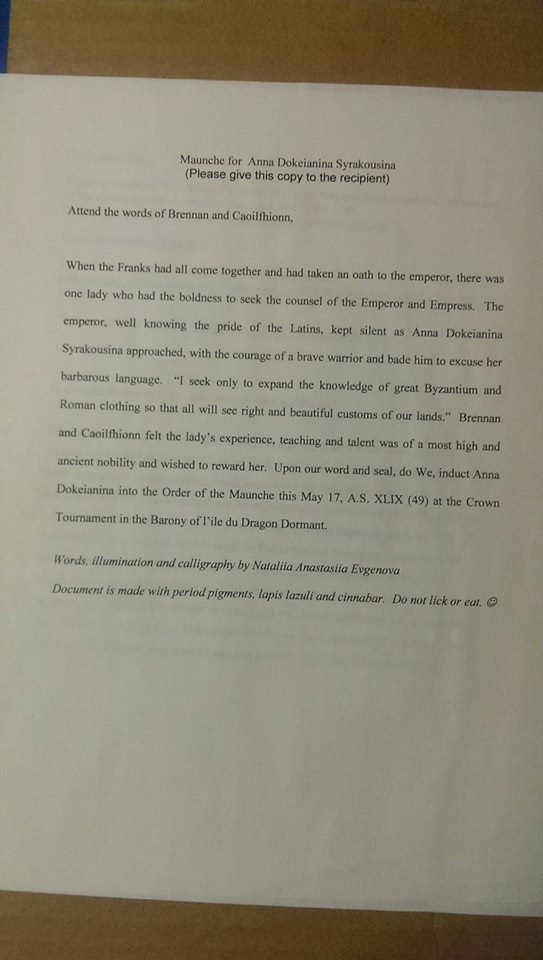
My scroll and wording, done by Mistress Nataliia Anastasiia Evgenova, who also did my AoA. The wording is based on The Alexiad.

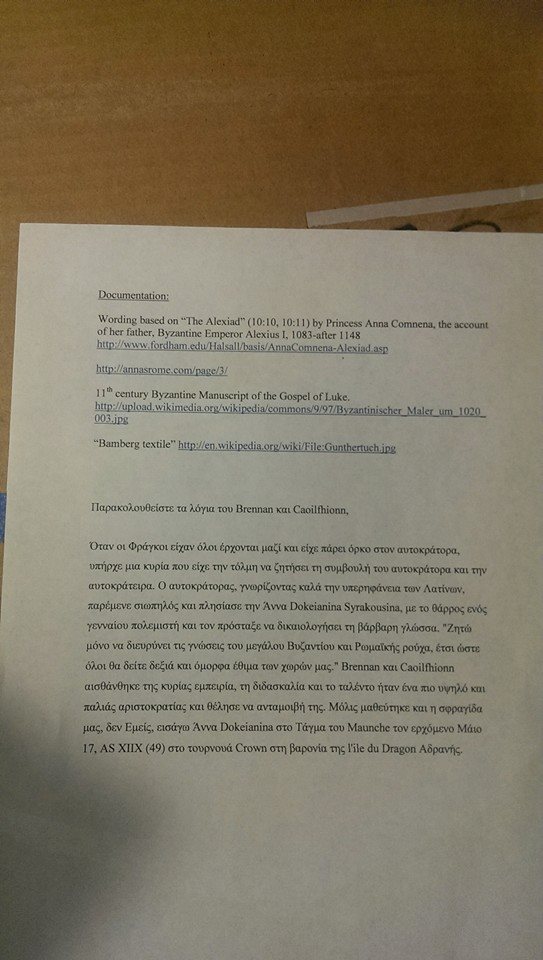
Well played, East Kingdom, well played…
Let me tell you all how hard it is to paint very light gray hair.
Also learned: Sometimes, your egg tempera medium just blows, and doesn’t work well. I had a really rough time dealing with my yellow ochre and vine black pigments this project, and I’m unsure why. Apparently it could do with the temperature of the medium (using it right out of the fridge) or my ratio of egg to wine.
This is an icon of St. Kenric I of Warwick, late King of the East. His martyrdom is signified by the wearing of a red cloak, and his death by black arrow is immortalized. This is a great schtick we have going in the East Kingdom right now as we try to discover the murderer of our former king. This icon is a donation to the Silent Auction we are running this weekend at the Coronation of Brennan and Caoilfhoinn to benefit the Royal War Chest Coffers.
I based this particular one off of an icon of Christ, and tried to mimic the earlier Orthodox church’s designs from the 6th and 7th Century, hence the freeform inscription, which reads, KENRIC BASILEUS ANATOLIKIS. “Kenric, King of the East.”
As you can see, I’m getting better, but not great yet. This was a great opportunity for practice, and man did it take some time.

I’ll be making a page for my iconography soon. I figure it’s the best way to document my journey through the art form rather than scattered blog posts.
Because of the impending doom, er, Coronation, I’ve been getting pinged a lot here in the East on how I tie my chiton and get my Roman clothing to drape properly. So, I made this handy dandy 10 minute vid to help explain my method, as well as give a brief look at my new dark blue stola. I hope it helps.
The Roman Matron: How to belt a chiton and an intro to the stola. from Anna Dokeianina Syrakousina on Vimeo.
 Anna's New Rome
You must be logged in to post a comment.