You heard me. I am interrupting this blog to talk about dangly bits. Appendages. Wee-wees, dangit! It’s perfectly okay, you see, because this is perfectly ROMAN.
A lot of information is surfacing lately on the amazing shiny Roman phallus jewelry, and I’m getting pinged on Facebook and email about it often, and I have been asked quite a bit about it. Well, here you go.
Everything you ever wanted to know about the Phallus in Roman culture!*
*but were afraid to ask! (Abridged. There really is a ton of stuff.)
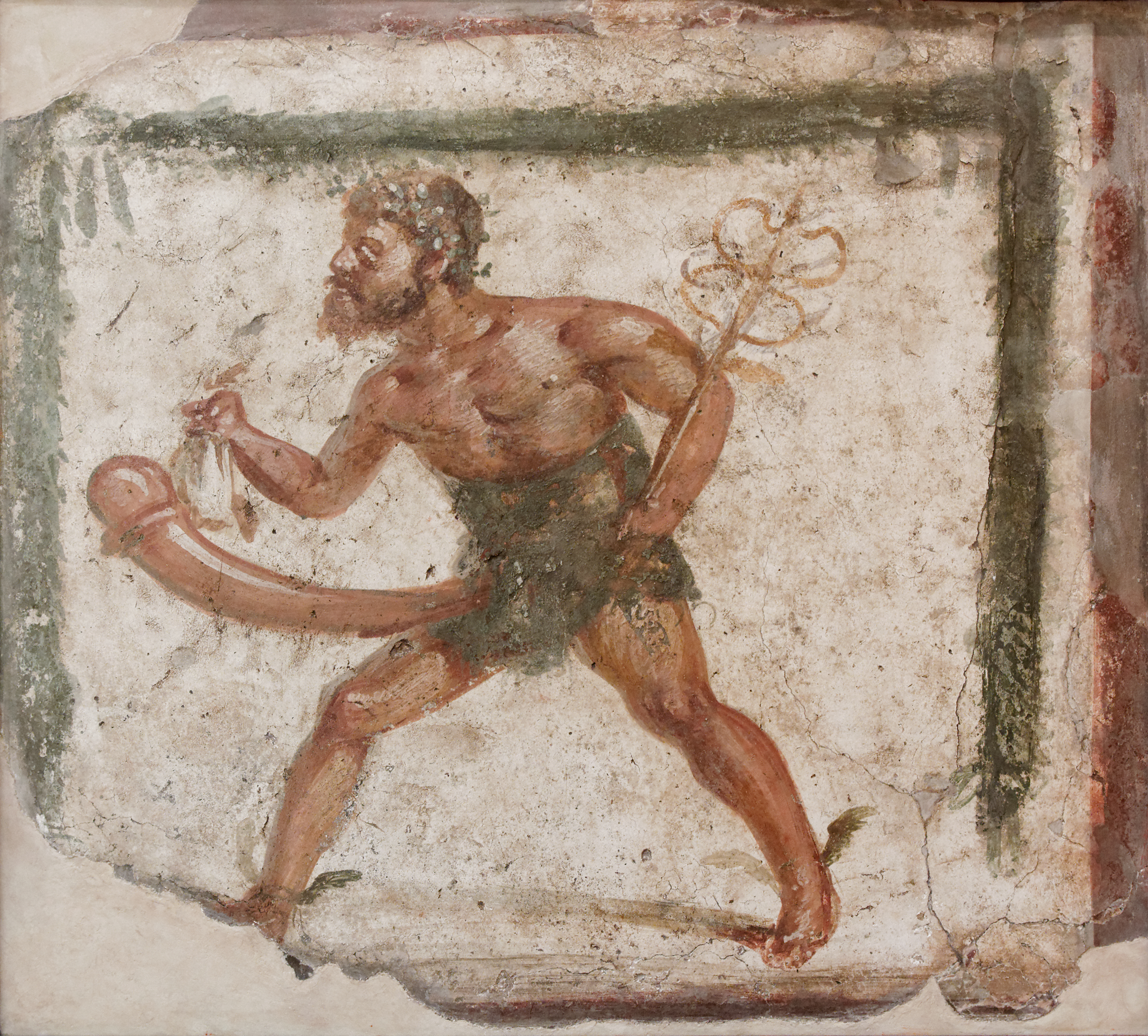
Well, first, I had to gauge my approach to this post. I mean we’re talking about PENISES here. Yes, I said it, penis. If that offends you, well, you may need to re-think reading this post, because it’s only going to get better. Anyways, I figured, well, we’re talking about something seriously historical, I could be dry and historical but…no. It’s hard enough for anyone in this day and age to take private bits seriously, and frankly, they didn’t take them seriously in Ancient Rome either. There is more penis graffiti in Pompeii than in a boy’s middle school bathroom, heck, even the first episode of HBO’s Rome shows penis graffiti. And if the graffiti wasn’t enough, well, there’s always this guy:
Well, that should have culled the prudes out of here. Hello, filthy minded history types! Welcome to Ancient Rome. Where pornography was on every street corner! If the first thing out of your mouth at this point is, “Oh God, think of the children!” Please leave now. If the first thought in your mind while looking at the above fresco is, “Why is Mercury exhibiting the…traits…of Priapus?” Then you’re in the right place. Let’s provide a bit of a background.
Priapus is a minor Greco-Roman god of fertility, as if you couldn’t guess. He also had something to do with fruits and livestock (twigs and berries?) This above fresco is from Pompeii, and well as this fella:
Ladies…
Now, there is a great deal going on here symbolically. The first I notice is the Phrygian cap on Priapus’ noggin. The best analysis I can give while I sit here sipping tea and giggling at pornographic frescoes is that this particular painting is from the House of the Vettii: two freedmen who made themselves a fortune in the merchant business, which I believe could have been imports. Note I said “freedmen.” These brothers were former slaves. In Rome, slavery was not a life sentence, in fact, slaves were often paid, and were able to buy their freedom at a certain age. Most were not kept over the age of 30. Pompeii was a resort town, sort of the Hamptons of its time, and these homes were worth quite a bit. My own conjecture about this cap is that it symbolizes the freedom of the Vettii, as the Phrygian cap was often presented to slaves upon their emancipation. But still…the penis, or the fact that the previous image is of Mercury. Let’s see what we can find.
Returning to Priapus, I hit the Wikipedia entry first for some fast facts. They’re also a good place to start for secondary sources. Skimming the article already provides a great deal of information, including his appearances in popular myths and theatrical performances, and role as a god. Toward the bottom though, is where I found the gold: Patron god of merchant sailing. Well, that would explain why the Vettii liked him so much. Right? Maybe? OMG wang?
There’s much more than meets the eye here, I think. What does a rustic lesser god with a Viagra addiction have to do with merchant sailing?
The Phallus and Navigation
In the International Journal of Nautical Archaeology September 2002 issue, there is an article entitled, “A terracotta phallus from Pisa Ship E: more evidence for the Priapus deity as protector of Greek and Roman navigators” by Harry R. Nielson III. Nielson, a professor at Florida State University, writes that the phallus is associated with “possession and territorial demarcation” in many cultures. This attributes to Priapus’ as a navigational deity. This is not the first instance in which phallic figures have been found aboard ships.
Returning to a primary source, the Satyricon by Petronius also bears mention to Priapus being present at a shipwreck. Although the Satyricon is a work of prose fiction and a comedy in which the instance of the shipwreck appears to be in parody of epic poetry, the fact that this was included in the body of work notes the connection of this deity to navigation by the Romans. There seems to be no shortage of archaeological evidence suggesting that vessels and ports displayed a significant amount of phallic imagery, including statues and frescoes of Priapus. I cannot seem to locate any other particular source without sitting and doing hard research through article databases and libraries, and since this is summer vacation and most academic libraries are closed or only open part-time, getting in to do the research I need just isn’t available. I wouldn’t typically rely on one secondary source for information, but the idea of the penis being regarded as a territorial symbol makes perfect sense from an anthropological standpoint, or really to any women who has ever dated jocks.
Another hypothesis that immediately comes to mind (again, this is my brain working, not actual research) is the pointing of a compass. Did the Ancient Romans have a compass? Unfortunately not, but they were formidable sailors with the ability to chart sea routes using the stars and landmarks. Any sort of a “heading” could be looked upon as an erect phallus. I have now completely ruined navigation for everyone with a dirty mind. The next time you’re on an airplane or a boat, and someone says, “heading,” you will think of some hairy old god with a huge schlong. You’re welcome.
Apparently it was common in Rome to have signs of Priapus with a message as he…pointed…in the direction of a landmark. In the case of this excerpt from the Priapeia, which is a collection of such sign verbiage, he points out a fountain:
‘Falce minax et parte tui maiore, Priape, ad fontem, quaeso, dic mihi qua sit iter.’
Priapus, terrific with thy sickle and thy greater part, tell me, prithee, which is the way to the fountain?
When in Rome, if you get lost, ask the guy with the huge erection.
Returning to the first image of Priapus sharing traits with Hermes/Mercury (winged feet and a caduceus staff) this immediately perplexed me, but I figure it had to do with a particular myth or characteristic of Mercury that I possible have overlooked in my studies. Priapus is almost always attributed to Dionysus/Bacchus: The god of wine and partying. Makes sense, right? Some believed he was the son of Dionysus and Aphrodite/Venus, so adding sex into the mix of booze and rock-n-roll would of course create the ultimate phallus god. But Mercury? People often overlook Mercury as being a phallic god, because he’s always depicted as the messenger. This is probably due to Victorian scholars hiding anything that has to do with sex. In fact, Hermes, the Greek counterpart, is often depicted with a phallus come to find out, and was the patron god of fertility during the archaic period of Greece. Eventually, Priapus broke off from this as the pantheon continued to grow. And despite similarities between the Greek and Roman pantheon, worship was very different. It was like a bad game of telephone, really. So a Roman depiction of Priapus with traits of Mercury or vice versa would make a lot of sense. Mercury also guarded travelers and merchants, so there’s a great deal of overlap, here. The image on the wall may not be Priapus at all, it could simply be a very happy Mercury painted in the home of the Vettii Brothers to protect their sea-going merchant business. Fair enough.
Jewelry
Phallic imagery evidently played a huge part in navigation and direction, as well as the protection of travelers, which is probably why these little suckers were all the rage in the First Century:
That is, indeed, a golden cock n’ balls, folks.
This has been getting a lot of press as of late because the museum in possession of this artifact is beginning to sell replicas, and I want one. For strictly Roman re-creation and re-enactment purposes only. I swear. (I also have a couple of medieval phallus replicas from Billy and Charlie at Pennsic, but I assure you that it wasn’t viewed as a good luck charm or a piece of navigational equipment in the Middle Ages. What can I say, I collect…charms. OH COME ON THEY ARE FUNNY!)
This piece is drawing a lot of attention, and it should, I mean, it’s pretty remarkably detailed and made of gold, and I’ve seen more than one ornamental dong in my day. No, really, these were REALLY COMMON among the Roman people, so common, that you can buy actual artifacts on eBay where I stumbled upon these remarkable doo-dads for the first time back when I was a wee, innocent Anna. If they are plentiful to sell on eBay for Wal-Mart artifact prices, then they were literally all over the place. But why? To our prude modern society the idea of wearing something like that is totally obscene. In fact, it could probably land someone in jail here in the states if someone’s very conservative grandmother mistook it for a cross and got the shock of her life. In fact, I would BANK on it, which is why I’m surprised they are selling replicas. Apparently the Jolly Old Mother Country isn’t as staunch as their screwy offspring.
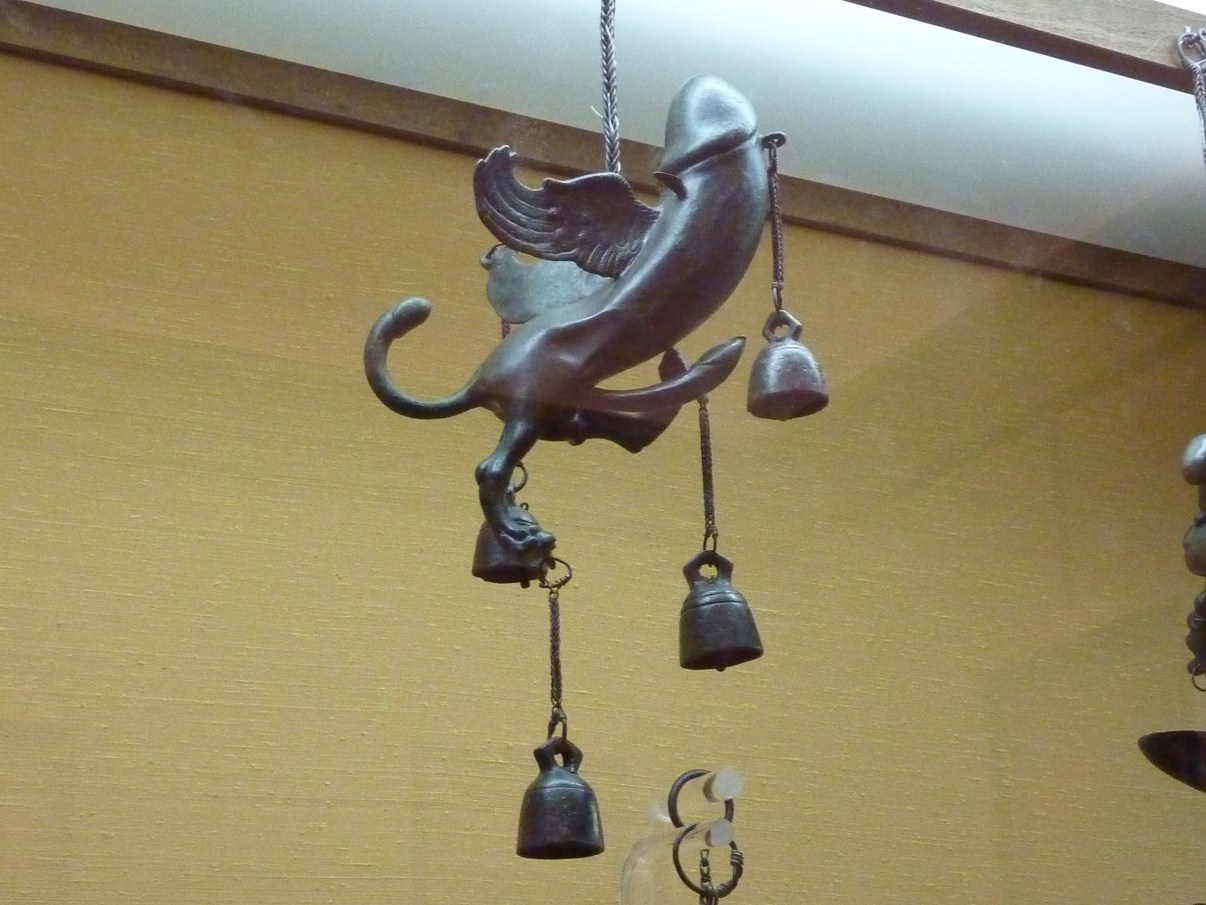
Either way, you’re looking as something that was a common as wearing a wrist watch, er…carrying a smartphone is today. This type of amulet is called a fascinus, and was essentially the embodiment of the divine phallus. You can easily see the word “fascinate” in there, only in Latin, it’s pronounced quite differently (Fahs-kee-noos.) Etymologically, to be “fascinated” means that you were put under a spell. This makes sense as it was considered a protective amulet. Much like the blue glass “evil eye” amulets you see today from the Mediterranean (which was also popular during Antiquity!) the phallus warded off evil. I certainly like this wind chime (tintinabulum, a wonderful Latin onomatopoeia!)
Now THIS is a conversation piece!
The majority of the finds of jewelry seem to be along the frontiers and roads of the Roman Empire, leading me to believe that it was something very popular with the legions. I’m sure if you ask any manly man today if they would wear a bronze penis around their neck, their answers could be mixed, but as we already determined, to the Romans, the phallus wasn’t just about impressing your friends. It was a charm for travel and navigation, and maybe fertility and general good luck. Knowing this, it would make perfect sense for Roman soldiers to wear one. It would protect the wearer and keep them headed in the right direction, since there were no compasses, only landmarks, the stars, and apparently horny gods.
But the buck doesn’t stop there, oh no, they gave these dangly bits to children. Yes, you read that correctly, phallus amulets were given to children after birth as a way to ward off evil spirits, and ensure they would grow to be strong and virile. I’m not sure if women got the same amulet, but I have yet to find a vagina amulet as a counterpoint. (If you find one, OMG show me!) Rome was a pretty chauvinistic society, not as much as the Greeks who treated their women like absolute dirt, the Romans just treated them as 2nd class citizens, so it’s doubtful that women would have been given the same treatment.
Public Religion
The more I dig, the more I find more really interesting stuff. The Vestal Virgins (cue Lighter Shade of Pale, it gets in my head every time.) tended the cult of the Phallus. Evidently, the phallus was a symbol of the safety of the state. By placing a phallus in the hearth, it embodied masculine power hidden within a female duty. Feminists will read this and cry. There were also public festivals that celebrated a lesser god known as Liber, who was a predecessor to the imported Dionysus, in which the phallus was represented.
Augustine of Hippo writes of this in his City of God, as described by the now-lost works of Varro:
Varro says that certain rites of Liber were celebrated in Italy which were of such unrestrained wickedness that the shameful parts of the male were worshipped at crossroads in his honour. … For, during the days of the festival of Liber, this obscene member, placed on a little trolley, was first exhibited with great honour at the crossroads in the countryside, and then conveyed into the city itself. … In this way, it seems, the god Liber was to be propitiated, in order to secure the growth of seeds and to repel enchantment (fascinatio) from the fields.
I cringe at this as a historian, mostly because Augustine himself was quite a manwhore (yes, that is a technical term) before he “found God.” So this point of view seems extremely hypocritical to me that he would cast this behavior as being so wicked. With the spread of Christianity came the demise of the cult of the phallus, and most information was lost, or covered up, by angry Christian philosophers such as Augustine. Could you imagine if Thomas Aquinas got his hands on this information? UGH! I am not insinuating any hate on the Christian faith, I am simply stating that they are mostly responsible for the prude ways of modern society. Contrary to popular belief, Christianity is what saved a great deal of Roman manuscripts by allowing them to be copied throughout the ages. Their moral views were just quite different than than of the pagan Romans, which is probably why these fun little novelties did not survive into the Byzantine Empire. In fact, it appears that the Byzantines may have covered up male genitalia in earlier works of art.
I could probably spend days of research on this and write a significant paper. I appear to really just be scratching the surface, but I wanted to give a cursory look on the commonality of the phallus pendant. So there you have it. Be it fertility, luck, navigation, direction, protection of merchants and babies, the phallus in Ancient Rome was hardly pornographic, it was a part of life. Like I’ve had to tell folks before when it comes to studying some of the finer…nuances of ancient culture is that you need to throw modern views of sexuality to the wind. They did not think like us, they did not act like us. They had a completely open view of sexuality that most people in modern society cannot comprehend, so the image of a phallus was not obscene, it was simply “there.” It was part of their culture and their day-to-day lives. That didn’t stop them from making plenty of sick jokes, much like we do today.
“Your nose is so long, and your dick is so big that you can smell it when you get an erection.” – Martial
Bibliography
Nielson III, Harry R. “A terracotta phallus from Pisa Ship E: more evidence for the Priapus deity as protector of Greek and Roman navigators,” The International Journal of Nautical Archaeology, Vol. 31, Issue 1. Pages 248-253
Csabo, Eric. “Riding the Phallus for Dionysus: Iconology, Ritual, and Gender-Role De/Construction,” Phoenix , Vol. 51, No. 3/4 (Autumn – Winter, 1997), pp. 253-295
Have you ever wanted some of my blatherings in printed form to have and to hold forever?
Well soon you CAN! I contacted Compleat Anachronist, the SCA-wide A&S publication that comes out quarterly. http://www.sca.org/ca/index.html It covers all kinds of awesome topics for SCAdians that want to up their game, and for me, the issue will be on…surprise, Roman and Byzantine clothing. I am making it as comprehensive as possible, however, so everything a SCAdian needs to know about dressing in bed sheets is covered. 😉
Oh yeah, I’ll get that stuff up soon on Byzantine dress. I swears.
… some people call me Anna. I have an unhealthy obsession with Ancient Rome and Byzantium. I spend time I need to be doing Latin homework cutting intricate felt appliques for a tunic for one of my best friends fighting in Crown, and not even for me as consort. I’m perfectly okay with this. My boyfriend, some Norman guy, spent his day pounding out fake coins and brewing beer. Welcome to the SCA, make sure your tray tables are in their upright and locked position, because its going to be a wild ride.
Half of an Order of the Tyger’s Combattant medallion.
That is probably the worst movie/history pun crossover in the entire internets. Anyways, we have wine!
First you gotta sanitize those bottles. We may be making Roman wine, but we don’t need Roman germs.
I use C-Brite sanitizer.
Then you make your boyfriend put the carboy on the counter for you.
It’s so clear, you can see from here to Guinness. BRILLIANT!
Once you siphen into the bottling bucket (best money ever spent, ever deal with bottling out of a carboy? Ung.) separate off the small batches of infused wines. Here is the Retsina with pieces of pine resin in the bottom, and the Rhosatum, with dried roses in a bag infusing in the pickle jar. These should be bottled by the end of the month. Pliny says to leave the roses in there for 3 months, but I’m assuming he meant fresh. I’m using dried, so I’d rather monitor what this is going to do and the flavor I’m going to get before creating a mess.
Retsina (resin) and Rhosatum (rose) wines.
I also separated my portion off for the Conditum Paradoxum, the spiced wine from Apicius. After gathering my ingredients, it all went into the pot for an hour on low heat to steep. The pine resin melted fast, which got me worried, but it was fine.
You can see the odd mix of ingredients here: dates, melting resin, bay leaf, saffron, black pepper, honey, and I threw in a cinnamon stick for fun and profit. And my stove is filthy. Welcome to brewing.
Once that was infused with the rest of the wine, it was strained and bottled. Here is the Conditum in the bottles next to the unaltered muscat wine I made.
Conditum on the left, plain wine on the right. You can see how the spices clouded the wine.
So, being the brave soul I am, I tried the Conditum in the period style, using warm saltwater to dilute it, as the straight liquor is extremely sweet.
The dilution cleared the wine, and brought out the infused flavors.
Bottling and infusing the wine today! Excited! Pictures to follow in tonight’s post.
In the end, I will have the following:
2 gallons of “Ancient White” Muscat wine.
1 gallon of Conditum Paradoxum (spiced wine from Apicius.)
1 gallon of Rhosatum (rose wine from Pliny the Elder.)
1 gallon of Retsina (resined wine.)
I’ve found a couple different redactions of the Conditum Paradoxum. I have one written down in my brewing journal (this is a must-have for anyone who brews as much as I do. I conjure up recipes and write them in, and track my progress on existing projects) but I found a different approach online I may go with instead. The basis of the drink is that you take a base wine, Apicius doesn’t say what color though both reds and whites were widely consumed by the Romans, and you make a must of honey, saffron, mastic, bay leaf, black pepper and dates. I don’t have any mastic, so I’m subbing in cinnamon. Plus, with my Retsina, I didn’t want to overdo it with that flavor. I *DO* have plenty of pine resin to work with, so that is still an option.
The rhosatum is getting treated exactly as Pliny says: put rose petals in a bag, put it in the must, close the sucker up and then let it sit for 3 months. I’m assuming he means fresh petals, and I’m using dried, so I’m going to be monitoring the color of the liquor and making sure nothing goes funky in there. If I stop the infusion early, I stop it early. No big.
The Retsina doesn’t have a clear cut recipe. I’m more or less trying to re-create a flavor profile than an actual recipe. Originally, Greek and Roman wines got the resin flavor from the use of pine resin as a sealant on the amphorae. Being that I don’t have an amphora, (I’ve looked, they’re expensive to get made) I’m cheating and tossing an ounce of resin in the wine and letting it age a month. If this works out, I’ll bottle the wine and seal the top of the bottles with resin like wax as a nice touch.
I’m going to let the wines bottle age a minimum of 3 months, so my first bottles should be ready by Pennsic War, at least of the Conditum Paradoxum (which I plan to panel with hot seawater to dilute it with!)
More updates today as it comes, live, from Black Dolphin Brewing!
One of the first pieces of Roman clothing I made was the stola, or, overdress of a matron. I was married at the time and it seemed like a good idea. I wish I could find pictures of the construction of it, because as far as a “tube dress” goes, it was a pain, being that i made it to almost-period specs, and it’s about twice my height clocking in at 8 full yards of this sassy red linen, and I still didn’t get the neckline right. I’m planning to make another one, um, eventually. With a proper institia, more on that as it comes and I can do more research on what it should look like exactly.
Here’s my first Roman garb EVUR. (I think this was 2008?) That white chiton still hasn’t softened.
ROMAN BLIMP. WIDE BERTH, PLZ.
And here it is as a stand-alone garment, which is how I wear it more often, however in that case, it is NOT a stola, just a form of a peplos without the peplum. I do plan on fixing the neckline eventually, because this is such lovely red linen, I’d hate for it to go to waste, especially at a whopping 8 yards in one dress. At least it fits better now that I’ve, uh…filled out.
Complete with adorable and totally period Northern Army trim girdle.
Racked the wine to the secondary today. It’s fermenting like a madwoman. I probably could have let it go longer, but the boy needed the larger carboy for his beer that he’s working on today. Either way, I plan to leave it in this carboy now for at least a month before the clarifying process. I picked up another 1 gallon jug today as well, now I have 2, which will be important for when I do my separate infusions of the rose and resin. As of this point, I’m not thinking they will be ready for paneling at War of the Roses (Memorial Day weekend) so at the earliest I should have a drinkable product by Pennsic, and especially good next year, as I intend to age as much as possible. It is wine after all. Though the Romans did drink a lot of young wine. Mostly because it was the primary beverage of choice, and though there were period winos (Pliny most certainly one of them) that did enjoy ages wines, there is no harm in younger beverages.
I also signed up for the Nobelese Largesse swap today via Facebook. It’s a Knowne-World wide artisanal swap that requires documentation. I cannot post what I am doing or who I have or pictures until the gift is sent for obvious reasons, but I am looking forward to participating in this one. 🙂
I am also involved in the East Kingdom Artisanal Swap for my second round. That gift has been finalized, and I am working on getting everything together to complete it. My previous swap gift went to Konstantia Kaloethina in Calontir, the founder of the NL swap, and I made for her a Byzantine Superhumeral out of shot purple silk, with some amethyst and pearl beadwork. I left it plain since we had discussed prior to me even having her as a swap recipient that she wanted one to adorn with her award medallions, but did not know how to sew one for herself.
I received in the swap a lovely wooden chest with my arms on it, and a couple of brass and bronze medallions from Sir Yessunge Altan, I was blown away.
You can see the type of work that goes into these swaps, this is why I’m so excited for NL, being limited to 40 participants, and worldwide. I do love a challenge!
I just knocked out my 2nd annual gallon of espresso cordial. It won big at the Bridge Birthday drinking, I mean, Brewing Contest, also known as “Pickle the Baron.” The recipe is proprietary, sorry, folks. 😉
The original name of it was “Dark, Dirty, and Whipped,” but I think I’m changing it to “Auntie Anna’s Award-Winning Marriage Proposal Juice” or something along those lines, as I have never been offered hands in marriage by so many people at once.
I also tried a new sekanjabin recipe today, and this is a Pomegranate Balsamic variant. The redaction is below:
2 cups of POM juice
1 cup water
1 cup balsamic vinegar (NOT vinaigrette! That’s dressing. LOL.)
4 cups of sugar
boil together for a half hour, cool, and bottle. Easy, peasy, tasty. The color is a dark burgundy/brown, and the flavor is very caramely and almost tea in nature from the balsamic, plus the juice. It’s very sweet, but I can see it being VERY nice on a hot day in ice cold water. So this will be popular at Pennsic.
So I now have 4 full sekanjabin recipes I can easily produce. However, the boyfriend does not enjoy it that much, so I can’t take over my kitchen with bottles of syrup, lol. I guess I’ll have to take my time with them, though I STILL want to try cinnamon with apple cider vinegar. 😉
I made rose sekanjabin for the first time today, so I documented it by video. Sekanjabin is a syrup with origins in Medieval Persia. It’s typically made with mint, but a variety of substitutions can be made. In this case, I used dried roses, since I have way too much for my wine.
The video will take you through the steps, but here’s the recipe:
2 1/2 cups of homemade rosewater (I boiled 4 cups of dried rose petals and buds in 3 cups of water. I had to add more water a couple of times to get the right amount.)
4 cups of granulated sugar
1 cup of white wine vinegar
Combine ingredients and boil for a half hour. Let cool. Syrup keeps indefinitely in a bottle without refrigeration.





 Anna's New Rome
You must be logged in to post a comment.