I have a treasure trove of weird, short papers I’ve done throughout my academic and professional career. Every now and then, I revisit my folders to find a source, and run into an occasional gem of an essay that was either an assignment, or a way for me to start additional research that I never followed up on.
My persona is most definitely not Merovingian, nor do I play one on TV, but I’ve spent more time reading Salic Law than I want to admit. This article is a very short paper I wrote examining the use of insults to incite feuds. After Pennsic, I think I’m going to revisit this topic and expand it into something more suitable for publication in an SCA context, because insults!
If you are interested in citing this, I’ve posted a version of it on Academia.edu here for access, please do not cite my blog:
Insult “Culture” and Violence in Early Merovingian Gaul
Gregory of Tours made his opinion of the Merovingian rulers quite clear throughout his Historia. These Frankish kings and queens were nothing more than brutish, blood-thirsty, and revenge-driven maniacs who turned a blind eye to the Church and its teachings, much to the chagrin of the bishop holding the pen. Gregory’s words were rather scathing, but in between the lines of disdain toward the violence inherent in the line of Long Haired Kings, the Bishop of Tours provides other clues as to what was going on to bring about such ensanguined entropy. The paper will argue that intense gossip and insults may have been used as a tool to provoke feuds, and incite violence in aristocratic Merovingian society.
Salic Law, during which the first draft was composed under Clovis I around the year 500, has an entire section devoted to insults, and the fines (wergeld) that they carry.[1] These insults range from being rather base by accusing somebody of homosexuality, or accusing them of being an informant or calumniator. This speaks a great deal of how strongly an insult was taken in the Frankish kingdom for it to have been codified in law. If these accusations were strong enough to incite the paying of wergeld to the victim, then what would the odds have been that such pejorative phrases would incite violence as a response, and that the laws were conceived in attempts to stop this response?
Autumn Dolan explores this avenue in her paper on the topic, “’You Would Do Better to Keep Your Mouth Shut’: The Significance of Talk in Sixth-Century Gaul.” Dolan states that the social ramifications of such things could have gravely damaged reputations more so than a sword could.[2] Dolan herself focuses more on just the culture of verbiage that is evident in Salic Law, but also reverts back to Gregory’s histories. Gregory served up the tale of Firmin, the Count of Clermont, and Caesaria, his mother-in-law, in Book IV of his Historia, during which Firmin was “offered serious insults” by Chramnus, and forced to seek sanctuary in the cathedral with his mother-in-law.[3] Chramnus then orders to have them taken from the cathedral, and does so by send a man to basically lie to them in attempts to get them to leave. As soon as they were within arm’s reach of the open cathedral doors, they were taken into custody violently, and sent into exile.
Dolan uses this as only one example of how insults could be dangerous, but fails to mention that the use of the insults, and subsequent lying to coax the two from the church, was a gateway to a violent end. Using the insults here was a catalyst, not the be-all-end-all technique to scare somebody away. Firmin and Caesaria were not just told to go away, they sought sanctuary because they knew that they were in immediate danger due to the defamation of their character. Since the insults were from the mouth of the king, versus anybody else, the idea of receiving compensation went just as easy as they were plucked from the door of the church. In the end, Chramnus got what he wanted. It is possible that if Firmin had taken the insults and immediately fled into exile, that they would not have been pursued, but the fact that he chose to stay in Clermont meant that he believed there was a sliver of a chance for a fight, either legal or physical, but in the end it took nothing more than the bishop to turn his back, and devious lies to draw them back into danger.
The laws pertaining to certain infractions against women may also demonstrate how such attacks could be taken not just as defamation against the woman in question, but also to her family. Dolan alludes to this in her paper as well, and offers a quote from Gregory, when Chilperic exclaims that the “slander of my wife is considered my shame.”[4] Referring back to Salic Law, an interesting excerpt involves the releasing a woman’s hair from its restraints. This would cost the assailant a wergeld of thirty solidi, no small fine by any means.[5] It would seem obvious that, with the law written in such a way to discourage violence, that heavy fines were put into place in order to discourage this behavior knowing that the shaming of an aristocratic woman could result in subsequent bloodshed in the form of a feud. This of course doubles back to the chapter on insults.
Laws are written for a reason. With dedicated chapters on insults in Salic Law, and Gregory of Tours’ interesting accounts of violent happenings in sixth century Gaul, it appears that an actual culture of shaming individuals as a way to spark feuds may have been a common occurrence in what Gregory described as a violent society. Whether it be a way to get under the skin of a political rival, or a backhanded attack by pulling a woman’s hair, the Merovingian’s certainly had a dark way of dealing with their business.
Bibliography
Gregory of Tours. “History of the Franks”. In From Roman to Merovingian Gaul. Edited and translated by Alexander Callander Murray. University of Toronto Press: Toronto. 2000.
“The Salic Law (Lex Salica.)” In From Roman to Merovingian Gaul. Edited and translated by Alexander Callander Murray. University of Toronto Press: Toronto. 2000.
Dolan, Autumn. “‘You Would Do Better to Keep Your Mouth Shut:’ The Significance of Talk in Sixth Century Gaul.” In Proceedings from The Western Society for French History 40 (2012.) http://quod.lib.umich.edu/w/wsfh/0642292.0040.001?view=text;rgn=main. Accessed November 22, 2015.
Notes
[1] “The Salic Law (Lex Salica.)” In From Roman to Merovingian Gaul. Ed. and trans by Alexander Callander Murray. (University of Toronto Press: Toronto. 2000.) 552.
[3] Gregory of Tours. “History of the Franks”. In The Internet History Sourcebook. Ed. by Paul Halsall. Trans. by Ernest Brehaut. https://legacy.fordham.edu/halsall/basis/gregory-hist.asp. Accessed November 22, 2015. Located on page 308 in the Murray edition, however it is abridged. The Internet History Sourcebook has the complete chapter.
I barely sew men’s Byzantine clothing. I know where to look, where to point friends, but for the most part, I personally haven’t touched it. My husband is a Norman. He wears riding tunics, and basic linen gored tunics with keyhole necklines. He likes them, and looks good in them. His complexion and appearance echoes Anna Komnene’s description of Bohemond I of Antioch in the Alexiad almost verbatim. It’s disgusting how Norman he is.
But we have a deal: I sew it, and he wears it.
Up until this project, I’ve made him 1 “SCA Byzantine™” tunic, made from lovely wine colored thick linen with potamia and fancy cuffs, but it’s sewn to his usual Northern European tunic style, versus anything actually Byzantine. I’ve also made him exactly one Roman tunic, and one later Roman dalmatica with clavii stripes for when the weather is stupid hot. He mostly stays in his period, with long sleeves on in warm weather because he’s very fair. Lightweight linen is his friend.
I’ve been meaning to try this pattern for a while, so, one day, I decided to sew things, and that he was going to deal with it.
The mummies of the Manazan Cave City date from the 9th-13th Century, though I believe more recent studies are putting it at the end of this period. Manazan is located in the region of Cappadocia, in Anatolia, present day Turkey. This shirt is based on the mummy at the Karaman Museum.
They haven’t updated their site since 2014, but if you’re reading this, thank you, Christobel and Peter, you helped me figure out pieces to my mental puzzle in constructing this based on Dawson’s descriptions.
I haven’t really ever seen this done in the SCA. At least not in my parts, aside from a member of my household, who I think I may have given the link to. I knew that the standing collar was seen in some Byzantine art, but I always kind of avoided it, since I hate being choked and didn’t know what was going on. After finally making a series of these for my husband, I gained a better understanding of how the shirt works, and feel like a ditz for not trying it sooner.
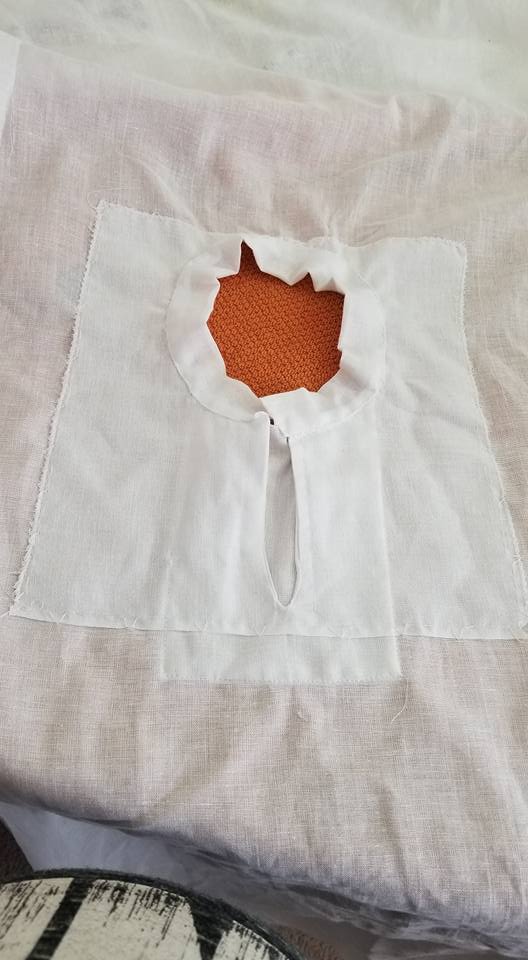
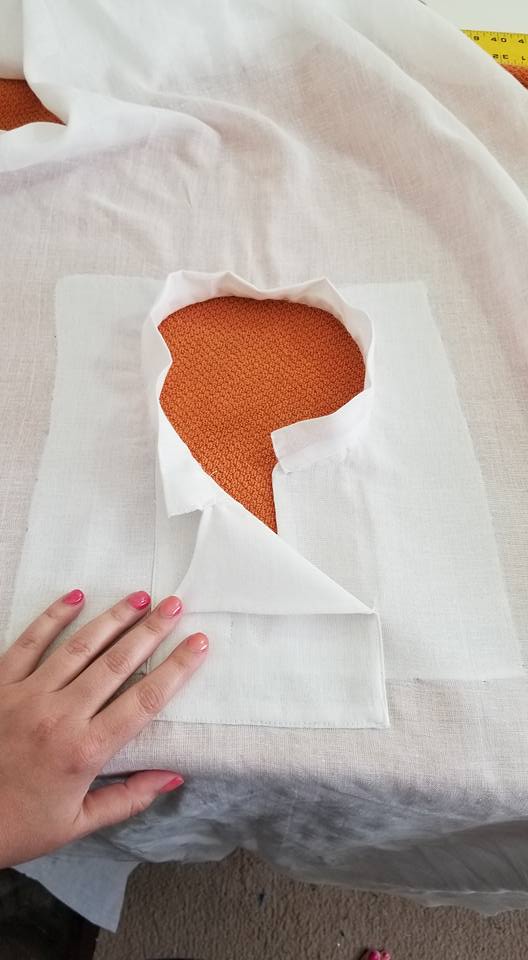
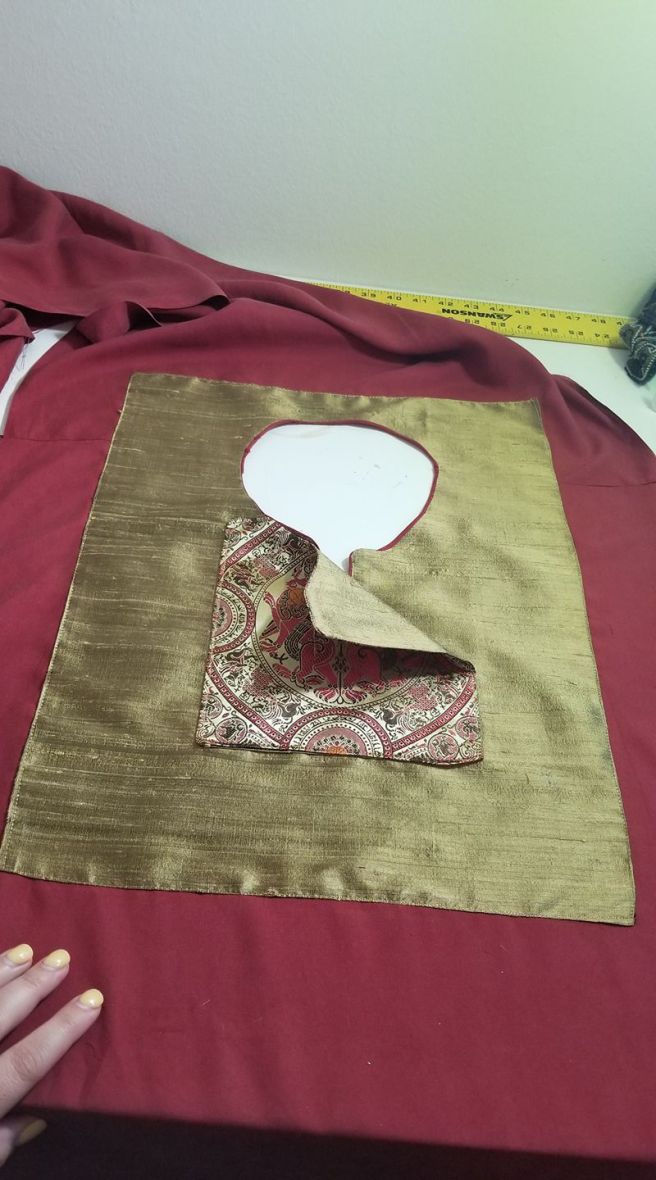
The Manazan tunic is, on the most basic level,a keyhole neckline with a placket over it. That’s it! Once you get that in your head, you look at the picture and go, “Oh.” Trust me, this is way easier than it looks at a first glance.
I made him three types, in this order: An indigo linen version, without the standing collar, knee length.
A white linen version as an esoforion/undershirt, with the collar, knee length. A swanky silk version as a court garment, ankle length.
I had a surplus of weird, secondhand linens I wasn’t afraid to screw up something on, so I decided that the first version would be out of a mid-weight linen with a rich indigo color that straight up reminds me of blue jeans. (In retrospect, I’m pretty sure it’s real indigo dye, talk about a luck out.) I like the idea of wearable mockups. If it doesn’t work, then it doesn’t work, but if it does, then you have a finished garment.
The way it works, is that the collar has to be completed before attaching the sleeves and side gores. The dark linen makes it hard to see details here, but here’s some photos of the construction.
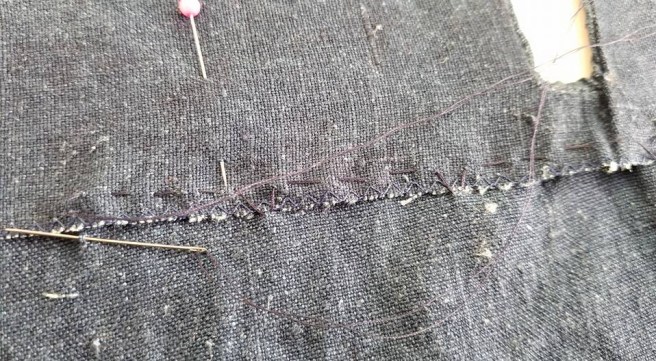
Placket closed.Placket open.Kind of a weird closeup, but when I attach facings on the inside, I use a hand invisible hem stitch. This stops the bold lines of machine sewing being visible on the front, and tacks it down securely. The machine zigzag is lazy finishing on the edge of the facing.Finished and laid out on my table so you can see how high the gores go under the arm.On the Norman. Following the instructions of the pattern to determine measurements gave us a very wide tunic, but when you see period garments, they are rather baggy, if not “bulbous” on men’s figures.
Adjustments made after the first tunic:
-Take in the measurements a couple of inches on each panel
-Re-calibrate the neckline gauge for a tighter fit (I added a half inch when I didn’t need to.)
Onto the full construction with the band collar out of crisp, white linen that took me 6 washes to get it usable. The white allows a more visible depth to the layers on the collar, so I have more pictures.
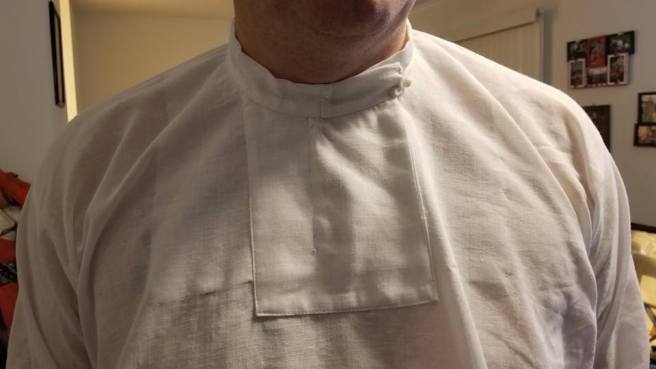
There really is no easy way to avoid handsewing on this pattern. You can if you want, but it won’t look right. After I attached the facing inside with the blind hem as seen above on the indigo tunic, I also attached the band collar to the inside by hand. You can do a machine running stitch when you initially attach it at the base, but when you flip it up and close it to the inside, hand is necessary, otherwise the outside will look ugly. I’m planning on handsewing a whole one for myself.View from the inside looking out, so you can see the keyhole neckline, the facing, the placket, and the collar.The same view from the outside.Let’s face it, this is basically Byzantine Han Solo.
I actually screwed up. I made the band too short because I read the pattern wrong. I repaired this by adding another length of band, versus taking the whole thing off and starting again. My husband destroys collars because his sweat contains amine, a chemical used on submarines to purify the air that also dyes everything a gross shade of rust, so he kills tunics and bedsheets by the dozen. I’ll replace it once it gets gross.
On the board, puffy before ironing, with the repaired collar.Actually on. I used a small white glass bead to make the toggle. Doesn’t it look so much more crisp than a normal keyhole?
Things learned from the full construction:
-Taking in the couple of inches doesn’t matter, this is a wide tunic.
-Pay attention to the taper on the sleeves, men have forearms that women don’t typically have. I made them a little snug, but not uncomfortably so.
For the grand finale, I wanted to see how I could really jazz it up. I had 3 yards of beautiful silk broadcloth in my stash reserved for when Gieffrei decided to dress like civilized folk, as well as my usual stack of dupioni remnants for trim, and a brocade I had stashed from when Sartor had a sale last year.
The broadcloth was narrower than the panels I had used on the blue tunic, and just about where I cut them on the white one, so I lucked out. I was nervous that the longer length would screw with his stride, but it did not. Instead of putting the facing on the inside, I put it on the outside for some pizazz, and made the placket from the brocade. Added some cuffs with the dupioni, and bottom trim with the brocade, and voila.
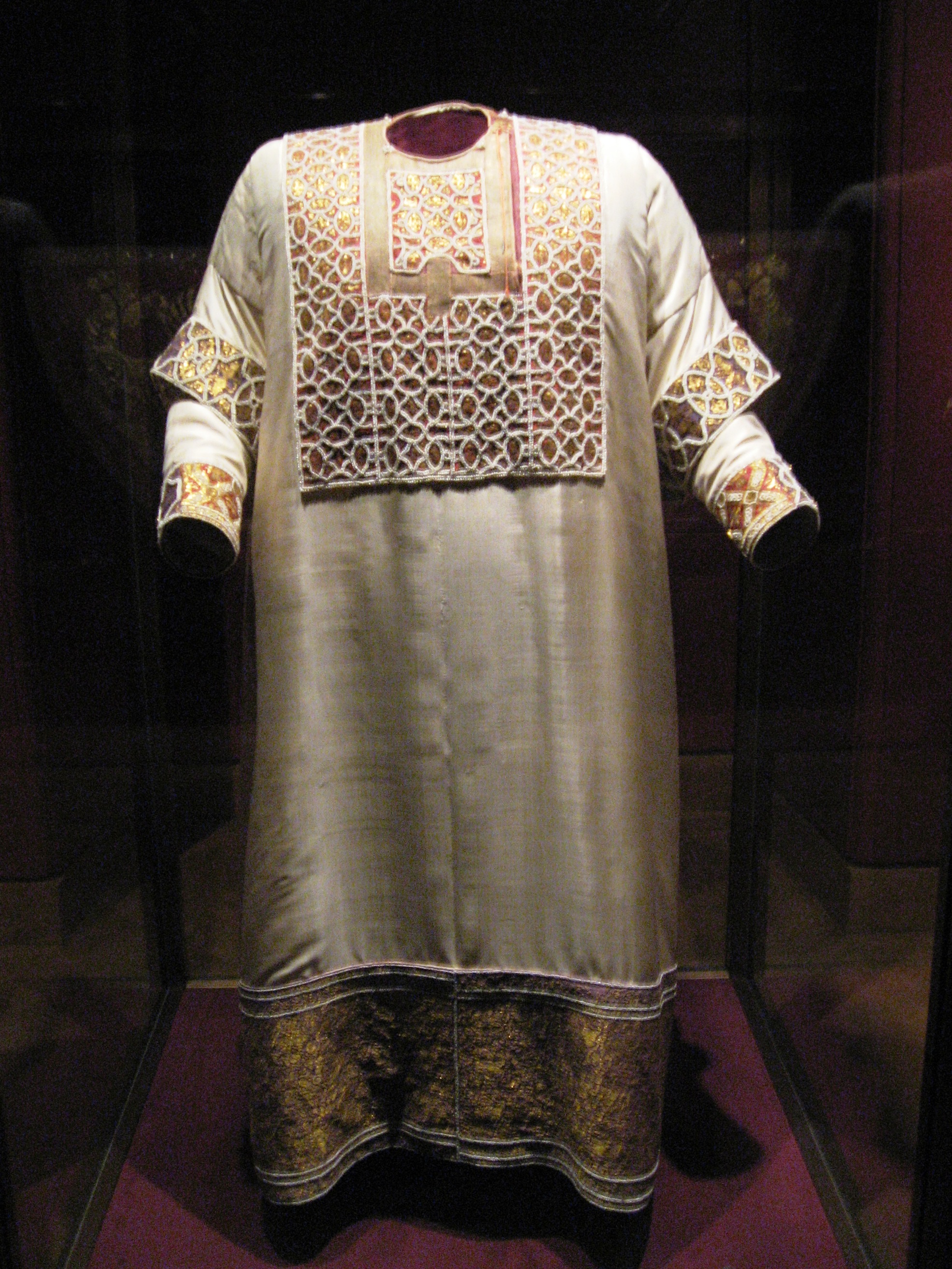
The alb of the Holy Roman Empire was my inspiration for his look, only sans all the pearls. (I did buy pearls, I just haven’t sat down and gotten busy with them yet.)
Alb of the Holy Roman EmpireKamision of the Holy Norman Jeff.Detail on the neckline before I finished it.
I don’t have good pictures of him fully dressed head to toe, that’s next on the agenda.
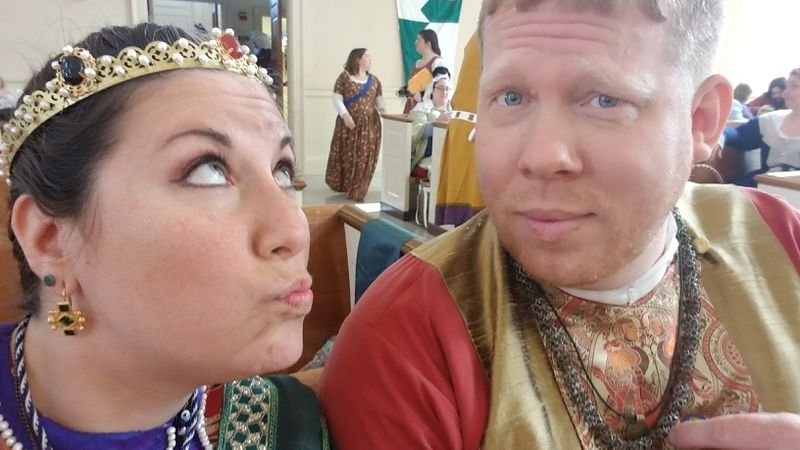
Here’s an extremely flattering shot of us both at East Kingdom Coronation, where you can see the band collar peeking out. The chain is tarnishing and already ruined it, so, I get to replace it sooner than him sweating amine, I guess. Boys are gross.
[Yes, the woman who named her site after a VNV Nation song just dropped a Wu Tang reference. Not even sorry.]
My husband has a huge head and a normal neck. Those of us who sew know what this means, it means a gaping maw of a neckline that shows off the Norman’s delicate ginger skin. And while it’s nothing a nice brooch and a gallon of sunblock can’t fix, it’s not -right-.
I’ll be posting soonish on dressing my husband in Byzantine, (yes, really, men’s garb, you heard it hear first), as well as including a new page on Norman Garb here on my site (*faints*) but I needed to reassess my approach toward fit.
During my short time in Caid, I had a discussion with a friend about necklines. American reenactors and re-creators make our necklines too big. After her visit to Scandinavia and meeting with Viking reenactors in the land of Where This Stuff Actually Happened, she gave me some tips on how to fix my stupidity.
I’m sure that this technique is known to a few people and I’m going to get a “WELL, DUH!” Gibbs Slap in the comments, but knowing also that there’s some derpy sewers out there who probably make the same mistakes I do, this post is important.
For the longest time, I’ve been following a formula given to me a while ago: You draw your neckline 3-4″ each way from the center point, 2″ down in the back, 4″ down in the front, and add a keyhole slit. This gives a lopsided oval effect with a shorter back than front, which is essential for comfort, but it’s just too wide around the neck. My husband’s head is 26″, his neck is 17″. He’s not a jacked guy, but he’s tall and broad, so making garb that doesn’t choke him has been a challenge.
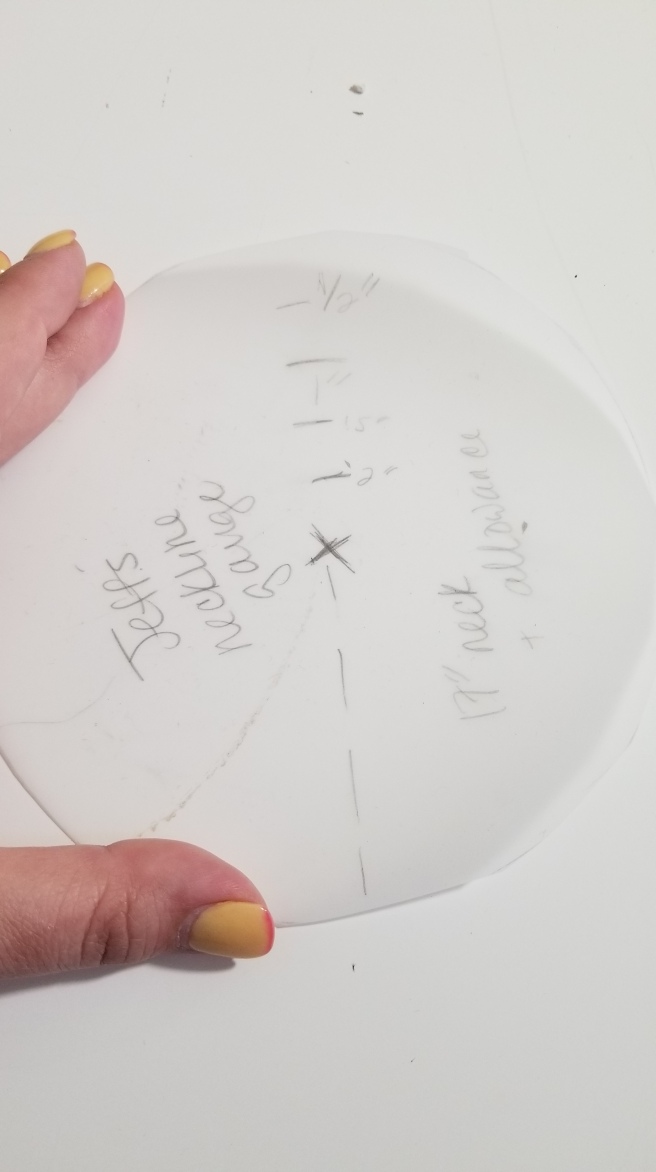
Here is my new hack: Neckline gauges.
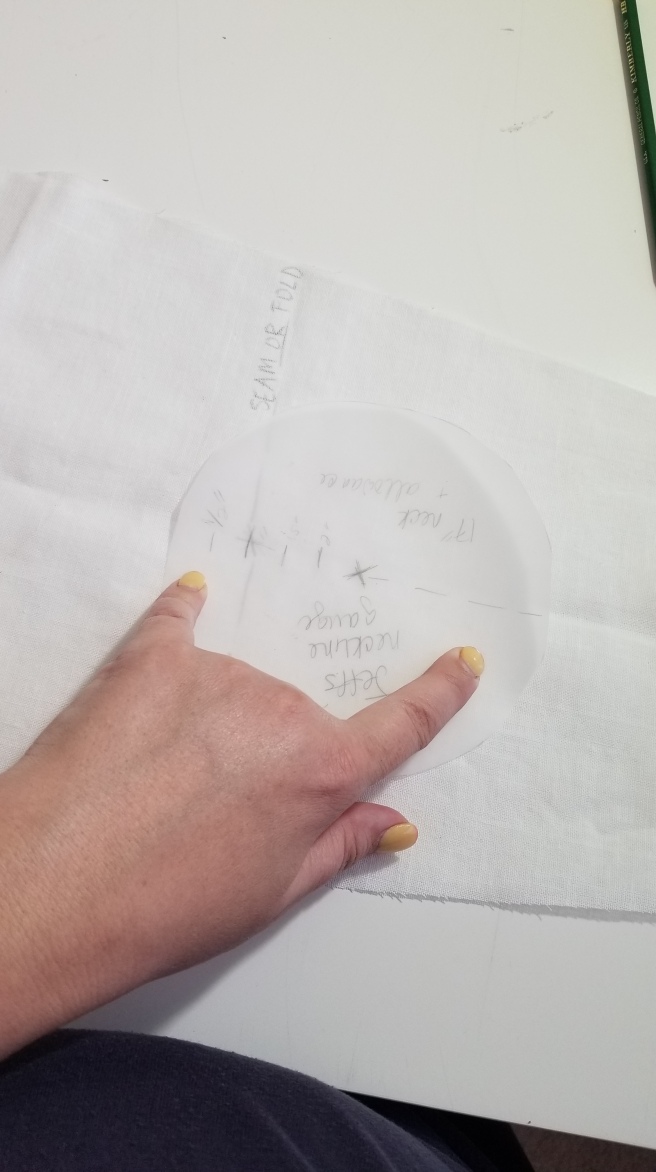
A true circle with the circumference of our necklines (13.5″ for me, 17″ for him), marked up showing increments of 1/2″ from the back toward the center mark. Ignore where it says “+ allowance”, I tried that and it made it too big. Just go with the regular neck measurement, the hem or facing will take care of that ease.
You place the gauge on the fabric, center mark matching to the dead center of where you want the neckline to be. Then, move it forward to where you want the depth of the back to be. I’ve done both 1″ and 1.5″ with good results. The dotted line helps you maintain the angle toward the front, and where you can mark your slit.
Here I am demonstrating it on a piece of scrap linen:
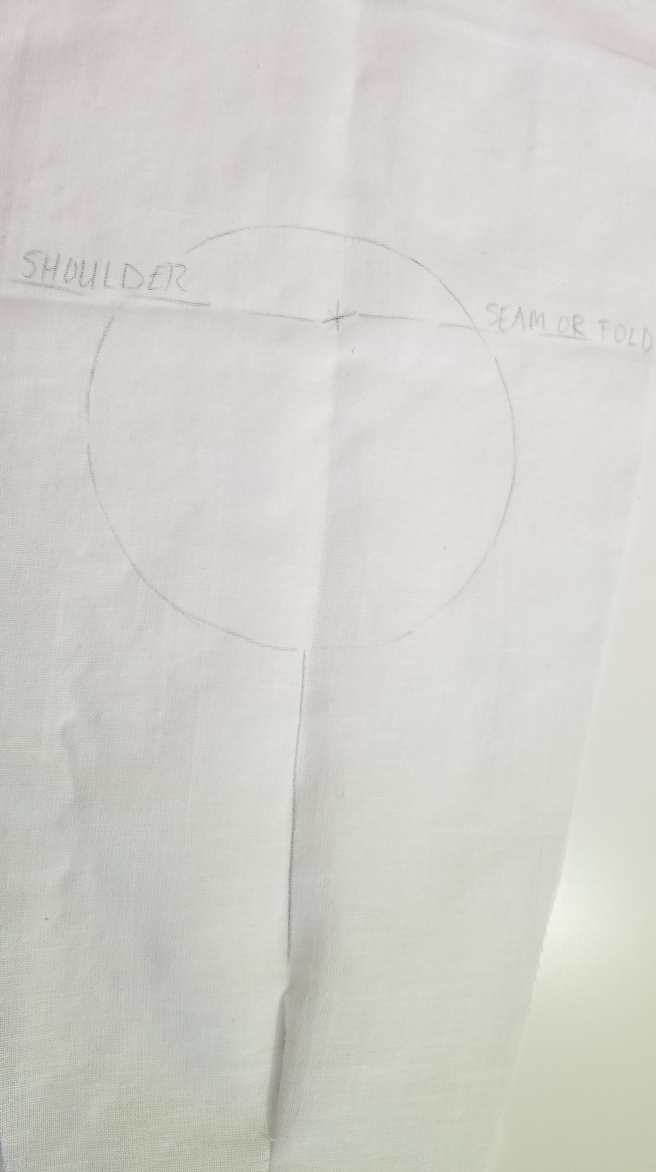
White on white was a horrible idea, but let’s pretend that fold in the scrap is our shoulder seam or fold.Place the gauge on the fabric, matching center points.Move it forward to how deep you want the neck to be. In this case, I’m leaving 1″ in the back, so I’m putting my 1″ mark over the center mark.Trace, and cut.
Give that a shot. Practice on a scrap and put it over your head. You should have a neckline that comes right up if not a bit above the clavicle, and looks more accurate. Voila!!
Clearly, a closed slit is vital to the tight necks in Byzantine artwork, but you never see the slit! What do we do?
I’ve constructed this for my husband with great results, both with, and without the band collar. This is also where I learned to NOT ADD A SEAM ALLOWANCE ON THE NECKLINE. I’ll be posting a better walkthrough once I’m done with his new collection of tunics so I can discuss my experience using the pattern above.
The other option is to put the slit off-center. The most common is just down the left side of the neck, as seen in the Alb of the Holy Roman Empire, and the Palermo Tunicella. While both not “Byzantine” garments, the Eastern influence is evident.
The Coronation Alb of the Holy Roman Empire. The left slit is closed with fingerloop braid. Click on this to see the larger image, it’s worth it.The Palermo Tunicella, with the deep slit off left on the neckline, surrounded by a band of brocaded trim.
So the next time you’re at a loss, looking at source artwork and wondering why your necks don’t look right, give this idea a shot and try a variation for a new fit. I know I’ve been totally converted.
Note that this is only a plausibly period approach with modern liberties. This is just a way to make good-looking, passable Byzantine garb on a budget for themed events, allow newcomers to try out a different style or persona, or make a low-cost “casual” wardrobe for when wearing fancier clothing is not appropriate (outdoor/warm weather events, wars, etc.)
This is a beginner/intermediate pattern. You will need to know how to do facings and have a basic idea of rectangular construction. You will still need a long sleeved undertunic, as well.
Pay no mind to my lack of makeup and phone acrobatics.
While Space Mom has little to do with the current Middle Ages, I’m using her activism, as well as the tradition of “feats of strength” on Festivus, on this last day of Saturnalia, to make a difficult post that I’ve been putting off as part of my psychotherapy.
Write about it. They always say to write about it. Write things down.
So, this post is going to tell you more about me than you ever really wanted. This is a vent, a way to open dialogue. This is not a cry for help, or a way to get attention. This is a necessary discussion that needs to happen, because I know I’m not alone.
My real name is Angela, and like so many others, I have clinical depression, with a chaser of generalized anxiety disorder. My brain decided chemicals are for losers around the same time my immune system decided my thyroid was a tasty snack, and and some sort of switch flipped from normal to batshit crazy. Or rather, somebody noticed that I was batshit, and that we needed to deal with it.
In January of 2014, I found myself a crying, broken mess in my now-husband’s barracks room. I was physically and mentally exhausted. An application to graduate school had been denied 2 weeks from the start of the semester, and my plans were suddenly on their head. The Norman’s solution?
“We should get married.”
My response was an expletive, but the rest was basically history. Two months later, I married the United States Navy. It was 13 degrees outside. I was accepted into graduate school the same month, and things appeared to be smoothing back over. Access to consistent healthcare now meant that my weird mood issues and lethargy could be addressed. I figured it was diabetes. Fortunately, I was wrong. Unfortunately, I was diagnosed with Hashimoto’s Disease, an autoimmune illness that effected my thyroid and would keep me on pills for the rest of my life. As far as AI diseases go, I got off lucky, guess, if there is such a thing. Hashimoto’s is very manageable. It does still knock me on my butt with flares, which usually happens after being extremely active or overstimulated for a few days, but I deal with those as they come. We figured that was the reason for my crankiness.
Healthcare is really only a fringe benefit to military life. I would soon find out it was a cornerstone of precious sanity in a world of pure, unadulterated chaos. In the last 3.75 years since we’ve been married, there was a move to NH, he made Chief, he was sent to Guam for three months, and the boat he was on got moved to San Diego. I moved to San Diego. He was deployed, and got extended. He came back, we tried to be normal for 2 minutes, and the hits just kept coming. I’ve was told it wouldn’t be this nuts. I’ve seen that it’s not always this nuts. In fact, it seems like we’re the only people that consistently get Eris at the detailer desk. Heck, my husband’s last sea duty started in Kuwait. Kuwait. He’s a ginger submariner, for freaking sake.
Sure, you’re sitting there reading this, going, “Well, you knew what you signed up for. Deal with it. This still has nothing to do with the SCA, why are you complaining about this? You didn’t have to marry him.” And all of that is correct. I’m setting the scene. Also: rude.
You see, the husband made Chief Petty Officer while we were AT Pennsic. This is when we knew that the balance between hobby and real life was a delicate one. Granted, Chief Season in itself is a special hell, and I got my first dose of going to events without him during the time we were a couple. It seems so normal now, that when he DOES go, it’s like a miracle. When he was in Guam, I kept myself busy with school and events. It was doable. The San Diego move was a little harder, but I still had my MA to complete, and events to go to. He couldn’t make my graduation, but at least got leave for my defense. He didn’t help me move to San Diego, and I didn’t see him until after being in the city for 3 weeks, alone. The SCA was my lifeline during this time. I went to an event, I met the people in Calafia. I was able to get advice on where to shop, where to eat, what to do. It proved to be more of a resource than you ever expect a silly club to me. The SCA saved my sanity during his extended deployment, and his first event home was Potrero War.
Between August 2015 and August 2017, I had spent probably about 4 months with him. We were eager for the break from this sea duty, returning to New England and the East Kingdom where our friends and family are. I was applying for jobs at some of the larger museums in the region and was eager to start my career back East. He got his orders to Connecticut in August, and by mid November, we were inspected, had a house, and were ready to go. Less than 2 weeks from our move date, those orders were canceled, and he was suddenly being sent to a sparsely populated corner of Georgia, and my brain split in half. I’ll come back to this in a bit.
I’ve known for some time that something wasn’t right upstairs. I was prone to ridiculous mood swings and moodiness as a teenager that was written off as being dramatic and, well, a teenager. High stress situations tended to make me flustered and upset beyond what seemed normal, and it didn’t take much for me to find a reason to lay on the couch and cry for weeks, overcome by muscle soreness, and by grief for seemingly nothing. While planning for the move to San Diego in the middle of writing my thesis, I started seeing a social worker at my university to help with stress management. She was concerned about my mood, and by things I was saying, and recommended I sit in front of the sun lamp (It was winter at the time), and said that even though she wasn’t a doctor, she was certain I was exhibiting signs of mental illness, probably anxiety and some kind of depression, maybe seasonal. She gave me therapy homework to help with my stress that ignored completely, and I just trucked through that last spring, living off of protein shakes, sadness, and Taco Bell. I should have taken her recommendation to seek out an actual psychologist, but I was busy, and felt embarrassed, because I was probably just stressed.
I should have paid more attention. My thought process prior to most events, especially big ones, tends to work like this:
-If I wear this, then XYZ. -If I wear this, then ABC. -I don’t even know why we do this. -What will they thing if I display this? -What will people say if I show up at this class? -What will people say about MY class? -I wonder if I’m going to be heckled again, what do I do? -Do I know my stuff well enough? -Ugh, I’m not going.
Like textbook impostor syndrome, right? Of course it is. Extroverted, talkative, strong women like me don’t have anxiety. That makes no sense.
I flew out to Pennsic from California that summer, and realized that I was wrong. I caught myself having anxiety attacks over and over for seemingly dumb reasons. My thought processes were a mess, and where I was once excited about the event, and seeing my friends, instead I found myself questioning everything I did.
– Do they even still want me around? – Will I make people mad for sitting with Caid for A&S? – Why is my household treating me like this? – I am an extrovert, why do I want to have nothing to do with this vigil in my camp? What is going on?
It was also dangerously hot, and my constant worrying about opinions of me make it easy for me to forget to take care of myself. This came to a head, and I ended up leaving war on an early flight back. It took weeks for me to want to go to an event again. I felt cowardly, tired, and depressed over Pennsic. Gieffrei finally dragged me out, and I ended up winning Queen’s Champion of A&S when I did. What the hell was going on with me? This wasn’t right.
I had another meltdown during his deployment when I fell, broke my computer, and hurt my knee. Chalking it up to stress again, I just let the waterworks fly, and let myself feel like ass for weeks until it blew over.
This last one? It was the last straw. Not just for me, but for my husband as well.
Back to my brain ripping in half, I felt as if I had ran into a hard glass wall. The life we had set up for ourselves was suddenly out of reach, but we could still see it. My job? Gone. Our house in CT? Gone. The SCA? Gone. Each thread of happiness I had got cut, and I found myself laying on the floor in the living room, wondering if it was worth it to end it all. Not a normal, rational reaction to dealing with a sudden change in your life. While the husband was trying to snap me out of it, and discussed making a plan to deal with the new move, my mind wouldn’t budge. It was still moving to CT. It was still going back to see our friends and family, into the house we had just secured. We were going to 12th Night and Ice Weasel and East Kingdom 50th Year, and I was doing research for the Byzantine Coronation in April. No, I was not moving to Georgia. There wasn’t even a stronghold at this base, no Meridies presence at all. The nearest group was an hour away, in Jacksonville, FL, in Trimaris, but I didn’t want to deal with another kingdom. I started in Trimaris ages ago, but I had a negative experience at fight practice, when I was driven off the field by aggressive men who didn’t want women in armor. I wanted the East back, and if I couldn’t have the East, I was staying in Caid. This wasn’t fair. It was ridiculous, and he needed to try to fight it. We were moving in 12 days. A neighbor ran over when she found out I wasn’t doing well, and, doing her best to make me laugh, insisted that I accept this fate by naming myself Queen of the Alligators. I would sit on my front porch with a tiara and a pretty dress, and hold a court of crocodilians while crushing a flat of cheap beer. Admit it, the concept has promise.
And fight we did. After he had his own explosion quelled, he dragged me to see a counselor on base, but I felt talked down to, like I was a kid throwing a tantrum. I was told that my feelings were valid, but I needed to nut up and shut up, we needed to make our plan for the new move. I left feeling less than sensational, but a small piece of my brain feigned acceptance, and suggested we put up the Saturnalia tree since we clearly weren’t leaving, even if I was still grasping at a glimmer of hope this was all just a misunderstanding that would be fixed.
I should have known better, we were warned by another SCAdian serviceperson who had done their share of voluntold traveling the world. Don’t be so optimistic that you’re going where you want to go. No orders are final until his ass is in the chair. Get ready to spend the rest of his career being transient SCA nobodies.
A week later, despite the local command doing what they could to overcome Navy bureaucracy, he got the official paper orders. Kings Bay it was. I was shattered. I was unable to function enough to even think straight about what to do next. Gieffrei had to leave work early (which he was fine with, considering his own mood) and had to take me to the ER since I decided I wanted to disappear rather than deal with anything else. This accomplished nothing but putting me in 2 hospital johnnies and a pair of socks, in a cold room for hours, being questioned by three different MDs. This wasn’t me, this wasn’t normal, and yet, it was such an oddly familiar feeling. It was brought to my realization that I’m so used to being sad, angry, and stressed, that finding the bright side to anything was not possible. I was given a list of numbers to call, it was time to make an appointment. These were the hardest phone calls and emails I’ve ever made in my life, ones that should have been done years ago.
I bawled during my first therapy session, blubbering about everything from having to call to cancel the lease on our house in Connecticut to being unable to even look at homes in Georgia. To having to explain to a stranger that I was a weird nerd who did medieval things and that all of my people are in one place, and there was nobody near this new place. I expected to get some weird reactions, but I did not. I expected to be told to put it aside to focus on my “real life”, I did not. My therapist was in my brain better than I was, but of course, that was their job. My hobbies mattered. The SCA mattered, the 501st mattered, my drawing and painting and sewing and comic books, this all mattered. I wasn’t treated like a child. I was allowed to be upset, frustrated, and overwhelmed. I was allowed to believe that life wasn’t fair. Even as I type this, I’m welling up, because I certainly wasn’t fixed immediately.
The diagnosis, after a long chat besides my current situation, was clinical depression, and anxiety. I was broken. Great. I had reasons for my behavior, but now I had that fear of whispers behind my back. What would people think of me, now?
“Oh, there goes crazy Anna, it’s fine. She just cries all the time. I don’t even know why she comes to events anymore.”
You see that? That’s what anxiety does to you. I can’t get rid of that thought now.
Not that it matters, you have no friends in that part of Meridies or that part of Trimaris. You may as well quit.
I wish I wasn’t having these thoughts, but they’re real.
Right now, the prescription is just therapy. Having to move makes it hard on me to explore psychiatric evaluation and medication, since such things need to be monitored. I don’t even want to talk about this. I want to pretend it isn’t real, and that I’m still just a ball of stress, and this too, will pass, but, it’s not passing. There’s still that plexiglass wall, with my normal life on the side, and I’m pounding at it, crying my eyes out and wondering what the hell we did to deserve this.
The latest development is that we decided to live in Florida versus Georgia. I grew up there, albeit far from Jacksonville in the Tampa Bay area, but at the very least, my immediate family is within a 4 hour drive. We’ll be in an active barony, which was part of the sell, but honestly, I’m not sure how active -we’ll- be. Still, it’s better than living just across the border, and having not even a local A&S night or fight practice to socialize at. My husband will have an hour commute, and I feel like it’s my fault, because he decided it was best for me to be in civilization. As civilized as Jacksonville can be, anyway. (Hey, I’m from Tampa, I have to jab.)
There’s still too much we have to do. We were supposed to be here in Caid until February, but now we’re moving mid-January. I need to get a job, relatively fast, and we’re down a car. We still have to go to New Hampshire to get our stuff in storage, including our large pavilion, and can’t do that until the spring. Needless to say, we won’t be at Gulf Wars, so please do not push it as a platitude. Our spring trip to New England will include East Kingdom Coronation, so I can fulfill their highness’ wishes for a Byzantine theme. We will be at Pennsic, or at least, Gieffrei says we will. We are not making plans for Trimarian or Meridian events at this time until we get over this shock, and I can become employed, because we’re gonna be flat broke if I don’t.
Things will work themselves out because they have to. Not because I want them to, or because I’m looking for a bright spot. I’ll get a job, I’ll live in misery in the sweaty corner of the country, back in the Motherstate, and then who the hell knows what we have next. Acceptance is going slowly, and there is still the option of me taking off for a job with some merit elsewhere. There’s too many variables, and it’s eating my brain like candy. This was the worst time for me to come to terms with my mental illness. The Holidays don’t help.
I found solace in the idea of being Queen of the Alligators. Of course, being queen without being a consort in crown doesn’t work in the SCA, so I can’t really call myself that in a SCAdian context without getting chastised, even in jest. But, as a baroness, I can wear a coronet, so I went on Etsy, and found brass alligators, six of them, and this will be happening. I also found woven trim, but it hasn’t come in yet.
Alligators are New World, but crocodiles are Old World, and a heraldic charge, so I’m also looking into registering one as a badge. Though, I’m sure if I dug into enough information about the settling of St. Augustine, I could probably find a reference to an alligator within SCA period. It does matter, after all, they look different, and alligators tend to be cuter since they have a broader snout, but I digress. Once a Florida girl, always a Florida girl, even when we try to run.
A crocodile tergiant, or. Well, it really looks more like a caiman with that snoot, but whatever.
I wish I could give a more positive answer in conclusion, other than sticking it to the Navy while creating novelty in the SCA with large reptiles, but right now, it’s the single thread of happiness I have, even in its absurdity. I think Space Mom would approve. I don’t know what the eventual step toward psychoactive medication will do, but I’m sure it’ll be interesting to feel like a nice, normally functioning, adult human being.
Kittens!
And this disjointed nightmare is how I tell the internet that I’m moving back to Trimaris after 15 years.
Baroness Anna Dokeianina Syrakousina, Lady of the Alligators
Conch Republic of the Early Disaster
No, really. Somehow, it ended up in a box of our holiday decorations because that’s how military packers and movers roll.
We aren’t pros, we have a basic know-how of the art thanks to a couple classes at Pennsic, and dropped a few hundred dollars on supplies because it sounded like a good idea at the time and then FORGOT ALL ABOUT IT.
So we decided to fire it up and see what kind of horrible we could make. We have a Sutton Hoo-era Coronation for our last hurrah here in Caid, so might as well go all out with some Anglian enameled jewelry. Sure, we could totally do this.
Oh yeah, no sweat. (This is a shoulder clasp from Sutton Hoo.)
Deciding that we were going to turn our early Anglian garb into Founders Era Harry Potter subtle SCA cosplays of Rowena Ravenclaw and Godric Gryffindor (Yes, I know that they founded the school in the 10th Century and not the 6th, but they were Anglo-Saxon so bear with my madness, please, we go any later and my Norman husband will declare war on himself and things get messy) I started planning stuff out, since I’d be doing most of the work, anyway. I needed brooches, but since I’m Ravenclaw, I needed some house pride. I’m really unsure if the plethora of bird brooches used between the Anglo-Saxon, Frankish/Merovingian, and Gothic cultures were used on the peplos dresses, but I decided to take that risk for my impression.
Now, there’s some REALLY IMPRESSIVE enameled and inset stone eagle fibulae out there. Way beyond what I can do, so I needed to keep it simple. I found that Quiet Press had a style I could possibly emulate, only in red, but I wanted to find his source before being a jerk and ripping off a respectable merchant I buy from frequently. I have no intention of selling my enameling work, or even attempting to compete in the reenactment jewelry market, ever, so I used that thought as a soothing mechanism, and reminded myself I was still learning. I still sought to find a few other birds I could work from for my “eagles.” (Let’s face it, they all look like Gonzo.)
This guy is from a lot at Christie’s, and I decided I liked the wire work for the cloisonne and the inclusion of the pearl. As you can see, red garnets were the thing for this period, but it didn’t work with the color scheme I’m going for.
Gonzo.
Two Gonzos. Ah Ah!An opposite-facing pair of Gonzos, which I wanted to find to support my own Gonzos.
Finding enough supporting evidence for my Gonzos and some line variants, I went ahead and made my shape, and the Norman cut them out of copper, which was chosen for the type of enamel we have. They do make enamels for bronze, brass, gold, silver, etc, but we have the copper kit. I sat, watching some bad television, and filed the edges of my birds down while the kiln warmed up. It went pretty fast.
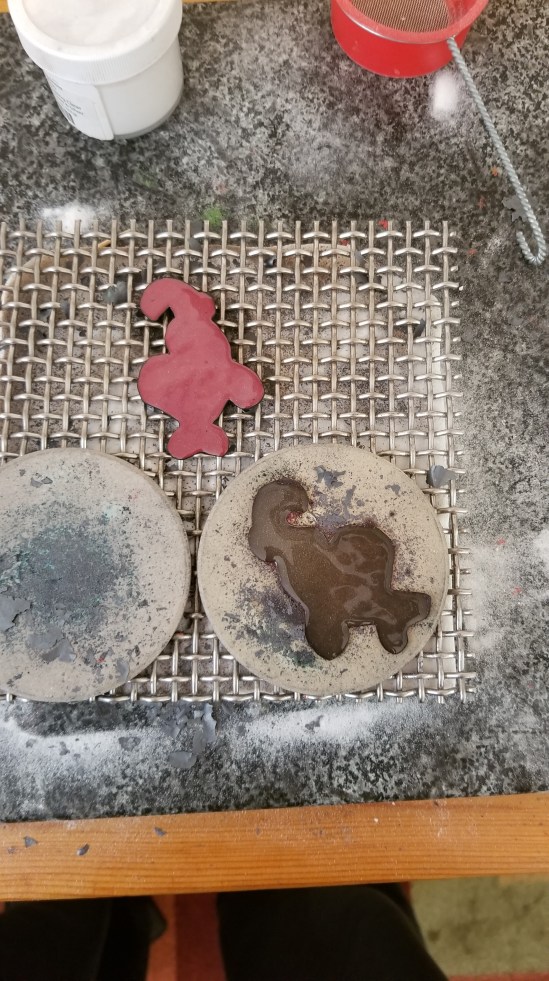
Once things got hot, I went ahead and prepped the pieces with the clear base coat:
And fired them:
Top bird is “cooled”, the one on the pizza stone is scorching hot. The base coat cools to a pleasant deep red.
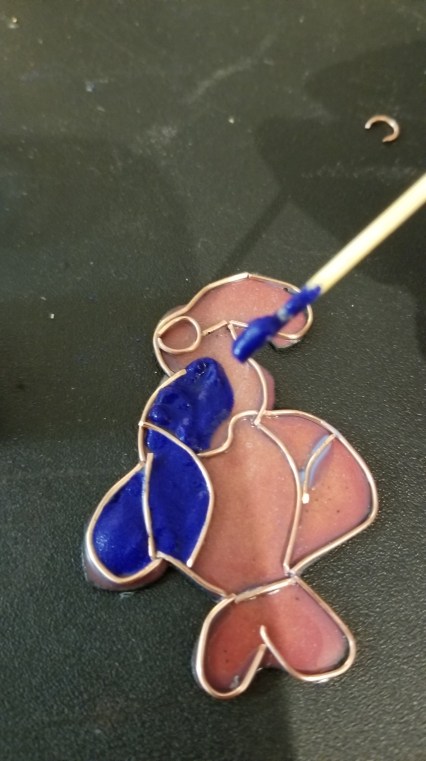
Once they were fully cooled, I started the wire work. A note about the temp: this is not a “fresh out of the oven” hot, this is surface of the sun hot. You will get severely injured if you are not cautious. This is 20g copper wire. It took me quite a bit of time, and I used Thompson Blue Stic glue to keep it down. I am unsure if any adhesive was used in period, but I assure you, it’s a pain if your wires move. It’s also a lot easier to work with smaller cuts of wire, as I found out almost immediately. Hopefully as I improve, I can handle manipulating larger pieces.
Once the glue was dried, completely (this is not a “fast” art), I put down the blue enamel, emulsified in water.
Fire! You can see how red-hot the stones get.
And cooling down to the blue. I had to do a second coat with the enamel since I had some coverage issues.
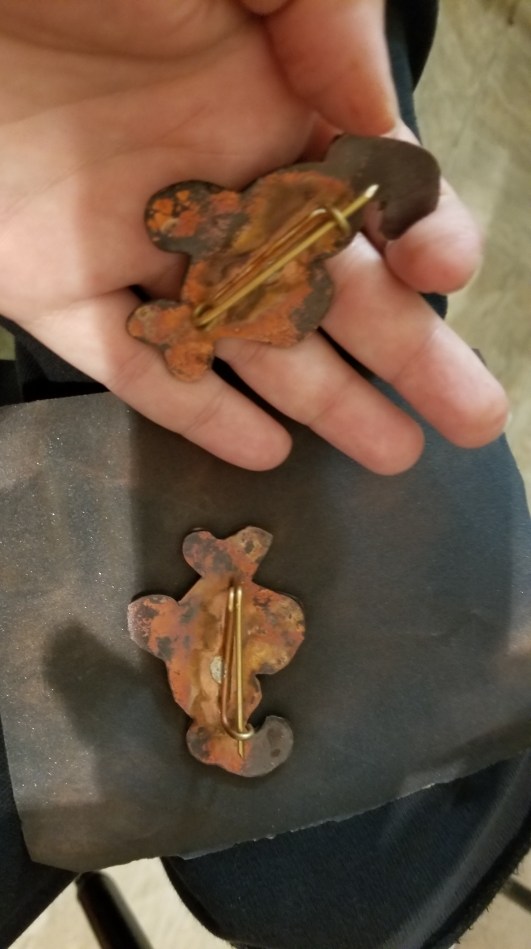
Husband made some fibulae pins from brass wire, and he showed me how to solder them on in about 5 minutes. Again, HOT. LET COOL. OMG. SO EASY TO REALLY BURN YOURSELF.
And then the sanding. This is how you get your wires to show up again, after oxidizing in the kiln. During the process, one of the brooches popped some air bubbles in the enamel. This upset me, but I’ve seen period pieces with similar imperfections. Part of the learning curve, I suppose. I was still pretty pleased (see also, hooting, hollering, and down right ECSTATIC over how these were coming out.)
For the finishing touch…pearl eyes. We gently sawed a couple pearls in half to get the right size, and glued them in the eye sockets. The period technique would have them set in, but I’m not really there as a jeweler, and probably never will be, but Gieffrei insisted I do this almost entirely myself, so…E6000 it was.
But seriously though…they aren’t museum quality works of art, but I am insanely proud of this project. Behold, Rowena Ravenclaw’s Gonzo, I mean, Eagle, fibulae!
I have a long way to go before I’m ready to do intricate Byzantine style enamels, but it certainly beats my “warm-up” project from the day before.
Uh. Well, that’s something.
I learned a lot. I think I learned how to do some troubleshooting on the appearance of the enamel, but this is going to take some time to really get into. I have some great friends in the East Kingdom that do enameling, so next I see them, I’ll have to see what kind of tips they can give to work with the minimal tools we own. I don’t know if we’re going to invest in a larger kit just yet, because it’s not our primary art form, but rather another corner of the Middle Ages that have entered our home. Or rather the entirety of our dining room. In fact, we had a ton of friends over on Saturday to give it a try with us, and we had a ton of fun with great results just after 2 little projects.
Well, I suppose Godric Gryffindor needs some kind of lions next. Stay tuned for the next segment of our Anglian Experience.
So I’m currently in the lead over at Fabrics-store.com’s Reenactment and Costume Contest, which is sort of funny, because I had to get my arm twisted to enter anyway. It’s even funnier than it’s our Norman garb, but I digress, I could use some votes to stay on top!
It’s simple! Just make an account (free!) and vote once every 24 hours for the next 2 days. The store doesn’t spam you with emails, and you can toggle that once you have an account. I would also appreciate a share or two on social media if you can spare the milliseconds and bandwidth.
I’ve posted previously on how using vintage cotton saris works for posh-looking classical garb on a budget. So, during my sari splurges, I picked up a few that I thought would work for Byzantine applications. It only took me a year to complete an unfinished early-period style dalmatica, but once I focused, I got it finished in a couple of hours for wearing at Calafia Anniversary.
I didn’t get any in-progress pictures, but here are the results:
The method:
Use the sari as fabric. It’s narrower than most modern bolt widths (around 36-42″ wide) so plan accordingly for what you need. I’m not that tiny, but it worked fine for my 42″ bust using the full width, and just cutting the garment into shape like and old-fashioned t-tunic with the Byzantine curved underarms. I didn’t add gores, but I did have enough left to consider putting in narrow ones if it came down to it. So this is a bit more slim-fitting than an actual period garment would be. I saved the extra to use as sleeve extensions instead, which I haven’t done yet. I may just keep the short sleeves, which is just the finished edges of the sari, thus eliminating the need for a hem or trim application.
The bottom embellishment is the pallu (decorative end) of the sari, applied as a facing to the bottom hem, and then covered with spangly trim to completely seal all raw edges. The weight on the bottom is essential, otherwise sari fabric is just too filmy and light for the proper fall of an over tunic. I should have done a facing on the neckline as well, but I ran out of steam.
Pros:
~Cheap
~Easy
~Good for outside events where there will be dirt, but you need to dress a bit nicer. I spend $17 on the sari. If it gets wrecked, all I do is remove the trim and throw it out, versus crying over potential damage to my nicer clothing.
~Great for newcomers, or those looking for a garb “one-shot” for a themed event, due to all of the above.
Cons:
~Too slim fitting for accuracy, and may not work well for fuller figures.
~Cotton is too filmy for a nice dalmatic/over tunic. This is a cotton/poly blend, so if it was a bit hotter, I could have risked being really uncomfortable. I did get chilly near the end of the day. I picked it because the pattern is actually quite period for early Byzantine, and decided to take the risk. 100% silk would be best, but then cost can become an issue.
~A lot of saris are “art silk”, which is not real silk, it’s short for artificial silk that is 100% dead dinosaur. A lot of these are far nicer than straight cotton ones, but it’s a great way to make yourself garb that doesn’t breathe, so shop carefully, or plan to wear it sparingly (and indoors!)
Conclusion:
I will probably make a couple more of these for Pennsic or other grubby camping events when I need to not look like a scrub, but I wouldn’t recommend filling a wardrobe with them.
Ironically, I was wearing this when I was summoned by their Majesties of Caid and gifted with their Lux Caidis, the Grant-level award for Arts and Sciences. It caught me completely off guard, because I had moved closer to see if one of the friends I had written in was receiving the award. Evidently, when they called my name, I made a velociraptor shriek of surprise.
Caid has been velociraptor-free for zero days.
Here’s a bad picture of the medallion on my chest, just above my Eastern Maunche, which carries the same precedence.
Unfortunately, with me returning to the East Kingdom in December, I feel like I have really no time to repay Caid for the precious gift, and it’s hard to put my honor into words.
So, you want to have a Byzantine persona? Welcome to the ranks of the mysterious medieval orient.
This, and more, are going to become a page here on my site shortly *points up to links*, I just need to find time to sit down and do it. Until then, I feel the information I am presenting here is somewhat necessary for SCAdians to find direction in their path, either to a full-fledged persona, or a garb project for a themed event.
Often, when people ask me what a Byzantine should wear, I respond with, “What period?”
This gets me a look of total confusion, and a response of, “You know, Byzantine.” I take a deep breath, and prepare to either bore the poor individual to tears with a well-rehearsed speech on the massive construct that was over 1000 years of history, or I open the flood gates and get them more excited about digging into more. I always hope it’s the latter, but the foremost argument I have to make is this:
There is no “Byzantine period.”
Repeat after me:
There is no “Byzantine period.”
That is the equivalent of asking somebody for French garb, and nobody ever just says “French”, there’s usually a century attached to it. Why is this never the case when it comes to Byzantine? Byzantine, like French, is a culture, it’s a place, it’s not a standalone period.
The Byzantine Empire, which is an anachronistic term for the Eastern Roman Empire, was the longest running medieval culture in Christendom. I use that term specifically, since it was not really a European culture, as much as it was an “Eastern” culture, or, generally referred to as “oriental.” Of course, that word today has a completely different connotation that comes across as somewhat pejorative of the Far East, but in actuality, it literally just means “eastern”, and that is exactly how the Western Europeans viewed the Romans, whom they referred to as Greeks. Both are correct, but a Roman would never call themselves Greek. 😉 They barely viewed themselves on the same plane of existence as the rest of the continent, as it was, and as my brother just haughtily remarked on my Facebook page less than 3 minutes after announcing I was writing this post, viewing the Eastern Romans as “medieval” is even somewhat insulting, but for the sake of the instructional nature of what I’m trying to do, this is the approach I’m taking. (What can I say? Byzantines were snooty people.)
So, as a newcomer, consider the Byzantines the medieval Greeks, because that is exactly who they were. Wash the romantic imagery of draped clothing, columns, and Socrates out of your head, because I know that’s exactly where you went. 😉 While ultra-early Byzantine would be basically Roman, let’s fast forward a bit to the 6th Century, during the reign of Justinian and Theodora. Here, we find what most scholars refer to as the shift into what is considered “Byzantine,” versus Late Antiquity. The culture did shift, and with that, so did clothing, language, religion, law, architecture, etc.
This is the period most SCAdians view as “Byzantine”, the 3 pages in their Western Civilization textbook devoted to the laws of Justinian and how his wife may have been a prostitute, and onto the feudal system you go in the next chapter. This is where I need my readers to start thinking outside of this box, because you’re looking at a total of 38 years encapsulated within the time Constantine renamed the Greek town of Byzantium to the new Roman capital of Constantinople in 330, to 1453 when Constantinople was taken by the Ottoman Turks. That’s a lot time to assume that everybody wore exactly what Justinian and Theodora wore in the San Vitale mosaics.
I break the Byzantine Empire down into 4 parts for ease of understanding culturally, but there were still shifts within. Heck, I just got an older book this week on the cultural changes between the 11th and 12th Century, which is where I “live”, so even I still need to do more nailing down.
The Byzantine Periods According to Anna:
Roman Period 330-500 CE Early Byzantine Period (including Iconoclasm) 500-900 CE Middle Period (Golden Age) 900-1204 CE Late Period (Collapse) 1261-1453 CE
Important dates you NEED TO KNOW:
First Iconoclastic Period: 726-787 Second Iconoclastic Period: 814-882 Establishment of the formal Varangian Guard: 980’s Sack of Constantinople during the 4th Crusade:April 12th, 1204 Latin Empire/Empire of Nicaea: 1204-1261 Empire of Trebizond: 1204-1461 Despotate of Epirus: 1204-1479 Fall of Constantinople: May 29th, 1453
I’m not going to go into a detailed history of the Fourth Crusade and the successor empires during this post, but as you can see, after the sack in 1204 by the crusaders, things kinda hit the fan and shattered. The Empire did not recover fully, and it remained unstable through to the absolute fall at the hands of the Ottomans in 1453. In my opinion, both scholarly and SCAdianly, anybody who wants a persona post-1204 has their work cut out for them. It can be done, it SHOULD be done, but I have yet to really see anybody nail it. My persona was probably dead by the mid 12th Century, so it’s all science fiction to me. 😛 Likewise, anybody looking for sources during the 8th and 9th centuries will also run into a lot of dead ends. Iconoclasm resulted into the loss of most artistic record from that period and earlier, which is why we have more illuminated manuscripts, frescoes, and mosaics from the 11th and 12th centuries than we do the 6th and 7th. These are all unfortunate events that are part of the Empire’s history, and as researchers and re-creators, we need to come to terms with it. Some things will just not be done easily, but what you can find could be incredibly rewarding.
I’m going to wrap up this post with a short selection on clothing, since that’s what a lot of people want to know about. When I make my full page, I’ll go into more detail regarding other factors.
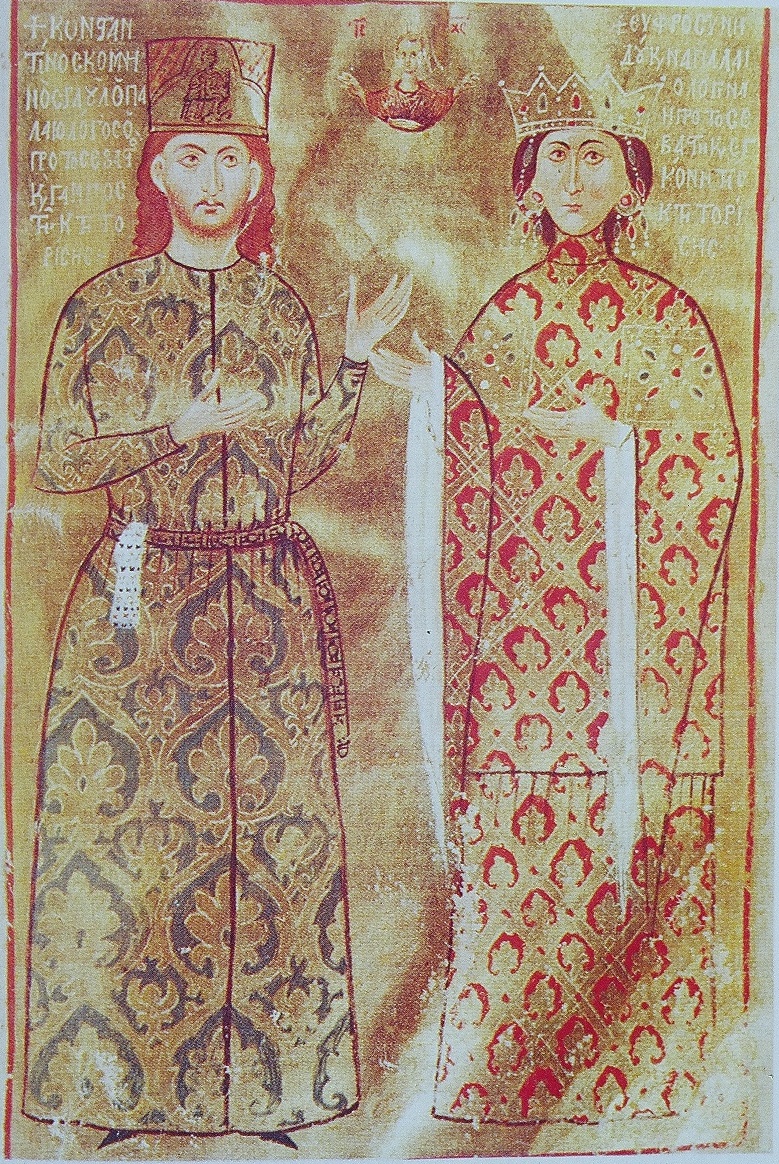
Sumptuary laws are, and always were, a thing. Many pieces of artwork we have are just of imperials, and the average aristocrat, and certainly not the commoners, would be wearing the same fashions as their rulers. While, as far as I know, there are no harsh rules in the SCA regarding dress aside from peerage elements and coronets in some kingdoms, in period a fashion faux pas could be devastating depending on when and where you lived, so if you plan to take the Byzantine route seriously, such laws need to be taken into account when it comes to your wardrobe, both male and female. Even shoe color was regulated. That idea of Byzantines always wearing red shoes? Drop it. That was for Imperials ONLY according to De Cerimoniis, a court manual written in the 10th Century. Prior to that? It seemed to be more widespread. Little things like that can make the difference between, “That guy in the clavii striped tunic and red shoes is a Byzantine” to, “Wow! You’re wearing something I’m not familiar with as Byzantine, tell me more.” There is so much of this culture that the SCA has just not explored.
Look at the differences between the clothing in the images below just to get a sense of how much things really changed over time.
6th Century Imperial and Attendants, showing a variety of fashions from the reign of Justinian I.14th Century Imperial fashions from the Lincoln Typikon, showing the encroaching Ottoman Turkish styles present in dress, 100 years before the Empire fell. Tell the 14th Century Mafia to step aside, this is how it’s done.
The purpose of this post is, of course, not to chastise, but rather remind folks that there’s so much more out there to explore. Break out of the SCAdian conscience of just “Being Byzantine”, and find your home somewhere within your own personal One True Century, within the One True Empire.
Konstantia made this for me. This is why we can’t have nice things. (I was making sekanjabin en masse for an event. I SWEARRRRRR!)
Coming soon to a mailbox near you!
If you don’t have a subscription, I will post an update as soon as the stock clerk has them available on the SCA website. I plan to also purchase additional copies aside from my author copies, and have them available at Birka.
I know I haven’t been posting as much as I used to. I do have content coming, but I was focusing on getting this off the ground, and, preparing for another fun-filled exciting cross-country move back to the East Kingdom from Caid. I was hoping they’d give us another winter in SoCal, but nooooooo. 😦







 You place the gauge on the fabric, center mark matching to the dead center of where you want the neckline to be. Then, move it forward to where you want the depth of the back to be. I’ve done both 1″ and 1.5″ with good results. The dotted line helps you maintain the angle toward the front, and where you can mark your slit.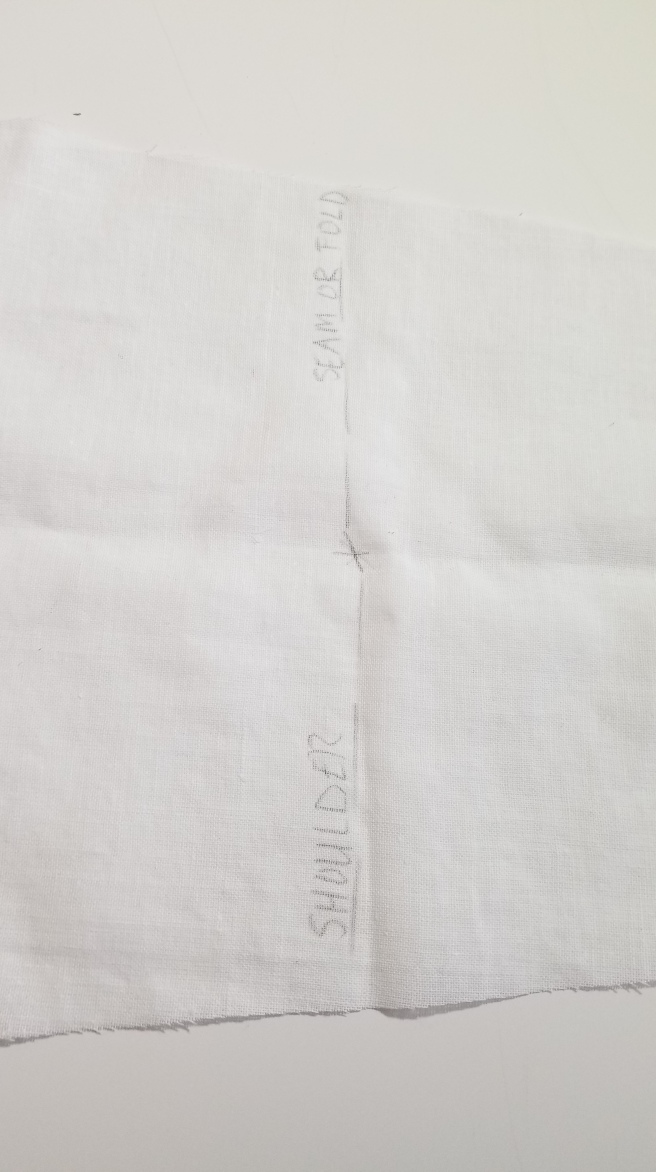











 Anna's New Rome
You must be logged in to post a comment.