Our soon-to-be Queen (Yes, that would make her the Princess) has issued a challenge for Birka, an event we have in January, in which participants are to make their favorite sports team jerseys into garb. Some people will find this dumb, I find it hysterical, because I live in New England, this is a New England event not far from Boston, and therefore 99.9% of everyone is going to be Red Sox, Patriots, Bruins, or Celtics. I’m from Tampa. I do not like these Boston teams (though Foxboro is actually closer to Providence than Boston, hence “New England”.) Which means I am going to stick out like a sore thumb no matter what, and probably risk getting the snot bludgeoned out of me. Therefore, I need to do it in style.
I have a few times to choose from, obviously the Rays, Buccaneers, and Lightning, but first I need to decide which type of garb to do. I should be a good kid and stay in persona, as much as I should also adhere to the event and wear Viking. Or I could break brains. I have a brain breaking plan but it will be kept sooper secret until it’s reveal should I go that way.
Anyways, here’s a poll. Feel free to respond as to what you see fit I should do. Not that I may listen, BUT, I’m sort of at a loss. I have until January.
This is a paper I wrote back in freshman year of College Mark II (2010.) It’s not in my finest academic form, and I used MLA instead of Chicago, since that’s what I knew at the time. I figured it’s length and content were perfect for a blog entry as I have been lacking on any real substantial content lately, ESPECIALLY about the Byzantine Empire. In-text citations with works cited at the end.
Stealing the Worm: Silk Production in the Byzantine Empire
Angela Costello
12/08/2010
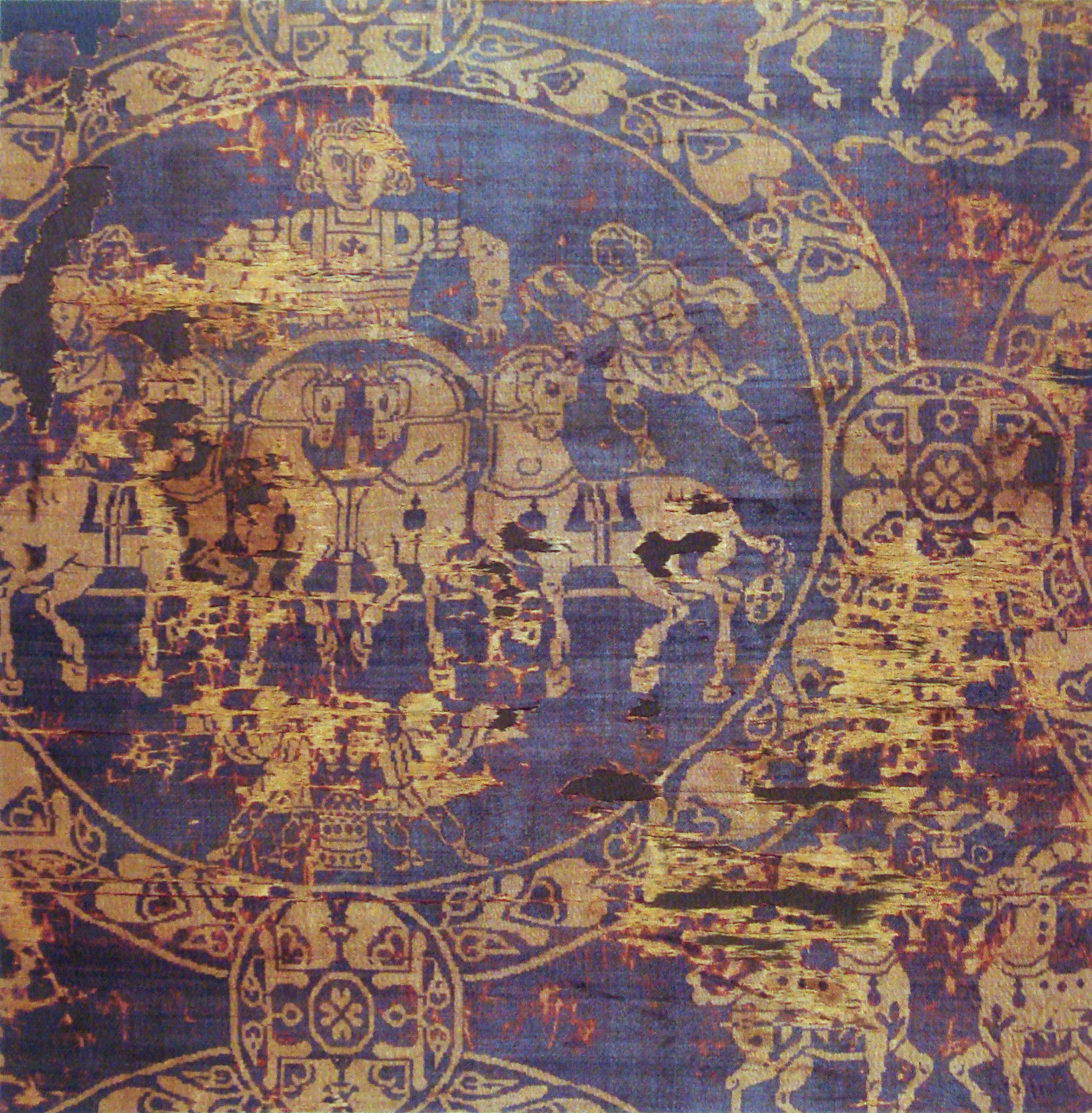
The Shroud of Charlemagne. Manufactured in Constantinople in 814.
One of the primary achievements within the reign of Justinian I was the obtainment of silkworms from China. We will analyze how this event led to major changes within the Eastern Roman Empire’s economy and foreign policies.
The Silk Road opened to Rome in the 2nd Century as caravans that traveled from China and through Persia worked their way into the outer provinces of the Empire. A chapter of the Hou Hanshu, a historic text from China, states that Roman contact was made by sea in AD116, which initiated a series of trades from there on out. (Hill) There are also Biblical mentions of silk, although the period translation from ancient Hebrew may be referring more to a very fine linen, there is one certain mention within the Book of Revelations during the description of the Fall of Babylon, as it was translated from Greek. “And the merchants of the earth weep and mourn for her, since no one buys their cargo any more … fine linen, purple, silk and scarlet”. (Revelation 18:12)So it is believed at the time the book was finalized, that the fabric was commonly known.
The luxuriousness of the fabric and the wealth that it embodied allowed the Empire at a time to use silk as a monetary standard for a short period of time. Silk was used as a way to determine the value of currency in the outer provinces, much like silver was used in the core of Rome. This didn’t seem to have lasted very long, however, as most records show that the silver standard took precedence for the majority of the period. (“Money” 701)
China was the sole manufacturer of silk for thousands of years, and it wasn’t until the Emperor Justinian I in 552 obtained the first silkworm eggs. Prior to that, the Romans had to trade through their strongest enemy to the East, Sassanid Persia. Trade with Persia was costly, strenuous, and often dangerous, therefore it was evident a solution was needed.
There was a high demand for silk in the Mediterranean during the reign of Justinian, both within Constantinople and into the outreaches at the highest extent of the Byzantine Empire. It was the prized fabric of the notably well-dressed Imperial court and an overall hot commodity in the area. Interaction with Persia needed to be brought to a minimum, and Procopius wrote of a solution.
The legend tells of the Emperor sending monks as emissaries to China, and smuggling back the worms in stalks of bamboo. The eggs did hatch on the journey back, but within the care of the monks they did arrive safely. With them also came several Chinese slaves, educated in the ways of sericulture, or the production of silk, and the humble beginnings of the silk industry in Constantinople began. (Procopius 229)
Although silk production began under the reign of Justinian I and Irene of Athens, it didn’t particularly pick up until several centuries later. It was necessary to breed the worms to have a significant production of the thread, so to do this would take a considerable amount of time. Thanks to the destruction of the Western Empire in the century prior, Constantinople had established itself as the economic superpower for nearly all of Europe and especially the Levantine Mediterranean realms. (Schoeser 27) So despite the work needed to establish a strong foothold on sericulture, the Romans found themselves in a strong opportunity.
Authors such as Procopius and Theophanes attempted to give a look as if the production of silk happened “overnight” in Byzantium, but the truth is that this just isn’t the case. Although Procopius’ stunning story of the theft of the worms from China is intriguing, it was probably nothing more than contemporary propaganda. The earliest known documented Byzantine silkworms were actually located in fifth-century Byzantine-controlled Syria. ( Muthesius 150)
Initially, silk production was limited to just the Imperial Palace, with private spinners and weavers put to work to create the splendid garments for the emperor, empress, and entourage of the court of Byzantium, much like the private workshops they had for jewelers and perfume makers. Eventually commerce spread outward to the people of Constantinople and the Empire as a whole, and an overall monopoly on silk goods produced by the former Imperial workshops had spread as far as Francia in the west, but that wasn’t until the 11th and 12th centuries once the Empire had established a solid industry.
The most notable factor of silk produced within the Eastern Roman Empire was the intricacy of the designs on the finished woven textiles. In Constantinople, improvements and innovations to the weaving industry were made to accommodate the desire for more elaborate designs. These were known as pattern harnesses, which required a considerable amount of skill to operate. As written by St. Theodoret of Cyrus, the skilled laborers were women:
“…Women take it in hand and weave the fine yarns. First they place the warp like strings in order on the looms and pass the weft through them, separating the threads with the combs, loosening some of the broken lines and tightening others; then they thrust and compress the weft with the instruments made for this purpose and in that way complete the web…Notice how on all kids of living things are embroidered, the forms of men, hunters, worshipers, and the images of trees and countless other objects.” (Theodoret 55)
Notable weaving patterns in early Byzantine textiles that still exist are the tabby, damask, twill, lampas, and tapestry weaves. (Muthesius 153) It seemed an entirely new sub-industry within the Empire was created to support this new weaving venture.
Despite the silk industrial revolution that was occurring in Constantinople, trade for raw and finished silk goods from China was still very prominent for several centuries. The Empire continued to import raw silk thread and yarn from the East as to support their weaving industry, and to get there; it had to go through the Persian Empire. Each stage of the journey from China, either by land or sea, dyes and designs added value and increased its cost. The uneasy relations that Byzantium had with Persia often made the trade difficult and dangerous, so the importation of silk and other eastern goods were subject to strict government regulations on both sides. (Feltham 5) Prior to Persian control, the majority of silk going into Greek and Roman provinces was done by nomadic tribes coming from the steppes of Central Asia, who traded for goods such as horses and furs.
An important question is raised in whom exactly, were the monks that Procopius mentioned. Sources point to them being Sogdian, which were a nomadic tribe that brought in silk from China, or even Persians. But why would either culture attempt to undermine their control of the trade?
In 529, Justinian himself passed a law within his codex that stated that Romans and Persians alike were to follow strict rules on when and where trade could take place “in order to prevent the secrets of either kingdom from being disclosed”. This limited trade between the Empires to take place at only three cities: Nisibus, Callinicum, and Artaxata, and that all outside trade would be confiscated. It goes on to list additional fees associated with violation of the law. (Justinian I LXIII, 4)
If it were in fact Persians that were the monks that Procopius mentioned, then they would be in direct violation of this law, which leads that hypothesis to be unlikely. At the time, other cultures were coming into the game plan as far as trade goes, including the Turks, whom would prove to be the ultimate downfall of the Roman Empire less than a millennium in the future, so it is still very unclear as to the origins of Procopius’ tale.
The Vikings were well-known trades people during this time period, and had a considerable amount of interaction with Eastern Rome. There have been numerous finds in Viking archaeological sites that demonstrate the wide contact they had with the continent. Silk from Byzantium is commonly found among other imported and domestic items of the Norse people. (Christensen) These examples were most likely brought back by the Varangian guards who were working under the imperial banner, and the extensive trade routes the Vikings set up from Constantinople to the Baltic.
Despite the demand for the silk goods to be purchased by foreign cultures, the Empire strictly regulated how much could be sold. It was written within the Russian Primary Chronicle, “When the Russes enter the city, they shall not have the right to buy silk above the value of fifty bezants…” (Muthesius 165) In edition to the limit on how much one could purchase, there were also tariffs placed in effect, which regulated the flow of illegal trading. This insured the Empire’s foothold in the silk trade, and helped regulate the economic impact the industry would eventually have on the growing market, which would boom during the prime of Byzantium in the twelfth and thirteenth centuries.
The interaction with Persia would not end immediately. Eastern Rome had to continue dealing with their menacing middleman while their industry was growing, and would be doing so until the Ottoman Empire came into play several centuries after the establishment of silk cultivation.
For Justinian, however, the ancestors of the Ottomans would be his loophole to bypass the Persians. The Turks had no love for the Sassanids, and during periods of hostility in which the silk trade between the Empires was suspended, Byzantium attempted to make direct contact with China. This brought them into an agreement with the Turks, whom Justinian’s successor, Justin II, drafted a treaty with, and they supported the Empire against Persia. (Ostrogorski 74) Similar arrangements were made with Ethiopia for imports from India by sea, but they could simply not break the hold that Persia had on the Indian Ocean.
Although the Eastern Roman Empire succeeded in becoming one of the foremost silk manufacturers of the Middle Ages, the path there began with a legend of stolen silkworms. This event aiding the shaping of a region that would be not only known for its beautiful textiles, but also for its strength in the Empire’s policies of trade.
Justinian I, “Codex Justinianus (529): Title LXIII. Concerning Commerce and Merchants.” The Civil Law. S.P. Scott A.M.. Cincinnati: The Central Trust Company, Digital.
Anyways, the boozes did well at Great Northeastern War. My conditum paradoxum and rose-lavender cordial were paneled and both scored relatively well for my first foray into the guild scene. My mead and cordial both one best in their division. There was only one cordial, but…hey, there were 8 meads. That counts for something.
Nobody showed up to my Roman garb class except for my friend Elinor Strangewayes (see also: woman who makes Roman phallus beads,) but my Varangian Guard class had a good group, even though I didn’t prep a good lecture, we sat there and talked for an hour and I spewed what I could from the top of my head. They loved the extensive biblio I put onto my handout. I think I will be posting that in the future.
The Byzantine garb page is almost finished, I hope to get that up in a day or so. I basically copy-pasta’d my handout, but I’ll also be adding more stuff. Since my persona is 11th Century, I need to focus on finding more information about that more rather than the generic “Throw clavii on a tunica and call it Byzantine” look. At least there’s lots of fun vocabulary to learn, right? @_@
I am also going to be playing with some Norman garb for upcoming events this fall and winter. The boyfriend is Norman, and technically so is half of my persona, so I get to wear Western European garb for the first time. Ever. I don’t count my Viking, that’s Northern. 😛
Have you ever wanted some of my blatherings in printed form to have and to hold forever?
Well soon you CAN! I contacted Compleat Anachronist, the SCA-wide A&S publication that comes out quarterly. http://www.sca.org/ca/index.html It covers all kinds of awesome topics for SCAdians that want to up their game, and for me, the issue will be on…surprise, Roman and Byzantine clothing. I am making it as comprehensive as possible, however, so everything a SCAdian needs to know about dressing in bed sheets is covered. 😉
Oh yeah, I’ll get that stuff up soon on Byzantine dress. I swears.
The summer means I work…work…work…(with that said, if you are reading this and you need garb, please send me an email!) And because I wasn’t able to work all last semester, and I was planning to study abroad this summer but the trip was cancelled…My heart and my wallet were not really prepped for Pennsic. Right now, there is only a slim chance I will make it for war week, but with the dates being so much earlier this year, and the fact that I am working on applying to grad schools and taking the GRE (EEP!) I think it’s more advantageous that I take a year off from the Big One, focus on real life (boooo…) and…GET TO PLAY AT LOCAL EVENTS I HAVEN’T PLAYED AT BEFORE! Such as: Great Northeastern War in Maine! YAY! It’s always a week or two before Pennsic, which makes it hellish to do both, so I’ve always skipped GNEW for Pennsic. This year, I don’t have to!
I will be teaching my Roman Dress class at GNEW, and my new Varangian Guard class, which is a history lecture, not anything about fancy garb. I will try to include what I do know about what was worn, but that’s not the focus of the class. I had contemplated doing the Byzantine Garb class as well, but I think 3 classes would be overkill for a weekend event. Even though I’ve taught 3 classes in one day at Pennsic (and lost my voice in the process) I’d much rather be able to do other things at GNEW such as um, fight, than teach all day.
I will be at War of the Roses this weekend in NY, but I am not teaching. I’m planning on relaxing the best I can during a soggy weekend.
I am also planning on writing a Compleat Anachronist this summer, as well as some articles for the East Kingdom A&S e-zine, Ars Scientia Orientalis. I need to get my work out there. So even though Pennsic isn’t an option, that doesn’t mean my life with the society ends. I merely look at it as 2 weeks I get to spend quietly with my boyfriend, who is unfortunately set to deploy in October, and work on documentation and publications. 🙂
I normally wouldn’t post such things here, but, as some of you know, I am a published author, and I used a Kickstarter 2 years ago to get my book off of the ground. This year, I am using Indiegogo, which is another platform, to crowdfund my endeavors.
This isn’t just about my book this time. My sewing room is in major needs of upgrades since I basically live off of my sewing in the summer months because during the semesters, I don’t have time for a full-time job if I intend to stay a full-time student. I make basic garb over the summer by commission for people who are going to Pennsic and the like. Good linen garb, and I occasionally take more involved work on. This is not my career, this is not what I intend to do for the rest of my life, but it does help me pay the bills. If anyone is interested in what I do, feel free to email me at syrakousina@gmail.com.
Here is the link to my IndieGogo. If you cannot contribute, please pass it along! The more exposure, the better.
… some people call me Anna. I have an unhealthy obsession with Ancient Rome and Byzantium. I spend time I need to be doing Latin homework cutting intricate felt appliques for a tunic for one of my best friends fighting in Crown, and not even for me as consort. I’m perfectly okay with this. My boyfriend, some Norman guy, spent his day pounding out fake coins and brewing beer. Welcome to the SCA, make sure your tray tables are in their upright and locked position, because its going to be a wild ride.
Half of an Order of the Tyger’s Combattant medallion.
One of the first pieces of Roman clothing I made was the stola, or, overdress of a matron. I was married at the time and it seemed like a good idea. I wish I could find pictures of the construction of it, because as far as a “tube dress” goes, it was a pain, being that i made it to almost-period specs, and it’s about twice my height clocking in at 8 full yards of this sassy red linen, and I still didn’t get the neckline right. I’m planning to make another one, um, eventually. With a proper institia, more on that as it comes and I can do more research on what it should look like exactly.
Here’s my first Roman garb EVUR. (I think this was 2008?) That white chiton still hasn’t softened.
ROMAN BLIMP. WIDE BERTH, PLZ.
And here it is as a stand-alone garment, which is how I wear it more often, however in that case, it is NOT a stola, just a form of a peplos without the peplum. I do plan on fixing the neckline eventually, because this is such lovely red linen, I’d hate for it to go to waste, especially at a whopping 8 yards in one dress. At least it fits better now that I’ve, uh…filled out.
Complete with adorable and totally period Northern Army trim girdle.
Garb does not blink into existence, but oh, how I wish it did.
I have a backlog of commissions right now because schoolwork is taking precedence right now in my life. I’m toward the end of my degree, and the classes are railing into me, this includes a capstone major paper on The Varangian Guard.
I haven’t really made myself any new “nice” garb in a while, because I don’t particularly have the time. My Viking dress was finished a year ago, and since I’ve made the switch to Byzantine persona full-time, I figured I needed more stuff. Well…I picked up some gorgeous jewel-toned linen and some trims at Birka for this project, and figured, “Oh I have PLENTY of time before I have to teach my class at Ice Weasel.”
Yeah no. A couple blizzards and the inability to get anywhere slowed me down greatly on the sewing front, because I couldn’t get to the laundromat or Joann’s for much needed supplies. This is annoying, but nothing life-threatening. So, as it stands, the gorgeous linen I have is still unwashed and shall remain that way until I have ample time to make myself this new tunica and dalmatica. Until then, I have older stuff I can bring to Ice Weasel I can use for the sake of the class. I would love to get my beaded dalmatica to a wearable state, so that’s an option, but…it’s Ice Weasel. Snow, ice, weasels. Okay, not actual weasels, but the climate and the fact I’d like to be outside supporting my lord in his first heavy tournament (I brought a newb into the society, teehee.) is more important than wrecking new, or nice expensive, garb. Plus, he’s been on my ASS to finish his Norman riding tunic, so that’s the project this week. I will post pics when it’s done.
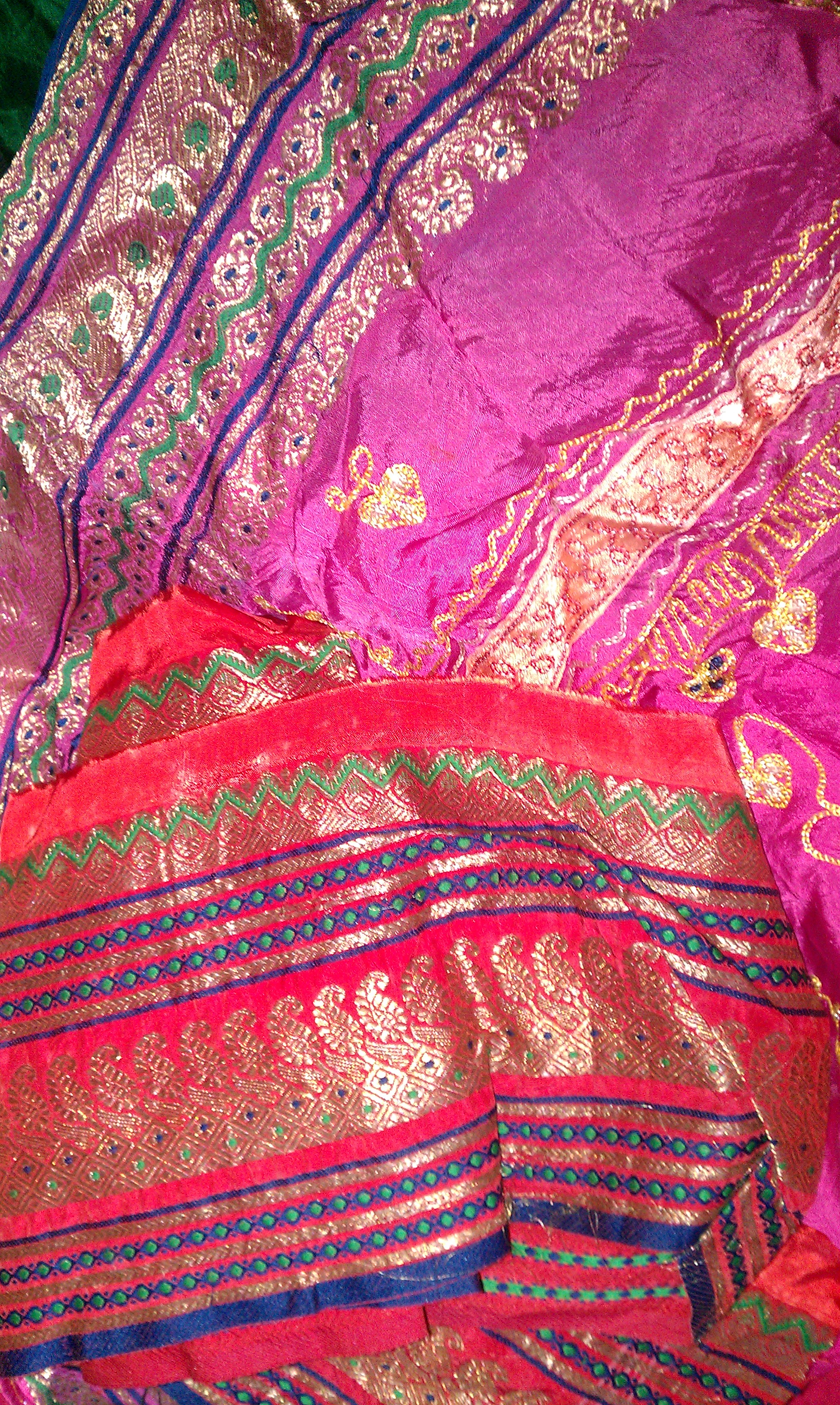
Until then, here’s pics of my fabric and trim that will some day become my next tunica and dalmatica. Complete with antique silk saris I pillaged for trim.
Mint green for the tunica, dusty rose for the dalmatica.
Some old, moth-eaten saris I’ll be cutting trim from. I’ll probably use the pink for the dalmatica, and save the red for a hand-sewn tunica I have planned for the summer.



 Anna's New Rome
You must be logged in to post a comment.