On our previous, “Why do I live where the sun melts my face” episode, I designed the Archaic Chiton and Archaic Himation for those that needed less fabric than Roman could provide, but still look glam. I’m pretty much kicking most of my Roman pieces to the curb for this. I feel more at home as an Archaic Greek for an alternate summer persona. Probably because it allows me to be more of a peacock in line with my Byzantine primary work when those heavy layers are unsuitable. This gives me time to work on my academic work with Byzantine dress, while keeping cool with simple sewing projects I can bling out extravagantly with trim and bezants.
I mean, look at this extra. I even had someone give me the braids despite my hair being unnaturally pink.
When it became clear that the weekend of Trimaris Memorial Tourney was going to be facing record breaking heat, I wondered how little I could wear, and still look put together. I feel like my Iron Age peploi/bog dresses/war tubes are just not okay enough outside of running around the field at Pennsic or working around camp. When my husband, who is known for his gingerness, is packing his Roman tunica and shorts and bottles of sunblock instead of his usual two layers of linen, you know what’s up.
Amenhotep Sa Amenemhat has been pretty inspiring with his work in the Bronze Age, predominately his impression of a New Kingdom Egyptian priest of Amun. He suggested I take a look at Egyptian, and I sort of sneered a bit. Really, the most common Egyptian look that women in the SCA attempt is the strappy sheath dress. I have no issue with it, because I’m a fan of supportive garments, I just have my own body image issues that are stopping me from tailoring my own. When Caid announced that their upcoming reign would be Egyptian, my friends from Calafia got in contact with me for sources, so I jumped onto the SCA Egypt group on Facebook and browsed through the files section, which I found out was pretty comprehensive on options outside of the strappy look.
I openly admit to not looking too deeply into Egyptian textiles. It’s not really my “thing”, though there’s quite a bit of overlap between that and some Bronze Age Greek I’ve been reading up on. When a book I have out on Interlibrary Loan, Ariadne’s Threads: The Construction and Significance of Clothes in the Aegean Bronze Age by Bernice R. Jones, cited images and contemporary extant pieces from Egypt that looked to be well-fitted tunic dresses of sorts versus the straps, or the oversized bag-tunic, I decided to look closer, and followed through to Pharaonic Egyptian Clothing by Gillian Vogelsang-Eastwood, where a fast skim was able to make the idea of a bag tunic more doable for my personal tastes.
The bag tunic itself was worn by both men and women, and there were a variety of cuts and pleating styles done with it. Most artwork shows women wearing slim fitting clothing, in reality, this may not have been the case. The bag tunic could have been quite wide, and when belted under the bust, created the wide top. I’ve played this game with wide Roman chitons that required double belting. No thank you. I want part of the “less is more” idea, here. I had a remnant of 27″ wide natural colored linen and a free afternoon. Why the heck not?
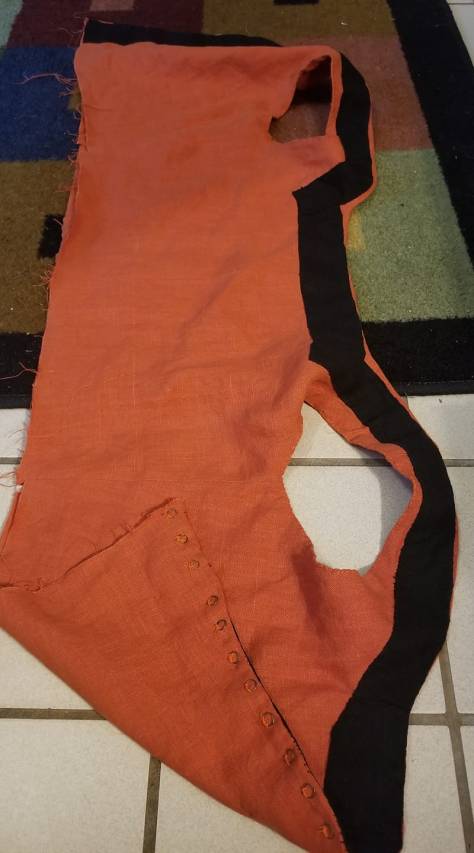
The construction is exactly the same as a Roman man’s tunica, or at least, the way I make them. I folded the fabric in half the short way, and formed holes for the arms on the sides. The neckline is based on the bag tunic found at Tarkhan, where it is nothing more than a vertical slit, versus a Roman boatneck style. Other tunics show keyholes, so there was some good variation going on. This image from University College London gives a good diagram, and also shows the inclusion of fringe. I did not fringe my linen, though I was seriously tempted to do so.
Click through to visit the UCL site, which showcases several extant Egyptian pieces.
My cut:
I finished the hem of my garment with a slit for walking, and an inkle trim that has been sitting on my loom for the better part of two years. It reminds me of pieces found in Tutankhamen’s tomb, and was given the thumbs up by Amenhotep when I asked for advice.
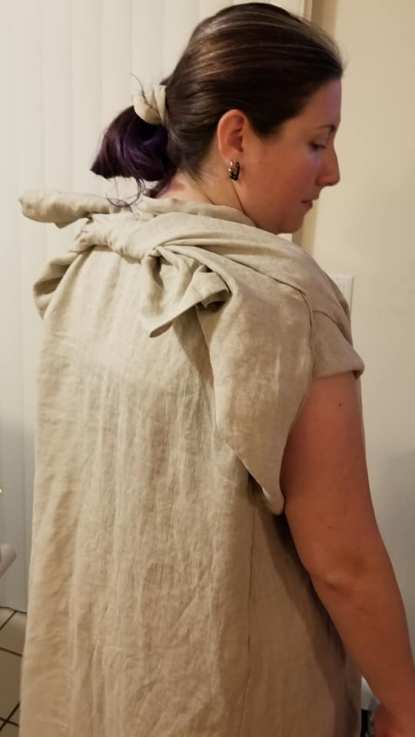
When I initially tried it on, I was first a bit twitchy about the low cut of the neckline, but had to remind myself that this was far from a modest society. That wasn’t as much of the issue as it wanting to slide off of my shoulders, though. This was rectified by adding a tie to the back, which Vogelsang-Eastwood mentions in her book as a technique done on women’s clothing.
I also tossed together a necklace with some beads I had in my stash, mostly leftover from my previous Bronze Age foray into Mesopotamian garb. The turquoise is ceramic, but not real faience. The red is genuine carnelian, and the cowries are also real, and took a bit of finagling with jump rings to turn into viable pendants. I stacked this with a carnelian necklace I made for my Mesopotamian project and still have, because it’s all real stone and worth a pretty penny.
The finished look on my dressform:
Of course, I still needed to cover my hair. What better than the quintessential Egyptian kerchief? A wig was not going to happen in this heat, and I’m a fan of veiling and covering when out in the sun, because scalp sunburns are awful. This gives the added bonus of protecting the back of the neck as well. It’s basically a half-oval with trim used for ties. Based on ones found in Tut’s tomb. The blue is accurate to one of the finds.
An extant kerchief from Tutankhamen’s embalming cache, courtesy of the Metropolitan Museum of Art. Click through to visit link.Me in my own version. Wondering if I’m going to be thrown from Nefretiri’s balcony.
And here I am all put together at Trimaris Memorial Tourney, Jeff takes bad pictures, so I found if I make terrible faces, they come out better. While I normally don’t put on makeup when it can melt off, I felt like the application of malachite-green eyeshadow and some black kohl eyeliner was necessary to complete the look. Both are non-toxic modern alternatives to the period cosmetics. Please, do not rub real malachite or lead galena on your eyes when we can fake it safely.
Pros:
– One layer and you’re done.
– Throw your hair in braids, pin them up, cover, done.
– Totally non-gendered. Men could wear a shorter tunic if desired.
-The v-neck style can be adjusted a bit to allow for more to show in the back or front. This allowed me to control cleavage, and give my back more “venting”, this was nice and let the usual back sweat evaporate out and cool that spot nicely. It also allowed me to wear a normal t-shirt bra, instead of a bandeau which is what I opt to in my chitons so there are no visible straps.
– Excellent use of a remnant that was otherwise going to just become another Greek chiton. 27″ was plenty wide for me. But this won’t work for everyone.
-Kerchief can be re-configured on your head for a Norse look. I did that later in the day when I was cooking and eating dinner in our camp.
Cons:
– It doesn’t feel much like, “me”. I got that vibe when I was making it more than wearing it. Though I got a ton of compliments for how put together it looked and the simplicity for dealing with the soaring temps.
-My Egyptian-ish sandals are in bad shape and made me gimpy.
– Not a lot of “peacocking” options outside of bling. The Egyptians didn’t really have dyes that worked on linen, so natural and bleached is the way to go.
Conclusion: Will I wear it again? Yes. I may even make another to add into my Pennsic/hot event rotation that has the waist seam. It will be good for waterbearing on the field, especially with the turban covering my head, and me avoiding the need for a floppy hat that usually just gets in the way. I also really want to try one of the super pleated long sleeved tunics with the waist seam. I figure I can easily sun-dry some pleats into wet linen on a hot enough day here in Trimaris, especially with how dry the summer is shaping up to be. Obviously, this technique would would better in Caid, but hey, we take what is given to us. Will I go for the full on crazy wrapped kalasiris look? Eh, that remains to be seen. I’m happy being Greek. 😉
I’ve already decided that my next stop on the Anna and Amenhotep’s Bronze Age Revue will be Hittite, but that will probably have to wait until after Pennsic once things cool down a smidge. Climate between Anatolia and Egypt were pretty different.
Next week at a Trimarian event called “Corsair’s Heart”, Mistress Mayken van der Alst is coordinating a Medieval Hike! I decided that this sounded more in my wheelhouse than an entry into the Birka Garb Challenge, so I chose to go full bore and see what I could come up with.
The short answer: A middle/working class Byzantine ensemble that would be comfortable for hiking in. The hilarious thing is that I don’t own anything lower class, or uh, casual.
But for real, in period, in persona, I would have been carried to Jerusalem in a litter, or rode in the back of a carriage. If I was “roughing it”, I would be on my own horse. Walking? Bah!
But that’s not the point of this exercise. The point is to walk, and wear and carry something that I could walk in, comfortably.
Better start at the bottom. Layer that is.
In my searching for *sigh* casual Byzantine, which, by the way, not that easy, I found a Cappadocian fresco that is contemporary to my period. Here, a midwife and Salome bathe the infant Jesus and his rippling man-pecks of the Divine.
Fresco is located in the Dark Church, Goreme, Cappadocia. 11th Century.
Everything here seemed perfect. You have women working, wearing clothing indicative of an arid climate that would have been passed through to continue to the Holy Land. The colors are great, and my favorite part? The Midwife’s SLEEVES:
Hot diggity, they’re tied behind her back!
I determined it was either one of two things: A guard that was slung over the shoulders to allow her to pull her clothing back and away for midwifery duties, or, slits in a tunic designed to do this, again, for her profession. Both are plausible, of course, but I decided to test the theory on a tunic, as it’s also supported by some of the work Dr. Timothy Dawson has done with kavadion/gambesons whereas the underarm is open, and the padded long sleeve can be pinned back for more movement.
This is what I came up with.
The base pattern for the esoforion (undershirt), is the Manazan Caves Tunic, which I’ve used before for some shirts for the hubby here. The reasons I decided to go forward with one of these for myself were: A; The high collar is good for protecting against the elements. B: The extant tunic is contemporary to Cappadocia, but not in the same location. The Manazan Caves are in present day Karaman, Turkey, and the Dark Church is in present day Goreme. This is a distance of about 270km. That doesn’t mean that these settlements weren’t in contact, and it’s still close enough for approximation of Cappadocian fashion. C: The long gore construction of the Manazan find would work well with allowing a ton of ease and slack on the arms for slits in the sleeves.
So, with my pile of 3.5oz natural linen, I set off on an adventure. I determined that the sleeves would have to be longer to pull this off, but since that was a Persian trend that had trickled into Byzantine fashion and stayed, I had no qualms with some potentially droopy sleeves. I also ended up hand-sewing the entire collar, and all openings/hems. There are only 6 machine sewn seams in the whole thing, not bad. I do want to do an entirely hand-sewn one of these, and I have the fabric to do it, so I figured this would be good practice. Plus, as I mentioned in my previous blog post about this tunic, hand sewing the collar construction is a must, anyway. It just won’t work right with a machine. Good thing too, because after the couple days it took me to complete the collar setup, I returned to the machine, and promptly sewed a full stitch through my left index finger, INCLUDING THE NAIL. Typing hurts right now, but it’s healing. I guess that’s a sign I should keep on my hand work practice.
So much whipstitching, man. The Byzantines loved them some whipstitch.
Tacking down the inside facing.
Seeing the hand stitching on the outside.
Putting the placket over the front.
Placket detail.
Inside view.
Attaching the band collar.
Finished handsewn collar.
Whipstitching the whole darn hem! I usually use a blind hem stitch, but it’s really not accurate.
I decided on the arm slit placement after basting the side seams together, and looking at fit. Each slit is 8″ out of the front seam that connects the gore. I then cut the basting, turned in a hem, and it was done. Zero fuss, and zero fabric waste or odd cuts into the garment.
The pictures speak for themselves. It works. The placement of the uber-long gore makes for a full range of movement, and as you can see, I can still create more slack to go over an outer tunic.
This garment is more than practical for just midwifery. While on pilgrimage, it would be beneficial to cover your skin for sun protection, and the long sleeves still allow for this. But, if I get too hot, or need to cook/set camp/do dirty work, I can tie my sleeves back and be comfortable doing so. Genius.
What’s next?
I’m going to use a tie on the front of the collar this time, versus a button and loop as I did for Gieffrei, because I feel it will allow me to adjust fit and function better during the hike. I can inkle weave a small band easy enough in an hour on my little loom.
Of course, the outer garment is next after that. I’m following through with the color scheme of the fresco, especially the look that Salome is wearing on the right. I have a block printed cotton I will be using for the turban to match the Cappadocian look, as well.
My final touches will be a shoulder bag, and a relic bag for my belt. If I can find out more, I want to research into accurate ankle support as well, only because I’m a chronic sprainer and could use the, uh, help. These will all be completed over the course of the next week, and I’m looking forward to pulling it all together for the hike!
I field more emails and more online questions about the Varangian Guard than I do actual Byzantine personae. I lifted most of the information below from my Byzantine Personal Basics page above, but I’ve included a bibliography to hopefully help those on the path find what they’re looking for.
I’m going to preface this by saying that I have nothing against Varangian personae, but I’m about to be very blunt: Varangians are not Byzantine.
The Romans viewed them as barbarians and outsiders, and despite the fun tales from the Norse Sagas, chances are, they weren’t well liked in the City. The truth of the matter is that there are currently more Varangians in the SCA than there ever was serving an emperor at one point in time due to the fact that it gives Norse personae an excuse to wear lamellar when it’s hot (which is fine, we don’t need anybody dropping dead at war, please). Not everybody could show up at the Blachernae Palace steps from somewhere up North and demand they be admitted into service to the Purple. It was a bit more complicated than that, and each emperor had different requirements. Not to mention, Varangians were only predominantly Norse for a short period of time in the mid 11th Century if we assume what the Sagas say is true.
The first Varangian Guard was not established until the late 10th Century (around 980) when Basil II was given thousands of Kievan soldiers in exchange for marriage of a Byzantine princess to the Prince of Kiev in order to defeat the Bulgarians. The Kievan Rus were not Norse, they were Slavic, potentially with Norse ancestry, but the term “Viking” itself is a particular Norse occupation. The “Viking Age” was pretty much over at this time. We do have record of plenty of Norse travelers coming to Constantinople prior to this, but the “Viking raid” in 860 was actually Rus that had come down into the Black Sea from what is now Ukraine.
To further screw things up, the term “Varangian” itself was used by both the Romans and the Rus to refer to Norse Vikings prior to the 10th Century. So, if this is the route you desire to go, determining if you’re just a Norse traveler from early period, or an actual member of the Emperor’s elite guard is important.
If you do decide to go Varangian GUARD, here is a list of “waves” of ethnicities that served at specific times. This is by no means set in stone, but it provides a guide for those that want to pinpoint a specific time period that suits their goals:
988 – 1020ish: Kievan Rus
1020-1070ish: Scandinavian (Icelandic, Norwegian, Swedish) Bolli Bollason and Harald Hardrada served at this time.
1070-1204ish: Danish and English (Anglo-Saxon). The term “Danes” comes up in Byzantine literature often to describe the Varangians, and the English were escaping Norman rule in England at this time. This is documented in the saga of Edward the Confessor. Siward Barn served at this time. Normans were NOT permitted to be apart of the Varangian Guard, but some may have served as mercenaries in other capacities.
The Fourth Crusade has probably some of the best documented accounts of the Varangian Guard in action protecting Constantinople. After the retaking of Constantinople and re-establishing the empire, however, there didn’t appear to be as formal of a guard unit, and those that were a part of it, had fully assimilated into the Roman culture. It is unclear if the Varangian Guard really remained a thing until the Fall of Constantinople in 1453.
There are a lot of myths surrounded what they actually wore, especially in the SCA. The “red is for the Emperor’s service” and “green is for the Empress’s service” is totally a SCAdianism as far as I’ve found. It looks like the on-duty color for the guard was blue or red, while off-duty, you see them in nothing more than plain tunics and slim-fitting trousers or hose, which was typical for men’s casual wear throughout the empire. Earlier travelers would have continued to wear the clothing of their culture, versus picking up stuff along the way. Clothing was expensive and difficult to carry and launder, so the other SCAdianism of having a diverse wardrobe boasting the latest fashions of every exotic port of call you visited is also inaccurate. They would, however, assimilate over time if they decided to stay put in an area. This does not include trade goods, but items that were exchanged in business were not necessarily the same as the clothes you wore on your back.
As far as religion goes, during the period of the active guard, most serving were already Christian, or converted to Orthodoxy from a later, heavily modified and somewhat hodgepodged version of Arian Christianity which was more common in Eastern Europe and the Scandinavian countries very early before the Western Church started coming in with missions. Please, remember that Arianism IS NOT THE SAME THING as Aryanism. Mind your i’s and y’s! Either way, the idea of your persona dripping in lovely Asatru regalia would be incorrect as a guardsman, but as a very early Norse traveler to Constantinople, still possible.
I totally just ganked these images off of Wikipedia since I know they’re there, but you can check out the Madrid Skylitzes here: https://www.wdl.org/en/item/10625/
“On Duty” Varangian Guardsmen in the gold armor with blue garments beneath. They are armed with rhomphaioi (axes), and shields. Note the round and teardrop shields. From the Madrid Skylitzes, 12th Century.
A woman kills her Varangian would-be rapist, and then is presented with his belongings from the other guardsmen. Note how they don’t look very “Norse” or Scandinavian – Dark hair and eyes, probably Eastern European, though at the time the manuscript was produced, they would have been mostly English (Anglo-Saxon). Plain tunics and slim-fitting trousers with boots- Typical of a Byzantine common man instead of a fancy hodgepodge of Norse and Byzantine that is common in the SCA. Also from the Madrid Skylitzes.
And for those that want to actually do homework, here are the goods:
Suggested Readings
Primary Sources
Of Aguilers, Raymond. Historia Francorum Qui Ceperint Jerusalem. Translated by John H, and
Laurita L. Hill. Philadelphia: American Philosophical Society. 1968; Medieval
Sourcebook, 1997. http://www.fordham.edu/halsall/source/raymond-cde.asp
Choniates, Niketas. O City of Byzantium. Translated by Harry J. Magoulas. Detroit: Wayne State
University Press. 1984.
de Clari, Robert. The Conquest of Constantinople. Translated by Edgar Holmes McNeal.
New York: Columbia University Press. 2005.
of Edessa, Matthew. The Chronicle of Matthew of Edessa. Translated by Ara Edmond
Dostourian. Ann Arbor: University Microfilms. 1972.
Komnene, Anna. The Alexiad. Translated by E.R.A. Sewter. London: Penguin Books. 2009.
The Laxdaela Saga. Translated by Muriel Press. London: The Temple Classics, 1899. The Online Medieval and Classical Library, 1996. http://www.omacl.org/laxdaela/
Porphyrogénnētos, Constantine. De Admininstrando Imperio. Translated by R.J.H. Jenkins.
Budapest: Pázmány Péter Tudományegyetemi Görög Filológiai Intézet. 1949-1962.
——. De Ceremonii. Translated by Ann Moffatt and Maxeme Tall. Canberra: Byzantina
Australiensia. 2012.
Sturleson, Snorri. Heimskringla (Saga of the Kings.) Translated by Samuel Laing. London: 1844; The Online Medieval and Classical Library, 1996. http://omacl.org/Heimskringla/
de Villehardouin, Geoffrey. Chronicle of The Fourth Crusade and The Conquest of
Constantinople. Translated by Frank T. Marzials. London: J. M. Dent. 1908; Medieval
Sourcebook, 1996. http://www.fordham.edu/halsall/basis/villehardouin.asp
Books and Articles
Blöndal, Sigfús. The Varangians of Byzantium. Translated by Benedikt S. Benedikz. Cambridge: Cambridge University Press. 1978.
D’Amato, Raffaele. The Varangian Guard: 988-1453. Oxford: Osprey Publishing. 2010.
Madden, Thomas F. The New Concise History of the Crusades. Lanham: Rowman and Littlefield. 2006.
Norwich, John Julius. Byzantium:The Decline and Fall. New York: Knopf. 1995.
Queller, Donald E. and Thomas F. Madden. The Fourth Crusade: The Conquest of Constantinople. Philadelphia: University of Pennsylvania Press. 1999.
Runciman, Steven. A History of the Crusades. 3 vols. Cambridge: Cambridge University Press. 1987.
Dawkins, R.M. “The Later History of the Varangian Guard: Some Notes.” The Journal of
Roman Studies Parts 1 and 2. 1947. http://www.jstor.org/stable/298453.
Shepard, Jonathan. “The English and Byzantium: A Study of Their Role in the Byzantine Army During the Later Eleventh Century.” Traditio Vol. 29 (1973): 53-92. http://www.jstor.org/stable/27830955.
I just uploaded my paper and Powerpoint presentation from the 2018 Fordham Medieval Studies Conference on Dress and Identity in the Middle Ages to my Academia.edu account.
This is both an abridged version of my Master’s Thesis and an expansion of sorts. It focuses solely on Kale’s garments and her inventory as such demonstrating her changing identity from noblewoman to nun. The Powerpoint has photos of my attempt at ecclesiastical dress and some dramatic poses for fun.
The publication of my thesis as a Compleat Anachronist (#177) is still available from the SCA Stock Clerk, here: https://members.sca.org/apps/#Store
You know, that head roll that SCAdians think is so Byzantine? You can buy them at Ren Fairs, they show up in commercial paper patterns. It basically looks like something you get at a medical supply store for bum cushioning.
Yeah, those.
Stop.
I know this sounds mean, but there is -zero- evidence that such a thing existed. Artwork from the early Byzantine period (300-899) shows -something-, and that something is called a fakiolion. It’s a turban, and it continues to be worn through the middle period, when art becomes more refined post-iconoclasm.
I’m far from innocent, of course. Here I am, 10 years ago and 50lbs lighter, wearing my hair donut in a photoshoot. This was my first attempt at Byzantine garb, which over all wasn’t bad, but if I could go back and beat myself with a hammer for the donut, I would. It was a waste of fabric and pillow fill that makes zero sense in the case of medieval construction.
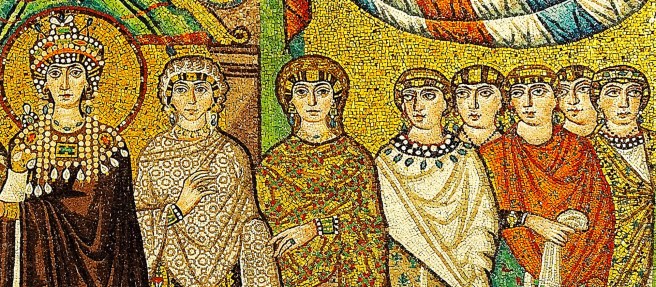
Here is the cut from Theodora’s procession at San Vitale. I know you see the stripes, and think that it has to be ribbons and spangles and fancy things wrapped around a roll to get that effect. The fact is, that the same effect can be made with a turban with the right designs on it.
Then of course, there is the bust of the Byzantine Woman from the Metropolitan Museum of Art, believed to be Julia Amicia, Theodora’s zoste patrikia, shown as the third woman from the left above, you know, the one actually looking at us with her elegantly draped palla over her fakiolion. The front of this sure makes it confusing. Even I haven’t been able to completely figure out what that pucker is, but, thanks to my skills at museum yoga, I was able to get pictures of behind her head. As you can see, it’s definitely not a donut. It almost reminds me of how a St. Birgitte’s Cap gathers in the back of the head. I wonder if this piece was polychromatic at one point, and, if the Met plans on having it investigated for color residue. I feel any trace of color on the hairpiece would probably make it easier to interpret.
The use of a turban rather than a head roll provides multiple benefits. One, it doesn’t use up fabric and filling that could have been better served in other capacities. Two, it keeps the hair out of the face, and most importantly, CLEAN. The use of silk on the hair also helps protect set styles, and women still use silk wraps today to wear over their rollers and other curling implements to bed in order to control frizz and damage. It was not uncommon for a Byzantine woman to leave her hair uncovered, even as a married woman, and noblewomen would have had the option of affording hair services such as ornate braids and temporary “perms” made with gum arabic. The fakiolion would have helped keep these styles in place and relatively clean, versus having to constantly re-set the hair on a daily basis. A head roll would have been useless in any of these applications. While Byzantines were known for conspicuous consumption, even that seems off the mark.
Here is my Byzan-bestie, Konstantia, showing her interpretation from the same period. Note that the stripes in scarf used to create the turban gives the same effect as you see above from the mosaic. It looks so much more elegant than the donut, don’t you think? You can read her blog post pertaining to Byzantine headwear, here: https://kaloethina.wordpress.com/2016/10/01/headgear/
The trick, is to make sure that your fakiolion has the right grammata on it, or geometric designs. The Last Will and Testament of Kale Pakouriane describes these designs as being done in goldwork, and some scholars believe that grammata had pseudo-kufic script embroidered in, which was a popular design feature. Typically, you want the design to run parallel along the edges of the length of your turban fabric. Both Konstantia and I have found that commercially available hijabs do this nicely. And, since they’re designed to be worn on the head, they tend to not be stifling materials, and stay put.
Here’s a similar scarf to what Konstantia is wearing above, only worn by me, in the most flattering selfie imaginable, that just happens to have the best shot of my turban style. It also gives a nice railing for coronets to perch without the pinching or headaches associated with some heavy head jewelry. Konstantia rocks the look complete with a maforion, or veil over top of it, which was common for the early period, versus the middle period, when I’m supposed to be living. She used a pashima here, for added thickness and warmth.
And here I am in some 11th Century, emulating looks from The Menologion of Basil II as seen in my master’s thesis and Compleat Anachronist.
My header of St. Pelagia’s minature from The Menologion, showing her wrapped turban in the center.
It was requested that I do a video tutorial of my preferred turban wrapping, so, here it is:
I know the phrase goes, “All good things must come to an end”, but in short, that head roll was never good. It’s an early Faire/SCAbomination of garb based on Italian and Spanish Renaissance fashions that don’t fit in this culture, has seen its day, and needs to be retired for a more accurate solution. Consider the fakiolion for your next event, and put your donut out to garb pasture for good.
This isn’t always the smartest idea. Especially when that particular garb is 16th Century and you literally haven’t sewed a fitted bodice on anything in about 5 years. But I was determined, and challenged by a certain Countess in Meridies who just received her Laurel in 16th Century German clothing to get it done. She even made me the wulsthaube as incentive.
I looked at a lot of pictures, and broke down the ensemble: shirt, dress with fitted bodice and full pleated skirt. Easy enough. Really. I could do this! Granted, I’m currently unemployed. Your mileage may vary.
It went as follows:
Sunday – Shirt.
Monday – Didn’t sew for some reason.
Tuesday – Skirt panels.
Wednesday – Fit the bodice.
Thursday – Sewed the bodice.
Friday – Constructed the dress.
So, first was the shirt. Kissa pointed me in the direction of a simple pattern, and I used some of my super soft Signature Finish linen from everybody’s favorite online linen store, Fabrics-Store.com. The shirt is pretty standard for a 16th century smock: sleeves are gathered into cuffs, and the collar has a slit, and is also gathered into a band. The Germans were extremely fond of pleatwork, or smocking, and that is really far out of my wheelhouse, so I opted for simple knife pleats, which also appears to be a period method. I made this is an afternoon, including hand-finishing the cuffs and collar. I initially left a slit in the cuffs, and then for some reason, closed it. I should have left them open, because it would have been easier to roll the sleeves.
Pleating in the neckline.
Finishing the cuffs.
Finished!
Back view.
Finished collar band.
I put a slit into the cuff, and then ended up closing it back up. I should have left it open.
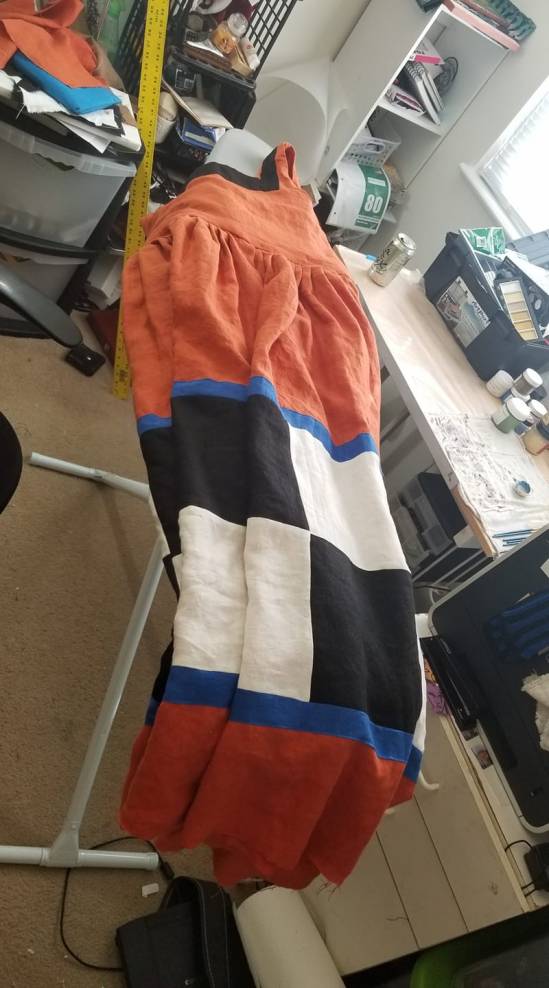
Now I had to construct the dress. The bodice needed to be fitted, so I had to wait for a friend of mine to find time to come over for a fitting. So I focused on the skirt pieces. At first, I was going to do basic black guards, and then I had a visit from the Scope Creep Imp in my sleep, and decided that big, funky checkers were going to be the answer. Because, I can’t do anything that doesn’t make me look like a traffic cone. This was another full day’s worth of work.
I had to get that bodice done come hell or high water, though. I started the project on a Sunday, it was now Wednesday. I don’t have any pictures of the fitting process, but I do have pictures of the aftermath. Linen is not really the best fiber for this. I know there’s ways to “hack”, and get it to work, but being that I was short on time, I had to make it work.
Mandatory Tim Gunn.Initial bodice block, I made no less than eleventy hundred more adjustments to it before I was pleased enough to cut the dress fabric.
I attempted a thick interfacing as the interlining, and it made all kinds of interesting geometric protrusions that were not okay. So, I stripped it out and conceded to just two layers of linen. I should have included a canvas interlining instead, but my brain went, “It’ll be fiiiiine”, and continued. I hand-closed the arms, and then attached the rings for lacing. It took me almost the entire film Dangerous Beauty to complete the rings.
And a fitting…over a T-shirt. We have bunching and not much support. Uh-oh. I just assume that adding the guards and the skirt would fix the fit. I wasn’t too off in the long run.
It was suggested that I hand-sew the guards down. I’m still not sure if this was the best option for me, but I did it anyway. It took the entirety of Dodgeball and almost all of A Knight’s Tale to get them down.
And then finished at 11am on Friday morning!
“I got blistehs on me fingehs!”
But it was far from over. I still had to actually get the dress together!
I sewed the skirt panels up the side seams, and started the super fun pleating into the waist of the bodice. I actually like pleating, so this part wasn’t so bad. I was having fun with it. And of course, more handsewing: the lining needs to cover the raw edges of the skirts! (Yes, I doubled my thread. I have a bad habit of doing it because I tend to get more tangled and become unthreaded when I don’t. Technically, you should only do this for buttons, because it’s kind of lazy, but whatever. I said it was a bad habit.)
Almost…there… I took a break for dinner before hemming.
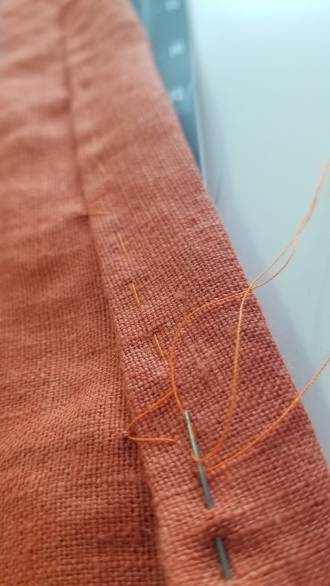
Welp, I did a ton of handwork already, may as well hand-finish the hem, as well. I love blind hems. They’re quick, but I use them mostly on collar facings than actual hems. This is the first hand-hem I’ve done on a dress in a while.
Look! I used a single thread this time!
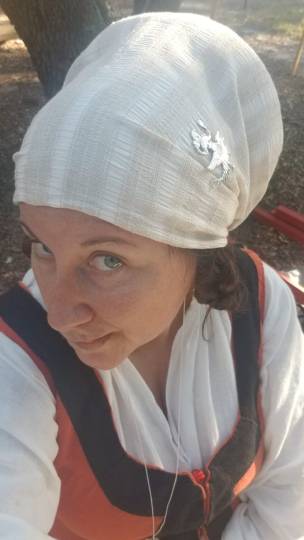
But what about the Wulsthaube?! I got in the hat from Kissa on Monday (it was now Friday), but all it needed was a cover. Easy enough. I braided my hair for maximum effort, and picked a striped linen remnant I had in the closet. I machine finished the raw edges, and bam.
Das ist meine Wulsthaube. It Haubes Wulsts!
Then I had to try it on…oh no! It didn’t have ANY support! *expletives* But nothing I can’t fix with a pushup bra for the sake of the event. This upset me,but it goes back to the not having an interlining + sagging linen + Florida humidity making it extra saggy.
Without a bra on the left, and with on the right. So annoyed that it wasn’t self-supporting, but the lift was necessary. For someone with a big butt like me, you’d think I have the top to match? Noooo, I live in pushup bras. 😦 Thankfully, most of them are t-shirt bras, so they don’t show, especially through 3 layers of linen. This allowed me to have the support and shape I needed to fill the dress, without showing modern intervention to pull it off.
Naturally, the best thing to do at this point was to put the whole thing on, run downstairs, and terrify my husband.
Gieffrei was…not pleased. He looked at me and went, “That’s so not you. You don’t look normal and I don’t like it.” Gee, thanks, Jeff. But, he obliged in taking pictures of me in our messy library, anyway, as he was covered in sawdust from making a new chair out in the garage.
Voila. A Trimaris-friendly Trossfrau in 5 days.
Well, maybe not THAT Trimaris-Friendly. The stockings and clogs ended up staying home. The high at Hausmaerchen was near 90 and humid. So I opted for cloth Mary Janes, since I don’t have duckbill shoes. I was a hot sweaty mess, and the linen sagged EVEN MORE, but it gave a sense of authenticity of following the Landsknecht tross on campaign, I guess. I also got bit the hell up by fire ants. Womp womp.
I topped off my wulsthaube with a pin of a harpy. The theme was “the Lorelei”, but as I had no mermaid, another man-eating lady monster would fit the bill.
So, why did I do this to myself, again? The bodice will have to be dissected and re-fitted before I wear it again, that’s for sure. And this was a lot of work for less than a week. This did, however, distract me from my regularly scheduled unemployment. Instead of sitting on the couch and surfing Facebook, or planning my next Byzantine attack, I had to go outside of my comfort zone (despite formerly having a 16th Century persona, hence the understanding of this basic pattern) and knock it out of the park in just a few days. It took my mind off of real life for a bit, and gave me a reset button to push. A new focus. Sometimes, we need that reset button. We need that challenge outside of our normal routine to wake the brainmeats up. The SCA gives us the fluidity to explore other cultures in that regard, which is nice. Otherwise, I probably would have just gone in a sloppy chiton to a German event if I didn’t give myself this chance to prove otherwise.
I’m going to try to give myself something new every year, now. Last year was the Burgundian, this year the Trossfrau. I wonder what’s next?
Or something to that effect. Edit 7/12/2019: It’s called a diplax, not himation. Derp.
Being that it will be no less than the temperature of the surface of the sun, plus 3000% humidity this weekend at Trimaris Coronation, I decided that less was more, and I would go in that killer yellow chiton from my previous post.
But then I decided to add more.
As mentioned, the Chios Kore is probably my favorite all-time Archaic statue. And the polychromatic replicas just make my gaudy heart sing. Plus that perfect example of the archaic smile. What does she know?
Here are the photos again, for a refresher:
508907 Kore 675, 510-520 BC, attributed to Archermos from Chios, marble sculpture of archaic age from Chios, Acropolis in Athens Greek Civilization, 6th Century BC; (add.info.: Kore 675, 510-520 BC, attributed to Archermos from Chios, marble sculpture of the archaic age from Chios, the Acropolis in Athens (Greece). Greek Civilization, 6th Century BC. Artwork-location: Athens, Moussío (Acropolis Museum, Archaeological Museum)); De Agostini Picture Library / G. Nimatallah; it is possible that some works by this artist may be protected by third party rights in some territories.
Take a look at her himation, the over-garment that would evolve into the Roman palla and toga. You see this style on multiple statues, such as the ones in the header on this great page that discusses polychromy and its recreation a bit more in detail:
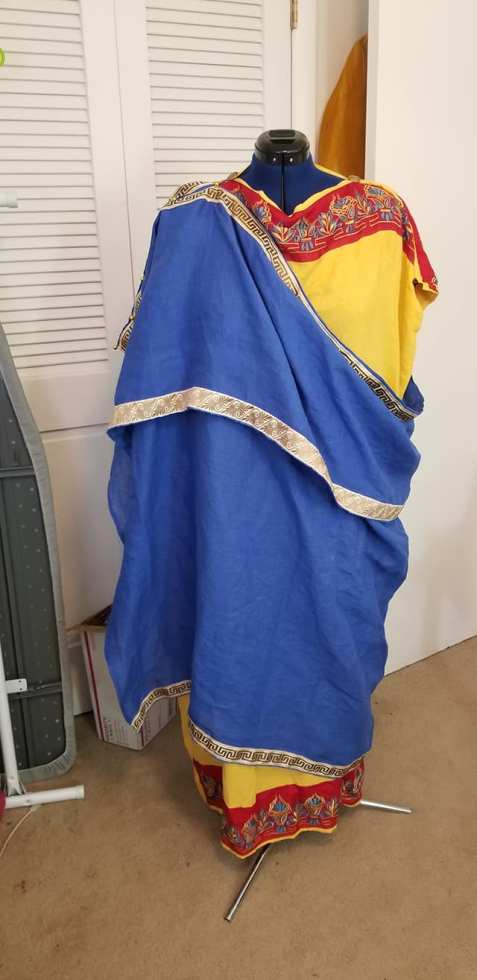
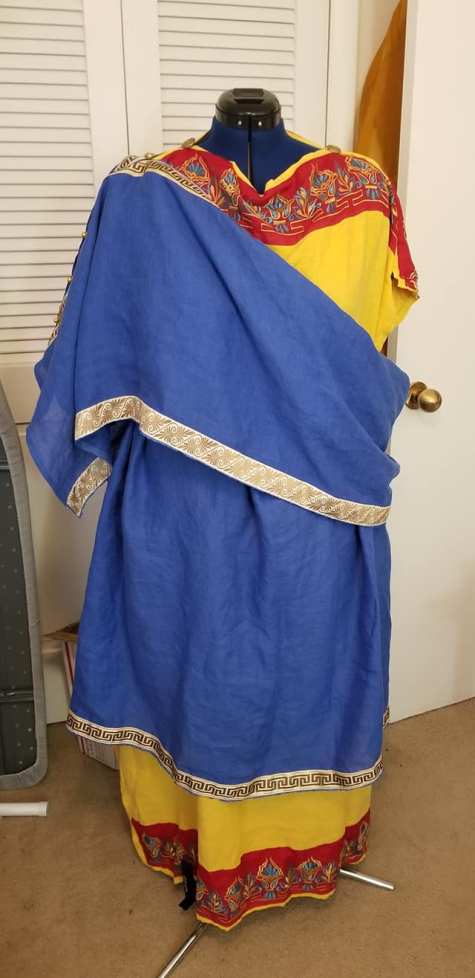
It’s not really a “himation” at all, but more of a peplos that is pinned as a chiton on one shoulder only. I figured this was easy enough to do, and would help complete my look for this weekend. This project was done entirely by machine in less than 2 hours. I think the longest part was just getting the trim down.
I went with the same orientation of the linen as the chiton: using the long weft length instead of the warp. I figured this would give me a comparable drape, and continue on this archaic project being a fabric-conserving venture. In hindsight, it probably could have been longer, but at least it won’t be dragging on the ground.
I started with a length of 2 yards and 10 inches (82″ total) of lightweight blue linen, and finished the two raw edges first. I maintained the finished selvedges as the hems.
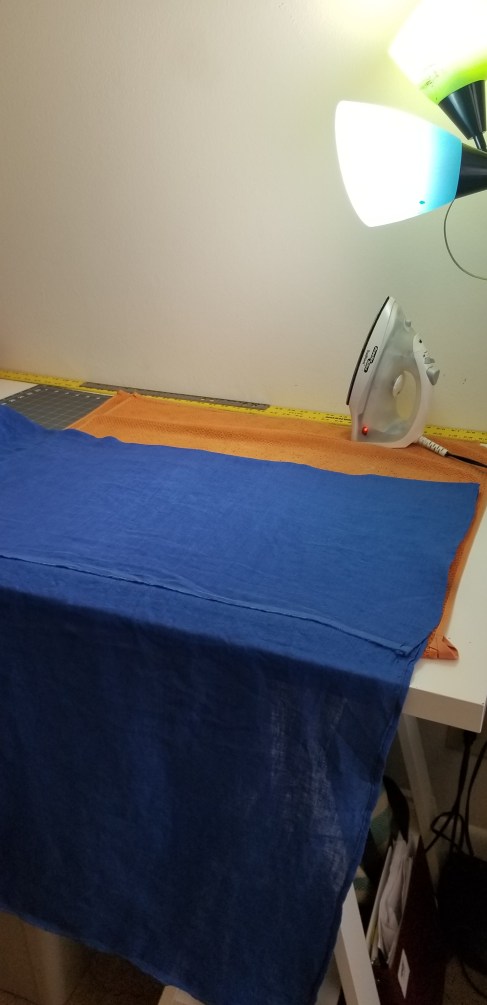
After that, I went and started making my peplos, using a 16″ peplum, and ironing the snot out of it to get a nice sharp crease.
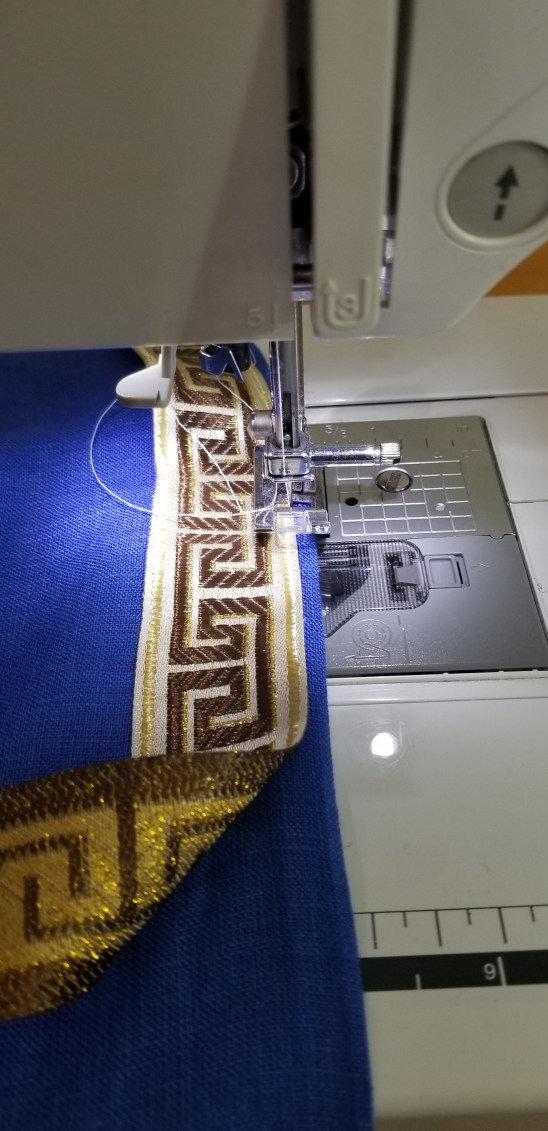
I applied a nice contrasting band of meander trim along this crease. In period, it would probably have not tacked the fold down, but rather have been a horizontal stripe along the fabric, and the fold actually being free to open back up. This would have allowed the garment to be worn multiple ways. For the sake of this test project and ease of wearing at an SCA event, I just stitched it down. The next one I try will be more accurate, so I can re-work it into a chiton or peplos or himation as I choose.
I then put bands of trim on the base of the peplum, and at the hem. Mixing them up a bit like on the original artwork. I did not have enough of either to do the vertical stripe down the front, or anything that looked “Grecian” enough to really match this go around. I’ll have to do some hardcore trim shopping and see what’s out there for my next attempt.
Here’s some pictures of my trim layout, complete with cat assist. I pulled up the top trim in the last photo to show my cheater stitches along the fold.
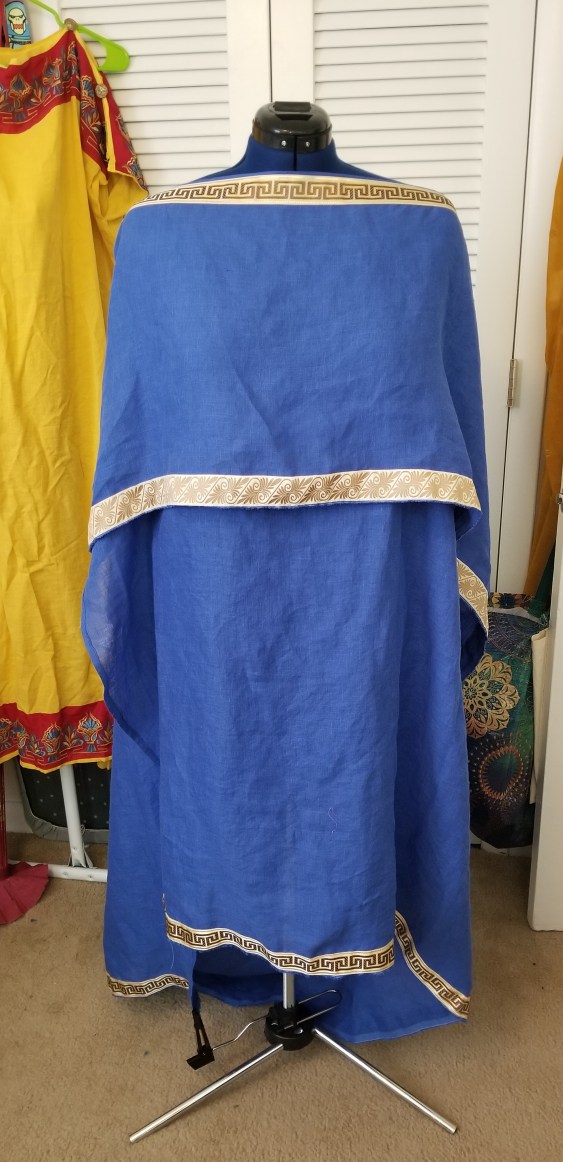
Next was draping. I threw it on the dressform, and formed the peplos. It is short, but look at how nice it fits the body, like the Peplos Kore variants, versus the more draped later styles. Once again, this is a 16″ peplum, and it fits nicely from my shoulder to natural waistline.
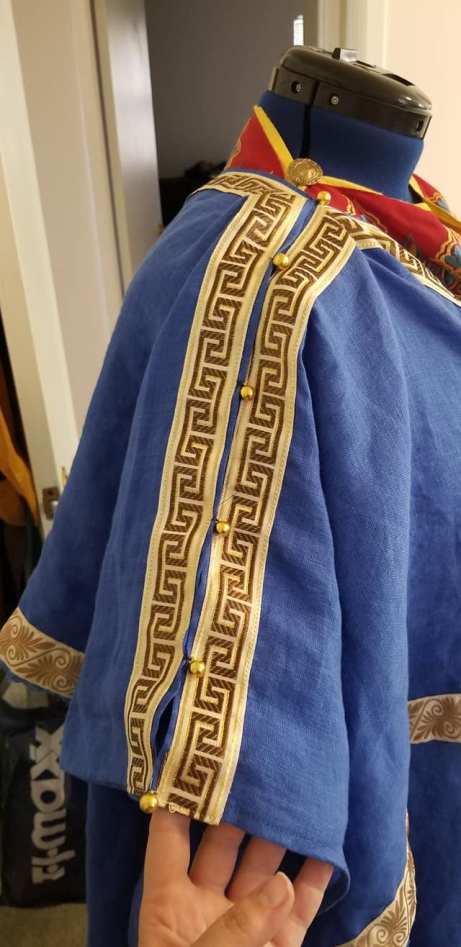
While on the dressform, I just started measuring like I would for a typical classical dress: found the center points, measured out my neckline, and then formed my sleeves from there. The Chios Kore shows 7 disc pins, I used 6 round buttons. I’ll probably use one of my smaller fibulae to keep it attached to my chiton, and stop it from slipping down my arm. It really does miss that vertical stripe, so I may have to go back and add one once I find a suitable trim for it.
And just like that, it was done!
Here are belting variations:
No belt.One belt over the top of both garments.Belt on the chiton and not the himation.
A belt on each garment.
And the side views. The open side makes for a more accurate garment, but if one were to make this into a functional full peplos or chiton, it would have to be wide enough to wrap around the body, or a nice breeze may reveal quite a bit.
I’m exceptionally pleased at the color palette, since the primaries were all over the archaic statues. While they were common tempera shades, I do admit I’m not 100% sure on if those colors could be achieved by dyes so early. I’ll have to touch base with my dyer friends to see what they think.
Now, if only I could put my hair in multiple braids to complete this look!
I live in Trimaris. It is summer. This post is a little punchy.
I swear, when I lived here 15 years ago, it wasn’t as hot. Granted, I was younger, I had grown up here, and I endured the summers because we were thrown out of the house over school break lest my parents go insane. Jumping Jeebus, it’s hot out right now. I know the Jacksonville area, where I am, can get hotter than the Tampa Bay area, where I grew up, because of the way the breeze crosses the state, BUT STILL!
Don’t get me wrong, Caid was hot. But most events weren’t awful. You could catch a breeze in the shade, and, of course, Southern California is a dry heat. Not that a good Santa Ana Wind didn’t turn you into a raisin, or anything, but your sweat served its purpose and evaporated. There is no such thing as a dry anything ever in Florida. Be it a heat, or a cold. Swamp-ass is the state’s actual unofficial pastime, not to be confused with bad news stories being released on the internet because of the state’s freedom of information act. Moist. Moist is the vocabulary word of this Uncle, Lord Samuel’s Naval Tour Post, and there is no way in heaven or hell that any of my Sartor silks or full on Byzantine anything ever is going outdoors into that schweaty abyss.
So, I have Roman. Roman is good. I only have a full bulbous Roman linen outfits after a recent garb purge, and decided I wanted to be pretty, and converted a lot to the cotton sari trend, which was great in non-schweaty Caid. I wore an ultralight set, composed of two thin cotton saris, one day at Pennsic 2 weeks ago (we had an exceptionally…swamp-assy war) and it stuck to every…crevice…on…my…body…that…could…pool…moisture. YUCK!!! Oh cotton, no! The elegance of the drape was lost when it just adhered itself to my bits. That got pulled off of my body in a hurry and replaced with one of my linen “war tubes” as I call them. Literally, just a one seam tube that I made at war one year that I can pin once on each shoulder for a Bronze Age look. These are often called bog dresses.
War tube with my Gonzos.
Somehow, my brain knew it was going to be a hot war, and decided weeks in advance that I was going to sew up slimmer-fitting chitons in more of an Archaic Greek look, versus the draped fullness you see in later artwork. I kept the embellishment simple, and even sewed most of the tops closed for ease of wear. I don’t think I really want to wear my full Roman dresses ever again.
“Archaic Greek?” You may ask, unsure of what I mean.
So, true story, most of my formal education is in Ancient Greek and Roman History and the Classics, versus Medieval History. We didn’t have any real Byzantine History classes, so I had to sort of do my own independent work in that regard in connection to other courses. Understanding Greek and Roman history is vital to Byzantium anyway, and the Middle Ages for that matter, but yeah, there’s my big secret, I’m not much of a Medievalist at all, I’m a Classicist. You may now ring the shame bell.
So, back to Greece. There are multiple periods of Ancient History, just as we have multiple periods anywhere else. For Greece, it was the Bronze Age, Dark Age/Geometric, Archaic, Classical, and Hellenistic periods.
The Archaic Age (pretty much the 7th-6th-5th centuries BC) is basically when a lot of what we know of as “Ancient Greece” begins to take shape. This is when Homer composed the Iliad and the Odyssey, when Sappho lived, and when sculpture started to make an appearance.
And now, a crash course in art history!
The pivotal sculpture forms of the Archaic Age are the Kouros and Kore statues, or “young man” and “young woman” respectively. There is some speculation on who they represent, but the general idea seems to be Apollo or Dionysus for the Kouros, and Persephone for the Kore. Or, nobody in particular after all. Kouros is almost always stark nekkid, while Kore has been draped with a variety of garments. The style was pretty much lifted directly from Egypt, and predated the more common contraposto-style statues you see from the late Classical period.
Thanks to the miracles of modern science, we’ve been able to really get an idea of what colors the statues were painted, and boy oh boy, are they a treat to the eyes.
When I was still out in California, The Norman and I went to San Francisco for a weekend, and I was able to catch the “Gods in Color” exhibition at the Legion of Honor. The exhibition, which started in Germany, I think, is a collection of reproduction Greek and Roman statues that have been painted to match their original, or experimental, colors. I may have cried a little (out of joy, mind you, again, this is my area of study), and took pictures of every single object in the show, while poor Jeff followed me around with raised eyebrows and bewilderment at why the Persians were wearing what appeared to be Lularoe leggings. (All photos from the exhibition are my own.)
Ow.
Or why this Kouros had some circa 1999 nipple tats going on. It’s like he listened to Godsmack in high school and made a bad life choice. (I swear, I am actually an adult, and not 12. It’s probably an interpretation of Apollo. Really. Now you know archaic nipple tats are a thing. In actuality, it has to do with the concept of ephebeia, or the adolescent male, in Greek society, but I’m keeping that off of my blog for my own sanity. Anybody interested in it as a scholarly discussion is welcome to contact me by email.)
But what I was really there for were the interpretations of Peplos Kore, and the colored version of Chios Kore. Happy nerd girl tears, again. I threw in images of the Phrasikleia Kore in here for added dweebery and inspiration.
The colors! The trim! Sure, most of it is allegorical to the goddess or person they are portraying and not actually indicative of patterns worn by actual people, but, the options for fun for hot weather garb! I would avoid wearing all of the lotuses that Phrasikleia Kore has on her, only because it’s a funeral stele and they’re symbolic of the afterlife, but the fit of her chiton got me thinking that there is no need to be swimming in fabric. Contrast her to the draped layers on the Chios Kore, means that there were possibly options, and not just limited to the skill of the sculptor, noted by the folds at the bottom of Phrasikleia Kore’s chiton.
Inspired by this fit, and bored with a stack of fabric at my parents’ house when house-sitting back in June. I decided to make a slimmer fitting chiton by taking 2 yards of 58″ wide linen, folded the short way. I determined that I could do this with less than 2 yards for my figure at this width. I know that not all women are created equal, so I apologize if this particular hack doesn’t work for you, but the style is still doable. For me, I found that I could go about 32″ per front and back panel and still have plenty of ease with my 42″ bust and even wider hips. This is a heck of a lot cheaper and less cumbersome than one of my 4-yard Roman style chitoi/tunicae interior.
I threw some trim on the top and bottom, and added a slit to one side seam for walking ease, and thus, my “archaic” chiton was born. Half the fabric as a Roman one, and still a flattering fit.
I sewed the top of the first one, instead of adding buttons or pins, and this allowed me to wear a real bra at Pennsic, instead of a tube bra, which relieved some of the uncomfortable under-the-boob sweat that women are subjected to. I lived in this thing at war.
So I made more! The black was inspired by some Romano-Egypt fayum portraits with the addition of the clavii (note that Romano-Egyptian garments were MUCH wider), and the yellow was straight out of the yellow Peplos Kore above. The trim is vintage sari trim I got from Ebay. Perfect! (The black has alligators. Because!)
The yellow I had some fit issues with. The trim made it stiff, and it wasn’t as flattering, even with my parents’ cat Mary Jane lending her assistance. So when I got back to my house, I added heavy brass buttons to the sleeves, and BOOM! A completed look and a smoother fit. I wore this one with a red himation/palla to the Courtesan Bacchanal at Pennsic.
For the finale, I ended up making one out of wool I had just laying around. Check out this draping! It looks SO PERIOD in contrast to linen! (I don’t have a full length mirror in my current apartment. So you get the Soviet selection of my propaganda collection instead and some curing silk banners.) I did try wearing it at Pennsic. Once. While it breathed well, and totally wicked the moisture off of my skin, the sun hitting it was too much for my modern sensibilities, so I went back to the linen. I do need to wear linen against my skin UNDER the wool next time (this is a nice basketweave that doesn’t itch or scratch) for a more accurate interpretation and perhaps less of a chance of being baked alive.
So, before you all run off to try this, I want to make a disclaimer, while I called this my Archaic Chiton, I’m only doing so because of the slimmer fit. In Greece, they sewed no seams. Everything was wrapped, pinned, and belted. I do not, and never will, have the huevos to pull that off.
Here is a drawing of my measurements, and basically how I did it, for those that want to try the slimmer look, as well.
For my next trick, I may actually attempt a full archaic look with those crazy colors and embellishment. Let’s see if I actually get around to it.
I do wear Norman garb, too, even if I don’t like to admit it. It’s one of those “well, I’m married to one, so I need to look the part sometimes” gigs, much like how he also owns Byzantine garb, to humor me. This post is to help start build content for my Norman Garb Basics page I hope to finish after Pennsic.
My first bliaut I talked about here on this blog, in the chronicles of the Norman longdress. Here and Here.
That one was not without issues. It didn’t fit the best, I back engineered the lacing, and the elongated torso does no favors in linen. I have since parted with this dress to someone who could wear it better.
My second bliaut was easy. It’s an earlier design: no side lacing, and a looser, skimming fit versus a tight, completely form-fitting one. A simple keyhole neckline, made of basketwoven wool. It has a nice drape and I like the fit. It’s more accurate to my husband’s timeline of the late 11th Century if I use similar cuts seen in the Bayeux Tapestry as an example. I am unsure if the lining was ever really contrasting, but I like the way the blue just punches out of this one. I guess this could be considered more of a proto-bliaut.
Figuring the experience of these two dresses combined, I could make a late-12th Century version, with the lacing, and the slit neck, and the pendant-style maunche sleeves, and rock it for the William Marshal Tourney at Pennsic as Jeff’s consort.
HAHAHAHAHAHAHAHAHAHAHAHAHAHAHAAHAHA. no.
I will say all of my mistakes could have been avoided by ACTUALLY MAKING A MOCKUP AND PROPERLY PATTERNING THE DAMN THING instead of what became another back-engineering project. The hilarious thing is by this point, I can help people figure this pattern out just fine with good results. I guess it’s a good thing that this particular style is too late for Gieffrei and myself, and I just made it with Pennsic in mind, so I didn’t spend the amount of time I normally would lining sleeves.
It started off easy enough. I make my bliaut pattern with a front and back seam, so I sew together 4 pieces for the body. This allows me to put in back and front gores with minimal fuss, and also helps get a clean neckline. I figured this would work great for the slit neck versus cutting the fabric, and draped it as such.
I applied the trim to the neckline at this point. The V comes down to mid bust. The back opens just below my first vertibrae. I found a vintage sari trim that looks wonderfully Siculo-Norman.
From here on, it went together pretty smooth, except that I cut the gores a bit too long. That was an easy fix, albeit a frustrating one. I was just careful to line up the front and back seams at the trim when I inserted the gores. Easy enough with a liberal dose of pins.
Much like constructing a regular t-tunic dress, it went together, and sat on my dress form like a lifeless sack with pretty trim.
The hard part was the fitting. I don’t know many people yet in my area, so having a friend to come over and actually fit this sucker was out of the question, so my husband helped. I put a gusset in the underarm out of habit, thinking that the sleeve would be okay, it was not. So he pinned and marked what would need to be taken in.
Oops. Either he got too excited, or I did. Crap. The sleeves were too tight! I tried it on with an underdress, and split the seam, so I knew this was going to be a tough fix. I could either insert a new gusset that would close the seam, or just lace it up to where it needed to be. To make matters worse, one sleeve was tighter than the other. I got way too scissors happy. @#$%!
When I spoke at the conference at Fordham in March, there was a session given by Gale Owen Crocker about extent garments and fit. We have a very symmetrical view on clothing in the modern period as a result of mass produced garments. The Middle Ages had no such sense. Clothing was tailored to the person, mistakes were worked around. Fabric was precious and so was sewing time. We’re spoiled with mechanization, and forget the “make it fit” view of the period we’re supposed to be representing. Well, considering I had no extra fabric to make new sleeves, I had to make this work.
The custom gussets were not working out well. I went from triangles to footballs to leaves to giving up. Laces it was going to be.
I measured out 16 eyelets on each panel, for a nice total of 64. I started marking them out, and my husband went, “Uh, you’re going to machine those, right?”
He had a valid point. While machine eyelets are not the best for fabric, handmade ones would take me far too long and far more stress I didn’t need. Machine it would be. Fortunately, my machine does a reasonable job.
Full sleeve and side opening.Adequate machine eyelets.
Despite it being by machine, these are not that fast, and not without error. I actually ran out of bobbin thread in the middle of a row, in the middle of an eyelet, which was the only way Jeff got me downstairs for dinner. NY Strips on the grill, and I still wasn’t going to leave the machine.
After about 12 hours of work spread out over 4 days (I was getting punchy), I finished it. I was hoping I could use one of my existing underdresses, but I don’t have a white one that is slim enough so…more sewing for me! @_________@ I do need to weave a wider belt and will probably do that on-site at Pennsic, since I’m pretty fast with inkle, and can get nice materials from the merchants. The one I used here is handwoven trim I made last year. I’m thinking it may look nice as the trim on the underdress.
Observations:
Make a freaking mockup, you lazy bint!
Linen is still not as good for a bliaut as wool, but Pennsic is death.
Triple check your husband’s work, and you know, make a mockup.
Not a fan of the slit neck as much as the keyhole. because of the way it effects the fit on top.
Really not a fan of the lacing, and I don’t think my next one (parti-heraldic for Crown tourney) is going to have them.
After Pennsic, I’ll be posting my pattern for my bliaut block in the Norman Garb page.


























 Anna's New Rome
You must be logged in to post a comment.