So last weekend (the 21st of September) was our Artifacts of a Life event here in the East Kingdom. There were some some amazing displays there!
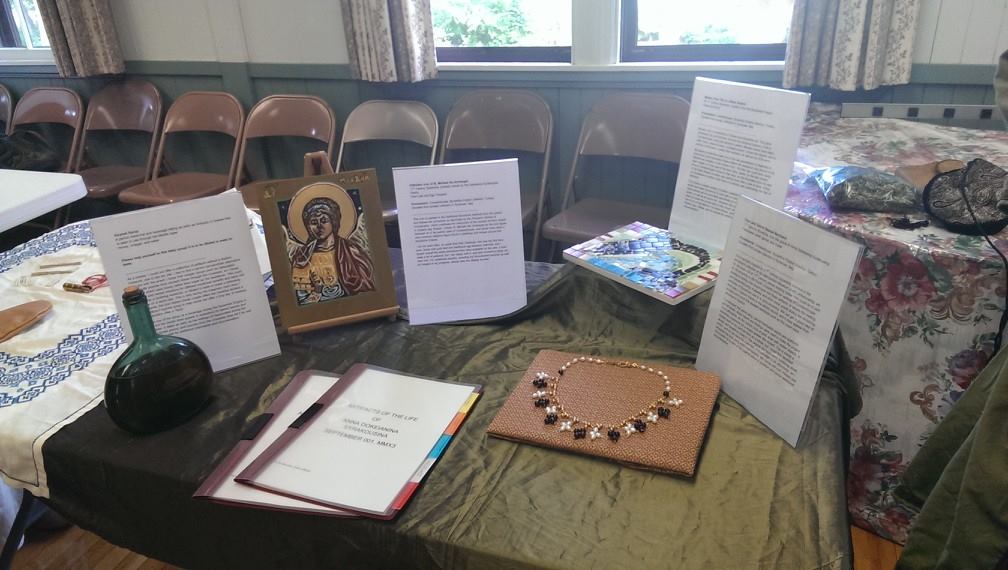
The premise of the event was to create a collection of artifacts pertaining to your persona or another persona, something that they would have had during their life, grave goods, etc. I chose an 11th Century Byzantine woman, which, by the way, is rather hard. Because the majority of the artifacts we have from the Byzantine period are earlier. Here is my display:
Left to Right: Oxymel syrup, Icon of St. Michael the Archangel, Mosaic of a Black Dolphin, and a necklace of garnets and pearls based on one at the Met.
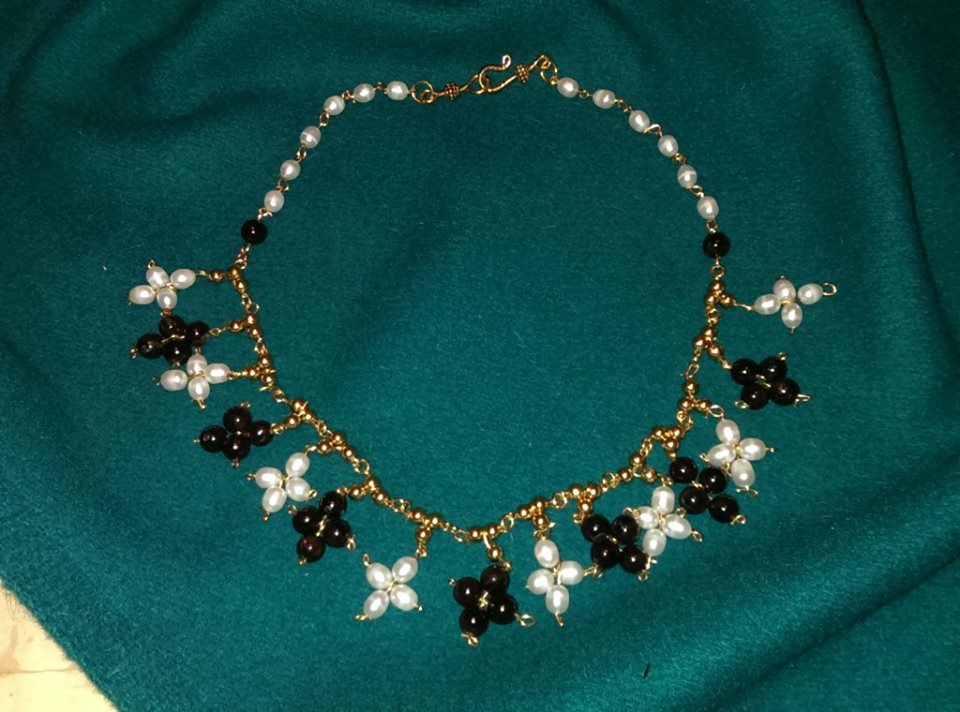
Here is a close up of the necklace. I totally failed in posting updates of me making it, but it took 2 seasons of Sons of Anarchy marathoning in the background to emulate the look. I swear my fingers still hurt looking at it.
And the original:
I tried to get a little bit of everything, namely aspects of a Byzantine life: Spiritual, Temporal, Wealth, and Food/Drink. I tied it together with that silly backstory I previously posted.
I did well, I learned a lot, and met some wonderful people. Although I did not win the category I entered, I did go home with an autocrat’s prize, that is a lovely HUGE book of Italian Renaissance paintings that is totally drool worthy. I can’t wait to do this again, I think next year my “persona” will be Roman Egyptian. 😉
While on my backpacking across Sicily, I decided to stop at an inn for the night in the city of Syracuse. The inn, which was more of a bed and breakfast by American standards, was in an old annex to an even older house. I’m not one for architecture, but if I had to guess, it was built during the baroque period, with some parts perhaps even earlier, but knowing how homes in the older parts of the world had a tendency to be rebuilt many times, it was difficult to say.
I was the only guest for the evening, and the older couple who ran the establishment put out their nightly assortment of rich Mediterranean pastries and gave me a unique beverage that tasted of honey and vinegar. Not wanting to be rude, I accepted the drink and cookies without question, and joined them at their table. Meeting locals make these journeys more enjoyable, with the exception of course, being the language barrier. My Italian was shaky at best, the same with their English, but I learned that the drink was an ancient recipe, one that would revitalize me after my long day of backpacking through the city. After some additional language struggles, I did manage to communicate the purpose of my trip.
“I’m studying to be a classical archaeologist, and I enjoy trekking through ancient regions.”
The couple became incredibly excited, and without a beat, asked, in perfect form, “Can you speak Greek?” The conversation officially began.
The couple, named Marco and Maria, claimed they had a fine collection of artifacts they wished for me to look at. They explained that Maria’s family had roots in the Byzantine Empire, and Marco’s had hailed from a town in Thrace. They had sought refuge in Italy when the Ottoman Empire sacked Constantinople in 1453, bringing only what they could carry. I was intrigued, and yet somewhat unsure if these older Sicilians were simply trying to pull a joke on me. One can never be too cautious when traveling alone. Reluctantly, I agreed to view their so-called collection.
Maria took my hand gently, and we followed her husband into a parlor, where he slid several modern cedar chests into the floor. I wasn’t entirely sure what I was expecting, but I do know that when they were opened, I nearly stumbled back. These weren’t just any artifacts; these were museum-quality heirlooms that spanned generations. Jewelry, silks, pearls, Bibles, manuscripts, this was an unbelievable haul of personal, priceless treasures that had been preserved lovingly to protect a lost cultural identity.
Maria reached into one of the chests, and removed a few items that were gingerly wrapped in stained ancient silk. She placed them out before me: A mosaic with a dolphin on it, a necklace of gold, garnets and pearls, and an Orthodox icon of the Archangel Michael. I sat and blinked. These were not the typical goods of a poor, refugee family.
“My grandmother told me as a young woman that these are the oldest.” Maria began, “From before the Crusades. Her name was Anna, and she was part of the imperial family in Constantinople.”
I knelt down to get a closer look, and she lifted the necklace for me to see. “I was told that when my ancestors fled the city after it had been destroyed by the Turks, they had to save what they could from the old homes and graves. Looting had already begun by the infidels, so they had to hurry. The necklace they were able to save from Anna’s grave. The icon was in the family crypt, and the tile was once part of a large floor in the palace apartment that Anna was said to have lived in. Dolphins are a symbol of our family, you see, and also the old symbol of Syracuse before the times of Rome. My family goes back before the times of Alexander.”
I was unsure of the provenance of anything, but I promised Maria that if she would let me take pictures, I could bring them home and do research, then send her all the information. She agreed, and then I proceeded to go through the rest of their impressive collection. I turned in for the night as my mind reeled on what it would have been like to have been the last of the Byzantines, fleeing with what bits and pieces I could from the crumbling remains of the once glistening empire.
The next morning, as I prepared to leave for my journey, Maria and Marco saw me off with a small package of leftover pastry and a cup of strong Italian coffee…and a small box with the artifacts of the life of Anna, Maria’s eleventh century ancestor. Despite my protests, she urged that I keep them as a gift. She had no daughters of her own to pass them on, and this way I could study them, and perhaps place them in a museum for the rest of future generations to enjoy. The final parting gift was a small bottle of vinegary smelling syrup. Marco told me this was called oxymel, the beverage they had served me when I arrived, it was to be diluted in water, and used just as the Romans and Byzantines did centuries ago.
I placed the goodies into my already-full backpack, but allowed myself to take on the additional burden for these people who had allowed me, a stranger, into their home and hearts for nothing more than a night.
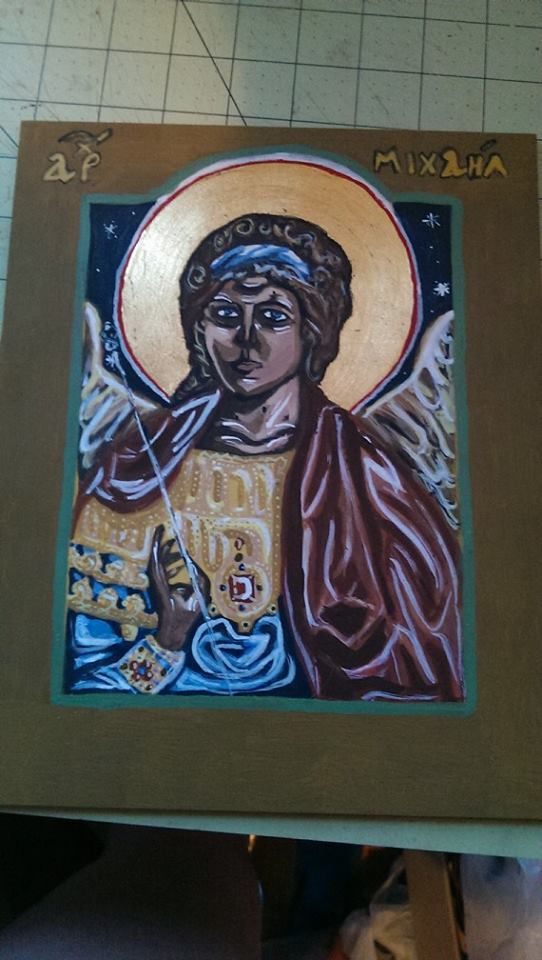
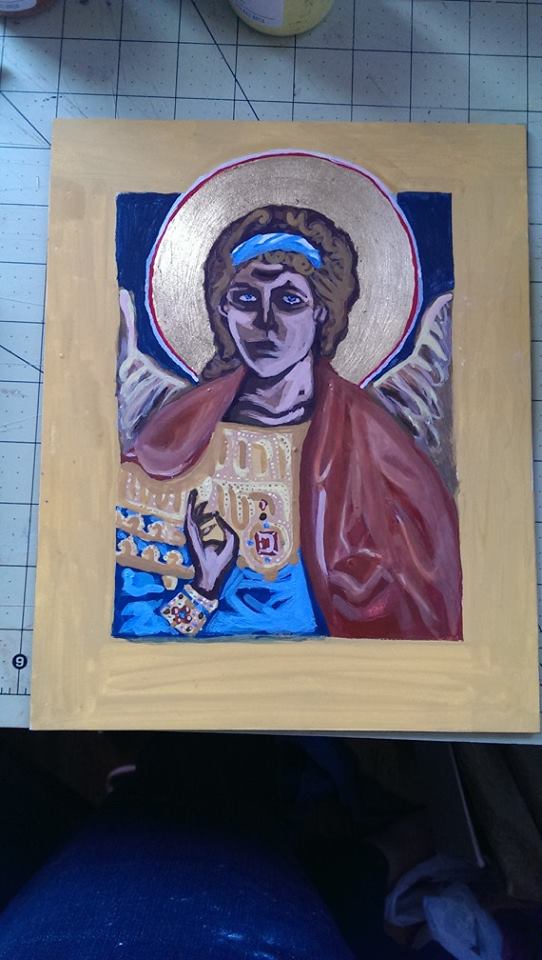
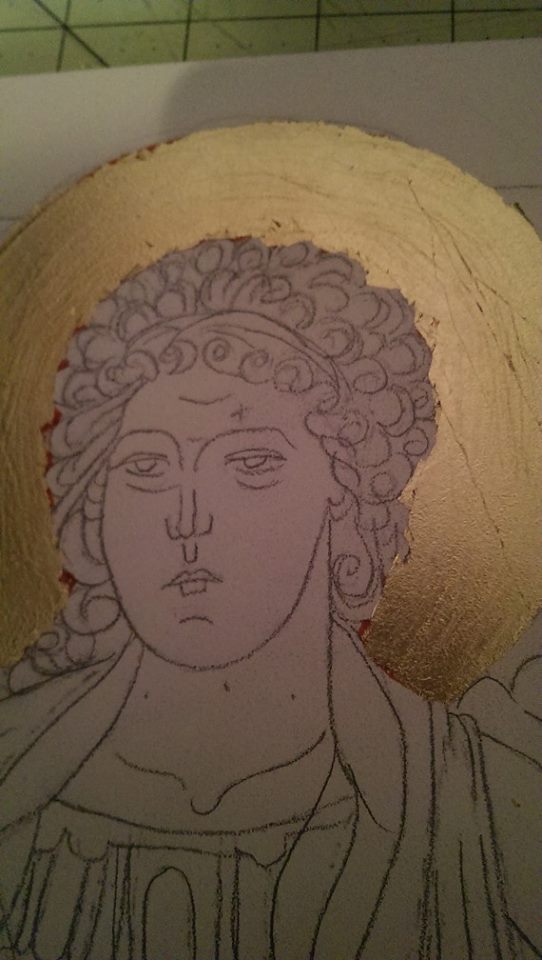
Well, this didn’t come out as well as I had hoped. In fact, it doesn’t look anything really like an “icon” as we know it, but looking at some actual period ones from the empire, most of them weren’t as structured as the ones we see today from the Russian schools are. Which makes feel A BIT better, but meh. An artist is never happy with her work.
However, this was my first ever attempt at ANYTHING like this, my first use of painting from dry pigment, let alone using period materials, so I can’t really be upset with myself. I learned a lot, and I know that if I want to try this again, I have a good foundation of where to start. First things first: work on faces, and get finer brushes. I will include my “next time” notes with my documentation for Artifacts of a Life. Judges always appreciate learning about what you learned. It was a journey and a process.
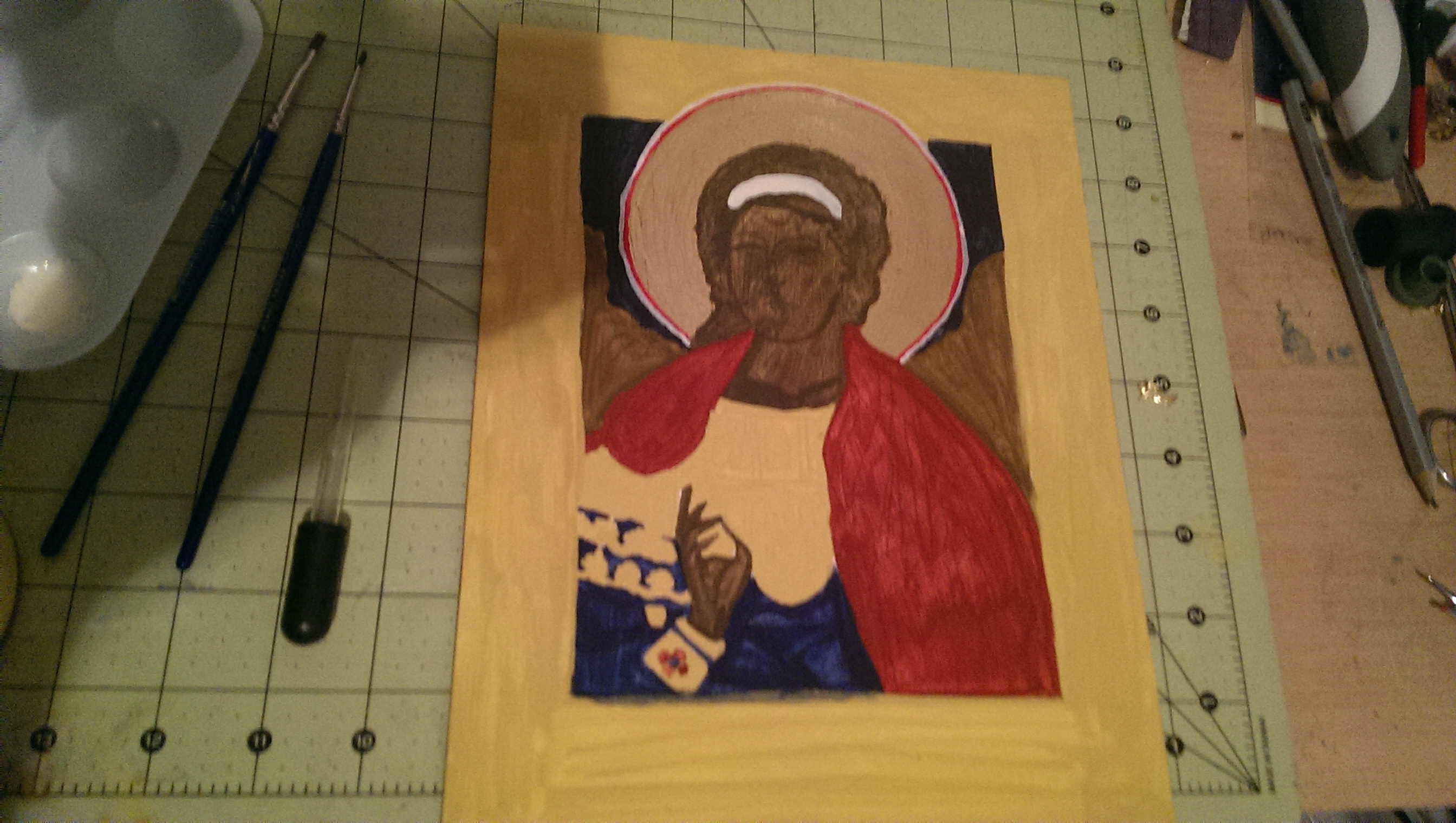
Here’s some action shots of my last 2 days of work. I have to let it cure overnight, so I can’t put more than a few hours of work in at a time. That and my eyes start going “NO.” And I get impatient.
Egg Tempera is a solution of egg yolk and white wine. I had a heck of a time separating the egg, then puncturing the yolk, but I was able to make the solution with some pinot grigio.
Yum.
You add this to natural, dry pigments.
No lead. Promise.
Then you start laying down the sankir, or skintone layer, and eventually all of the dark under layers. This is called the roskrish. This is what I got done last night.
Today I started the highlighting process, and it was uh…interesting at first. It’s a system of layers and building, so I had to step back, think, blend, curse, re-blend, paint, curse, try again, etc. Either way, Michael is starting to get that “illuminated” look that is typical of most icons. I feel I should be finished in the next couple of days. I don’t think I will have time tomorrow as my last class gets out rather late, but Wednesday afternoon I should be able to put a good dent into it.
I’m fairly pleased with how it’s coming out so far, and can’t wait to see the finished product now.
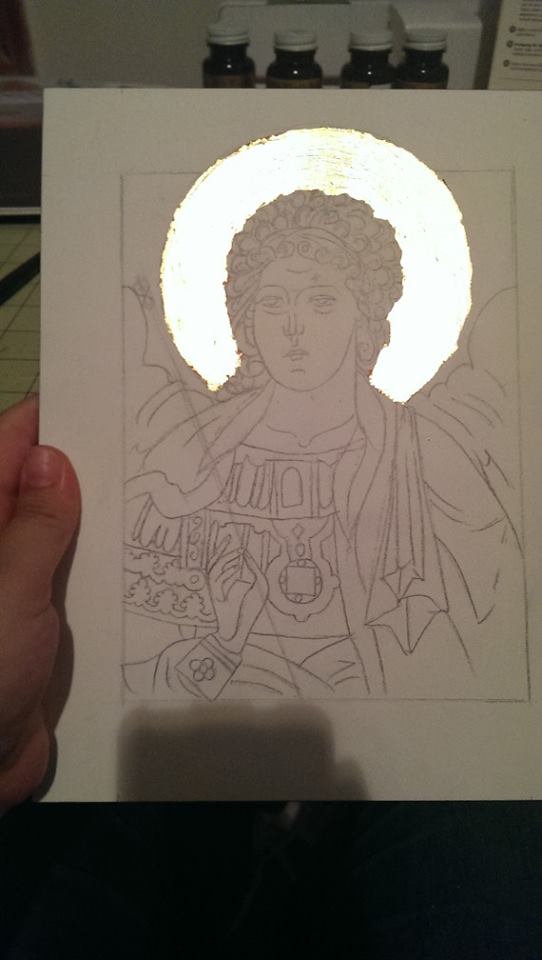
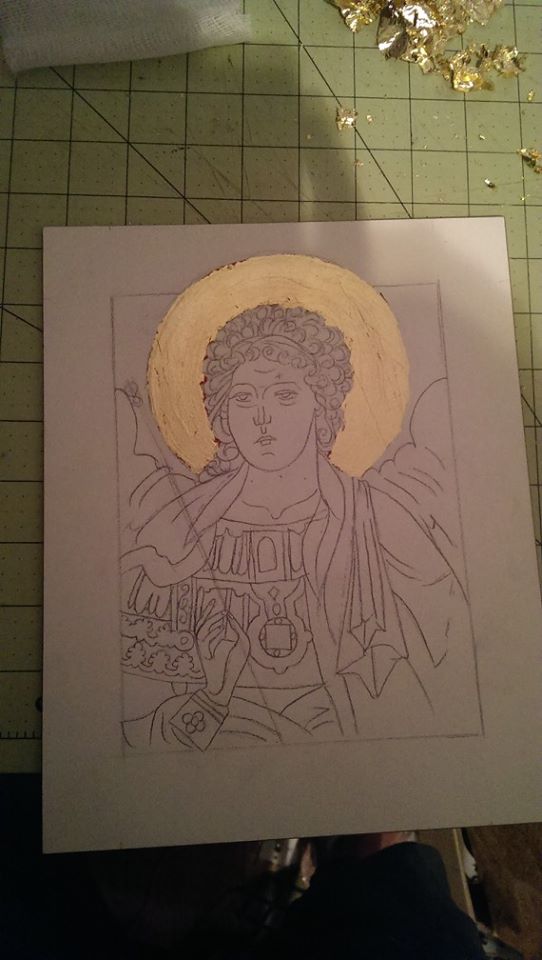
Well, so far. I got the gilding down tonight. This makes me insanely happy, since it was probably the part I was most worried about.
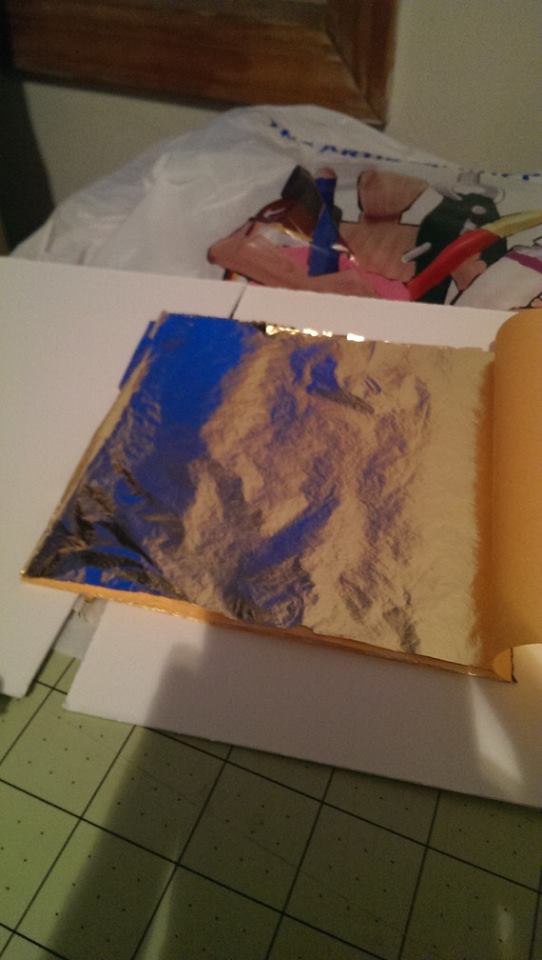
St. Michael the Archangel, patron of Constantinople. Naturally.The red stuff is called bole. It’s a mixture of red clay and animal skin glue. This is the adhesive for the gold leaf.GOLD LEAFS. Okay, it’s composite gold. I was too afraid to invest in the real stuff just yet. I figure after some more practice if it looks like I can get this technique down, I will take the leap of faith to the 23kt sheets.
HOLY SHINY. LITERALLY.
I did it! I applied gold leaf for the first time ever!
There are a little gaps, but it’s all fixable using shell gold, which is using the leftover leaf and mixing it with gum arabic to make a paint.
After the pictures were taken, I burnished the leaf, and used a modern sealant that came with the leaf because, well, I’m a rookie, and I’d rather be careful while I learn. So tomorrow I will try mixing the natural pigments into egg tempera, which is going to be the next hurdle.
When many people think of the Byzantine Empire, they probably think of one of these shiny things:
I am not a religious person mundanely, but I’ve always found the artistry of Orthodox iconography to be hauntingly beautiful. Icons have been a part of the religious tradition of Greece and Russia since the Byzantine Empire, and come to find out, the techniques used to create them are pretty much spot on to what have been done in period as is used today.
So today, I spent quite a bit of money on supplies to get started on attempting to paint my first icon, using period mineral pigments and composite gold leaf (No way I can afford the real stuff right now.) I did cheat a bit with getting gesso boards instead of preparing my own with poplar wood, rabbit skin glue, and natural gesso, but I only have so much money for this, and I’d rather not spend hundreds on creating something that I may completely screw up. Even the pigments I got, although natural, are not top of the line. I will be mixing them into egg tempera, the period method of using egg yolk and white wine to create a paint medium.
I’m pretty excited about starting this project. I’m also scared to death. So this will be the next multi-post series here on ye olde Anachronistic and Impulsive.
This is a paper I wrote back in freshman year of College Mark II (2010.) It’s not in my finest academic form, and I used MLA instead of Chicago, since that’s what I knew at the time. I figured it’s length and content were perfect for a blog entry as I have been lacking on any real substantial content lately, ESPECIALLY about the Byzantine Empire. In-text citations with works cited at the end.
Stealing the Worm: Silk Production in the Byzantine Empire
Angela Costello
12/08/2010
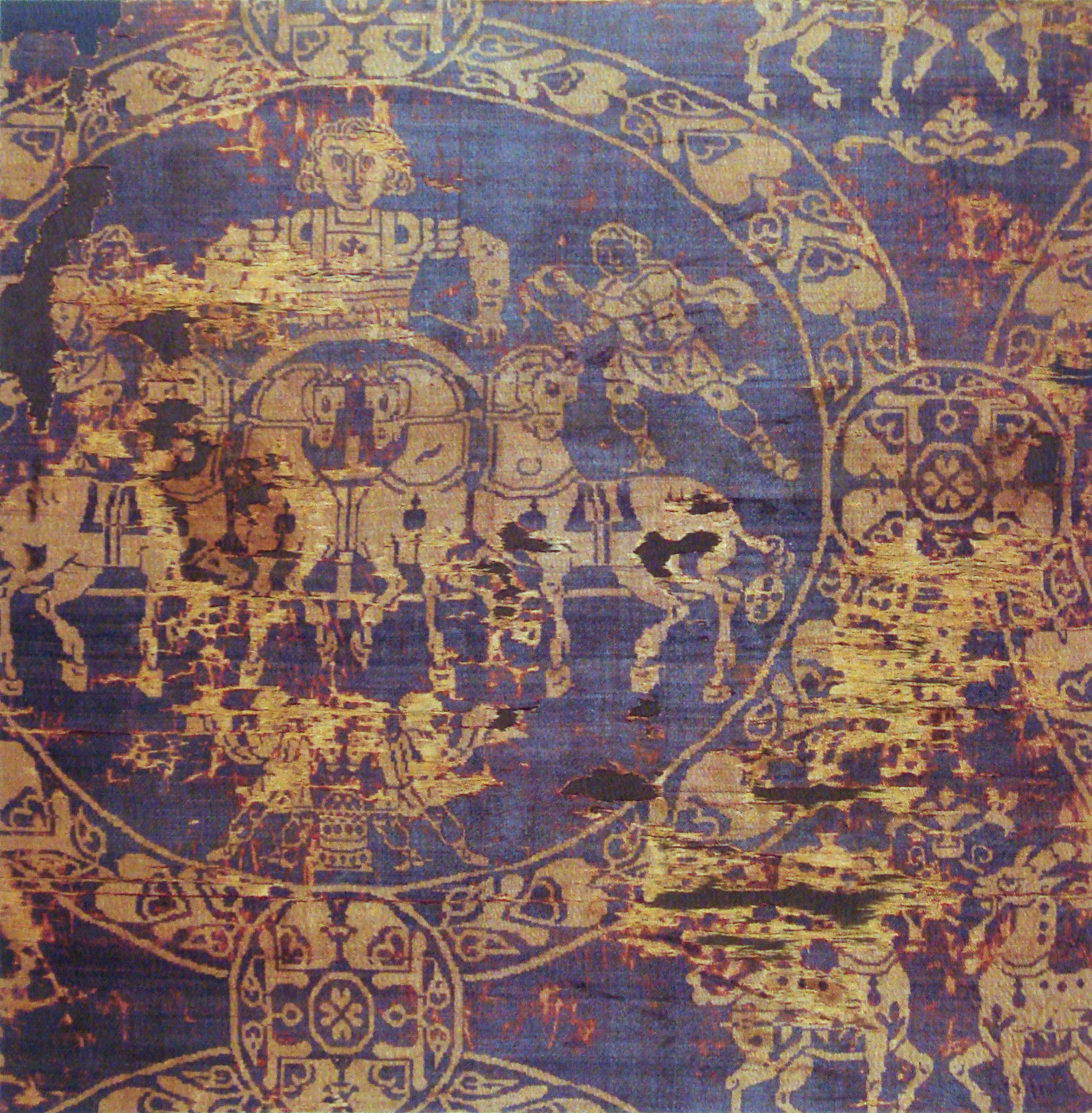
The Shroud of Charlemagne. Manufactured in Constantinople in 814.
One of the primary achievements within the reign of Justinian I was the obtainment of silkworms from China. We will analyze how this event led to major changes within the Eastern Roman Empire’s economy and foreign policies.
The Silk Road opened to Rome in the 2nd Century as caravans that traveled from China and through Persia worked their way into the outer provinces of the Empire. A chapter of the Hou Hanshu, a historic text from China, states that Roman contact was made by sea in AD116, which initiated a series of trades from there on out. (Hill) There are also Biblical mentions of silk, although the period translation from ancient Hebrew may be referring more to a very fine linen, there is one certain mention within the Book of Revelations during the description of the Fall of Babylon, as it was translated from Greek. “And the merchants of the earth weep and mourn for her, since no one buys their cargo any more … fine linen, purple, silk and scarlet”. (Revelation 18:12)So it is believed at the time the book was finalized, that the fabric was commonly known.
The luxuriousness of the fabric and the wealth that it embodied allowed the Empire at a time to use silk as a monetary standard for a short period of time. Silk was used as a way to determine the value of currency in the outer provinces, much like silver was used in the core of Rome. This didn’t seem to have lasted very long, however, as most records show that the silver standard took precedence for the majority of the period. (“Money” 701)
China was the sole manufacturer of silk for thousands of years, and it wasn’t until the Emperor Justinian I in 552 obtained the first silkworm eggs. Prior to that, the Romans had to trade through their strongest enemy to the East, Sassanid Persia. Trade with Persia was costly, strenuous, and often dangerous, therefore it was evident a solution was needed.
There was a high demand for silk in the Mediterranean during the reign of Justinian, both within Constantinople and into the outreaches at the highest extent of the Byzantine Empire. It was the prized fabric of the notably well-dressed Imperial court and an overall hot commodity in the area. Interaction with Persia needed to be brought to a minimum, and Procopius wrote of a solution.
The legend tells of the Emperor sending monks as emissaries to China, and smuggling back the worms in stalks of bamboo. The eggs did hatch on the journey back, but within the care of the monks they did arrive safely. With them also came several Chinese slaves, educated in the ways of sericulture, or the production of silk, and the humble beginnings of the silk industry in Constantinople began. (Procopius 229)
Although silk production began under the reign of Justinian I and Irene of Athens, it didn’t particularly pick up until several centuries later. It was necessary to breed the worms to have a significant production of the thread, so to do this would take a considerable amount of time. Thanks to the destruction of the Western Empire in the century prior, Constantinople had established itself as the economic superpower for nearly all of Europe and especially the Levantine Mediterranean realms. (Schoeser 27) So despite the work needed to establish a strong foothold on sericulture, the Romans found themselves in a strong opportunity.
Authors such as Procopius and Theophanes attempted to give a look as if the production of silk happened “overnight” in Byzantium, but the truth is that this just isn’t the case. Although Procopius’ stunning story of the theft of the worms from China is intriguing, it was probably nothing more than contemporary propaganda. The earliest known documented Byzantine silkworms were actually located in fifth-century Byzantine-controlled Syria. ( Muthesius 150)
Initially, silk production was limited to just the Imperial Palace, with private spinners and weavers put to work to create the splendid garments for the emperor, empress, and entourage of the court of Byzantium, much like the private workshops they had for jewelers and perfume makers. Eventually commerce spread outward to the people of Constantinople and the Empire as a whole, and an overall monopoly on silk goods produced by the former Imperial workshops had spread as far as Francia in the west, but that wasn’t until the 11th and 12th centuries once the Empire had established a solid industry.
The most notable factor of silk produced within the Eastern Roman Empire was the intricacy of the designs on the finished woven textiles. In Constantinople, improvements and innovations to the weaving industry were made to accommodate the desire for more elaborate designs. These were known as pattern harnesses, which required a considerable amount of skill to operate. As written by St. Theodoret of Cyrus, the skilled laborers were women:
“…Women take it in hand and weave the fine yarns. First they place the warp like strings in order on the looms and pass the weft through them, separating the threads with the combs, loosening some of the broken lines and tightening others; then they thrust and compress the weft with the instruments made for this purpose and in that way complete the web…Notice how on all kids of living things are embroidered, the forms of men, hunters, worshipers, and the images of trees and countless other objects.” (Theodoret 55)
Notable weaving patterns in early Byzantine textiles that still exist are the tabby, damask, twill, lampas, and tapestry weaves. (Muthesius 153) It seemed an entirely new sub-industry within the Empire was created to support this new weaving venture.
Despite the silk industrial revolution that was occurring in Constantinople, trade for raw and finished silk goods from China was still very prominent for several centuries. The Empire continued to import raw silk thread and yarn from the East as to support their weaving industry, and to get there; it had to go through the Persian Empire. Each stage of the journey from China, either by land or sea, dyes and designs added value and increased its cost. The uneasy relations that Byzantium had with Persia often made the trade difficult and dangerous, so the importation of silk and other eastern goods were subject to strict government regulations on both sides. (Feltham 5) Prior to Persian control, the majority of silk going into Greek and Roman provinces was done by nomadic tribes coming from the steppes of Central Asia, who traded for goods such as horses and furs.
An important question is raised in whom exactly, were the monks that Procopius mentioned. Sources point to them being Sogdian, which were a nomadic tribe that brought in silk from China, or even Persians. But why would either culture attempt to undermine their control of the trade?
In 529, Justinian himself passed a law within his codex that stated that Romans and Persians alike were to follow strict rules on when and where trade could take place “in order to prevent the secrets of either kingdom from being disclosed”. This limited trade between the Empires to take place at only three cities: Nisibus, Callinicum, and Artaxata, and that all outside trade would be confiscated. It goes on to list additional fees associated with violation of the law. (Justinian I LXIII, 4)
If it were in fact Persians that were the monks that Procopius mentioned, then they would be in direct violation of this law, which leads that hypothesis to be unlikely. At the time, other cultures were coming into the game plan as far as trade goes, including the Turks, whom would prove to be the ultimate downfall of the Roman Empire less than a millennium in the future, so it is still very unclear as to the origins of Procopius’ tale.
The Vikings were well-known trades people during this time period, and had a considerable amount of interaction with Eastern Rome. There have been numerous finds in Viking archaeological sites that demonstrate the wide contact they had with the continent. Silk from Byzantium is commonly found among other imported and domestic items of the Norse people. (Christensen) These examples were most likely brought back by the Varangian guards who were working under the imperial banner, and the extensive trade routes the Vikings set up from Constantinople to the Baltic.
Despite the demand for the silk goods to be purchased by foreign cultures, the Empire strictly regulated how much could be sold. It was written within the Russian Primary Chronicle, “When the Russes enter the city, they shall not have the right to buy silk above the value of fifty bezants…” (Muthesius 165) In edition to the limit on how much one could purchase, there were also tariffs placed in effect, which regulated the flow of illegal trading. This insured the Empire’s foothold in the silk trade, and helped regulate the economic impact the industry would eventually have on the growing market, which would boom during the prime of Byzantium in the twelfth and thirteenth centuries.
The interaction with Persia would not end immediately. Eastern Rome had to continue dealing with their menacing middleman while their industry was growing, and would be doing so until the Ottoman Empire came into play several centuries after the establishment of silk cultivation.
For Justinian, however, the ancestors of the Ottomans would be his loophole to bypass the Persians. The Turks had no love for the Sassanids, and during periods of hostility in which the silk trade between the Empires was suspended, Byzantium attempted to make direct contact with China. This brought them into an agreement with the Turks, whom Justinian’s successor, Justin II, drafted a treaty with, and they supported the Empire against Persia. (Ostrogorski 74) Similar arrangements were made with Ethiopia for imports from India by sea, but they could simply not break the hold that Persia had on the Indian Ocean.
Although the Eastern Roman Empire succeeded in becoming one of the foremost silk manufacturers of the Middle Ages, the path there began with a legend of stolen silkworms. This event aiding the shaping of a region that would be not only known for its beautiful textiles, but also for its strength in the Empire’s policies of trade.
Justinian I, “Codex Justinianus (529): Title LXIII. Concerning Commerce and Merchants.” The Civil Law. S.P. Scott A.M.. Cincinnati: The Central Trust Company, Digital.
Anyways, the boozes did well at Great Northeastern War. My conditum paradoxum and rose-lavender cordial were paneled and both scored relatively well for my first foray into the guild scene. My mead and cordial both one best in their division. There was only one cordial, but…hey, there were 8 meads. That counts for something.
Nobody showed up to my Roman garb class except for my friend Elinor Strangewayes (see also: woman who makes Roman phallus beads,) but my Varangian Guard class had a good group, even though I didn’t prep a good lecture, we sat there and talked for an hour and I spewed what I could from the top of my head. They loved the extensive biblio I put onto my handout. I think I will be posting that in the future.
The Byzantine garb page is almost finished, I hope to get that up in a day or so. I basically copy-pasta’d my handout, but I’ll also be adding more stuff. Since my persona is 11th Century, I need to focus on finding more information about that more rather than the generic “Throw clavii on a tunica and call it Byzantine” look. At least there’s lots of fun vocabulary to learn, right? @_@
I am also going to be playing with some Norman garb for upcoming events this fall and winter. The boyfriend is Norman, and technically so is half of my persona, so I get to wear Western European garb for the first time. Ever. I don’t count my Viking, that’s Northern. 😛
This is a great post from another blog that I follow. It shows styles of Byzantine swords, which is great when I’m “furniture shopping” for my SCA weapons. Check it out, Byzanteam!
The summer means I work…work…work…(with that said, if you are reading this and you need garb, please send me an email!) And because I wasn’t able to work all last semester, and I was planning to study abroad this summer but the trip was cancelled…My heart and my wallet were not really prepped for Pennsic. Right now, there is only a slim chance I will make it for war week, but with the dates being so much earlier this year, and the fact that I am working on applying to grad schools and taking the GRE (EEP!) I think it’s more advantageous that I take a year off from the Big One, focus on real life (boooo…) and…GET TO PLAY AT LOCAL EVENTS I HAVEN’T PLAYED AT BEFORE! Such as: Great Northeastern War in Maine! YAY! It’s always a week or two before Pennsic, which makes it hellish to do both, so I’ve always skipped GNEW for Pennsic. This year, I don’t have to!
I will be teaching my Roman Dress class at GNEW, and my new Varangian Guard class, which is a history lecture, not anything about fancy garb. I will try to include what I do know about what was worn, but that’s not the focus of the class. I had contemplated doing the Byzantine Garb class as well, but I think 3 classes would be overkill for a weekend event. Even though I’ve taught 3 classes in one day at Pennsic (and lost my voice in the process) I’d much rather be able to do other things at GNEW such as um, fight, than teach all day.
I will be at War of the Roses this weekend in NY, but I am not teaching. I’m planning on relaxing the best I can during a soggy weekend.
I am also planning on writing a Compleat Anachronist this summer, as well as some articles for the East Kingdom A&S e-zine, Ars Scientia Orientalis. I need to get my work out there. So even though Pennsic isn’t an option, that doesn’t mean my life with the society ends. I merely look at it as 2 weeks I get to spend quietly with my boyfriend, who is unfortunately set to deploy in October, and work on documentation and publications. 🙂









 Anna's New Rome
You must be logged in to post a comment.