
I’m hanging out down in Trimaris for a while to beat the winter up north. All sorts of new wonderful Byzantine and Roman goodies coming soon after the new year!
Tag: byzantine
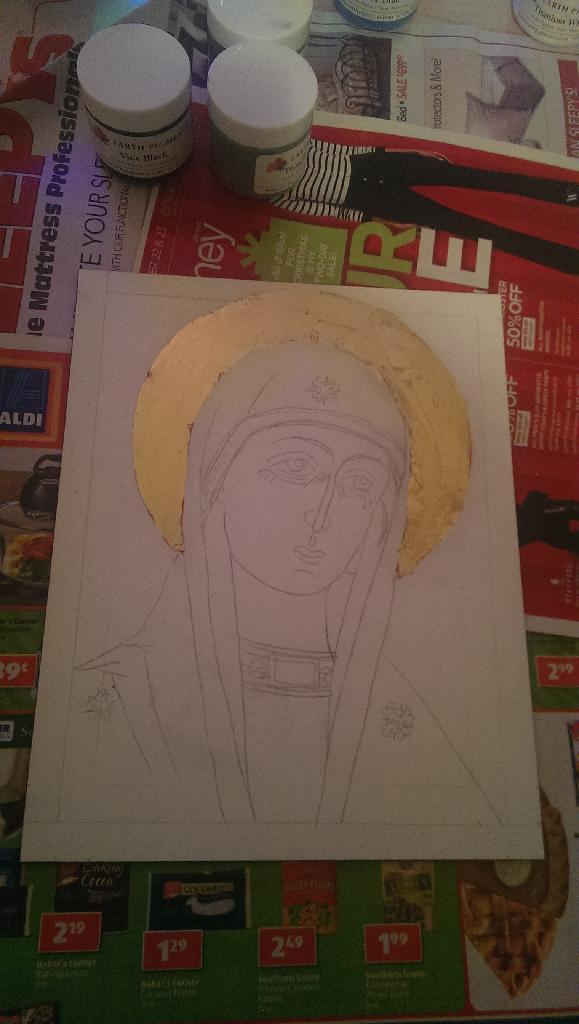
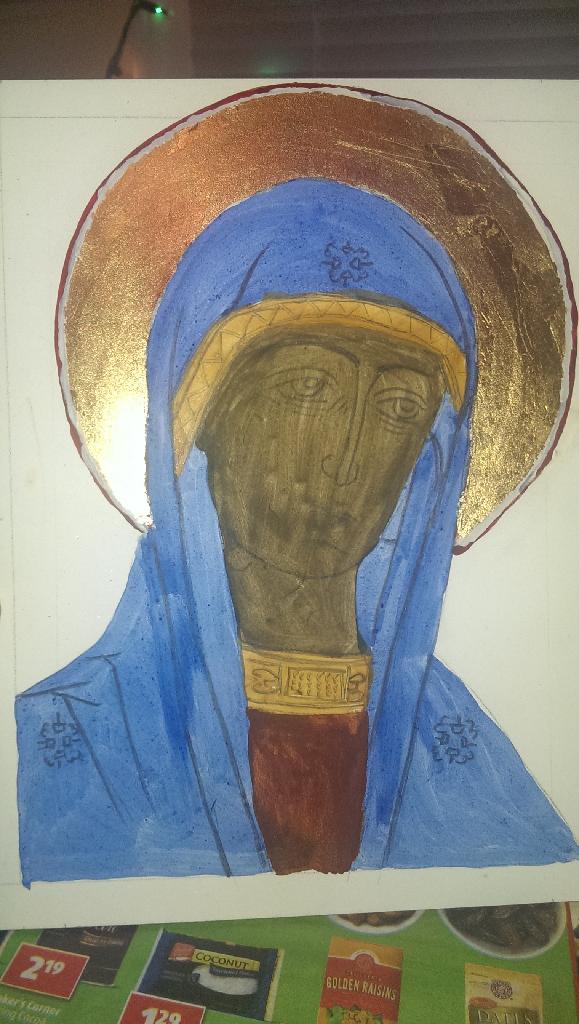
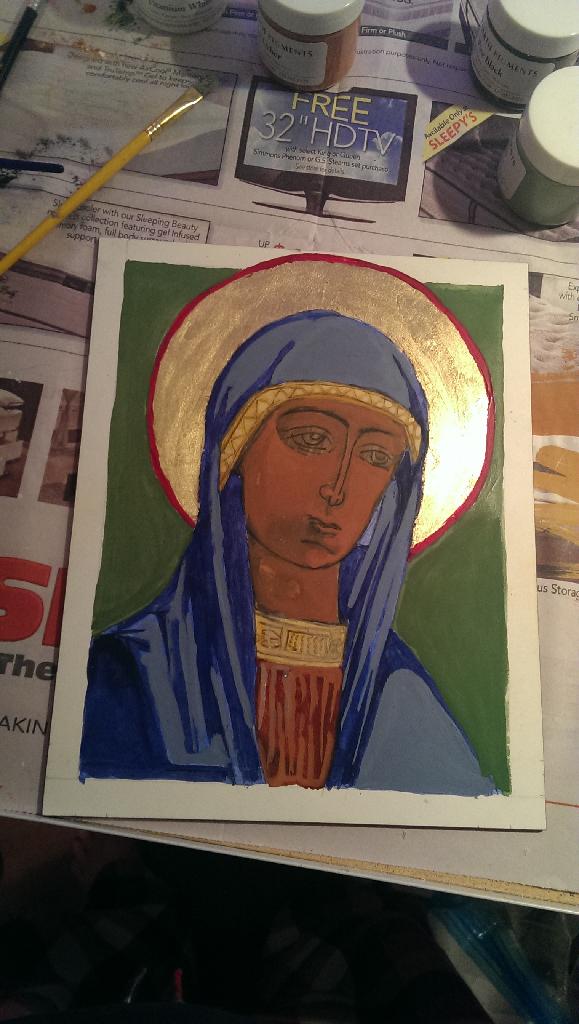
Another icon – The Virgin Mary
I made this specifically for my friend in the East Kingdom Artisanal Exchange for this fall. Typically, Mary would be in red, but since this was based on an in-joke between the recipient and her friends, I put her in blue. Aside from that, I can happily say that my skills have improved since my last attempt. Egg tempera is a tricky medium.


The illusive Dover dress debunked.
I can’t tell you how many times I’ve seen people emulating this look from the “Byzantine Fashions” Dover Coloring Book by Tom Tierney and “Ancient Greek, Roman, and Byzantine Costume” by Mary G. Houston.


First of all, I want to say I have no issue with the images presented by Dover. They usually do a good job, but they have a hard time backing up their sources. When asked about that particular clothing style, especially the belt, I had no idea what their source was, and upon asking others, I got a lot of shrugs and odd statements such as, “Oh, the book says it’s a princess/prostitute/ancient Roman goddess.” Which only led to me getting more confused.
I’ve had the Tierney books for a while, both “Byzantine Fashions” coloring book and the paper dolls of Justinian and Theodora, which are adorable. They do provide a pretty solid idea of Byzantine styles based on artistic record. So don’t knock them, but don’t run off with them as a primo source, either.
This particular style intrigues me. Mostly because it’s almost always done with a V-neck. This seems wasteful, especially for the opulent, fabric hoarding Byzantines. So, I ran a brief Google search on “Bamberg textile” and…

Well that wasn’t very difficult to find. I yanked it right from Wikipedia. The note on the image reads:
The so-called “Bamberger Gunthertuch“, a Byzantine silk tapestry depicting a Byzantine emperor on his triumphant return from a campaign. He is crowned, bears the labarum and rides a white horse. Originally identified as Basil II (by A. Grabar), it is now accepted that he represents John I Tzimiskes on his return from the campaign against the Rus’ in Bulgaria. He is flanked by two female tychae, who personify Constantinople’s two demoi, the Blues and the Greens. The one on the right offers [possibly] a crown, and the one on the left a triumphal toupha headdress. The silk was acquired by Gunther, bishop of Bamberg, in 1064-5, and re-discovered on 22 December 1830 in his grave. The silk is now on display in the treasury of the Bamberg Cathedral.
Well, there you have it. They aren’t princesses, they’re political parties.

Now, moving on. What are we looking at here as far as clothing goes? This is 10th Century, so it’s 100 years prior to my period (not that it’s ever really stopped me or anyone else in the SCA about being anachronistic with their anachronism.) And what I see, instead of any sort of fitted short sleeveless tunic, is the trusty stola. A woman’s garment that was somewhat carried over from the Classical period, only cut like a classical tunica, or “Roman Rectangle” as my friends and I like to call it. Here’s a Coptic-Byzantine stola:

You’re looking at an insanely simple garment. Almost tabard-like in nature, with minimal decoration. The ones depicted by the ladies in the textile fragment only have trim on the bottom, and it’s short enough to show off ornately decorated tunicae underneath, which seemed to be a popular look. This would explain the heavily gathered appearance on the Bamberg piece. After trying a stola for myself before, I can see why women would rather opt for the look portrayed in the Dover books, it’s a lot more flattering. Yeesh.
As far as that double hanging belt thing goes…uh…it doesn’t look like anything depicted in the textile at all. The woman to the right is wearing a belt, but that looks more like the end of a buckled belt than any extra ornamentation, and they certainly don’t have the spacing shown in the Dover illustrations. So that’s something that is certainly open to interpretation as far as design goes. I also really like the pink pallas, as I have a pink palla. 😉
It’s hard to say exactly if this was a commonly worn fashion. Much like the sideless surcoat debate, it may have been something only worn for ceremony and therefore depicted in art, or, as is common with Byzantine motifs, it’s hearkening back to the classical period of Rome. Either way, I hope that women looking for more information on this dress style have at least been able to get what they’re looking for from this little blurb. 🙂
I’m asking for money…again
I’ve officially started my Kickstarter for the next book! I know I tried that IndieGoGo back in the summer, but it didn’t work, because I think I was asking for too much at once. This is a more solvent project, just for the book, to get me through the initial production costs while I’m still a poor student. I’m shooting for an August release. Just in time for Pennsic War! If you liked “Of Summer and Winter” you’re gonna LOVE “The Overcast of Autumn.”
http://www.kickstarter.com/projects/kaousuu/the-overcast-of-autumn-sequel-to-of-summer-and-win
What’s that? You don’t have a copy of my first book?
http://www.amazon.com/Of-Summer-Winter-Angela-Costello/dp/1480083968/ref=cm_cr_pr_product_top
The Providence Street Painting Festival! Look what I did!
I’ve been doing this since 2006. This is the first time I got First Place (I did get 3rd in 2009.)
I blame Justinian and Theodora.
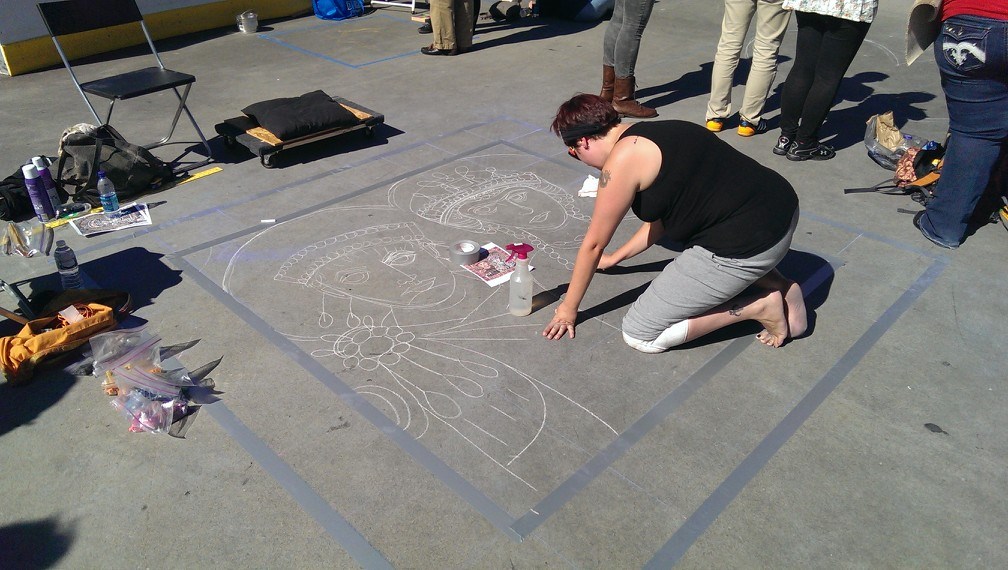
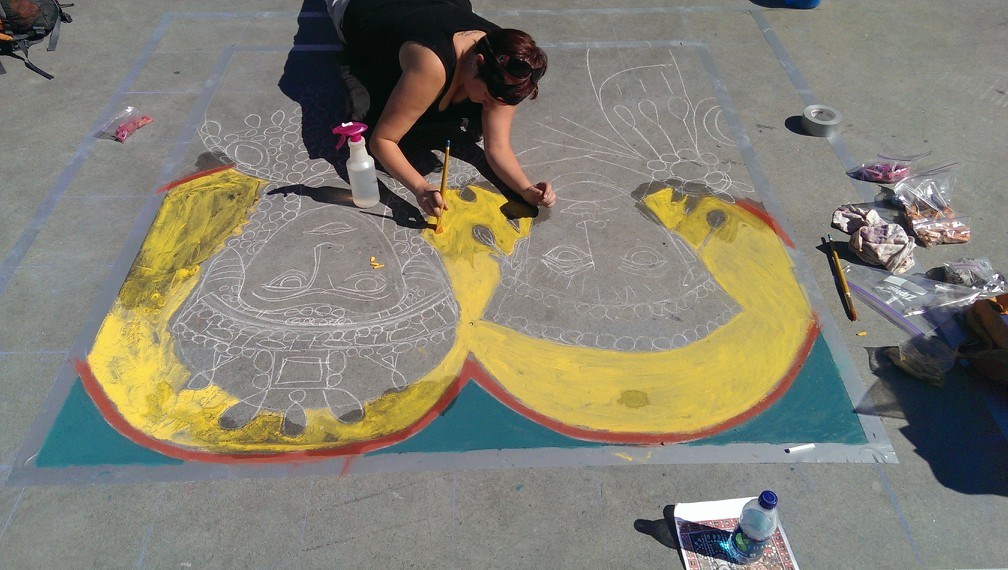

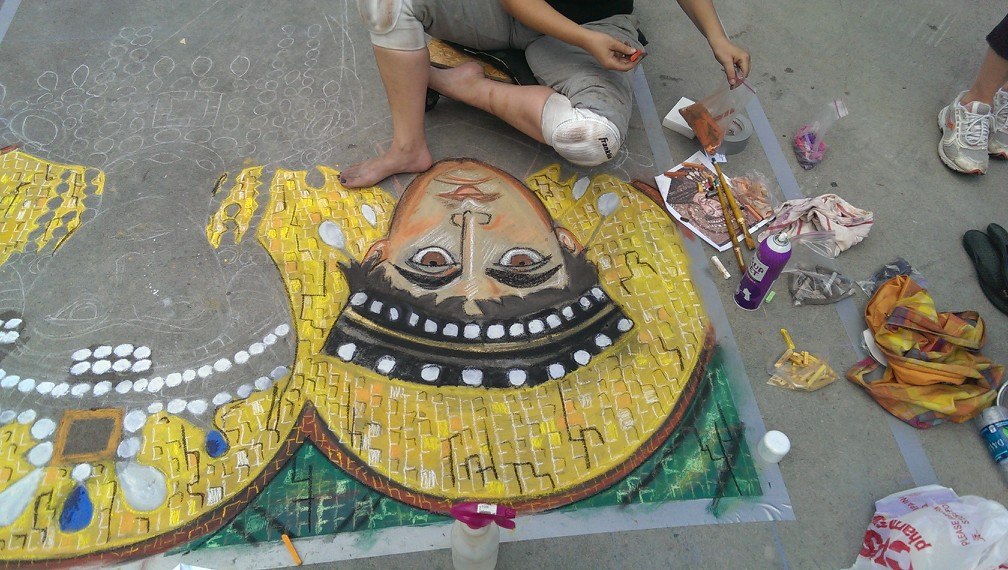
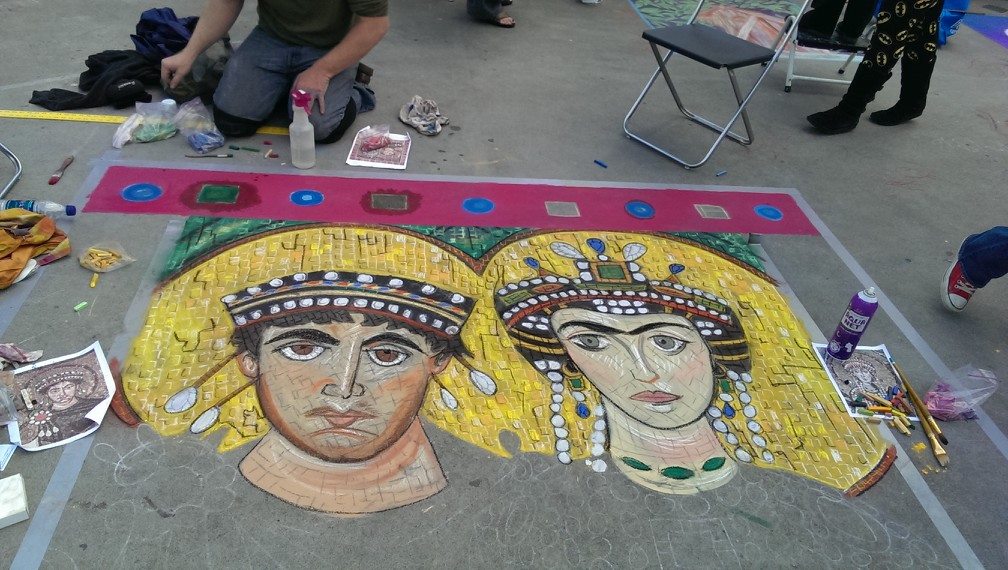

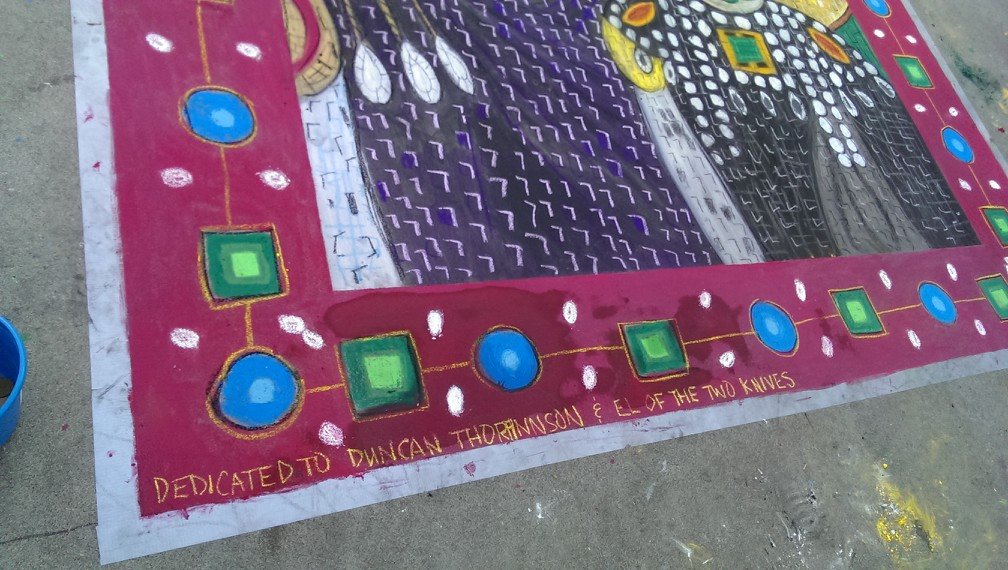
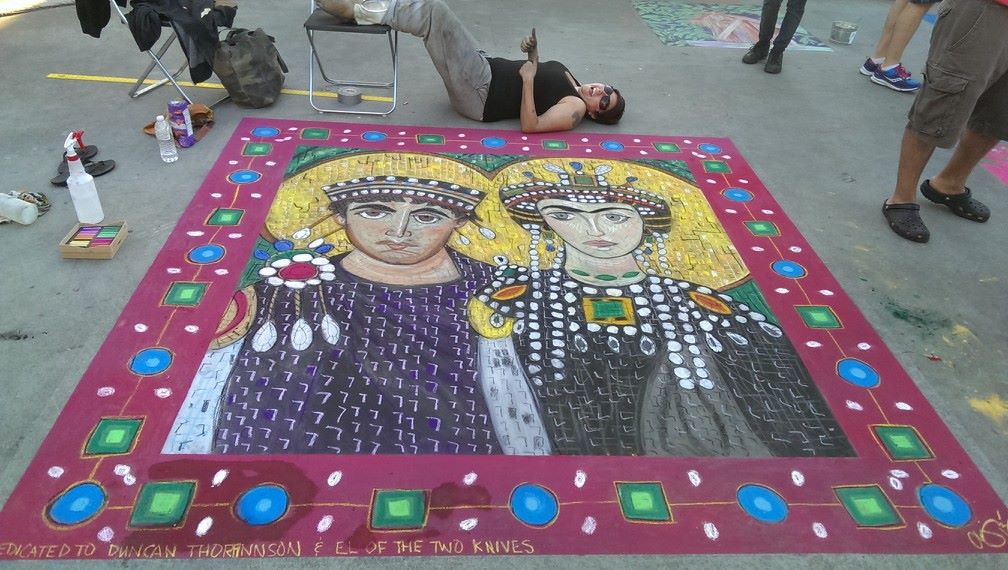
I dedicated it to two members of the Society we have lost/about to lose to battles with cancer.
So yes, first place in the adult division! I won $200! …And a kidney stone that put me in the hospital the next day. This growing up stuff sucks.
Artifacts of a Life recap
So last weekend (the 21st of September) was our Artifacts of a Life event here in the East Kingdom. There were some some amazing displays there!
The premise of the event was to create a collection of artifacts pertaining to your persona or another persona, something that they would have had during their life, grave goods, etc. I chose an 11th Century Byzantine woman, which, by the way, is rather hard. Because the majority of the artifacts we have from the Byzantine period are earlier. Here is my display:
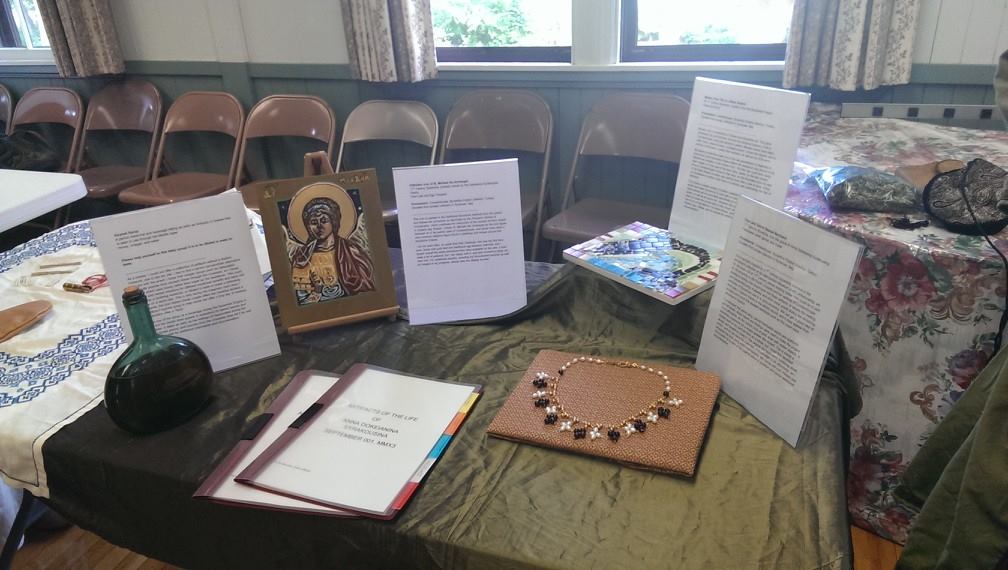
Here is a close up of the necklace. I totally failed in posting updates of me making it, but it took 2 seasons of Sons of Anarchy marathoning in the background to emulate the look. I swear my fingers still hurt looking at it.
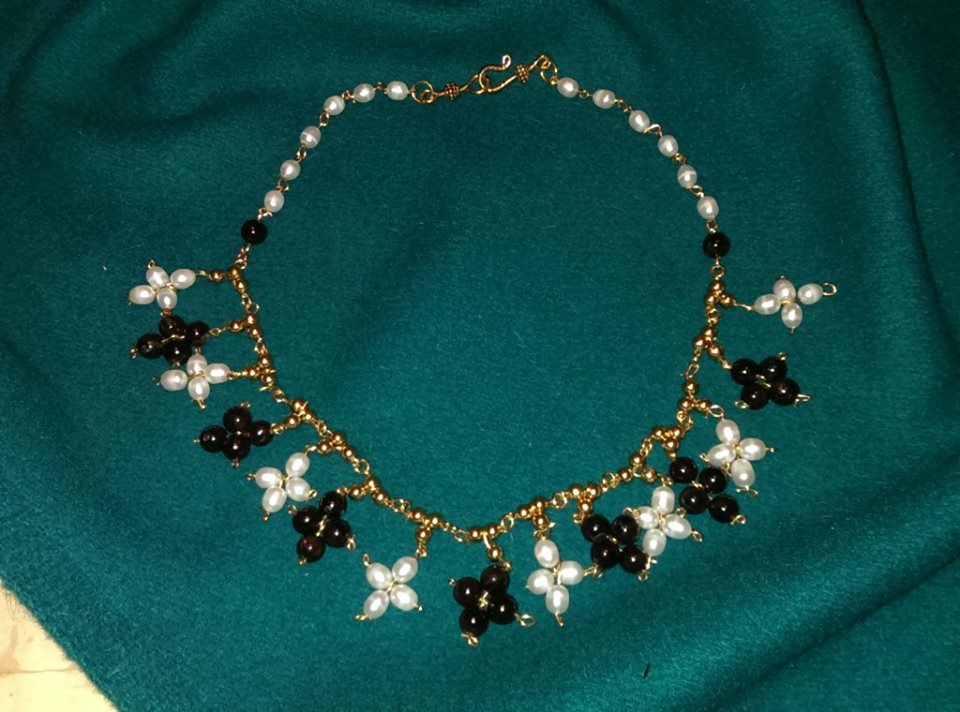
And the original:

I tried to get a little bit of everything, namely aspects of a Byzantine life: Spiritual, Temporal, Wealth, and Food/Drink. I tied it together with that silly backstory I previously posted.
I did well, I learned a lot, and met some wonderful people. Although I did not win the category I entered, I did go home with an autocrat’s prize, that is a lovely HUGE book of Italian Renaissance paintings that is totally drool worthy. I can’t wait to do this again, I think next year my “persona” will be Roman Egyptian. 😉
Artifacts of a Life. IT’S HERE.
On the discovery of the artifacts:
While on my backpacking across Sicily, I decided to stop at an inn for the night in the city of Syracuse. The inn, which was more of a bed and breakfast by American standards, was in an old annex to an even older house. I’m not one for architecture, but if I had to guess, it was built during the baroque period, with some parts perhaps even earlier, but knowing how homes in the older parts of the world had a tendency to be rebuilt many times, it was difficult to say.
I was the only guest for the evening, and the older couple who ran the establishment put out their nightly assortment of rich Mediterranean pastries and gave me a unique beverage that tasted of honey and vinegar. Not wanting to be rude, I accepted the drink and cookies without question, and joined them at their table. Meeting locals make these journeys more enjoyable, with the exception of course, being the language barrier. My Italian was shaky at best, the same with their English, but I learned that the drink was an ancient recipe, one that would revitalize me after my long day of backpacking through the city. After some additional language struggles, I did manage to communicate the purpose of my trip.
“I’m studying to be a classical archaeologist, and I enjoy trekking through ancient regions.”
The couple became incredibly excited, and without a beat, asked, in perfect form, “Can you speak Greek?” The conversation officially began.
The couple, named Marco and Maria, claimed they had a fine collection of artifacts they wished for me to look at. They explained that Maria’s family had roots in the Byzantine Empire, and Marco’s had hailed from a town in Thrace. They had sought refuge in Italy when the Ottoman Empire sacked Constantinople in 1453, bringing only what they could carry. I was intrigued, and yet somewhat unsure if these older Sicilians were simply trying to pull a joke on me. One can never be too cautious when traveling alone. Reluctantly, I agreed to view their so-called collection.
Maria took my hand gently, and we followed her husband into a parlor, where he slid several modern cedar chests into the floor. I wasn’t entirely sure what I was expecting, but I do know that when they were opened, I nearly stumbled back. These weren’t just any artifacts; these were museum-quality heirlooms that spanned generations. Jewelry, silks, pearls, Bibles, manuscripts, this was an unbelievable haul of personal, priceless treasures that had been preserved lovingly to protect a lost cultural identity.
Maria reached into one of the chests, and removed a few items that were gingerly wrapped in stained ancient silk. She placed them out before me: A mosaic with a dolphin on it, a necklace of gold, garnets and pearls, and an Orthodox icon of the Archangel Michael. I sat and blinked. These were not the typical goods of a poor, refugee family.
“My grandmother told me as a young woman that these are the oldest.” Maria began, “From before the Crusades. Her name was Anna, and she was part of the imperial family in Constantinople.”
I knelt down to get a closer look, and she lifted the necklace for me to see. “I was told that when my ancestors fled the city after it had been destroyed by the Turks, they had to save what they could from the old homes and graves. Looting had already begun by the infidels, so they had to hurry. The necklace they were able to save from Anna’s grave. The icon was in the family crypt, and the tile was once part of a large floor in the palace apartment that Anna was said to have lived in. Dolphins are a symbol of our family, you see, and also the old symbol of Syracuse before the times of Rome. My family goes back before the times of Alexander.”
I was unsure of the provenance of anything, but I promised Maria that if she would let me take pictures, I could bring them home and do research, then send her all the information. She agreed, and then I proceeded to go through the rest of their impressive collection. I turned in for the night as my mind reeled on what it would have been like to have been the last of the Byzantines, fleeing with what bits and pieces I could from the crumbling remains of the once glistening empire.
The next morning, as I prepared to leave for my journey, Maria and Marco saw me off with a small package of leftover pastry and a cup of strong Italian coffee…and a small box with the artifacts of the life of Anna, Maria’s eleventh century ancestor. Despite my protests, she urged that I keep them as a gift. She had no daughters of her own to pass them on, and this way I could study them, and perhaps place them in a museum for the rest of future generations to enjoy. The final parting gift was a small bottle of vinegary smelling syrup. Marco told me this was called oxymel, the beverage they had served me when I arrived, it was to be diluted in water, and used just as the Romans and Byzantines did centuries ago.
I placed the goodies into my already-full backpack, but allowed myself to take on the additional burden for these people who had allowed me, a stranger, into their home and hearts for nothing more than a night.
I present for you these artifacts today.
Sincerely,
Angela L. Costello
University of Rhode Island
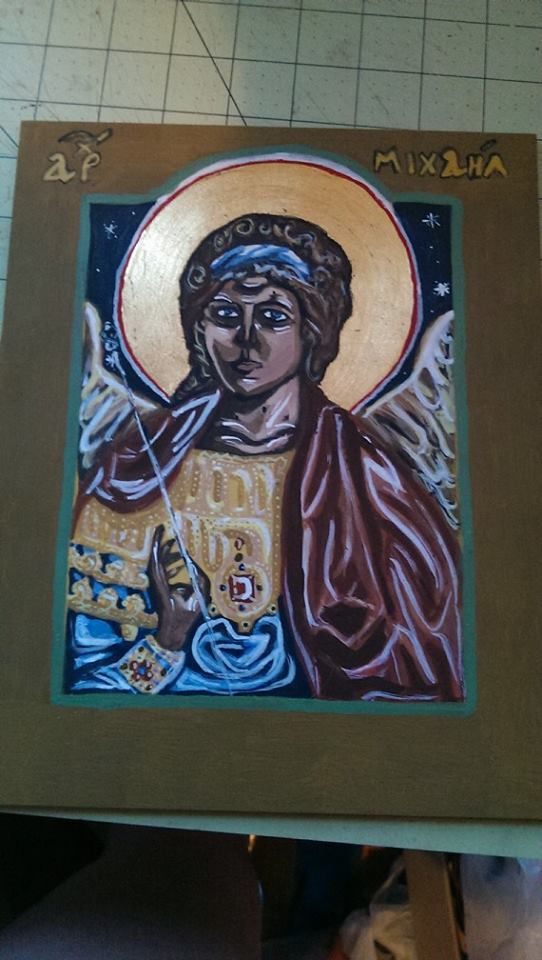
Experiments in Iconography Part IV: Done.
Well, this didn’t come out as well as I had hoped. In fact, it doesn’t look anything really like an “icon” as we know it, but looking at some actual period ones from the empire, most of them weren’t as structured as the ones we see today from the Russian schools are. Which makes feel A BIT better, but meh. An artist is never happy with her work.
However, this was my first ever attempt at ANYTHING like this, my first use of painting from dry pigment, let alone using period materials, so I can’t really be upset with myself. I learned a lot, and I know that if I want to try this again, I have a good foundation of where to start. First things first: work on faces, and get finer brushes. I will include my “next time” notes with my documentation for Artifacts of a Life. Judges always appreciate learning about what you learned. It was a journey and a process.

Experiments in Iconography Part III: Egg Tempera
Here’s some action shots of my last 2 days of work. I have to let it cure overnight, so I can’t put more than a few hours of work in at a time. That and my eyes start going “NO.” And I get impatient.
Egg Tempera is a solution of egg yolk and white wine. I had a heck of a time separating the egg, then puncturing the yolk, but I was able to make the solution with some pinot grigio.

You add this to natural, dry pigments.

Then you start laying down the sankir, or skintone layer, and eventually all of the dark under layers. This is called the roskrish. This is what I got done last night.


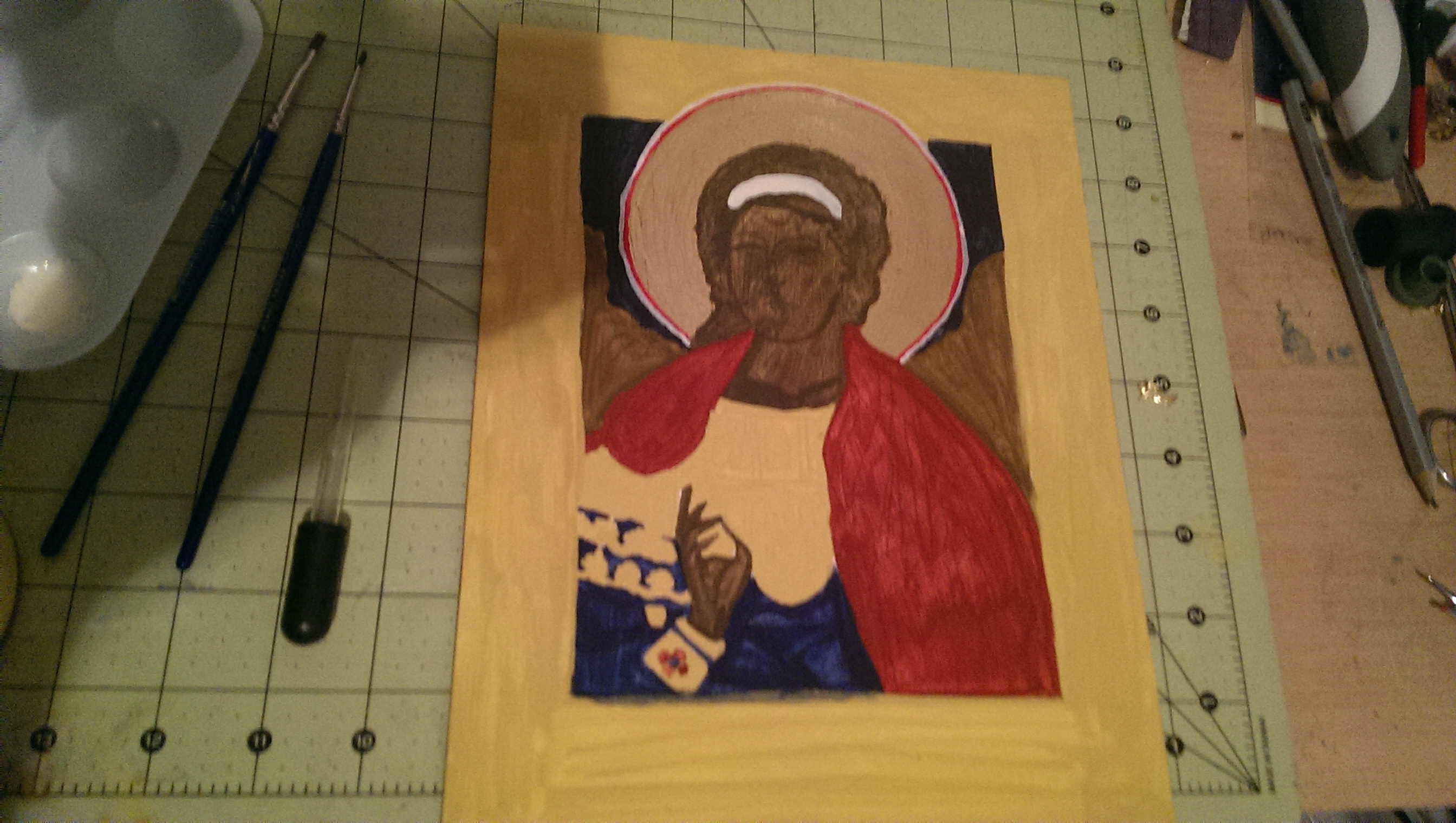
Today I started the highlighting process, and it was uh…interesting at first. It’s a system of layers and building, so I had to step back, think, blend, curse, re-blend, paint, curse, try again, etc. Either way, Michael is starting to get that “illuminated” look that is typical of most icons. I feel I should be finished in the next couple of days. I don’t think I will have time tomorrow as my last class gets out rather late, but Wednesday afternoon I should be able to put a good dent into it.


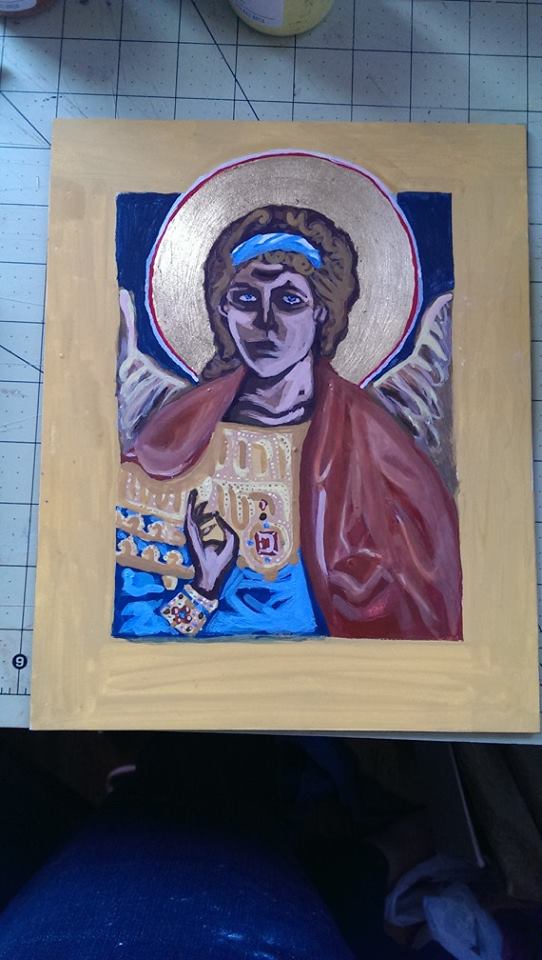
I’m fairly pleased with how it’s coming out so far, and can’t wait to see the finished product now.
Experiments in Iconography part II
I DOOD IT.
Well, so far. I got the gilding down tonight. This makes me insanely happy, since it was probably the part I was most worried about.


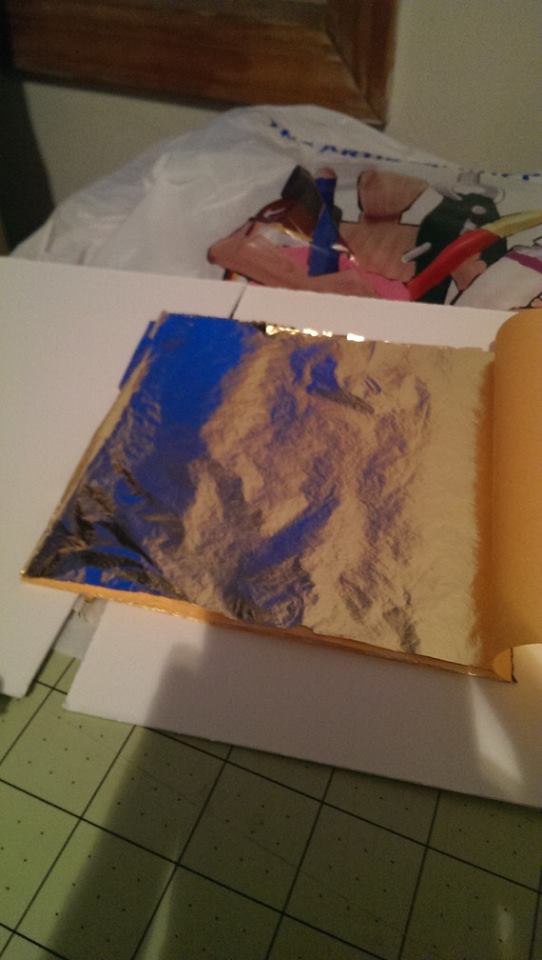
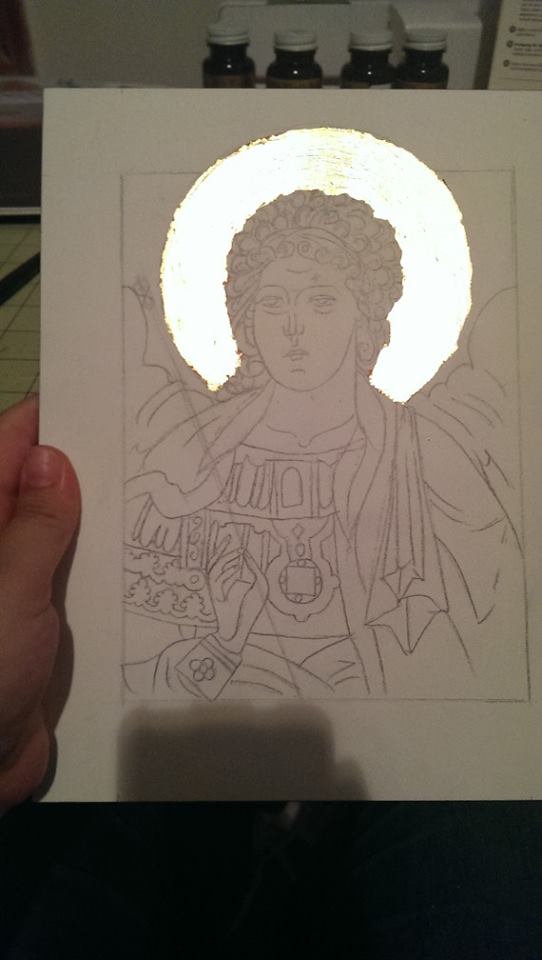
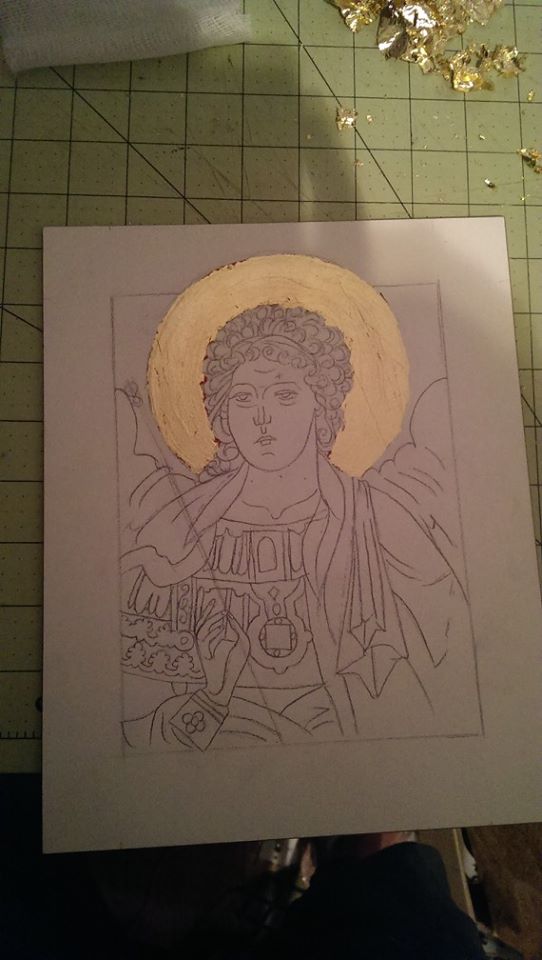
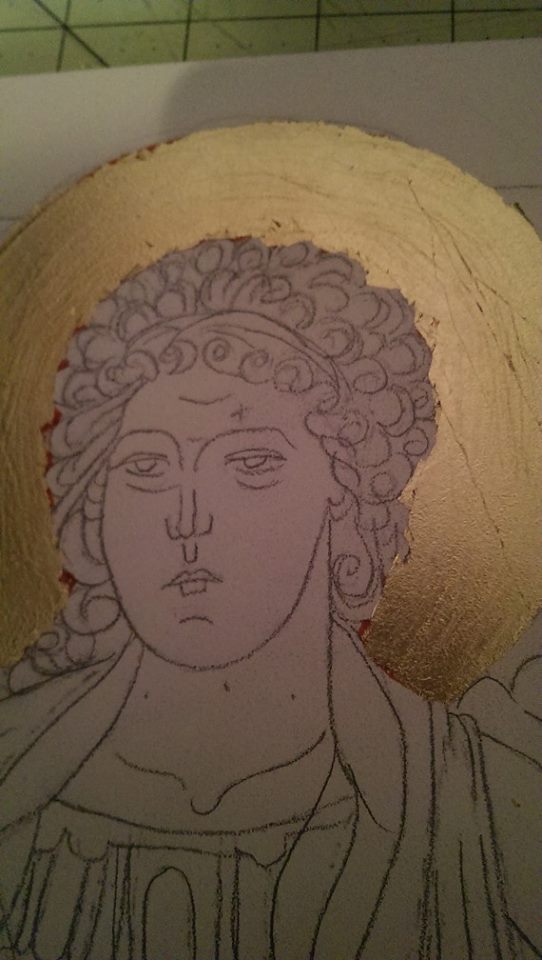
After the pictures were taken, I burnished the leaf, and used a modern sealant that came with the leaf because, well, I’m a rookie, and I’d rather be careful while I learn. So tomorrow I will try mixing the natural pigments into egg tempera, which is going to be the next hurdle.
 Anna's New Rome
You must be logged in to post a comment.