Long Dress Is Long

So I made a bliaut this week.Yep. This happened.

I’m sure readers are wondering why a woman, who is normally focused on the clothing of Rome and Byzantium, is now making Norman garb. Well, for one, I’ve wanted one for a long time. For twos, my persona is half-Norman. My boyfriend is Norman, and the freehold I am apart of is a Norman keep. So…it was only a matter of time before I made Norman garb for myself. My friends in the neighboring barony are being invested as baron and baroness this coming weekend, and they are Saxon. So, what could be funnier than all of their pals showing up as Normans to the party? Our area 12th Night event is also very early 12th century and traditionally a 10 foot rule event, so I needed to make something appropriate for that, also. The only hitch was that I’m 11th Century, 1090s to be exact, so I had to find evidence to support the wearing of this garment in that period. That was relatively easy, as the Bayeux Tapestry clearly shows women wearing snug dresses with droopy sleeves. Tada!

Fig1
Queen Aelfgyva says, “Whatevs.”

I found the spot of evidence I needed from Sarah Doyle’s Page on The Clothing of Norman Women in the Late 11th and Early 12th Centuries. She gives a wealth of sources that made it easy to get an idea of the style I wanted to make, as bliauts can vary quite a bit. I wanted to keep it relatively simple with sleeves a reasonable length such as Aelfgyva’s above, and line then to show contrast as what seemed popular during this period. The only other real issue I had was determining a neckline, and I went with the keyhole rather than the V-Neck. It will be mostly covered by my veil anyway.

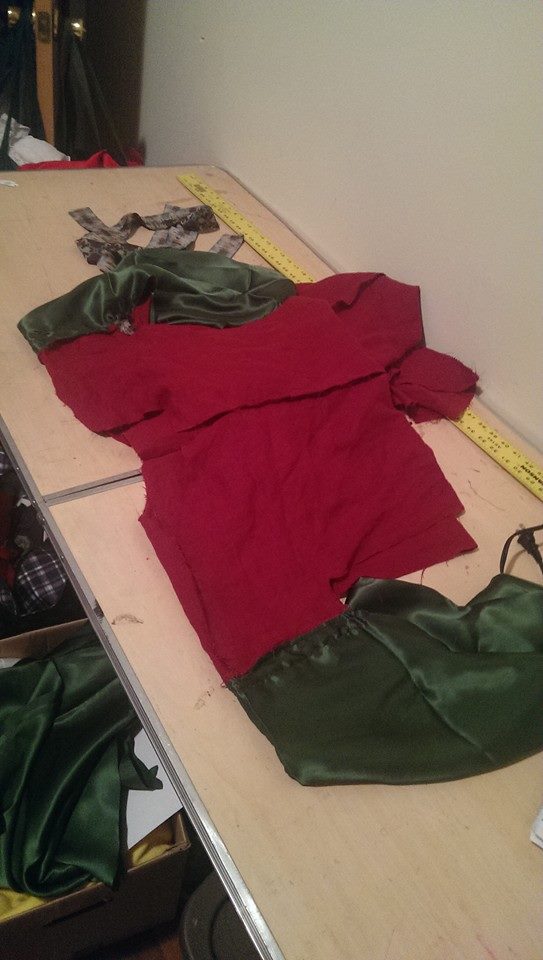
The process didn’t take too long. I made an underdress out of black linen and 4 gores. I threw some trim on the neckline, cuffs and bottom hem. The main gown is made from a deep red linen, that also has 4 gores and cut-out underarms to allow for the easier attaching of the sleeves. The sleeves were really the most tedious part, but still not difficult. Linings don’t scare me, but I ran into some hiccups as far as being able to ensure the hiding of seams but still closing a side seam up after the sleeves were inserted. So I basically had to partially complete the sleeves and then leave about 5-6 inches unsewn so I could attach it to the main body of the dress. Easy enough. Under normal circumstances I would have sewn just the linen together and then finished the green silk lining over the seam by hand, but it was fighting back and some points weren’t matching as well as I planned them too, SO, the silk got machined into the seam and finished with a zig zag. This makes me worry a bit about fraying, but it was the best option given the circumstances, and that I decided to make this 3 days before wearing it. More on that later. Here’s some pictures of the sleeve process.
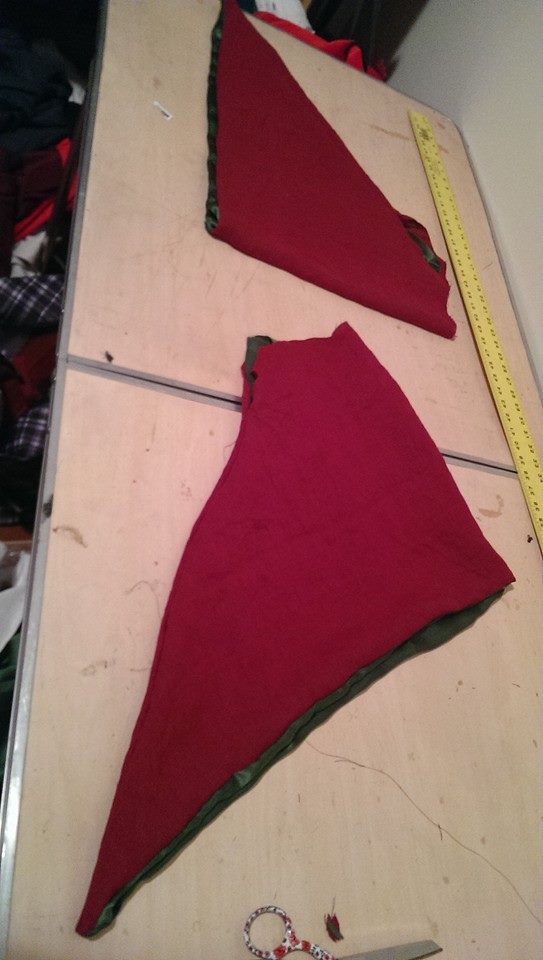
943731_10151832256933143_339060953_n
Before pressing.
1455874_10151834673403143_1733924044_n
After pressing.
1452361_10151835257673143_2056155097_n
Attached to the body. There’s also trim on the outside, which I should have waited to do by hand.

Once the sleeves were on, the dress came together much faster. All I had to do at this point was finish the trim on the neckline, sew on the side gores and then close the sides. The dress itself is a foot longer in the torso than a normal tunic dress, this allows for the ruching look that was desirable during the period. I opted to not lace the side of the dress. This results in some interesting shimmy shimmy shakes to take it off, since I had to take in the sides to make it tight enough.
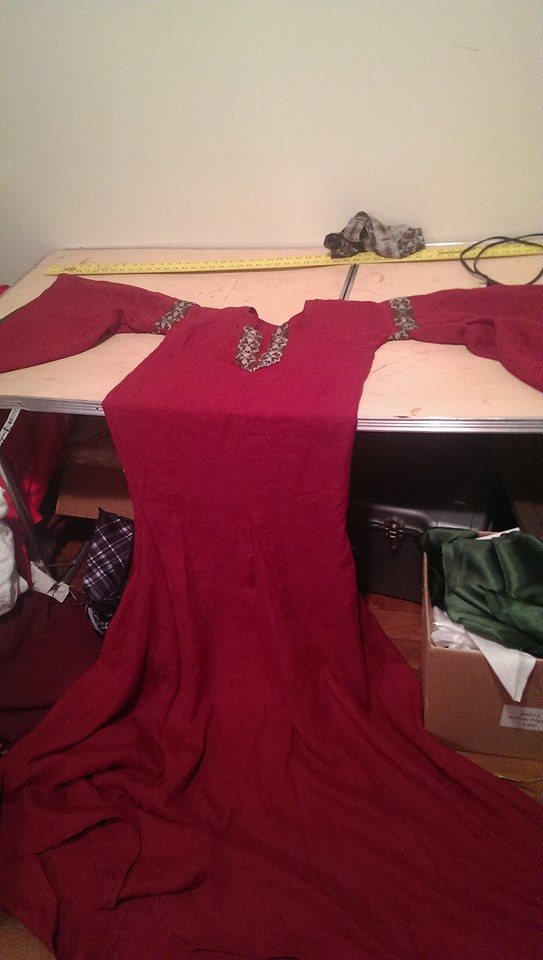
I told you. Long dress is long.
I told you. Long dress is long. This is what it looked like before I shaped the side seams.

And here’s a snapshot of my first test fitting before taking in the sides.
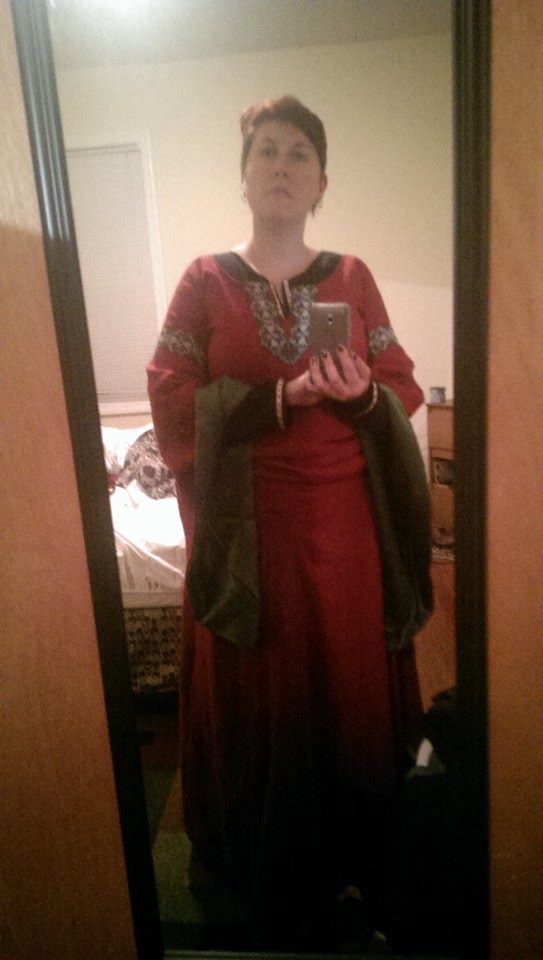
936008_10151835748198143_1029283617_nI pulled in the sides a bit more after this, and made the girdle out of the leftover trim I had. The only REAL mistake I did was attaching the trim on the upper arm before sewing the side seam. This sounded like a great idea at the time, but they don’t match up, which you can kind of see if you’re standing behind me. I expect to hear some crap about that this weekend. So I figure once the event is over, I can go and remove the trim, and replace it by hand so I don’t have that problem. I’m still not sure why my measurements are off.

The only other real “problem?” I’ve lost weight. 8 inches total from my hips alone to be exact from two points, so making a fitted dress earlier in the year was going to be a problem. Chances are if I keep this up, I’m going to have to not just take in more from the sides, but put in the lacings to MAKE it tight enough. This is why I had to wait until last minute to make it. 🙂

Artifacts of a Life. IT’S HERE.

On the discovery of the artifacts:

While on my backpacking across Sicily, I decided to stop at an inn for the night in the city of Syracuse. The inn, which was more of a bed and breakfast by American standards, was in an old annex to an even older house. I’m not one for architecture, but if I had to guess, it was built during the baroque period, with some parts perhaps even earlier, but knowing how homes in the older parts of the world had a tendency to be rebuilt many times, it was difficult to say.

I was the only guest for the evening, and the older couple who ran the establishment put out their nightly assortment of rich Mediterranean pastries and gave me a unique beverage that tasted of honey and vinegar. Not wanting to be rude, I accepted the drink and cookies without question, and joined them at their table. Meeting locals make these journeys more enjoyable, with the exception of course, being the language barrier. My Italian was shaky at best, the same with their English, but I learned that the drink was an ancient recipe, one that would revitalize me after my long day of backpacking through the city.  After some additional language struggles, I did manage to communicate the purpose of my trip.

“I’m studying to be a classical archaeologist, and I enjoy trekking through ancient regions.”

The couple became incredibly excited, and without a beat, asked, in perfect form, “Can you speak Greek?” The conversation officially began.

The couple, named Marco and Maria, claimed they had a fine collection of artifacts they wished for me to look at. They explained that Maria’s family had roots in the Byzantine Empire, and Marco’s had hailed from a town in Thrace. They had sought refuge in Italy when the Ottoman Empire sacked Constantinople in 1453, bringing only what they could carry. I was intrigued, and yet somewhat unsure if these older Sicilians were simply trying to pull a joke on me. One can never be too cautious when traveling alone. Reluctantly, I agreed to view their so-called collection.­­

Maria took my hand gently, and we followed her husband into a parlor, where he slid several modern cedar chests into the floor. I wasn’t entirely sure what I was expecting, but I do know that when they were opened, I nearly stumbled back. These weren’t just any artifacts; these were museum-quality heirlooms that spanned generations. Jewelry, silks, pearls, Bibles, manuscripts, this was an unbelievable haul of personal, priceless treasures that had been preserved lovingly to protect a lost cultural identity.

Maria reached into one of the chests, and removed a few items that were gingerly wrapped in stained ancient silk. She placed them out before me: A mosaic with a dolphin on it, a necklace of gold, garnets and pearls, and an Orthodox icon of the Archangel Michael. I sat and blinked. These were not the typical goods of a poor, refugee family.

“My grandmother told me as a young woman that these are the oldest.” Maria began, “From before the Crusades. Her name was Anna, and she was part of the imperial family in Constantinople.”

I knelt down to get a closer look, and she lifted the necklace for me to see. “I was told that when my ancestors fled the city after it had been destroyed by the Turks, they had to save what they could from the old homes and graves. Looting had already begun by the infidels, so they had to hurry. The necklace they were able to save from Anna’s grave. The icon was in the family crypt, and the tile was once part of a large floor in the palace apartment that Anna was said to have lived in. Dolphins are a symbol of our family, you see, and also the old symbol of Syracuse before the times of Rome. My family goes back before the times of Alexander.”

I was unsure of the provenance of anything, but I promised Maria that if she would let me take pictures, I could bring them home and do research, then send her all the information. She agreed, and then I proceeded to go through the rest of their impressive collection. I turned in for the night as my mind reeled on what it would have been like to have been the last of the Byzantines, fleeing with what bits and pieces I could from the crumbling remains of the once glistening empire.

The next morning, as I prepared to leave for my journey, Maria and Marco saw me off with a small package of leftover pastry and a cup of strong Italian coffee…and a small box with the artifacts of the life of Anna, Maria’s eleventh century ancestor. Despite my protests, she urged that I keep them as a gift. She had no daughters of her own to pass them on, and this way I could study them, and perhaps place them in a museum for the rest of future generations to enjoy. The final parting gift was a small bottle of vinegary smelling syrup. Marco told me this was called oxymel, the beverage they had served me when I arrived, it was to be diluted in water, and used just as the Romans and Byzantines did centuries ago.

I placed the goodies into my already-full backpack, but allowed myself to take on the additional burden for these people who had allowed me, a stranger, into their home and hearts for nothing more than a night.

I present for you these artifacts today.

Sincerely,

Angela L. Costello
University of Rhode Island