I need to confess that I name my nice garb. I do. If it hangs up in the closet and doesn’t get balled up and thrown in a tub for camping season, it has a name.
For example, my heavily pearled gold delmatikion is my Dalek Dress. I didn’t name it that, but it stuck, and I certainly did want to exterminate all the things by the time I was finished beading it the first time around. My Turkish fencing coat is the Portuguese Whirling Dervish, because of the colors, and my Buccaneers-inspired Elizabethan from last Birka is the Traffic Cone. My burgundy bliaut is the Norman Longdress, because long dress is long. Much like the longcat of internet yore.
Longcat is Long.
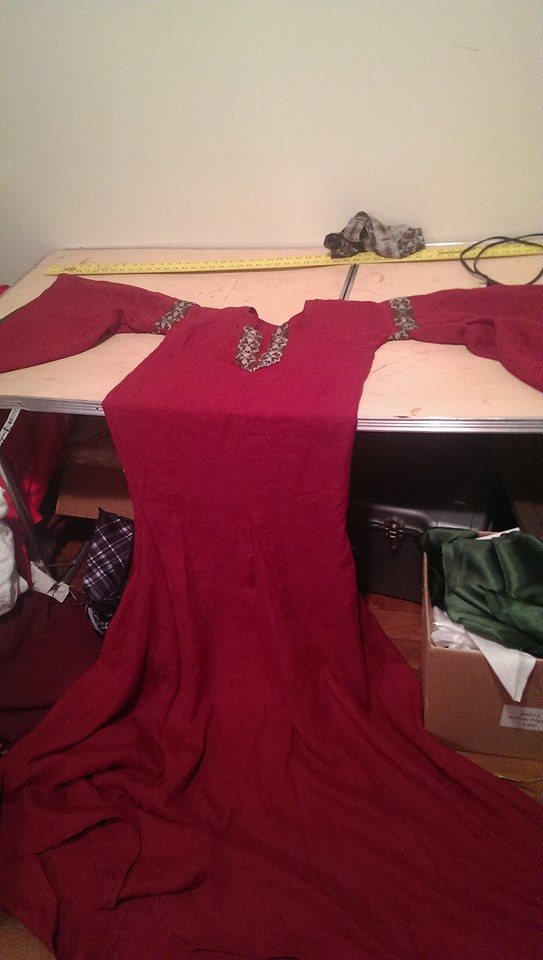
I didn’t fix it last year after I wore it to Smoking Rocks Baronial Investiture, and it’s been sitting in my closet since. Not that anything was terribly wrong with it, but I didn’t have a lacing up one side to create the ruching effect that Norman women found ever-so-sexy. So I simply made the dress tighter, and hoped for the best. It worked, but not that well.
Since the local 12th Night event that I attend in the Barony of Smoking Rocks is usually 11th Century Norman and/or Saxon, I figured that’s where I would get the most bang for my buck with this floor dragger. I didn’t wear it last year since we did a murder mystery in which Anna as a Byzantine needed to be present, so this year, I FINALLY get to wear it again. Time to get the lacings in.
Fortunately for myself, I had some sort of plan when I sewed the thing, and left the side seams unfinished so I could pop one for the lacings. This made me more happy that it probably should have. So I split the right side of the dress from the upper arm to the hip, hemmed it, and got to play with my machine’s buttonhole function 41 times. In theory and practice, yes, I should be doing eyelets by hand, but I assure you all that my machine does a way better job than I can do, and in a quarter of the time. Cheating? Yeah, probably. Utilitarian? Very yes.
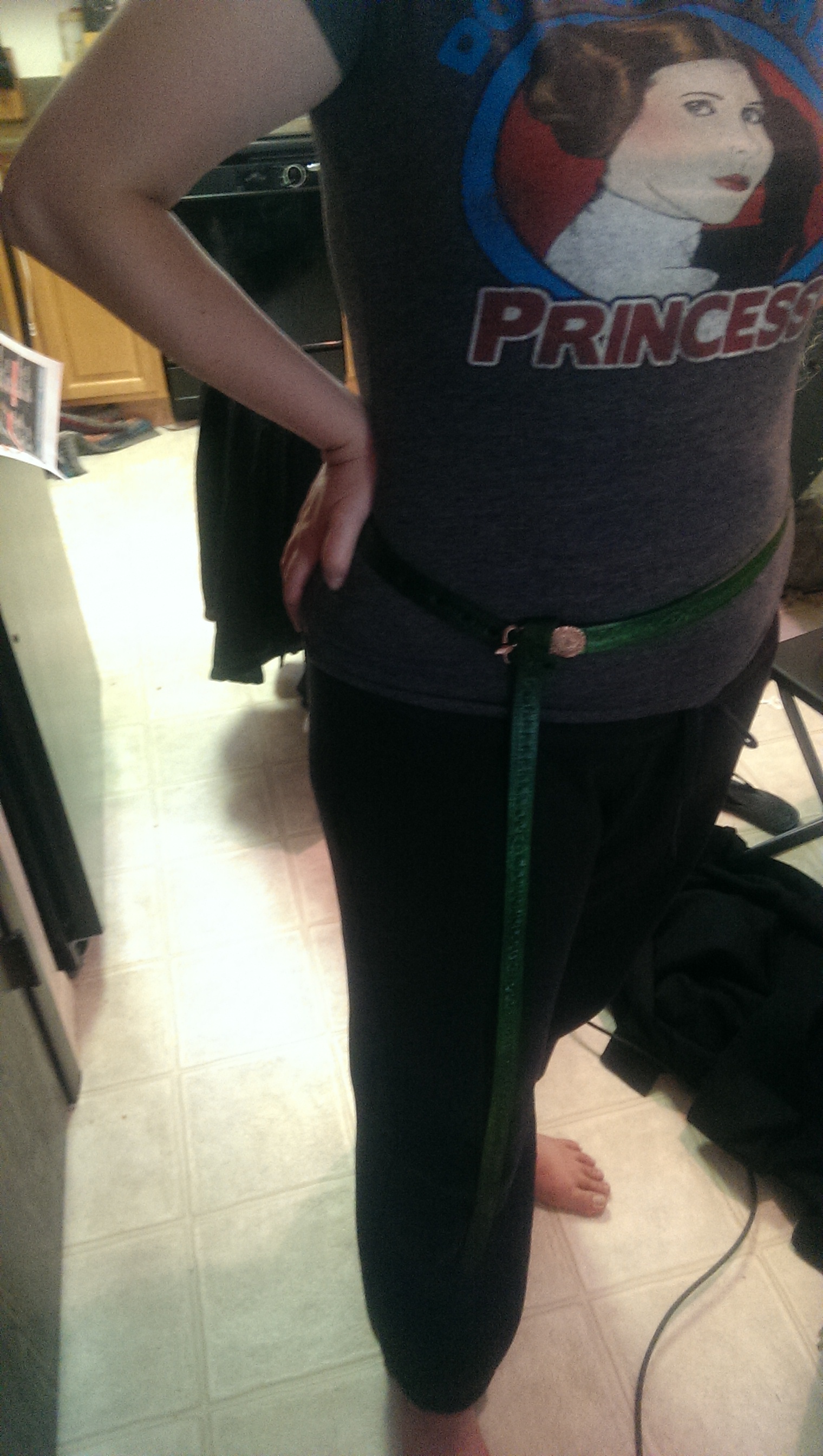
So here’s the first look, before I put on the girdle. You can see how the lacing (spiraled, I should mention that) draws up the length of the dress to create the desired wrinkles. The “I’m so important I can afford extra fabric to just wrinkle around mah belly” look.
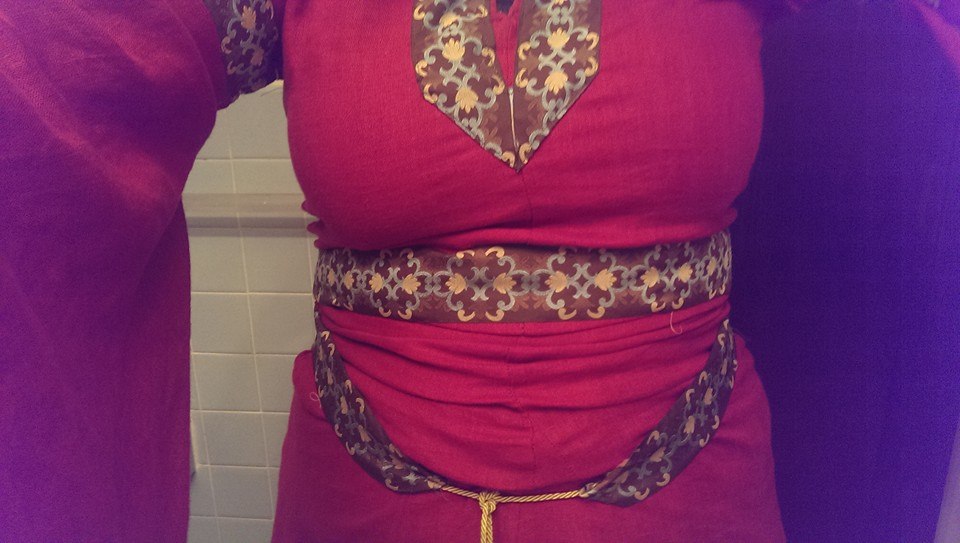
And here’s with the girdle, which after doing the requisite dancing around the house, is necessary. The design is not only decorative, but it holds the ruching in place in the front. Otherwise, you’re going to walk on your dress and faceplant. I wonder how many Norman women fell down the stairs before they figured this one out.
My husband didn’t even pull it as tight as it could go. I wonder if we really yanked it around my chest if it would draw up the fabric more. The torso is approximately a foot longer than my own to allow for this extra gathering. My underdress is tailored normally. Each have 4 gores instead of just on the sides to allow for very full skirting. It is HEAVY, and when I spin around I feel like a princess, and then try not to fall.
I do think that the bliaut itself would be far more beneficial in wool than linen. I can’t afford that much dress-weight wool right now, but the stretching and conforming to a shape with body heat versus the less pliability of linen would make a HUGE difference. So those reading this post to get ideas, I would recommend that if you can swing it. If not, linen is a perfectly fine choice.
I’m hoping to finally get REAL pictures of me in this dress next to my Lord in his Norman. So we’re finally in the same time period at the same time. Once I eventually make him real Byzantine on par with my own instead of the one tunic he occasionally wears when I order him to, we can have a set of good photos for things such as holiday cards, and gifts for our families who think us terribly weird. 😀
My lord had to go do Navy things for a few months, so when I should have been studying for school, I sewed things.
I also found out that Santa Claus can read heraldry! You see, we stayed home for the holidays this year when both of us usually travel, sometimes in opposite directions to keep both families happy, so we had no decorations. None. Zip. So I was shopping for the necessary trimmings, and found that they’re all way too expensive and I didn’t like them all anyway. So I went to Joann’s, dropped $60 in supplies, and went to work.
Here’s our heraldically (is word?) influenced tree skirt, hand appliqued, lined in horrible plaid with fringy fringe that was more of a pain in the butt than it probably should have been:
And our heraldically correct stockings, you know, instead of writing our names in puffy paint:
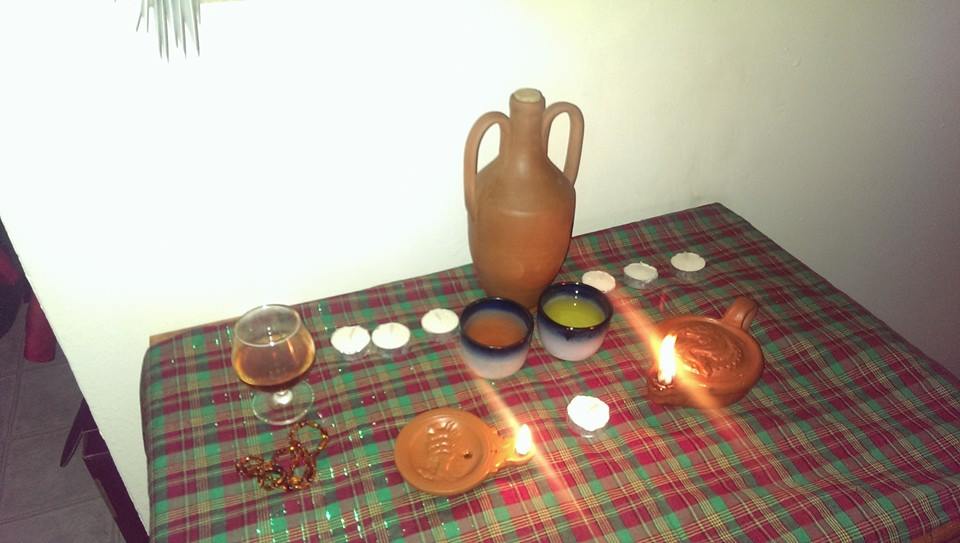
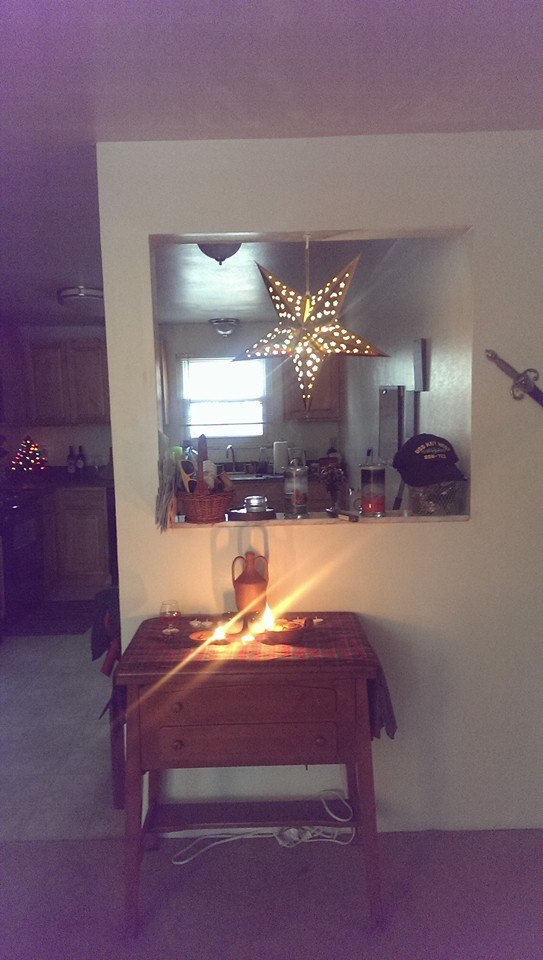
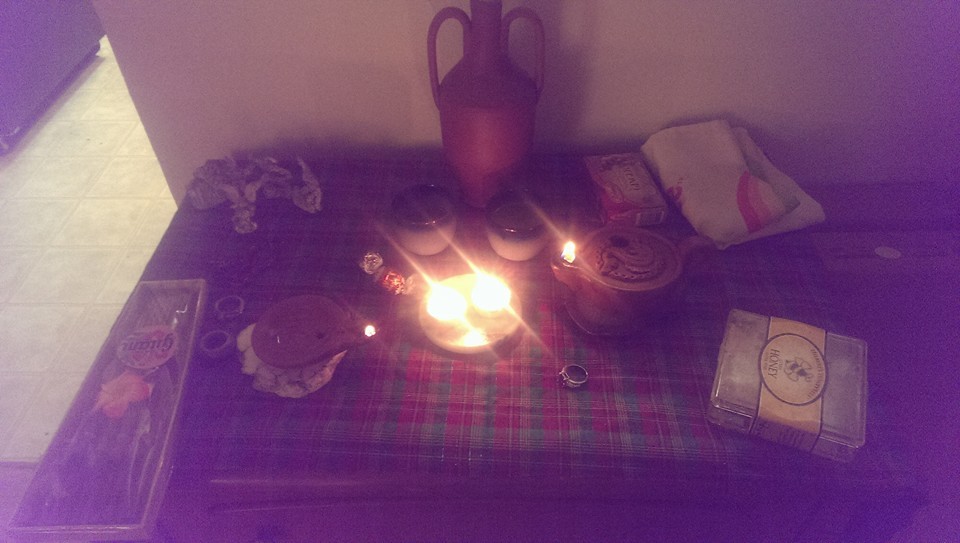
But modern Christmas is not terribly period ,but it sure is pretty. So, I decided to try Saturnalia from the 17th-23rd of December for the first time this year, and we definitely had fun! We set up a household altar with Roman goodies: an amphora, a cup of wine and a cup of olive oil, lamps, and I had a tea light for each night of the festival (how, uh, syncretic of me.) Each day the lord and I would make an “offering” to Saturn in the ways of whatever we had around. This varied from my actual Roman artifact rings, to a cheap rhinestone ring, amber necklace, chunk of shortbread, coffee, and Geoffrey’s Dungeons and Dragons Elementals. I am not even kidding.
The First Day of Saturnalia.The star lamp would have been very appealing to the Romans, who were fond of gilding all the things with gold suns and stars for the festival. I kept it lit the entire 7 days.The last night of the festival with all the goodies we offered! Rainbow Brite pillowcase from the 80s and chopsticks my husband brought me home from Guam. Why not?! I was burning some extra candles since we weren’t home for a couple of nights.The magnet on my car. Complete with some New Hampshire December ice and grime.
It was all in the spirit of the season, and trying to feel as the Romans would have felt. Every holiday in December has one thing in common: The solstice and the return of light at the darkest part of the year. So I’m a big fan of setting things on fire or putting a mere 1500 lights on my balcony and 400 lights on my tree.
And lawn flamingos. Nothing screams winter like pink plastic.
Most of all, we had FUN. I hope everyone else had fun with the holidays this week, also!
Felicem Dies Natalis Sol Invicti!
Καλά Χριστούγεννα!
Or as my friends say, “Happy Lights!”
I hope everyone has a Happy New Year, and I’ll catch you all on the flip side with some neat info on Byzantine outerwear, and the upcoming garb challenge at Birka!
I made a new Propoloma tonight for an upcoming A&S display here in the East. If you don’t know what I’m talking about, please see this informative earlier post.
Basically, I had a 60% off coupon for Joann’s, and decided I needed to spend money immediately, so I went in, paid less than $10 for 2 yards of white wool felt, and ran out giggling. I put on my car, and Alien Ant Farm’s cover of “Smooth Criminal” was on the radio. This is, ironically, how I got my persona name from an ex-boyfriend.
“Annie are you okay?”
NO! I’m about to make a funny looking hat!
So, for fast reference, here we have Irene Gabras to inspire my Flying Nunnery:
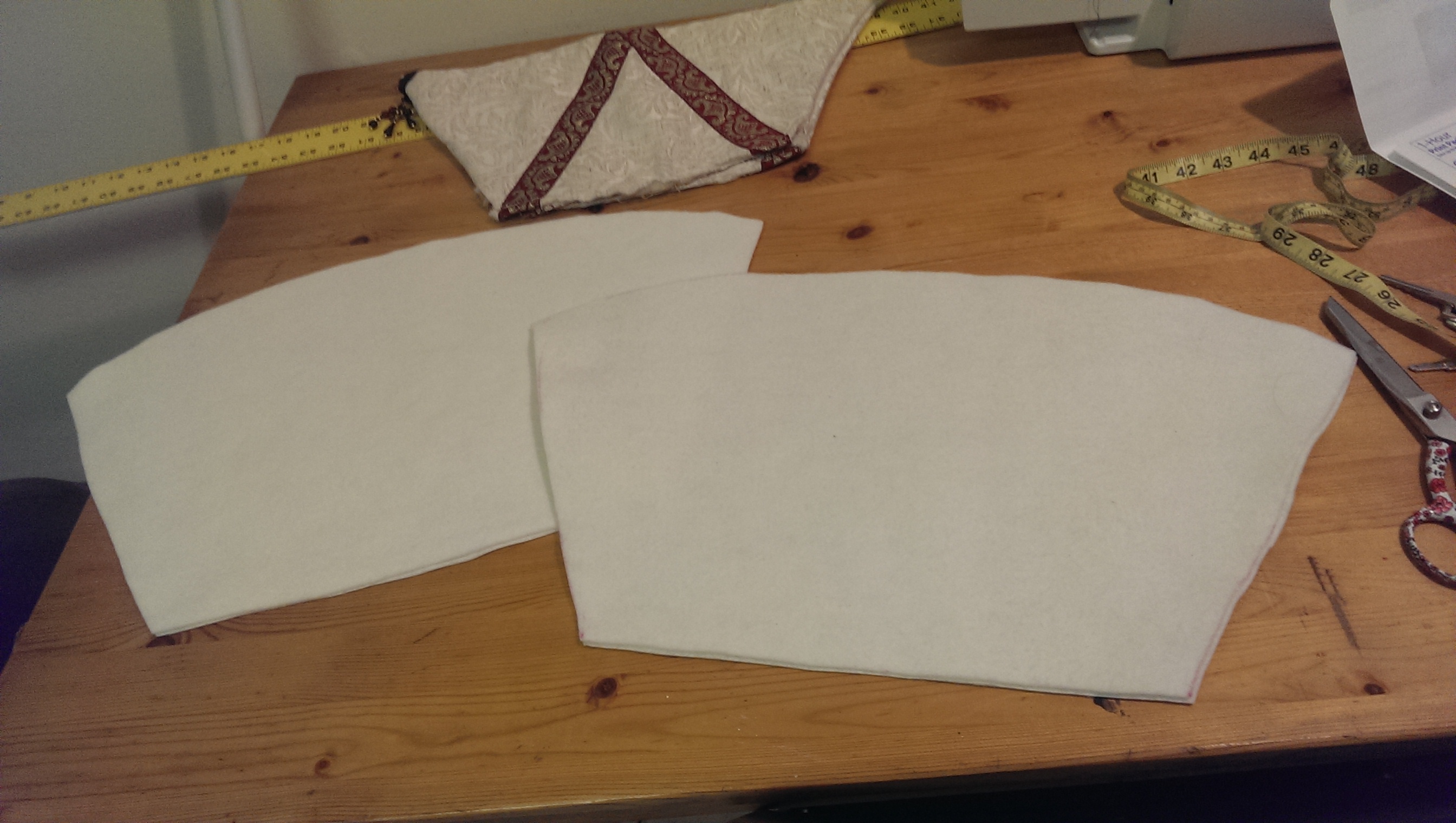
So, first, I cut the wool using my first version of the hat as a guide. I needed it bigger and rounder. I cut four pieces total, as I wanted a lining and a shell. I figured this would be full bodied enough to stand on its own without using buckram or other modern stiffening materials.
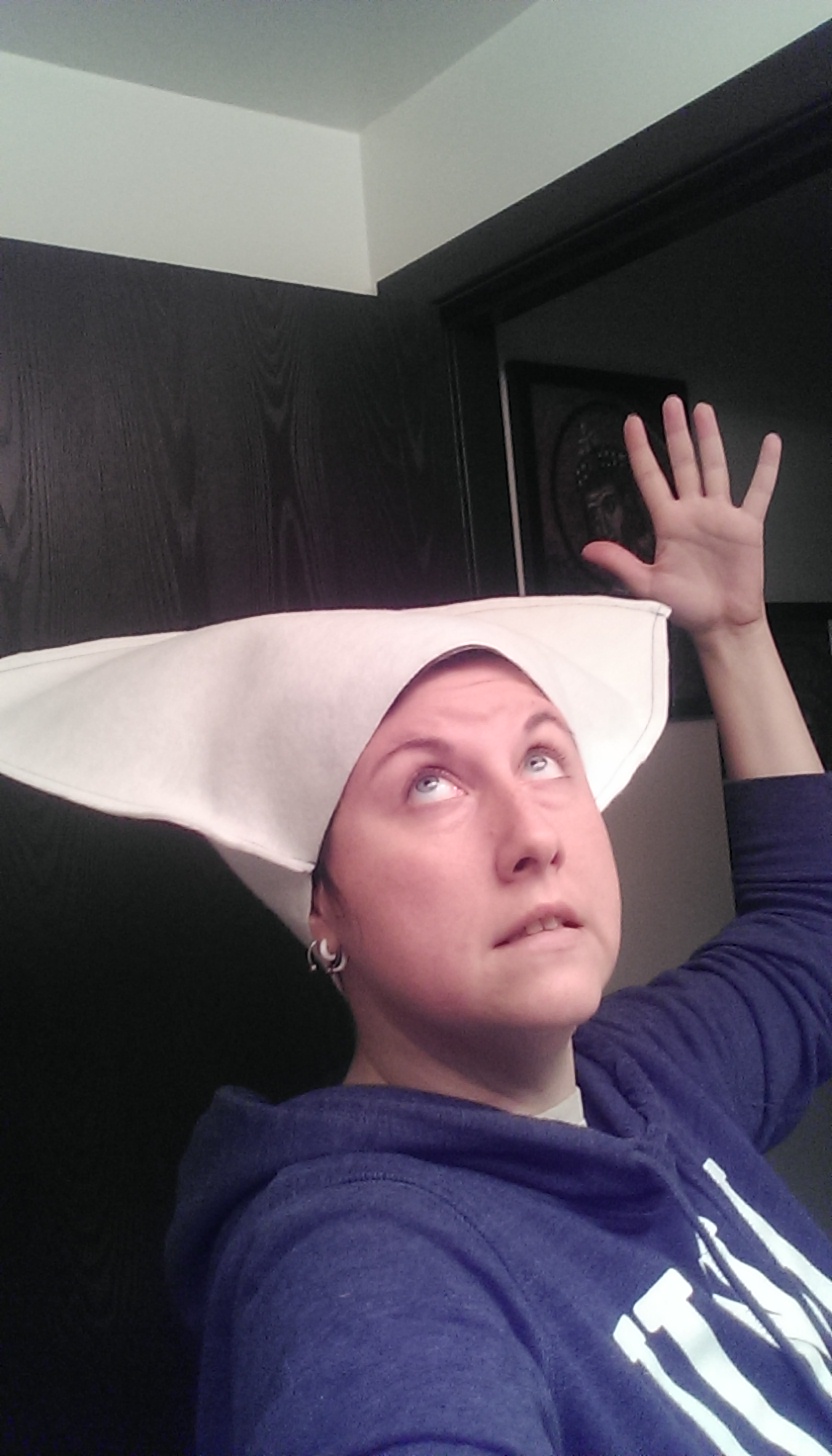
After that, I sewed the lining together, and tried it on.
Holy amazeballs, it’s Sally Field!
This, of course, resulted in all sorts of funny name calling on Facebook, which both amuses me and aggravates me at the same time. On one hand, I posted it, I deserve the jokes and I know my friends are jerks. It’s a thing. On the other hand, I am introducing this hat and style of dress to the SCA, and I’m met with joking. Way to make me want to actually wear it, guys. Not that I should ever expect constructive comments of any kind on a social network that devotes more time to political party bashing than…oh wait, that’s perfectly Byzantine. *Ahem* MOVING ON.
I used some silk remnants I had to make the stripey bit. I’m not good at this part. Irons and I don’t get along.
Meh, good enough.
Then I began to apply it to the shell, using the painting of Irene Gabras as a guide.
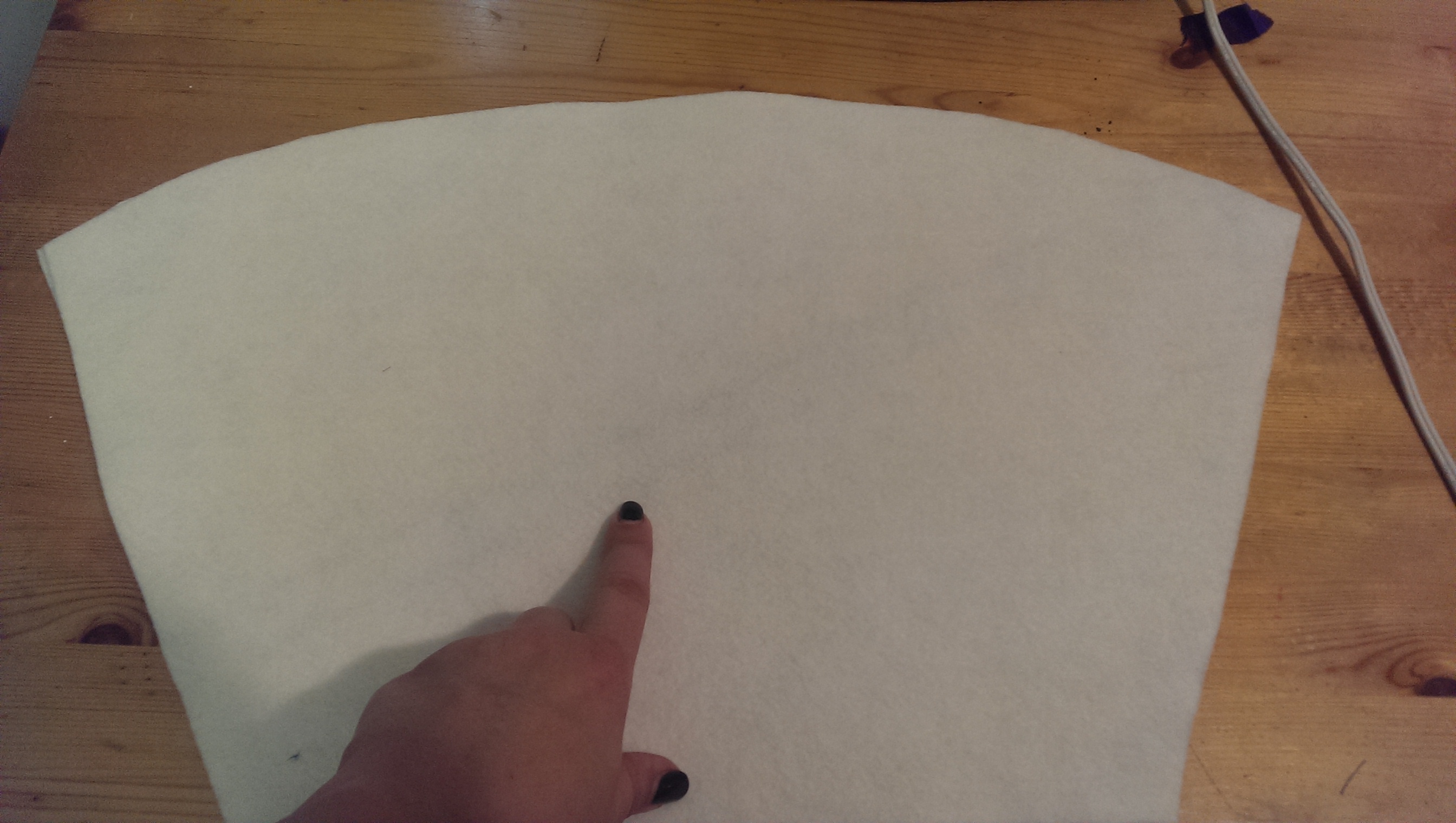
After sewing it down, I did the same for the other side, opposite directions so the ends would meet. I was able to barely see the stitches through the wool, so that made a nice guide.
Once both sides were sewn down, I went back and added a little bling with gold thread. I had considered using some of my embroidery stitches for more shiny, but I decided in the end that I need to 1: Lay off my embroidery stitches and start doing more hand work, 2: this is a statement hat in its own. It will speak for itself, and 3: I didn’t want to be presumptuous in persona.
Once the silk was sewn down, I finished the sides of the hat, and turned it right side out, and then made sure it was still equal to the lining.
Then I put the lining inside of the shell, and immediately felt like Rita Repulsa from the original Power Rangers series:
By this point, I was being compared to Yoda on Facebook, but I didn’t care. I was ready to wrap this up. A little whip stitchin’s for the opening:
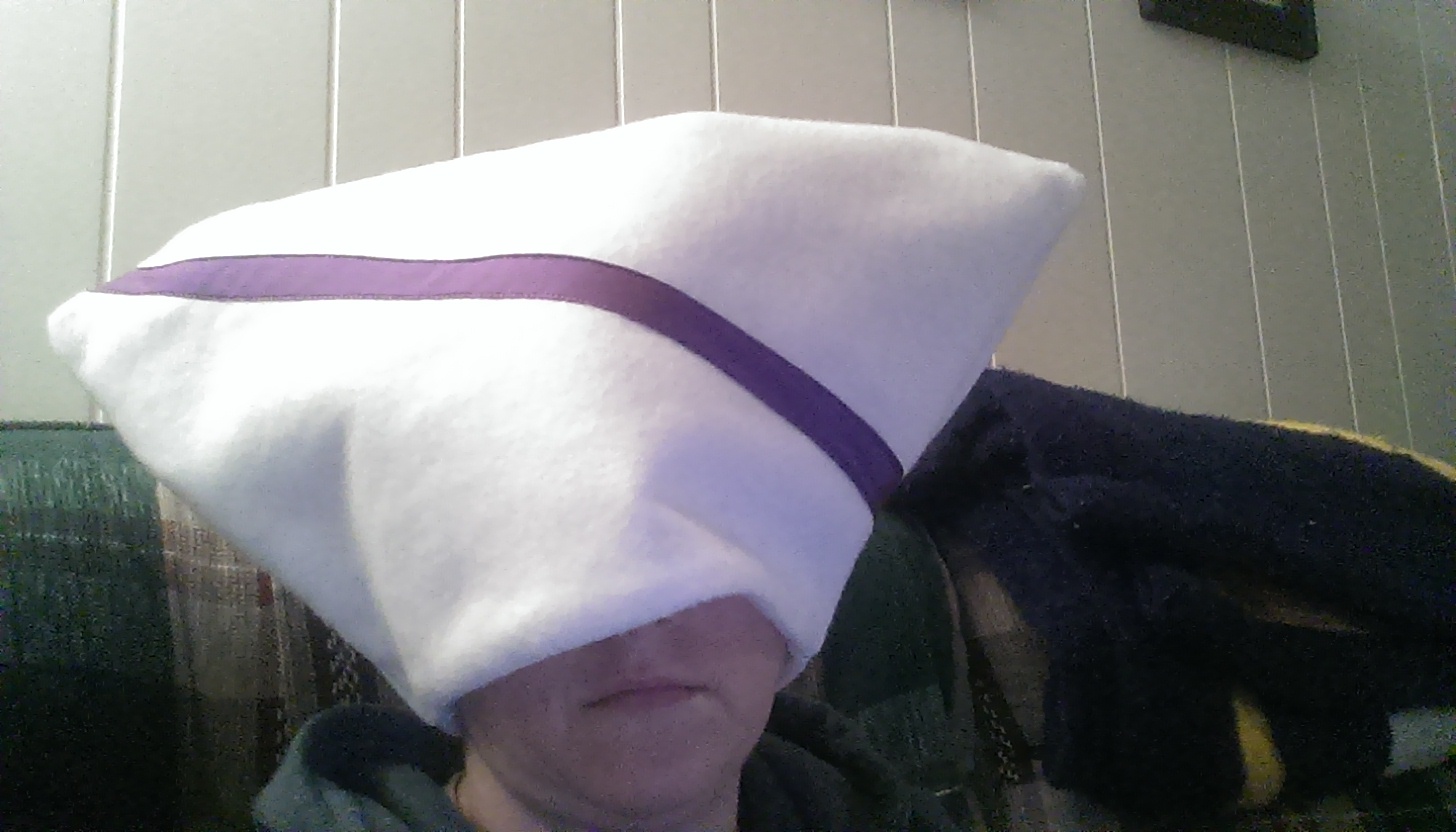
And Voi—-uh. Hmm…
But that’s okay, I have a notoriously small head, and I did it on purpose for veils and nets and such. So, naturally, I had to go play dress-up.
VOILA! ANNA ZOSTE PATRIKIA!
Putting the kohl on my eyes really makes it, I think, I mean, I practically just wrapped myself up in fabric like a Glamour Shot. :3 it also shut up the peanut gallery. Context is everything!
As you can see, the 2 layers of wool felt gives the hat enough body to stay up on it’s own, and it’s also nice and toasty, because I live in New Hampshire, where we are known best for our tropical winters.
Here’s a comparative shot of my first hat and my new one. What an improvement!
The Propoloma: A headdress of the Zoste Patrikia and other high ranking women in the courts of Eastern Rome
Kyria Anna Dokeianina Syrakousina, OM, OBT
One of the more difficult aspects of studying Eastern Roman dress for the SCA is locating suitable headwear outside of the typical veil and circlet that seems common place, and easily mimicked from iconographic depictions of female saints, and especially the Virgin Mary. I have just started to scratch the surface of ceremonial Roman dress, but so far I have been able to uncover some rather unique pieces that may begin to open the door into more complex appearances for Eastern Roman personae to try.
The zoste patrikia was a title held by the chief attendant or lady in waiting to the Eastern Roman Empress. It literally translates to “girded-lady patrician” but is often translated into English as “Mistress of the Robes.” It appears to have been given only to extremely high ranking ladies in direct service to the empress.[1] She was not only the head retainer for the empress, but also the head of the court of ladies, the wives of other high ranking patrician men in the court of Byzantium.[2]
As was tradition with the Eastern Romans, ceremony heavily accompanied any augmentation in rank, and with ceremony, came elaborate new costume. Ioannis Spatharakis, in his monograph, The Portrait in Byzantine Illuminated Manuscripts, gives a detailed footnote of the ceremony, as described by Constantine Porphyrogénnētos in De Cerimoniis in Latin, while explaining the details of a manuscript depicting the installation of Anicia Juliana as patrician:
“In the church of the Theotocos of Pharos she received from the despotes a delmatikion [dalmatica], a thorakion [ecclesiastical pallium, similar to a chasuble], and a white maphorion [hooded veil]. In the Pantheon, wearing the thorakion and the delmatikion and carrying the loros [heavy gold wrap] and the propoloma [trapezoid hat], she received from the enthroned emperors the kodikellia [codex], which were later blessed by the patriarch. Because she was wearing the loros and the propoloma, she was not able to prostrate and kiss the feet of the despotai, as she did when she received her costume, but she bent slightly and kissed their knees.” [3] (The available text of De Cerimoniis is only in Latin or Greek. I did my best to translate the footnote and verify it with the original 1830 publication.)
This article will focus on the design of and wearing of the propoloma. This particular style of the hat is described as being in use as early as the 10th Century, but appeared to have had its heyday during the 11th and 12th Centuries, which allows it to fit perfectly into my persona. It appears to have taken the shape of a trapezoid, or upside down cone sewn shut on all but one side for the head. It may have been covered in silk, and then decorated in a variety of ways.[4]
Anna Radene wearing the propoloma during her occupation of zoste patrikia in 1070, image courtesy of 1186-583.org.Possibly Irene Gabras, wife of St. Theodore Gabras. Who did not serve as zoste patrikia. Image courtesy of 1186-583.org.
Dawson seems to have done most of the legwork on this hat, as there is not an English translation of De Ceremoniis available to do primary source research from Constantine’s perspective. He discusses that although the hats were usually white, it appears that in one manuscript, purple ones were seen. This may indicate that these women may have been members of the extended royal family.[6] He also brings into account on his Levantia website that the padded headroll seen in earlier artwork, including the Ravenna mosaics, may have been the predecessor to the trapezoid propoloma.[7] So for those who have an earlier period persona, we simply need to take a look at the bust of Anicia Juliana to get a glimpse at the earlier hat style.
(Photos taken by me at the Metropolitan Museum of Art in March of 2014.)
Anicia was born in 462, which puts her occupation of zoste patrikia during the reign of Anastasius I, two reigns prior to Justinian I. So it is arguable that her attire could be considered that of late Antiquity of the very late Roman Empire, rather than “Byzantine” in nature. However, a similar style was worn by Theodora’s court in the mosaics at Ravenna:
The first thing I noticed immediately on this particular bust was not the layered look at the top, but the gathering in the back at the base of the skull. This reminded me immediately of the Cap of St. Birgitta, a style that was popular in the 14th century:
The original cap.When worn.
Naturally, there is no reason why this cap could not be older in origin, and this marble bust may just show a similar cap being in use as early as the 5th century. At least for the over cap, the under cap is a bit more perplexing, especially with the pucker going on at the top of the head. It is highly unlikely that is a hair part, considering the detail given to the rest of the statue, in addition to the same look of the layered “turbans” on the mosaic, so my belief is that it was two separate pieces, but how they created that gather on the top is still a mystery to me. It is something I do plan on exploring later to help those with early period personae.
But how does a re-creator or reenactor transfer the wearing of this type of hat into their hobby? Well for one, this is a hat of station and rank. In the SCA, some kingdoms have sumptuary laws, the East Kingdom, where I reside, does not. However, I like to take into account the “what would my persona do?” clause when it comes to my clothing choices. My persona is well-developed, but not everybody else’s is, nor should they have to be. It is absolutely a personal choice on how much thought you want to put into your persona, and what you want them to wear. In the case of portraying a persona from a culture that has strong sumptuary laws, such as the Eastern Roman Empire, and especially if you reside in a kingdom that has laws about what one can wear on their head regarding their own rank, this is when the re-creator needs to take into account what he or she wants to wear, or should be wearing, for the holder of their awards.
In the case of the propoloma, I would recommend that nobody holding anything less than an Award of Arms wear this hat. A woman who would have received this hat would have already been of high patrician rank, and even though the title of lady may or may not convey this, it would be unfair to say that only peers or grant holders/court baronesses would be permitted to wear it as well as far as the game we play goes. I made my first one from looking at the Tom Tierney coloring books, which have proven to be rather inaccurate the more that my studies continue before understanding that it was a hat of rank. However, I feel that it would make an excellent choice for something akin to a cap of maintenance for a Pelican, or wreath for a Laurel, as the SCA simply does not hold a candle to the intense pomp of Eastern Roman ceremony. But by bringing pieces of these ceremonies into the SCA, bit by bit, we can help enrich our game even more, and introduce others to a new and exciting part of Roman culture they may have never otherwise known about.
[1] Alexander Kazhdan, The Oxford Dictionary of Byzantium, (New York: Oxford 1991), 2231.
[2] Lynda Garland, Byzantine Empresses:Women and Power in Byzantium, AD 527-1204, (Abington: Routledge 1999), 5, 245, 264.
[3] Ioannis Spatharakis, “The Portrait in Byzantine Illuminated Manuscripts”, Byzantina Neerlandica 6, (1976): 145.
[4] Timothy Dawson, “Women’s Dress in Byzantium” in Byzantine Women: Varieties of Experience 800-1200. Ed. Lynda Garland (London: Ashgate, 2006), 47. Dawson cites De Cerimoniis by Constantine Porphyrogénnētos, the 1837 Latin edition, which I am currently translating into English.
[7] “A Woman of the High Aristocracy,” Timothy Dawson, accessed August 13, 2014, http://www.levantia.com.au/clothing/zoste.html. Also gives his interpretation of what a complete outfit may have looked like.
In between sewing way too much, and horrifying Pre-Pennsic Panic (tears, there are tears. I know I’m not the only one.) I’ve made a couple things that have been totally new to me, and therefore I feel the need to share them with people looking for Roman and Byzantine stuff here, that aren’t going to find it in this post. (Sorry.) However, I do hope you find inspiration for working outside of your comfort zone and exploring new projects.
First thing: I made a belt. Seriously! I have an apprentice sash I made from faux silk and fancy stitches, but I can’t wear that all the time, so I needed a sturdier leather belt for times I need to carry a pouch or bum around not in Byzantine. This was an adventure. My husband has leather working experience, and I figured he would just do it for me. NOPE. He made me do it while fielding a tapestry of profanity so thick it’s probably seen as smog over the Boston area. Here are some pics of my experience.
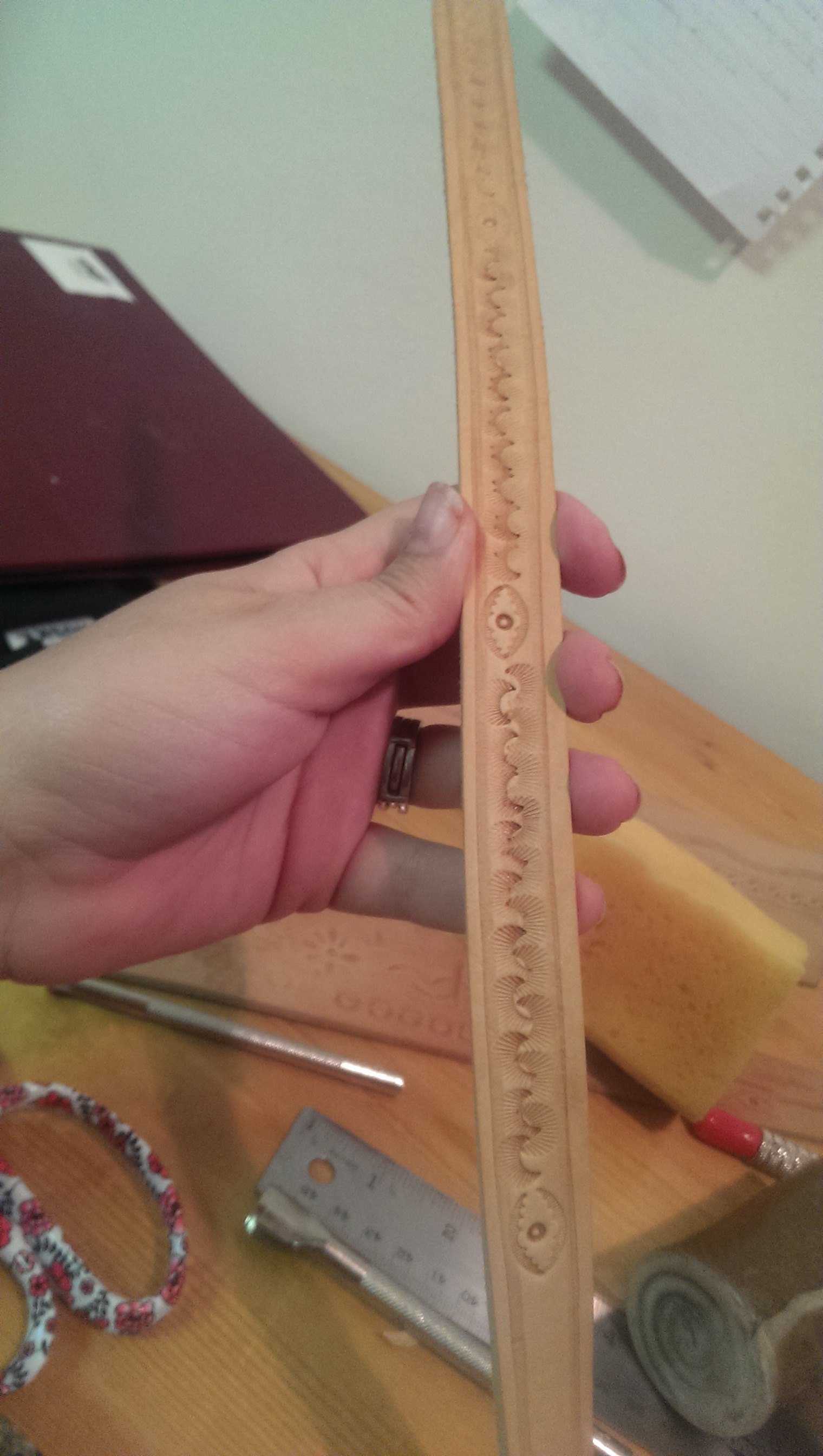
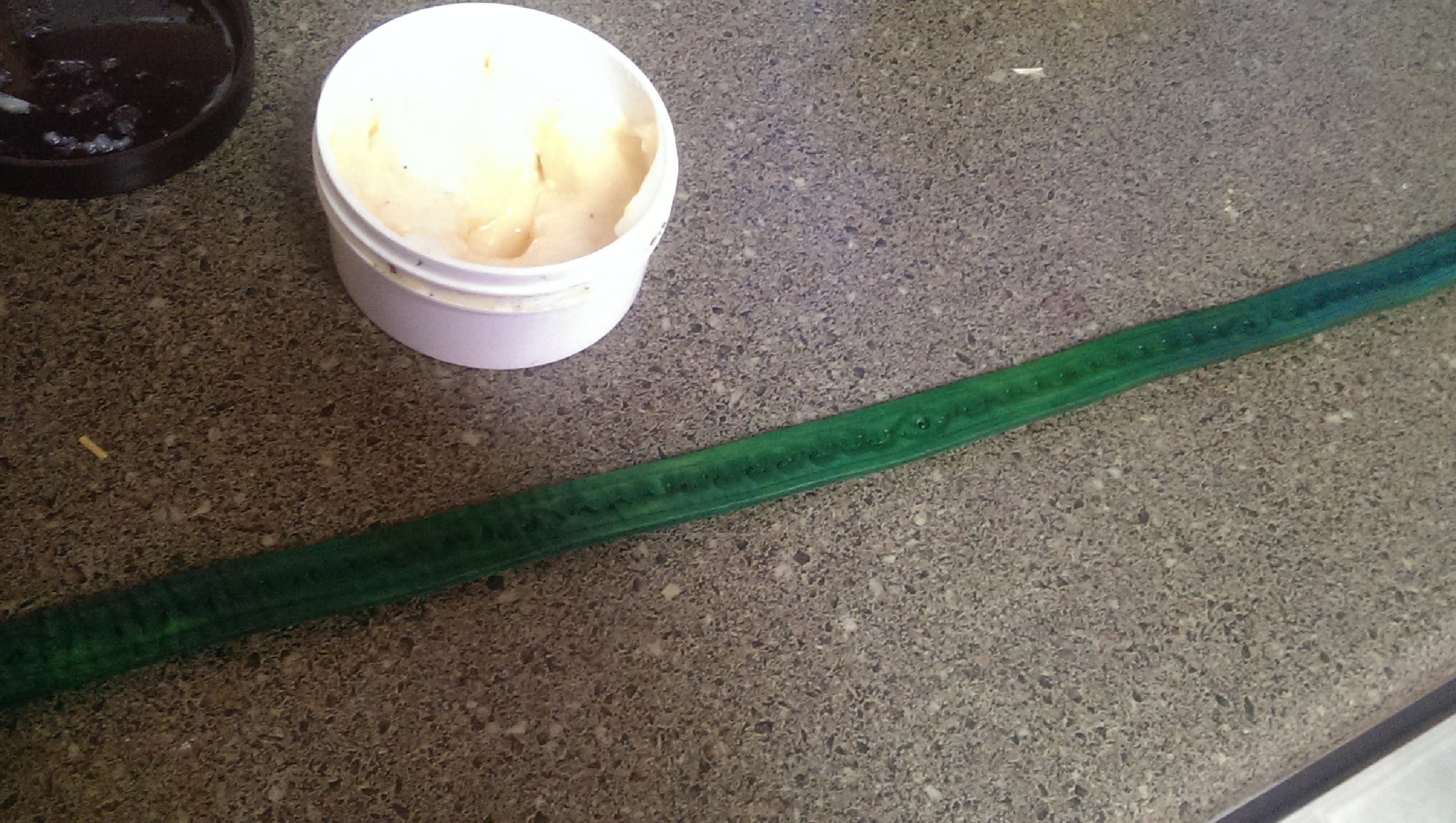
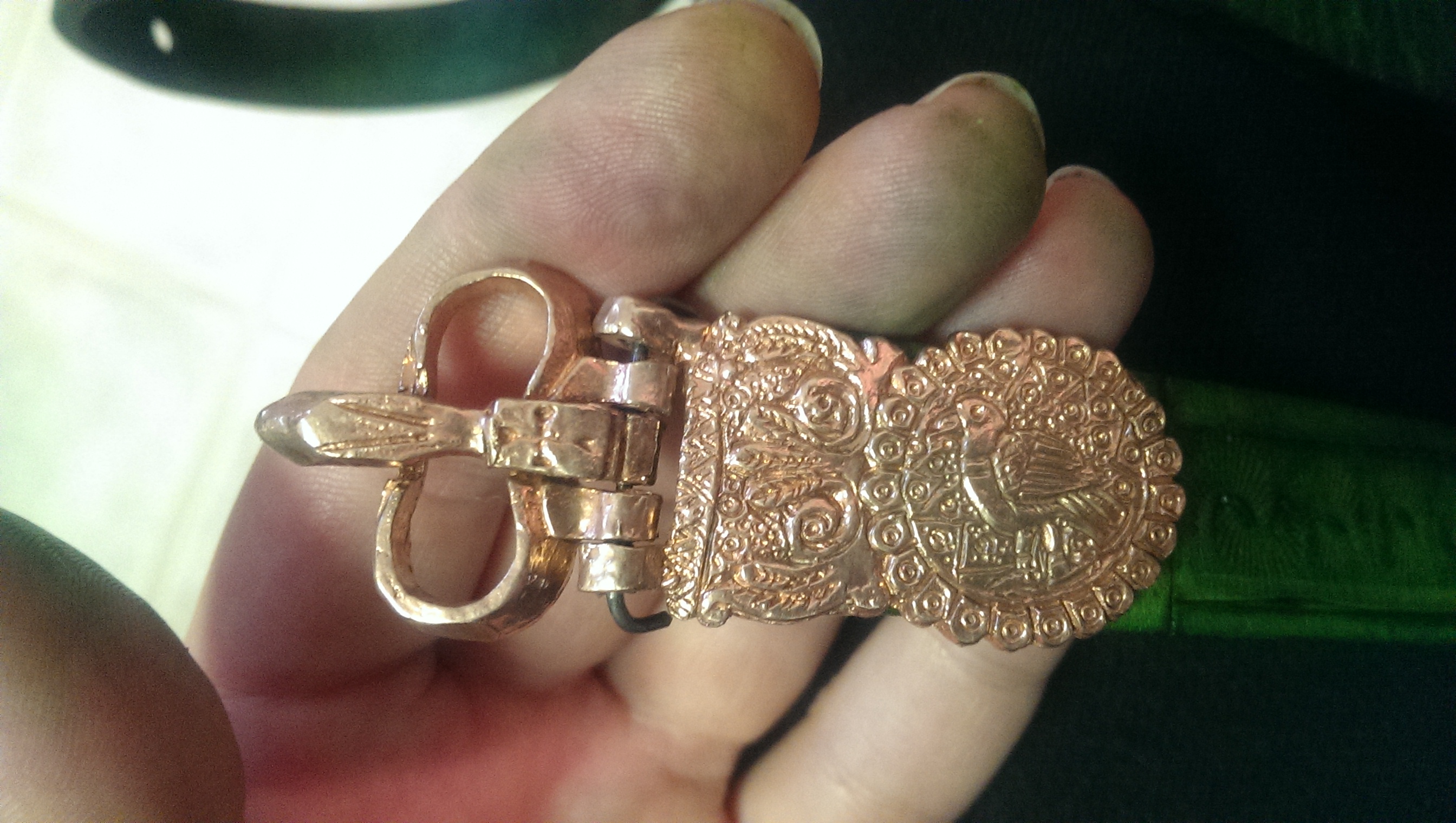
I started with a 3/4″ belt blank from Tandy, and an 8th Century Syrian belt buckle from Raymond’s Quiet Press…got green dye and Geoffrey’s basic tools and designed a pattern that I felt could work. This was my first time tooling leather, ever, so I just kept telling myself that straight lines were for sissies, mistakes are period, and if anyone needs to get that close to my belt to see my mistakes, they need to buy me dinner, first.
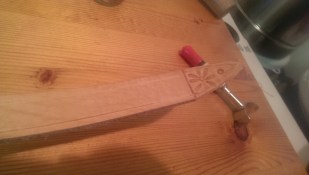
Practicing with the tools and my thingy at the end of the belt.I managed to do this with the knife. Somehow. I impressed Geoffrey.The idea I came up with. I went with thingies and Apotropaic amulets (Evil Eye). Very Levantine that fits not only my persona, but the Syrian belt buckle I got. I have no idea if it was used on belts in period.Dyed green outside on my sunny deck full of pine needles, and potted herbs that attract things that will sting you.After it was dyed and sealed, I used hide rejuvenator to lube it up and moisturize it. It absorbed two full coats. Oof.Geoffrey attached the buckle, and done!Here’s the buckle in my green hands.
BUT WAIT, THERE’S MORE! I ALSO PAINTED A SILK BANNER FOR MY PAVILION!
I have no idea where I find the time for this stuff, but Geoffrey made this pretty finial for the Green Monstah, and said we needed a banner. After me giving him a dirty look for a solid minute, I agreed, and ordered the supplies from Dharma. Fortunately I have friends who have done silk painting before, and the concept overall is very simple. It’s controlling the dye that’s tricky, and understanding that mistakes do happen and not to care that much since it will be up on a pole.
Here is the Green Monstah. It’s in Geoffrey’s colors. I am not a Red Sox fan and hate all things Boston, and he doesn’t watch baseball, but the name was apropo:
The plain red linen banner simply cannot do.
So we had to go all out with a war standard. Now, there are rules that need to be followed for displaying heraldry, but the SCA tends to be different than the real world, so the order I did is perfectly fine. Most importantly, your country or kingdom needs to be on the hoist, which is the pole, and then you work out from there. In this case, mine is East Kingdom (populace badge), The Northern Army, Geoff’s Arms, and then mine. When marshalling married arms, the lady is always RIGHT. This means my dolphin is way at the end, but hopefully the breeze catches it enough.
With the waterbased resist applied on the designs. Next time I want to use the rubber gutta, I think it will work better.And painted! Loaded with mistakes, YAY!It’s currently making a lovely door screen as it finishes drying.
All I have to do now is wait for it to dry, rinse it to remove the resist and excess dye, and then toss it in the dryer. Oh, and attach it onto the pole, of course. It will be sewn onto the casing part of the red linen flag in the above picture so it fits properly.
So there you have it, folks. Anna did stuff she doesn’t normally do and did not kill or maim anyone in the process. I definitely want to try another silk banner with better brushes and gutta, I think it will make a difference in controlling the dyes.
Now if you excuse me, I need drink 3 more cups of coffee, and start sewing even more stuff. We leave on Saturday morning. ~_~
I’m REALLY MEAN when I teach at Pennsic and only give out outlines when I teach my classes. There’s multiple reasons for this:
1: You can’t show up, jack a handout, and then not stick around for my class thus shorting the people who stay a handout.
2: It’s harder to plagiarize me. Yes, it’s happened. Really people, just cite me in your work.
3: It makes you become more engaged in what I’m teaching by following my outline, and taking your own notes for your own benefit. I do pass around supplemental materials and draw pretty pictures on the whiteboard and I want you to pay attention.
4: IT SAVES TREES. If I printed everything I needed for a 2 hour class, it would be a small booklet, and cost me a lot.
However, this has a downfall. Those that want to go to my classes and then can’t get shafted. So I was thinking to myself, “How do I make this easier for folks who can’t make it? You can’t learn much from a boring old handout.”
DING. SOCIAL MEDIA.
I understand that not everyone has Facebook, I apologize, but not everyone has Google + either, and I find the Facebook group interface a bit better for discussion anyway. Therefore, I created a group on Facebook that I plan to fill with all of my class goodies after war, so everyone can jump in, ask questions, and engage in a sorta online class. This is pretty beta, and I hope it works out. If it doesn’t, I’ll just can it.
In more of my pre-Pennsic Procrastination, additional thoughts have chopped their way into, “gee, I should be sewing right now” time.
Namely, this:
No! I mean THIS:
That is the shade of what is known as Tyrian, or Murex Purple. The imperial purple of Rome. As you can see, it is NOT indigo, it’s closer to a magenta-red, and it’s actually quite nice.
This was brought up because right now I have enough free linen points over at Fabrics-store.com to do some damage, and wildcherry, a color similar to this purple is on sale. This put me in a conundrum. Do I spend the money and being haughty and make a lovely purple piece of garbery, or, do I let it slide and stay within my persona? The East Kingdom has no sumptuary laws, especially when it comes to the wearing of colors, so I could wear this without any issue on the game side of of things. However, on the Anna side of things is where I question it. Would my persona be in the purple? As an imperial with the rank of lady, it’s likely I could have afforded it, and sumptuary laws did change over time to make it more available…IF you could afford it.
However, I feel like the wearing of purple, to me, as a Romanian (Byzantine), is being presumptuous in rank. If I was bestowed the gift of purple from someone of a higher station, that’s different. If someone won crown for me (highly unlikely situation) then well, yes, definitely. But the purchasing, sewing, and wearing of a purple garment would make me feel like I cheated. Yes, even though I hold the rank of lady, and I have seen period imagery of ranked women wearing SOME purple in their embellishment, they were never clad in it fully like the actual emperor and empress. So even though I may hold a position that allows me to wear it, and I could probably afford the dye, I would limit my purple to embellishment only, rather that entire garments.
Instead, I will play with words. Purpura, in both Latin and Greek, is a funny word. It means both purple AND red, so it’s hard to assume which color was being worn unless modifiers are being given, which they sometimes aren’t. And a good red color, like kermes derived from crushing little insects into dye, was just as expensive as milking murex snails. So I will gladly spend all of my persona’s invisible money on quality crimson and not feel like I’m placing myself higher than I should be while still dressing as a diva. 😉 Problem SOLVED. HOMERUN!
This of course doesn’t mean a thing outside of my own persona and kingdom. If you want to wear purple, and can wear the purple, rock that purple.
So I was able to get some calcium carbonate (natural chalk) from a brewing supply store, and decided to, you know, put it on my face with the other questionable materials I’ve been using.
DISCLAIMER: NOT APPROVED BY THE FDA, NOT APPROVED FOR COSMETICS, YADDA YADDA CANCERFACE YADDA YADDA DO THIS AT YOUR OWN RISK.
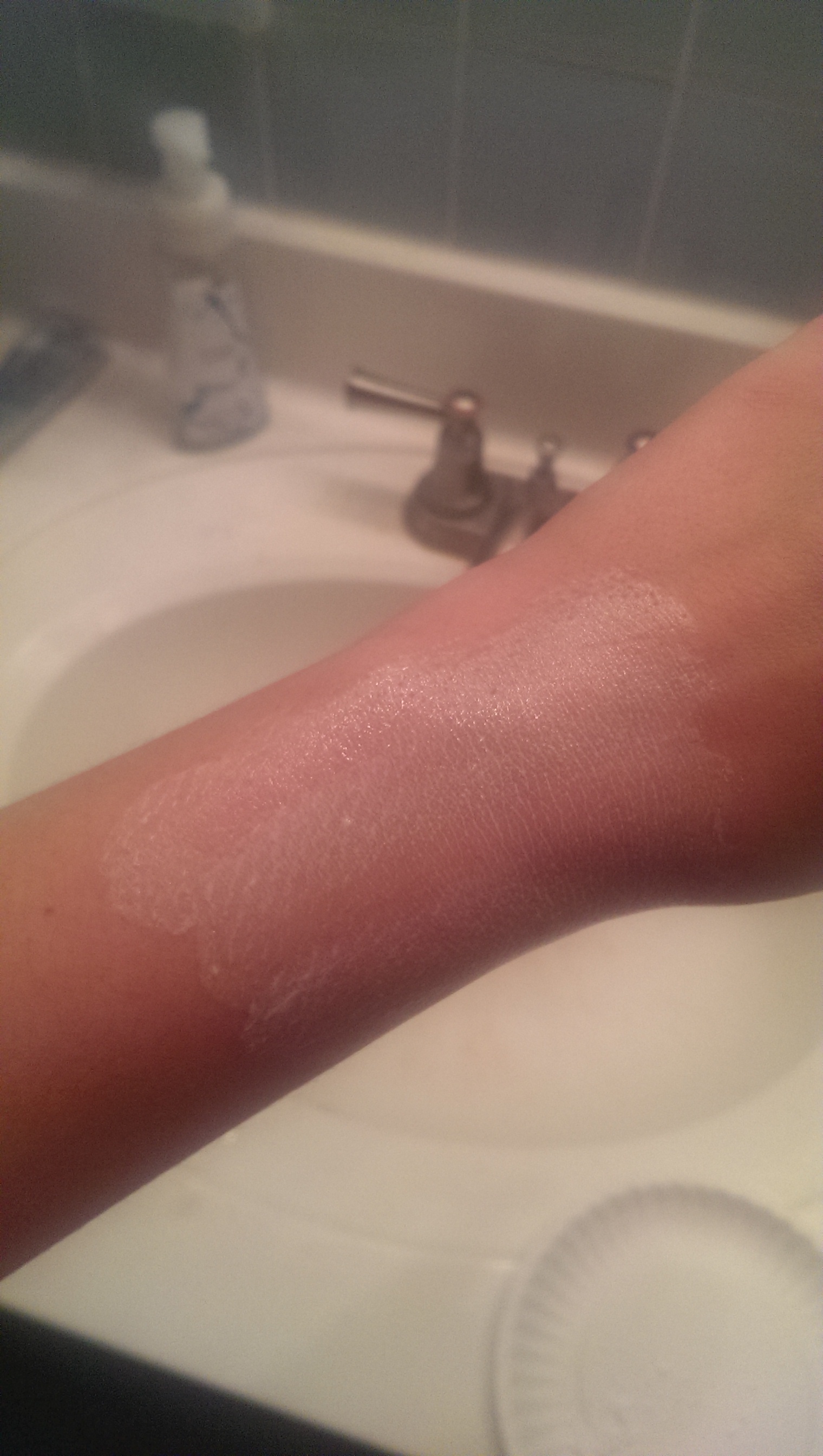
Okay, so…the article I’m using as a basis for this starter kit said that the chalk was mixed with vinegar. So, I raided my kitchen for white wine vinegar that I typically use to make sekanjabin or oxymel, and combined the two in a plastic cup. This immediately caused the fizzies due to the reaction of the acetic acid releasing the carbon, much like what would happen with sodium bicarbonate (baking soda) but not nearly as explosive. This intrigued me and worried me, but it seemed too thin, so I added more chalk to get a paste that was more reminiscent of a modern liquid foundation. I slathered it on my arm for a patch test, and let it dry. It didn’t look so bad or cause a reaction, so…
…I slathered it on my face… As you can see, it was a bit…paste-like, and didn’t blend well. It clung to every wrinkle and scar or zit on my face, and I immediately remembered I was in my 30s. So I washed it off with soap and water and it came off quite easily. (Note, it’s not in my hair, that’s my Rogue stripe.)
So I thinned the paste with more vinegar, and got a more powdery, fast drying finish. It was still lightening my skin, but not the consistency of glue.
Quickly, it was evident that thin layers would do the trick. It’s not an emulsion like a modern foundation, and therefore the mineral can be displaced and clump easily, as you can see on my eyebrow and cheek. I did apply it with a modern cosmetics brush as well, so I need to do more research into period applicators, that should also help.
Well, there was only thing left to do: PUT THE WHOLE FACE ON. I went lighter on the red ochre this time, since I haven’t yet made my balm for it as planned. I should do that, oh, tonight.
I applied the lamp black to my eyebrows and as eyeliner using the olive oil mixture from my first post. (I also patch tested this. ALWAYS PATCH TEST!) I went a bit crazy with it on the eyebrows, I need better brushes to tone it down. Eyeliner was done by toothpick.
This side was a bit heavier, and I look even less glamorous:
Of course, now I had to take this stuff OFF. Modern soap and water worked fine for the chalk and the ochre, but the carbon?
.
.
. Not so much. (I had to.)
I was able to remove it using the olive oil mixture it was applied with, to a point, and then with a non-oil based modern makeup remover, which helped but wasn’t great. The oil is needed to break up the black. It’s very staining, and I wasn’t able to remove it completely, so I think a modern oil-based remover would do the job nicely.
So, I now have the beginnings of a basic Roman makeup kit which should make my A&S display this weekend at Palio di Stonemarche an interesting one. I hope to have something more to show come Pennsic.
A pigment used for blush and lip stain from Egypt through Byzantium was red ochre. This is a very safe, non-toxic pigment that is derived naturally from iron oxide (rust) and hematite. It’s been used in artwork since the cave paintings in France, so we know it’s been around for a very long time, so use in cosmetics would make sense.
Like I mentioned, it was used as a blush, and a lip gloss. The Roman women were known for going a bit…overboard with their rouge, so sayeth Martial, who was convinced their faces would melt. Well, here’s my face, complete with annoying duck face (I HAD TO) slathered in rust. Really. Note my bathroom light for whatever reason makes my black hair look purple. It is not. It is black, but other than the the pigment looks correct.
This is 100% natural red ochre pigment that I use for my icons from Earth Pigments. I applied it to my face using a modern angled blush brush.
My right cheek I applied the pigment straight on with knocking the brush a couple times to remove excess. The resulted in…OH MY GOD. ORANGE CHEEK, with next to no fall out.
My left cheek I used the brush after I had used it on my right, and it gave a nice bronzing effect. This would have been a lovely healthy glow that I think the Egyptians prized, but Roman ladies apparently were a bit more bold with their color usage.
I applied the pigment to my lips using a Q-tip soaked in olive oil. The pigment still dried my lips out quickly, but it did not burn.
I assume once I get the chalk and vinegar face paste on there, it will look even more ridiculous. I will be making that up once I find powdered calcium carbonate, which is true chalk, versus the gypsum chalkboard “chalk” used today. I should be able to locate it in a vitamin store or a brew store.
I’ve decided that since my Kingdom thought I was good enough to get a Maunche (and I got to write OM after my name on a class handout coming up. WEIRD!) I needed to step up my game and get down and dirty. Since I’m really good at making a mess, I decided to jump into the dangerous, but interesting world of ROMAN COSMETICS.
Here it is, my disclaimer: What I do here is at my own risk. Please, for the love of Hades and all that is holy, do not try this at home if you feel that you may react to any of these cosmetics or their contents make you feel unsafe. Although I am working with non-toxic ingredients, some of them can be a bit scary.
The Romans (in this case, we are including the Byzantines, as they SHOULD be included) were fond of personal hygiene and their appearance, so there’s a great deal of information on what they used for makeup, face creams, depilatories, and the like, so it’s something I’ve been kicking around for a bit. After talking a bit with Mistress Aife who has done similar things with Irish cosmetics, I decided, “Oh hell, why not? As long as it’s not lead and mercury I should be fiiiiiiiine.”
So I decided to start with the famous kohl eyeliner that was all the rage in the Levantine civilizations, and the early 1990’s. I’m a pretty heavy eyeliner wearer when I DO wear makeup (see also, 1990’s) so I always have some on when I have court garb on, but if I want to be authentic, I should take the next step.
For the most part, kohl was made (and is still made in some countries) with galena, which is lead sulfide. This is baaaaaad. So, I looked for alternatives. Immediately, I found that both in period and in modern preparations, lamp black is used with some sort of medium to spread it on the eyes. In Roman times, this is a scented oil or water, and in modern times, it’s ghee, a clarified butter. So, here I was getting all excited about this fun new exciting way to make sexy eyeliner when my med school friend Margaret down in Meridies nearly beheaded me on my Facebook page. Come to find out, soot and lamp black have something called polycyclic aromatic hydrocarbons, and these such things are a carcinogen. Who knew? She did, and then I got a bummer, but I was determined to make some anyway for science and display purposes. I have no intention of putting this stuff on my face, but I needed to find an alternative. So, in some skimming today of a couple of articles, I found that they also used charcoals and ashes, basically anything that could smear black. Saffron was suggested, and I happened to have some I could, well, reasonably part with. So I made 3 batches of kohl, lamp black, willow charcoal, and saffron ash, and a scented oil carrier that’s simply olive oil with a few drops of frankinscense and myrrh. Here are my observations:
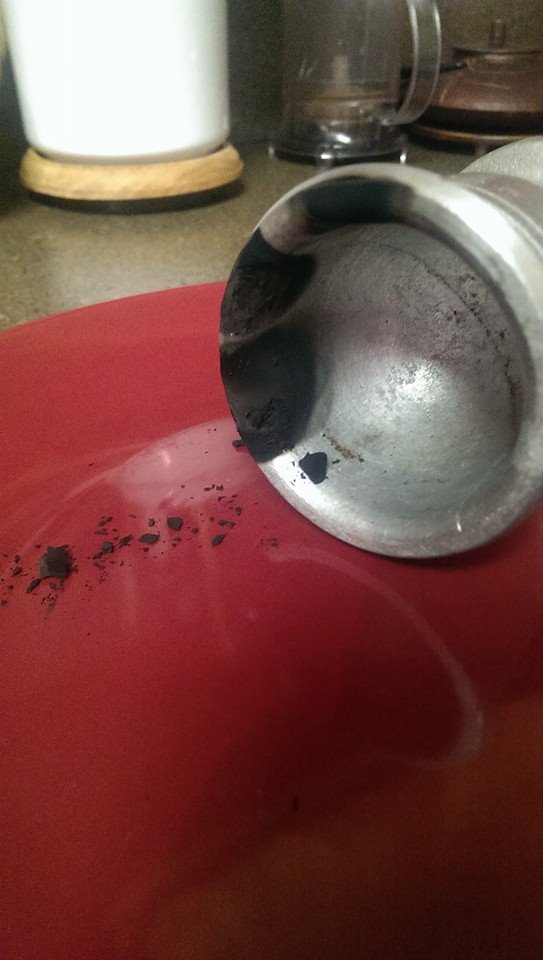
Lamp black: This stuff is great. If it wasn’t for the fact it could give me cancerface (that’s a thing now, I just made it up) I would rock this. Why? It’s smooth and already somewhat creamy from the oil content from my burning lamp. It made a beautifully dark line on my wrist that didn’t wash off easily. I’m really tempted to use it on my eyes, just once, but my better judgement is getting the best of me. As you can see, I used my Roman lamp from Claybaby Pottery, with a wick I braided myself out of fustian and olive oil, and collected the soot in a lead-free pewter mortar.
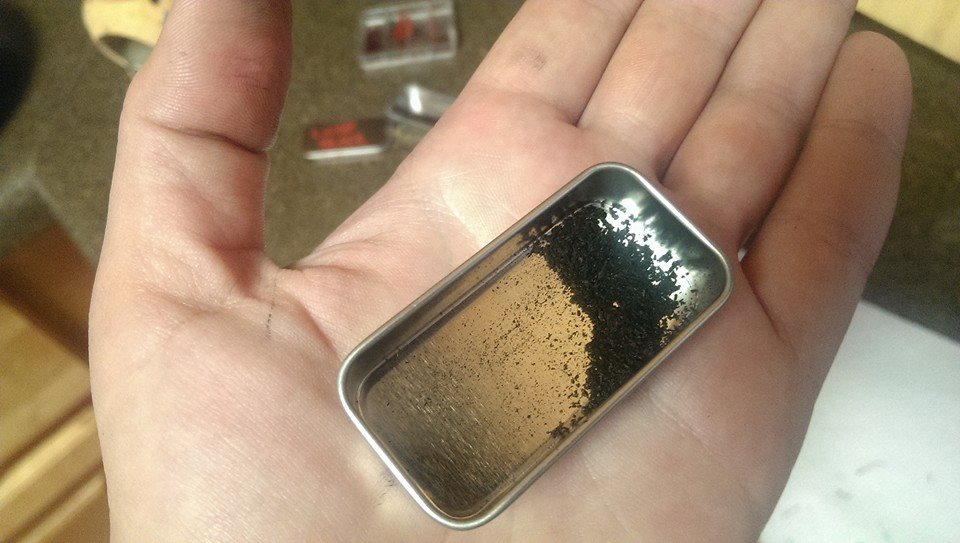
Willow charcoal: I have lots of charcoal sticks around the house, so I picked one from a natural source and got to smash it up in a mortar and pestle. This was great fun and a great mess. I wish I could grind it a bit better, but it did give me a decent line once I got the balance between kohl and oil down. Easy, readily available ingredients that are affordable, and charcoal eyeliners are already prevalent in the modern market. And one stick of charcoal filled my tin. I’ll have eyeliner forever! I want to try to apply this using modern eyeliner brush and water.
Saffron ashes: I was hoping this would be better, I really did. I need to figure out a better way to carbonize the saffron, because at first I tried to burn it on an incense burner/oil warmer. That didn’t work well, though my house smelled lovely. So I resorted to just getting impatient and setting it on fire with my lighter in a metal jar lid. This burned it, and I was able to get ash from it, but it does not carry well as a liner at all. It was suggested by both Geoffrey and a friend on the Romans of the SCA page to treat it as if I was making charcloth. So basically, I need to put it in a metal container and bake it until it turns to ashes. Yes, I’m basically cremating saffron…I’m going to need to buy more I’m not afraid to waste for this project to do this. The bit I burned did not yield much.
Here’s a picture of my filthy arm, top to bottom is lamp black, saffron, and charcoal:
I will be re-trying the saffron kohl sometime this week, as well as making my face whitener and blush. Once I conclude this project I’ll provide a list of sources I’ve compiled.














 Practicing with the tools and my thingy at the end of the belt.









 Anna's New Rome
You must be logged in to post a comment.