A Gallery of Roman Provincial Clothing

We’re always so quick to forget that fashion has been a phenomenon for thousands of years. Women just didn’t wear one or two style dresses. They wore what was in style, they wore what was popular in other places and made it work for them. I’m a firm believer that the clothing of Roman women was pretty limitless. They were essentially the original divas.

This is a public gallery on Facebook by Ratna Drost, who is a researcher and reenactor at the Archeon museum in the Netherlands. It’s a collection of her interpretation of provincial (Think Gaul and Belgica) clothing, with some great cold weather options for those of us who live in the Frozen Tundra. I’ve been pretty good about sticking with my Byzantine lately, but some of these looks are totally inspiring.

I hope these images help those looking for alternatives to the traditional peplos and chiton looks. I would recommend sending questions to Ms. Drost herself. This is not my work, I just wanted to share this great collection!


https://www.facebook.com/ratna.drost/media_set?set=a.380002448762101.90838.100002570474924&type=1

Award of Arms scroll for Lady Petra de Cilicia

I’ve done some translation before for scribal work, but I never really get the chance to play wordsmith. So when the husband of a friend receiving her AoA at Birka this last weekend asked me and the other ladies of the house to help, I got excited. Her persona is Spartan, which makes things surprisingly difficult as written Spartan anything is scarce. There’s only 2 recorded Spartan poets, and they were entirely chronicled by later authors. In this case, I was able to find some Tyrtaeus quoted by the Roman author, Plutarch, in “The Life of Lycurgus” from The Parallel Lives, and some snippets of awesome from his section on Spartan sayings in Moralia.

This is what I was able to come up with, with notations in brackets:

Phoebus Apollo’s the mandate was which they brought from Pytho, [Pythian Apollo was a  Spartan patron god.]

Voicing the will of the god, nor were his words unfulfilled:

Sway in the council and honors divine belong to Edward and Thyra, [King and Queen of the East.]

Under whose care has been set Sparta’s city of charm;

Second to them is one, Petra de Cilicia.

Who swift in foot, aides our Hoplites of Eastern Shores,

Supporting the armies, and the love of her husband unwavering

and thus, the understanding that a helmet is for personal protection,

but the shield is common good for all. [The court laughed a lot here, I wish they didn’t. The quote is serious.]

And by this duty, our king, our queen, and council

Name on this day, Lady Petra, and award her arms for her to bear alone.

Duly confirming by vote this unperverted decree

Declared six days before the month of Eleusinios, [Eleusinios is approximately the Spartan month of February, named for the Eleusinian Mysteries, another cult that the Spartans revered.]

Before the great council at Market Day at Birka, [Spartans were huge into councils.]

Koino̱nía Étos Forty-Nine. [‘Koino̱nía Étos’ is Greek for the Latin ‘anno societatis’ or, ‘in the year of the society’.]

For anyone interested in Spartan society, I highly recommend the above sources by Plutarch, and also Herodotus’ Histories.

Linkage:

Plutarch: “Sayings of the Spartans” from Moralia:
http://penelope.uchicago.edu/Thayer/E/Roman/Texts/Plutarch/Moralia/Sayings_of_Spartans*/main.html

Plutarch: “Life of Lycurgus” from Parallel Lives:
http://penelope.uchicago.edu/Thayer/E/Roman/Texts/Plutarch/Lives/Lycurgus*.html

Herodotus’ Histories:
http://www.gutenberg.org/files/2707/2707-h/2707-h.htm

My very heraldic Christmas and Io Saturnalia!

My lord had to go do Navy things for a few months, so when I should have been studying for school, I sewed things.

I also found out that Santa Claus can read heraldry! You see, we stayed home for the holidays this year when both of us usually travel, sometimes in opposite directions to keep both families happy, so we had no decorations. None. Zip. So  I was shopping for the necessary trimmings, and found that they’re all way too expensive and I didn’t like them all anyway. So I went to Joann’s, dropped $60 in supplies, and went to work.

Here’s our heraldically (is word?) influenced tree skirt, hand appliqued, lined in horrible plaid with fringy fringe that was more of a pain in the butt than it probably should have been:

treeskirt

And our heraldically correct stockings, you know, instead of writing our names in puffy paint:

stockings

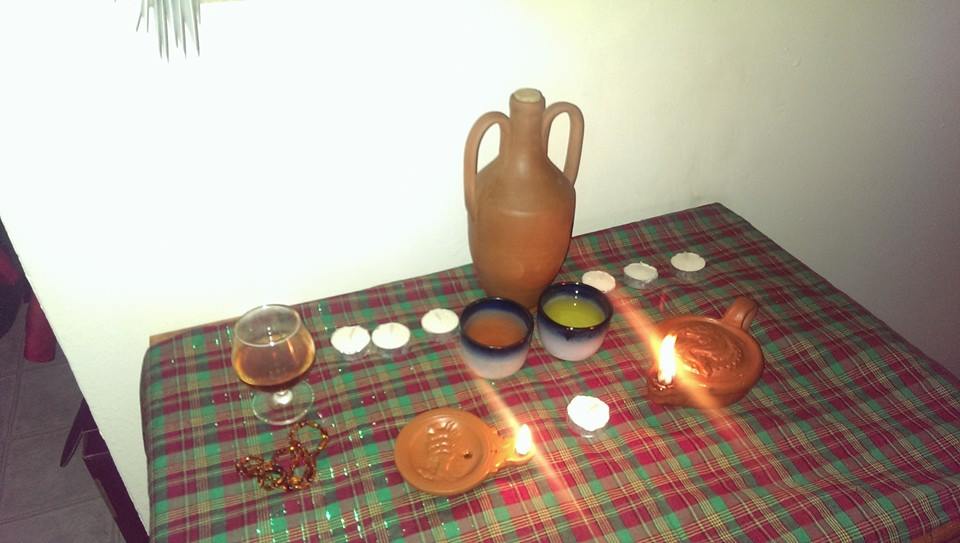
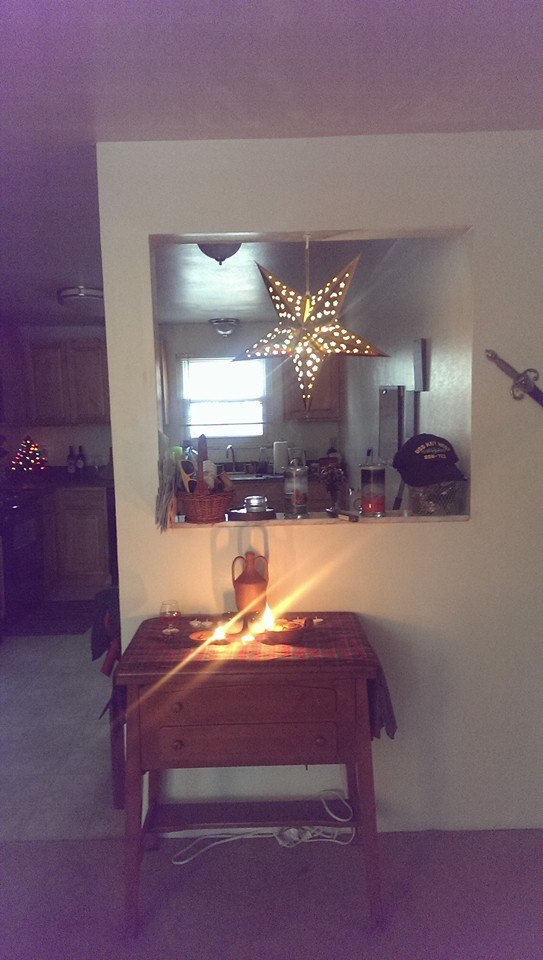
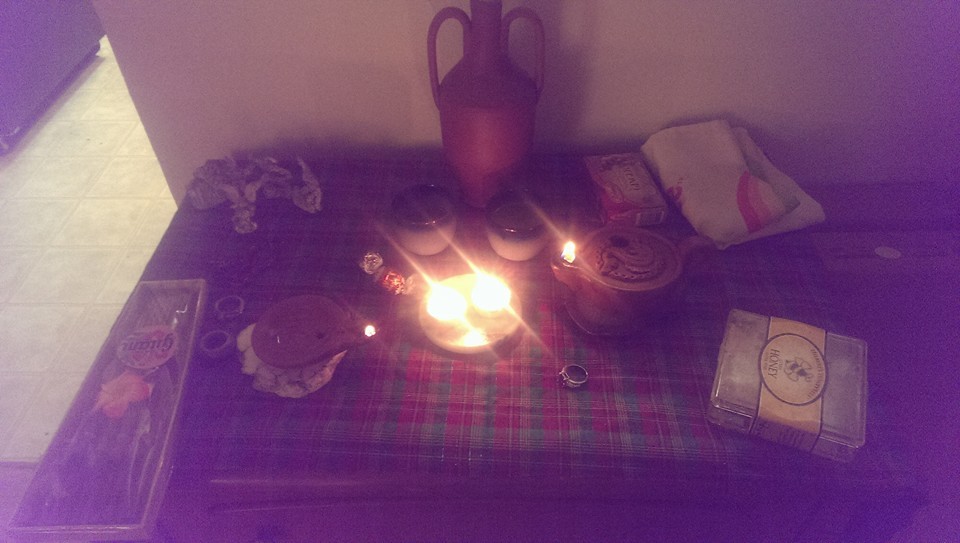
But modern Christmas is not terribly period ,but it sure is pretty. So, I decided to try Saturnalia from the 17th-23rd of December for the first time this year, and we definitely had fun! We set up a household altar with Roman goodies: an amphora, a cup of wine and a cup of olive oil, lamps, and I had a tea light for each night of the festival (how, uh, syncretic of me.) Each day the lord and I would make an “offering” to Saturn in the ways of whatever we had around. This varied from my actual Roman artifact rings, to a cheap rhinestone ring, amber necklace, chunk of shortbread, coffee, and Geoffrey’s Dungeons and Dragons Elementals. I am not even kidding.

saturn1
The First Day of Saturnalia.
saturn2
The star lamp would have been very appealing to the Romans, who were fond of gilding all the things with gold suns and stars for the festival. I kept it lit the entire 7 days.
saturn4
The last night of the festival with all the goodies we offered! Rainbow Brite pillowcase from the 80s and chopsticks my husband brought me home from Guam. Why not?! I was burning some extra candles since we weren’t home for a couple of nights.
saturn3
The magnet on my car. Complete with some New Hampshire December ice and grime.

It was all in the spirit of the season, and trying to feel as the Romans would have felt. Every holiday in December has one thing in common: The solstice and the return of light at the darkest part of the year. So I’m a big fan of setting things on fire or putting a mere 1500 lights on my balcony and 400 lights on my tree.

flamingo
And lawn flamingos. Nothing screams winter like pink plastic.

Most of all, we had FUN. I hope everyone else had fun with the holidays this week, also!

Felicem Dies Natalis Sol Invicti!
Καλά Χριστούγεννα!
Or as my friends say, “Happy Lights!”

I hope everyone has a Happy New Year, and I’ll catch you all on the flip side with some neat info on Byzantine outerwear, and the upcoming garb challenge at Birka!

THIS IS WHY WE CAN’T HAVE NICE THINGS, ANNA.

On the 1st day of Saturnalia, dilectus meus gave to me: A Judean Date Palm Tree.
On the 2nd day of Saturnalia, dilectus meus gave to me: 2 Punic Wars, and a Judean Date Palm Tree.
On the 3rd day of Saturnalia, dilectus meus gave to me: 3 Gauls dead, 2 Punic Wars, and a Judean Date Palm Tree.
On the 4th day of Saturnalia, dilectus meus gave to me: 4 Aureii, 3 Gauls dead, 2 Punic Wars, and a Judean Date Palm Tree.
On the 5th day of Saturnalia, dilectus meus gave to me: 5 Good Emperors! 4 Aureii, 3 Gauls dead, 2 Punic Wars, and a Judean Date Palm Tree.
On the 6th day of Saturnalia, dilectus meus gave to me: 6 legions a slaying, 5 Good Emperors!  4 Aureii, 3 Gauls dead, 2 Punic Wars, and a Judean Date Palm Tree.
On the 7th day of Saturnalia, dilectus meus gave to me: 7 Hills of Rome, 6 legions a slaying, 5 Good Emperors! 4 Aureii, 3 Gauls dead, 2 Punic Wars, and a Judean Date Palm Tree!

The end.

You’re welcome, and Happy Holidays folks, no matter what edition of lamp burning or tree lighting you partake in.

A review of FutureLearn’s course on “Hadrian’s Wall: Life on the Roman Frontier”

Readers of my blog will probably recall a post I made not long ago, well, six weeks ago to be exact, on my beginning of a course on FutureLearn. I reblogged a post “Who built the wall?” when the course started, and now I feel urged to share a poem by Rudyard Kipling, “The Roman Centurion’s Song”. It’s that feeling you get when you finish a good book, that emptiness that comes with completion. I guess I didn’t expect to feel this way, but that’s a good thing! That means that FutureLearn and Newcastle University have done their jobs. For a free online course, it was OUTSTANDING.

A little bit about the breakdown of the course:

Each week had about 20 short sections to complete. They ranged from short videos, to articles, and quizzes. The quizzes don’t count against your grade, they were just a learning tool. Every 2 weeks there was an actual test, culminating with the final test at the end of the 6th week (That one had some curveballs in it.) My favorite part were the little forensic challenges that happened every other week or so. You would be given an archaeological find of bones, and then try to determine cause of death, gender, etc from the clues given in an article. It was a great insight into the grim world of forensic archaeology.

The Vindolanda tablets were totally awesome. I had heard about them before, but never actively went seeking them. I really suggest taking a look at them here. Learning a bit more about the religious syncretism that occurred at the wall and methods of worship was also incredibly fascinating.

In addition, the discussions that were had were also great. Each section has a discussion area that functions like a social media platform, in which one could post an answer or topic of discussion and receive answers, sometimes even by the staff at the University, who was actively engaging with the MOOC the entire time.

Here’s Newcastle University’s blog of their experience: https://blogs.ncl.ac.uk/numoocs/

I do believe you can still check out the course. Go to https://www.futurelearn.com/courses/hadrians-wall/ and see for yourself. I may have also totally taken the bait, but Newcastle University may be on the list of schools I look into for my PhD. But that’s a ways off yet, let me finish my MA first!

Thank you to the staff at Newcastle University and FutureLearn for offering this experience. I’ve already enrolled in an upcoming course, also through FutureLearn, on the archaeology of Portus which is being given by the University of Southampton, another UK school. I look forward to checking that out in January. 🙂


Who Built the Wall?

I’ve signed up for a free online course on Hadrian’s Wall via FutureLearn, offered by Newcastle University in the UK. Not that I don’t already have enough to do with my own graduate studies at the University of New Hampshire, but I figured that I would reblog a site that came up on Twitter, and link to the course itself. It started Monday, but I believe there is still time to sign up. Please join me in learning about this really cool part of Roman History!

https://www.futurelearn.com/courses/hadrians-wall
#FLHadrian is the hashtag, find me under @ang_costello on Twitter for discussion. 🙂

Mike Bishop's avatarPer Lineam Valli

The legions

A legion was around 5,000 heavily armed and armoured men who were, by the 2nd century AD, even more of an anachronism than the rams that still adorned the prow of every Roman warship in their fleets. Organised into ten cohorts, each of around 480 men, they were extremely effective in open battle, especially when complemented by their attached auxiliaries. Legionaries (never, please, ‘legionnaires’) were nevertheless unsuitable for garrisoning a province and all-too-easily wrong-footed by even the most basic of insurgencies (as all technologically dependent armies tend to be).

Britannia was to turn out to be a troubled (and troubling) place. It needed four legions until the end of the AD 80s and right up until the beginning of the 2nd century AD it still had three (II Augusta, IX Hispana, and XX Valeria Victrix). Then something happened, and at some point between…

View original post 604 more words

Facebook Group for Pennsic Classes

I’m REALLY MEAN when I teach at Pennsic and only give out outlines when I teach my classes. There’s multiple reasons for this:


1: You can’t show up, jack a handout, and then not stick around for my class thus shorting the people who stay a handout.

2: It’s harder to plagiarize me. Yes, it’s happened. Really people, just cite me in your work.

3: It makes you become more engaged in what I’m teaching by following my outline, and taking your own notes for your own benefit. I do pass around supplemental materials and draw pretty pictures on the whiteboard and I want you to pay attention.

4: IT SAVES TREES. If I printed everything I needed for a 2 hour class, it would be a small booklet, and cost me a lot.


However, this has a downfall. Those that want to go to my classes and then can’t get shafted. So I was thinking to myself, “How do I make this easier for folks who can’t make it? You can’t learn much from a boring old handout.”

DING. SOCIAL MEDIA.

I understand that not everyone has Facebook, I apologize, but not everyone has Google + either, and I find the Facebook group interface a bit better for discussion anyway. Therefore, I created a group on Facebook that I plan to fill with all of my class goodies after war, so everyone can jump in, ask questions, and engage in a sorta online class. This is pretty beta, and I hope it works out. If it doesn’t, I’ll just can it.

Group link:

AΔΣ’s Pennsic Classes
https://www.facebook.com/groups/1448455932095583/


Please feel free to join in advance for when the fun begins.

Idle Musings, Part 2: On the Wearing of the Color Purple

In more of my pre-Pennsic Procrastination, additional thoughts have chopped their way into, “gee, I should be sewing right now” time.


Namely, this:


No! I mean THIS:


That is the shade of what is known as Tyrian, or Murex Purple.  The imperial purple of Rome.  As you can see, it is NOT indigo, it’s closer to a magenta-red, and it’s actually quite nice.

This was brought up because right now I have enough free linen points over at Fabrics-store.com to do some damage, and wildcherry, a color similar to this purple is on sale. This put me in a conundrum. Do I spend the money and being haughty and make a lovely purple piece of garbery, or, do I let it slide and stay within my persona? The East Kingdom has no sumptuary laws, especially when it comes to the wearing of colors, so I could wear this without any issue on the game side of of things. However, on the Anna side of things is where I question it. Would my persona be in the purple? As an imperial with the rank of lady, it’s likely I could have afforded it, and sumptuary laws did change over time to make it more available…IF you could afford it.

However, I feel like the wearing of purple, to me, as a Romanian (Byzantine), is being presumptuous in rank. If I was bestowed the gift of purple from someone of a higher station, that’s different. If someone won crown for me (highly unlikely situation) then well, yes, definitely. But the purchasing, sewing, and wearing of a purple garment would make me feel like I cheated. Yes, even though I hold the rank of lady, and I have seen period imagery of ranked women wearing SOME purple in their embellishment, they were never clad in it fully like the actual emperor and empress. So even though I may hold a position that allows me to wear it, and I could probably afford the dye, I would limit my purple to embellishment only, rather that entire garments.

Instead, I will play with words. Purpura, in both Latin and Greek, is a funny word. It means both purple AND red, so it’s hard to assume which color was being worn unless modifiers are being given, which they sometimes aren’t. And a good red color, like kermes derived from crushing little insects into dye, was just as expensive as milking murex snails. So I will gladly spend all of my persona’s invisible money on quality crimson and not feel like I’m placing myself higher than I should be while still dressing as a diva. 😉 Problem SOLVED. HOMERUN!

This of course doesn’t mean a thing outside of my own persona and kingdom. If you want to wear purple, and can wear the purple,  rock that purple.

I need to get work done.


Send in the clowns (Roman makeup research, part 3.)

So I was able to get some calcium carbonate (natural chalk) from a brewing supply store, and decided to, you know, put it on my face with the other questionable materials I’ve been using.

DISCLAIMER: NOT APPROVED BY THE FDA, NOT APPROVED FOR COSMETICS, YADDA YADDA CANCERFACE YADDA YADDA DO THIS AT YOUR OWN RISK.


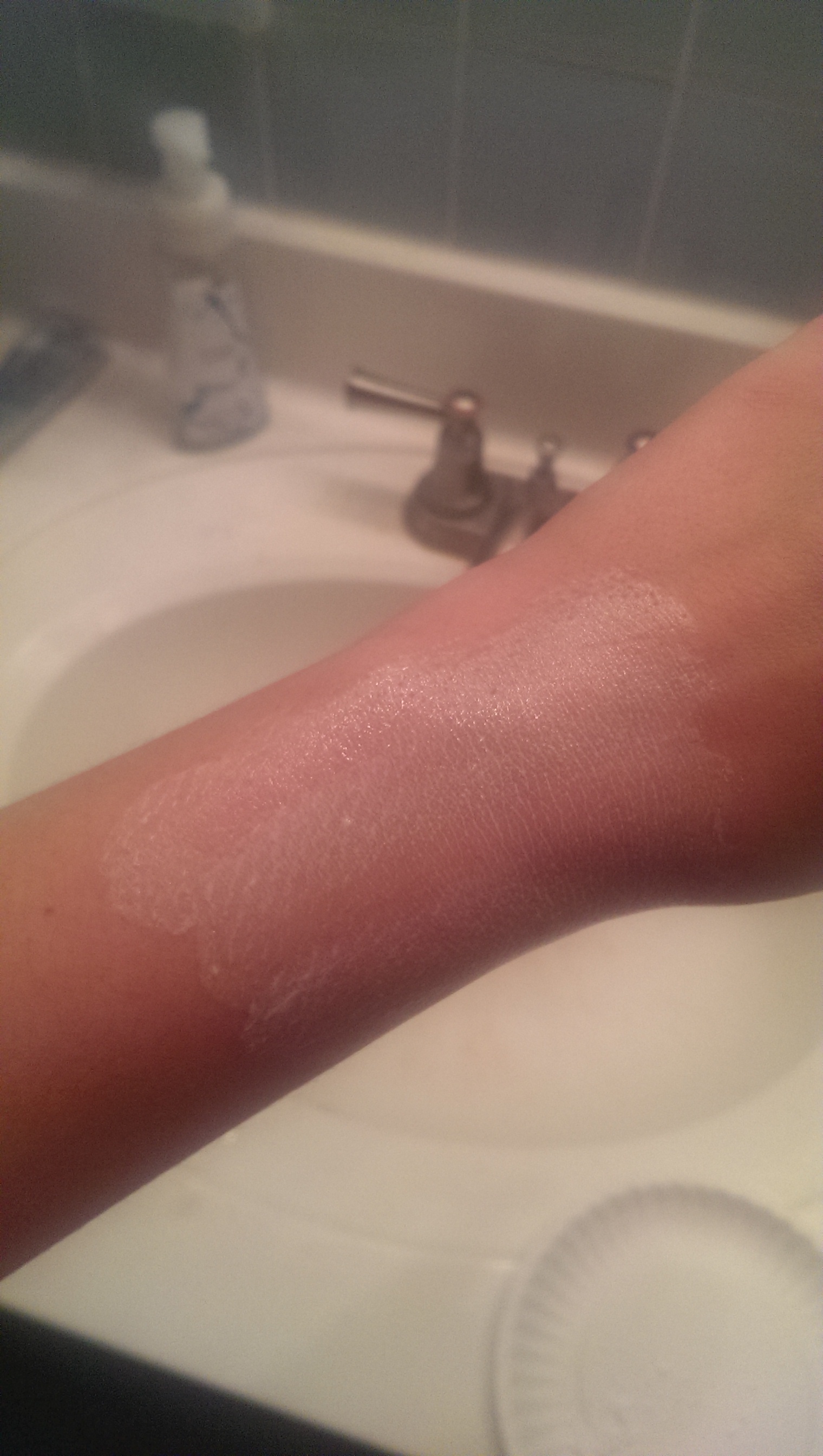
Okay, so…the article I’m using as a basis for this starter kit said that the chalk was mixed with vinegar. So, I raided my kitchen for white wine vinegar that I typically use to make sekanjabin or oxymel, and combined the two in a plastic cup. This immediately caused the fizzies due to the reaction of the acetic acid releasing the carbon, much like what would happen with sodium bicarbonate (baking soda) but not nearly as explosive. This intrigued me and worried me, but it seemed too thin, so I added more chalk to get a paste that was more reminiscent of a modern liquid foundation. I slathered it on my arm for a patch test, and let it dry. It didn’t look so bad or cause a reaction, so…

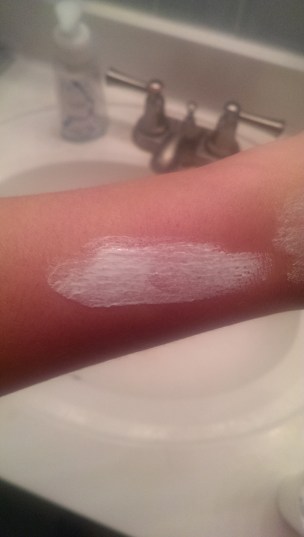
IMAG2161 IMAG2162


…I slathered it on my face…IMAG2163 As you can see, it was a bit…paste-like, and didn’t blend well. It clung to every wrinkle and scar or zit on my face, and I immediately remembered I was in my 30s. So I washed it off with soap and water and it came off quite easily. (Note, it’s not in my hair, that’s my Rogue stripe.)

So I thinned the paste with more vinegar, and got a more powdery, fast drying finish. It was still lightening my skin, but not the consistency of glue.

IMAG2164 IMAG2165

Quickly, it was evident that thin layers would do the trick. It’s not an emulsion like a modern foundation, and therefore the mineral can be displaced and clump easily, as you can see on my eyebrow and cheek. I did apply it with a modern cosmetics brush as well, so I need to do more research into period applicators, that should also help.

IMAG2166

Well, there was only thing left to do: PUT THE WHOLE FACE ON. I went lighter on the red ochre this time, since I haven’t yet made my balm for it as planned. I should do that, oh, tonight.

I applied the lamp black to my eyebrows and as eyeliner using the olive oil mixture from my first post. (I also patch tested this. ALWAYS PATCH TEST!) I went a bit crazy with it on the eyebrows, I need better brushes to tone it down. Eyeliner was done by toothpick.

IMAG2167

This side was a bit heavier, and I look even less glamorous:

IMAG2169

Of course, now I had to take this stuff OFF. Modern soap and water worked fine for the chalk and the ochre, but the carbon?

.

.

. Not so much. (I had to.)

IMAG2170

I was able to remove it using the olive oil mixture it was applied with, to a point, and then with a non-oil based modern makeup remover, which helped but wasn’t great. The oil is needed to break up the black. It’s very staining, and I wasn’t able to remove it completely, so I think a modern oil-based remover would do the job nicely.

So, I now have the beginnings of a basic Roman makeup kit which should make my A&S display this weekend at Palio di Stonemarche an interesting one. I hope to have something more to show come Pennsic.


I’m feeling a bit rusty.

A pigment used for blush and lip stain from Egypt through Byzantium was red ochre. This is a very safe, non-toxic pigment that is derived naturally from iron oxide (rust) and hematite. It’s been used in artwork since the cave paintings in France, so we know it’s been around for a very long time, so use in cosmetics would make sense.

Like I mentioned, it was used as a blush, and a lip gloss. The Roman women were known for going a bit…overboard with their rouge, so sayeth Martial, who was convinced their faces would melt. Well, here’s my face, complete with annoying duck face (I HAD TO) slathered in rust. Really. Note my bathroom light for whatever reason makes my black hair look purple. It is not. It is black, but other than the the pigment looks correct.

This is 100% natural red ochre pigment that I use for my icons from Earth Pigments. I applied it to my face using  a modern angled blush brush.

10341744_10152264187483143_6306349082299873484_n


My right cheek I applied the pigment straight on with knocking the brush a couple times to remove excess. The resulted in…OH MY GOD. ORANGE CHEEK, with next to no fall out.

10402439_10152264187523143_1723956463136150213_n


My left cheek I used the brush after I had used it on my right, and it gave a nice bronzing effect. This would have been a lovely healthy glow that I think the Egyptians prized, but Roman ladies apparently were a bit more bold with their color usage.

10441451_10152264187578143_3476787205910562077_n

I applied the pigment to my lips using a Q-tip soaked in olive oil. The pigment still dried my lips out quickly, but it did not burn.

I assume once I get the chalk and vinegar face paste on there, it will look even more ridiculous. I will be making that up once I find powdered calcium carbonate, which is true chalk, versus the gypsum chalkboard “chalk” used today. I should be able to locate it in a vitamin store or a brew store.


Until then…rouge it up, ladies! *_*