“All I wanted was a cloak!” Part I: The research.

Really, that’s it. A cloak.

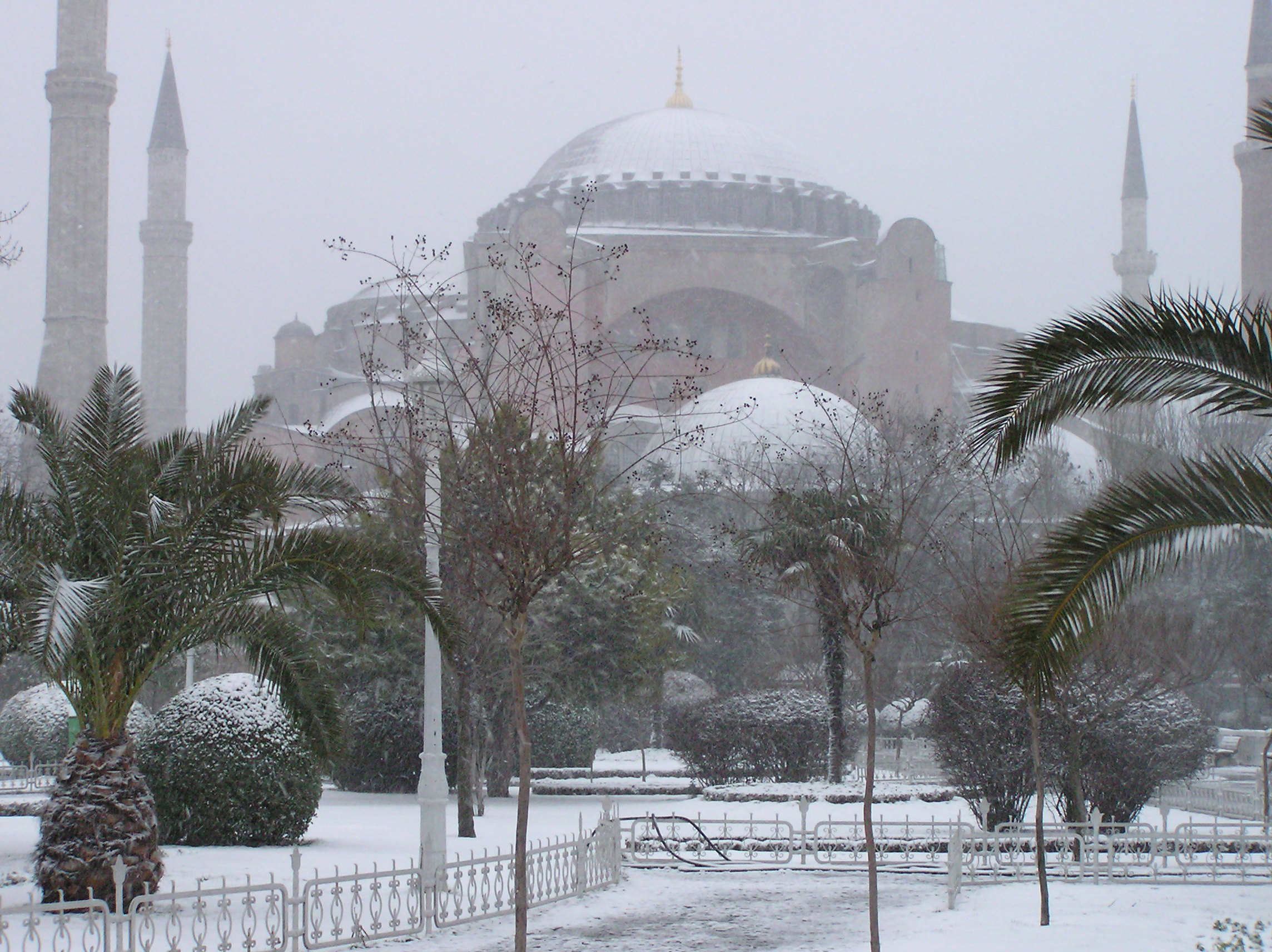
I mean, I have one, it’s a basic generic black wool with a lined hood and shoulder seams. I made it about 10 years ago and it’s still going strong. There’s nothing wrong with it, but it’s also not any particular period. Since I’ve been digging into Byzantine outerwear, I’m trying to discover what my persona would have worn, as well as other options in cloaking and coating for both men and women. It does snow in Constantinople, not a lot, but it does, as seen in this modern photograph of the Hagia Sophia from Wikipedia:
Meanwhile, in New Hampshire:

10923207_10152797109563143_6536709114114551622_n
This is actually the balcony of my apartment after the 2nd snowstorm this month. Today we’re getting the 4th foot+ blast. I want to cry.

Outerwear is important, just as much then as it was now. I plan on keeping my first cloak for outside use when the weather is exceptionally foul, but to have one for nicer occasions outside in the cold or inside cold venues will help complete my look as a properly dressed 11th Century Eastern Roman woman.

This post serves as a cautionary tale into how looking for a simple garment can turn into a whirlwind of research that you didn’t expect. This is the method to my madness.

First I picked up the Byzantine cloak clasp offered by Raymond’s Quiet Press, you can buy your own by clicking on the pic.

In addition to some wool and trim, I had the materials necessary to get started.

I never intended on this to become any sort of research project, I just wanted a cloak. So a fast search on the internet came up first with what I always refer to as the paludamentum in Latin, or a chlamys in Greek, a male cloak fastened at one shoulder, such as in the mosaic of Justinian and his entourage at Ravenna, but the women in Theodora’s mosaic are wearing wrapped shawls,  EXCEPT for the Empress herself, who is also in a chlamys. I haven’t seen too many images from the 11th Century in which these are worn by anybody other than the imperials. It seemed to have evolved from daily wear of even lower office holders (for men!) into ceremonial dress for high court functions.  This theory is supported by Maria Parani in Reconstructing the Reality of Images: Byzantine Material Culture and Religious Iconography 11th-15th Centuries, which I was able to snag on interlibrary loan to begin preliminary research on my Master’s Thesis.
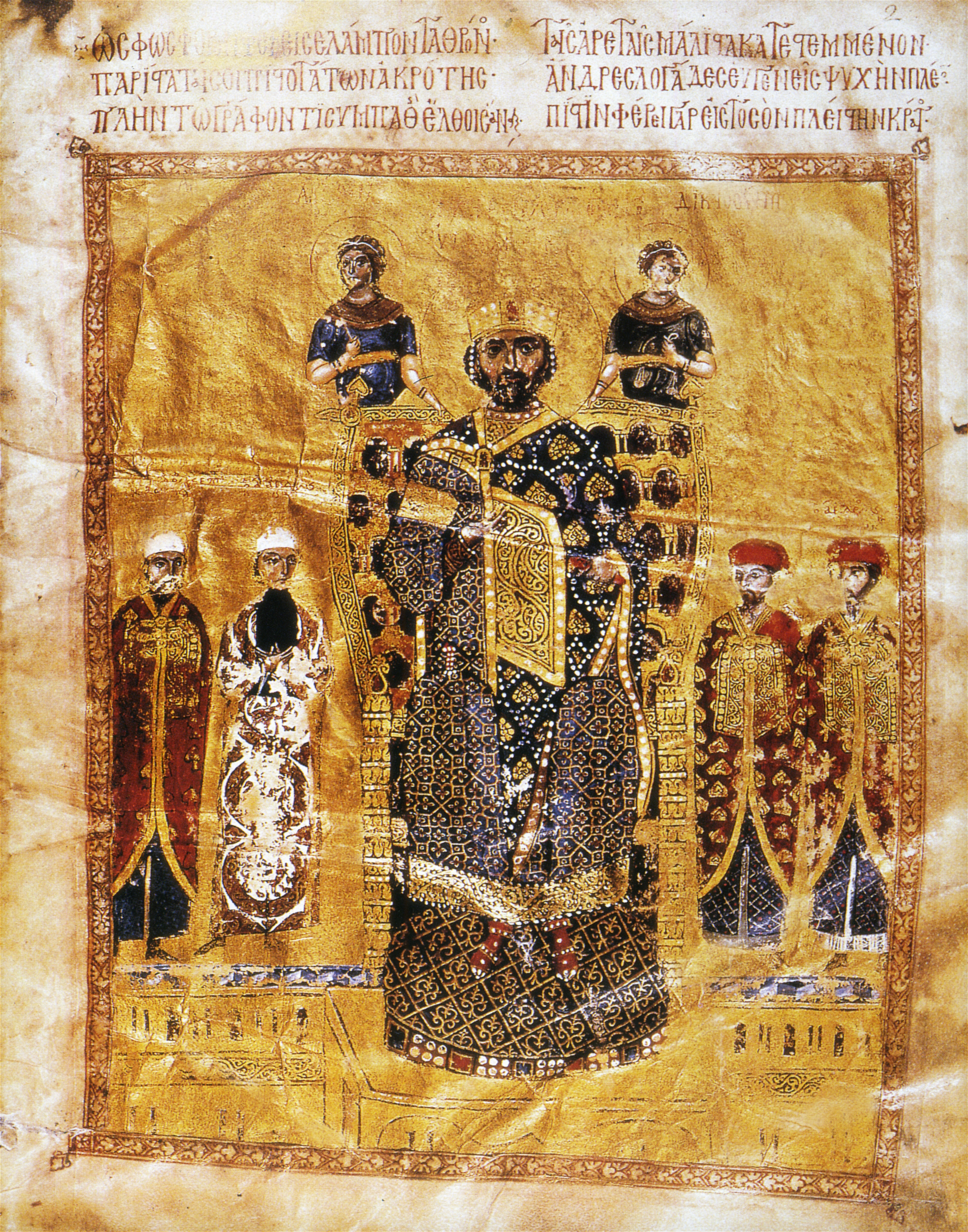
Michael VII Doukas wearing the chlamys, while his attendants wear mandyas, or front closed cloaks. From Coislin 79, f. 2r. Shown in Parani, page 11.

Parani discusses briefly in her chapter on the Imperial Costume that the empress was invested in the chlamys, but probably did not wear it otherwise.[1] So as tempting and shiny as the garment is, unless you are the queen of your SCA kingdom and it’s your coronation, or some extremely important court event, you probably should avoid wearing this garment. Even for men, if you’re middle period (10-12th century) Byzantine and not a king, I’d skip this. It’s just too presumptuous.

Moving away from this idea, there’s the paenula, which is the traditional Roman hooded cloak that dates from antiquity.
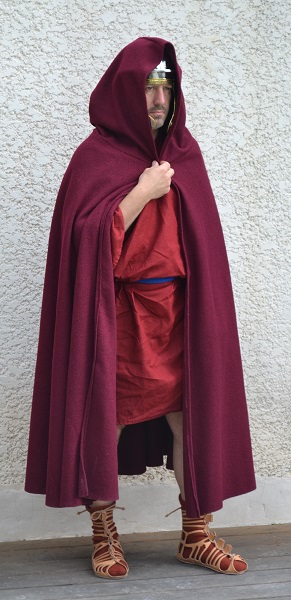
JME_Paenula
Image found in a search online with the search page Hedgy.com, but it would not load.


The only time you see this worn by a woman in any art is by the Virgin Mary and other ecclesiastical women in icons. Avoid this one too. Not only was it out of style pretty early on for both genders, and you wouldn’t want to commit the sin of wearing such an outdated fashion, but the Romans had a very high regard for their iconographic imagery, and this is another one of those things you should just avoid wearing.

Timothy Dawson argues that the practicality of such a garment would be useful, but evidence of its wear in period in scarce[2]. I agree with him here, though I assert that the reason for such scarcity would be the connection to the Virgin, and therefore making the garment a symbol of her own connection to the past. For women who wish to cover their heads in a simple, demure fashion both indoors and out, a veil or wrapped shawl/palla works just fine.

Moving away from the chlamys and paenula, the other option would be the half-circle cloak.

The same images on Dawson’s website over at Levantia.com.au are also in his article within the Varieties of Experience book cited above. So went to myself, “Oh look, there’s a cloak. Sold.”

Finally, a design that was easy and period, and above all, not being presumptuous in rank, all I really need. It’s not like I wanted to put in more research that I really needed for a cloak, but I do like to check the primary sources to get ideas for embellishments and the like. So Plate 10 in “Woman’s Dress in Byzantium” matches the same that he has on the page for “A Typical Middle Byzantine Outfit” here: http://www.levantia.com.au/clothing/reddress.html.[3] This is where my confusion set in. On his page, Dawson refers to this as a mantion, and cites a page from the 1839 edition of De Ceremoniis for the source on this. Fair enough.

I dig up the ebook on Google Books, and begin translating the ecclesiastical Latin of Reiske’s commentary on the page cited, and found that there was nothing of the sort there, in fact, it’s about pyrotechnics, Persians,  and contains a great deal of commentary on a primary source in Arabic. It is unclear from Dawson’s footnote if this is volume one or two, and since two is the only one I can ever find copies of, I went with that. Just to be sure, I searched the document on Google Books for the Greek spelling of mantion, μάντιον, as Dawson suggested on his page, and found nothing. So then turned back to “Women’s Dress in Byzantium” and found that his research was inconsistent in the section where he discussed cloaks and mantles on page 48. In the actual printed article, the word “mantion” isn’t even mentioned, and instead he uses “mandyas,” and supports this through several citations of manuscripts. The book may be a few years older than the webpage, which was last modified in November 2013 according to the page info, but I’m still not 100% sure on why Dawson changed the name between publications. If I can locate the correct supporting evidence in De Ceremoniis, I will know for sure. Until then, I’m chalking it up to a simple error in the footnote that is leaving the source vague. Parani supports the use of mandyas as the correct term.[4]

Now, a mandyas I know is the modern ecclesiastical cloak of the same cut. It’s basically a half circle ornamented in a variety of ways, draped over the shoulder and pinned in front. That’s it. The design is frankly, timeless.

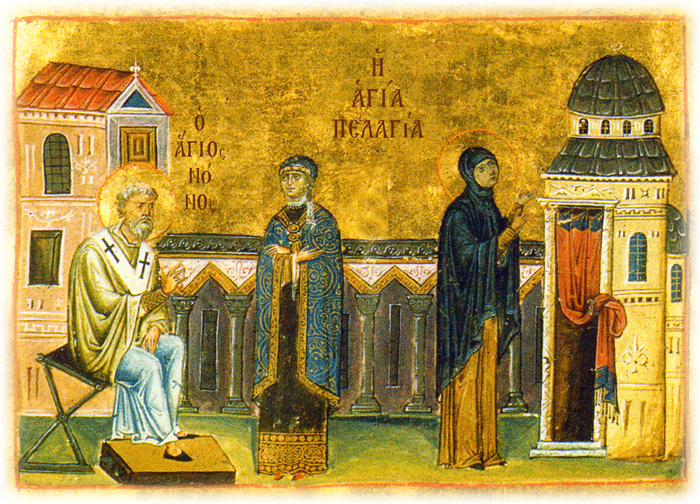
I did some searching for Dawson’s cited manuscripts and couldn’t locate most of them online. This is a common hurdle, as not all libraries have been digitized yet, but fortunately for all of us in the future, they will be. Even the Vatican is digitizing their manuscript library. Even though my initial searches were fruitless, I did find some neat sources for future perusing. I did have some luck with the Menologion of Basil II, which does have its own Wikipedia page for those seeking instant gratification, and found a couple of images, including the empress in a chlamys and a sainted nun in a paenula. What I needed though was evidence of women of aristocratic status wearing it, and folio 98 delivered. Both Dawson and Parani cited this image, and Parani included it in her book.[5]

Melania_the_Younger,_nun_of_Rome_(Menologion_of_Basil_II)
St. Melania the Younger from the Menologion of Basil II. To me it looks like she’s in a paenula.
theophano_himation
Empress Theophano from the same manuscript. Notice how her chlamys is fastened on her right shoulder. A women wearing this in artwork signifies the empress.
ag-Pelagia
Folio 98 of the Menologion of Basil II, featuring St. Palagia before and after she is called to God.

This image above shows both a saint and a laywoman. The haloed saint Palagia wears the hooded paenula, while the woman in the middle, whom I’m assuming is Palagia repenting her sins before converting and devoting her life to God, is secular dress, and, tada! Wearing a mandyas.

Another image that supports the wearing of this style of mantle is one that I’ve previously shown during my research of the propoloma are the donor frescoes of Irene Gabras, and Anna Radene in its full form. The one of Radene shows the traditional thick trim outside, as well as an elaborate lining  behind the magnificently large sleeves of her red 12th Century delmatikion.

NK2HVE00
Irene Gabras, image borrowed from 1186-583.org.
radene-full
Anna Radene from the church of Sts. Anargyroi in Kastoria, Macedonia. Image found on Surprisedbytime.blogspot.com, but the church also has a smaller image here: http://www.macedonian-heritage.gr/HellenicMacedonia/en/img_C252a.html


These three sources span the period from 1000-1180, so it’s safe to say that this garment was very much in style for probably a fair portion of the 10th Century, the duration of the entire 11th Century and into the 12th. All three are featured within Parani’s book.[6] Since my persona is a woman who could have served as a zoste patrikia such as the likes of Radene, it is safe to assume that wearing the mandyas in her style would not be presumptuous, and therefore the route I should take.

Now, I have already been asked, “What makes a mandyas different from a chlamys?”

This is a good question.

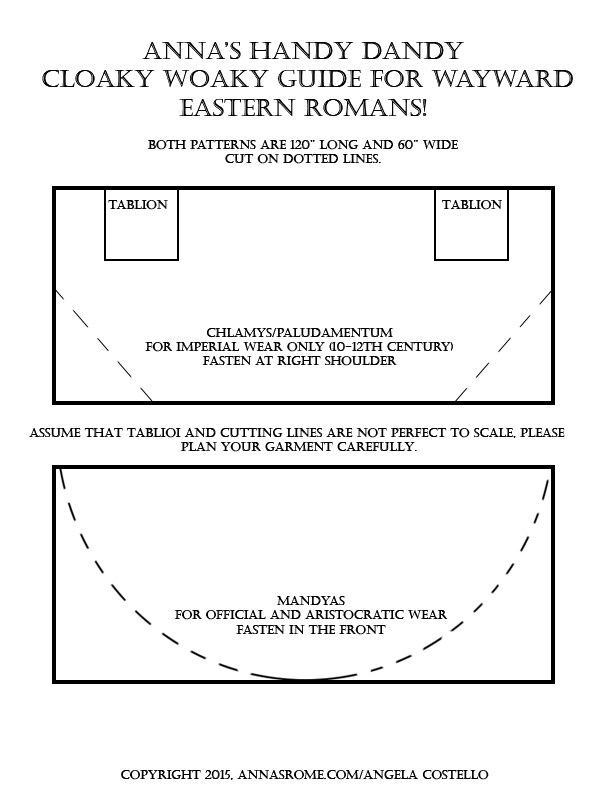
Both historians I have cited, primarily Parani as she has focused on the differences in both imperial and aristocratic dress, agree that the chlamys is absolutely imperial only. Descriptions lead me to believe that the broaching at the right shoulder, as well as the addition of the traditional ornamented panel, the tablion, are the single most important things one needs to pay attention to when making cloaks for  themselves.[7] It was extremely ornate, and not practical in any sense of the word for wearing outside of high court ceremonies.[8] So in theory, this thing was probably so heavily laden down with jewels and metals that not only was it out of the price range of anything but the imperial family, but also its sheer weight was probably enough to keep the wearers indoors. I also believe that since the Roman paludamentum, which is essentially the same garment as the Byzantine chlamys, was trapezoidal (think rectangle with the two bottom corners cut off) and not semi-circular, that the imperials would have preferred to maintain the ancient shape, versus the easier to cut and trim half-circle counterpart.[9]

Note: If you see an icon of an angel or saint wearing a chlamys, remember that these figures are often in imperial ceremonial dress, as that is to be expected of all divine beings.

Here are patterns I just cooked up to give a better understanding:
cloakpatterns


As for how these can be embellished, if Anna Radene is any indication, the aristocracy did not slouch when it came to blinging their accoutrements. In Dawson’s article, he discusses the will of an aristocratic lady by the name of Kale Pakouriane in which she discusses her clothing items, including heavily embellished mandyai with silk, pearls, and gold bands.[10] Parani brings up this same document for different reasons, so now it’s on my “MUST FIND” list, so that I too, can get a glimpse into the belongings of a high ranking lady of this period.


Anyways, I’m cooked. This just goes to show you how much you can find about one garment in just 2 monographs and an afternoon to kill looking for images and writing a blog post. I will be planning and making my own mandyas this week.


….all I wanted was a cloak. Seriously.

But at least I didn’t want a Pepsi.

free-mike
If you don’t get this, go here: https://www.youtube.com/watch?v=LoF_a0-7xVQ


Bibliography (image sources cited within text):

Constantine Porphyrogénnētos, De Cerimoniis aulae Byzantinae libri duo. London: Oxford. 1830.

Dawson, Timothy. “Propriety, Practicality, and Pleasure: The Parameters of Women’s Dress in Byzantium, A. D. 1000-1200.” In Byzantine Women: Varieties of Experience AD 800-1200, edited by Lynda Garland. Hampshire; Burlington: Ashgate, 2006.

Goldman, Norma. “Reconstructing Roman Clothing.” in The World of Roman Costume. Edited by. Judith Lynn Sebesta and Larissa Bonfante. Madison: University of Wisconsin Press, 2001.

Parani, Maria. Reconstructing the Reality of Images: Byzantine Material Culture and Religious Iconography 11th-15th Centuries. Leiden;Boston: Brill, 2003.


[1] Maria Parani, Reconstructing the Reality of Images: Byzantine Material Culture and Religious Iconography 11th-15th Centuries, (Leiden;Boston: Brill, 2003.) 17-18.

[2] Timothy Dawson, “Propriety, Practicality, and Pleasure: The Parameters of Women’s Dress in Byzantium, A. D. 1000-1200.” In Byzantine Women: Varieties of Experience AD 800-1200, ed. Lynda Garland, (Hampshire; Burlington: Ashgate, 2006.) 48.

[3] Dawson, “Woman’s Dress in Byzantium,” 73.

[4] Parani, 73. Here she’s citing the will of Kale Pakouriane, a lady of the middle Byzantine period who discusses clothing in her will. She also discusses it as being an alternative garment worn by the Emperor on pages 16 and 17.

[5] Parani, plate 80. Vat. Gr. 1613, f. 98 depicting St. Pelagia the Harlot

[6] Ibid, plates 80, 81, 84.

[7] Dawson, 49.

[8] Parani, 12.

[9] Norma Goldman, “Reconstructing Roman Clothing,” in The World of Roman Costume, ed. Judith Lynn Sebesta and Larissa Bonfante, (Madison: University of Wisconsin Press, 2001.) 233.

[10] Dawson, 49.

Justified and Ancient: Babylonians at Birka

The Earliest Period.
The Final Frontier.
The Alpha to our not-yet-happened Omega.
The Cradle of Civilization.
The Mesopotamians.

I am insane. As if my entry to the Garb Challenge last year wasn’t crazy enough, I had to find a way to one-up myself. Because that is what I do.

It’s not a challenge unless you’re actually challenged.

Her Majesty Thyra called for a “celestial” theme for the Birka garb challenge for this year, leaving it fully open to the interpretation of the artistes.

When I think of “celestial,” two things come to mind: the zodiac and tea. As funny as it could have been to dress up as an interpretation of Celestial Seasonings (that idea is totally attributed to my Laurel’s husband) I figured that the zodiac would be more cool. After all, Leo is by far the most superior sign in the entire sky, and with 1/12th of the world’s population, we should really be ruling it. Those other guys? Peons.  Meh.

I’ve been toying with the idea of the Earliest Period for a while. There’s just not much to work with but an interesting artistic record and old books on the subject. Plus, the majority of what’s been done is for religious plays, so sources are more  theatrical, rather than historical. In the end, I ended up getting a pleasant mix. Let’s get started.

tumblr_mdr1fcwRma1rrje88o1_500
“GET OFF MY ZIGGURAT!” (I love this frieze way too much.)

The Babylonians and their sister Mesopotamian cultures (Sumerians, Assyrians, Ugarites, etc.)  invented  the origins of what we consider as our Western Zodiac and modern astrology. So they’re responsible for your bad hair days during Mercury Retrograde, and your incompatibility with Libra.  They also didn’t wear much, and left behind just enough for us to get the gist. As for sources, I was only able to get my paws on a couple:

Jenkins, David. The Cambridge History of Western Textiles. Cambridge: Cambridge University Press. 2003.

Houston, Mary G. Ancient Egyptian, Mesopotamian, and Persian Costume. Mineola: Dover. 2002. Reprint by Dover of a 1920 edition.

What they DID leave us, is jewelry. Holy smokes.

attendant
An “attendant” to Queen Puabi found in the Great Death Pit find at Ur. Source: http://sumerianshakespeare.com/117701/118101.html

It was actually my husband Geoffrey that alerted me to this. I was going to make some sort of turban or hat. In fact, I came up with this bright idea while he was away on deployment during the Fall. So he had no idea how I planned to torture him until he got home. At first, he looked at me like I had six heads. Then I told him that he didn’t have to play, and he could just help me with some projects. Then I didn’t see him for weeks once the brass came in.

Anna’s job: Design the costumes and do all the soft parts.
Geoffrey’s job: Execute the metalwork and jewelry designs.

Anna’s work:

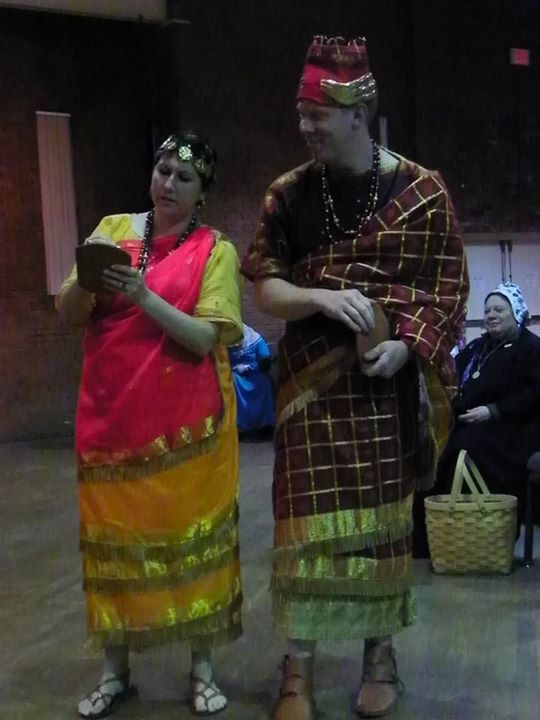
Before Geoff was even home, I got the fabric ordered. My plan of attack? Vintage sarees. Did the Babylonians wear sarees? Well, no. And certainly not ones out of cotton, silk, and polyester.  They wore a lot of wool actually, and from what I gathered, sheep fleece made into fringe. However, they did wear spiral wraps, and it wouldn’t surprise me in the least if they did have influence on the fashion of the Indian subcontinent. In their existing artwork, you see tons of interesting motifs, including palms, various vines, and geometrics. Sometimes the wraps were over tunics, sometimes they weren’t. Sometimes they were nakey, but that wouldn’t fly for January in New Hampshire. So I had to play around with what we could do. First: Color.

There’s a variety of options out there for saris, but the zodiac has their own colors assigned to them. Most of my research (See also: Fast Google Search) returned that Leo was yellow, and Aries was red. Easy enough. Geoff can wear red. I can wear anything because I’m fabulous. I’m also a fan of orange, previously established last year, so I had to include it again. Some charts said Leo could wear orange, so…let’s do this. I decided on flame colors for Leo: Yellow, orange, and gold. And decadent shades of red and gold for Aries. Both signs are fire signs, so the gold needed to get in there. Other details I discovered was that Leo is ruled by the Sun, while Aries is ruled by Mars. We were also both Rising Capricorn, whatever that means, which involves purple and silver. So, I thought of throwing a stripe in there somewhere, and then decided not to.

I found a variety of sarees to work from in the eBay store of a seller in India. I bought so many that they sent it via FedEx for free, and I had a package from India in less than a week. I love the internet.

Once I had supplies in hand, I started the design process. Surprisingly enough, men seemed to have more convoluted options than women, so I started with myself first.

Women were usually depicted wearing the spiral over the left shoulder. Sometimes with a tunic underneath, but usually not. I decided to go FOR the tunic, as the materials I got were rather sheer, and well, January.

winged_ishtar
An image of Ishtar wearing the spiral, with attendants that I THINK are wearing sleeves.
ang1
Image from Houston, I think this is a dude, but there’s the tunic.
ang2
Another image from Houston from a cylinder seal that shows women.

I decided that the yellow saree would be the tunic, and the orange and pink one I got would make a nice spiral. This would give me a flame-like appearance. I got a new dressform for Christmas, so I got to play. \m/

First, I played with the spiral.

IMAG3366
Once I got in the 20yds of fringe, I trimmed it. I got asked by my apartment manager why I needed 20 yards of fringe when it came in. (I’ll cover the jewelry in a bit.)

IMAG3419

Tunic time. This took some thought. How would I cut the sari to best accommodate the ornamentation of the fabric. I ended up going with my simple dalmatica pattern, which would probably be the most reasonable way the Babylonians may have sewn something without tailoring.

IMAG3466

It was very sheer and oversized.

IMAG3467

And I got to use scraps as a headband like a rockstar.

IMAG3468

I recycled the fall from the bottom edge of the saree as the belt. So sheeeeeer.

IMAG3472

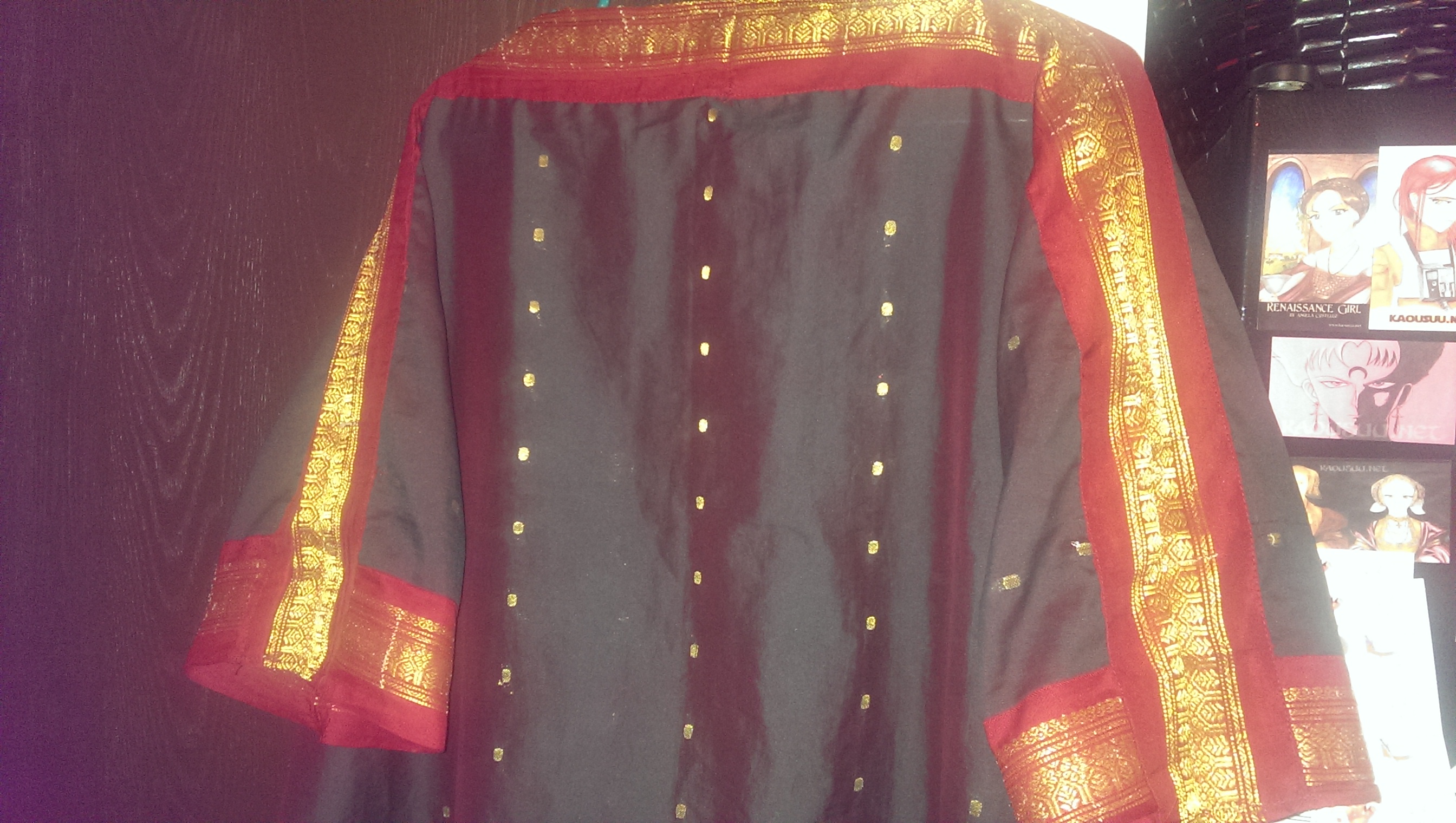
So I went ahead and wrapped the spiral up, folding down some layers to be able to build the dress, and voila. Finished garb.

IMAG3475

Onto Geoffrey as Aries. This is where it got tricky. The tunic would  be a given, but there’s a fairly large amount of fantasy Babylonian out there because of religious plays, and some old, old plates from Victorian costume books. I needed to do what I could to make it less theatrical and more historical, despite the gaudy sarees.

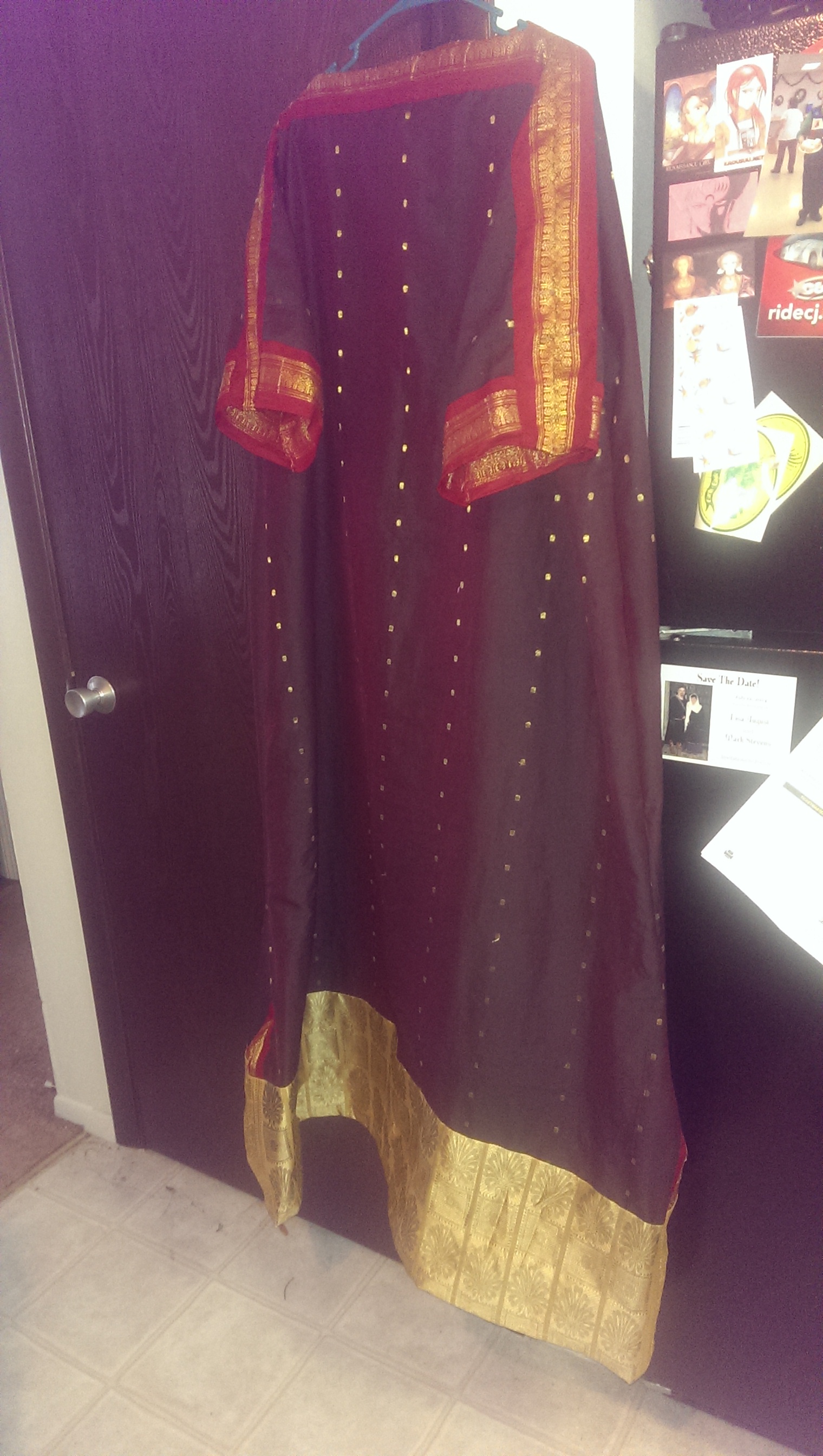
His tunic was the same pattern, then I took the trim from the edges of the saree and added an accent to the sleeves and collar, which is actually pretty Roman-looking. Aries is more decadent than Leo, so I decided to give him more metallics than myself. I would have enough bling with my jewelry.

IMAG3478 IMAG3479

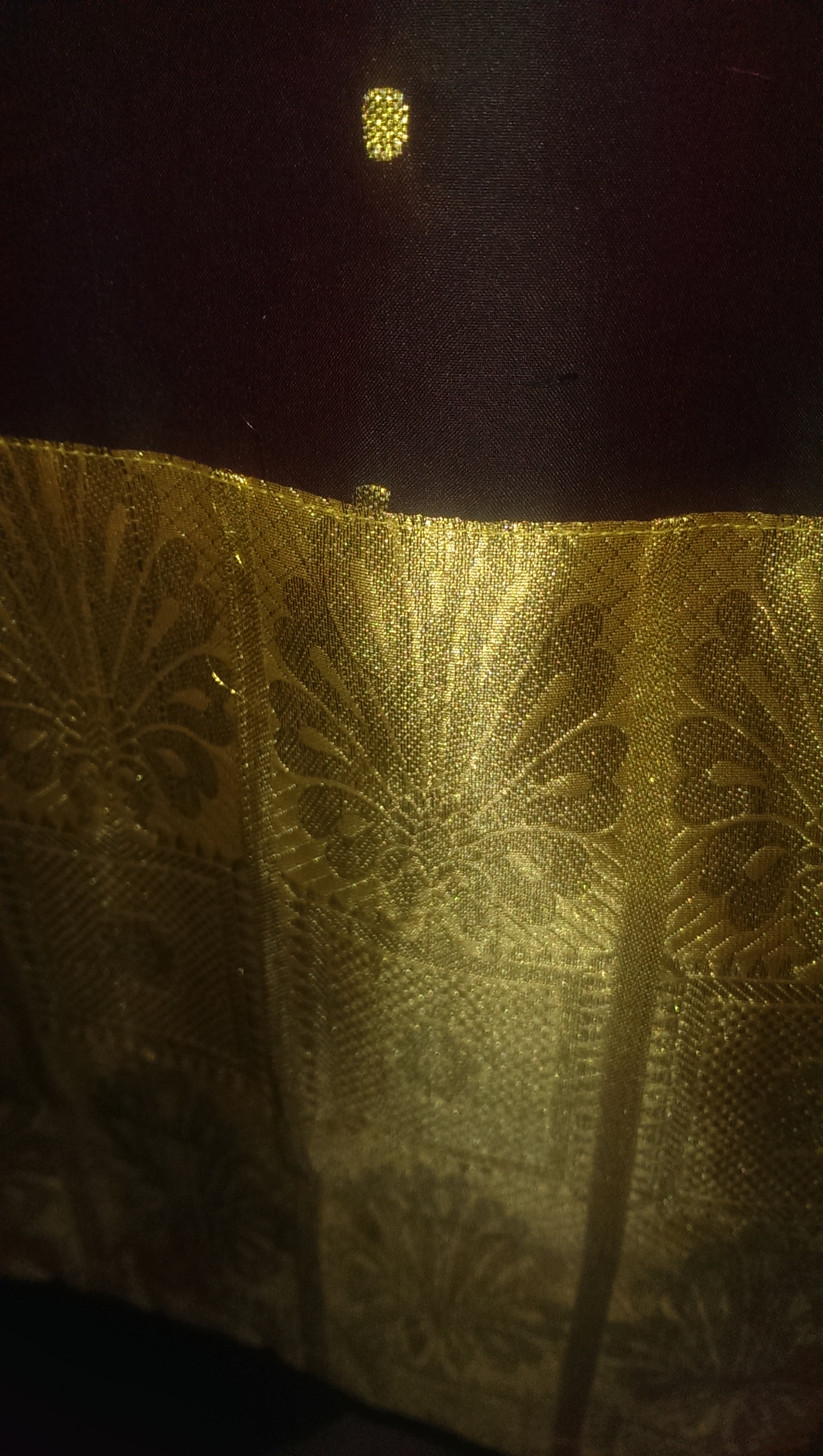
I cut the pallu off of another saree, and trimmed the bottom of this tunic to make it longer and to mimic some palm designs I’ve seen in artistic record.

IMAG3482 IMAG3483 IMAG3484 IMAG3488

Now for his spirally goodness. I used the saree that I had cut the pallu from for his wrap, added the fringe, and looked at some art. This one has men dressed in several types of wrapping, so it’s clear that there was no set method.

babylonian_jeff

So I kept it basic for the drape test.

IMAG3492

And then I had the prettiest mannequins in Portsmouth. My work was pretty much done.

IMAG3496

I had to make him a hat. We debated for a while on which shape was best, but I ended up going with the “fez” shape, as it seemed the most reasonable for the application of his horns and wireform Aries symbols. Easy enough. 2 layers of felt and extra saree trim. It was still a bit squishy, but workable.

IMAG3537 IMAG3540

….And then we had the jewelry.

By the time I was on the website for Fire Mountain Gems, Geoffrey said we were going big, or going home. In that case, we were going to spend the money for actual semi-precious stones, rather than glass or lower-quality rocks. So, yes, our necklaces are all real lapis lazuli and carnelian. Fortunately, a friend of ours went in on the Fire Mountain order and saved us over $100. The gold tone beads are plated brass, as there’s no way we could afford that much real gold.  We based most of the necklaces off of pictures from this page that was wonderful for reference shots. http://sumerianshakespeare.com/117701/118101.html

They were just simply threaded on monofilament. We couldn’t find a hemp or linen cord thin enough for our use, plus, we are planning on taking these apart and re-using them for other projects or selling them. So for temp stringing, the fishing line would do just fine.

I could string beads, the rest was up to Geoffrey.

Geoffrey’s Work:

Geoff has been exploring the intricate world of jewelry a bit. He’s the only active coinmaker in the East (as far as we know) and he’s been doing great work with pewter casting. These pieces couldn’t be cast, so he finally got to dust off the pitch plate he purchased at Pennsic (nice alliteration there) and enter the wiley whimsical world of chase and repousse embossing. (He has his own blog and you should follow it at www.jeffthemoneyer.wordpress.com. I do maintain the page, he’s not very websavvy.)

He purchased the sheets of brass from onlinemetals.com. We originally wanted bronze, but the price was a bit higher than what we wanted to pay because the cost of tin is up, and they didn’t have a good thickness anyway. He used brass sheets that were probably still too thick at 24 gauge.

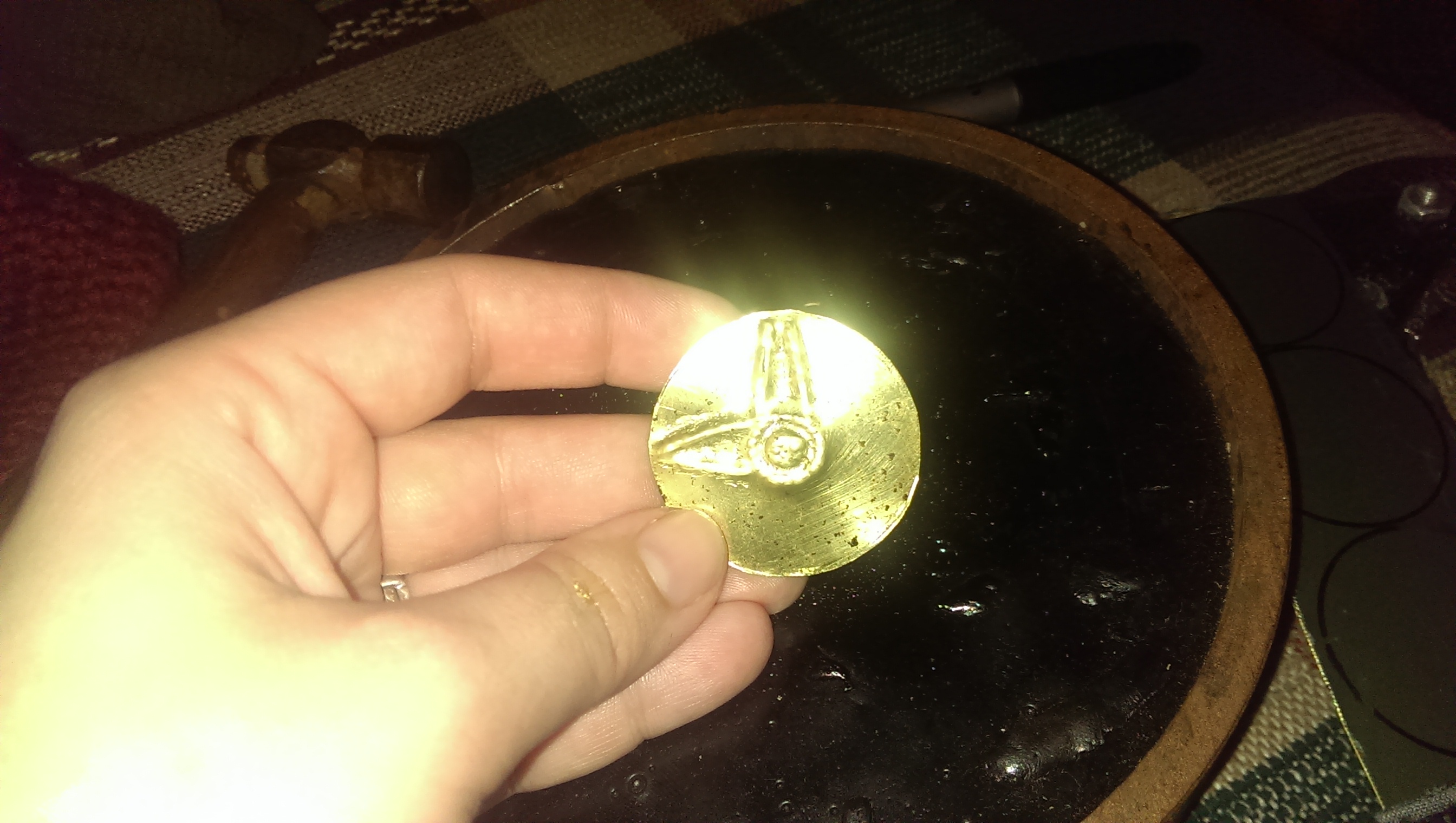
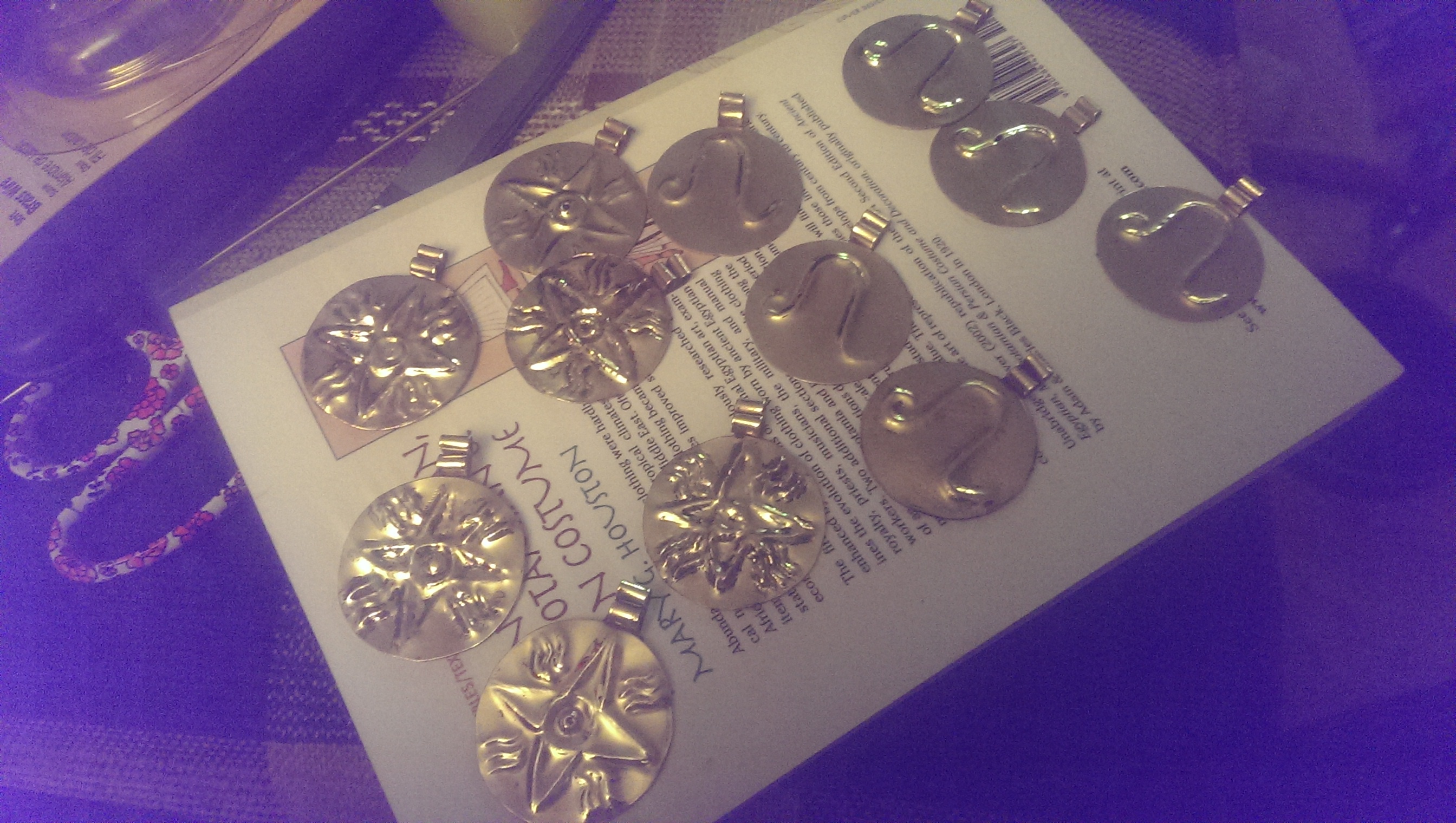
The original circlets from this period had leaves. They’re absolutely stunning. However, in order to not appear presumptuous and pay honor to the Order of the Laurel which I am not apart of, we decided to go with round medallions instead of leaves. Each of the large medallions he hand cut, repoussed, soldered, and wheel polished. This took days. DAYS. It took so long that we had to cut the process short for the other circlet, and just go with smaller medallions he could use punches with.

The large medallions have the Leo symbol, and a Babylonian sun motif that is connected to the sun god, Shamash.

IMAG3500
Lap top metalwork in the bathrobe. Yep. This is how we roll.
IMAG3503
The beginning of the first piece.
Shamash-Sun-God
Symbol of the sun god, Shamash.
IMAG3506
The first completed sun.
IMAG3543
He got a polishing wheel from Santa, and put it to good use.
IMAG3545
The finished medallions!
IMAG3547
The first layer of carnelian and lapis, following the same pattern as the original circlet.
c86860ffc8069cc7ffff86d8ffffe41e
Original circlet.
IMAG3550
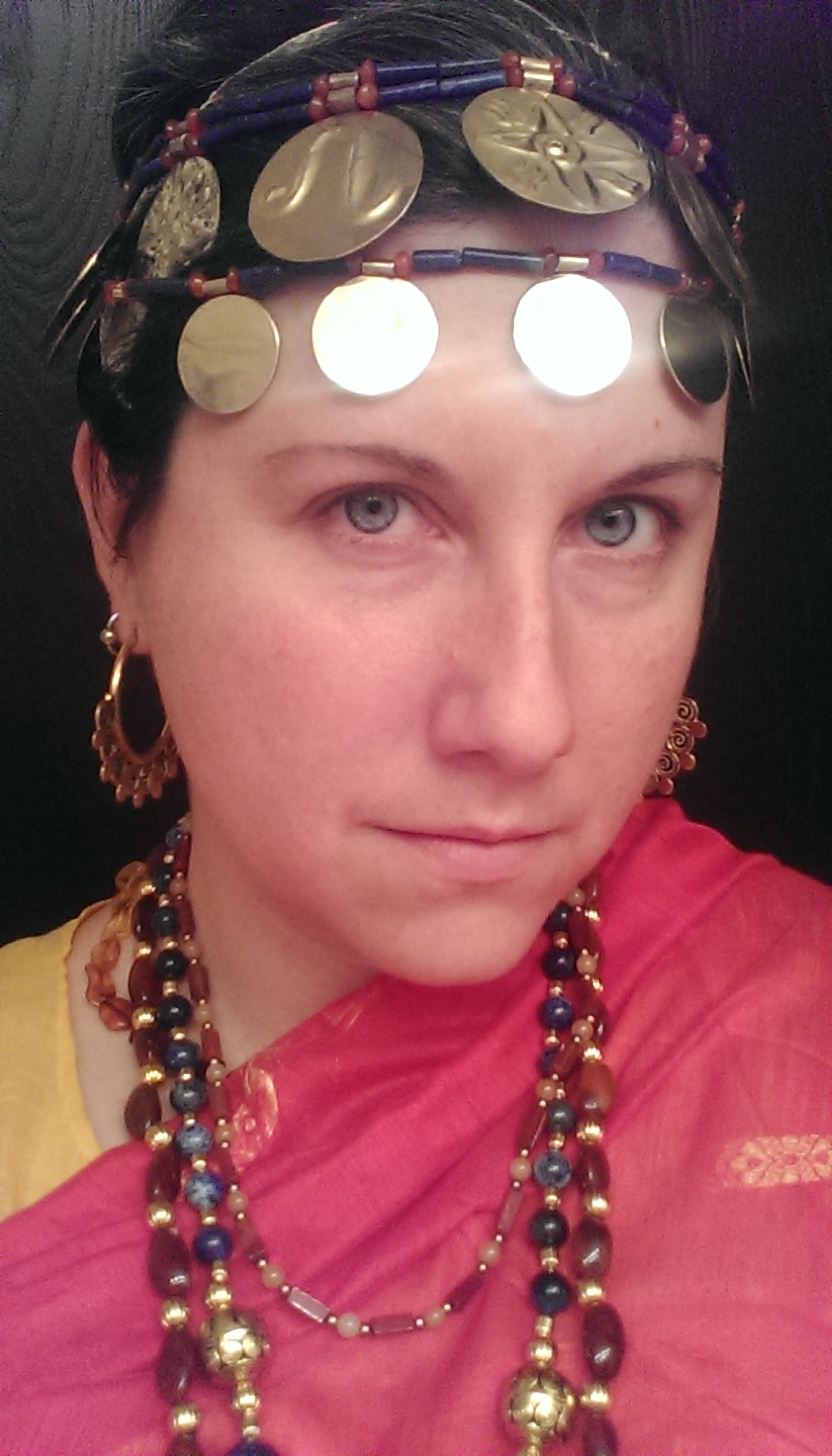
My Leonine circlet of shiny and messy hair. The test fit.

He did the same thing for the smaller medallions, only with one row of beads instead of two. And polished up a hammered brass circlet he had made me previously. Combined with the necklaces, and brass earrings from Thailand, I had my first full costume fitting:

IMAG3575

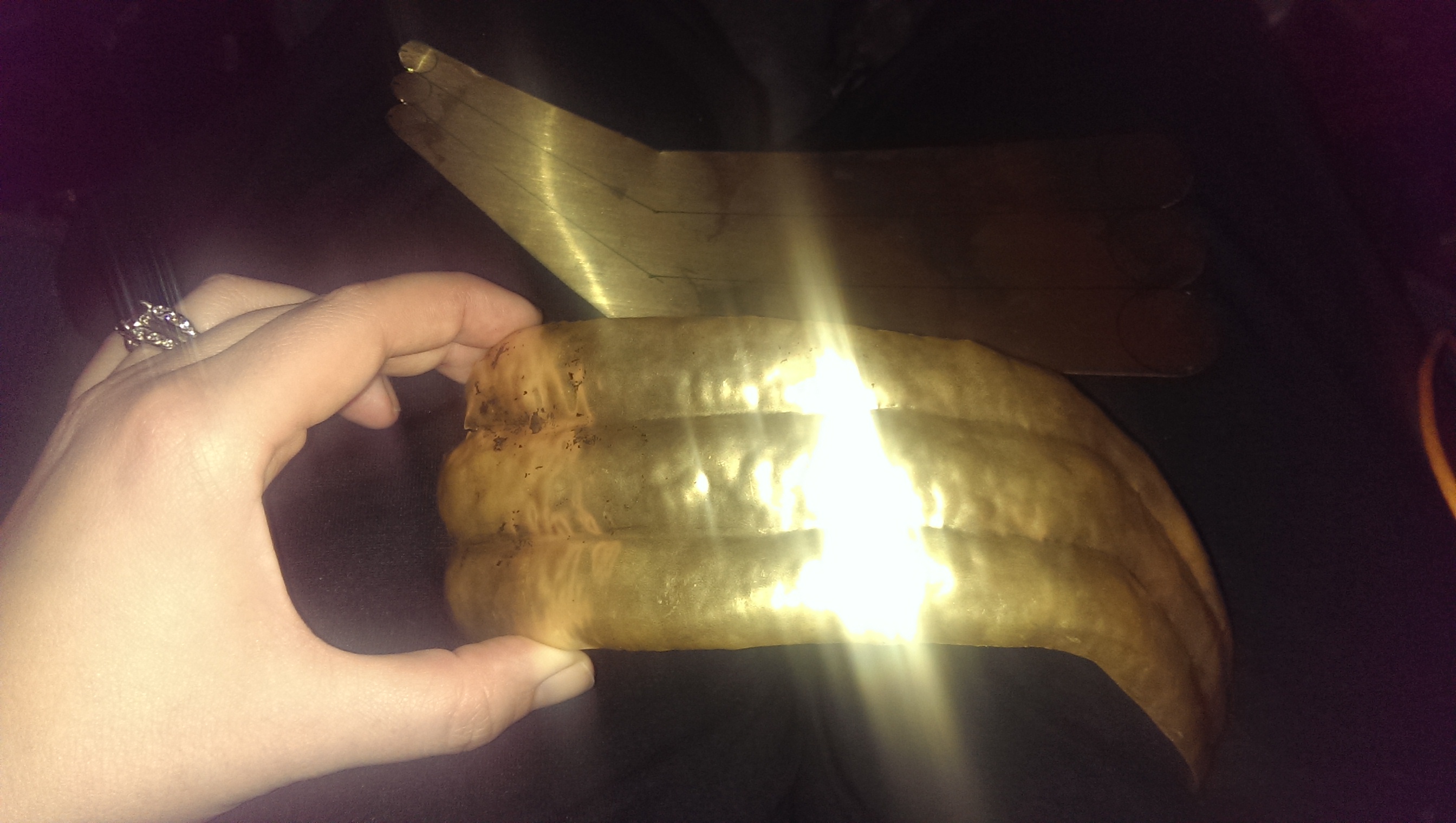
Next, we moved onto Aries. He hammered the “horns” for the traditional hat right out of cut pieces of brass.

IMAG3569
So much shiny, and this is PRE-polishing wheel.

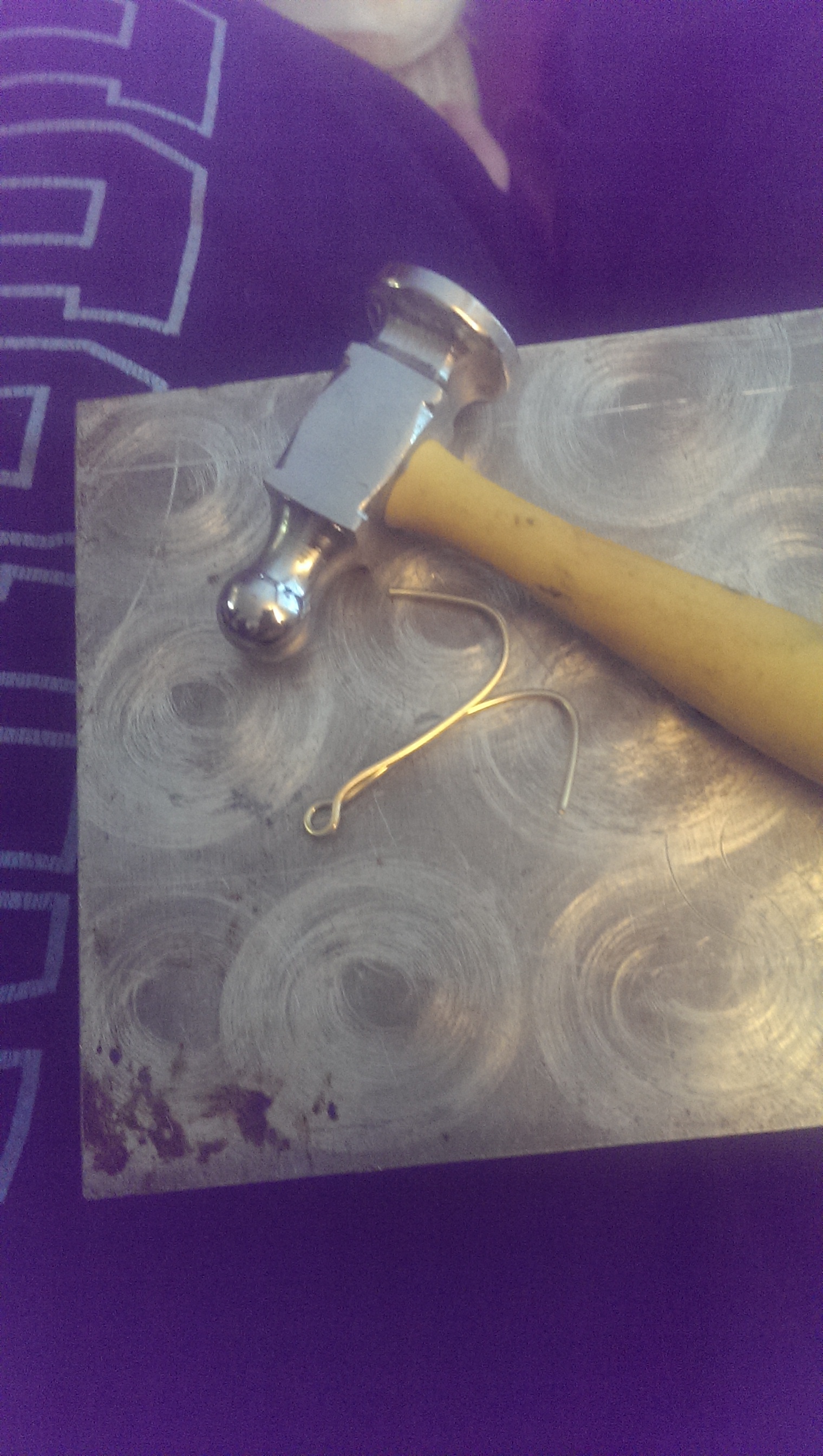
And I made 2 dozen wire formed Aries symbols for dongles to sew onto the top of his hat in place of the feathers, and some ornamentation on his sleeves. This sucked. Anna is not a jeweler. Anna LIKES having skin on her fingers and not smashing her hand with a hammer. I also made Leo symbols that I ended up not using. C’est la vie.

IMAG3536


Those got attached to his hat by hand. Sewing the upside down fish hooks on was enough of a challenge for me. He had to rivet on the horns with pieces of brass wire he soldered on. This made the hat uncomfortable. The horns also made it a bit snug since he didn’t form them to his head enough. He was going to be in some pain when this was done.

They say props are everything:

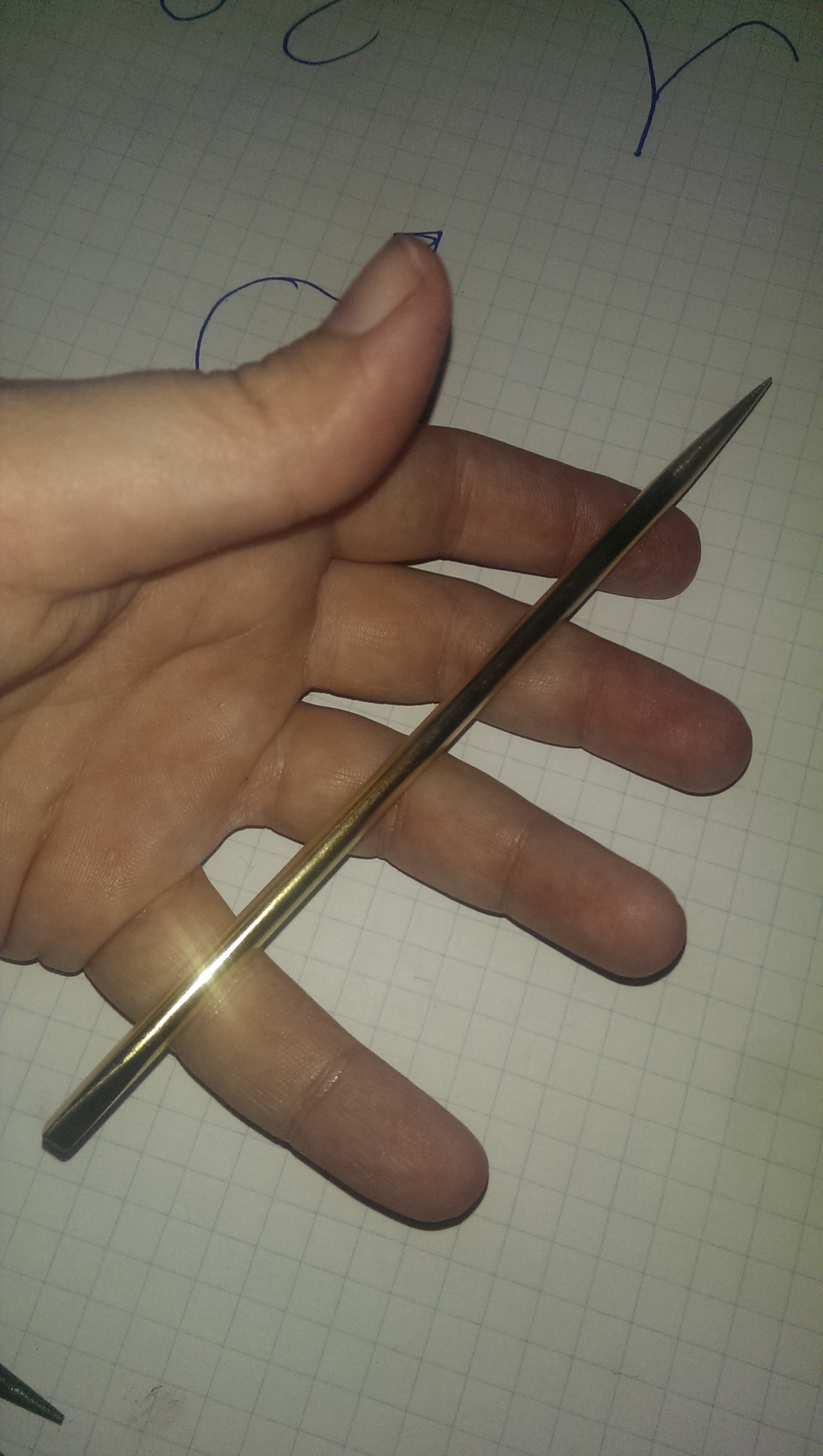
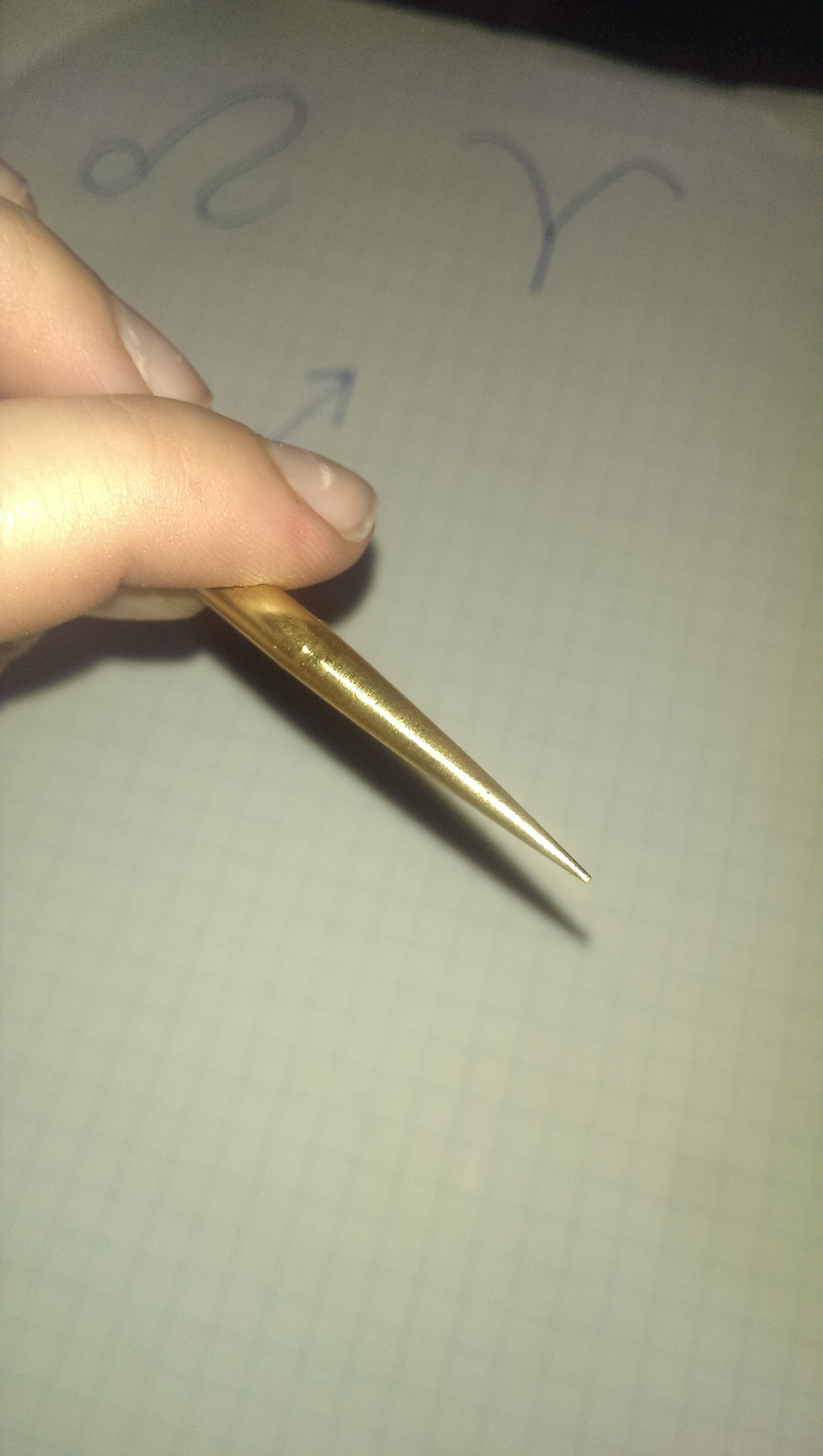
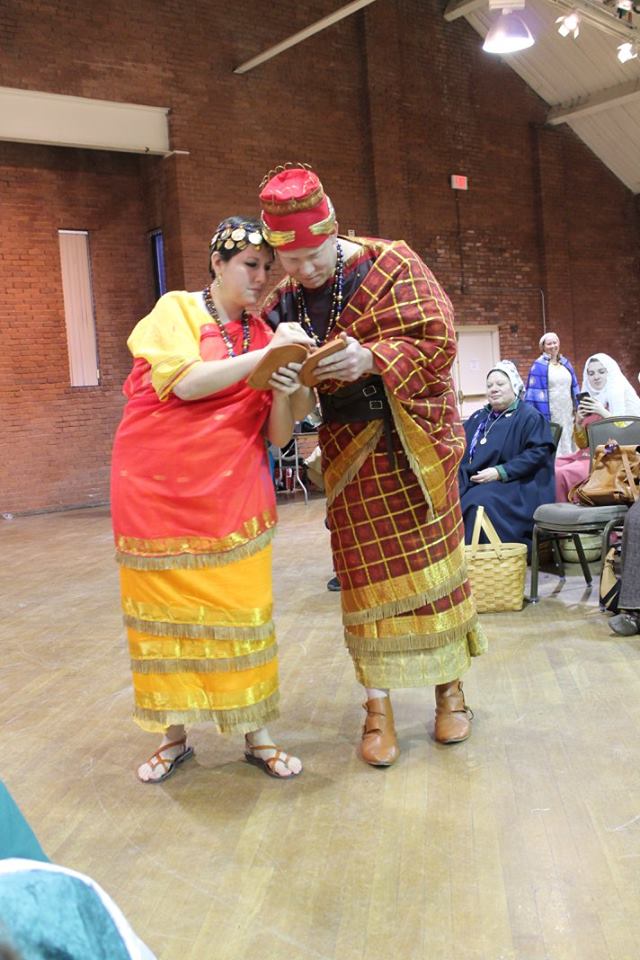
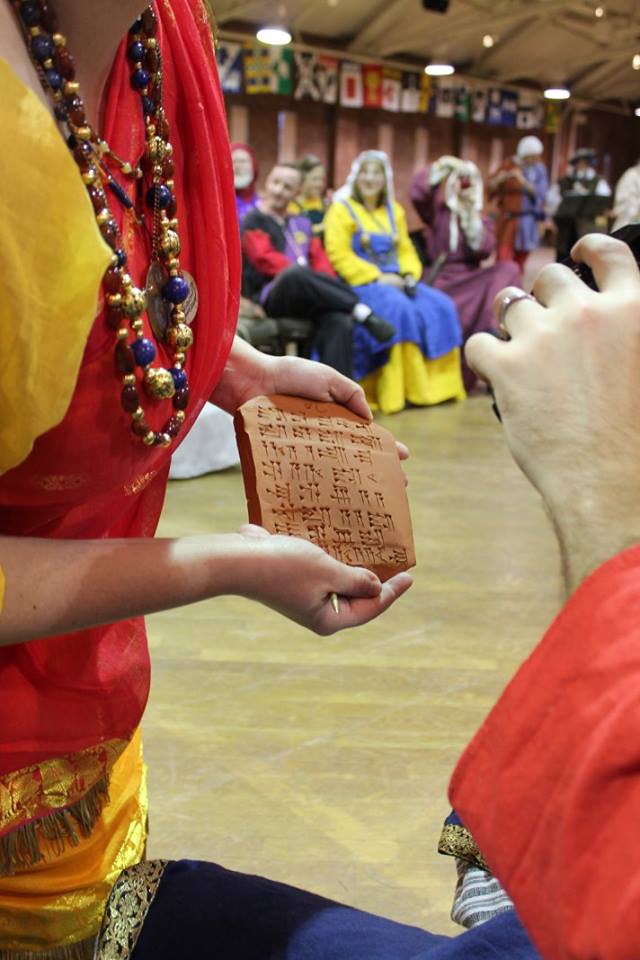
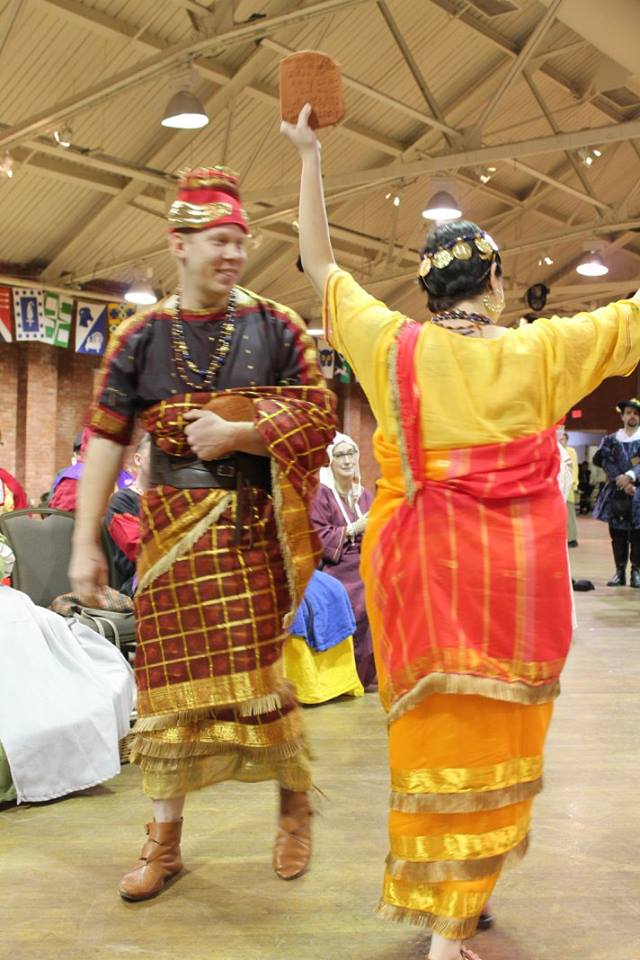
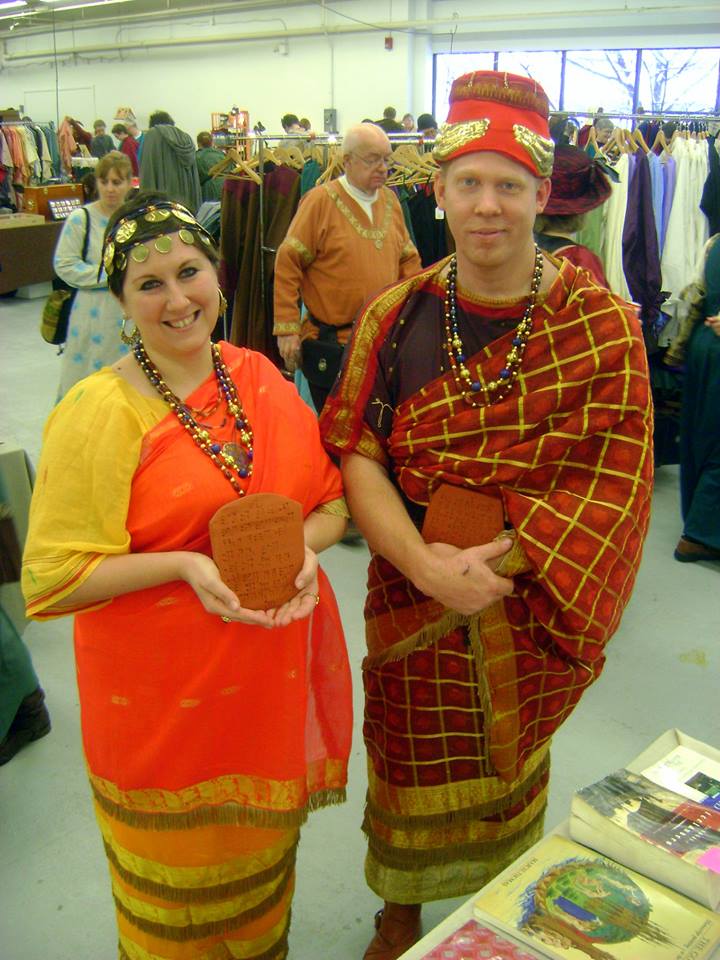
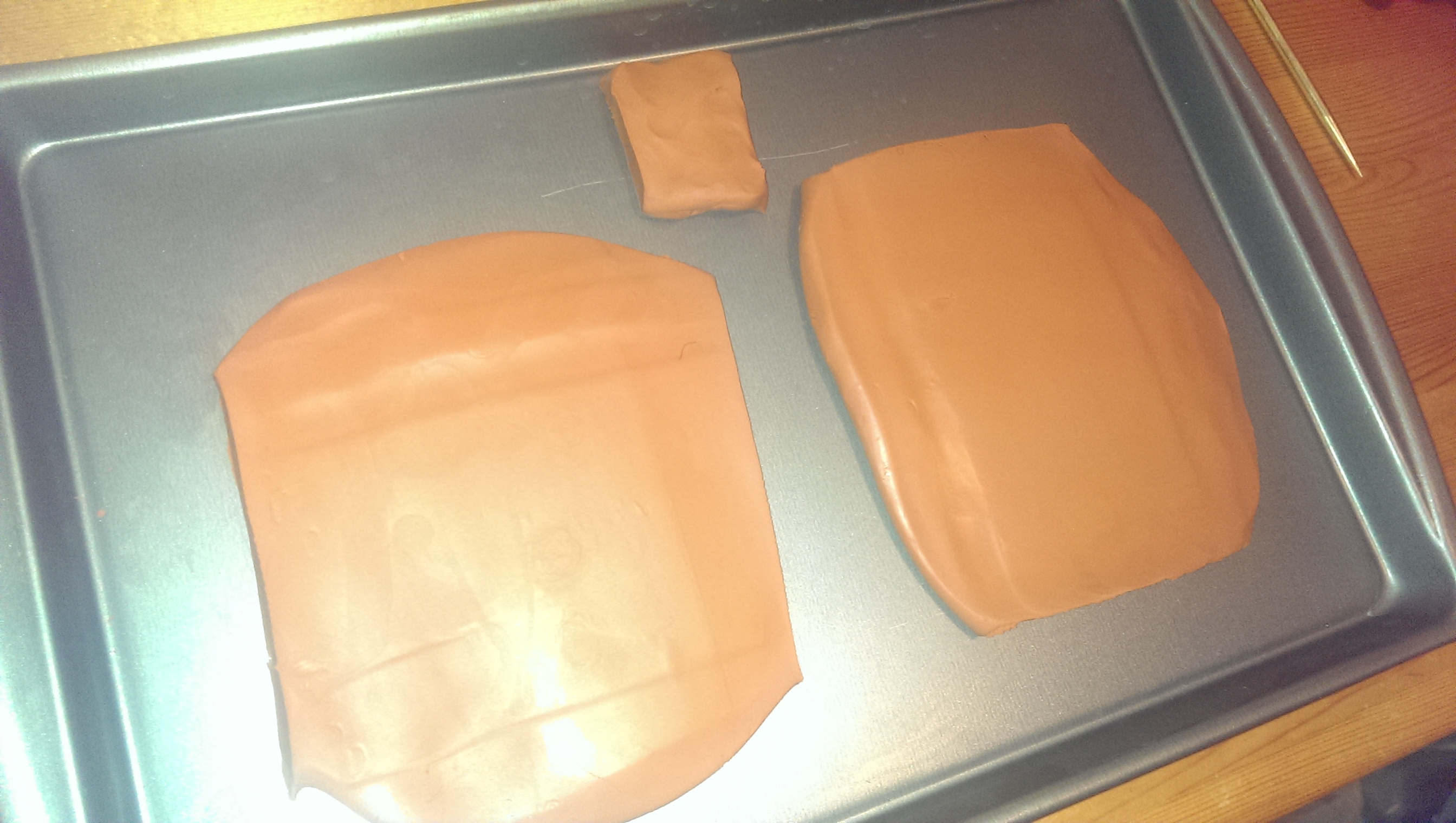
I made two cuneiform tablets out of terracotta Sculpey, with a stylus Geoffrey formed for me out of a brass dowel.

IMAG3525 IMAG3526 IMAG3528 IMAG3551 IMAG3552  IMAG3554

The tablets read:

Leo: “Remember this: Leo rules and Aries drools!” (He wasn’t happy about that one.)
Aries: “If you can read this, you’re pretty damn smart.”

They are in English, not Akkadian,  and I just translated them into cuneiform using this website: http://www.paleoaliens.com/event/babylonian/ (PaleoAliens sounds like a legit source!)


The finale:

After all was said and done, we did our test wearings, and figured out the best ways to wrap the spirals on our bodies. You need to start at the belt like a saree, and work it up your body, carefully folding to create the tiers. For Geoffrey, we brought it up to about his sterum, and used his kidney belt to secure it. Mine was safety pinned in the back to hold the drape in place.

Over all, this was an exercise in experimental archaeology and making fancy kinda-accurate showy garb. If anyone is serious about looking into the persona of the Earliest Period, I recommend you actually attempt dreadlocking your own sheep fleece for the fringe. 😉 Other than that, I don’t have much to say on the subject of garb from this period. What you see is what you get until more artifacts are found.

As for women, if you’re curvy like I am, this may not be the best option. I’m not sure how Mesopotamian women were shaped, but this garment is not figure flattering. It fits to the widest part of your body, and stays there. SO for me, it was my hips. I lost my waist entirely in the wrap, so the pictures coming in are mortifying.

I couldn’t get Geoffrey to wear a wig and beard, or even kohl on his eyes, but in the end, wigs and a fake beard would have no re-wear for us. So it would have been a waste of money. At least for the garments and the jewelry, most can be reconstituted into different pieces. His tunic is going to become a Byzantine kamision for him, and I will be taking the wraps and making loroi/pallae, and maybe a delmatikion. My yellow tunic can work under a Roman dress for a splash of sheer color. So everything can be re-worn as something else. This way the money and time we put into this won’t be for nothing.

But, we DID win Best Garb in the Early Period category for the Fashion Show! We didn’t win the overall Celestial Challenge, that went to a woman who made an AMAZING cloak with the planets from a 14th Century Manuscript.

scroll

Here’s some pictures of us in action at Birka, enjoy!

1897750_10153009301203959_8936626155477613510_n 10418393_10153009301223959_1680984858815226089_n 10423269_10153668651504848_2173191541741422227_n 10940528_10153009301473959_5125582394689521577_n 10941385_10153009301483959_1898059147726376917_n headwear us better

Award of Arms scroll for Lady Petra de Cilicia

I’ve done some translation before for scribal work, but I never really get the chance to play wordsmith. So when the husband of a friend receiving her AoA at Birka this last weekend asked me and the other ladies of the house to help, I got excited. Her persona is Spartan, which makes things surprisingly difficult as written Spartan anything is scarce. There’s only 2 recorded Spartan poets, and they were entirely chronicled by later authors. In this case, I was able to find some Tyrtaeus quoted by the Roman author, Plutarch, in “The Life of Lycurgus” from The Parallel Lives, and some snippets of awesome from his section on Spartan sayings in Moralia.

This is what I was able to come up with, with notations in brackets:

Phoebus Apollo’s the mandate was which they brought from Pytho, [Pythian Apollo was a  Spartan patron god.]

Voicing the will of the god, nor were his words unfulfilled:

Sway in the council and honors divine belong to Edward and Thyra, [King and Queen of the East.]

Under whose care has been set Sparta’s city of charm;

Second to them is one, Petra de Cilicia.

Who swift in foot, aides our Hoplites of Eastern Shores,

Supporting the armies, and the love of her husband unwavering

and thus, the understanding that a helmet is for personal protection,

but the shield is common good for all. [The court laughed a lot here, I wish they didn’t. The quote is serious.]

And by this duty, our king, our queen, and council

Name on this day, Lady Petra, and award her arms for her to bear alone.

Duly confirming by vote this unperverted decree

Declared six days before the month of Eleusinios, [Eleusinios is approximately the Spartan month of February, named for the Eleusinian Mysteries, another cult that the Spartans revered.]

Before the great council at Market Day at Birka, [Spartans were huge into councils.]

Koino̱nía Étos Forty-Nine. [‘Koino̱nía Étos’ is Greek for the Latin ‘anno societatis’ or, ‘in the year of the society’.]

For anyone interested in Spartan society, I highly recommend the above sources by Plutarch, and also Herodotus’ Histories.

Linkage:

Plutarch: “Sayings of the Spartans” from Moralia:
http://penelope.uchicago.edu/Thayer/E/Roman/Texts/Plutarch/Moralia/Sayings_of_Spartans*/main.html

Plutarch: “Life of Lycurgus” from Parallel Lives:
http://penelope.uchicago.edu/Thayer/E/Roman/Texts/Plutarch/Lives/Lycurgus*.html

Herodotus’ Histories:
http://www.gutenberg.org/files/2707/2707-h/2707-h.htm

THIS IS WHY WE CAN’T HAVE NICE THINGS, ANNA.

On the 1st day of Saturnalia, dilectus meus gave to me: A Judean Date Palm Tree.
On the 2nd day of Saturnalia, dilectus meus gave to me: 2 Punic Wars, and a Judean Date Palm Tree.
On the 3rd day of Saturnalia, dilectus meus gave to me: 3 Gauls dead, 2 Punic Wars, and a Judean Date Palm Tree.
On the 4th day of Saturnalia, dilectus meus gave to me: 4 Aureii, 3 Gauls dead, 2 Punic Wars, and a Judean Date Palm Tree.
On the 5th day of Saturnalia, dilectus meus gave to me: 5 Good Emperors! 4 Aureii, 3 Gauls dead, 2 Punic Wars, and a Judean Date Palm Tree.
On the 6th day of Saturnalia, dilectus meus gave to me: 6 legions a slaying, 5 Good Emperors!  4 Aureii, 3 Gauls dead, 2 Punic Wars, and a Judean Date Palm Tree.
On the 7th day of Saturnalia, dilectus meus gave to me: 7 Hills of Rome, 6 legions a slaying, 5 Good Emperors! 4 Aureii, 3 Gauls dead, 2 Punic Wars, and a Judean Date Palm Tree!

The end.

You’re welcome, and Happy Holidays folks, no matter what edition of lamp burning or tree lighting you partake in.

Heraldry for the Byzantine Persona

I’ve had some questions about heraldry lately. As I’m not a herald, but my dear friend Konstantia Kaloethina out in Calontir is, I figured I would just re-blog a post of hers. Feel free to ask questions in the comments section, and we’ll see what we can do to help.

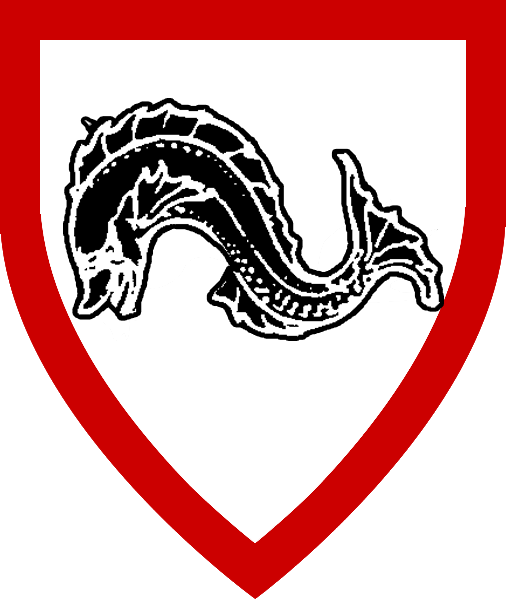
Here’s a picture of my heraldry, which I didn’t actually make while I had with my Byzantine persona, but it works.

ADS-device

Konstantia/Constans's avatarkonstantia kaloethina

As Principal Herald for Calontir, one of the many things I am excited to do with that role is assisting with names and devices.  It is also one of the more frustrating things for early period personae or cultures that are not known for heraldry.  It’s a bit of a balancing act, between actuality and the more creative parts of the Society for Creative Anachronism.

Seriously.  Go purchase things from her. Azure, a standing seraph argent, a bordure gyronny argent and sable. Art by Kythera of Anevern (http://www.anevern.com/)

In my persona’s period (6th century Constantinople, around the time of Justinian and after the death of Theodora), the only person who would use heraldry would be the Emperor, and it would often be displayed on a labarum (a specific type of vexillium), or a banner that hung vertically.  This labarum often featured a Chi Rho as part of the standard, while the vexillium would often be the…

View original post 384 more words

The Return from Pennsic: The SCA versus the Navy.

I don’t always post about my really real for real life here on this blog, because this is a place for the research I wish to share with like-minded folks. However, this being relevant to my SCA life, I thought I could share a bit about generally crazy our lives can get.

First and foremost, a disclaimer: I haven’t been a military wife for that long, and I met Geoffrey when he was still on shore duty. As far as things are going so far, I’m downright spoiled. This is all going to change in about a year, but I don’t have much to say about it yet, other than that there is a potentially big move involved. We did move from Rhode Island to New Hampshire this year, or rather, he moved last fall and I joined him in the winter once I finished my degree, so I already got displaced from my home of 11 years into a totally new, and entirely less urban-convenient area.

angjeff1
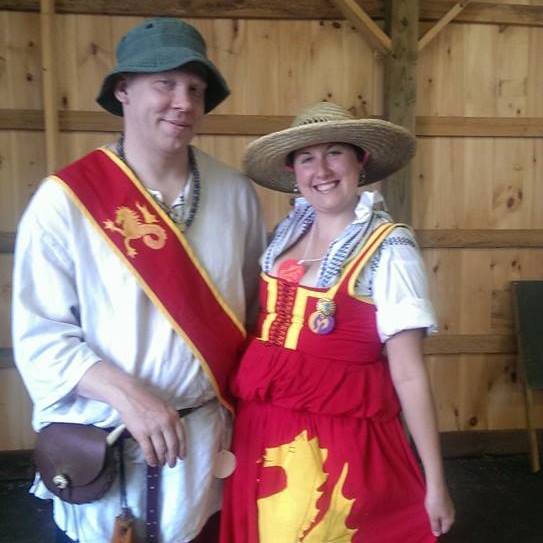
Us at Palio di Stonemarche. Being all matchy Italian rennie and stuff.

VERSUS

angjeff3
Us at the USS Constitution for a sailor’s re-enlistment ceremony and probably the worst hair day of my life.

Geoffrey is an active-duty submariner. That means for the most part [but not always], his home base is going to be in New London, CT. This makes us already percentages more stable than the majority of military families. Subs can be moved, though, such as up to a shipyard for repairs, which is what put us in Portsmouth, NH for the time being. This worked out well, since I was accepted into the University of New Hampshire for my MA, which is just 20 minutes away, and thanks to the Navy, I was given in-state tuition.

On the SCA front, of course, this had us switch baronies from Bridge to Stonemarche here in the East. Being in Bridge for over a decade and knowing everyone for so long made this probably the most difficult part of the move. Not that I didn’t know folks up here in Stonemarche, but it’s just not the same. Different events, different sites, the idea that we would have to drive more than an hour to our “local” events that seemed stupidly flabbergasting thanks to the New England mentality we both disgustingly adopted.  (Yeah, um, here in the East, aside from Tir Mara, the Canadian Provinces, we’re REALLY spoiled when it comes to events being close. We’re more population than area, and still, Montreal is only 4 hours away. Halifax or St. John’s, on the other hand…)

Then comes the questions: How involved do we get when we know we’re only here for 2 years? How attached do we stay with the baronies to our south? How is our mundane workload now going to effect our eventing?

Oh, that last one is a doozy. With Geoffrey being on a submarine now and not on shore, despite the fact that it’s up on blocks and full of holes, means that he has to work more on base, and leave is harder to get. We had a hell of a spring into summer. Especially with the odds of a deployment around every corner.  Pins and needles. He started taking every weekend off for events, figuring that Pennsic wasn’t an option, but once that changed, again, he put in for the 2 weeks of war, and we were good to go.

This is when the really fun stuff happens.

We knew he was up for Chief. Things were working in his favor for promotion, and we had a feeling that this could be it. And well, it was. We found out that he made E-7 while sipping iced coffees at Cafe Merhaba, while I waited to work the State Dinner. I watched him hold back emotions so much that tears welled in his eyes…and of course, you know, I footed the bill at the Cafe. What I didn’t know, however, was that in the Navy, making chief is more than just a big deal, it comes with 6 weeks of very high stress training, called induction or indoctrination or simply “Chief Season”. Some call it hazing, and some say that it’s not what it used to be, all I know is that both of our phones started blowing up. They wanted him back as soon as possible. He told them that this wasn’t happening. There was no way, even if we left early, we’d still need a day to drive and a day to unload, putting us into the weekend anyway. I watched as Geoffrey’s relaxed vacation turned into moments of anxious stress, and I kept saying that if he wanted to leave early, we could. At this point I was done teaching my classes. I couldn’t fight because I sprained my ankle 2 weeks prior (that’s a whole other story) and I was generally having a “meh” war. But he insisted we stay to help break camp, and even stay with the freehold I’m apart of in the hotel on the way home. And honestly, I’m glad we did, because he hit the pillow and passed the hell out. There’s no way he would have made a 10 hour drive home. No.

So we got home from Pennsic around 5:30pm on Sunday August 10th, and he dropped the trailer in our parking lot and went, “I’ll be back in a bit, I need to run to base.”

…So that bit? That bit took til 10pm. The car and trailer were still loaded. This is when Anna’s stress levels started to soar. My sewing machine, my inkle loom, OUR THOUSANDS OF DOLLARS WORTH OF GARB were sitting in space bags in tubs on a trailer, in a parking lot, with a ripped tarp that was strapped down so tight I couldn’t undo the knots myself.  And it stayed like this for a week.  It took Geoffrey falling out at PT due to dehydration for him to get an afternoon off so we could actually try to do things. This was Friday, we had been home for 6 days, and naturally, it had POURED during the week, so I was constantly freaked over the condition of the stuff, and you know, the condition of my husband, who had decided to stress so much he wasn’t staying hydrated enough. If it wasn’t for me feeding him, he wouldn’t have been eating enough, either. It was only his first week, but because he missed several days while we were at Pennsic, they were running him ragged, and my stress only compounded every day seeing him drag ass, and seeing our stuff get soaked. On top of that, I had to make a flag for the CPO selects on the base in 2 days. Which I have to admit I am most proud of (thank you, Wonder Under and the marvel that is iron on anything!) But at least this promotion means that he isn’t going on a fall deployment [as of right now]. So there is THAT [maybe]. *phew* [don’t hold your breath.]

It is now one full week since we have been home. The trailer and car are now empty, and the majority of the contents that need to go back into homes here in the house are now sitting in my living room waiting to be washed or hung back up, and are emanating a smell that is akin to campfire and Old Spice deodorant-infused man-sweat. Where’s Geoffrey? Geoffrey is in Boston, playing on the Constitution (!!!) for a week. I’m probably the only Navy Wife that is more geeky about this than all the guys are, especially since on Friday they get to take her out onto the water, and I can’t go, sit on the pier, and cry in jealousy. I got $40 for laundry, Oxyclean, and a kiss, and he’s gone. Of course before that, I had to press his dress whites, sew on patches to 2 new sets of NWUs, even breaking a needle and having it fly up my nose. No, I’m not making that up. The pointy end of the needle FLEW INTO MY NOSE. If it wasn’t for my nose ring, it probably would have hurt a lot more than it did. The words I uttered are already circulating the world and causing pearl clutching as far as Siberia. I assure you. I never did fine the pointy end. I keep blowing my nose wondering if it’s stuck. For those that don’t know, it costs servicemembers A LOT OF MONEY to maintain uniforms. I probably just saved us $50 in patch-sewing alone. That’s clearly $50 I can use on fabric. Clearly.

..And now he has to buy all new uniforms, and I get to re-patch all his other sets of NWUs.

So, he’s gone all week. That gives me a chance to FINALLY un-Pennsic the house, a week later. Catch up on the rest of my sewing work…a week later, and generally attempt to finally decompress and make sure he can come home on Friday and relax. Then I have one week left before I start a whole new degree at a whole new university, and he’s not through with this until the 15th of September.

No pressure.

I Love you, muffin. ❤ It certainly will be an interesting 2 more years of sea duty.

nerdedbliss1

I MADE DIS. (Things I don’t normally make that I just made.)

In between sewing way too much, and horrifying Pre-Pennsic Panic (tears, there are tears. I know I’m not the only one.) I’ve made a couple things that have been totally new to me, and therefore I feel the need to share them with people looking for Roman and Byzantine stuff here, that aren’t going to find it in this post. (Sorry.) However, I do hope you find inspiration for working outside of your comfort zone and exploring new projects.


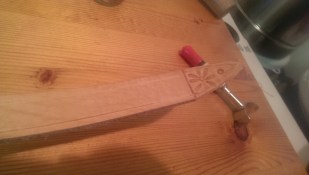
First thing: I made a belt. Seriously! I have an apprentice sash I made from faux silk and fancy stitches, but I can’t wear that all the time, so I needed a sturdier leather belt for times I need to carry a pouch or bum around not in Byzantine. This was an adventure. My husband has leather working experience, and I figured he would just do it for me. NOPE. He made me do it while fielding a tapestry of profanity so thick it’s probably seen as smog over the Boston area. Here are some pics of my experience.

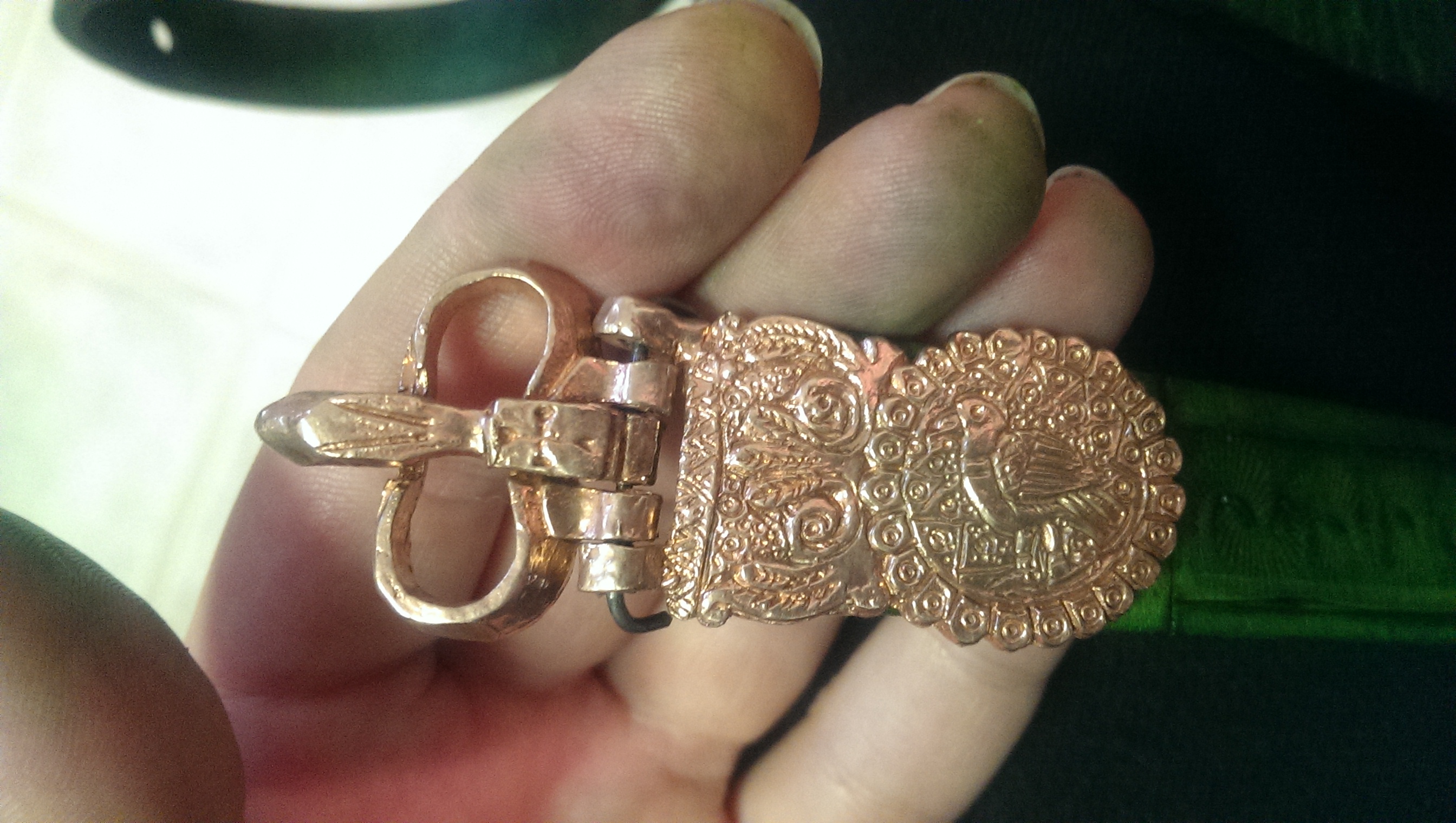
I started with a 3/4″ belt blank from Tandy, and an 8th Century Syrian belt buckle from Raymond’s Quiet Press…got green dye and Geoffrey’s basic tools and designed a pattern that I felt could work. This was my first time tooling leather, ever, so I just kept telling myself that straight lines were for sissies, mistakes are period, and if anyone needs to get that close to my belt to see my mistakes, they need to buy me dinner, first.

IMAG2366
IMAG2367 Practicing with the tools and my thingy at the end of the belt.
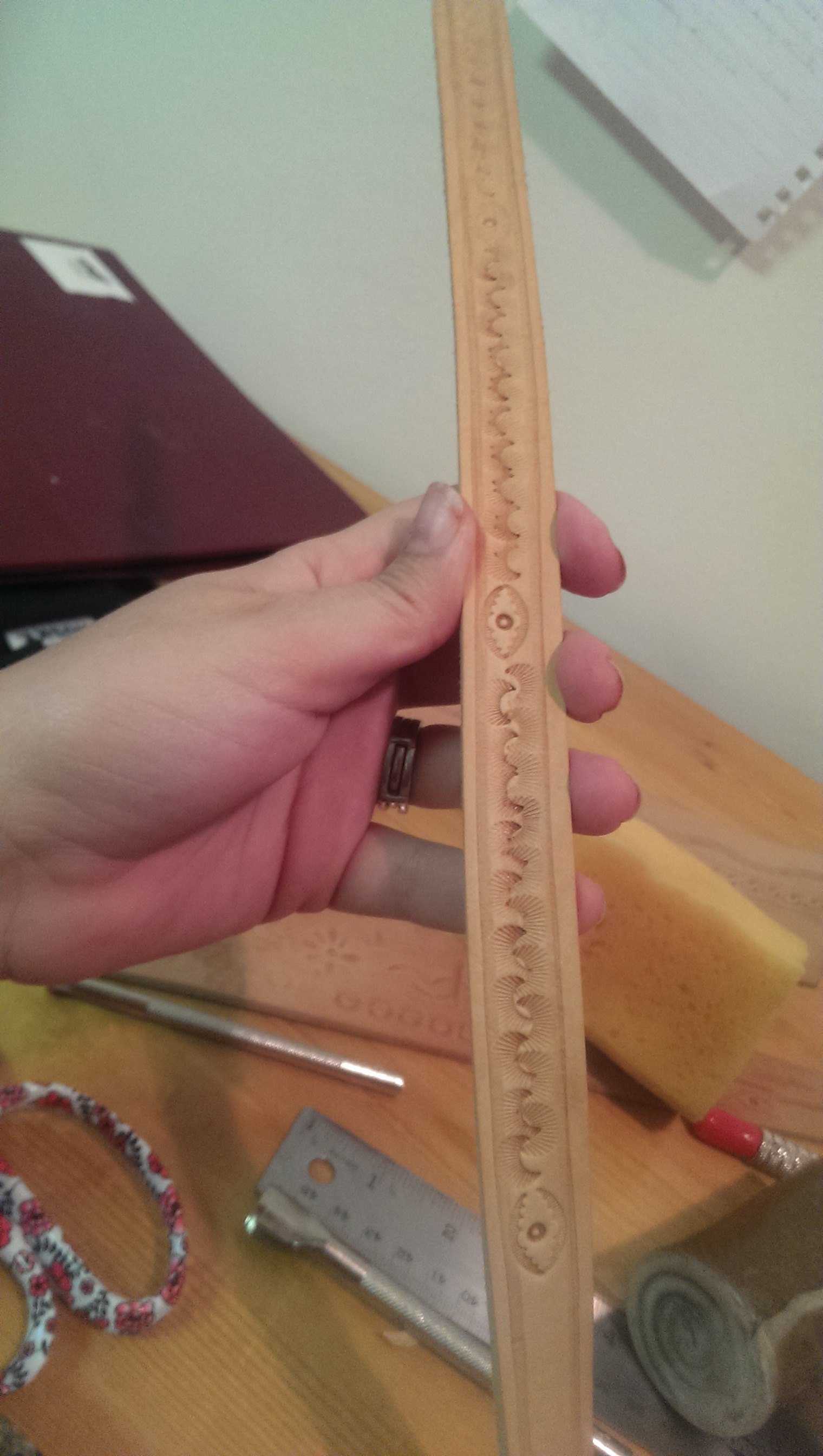
IMAG2368
I managed to do this with the knife. Somehow. I impressed Geoffrey.
IMAG2371
The idea I came up with. I went with thingies and Apotropaic amulets (Evil Eye). Very Levantine that fits not only my persona, but the Syrian belt buckle I got. I have no idea if it was used on belts in period.
IMAG2376
Dyed green outside on my sunny deck full of pine needles, and potted herbs that attract things that will sting you.
IMAG2379
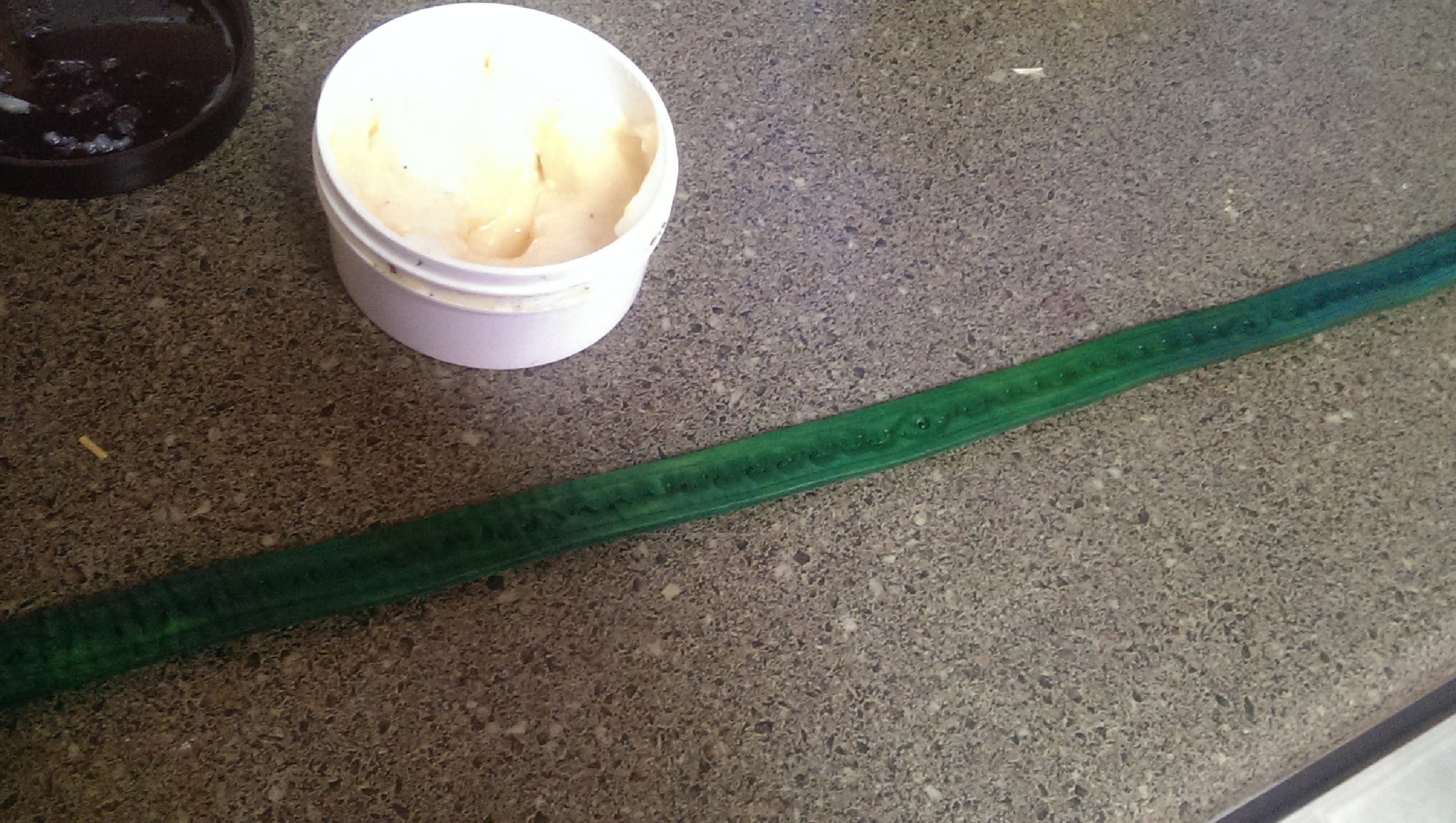
After it was dyed and sealed, I used hide rejuvenator to lube it up and moisturize it. It absorbed two full coats. Oof.
IMAG2380
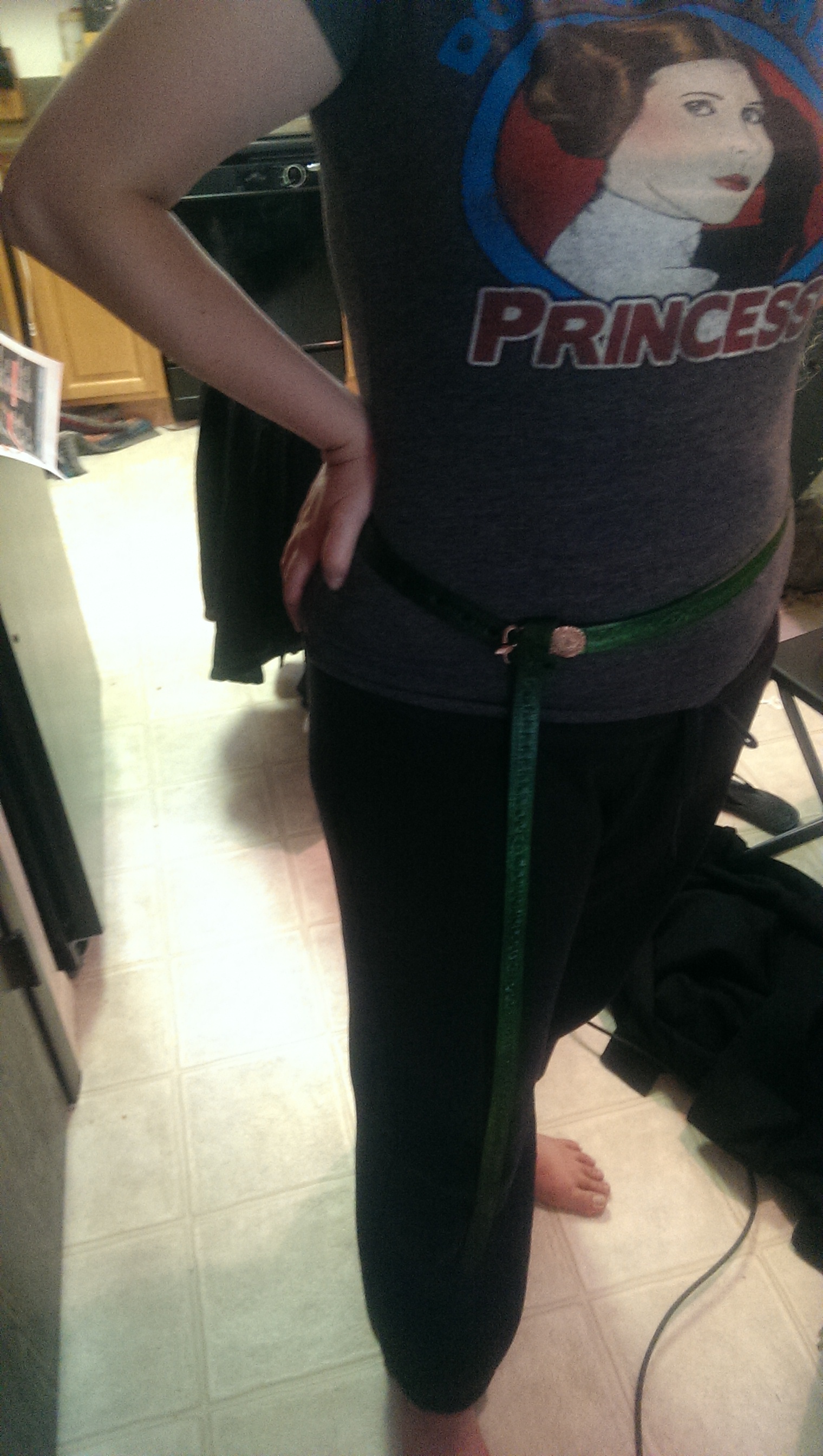
Geoffrey attached the buckle, and done!
IMAG2383
Here’s the buckle in my green hands.


BUT WAIT, THERE’S MORE! I ALSO PAINTED A SILK BANNER FOR MY PAVILION!

I have no idea where I find the time for this stuff, but Geoffrey made this pretty finial for the Green Monstah, and said we needed a banner. After me giving him a dirty look for a solid minute, I agreed, and ordered the supplies from Dharma. Fortunately I have friends who have done silk painting before, and the concept overall is very simple. It’s controlling the dye that’s tricky, and understanding that mistakes do happen and not to care that much since it will be up on a pole.

Here is the Green Monstah. It’s in Geoffrey’s colors. I am not a Red Sox fan and hate all things Boston, and he doesn’t watch baseball, but the name was apropo:

The plain red linen banner simply cannot do.

So we had to go all out with a war standard. Now, there are rules that need to be followed for displaying heraldry, but the SCA tends to be different than the real world, so the order I did is perfectly fine. Most importantly, your country or kingdom needs to be on the hoist, which is the pole, and then you work out from there. In this case, mine is East Kingdom (populace badge), The Northern Army, Geoff’s Arms, and then mine. When marshalling married arms, the lady is always RIGHT. This means my dolphin is way at the end, but hopefully the breeze catches it enough.

With the waterbased resist applied on the designs. Next time I want to use the rubber gutta, I think it will work better.
And painted! Loaded with mistakes, YAY!
It’s currently making a lovely door screen as it finishes drying.


All I have to do now is wait for it to dry, rinse it to remove the resist and excess dye, and then toss it in the dryer. Oh, and attach it onto the pole, of course. It will be sewn onto the casing part of the red linen flag in the above picture so it fits properly.


So there you have it, folks. Anna did stuff she doesn’t normally do and did not kill or maim anyone in the process. I definitely want to try another silk banner with better brushes and gutta, I think it will make a difference in controlling the dyes.

Now if you excuse me, I need drink 3 more cups of coffee, and start sewing even more stuff. We leave on Saturday morning. ~_~