We’re always so quick to forget that fashion has been a phenomenon for thousands of years. Women just didn’t wear one or two style dresses. They wore what was in style, they wore what was popular in other places and made it work for them. I’m a firm believer that the clothing of Roman women was pretty limitless. They were essentially the original divas.
This is a public gallery on Facebook by Ratna Drost, who is a researcher and reenactor at the Archeon museum in the Netherlands. It’s a collection of her interpretation of provincial (Think Gaul and Belgica) clothing, with some great cold weather options for those of us who live in the Frozen Tundra. I’ve been pretty good about sticking with my Byzantine lately, but some of these looks are totally inspiring.
I hope these images help those looking for alternatives to the traditional peplos and chiton looks. I would recommend sending questions to Ms. Drost herself. This is not my work, I just wanted to share this great collection!
I mean, I have one, it’s a basic generic black wool with a lined hood and shoulder seams. I made it about 10 years ago and it’s still going strong. There’s nothing wrong with it, but it’s also not any particular period. Since I’ve been digging into Byzantine outerwear, I’m trying to discover what my persona would have worn, as well as other options in cloaking and coating for both men and women. It does snow in Constantinople, not a lot, but it does, as seen in this modern photograph of the Hagia Sophia from Wikipedia:
Meanwhile, in New Hampshire:
This is actually the balcony of my apartment after the 2nd snowstorm this month. Today we’re getting the 4th foot+ blast. I want to cry.
Outerwear is important, just as much then as it was now. I plan on keeping my first cloak for outside use when the weather is exceptionally foul, but to have one for nicer occasions outside in the cold or inside cold venues will help complete my look as a properly dressed 11th Century Eastern Roman woman.
This post serves as a cautionary tale into how looking for a simple garment can turn into a whirlwind of research that you didn’t expect. This is the method to my madness.
First I picked up the Byzantine cloak clasp offered by Raymond’s Quiet Press, you can buy your own by clicking on the pic.
In addition to some wool and trim, I had the materials necessary to get started.
I never intended on this to become any sort of research project, I just wanted a cloak. So a fast search on the internet came up first with what I always refer to as the paludamentum in Latin, or a chlamys in Greek, a male cloak fastened at one shoulder, such as in the mosaic of Justinian and his entourage at Ravenna, but the women in Theodora’s mosaic are wearing wrapped shawls, EXCEPT for the Empress herself, who is also in a chlamys. I haven’t seen too many images from the 11th Century in which these are worn by anybody other than the imperials. It seemed to have evolved from daily wear of even lower office holders (for men!) into ceremonial dress for high court functions. This theory is supported by Maria Parani in Reconstructing the Reality of Images: Byzantine Material Culture and Religious Iconography 11th-15th Centuries, which I was able to snag on interlibrary loan to begin preliminary research on my Master’s Thesis.
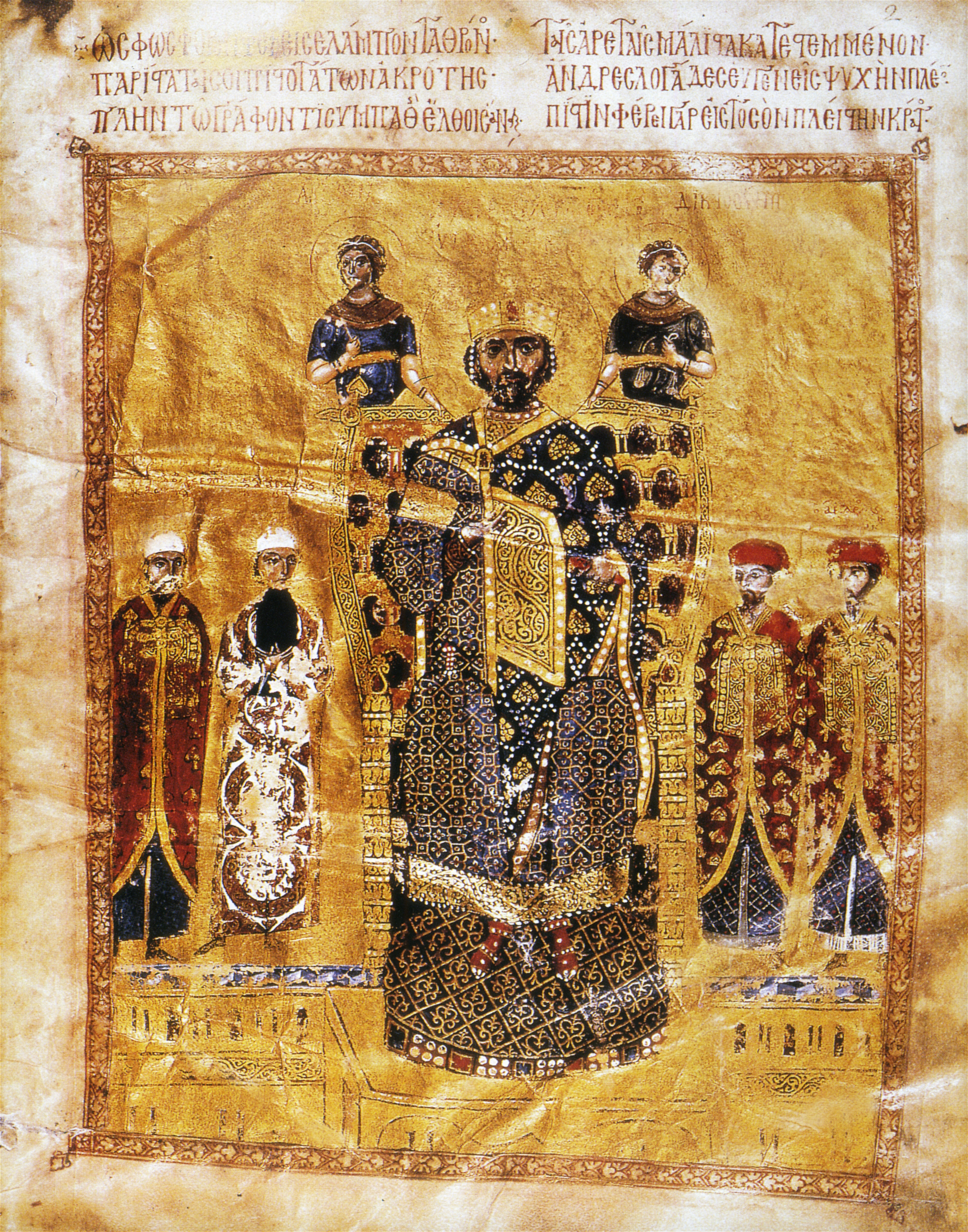
Michael VII Doukas wearing the chlamys, while his attendants wear mandyas, or front closed cloaks. From Coislin 79, f. 2r. Shown in Parani, page 11.
Parani discusses briefly in her chapter on the Imperial Costume that the empress was invested in the chlamys, but probably did not wear it otherwise.[1] So as tempting and shiny as the garment is, unless you are the queen of your SCA kingdom and it’s your coronation, or some extremely important court event, you probably should avoid wearing this garment. Even for men, if you’re middle period (10-12th century) Byzantine and not a king, I’d skip this. It’s just too presumptuous.
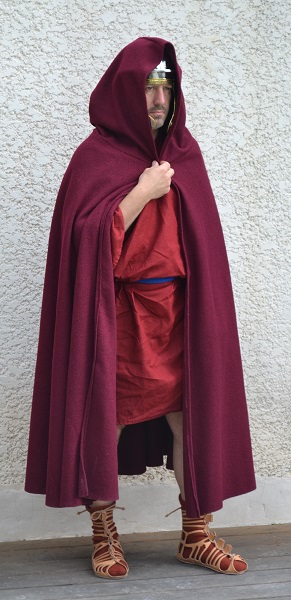
Moving away from this idea, there’s the paenula, which is the traditional Roman hooded cloak that dates from antiquity.
Image found in a search online with the search page Hedgy.com, but it would not load.
The only time you see this worn by a woman in any art is by the Virgin Mary and other ecclesiastical women in icons. Avoid this one too. Not only was it out of style pretty early on for both genders, and you wouldn’t want to commit the sin of wearing such an outdated fashion, but the Romans had a very high regard for their iconographic imagery, and this is another one of those things you should just avoid wearing.
Timothy Dawson argues that the practicality of such a garment would be useful, but evidence of its wear in period in scarce[2]. I agree with him here, though I assert that the reason for such scarcity would be the connection to the Virgin, and therefore making the garment a symbol of her own connection to the past. For women who wish to cover their heads in a simple, demure fashion both indoors and out, a veil or wrapped shawl/palla works just fine.
Moving away from the chlamys and paenula, the other option would be the half-circle cloak.
The same images on Dawson’s website over at Levantia.com.au are also in his article within the Varieties of Experience book cited above. So went to myself, “Oh look, there’s a cloak. Sold.”
Finally, a design that was easy and period, and above all, not being presumptuous in rank, all I really need. It’s not like I wanted to put in more research that I really needed for a cloak, but I do like to check the primary sources to get ideas for embellishments and the like. So Plate 10 in “Woman’s Dress in Byzantium” matches the same that he has on the page for “A Typical Middle Byzantine Outfit” here: http://www.levantia.com.au/clothing/reddress.html.[3] This is where my confusion set in. On his page, Dawson refers to this as a mantion, and cites a page from the 1839 edition of De Ceremoniis for the source on this. Fair enough.
I dig up the ebook on Google Books, and begin translating the ecclesiastical Latin of Reiske’s commentary on the page cited, and found that there was nothing of the sort there, in fact, it’s about pyrotechnics, Persians, and contains a great deal of commentary on a primary source in Arabic. It is unclear from Dawson’s footnote if this is volume one or two, and since two is the only one I can ever find copies of, I went with that. Just to be sure, I searched the document on Google Books for the Greek spelling of mantion, μάντιον, as Dawson suggested on his page, and found nothing. So then turned back to “Women’s Dress in Byzantium” and found that his research was inconsistent in the section where he discussed cloaks and mantles on page 48. In the actual printed article, the word “mantion” isn’t even mentioned, and instead he uses “mandyas,” and supports this through several citations of manuscripts. The book may be a few years older than the webpage, which was last modified in November 2013 according to the page info, but I’m still not 100% sure on why Dawson changed the name between publications. If I can locate the correct supporting evidence in De Ceremoniis, I will know for sure. Until then, I’m chalking it up to a simple error in the footnote that is leaving the source vague. Parani supports the use of mandyas as the correct term.[4]
Now, a mandyas I know is the modern ecclesiastical cloak of the same cut. It’s basically a half circle ornamented in a variety of ways, draped over the shoulder and pinned in front. That’s it. The design is frankly, timeless.
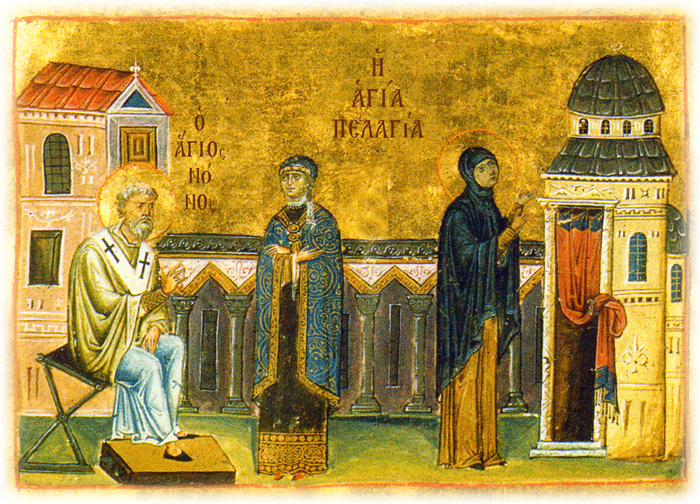
I did some searching for Dawson’s cited manuscripts and couldn’t locate most of them online. This is a common hurdle, as not all libraries have been digitized yet, but fortunately for all of us in the future, they will be. Even the Vatican is digitizing their manuscript library. Even though my initial searches were fruitless, I did find some neat sources for future perusing. I did have some luck with the Menologion of Basil II, which does have its own Wikipedia page for those seeking instant gratification, and found a couple of images, including the empress in a chlamys and a sainted nun in a paenula. What I needed though was evidence of women of aristocratic status wearing it, and folio 98 delivered. Both Dawson and Parani cited this image, and Parani included it in her book.[5]
St. Melania the Younger from the Menologion of Basil II. To me it looks like she’s in a paenula.Empress Theophano from the same manuscript. Notice how her chlamys is fastened on her right shoulder. A women wearing this in artwork signifies the empress.Folio 98 of the Menologion of Basil II, featuring St. Palagia before and after she is called to God.
This image above shows both a saint and a laywoman. The haloed saint Palagia wears the hooded paenula, while the woman in the middle, whom I’m assuming is Palagia repenting her sins before converting and devoting her life to God, is secular dress, and, tada! Wearing a mandyas.
Another image that supports the wearing of this style of mantle is one that I’ve previously shown during my research of the propoloma are the donor frescoes of Irene Gabras, and Anna Radene in its full form. The one of Radene shows the traditional thick trim outside, as well as an elaborate lining behind the magnificently large sleeves of her red 12th Century delmatikion.
Irene Gabras, image borrowed from 1186-583.org.Anna Radene from the church of Sts. Anargyroi in Kastoria, Macedonia. Image found on Surprisedbytime.blogspot.com, but the church also has a smaller image here: http://www.macedonian-heritage.gr/HellenicMacedonia/en/img_C252a.html
These three sources span the period from 1000-1180, so it’s safe to say that this garment was very much in style for probably a fair portion of the 10th Century, the duration of the entire 11th Century and into the 12th. All three are featured within Parani’s book.[6] Since my persona is a woman who could have served as a zoste patrikia such as the likes of Radene, it is safe to assume that wearing the mandyas in her style would not be presumptuous, and therefore the route I should take.
Now, I have already been asked, “What makes a mandyas different from a chlamys?”
This is a good question.
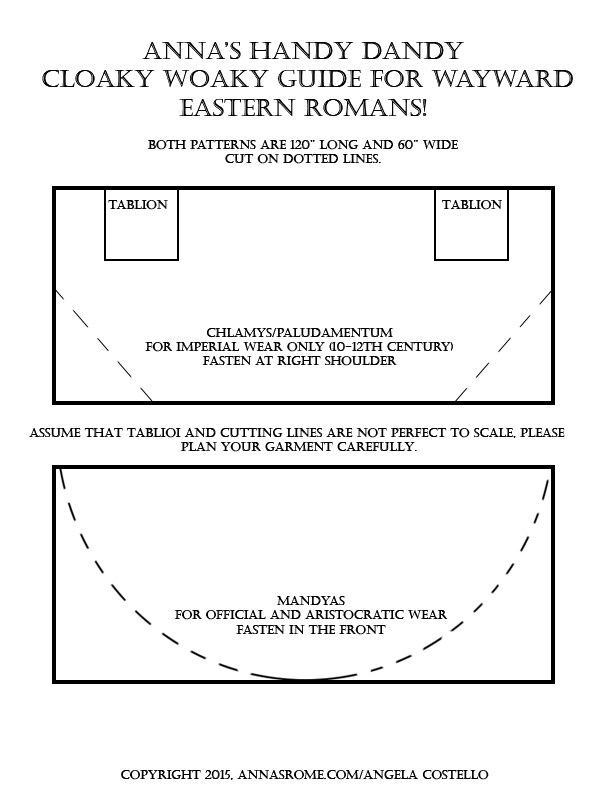
Both historians I have cited, primarily Parani as she has focused on the differences in both imperial and aristocratic dress, agree that the chlamys is absolutely imperial only. Descriptions lead me to believe that the broaching at the right shoulder, as well as the addition of the traditional ornamented panel, the tablion, are the single most important things one needs to pay attention to when making cloaks for themselves.[7] It was extremely ornate, and not practical in any sense of the word for wearing outside of high court ceremonies.[8] So in theory, this thing was probably so heavily laden down with jewels and metals that not only was it out of the price range of anything but the imperial family, but also its sheer weight was probably enough to keep the wearers indoors. I also believe that since the Roman paludamentum, which is essentially the same garment as the Byzantine chlamys, was trapezoidal (think rectangle with the two bottom corners cut off) and not semi-circular, that the imperials would have preferred to maintain the ancient shape, versus the easier to cut and trim half-circle counterpart.[9]
Note: If you see an icon of an angel or saint wearing a chlamys, remember that these figures are often in imperial ceremonial dress, as that is to be expected of all divine beings.
Here are patterns I just cooked up to give a better understanding:
As for how these can be embellished, if Anna Radene is any indication, the aristocracy did not slouch when it came to blinging their accoutrements. In Dawson’s article, he discusses the will of an aristocratic lady by the name of Kale Pakouriane in which she discusses her clothing items, including heavily embellished mandyai with silk, pearls, and gold bands.[10] Parani brings up this same document for different reasons, so now it’s on my “MUST FIND” list, so that I too, can get a glimpse into the belongings of a high ranking lady of this period.
Anyways, I’m cooked. This just goes to show you how much you can find about one garment in just 2 monographs and an afternoon to kill looking for images and writing a blog post. I will be planning and making my own mandyas this week.
Constantine Porphyrogénnētos, De Cerimoniis aulae Byzantinae libri duo. London: Oxford. 1830.
Dawson, Timothy. “Propriety, Practicality, and Pleasure: The Parameters of Women’s Dress in Byzantium, A. D. 1000-1200.” In Byzantine Women: Varieties of Experience AD 800-1200, edited by Lynda Garland. Hampshire; Burlington: Ashgate, 2006.
Goldman, Norma. “Reconstructing Roman Clothing.” in The World of Roman Costume. Edited by. Judith Lynn Sebesta and Larissa Bonfante. Madison: University of Wisconsin Press, 2001.
Parani, Maria. Reconstructing the Reality of Images: Byzantine Material Culture and Religious Iconography 11th-15th Centuries. Leiden;Boston: Brill, 2003.
[1] Maria Parani, Reconstructing the Reality of Images: Byzantine Material Culture and Religious Iconography 11th-15th Centuries, (Leiden;Boston: Brill, 2003.) 17-18.
[2] Timothy Dawson, “Propriety, Practicality, and Pleasure: The Parameters of Women’s Dress in Byzantium, A. D. 1000-1200.” In Byzantine Women: Varieties of Experience AD 800-1200, ed. Lynda Garland, (Hampshire; Burlington: Ashgate, 2006.) 48.
[4] Parani, 73. Here she’s citing the will of Kale Pakouriane, a lady of the middle Byzantine period who discusses clothing in her will. She also discusses it as being an alternative garment worn by the Emperor on pages 16 and 17.
[5] Parani, plate 80. Vat. Gr. 1613, f. 98 depicting St. Pelagia the Harlot
[9] Norma Goldman, “Reconstructing Roman Clothing,” in The World of Roman Costume, ed. Judith Lynn Sebesta and Larissa Bonfante, (Madison: University of Wisconsin Press, 2001.) 233.
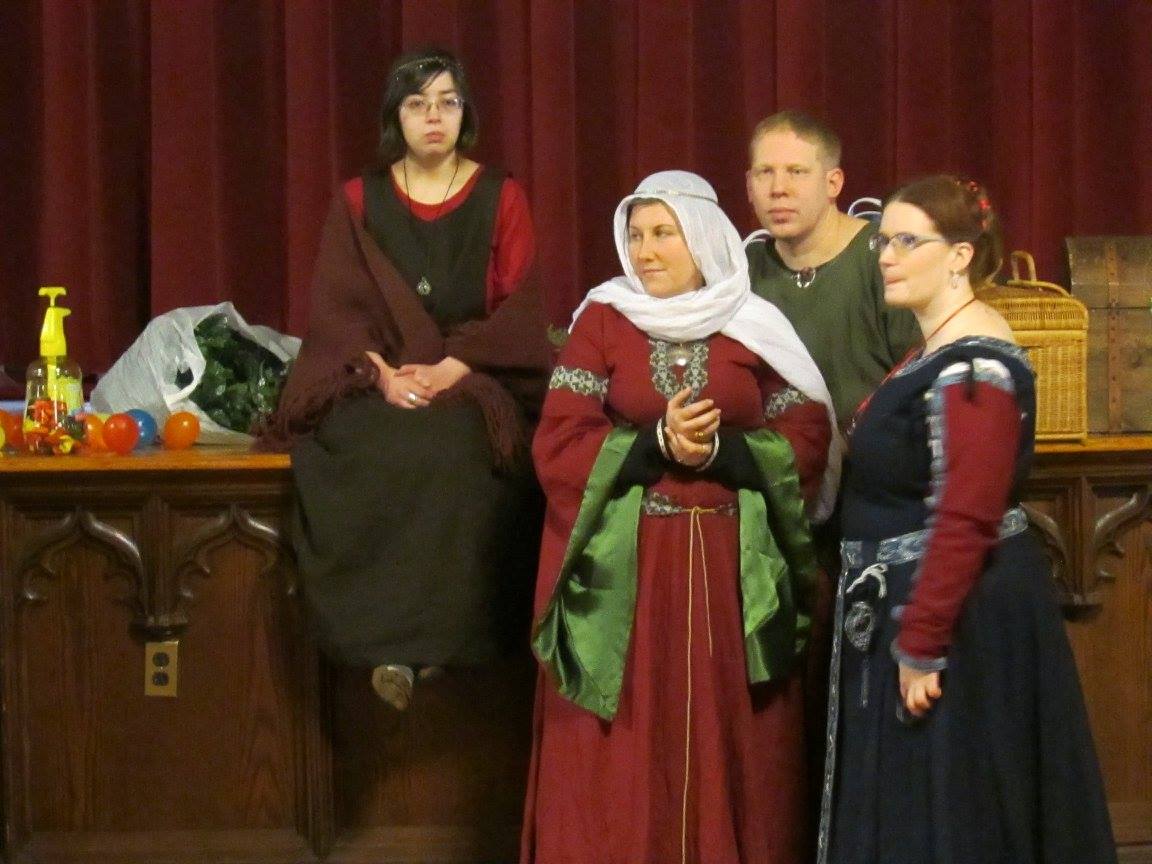
As I mentioned in my previous post, the Twelfth Night event in the Barony of Smoking Rocks (Southeastern Massachusetts) often has an early period theme. Typically 11th-12th Century. This year’s period was 1066, pre-conquest, so we went as my husband’s parents, Robert and Adelize de Tosny, looking to check out real estate on a plain called Hastings.
“Why the same thing we do every Twelfth Night in Angleland, Geoffrey, TRY TO TAKE OVER THE ISLAND!”For those experiencing instant site-envy, I give thee the Raspberry! Neener, neener!
For the curious, the site is the Unitarian Universalist Society in Fairhaven, MA. Here’s some additional pictures of the site and event.
I need to confess that I name my nice garb. I do. If it hangs up in the closet and doesn’t get balled up and thrown in a tub for camping season, it has a name.
For example, my heavily pearled gold delmatikion is my Dalek Dress. I didn’t name it that, but it stuck, and I certainly did want to exterminate all the things by the time I was finished beading it the first time around. My Turkish fencing coat is the Portuguese Whirling Dervish, because of the colors, and my Buccaneers-inspired Elizabethan from last Birka is the Traffic Cone. My burgundy bliaut is the Norman Longdress, because long dress is long. Much like the longcat of internet yore.
Longcat is Long.
I didn’t fix it last year after I wore it to Smoking Rocks Baronial Investiture, and it’s been sitting in my closet since. Not that anything was terribly wrong with it, but I didn’t have a lacing up one side to create the ruching effect that Norman women found ever-so-sexy. So I simply made the dress tighter, and hoped for the best. It worked, but not that well.
Since the local 12th Night event that I attend in the Barony of Smoking Rocks is usually 11th Century Norman and/or Saxon, I figured that’s where I would get the most bang for my buck with this floor dragger. I didn’t wear it last year since we did a murder mystery in which Anna as a Byzantine needed to be present, so this year, I FINALLY get to wear it again. Time to get the lacings in.
Fortunately for myself, I had some sort of plan when I sewed the thing, and left the side seams unfinished so I could pop one for the lacings. This made me more happy that it probably should have. So I split the right side of the dress from the upper arm to the hip, hemmed it, and got to play with my machine’s buttonhole function 41 times. In theory and practice, yes, I should be doing eyelets by hand, but I assure you all that my machine does a way better job than I can do, and in a quarter of the time. Cheating? Yeah, probably. Utilitarian? Very yes.
So here’s the first look, before I put on the girdle. You can see how the lacing (spiraled, I should mention that) draws up the length of the dress to create the desired wrinkles. The “I’m so important I can afford extra fabric to just wrinkle around mah belly” look.
And here’s with the girdle, which after doing the requisite dancing around the house, is necessary. The design is not only decorative, but it holds the ruching in place in the front. Otherwise, you’re going to walk on your dress and faceplant. I wonder how many Norman women fell down the stairs before they figured this one out.
My husband didn’t even pull it as tight as it could go. I wonder if we really yanked it around my chest if it would draw up the fabric more. The torso is approximately a foot longer than my own to allow for this extra gathering. My underdress is tailored normally. Each have 4 gores instead of just on the sides to allow for very full skirting. It is HEAVY, and when I spin around I feel like a princess, and then try not to fall.
I do think that the bliaut itself would be far more beneficial in wool than linen. I can’t afford that much dress-weight wool right now, but the stretching and conforming to a shape with body heat versus the less pliability of linen would make a HUGE difference. So those reading this post to get ideas, I would recommend that if you can swing it. If not, linen is a perfectly fine choice.
I’m hoping to finally get REAL pictures of me in this dress next to my Lord in his Norman. So we’re finally in the same time period at the same time. Once I eventually make him real Byzantine on par with my own instead of the one tunic he occasionally wears when I order him to, we can have a set of good photos for things such as holiday cards, and gifts for our families who think us terribly weird. 😀
I made a new Propoloma tonight for an upcoming A&S display here in the East. If you don’t know what I’m talking about, please see this informative earlier post.
Basically, I had a 60% off coupon for Joann’s, and decided I needed to spend money immediately, so I went in, paid less than $10 for 2 yards of white wool felt, and ran out giggling. I put on my car, and Alien Ant Farm’s cover of “Smooth Criminal” was on the radio. This is, ironically, how I got my persona name from an ex-boyfriend.
“Annie are you okay?”
NO! I’m about to make a funny looking hat!
So, for fast reference, here we have Irene Gabras to inspire my Flying Nunnery:
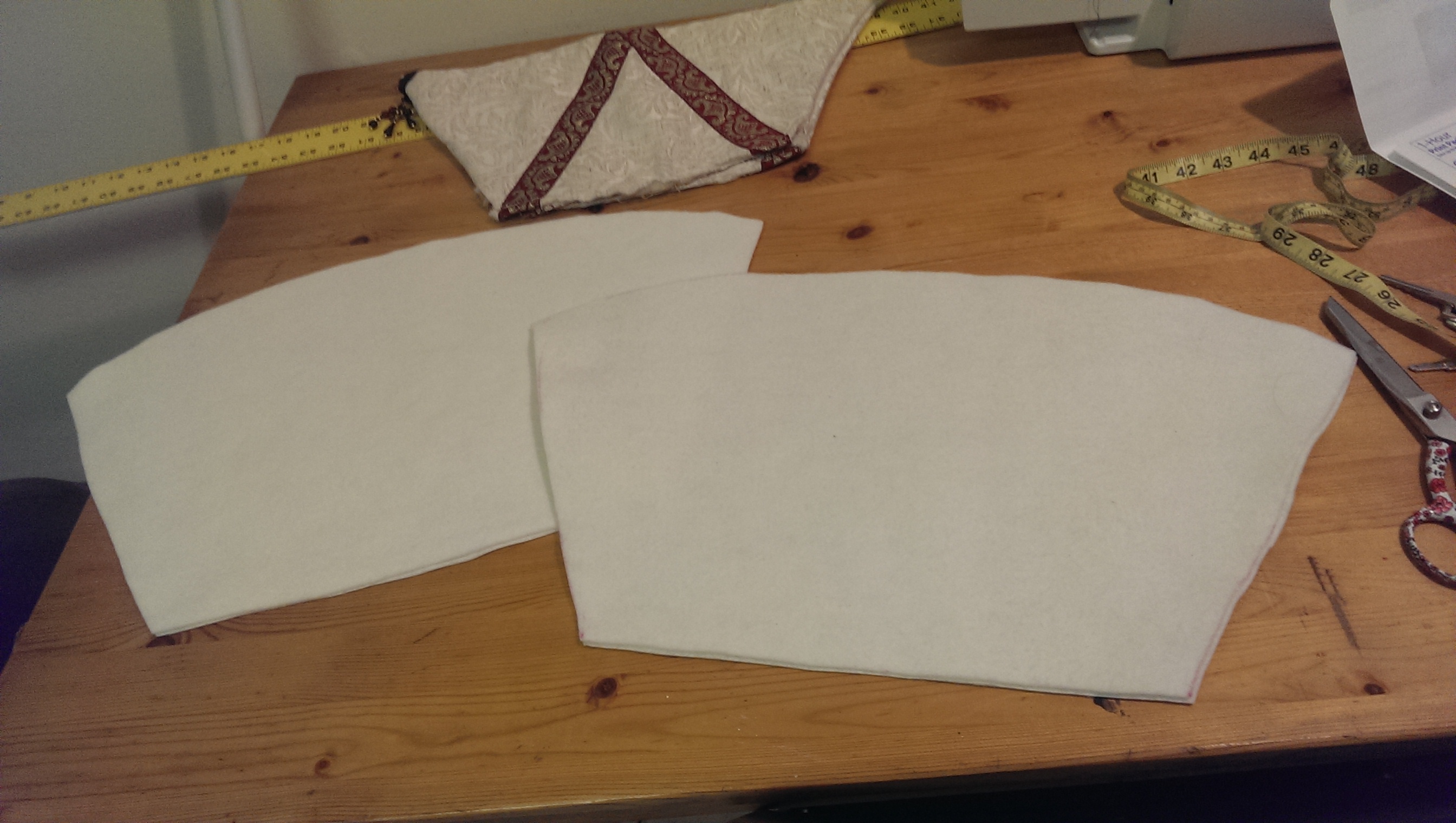
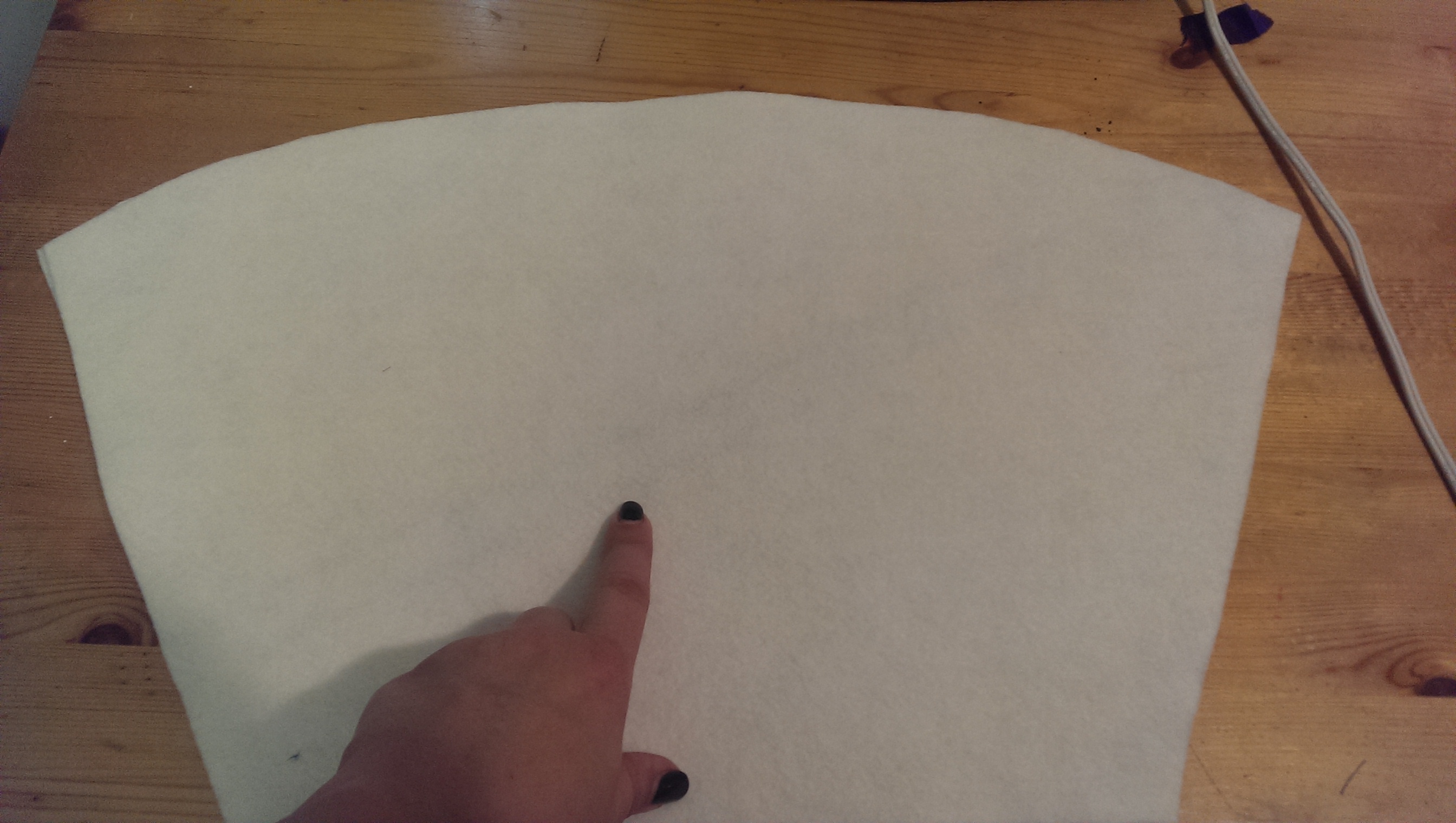
So, first, I cut the wool using my first version of the hat as a guide. I needed it bigger and rounder. I cut four pieces total, as I wanted a lining and a shell. I figured this would be full bodied enough to stand on its own without using buckram or other modern stiffening materials.
After that, I sewed the lining together, and tried it on.
Holy amazeballs, it’s Sally Field!
This, of course, resulted in all sorts of funny name calling on Facebook, which both amuses me and aggravates me at the same time. On one hand, I posted it, I deserve the jokes and I know my friends are jerks. It’s a thing. On the other hand, I am introducing this hat and style of dress to the SCA, and I’m met with joking. Way to make me want to actually wear it, guys. Not that I should ever expect constructive comments of any kind on a social network that devotes more time to political party bashing than…oh wait, that’s perfectly Byzantine. *Ahem* MOVING ON.
I used some silk remnants I had to make the stripey bit. I’m not good at this part. Irons and I don’t get along.
Meh, good enough.
Then I began to apply it to the shell, using the painting of Irene Gabras as a guide.
After sewing it down, I did the same for the other side, opposite directions so the ends would meet. I was able to barely see the stitches through the wool, so that made a nice guide.
Once both sides were sewn down, I went back and added a little bling with gold thread. I had considered using some of my embroidery stitches for more shiny, but I decided in the end that I need to 1: Lay off my embroidery stitches and start doing more hand work, 2: this is a statement hat in its own. It will speak for itself, and 3: I didn’t want to be presumptuous in persona.
Once the silk was sewn down, I finished the sides of the hat, and turned it right side out, and then made sure it was still equal to the lining.
Then I put the lining inside of the shell, and immediately felt like Rita Repulsa from the original Power Rangers series:
By this point, I was being compared to Yoda on Facebook, but I didn’t care. I was ready to wrap this up. A little whip stitchin’s for the opening:
And Voi—-uh. Hmm…
But that’s okay, I have a notoriously small head, and I did it on purpose for veils and nets and such. So, naturally, I had to go play dress-up.
VOILA! ANNA ZOSTE PATRIKIA!
Putting the kohl on my eyes really makes it, I think, I mean, I practically just wrapped myself up in fabric like a Glamour Shot. :3 it also shut up the peanut gallery. Context is everything!
As you can see, the 2 layers of wool felt gives the hat enough body to stay up on it’s own, and it’s also nice and toasty, because I live in New Hampshire, where we are known best for our tropical winters.
Here’s a comparative shot of my first hat and my new one. What an improvement!
The Propoloma: A headdress of the Zoste Patrikia and other high ranking women in the courts of Eastern Rome
Kyria Anna Dokeianina Syrakousina, OM, OBT
One of the more difficult aspects of studying Eastern Roman dress for the SCA is locating suitable headwear outside of the typical veil and circlet that seems common place, and easily mimicked from iconographic depictions of female saints, and especially the Virgin Mary. I have just started to scratch the surface of ceremonial Roman dress, but so far I have been able to uncover some rather unique pieces that may begin to open the door into more complex appearances for Eastern Roman personae to try.
The zoste patrikia was a title held by the chief attendant or lady in waiting to the Eastern Roman Empress. It literally translates to “girded-lady patrician” but is often translated into English as “Mistress of the Robes.” It appears to have been given only to extremely high ranking ladies in direct service to the empress.[1] She was not only the head retainer for the empress, but also the head of the court of ladies, the wives of other high ranking patrician men in the court of Byzantium.[2]
As was tradition with the Eastern Romans, ceremony heavily accompanied any augmentation in rank, and with ceremony, came elaborate new costume. Ioannis Spatharakis, in his monograph, The Portrait in Byzantine Illuminated Manuscripts, gives a detailed footnote of the ceremony, as described by Constantine Porphyrogénnētos in De Cerimoniis in Latin, while explaining the details of a manuscript depicting the installation of Anicia Juliana as patrician:
“In the church of the Theotocos of Pharos she received from the despotes a delmatikion [dalmatica], a thorakion [ecclesiastical pallium, similar to a chasuble], and a white maphorion [hooded veil]. In the Pantheon, wearing the thorakion and the delmatikion and carrying the loros [heavy gold wrap] and the propoloma [trapezoid hat], she received from the enthroned emperors the kodikellia [codex], which were later blessed by the patriarch. Because she was wearing the loros and the propoloma, she was not able to prostrate and kiss the feet of the despotai, as she did when she received her costume, but she bent slightly and kissed their knees.” [3] (The available text of De Cerimoniis is only in Latin or Greek. I did my best to translate the footnote and verify it with the original 1830 publication.)
This article will focus on the design of and wearing of the propoloma. This particular style of the hat is described as being in use as early as the 10th Century, but appeared to have had its heyday during the 11th and 12th Centuries, which allows it to fit perfectly into my persona. It appears to have taken the shape of a trapezoid, or upside down cone sewn shut on all but one side for the head. It may have been covered in silk, and then decorated in a variety of ways.[4]
Anna Radene wearing the propoloma during her occupation of zoste patrikia in 1070, image courtesy of 1186-583.org.Possibly Irene Gabras, wife of St. Theodore Gabras. Who did not serve as zoste patrikia. Image courtesy of 1186-583.org.
Dawson seems to have done most of the legwork on this hat, as there is not an English translation of De Ceremoniis available to do primary source research from Constantine’s perspective. He discusses that although the hats were usually white, it appears that in one manuscript, purple ones were seen. This may indicate that these women may have been members of the extended royal family.[6] He also brings into account on his Levantia website that the padded headroll seen in earlier artwork, including the Ravenna mosaics, may have been the predecessor to the trapezoid propoloma.[7] So for those who have an earlier period persona, we simply need to take a look at the bust of Anicia Juliana to get a glimpse at the earlier hat style.
(Photos taken by me at the Metropolitan Museum of Art in March of 2014.)
Anicia was born in 462, which puts her occupation of zoste patrikia during the reign of Anastasius I, two reigns prior to Justinian I. So it is arguable that her attire could be considered that of late Antiquity of the very late Roman Empire, rather than “Byzantine” in nature. However, a similar style was worn by Theodora’s court in the mosaics at Ravenna:
The first thing I noticed immediately on this particular bust was not the layered look at the top, but the gathering in the back at the base of the skull. This reminded me immediately of the Cap of St. Birgitta, a style that was popular in the 14th century:
The original cap.When worn.
Naturally, there is no reason why this cap could not be older in origin, and this marble bust may just show a similar cap being in use as early as the 5th century. At least for the over cap, the under cap is a bit more perplexing, especially with the pucker going on at the top of the head. It is highly unlikely that is a hair part, considering the detail given to the rest of the statue, in addition to the same look of the layered “turbans” on the mosaic, so my belief is that it was two separate pieces, but how they created that gather on the top is still a mystery to me. It is something I do plan on exploring later to help those with early period personae.
But how does a re-creator or reenactor transfer the wearing of this type of hat into their hobby? Well for one, this is a hat of station and rank. In the SCA, some kingdoms have sumptuary laws, the East Kingdom, where I reside, does not. However, I like to take into account the “what would my persona do?” clause when it comes to my clothing choices. My persona is well-developed, but not everybody else’s is, nor should they have to be. It is absolutely a personal choice on how much thought you want to put into your persona, and what you want them to wear. In the case of portraying a persona from a culture that has strong sumptuary laws, such as the Eastern Roman Empire, and especially if you reside in a kingdom that has laws about what one can wear on their head regarding their own rank, this is when the re-creator needs to take into account what he or she wants to wear, or should be wearing, for the holder of their awards.
In the case of the propoloma, I would recommend that nobody holding anything less than an Award of Arms wear this hat. A woman who would have received this hat would have already been of high patrician rank, and even though the title of lady may or may not convey this, it would be unfair to say that only peers or grant holders/court baronesses would be permitted to wear it as well as far as the game we play goes. I made my first one from looking at the Tom Tierney coloring books, which have proven to be rather inaccurate the more that my studies continue before understanding that it was a hat of rank. However, I feel that it would make an excellent choice for something akin to a cap of maintenance for a Pelican, or wreath for a Laurel, as the SCA simply does not hold a candle to the intense pomp of Eastern Roman ceremony. But by bringing pieces of these ceremonies into the SCA, bit by bit, we can help enrich our game even more, and introduce others to a new and exciting part of Roman culture they may have never otherwise known about.
[1] Alexander Kazhdan, The Oxford Dictionary of Byzantium, (New York: Oxford 1991), 2231.
[2] Lynda Garland, Byzantine Empresses:Women and Power in Byzantium, AD 527-1204, (Abington: Routledge 1999), 5, 245, 264.
[3] Ioannis Spatharakis, “The Portrait in Byzantine Illuminated Manuscripts”, Byzantina Neerlandica 6, (1976): 145.
[4] Timothy Dawson, “Women’s Dress in Byzantium” in Byzantine Women: Varieties of Experience 800-1200. Ed. Lynda Garland (London: Ashgate, 2006), 47. Dawson cites De Cerimoniis by Constantine Porphyrogénnētos, the 1837 Latin edition, which I am currently translating into English.
[7] “A Woman of the High Aristocracy,” Timothy Dawson, accessed August 13, 2014, http://www.levantia.com.au/clothing/zoste.html. Also gives his interpretation of what a complete outfit may have looked like.
In more of my pre-Pennsic Procrastination, additional thoughts have chopped their way into, “gee, I should be sewing right now” time.
Namely, this:
No! I mean THIS:
That is the shade of what is known as Tyrian, or Murex Purple. The imperial purple of Rome. As you can see, it is NOT indigo, it’s closer to a magenta-red, and it’s actually quite nice.
This was brought up because right now I have enough free linen points over at Fabrics-store.com to do some damage, and wildcherry, a color similar to this purple is on sale. This put me in a conundrum. Do I spend the money and being haughty and make a lovely purple piece of garbery, or, do I let it slide and stay within my persona? The East Kingdom has no sumptuary laws, especially when it comes to the wearing of colors, so I could wear this without any issue on the game side of of things. However, on the Anna side of things is where I question it. Would my persona be in the purple? As an imperial with the rank of lady, it’s likely I could have afforded it, and sumptuary laws did change over time to make it more available…IF you could afford it.
However, I feel like the wearing of purple, to me, as a Romanian (Byzantine), is being presumptuous in rank. If I was bestowed the gift of purple from someone of a higher station, that’s different. If someone won crown for me (highly unlikely situation) then well, yes, definitely. But the purchasing, sewing, and wearing of a purple garment would make me feel like I cheated. Yes, even though I hold the rank of lady, and I have seen period imagery of ranked women wearing SOME purple in their embellishment, they were never clad in it fully like the actual emperor and empress. So even though I may hold a position that allows me to wear it, and I could probably afford the dye, I would limit my purple to embellishment only, rather that entire garments.
Instead, I will play with words. Purpura, in both Latin and Greek, is a funny word. It means both purple AND red, so it’s hard to assume which color was being worn unless modifiers are being given, which they sometimes aren’t. And a good red color, like kermes derived from crushing little insects into dye, was just as expensive as milking murex snails. So I will gladly spend all of my persona’s invisible money on quality crimson and not feel like I’m placing myself higher than I should be while still dressing as a diva. 😉 Problem SOLVED. HOMERUN!
This of course doesn’t mean a thing outside of my own persona and kingdom. If you want to wear purple, and can wear the purple, rock that purple.
This weekend is my [new] barony’s annual Palio, or civic competition. Stonemarche is broken up into 3 rival contrade, or districts, that compete in games and tournament to determine a winner. Originally, I wasn’t planning on going, since this weekend has always been reserved for Vinland Raids down on Cape Cod. Unfortunately that event is on hiatus, so, off to Palio di Stonemarche to roll some cheese we go!
Then I thought, “I should wear something red and yellow for the Hippocampo Contrada!” And figure I had some stuff that would work.
…and then I basically got garb challenged. I had 2 weeks to make a new outfit for this event. Ugh, why do I get myself into these things?! So I settled on 16th century Italian working class pretty quickly. Because I’m broke, I pillaged my old garb piles, and decided to kill the old red stola I had that was way too big and I never wore anyway. This would be my dress material. I found an old chunk of blackworked cotton from when I actually pretended to be Late Period for a while, and some white linen for sleeves and…
+ =
Nailed it.
I kind of feel like Ronald McDonald, but considering it was thrown together from a box of scraps and bias tape, I can’t complain. The pattern drafting instructions I had from my collected old notes back from when my persona WAS 16th Century working class Italian that I never did anything with, and I finally made a damn Campi-style dress. Not without tons of flaws, mind you, considering the materials at hand, and I probably wouldn’t have done it at all if it wasn’t for the fact that my machine has an automated buttonhole feature. Other then that, after I got through the hiccups of fitting the bodice, the rest went together insanely easily. The camicia’s collar is also just white hem facing. Hey, I did say, “box of scraps” didn’t I? The skirt isn’t as full as it should be, but it’s not as slim as it appears in the pic, either. I’m also glad that 2 layers of linen and some interfacing in the front is apparently enough to control my figure without boning or a heavier interlining.
At least I can wear this again next year at the event! And once I do move back south, I plan to give the dress to the barony so another can enjoy it.
I basically just sewed what I saw. I’m sure there’s more tailoring that should be going into this, but this isn’t for an A&S project, or persona development, this was made for 100% fun, unlike my orange traffic cone, which took me almost a month’s worth of work and did require some actual research. But still, this is what happens when I get challenged to make garb. I am the reason why we can’t have nice things.
Here’s some other pics circa 1580’s I used for reference:
Rolled Sleeves:
Front lacing:
Blackworked camicia:
That’s 2 late period outfits in a year, as opposed to when I claimed to be late period, and had like, none. Wow, Anna. WOW.
I do have some much more interesting Byzantine stuff coming up soon. I just need to get through my rush at work before Pennsic, my Pennsic classes, and whatever other curveballs before I start posting more research relevant to the site. Until then, enjoy my ghetto fabulous Italian Ren dress.
As frequent readers may recall, I have a post here entitled, “The Illusive Dover Dress Debunked.” Wherein I was determined to set the record straight from badly interpreted secondary source material using the primary source. I have created what I think is the look portrayed in the silk fragment. At least the start, anyway. Let’s review.
Here’s the look most often emulated in the SCA:
Which was taken from this interpretational sketch from the 1980’s:
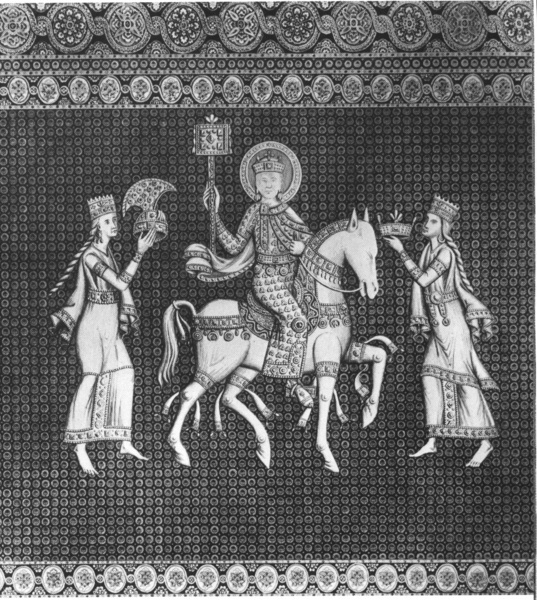
Here’s the actual source:
Here’s the Anna, zoning off as Queen’s Guard (hence rose baldric) at Crown Tourney (I was so tired.):
Yes, it’s a very simple style to emulate. I often wonder if Elizabethan personae come to my page and sneer at my untailored, baggy linen glory. 😉 However, lets see if we can break this down and determine what we’re looking at, and how I did.
First, the women portrayed in the tapestry are both Tyche, the goddess of fortune and prosperity, taking on the shape of the Blue and Green Demoi, the two main political associations in the Eastern Roman Empire. They are supporting a figure that seems to be Emperor John I Tzimiskes on his triumph over Bulgaria in the late 10th Century.
The women are first and foremost, deities. Even though the Byzantines were extremely pious Orthodox Christians, they were proud of their Hellenistic and Roman roots, and often displayed images from classical mythology and literature as part of their way to connect themselves to the splendor of the ancient empires.
The dead giveaway on the divinity of the subject is that they are barefoot. In the Greco-Roman culture, only the divine could be portrayed as barefoot. That does not mean that people could not and did not go barefoot in real life, but as far as artistic record goes, this was reserved for the gods. I am not barefoot for a few reasons. 1: I am a high lady of the court. Barefoot would mean I couldn’t afford shoes. 2: It was Crown Tourney, ew, gross. I am actually wear a pair of red China flats, since red shoes were all the rage for women during the period. One day, I will make nice, period shoes, but I digress…
Another odd observation is that they have bare arms and appear to be wearing cuffs of some sort. This boggles me. The Blue is wearing a tunica that appears to be almost-flesh colored, but the Green, in her minty green tunica, definitely has bare arms. What I have determined off the cuff (*rimshot*) is that this is another classical throwback, or, the weaver really screwed up. Screwing up is period, we see it all the time, which would make some sense. I don’t understand the placement of the cuffs on the arm when they look like trim that matches the garments. If you’ve ever worn a wide cuff on the upper arm, you know how uncomfortable they can be. However, to me, the dead giveaway that this was an error is if you look at the woven pattern on the wrists of both demoi, you see that the trim matches that of their tunicae. Jewelry wouldn’t match embroidery, and their headwear doesn’t match their dresses, and they’re both different. I suppose the only way to really tell is to see the textile in person, which will probably never happen unless I get to go frolic about cathedrals in Germany sometime soon.
EDIT 5-21-14: I did find this small scan of a book about the textile, and it looks like there may be a touch of green left on her shoulder, so fading could also be a culprit.
Of course, if this WAS intentional, my guess would be that the artist was trying to emulate the sleeveless fashions of the classical period.
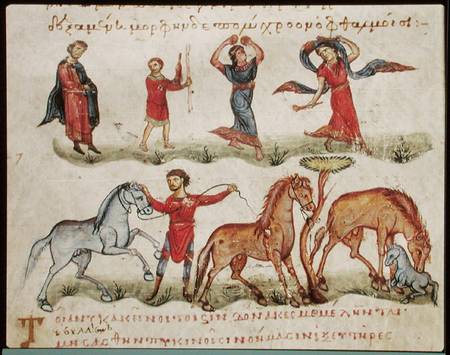
Or, they could be dancers. I’ve seen a great deal of sleeveless “Byzantine Dancer” interpretations in the SCA and other re-creation groups around on the web, but I did find this image from the Paris Psalter very quickly on Wikipedia with a fast search. This also dates to the 10th Century and has connections to Basil II/John I Tzimiskes period as the textile.
From Wikipedia, “David Glorified by the Women of Israel.”
These women are definitely dancers, and the painted style of this is most interesting in the layering of the colors. They are definitely wearing what could be considered the classical stola on it’s own, and the men are wearing the clothing of Late Antiquity and do look more Western Roman rather than Byzantine. This is a curious piece to work from as far as clothing styles go. However, looking directly at the women, you can tell the dresses are one piece and woven or dyed into different colors, and the actively dancing woman is still wearing some sort of sandal on her feet, so she’s not totally barefoot like the demoi are. However, the sleeveless style is there for a dancer. This link that shows a modern woman reenactor gives a source as being in the Biblioteca Marciana, or the Library of St. Mark’s in Venice. I went to check it out on the Biblioteca Marciana digital library, but the back-end of their Java encoding is broken, and couldn’t view their manuscripts, not to mention the reference given is so vague, I’m unsure of which manuscript it’s actually in.
EDIT 5-21-2014: somebody on the SCA Garb Page on Facebook has found it for me, HURRAY!
Those dancers may be similar, but the lack of ornamentation, and the weird flounces at the bottom of the skirt don’t mesh with the Tyches in the tapestry.
My big red X over this hypothesis is that the job of a dancer in the Byzantine Empire was THE LOWEST OF THE LOW. They did have court dances, and ritual dances, but for entertainment purposes, especially the showing of the arms and legs? You’re a harlot. Plain and simple. This is seem all too well in the opinion Procopius had of the Empress Theodora in his “Secret History.” Granted, he was a bit of a gossiper, but she was portrayed as the absolute dregs of society before she was married to Justinian. This was not a wanted profession. Why would 2 images of a divine person be dressed as dancers? That sounds insulting to the goddess Tyche. It would be almost satirical in nature for the demoi (remember, political parties) to be dressed as such, but not in the way that the silk is portrayed. They’re supporting figures for a conquering emperor, and not there as jokes.
For now, I will stick with the idea that the sleeveless-appearing Green Tyche was done in error on the weaver’s part, considering the Blue Tyche has the cream colored tunica. If it is an attempt at classical Roman revival, the stola should be to the floor, as the two layer look is strictly a Byzantine fashion style. The weaver was emulating Byzantine fashion, not Roman.
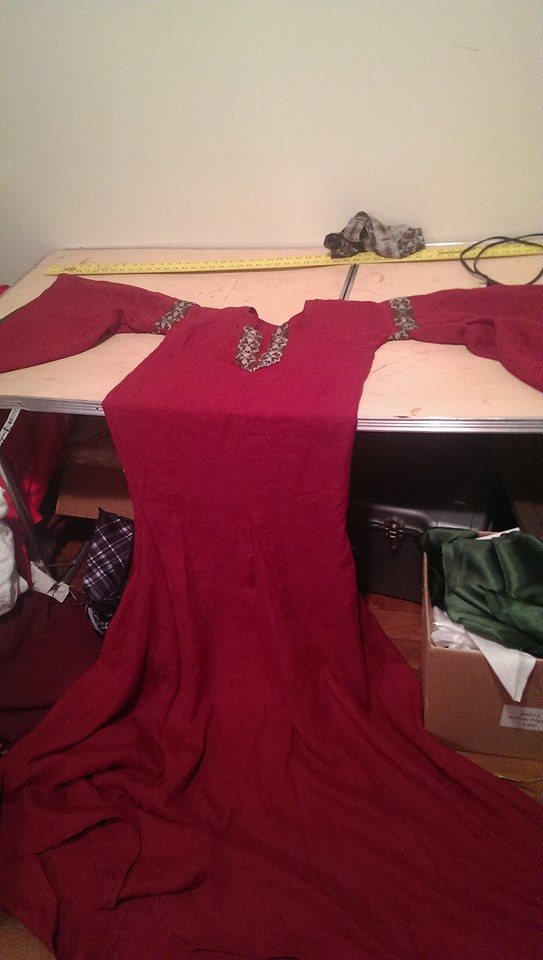
Moving onto discussing my interpretation, I created the stola from about 3 yards of red-orange linen. As shown in my previous post on this style, the Byzantine woman’s stola would have looked similar to the Roman stola (see my Ancient Roman costuming page for more info on that) but closer in cut to the men’s Roman tunica, as seen in this Coptic example:
I opted to play with this idea with the “pinching” method of the Roman stola, that is, bringing in the top seam a bit to achieve straps, and provide a more comfortable neckline. The textile shows the women wearing a relatively high neck, as opposed to the deep V-necked style of antiquity. Easy enough. The trick of course is to fit the neck to yourself over and over again with pins to get the look you want. Here is the illustration of mine:
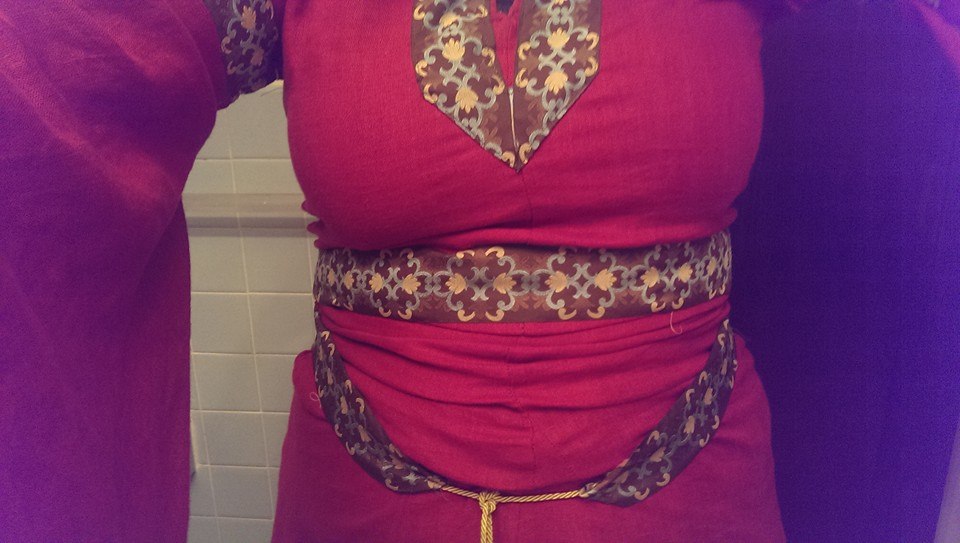
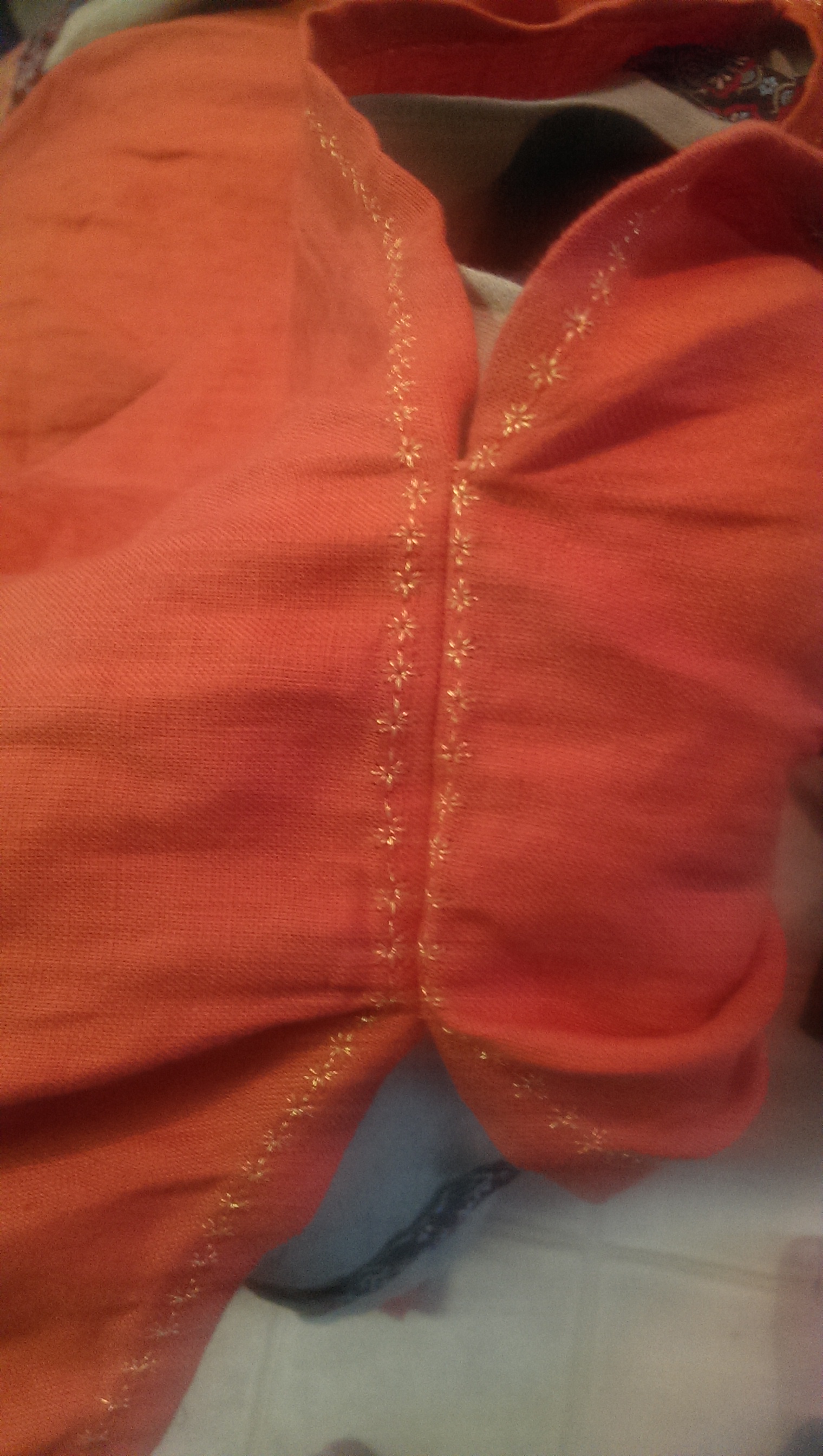
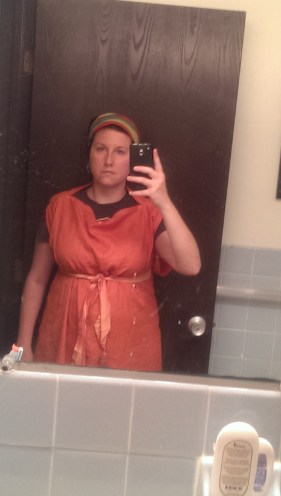
Here’s some pictures of the finished product to help give a better understanding, you can see how I already finished the neck and shoulders before I attached the straps. The embroidery is done by machine and I’m just a fan of that aesthetic. Similar bands are shown in some artwork, but I just wanted a little bling. Also, pardon the icky bathroom mirror:
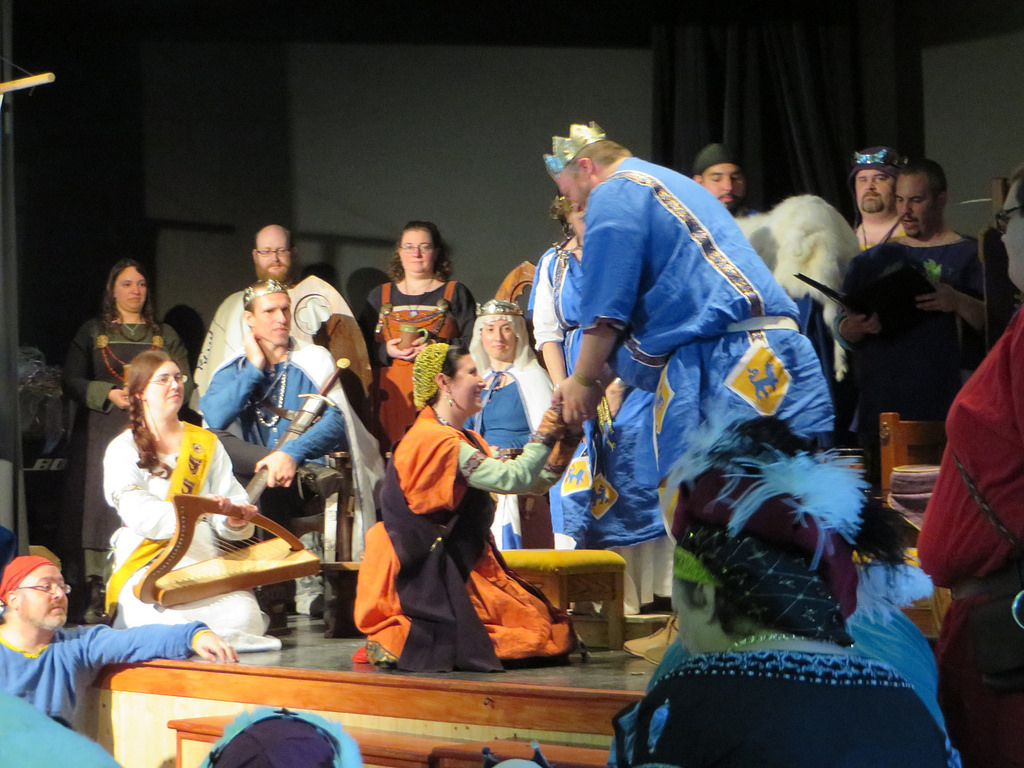
And here’s an action shot of me receiving my Maunche, which I was actually happy to see so I could see how the sleeve openings looked, and they look comparatively well against the original source material. There is no large gap as shown in the Dover artwork at the top, and the draping against my shoulders looks fantastic and flattering. If I would have left the fabric any wider, it would have been frumpy, and any smaller it would have been too tight. So 40″ wide is the magic number for me and stolas. Your mileage will vary depending on the person.
I guess the next thing on my list is to make a tunica with the solid stripe in the front as opposed to the clavii, and take pictures with my turret hat and a palla in such a way that mimics Tyche. I still love my overdramatic dalmatica style of the 11th Century, but this is a comfortable option for warmer events, and it was relatively warm indoors. Hence the lack of hat and palla. I did have it with me, but they made me toasty. It’s also hard to guard thy queen while being immobilized by your garb. 😉
It’s pretty much safe to say that this particular short stola was worn from the period of Justinian and Theodora in the 6th Century as seen in the Ravenna mosaics, and through the 10th Century as seen in the Bamberger Gunthertuch.
From Ravenna: Possibly stolas, possibly tighter dalmaticae, the hems are tucked up, not cut on an angle.
I hope this little simple project of mine helped those who were scratching their heads over the Dover illustrations. I feel that this is the correct form of the garment worn, and that more women will be interested in trying this unique style of the Byzantines. 🙂




































 Anna's New Rome
You must be logged in to post a comment.