I thought I would do something more fantastical for my 100th blog post, but no.
I’m sorry, I’m going a little thesis stir-crazy after a long day of frustrating research in three languages, and I need to let my brain leak out of my ears a bit.
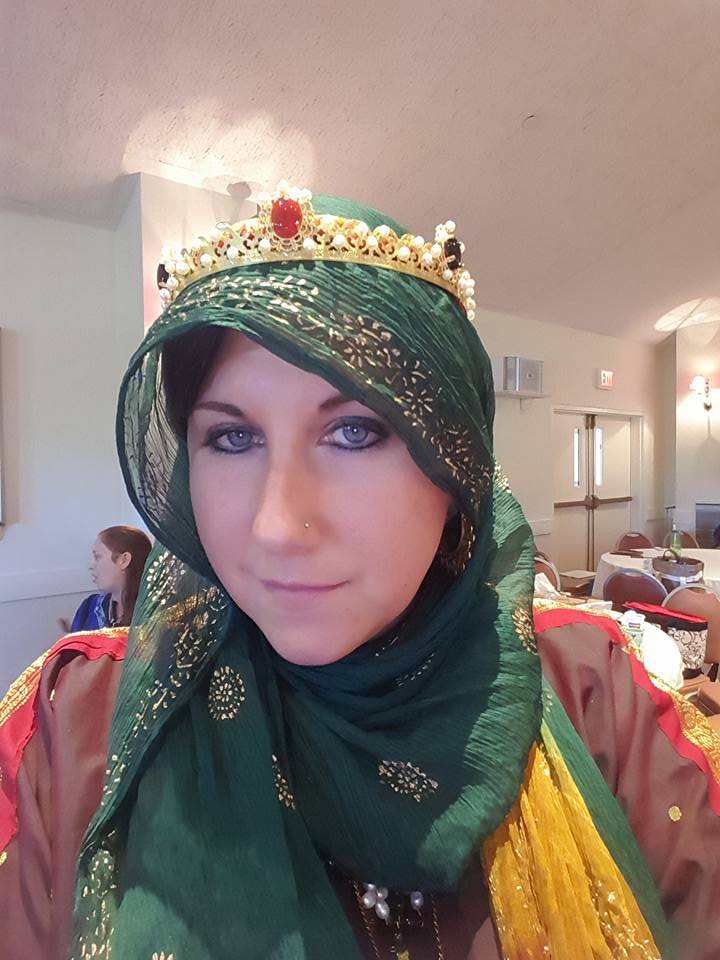
So here’s a self-portrait:
Fantastic updates will be coming soon! I just need to go through pages of handwritten OH GOD WHAT IS THAT and formulate a public post from it.
I managed to get back to the Met last month, and spend a whopping six hours there, never getting off the first floor. Again. Well, except for the Roman study rooms, but I digress. They have a really neat exhibit right now under the stairs in the Jaharis vault (where my favorite tunic was) that shows off some very cool painted liturgical linens from the late Roman/early Byzantine Egyptian period.
I’m going to start trying the technique, as it doesn’t look too daunting, it’s just egg tempera on linen, either pure white or dyed indigo. I figure if I can frame the fabric in an embroidery apparatus, it should work. As far as I know, the fabric wasn’t sized or gessoed prior to painting, at least it didn’t seem that way, so this could turn into a big mess. Should I succeed, I see a very nifty, period way to display heraldry indoors.
My paper has been published on the East Kingdom Gazette page. For some reason the reblogging feature isn’t working right, but that’s okay. Here’s the link!
So I totally lied about doing updates over winter break. I am working on some sewing, but for the most part, I wanted to give my poor burned out brain some time to unwind after a particularly difficult semester.
Here’s a few important and interesting updates:
In June I will be relocating from the East Kingdom to the Kingdom of Caid. This will be a short-term relocation with an inevitable return to the East due to my husband’s naval career, but it will definitely affect my attendance at events to teach. I am planning on Pennsic this coming summer by flying into Pittsburgh, but I will NOT be at 50 Year. As much as I’d love to go, the timing with the move is making it impossible, and there is no way around this, as mundane life comes first. However, I am looking forward to infiltrating, I mean, attending, new events on the West Coast for the short period of time we will be out there. I will know more about schedules and such after the move and once my own employment is sorted out. Right now the ultimate goal is to secure temporary work as adjunct faculty within the San Diego Community College District, but there is no guarantee I will be offered a teaching appointment. But this blog isn’t about mundane stuffs…
The cool news is that this is the semester of The Thesis:
For my final project of my master’s degree, I am exploring the material culture of the Last Will and Testament of Kale Pakouriane, an 11th Century patrikia who entered a convent upon being widowed. I will be making a selection of her things.
MAKING THINGS. BYZANTINE THINGS. FOR THE SCHOOL LEARNIN’S.
I have not settled on which things yet, her inventory was impressive and I have three months. The primary goal of the project, in addition to making things, is actually attempting a reconstruction of her life from this inventory. This obviously includes her wealth, but also tangible goods, why she made the bequests that she did, and how class structure affected her decisions to leave lower household members with significant inheritances from her estate. I’m very excited about this project, and the bulk of my upcoming posts will be regarding this. I’m considering making a mundane blog for it, but I need to go over requirements with my academic committee first to see what they recommend. Either way, anything posted on a separate page will be mirrored here for the benefit of the SCA. Once completed, I’m going to submit it for publication in the form of a Compleat Anachronist.
I also have a short research paper on the Perception of Women during the Ancient Greek periods that will be published on the East Kingdom Gazette this week. Once that goes live, I will re-press it here.
I hope everybody is having a splendid New Year so far, and I look forward to sharing my progress on this epic project!
This is what happens when I catch a cold, miss an event, and decide to not do homework. When I’m sick, I get bored, and when I’m bored and hopped up on cold medicine, well…I needed to tinker.
Edited on 9-28-2015 to add finished pictures.
PROJECT ONE: WEAVING THINGS.
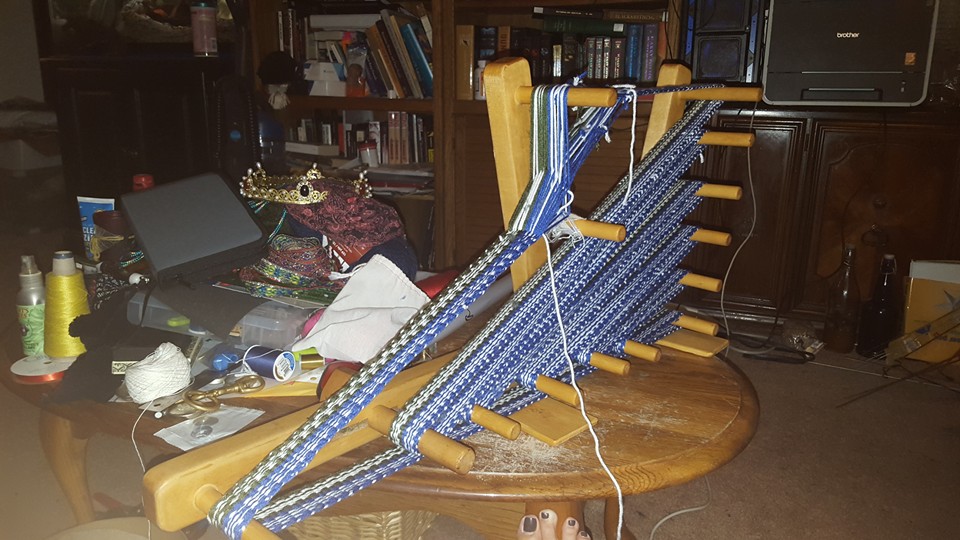
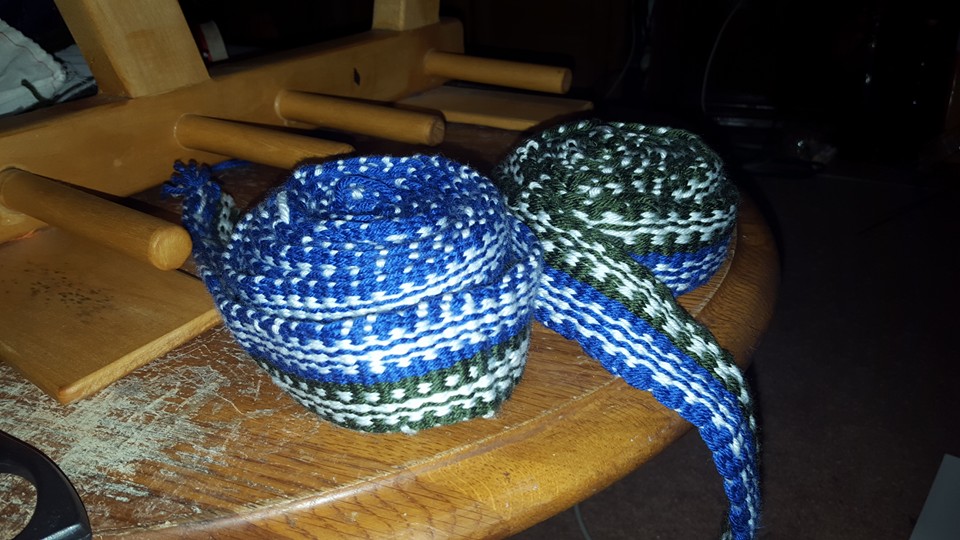
Well, I started by warping up the inkle loom and making the Norman husband a pair of leg wrappings in his heraldic colors. They’re pretty crappy in some places, and hence, leg wrappings, rather than trim. This is the first full 6 yard band I’ve ever made! Material is acrylic yarn, because I wanted them thick,washable, and low-cost in case of it turning into a cat toy. I did okay though, so now I’m more confident in trying wool yarns for the next batch. I finished this in a day. I warped it Saturday night and by Sunday night the band was complete. I was a MACHINE.
The pattern when I hit my stride.
FULL LOOM! And a coffee table full of craft supplies.
BOOM! A pair of leg wraps at 3 yards each, about 2.5″ wide.
PROJECT TWO: SHINY THINGS.
Oh yeah, see that coronet on the table? I made that too. Norman Husband challenged me to make a coronet with him out playing Navy. Him not around left with me NO METALWORKING SUPPLIES. So, I had to play, and go buy a new beading pliers set. And JB Weld. I could NOT have done this without clear 2-part epoxy. G-S Hypo Cement did not cut it except for gluing the band itself together and the cabochons onto the settings. It did not hold the settings onto the band. I’m still not 100% finished with it, when I am I’ll post finished pics.
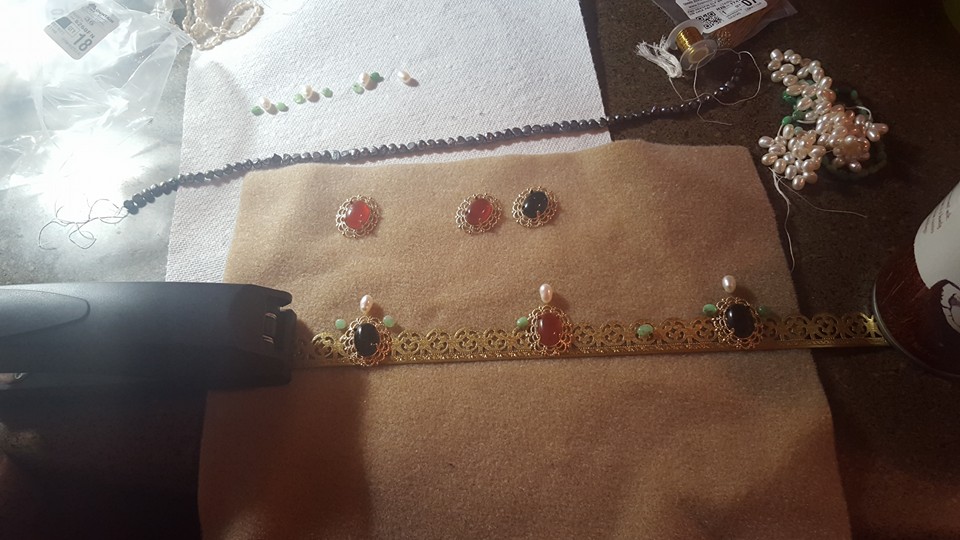
I set up a “coronet bar” on my kitchen counter, because it’s high enough for me to not hunch, and I have great lighting. Findings are just some vintage brass lamp banding and shiny bits from Fire Mountain. Stones are real carnelian and onyx, and pearls. Lots and lots of freshwater pearls. Not only very period, but also my heraldic colors.
Epoxying the cabs on the band.
It didn’t look so bad the way it was, but you know, Byzantine…
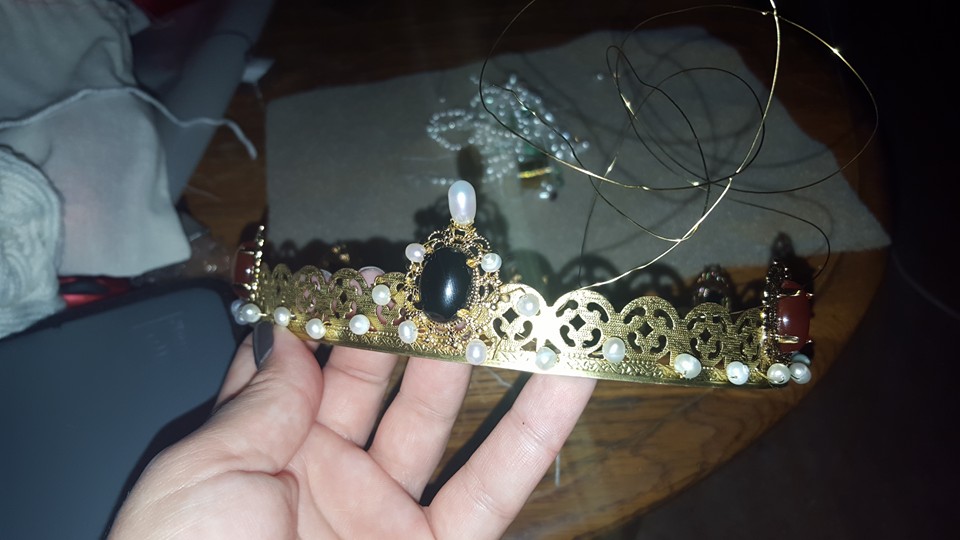
Lotsa Byzantine. I’m just attaching the pearls by weaving wire through openings in the brass.
I marathoned the original Star Wars Trilogy while I worked on this. It gives you an idea of how long it took. Here it is almost done with some Darth Vader.
Here it is on my head. I think the top pearls make it look too Western (boo hiss), so I’m going to cut them off, and replace them with round pearls. I could have gone WAY OVER THE TOP with this, and wanted to, but I was talked out of it, and I’m glad.
I added rings on each side near my temples for a pair of pendilla to hang from. I don’t have the pendilla made yet, and I don’t ALWAYS have to wear them.
Finished coronet as of one week after I made it, after removing the top pearls, replacing them with smaller ones, and lining it with orange velvet:
Notes after wearing for an event: Too much padding, it didn’t want to stay put. I know coronets are jewelry and not a headband, but still. I’m going to try a different method before I wear it next. Also, I got a lot of compliments on my veil. All it is, is a green/yellow/red ombre dyed Indian dupatta. It still smells like batik. I wrapped it and tucked it into my belt in the front based on some icons and manuscripts I’ve seen.
No, using vintage lamp brass and epoxy aren’t exactly period techniques, but it creates the illusion for now until Norman Husband completes the Hagia Sophia of Coronets he’s promising me. Plus, this is dainty and clocking in at 1 3/4″ at the tallest, so it works for periods I wear that AREN’T Byzantine. I’m not a jeweler, and especially not a hat maker, so even three days later my hands are KILLING ME.
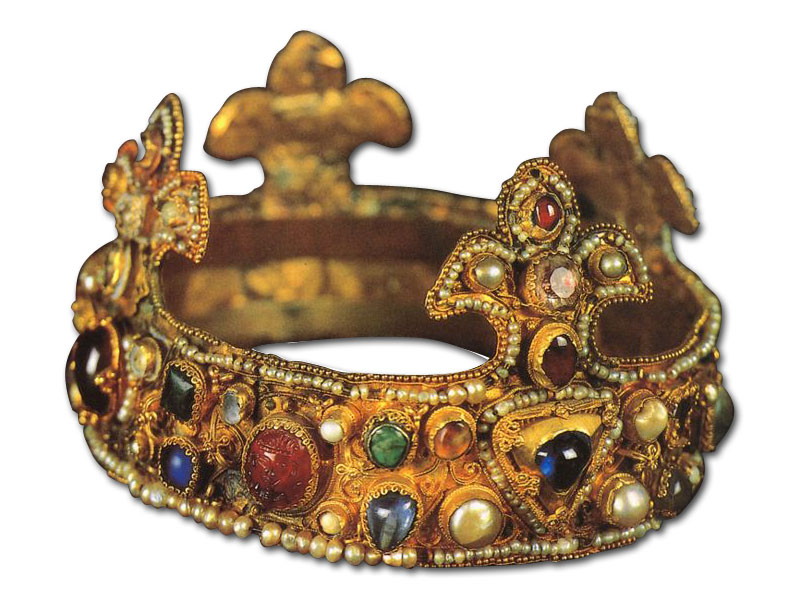
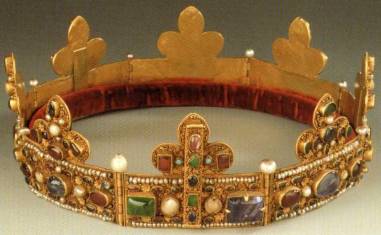
Here’s a couple of Byzantine crowns that I pulled some [vague] inspiration from. They didn’t always wear votive crowns and massive tall hinged plaque things of doom.
PROJECT THREE: MODIFYING THINGS.
And last but not least, OMG SHOES.
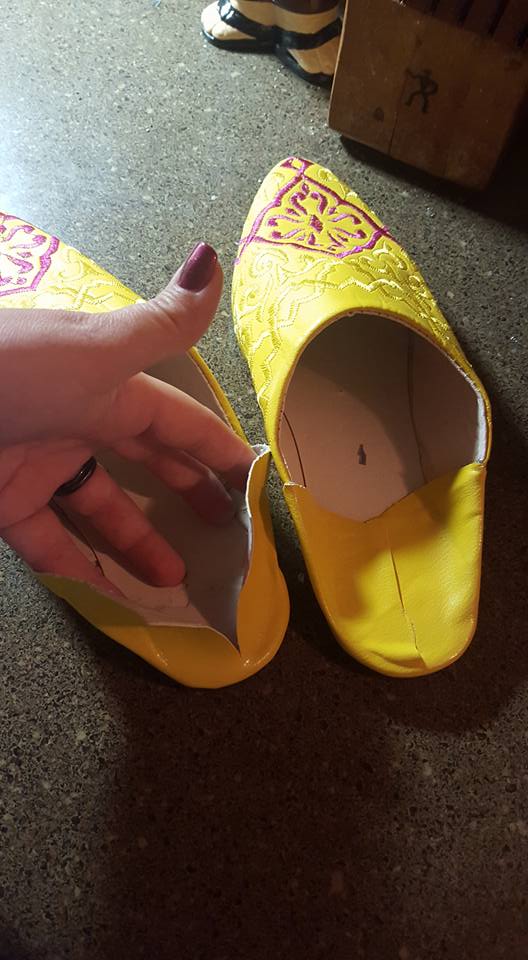
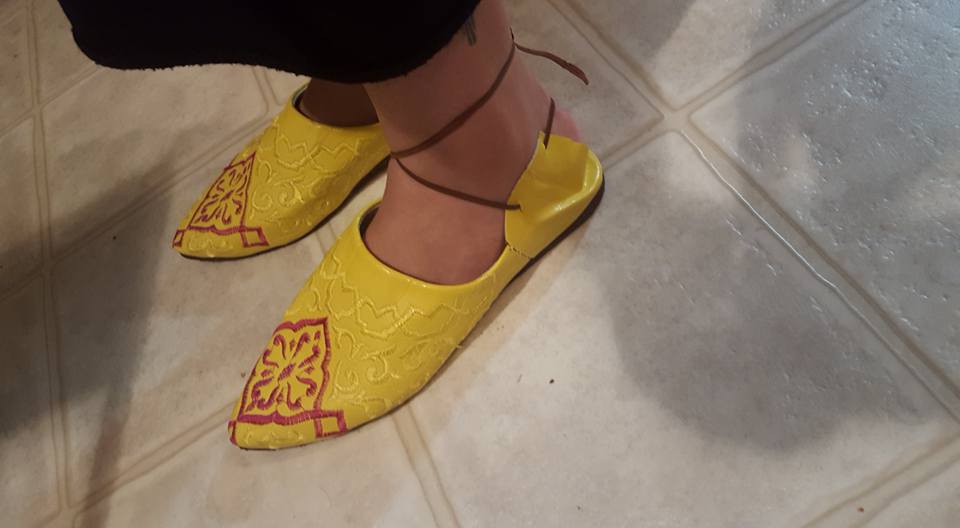
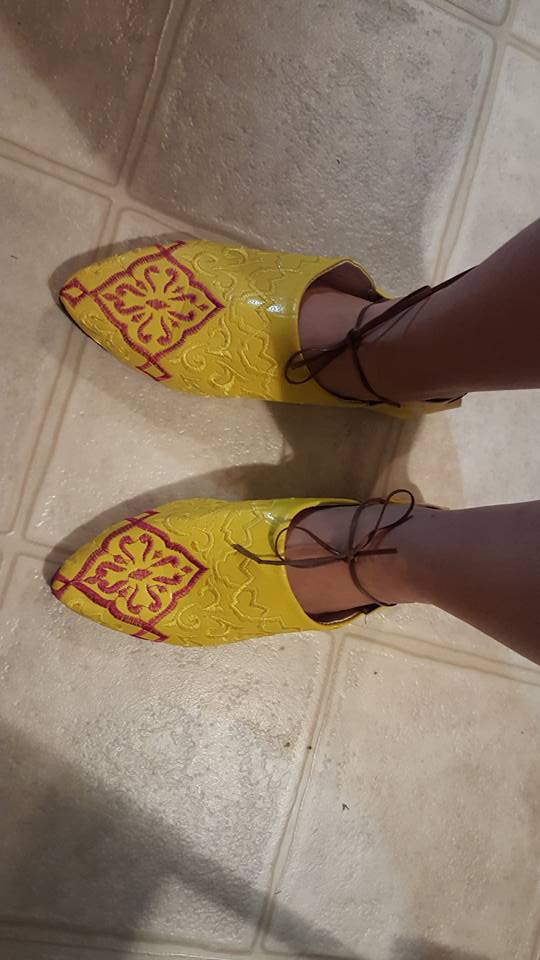
If you read my previous post, I made a blurb about what color shoes are appropriate for a Byzantine persona. As a court baroness, I could get away with yellow, so, I wanted to see if I could invest in a pair of proper Eastern looking shoes. Unfortunately, most medieval cordwainers don’t make Byzantine or Middle Eastern shoes (that’s a hint, folks) so I had to improvise. I hate HATE HATE wearing Pakistani/Indian Khussa, because they eat my feet alive. Even if I shower with them on, or wet my feet, they just never break in, and rip me up. That’s no fun. So some searches yielded Moroccan Babouches. These are actually pretty perfect, except that they’re backless. Now, extant mules have been found, and are still worn in Turkey today, but I hate backless shoes, mostly because as you can see in these pics, my feet and ankles are very narrow. It makes mundane boot shopping a crappy experience when the material just pools around my ankles.
I found these super awesome embroidered babouches on Etsy. They look very…Calontir.
I ripped the backs up to find that they’re designed in a way that you cannot fit your foot in comfortably, so, I split them down the back.
Cut holes with scissors on cutting board, because husband brought leather tools with him while playing Navy. Find random leather strap in his leftover stuff, and lace.
Experiment with lacing.
Walk around and immediately get blister.
Tie them in the front. Ah, that’s better.
Side view, they don’t look horrible. However, taking pics of your own feet is kind of tricky.
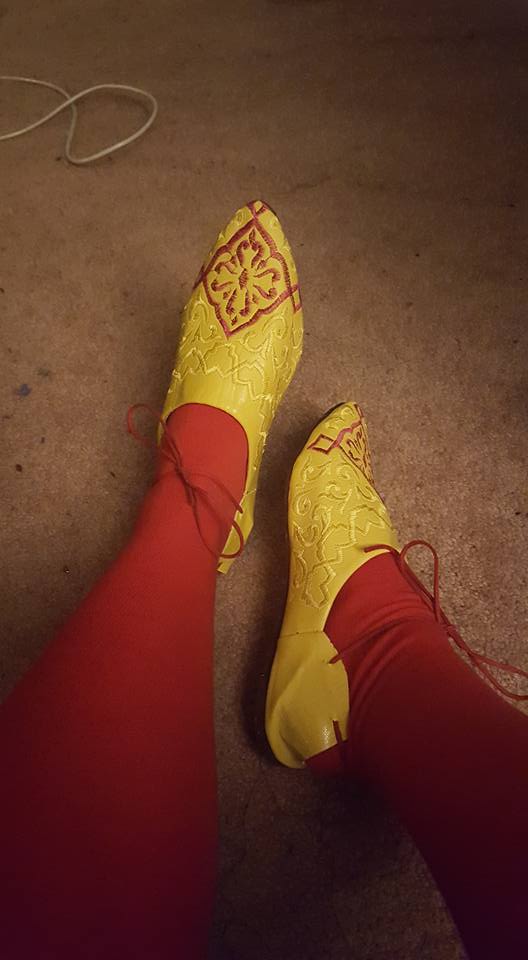
Shoes with better lacing and my red stockings:
I just felt so damn sassy.
Period shoes that gave me this horrible idea:
We called these the “Byzantine Chuck Taylors” on Facebook. No, the backs aren’t open. I know. I know. I IMPROVISED, OKAY?
A pair of Byzantine Mules dated to 300-700 from Panopolis. Here’s that backless option for those that aren’t afraid of flat tires and don’t have feet that fall out of everything like I do.
The ones I made are clearly going to be “inside event” shoes. I’ll wear them with stockings in hopes to combat some of that extra width while the lacing will stop my feet from falling out. The best part that is if I want to, I can pull the lacing out of my shoes and flatten the backs again into mules.
Again, like the coronet, I’m creating an illusion from modern materials. Once I’m done with my master’s degree and move across the country, I’ll have time to work on making an actual pair of period leather shoes with gold leafing that WON’T be too wide for my feet and involve kitchen surgery. And maybe I’ll learn some metalworking so I can help my husband in making a proper hinged 11th Century coronet, but until then, it doesn’t hurt to use your imagination in the little game we play.
Oh red shoes. Byzantines and red shoes. Wear ALL the red shoes, but…should we be wearing the red shoes?
In the SCA, we’re all playing nobility, but we still have a hierarchy. Granted, it’s nothing like a true feudal system, but we still have ranks and titles that come with it certain privileges in dress. A knight or master of arms is a fine example with their right to wear a white belt or baldric. In the case of the Eastern Romans, shoes played a huge part in who you were and what job you did.
Red shoes are imperial in nature. Done. Story over.
This is me getting my dreams shattered.
This started because I was pondering joining the Red Shoe Club under the urgings of a duchess friend from Artemisia. Prompted for documentation that women wore them, I turned to my favorite, expensive source on the matter: Reconstructing the Reality of Images by Maria Parani. (Best $300 I ever spent on one book.) I seriously refer to it as my Book of Armaments.
Oh Lord, bless this my book of Byzantine goodness so that I may dress snazzily, with thy mercy!
Parani pulls no punches in that she states that documentation for women wearing the red shoes is scarce (pg. 30.). I have yet to follow up her footnotes, but she cites Michael Psellos on the fact that the Empresses did wear the red shoes, and then Anna Komnene on that women wearing them in the absence of a male heir was rare. Veering away from shoes momentarily, this is something I’m noticing a lot in the ways of court dress and titles: the women often wore what their husband were wearing. They took their titles, and they took their clothing privileges. So in the case of a solitary female ruler, she may not wear the red shoes in the lack of a male consort. We look at this now as incredibly misogynistic, but this is how the world worked for centuries.
In period, I would have a husband, and he would be the hypatos (consul), therefore, as hypatissa, I would be allowed to mimic his clothing and regalia for court functions. In the SCA, my husband is not a baron, so I stand alone as a baroness. This is common in the game we play. So this is when you need to think with your persona, versus thinking as a SCAdian. Of course, if I really thought as my persona, I wouldn’t be in Byzantine dress most of the time anyway, I would be in Norman dress. Gross. But I digress.
So, if red shoes aren’t an option unless you’re on the throne (and consequently, a royal peer having already been ON the throne and have in excess a wardrobe of royal lovelies) what choices do you have?
Parani herself seems to uncover several color options. In addition to the Imperial red, there’s yellow, blue, and green. Like all things Byzantine, these change over the course of history depending on what the emperor ate for lunch. There is one citation she gives in which in a manuscript dated to the 10th Century, Pontius Pilate is seen wearing red shoes. (pg 82.) Is this evidence that non-imperials were wearing red? Hard to say. Personally as somebody who’s been reading up on iconography, such things could be used as symbolism. Perhaps to this artist, Pilate had feigned imperial power?
The general information I can compile (without just regurgitating Parani’s words, which is uncool anyway) at least for the re-enactor/re-creators looking for shoe ideas, is the following:
Yellow: Prefects, and then later the panhypersebastos (patrikoi within high favor of the Imperial Family) (pg. 71-72, 82.)
Blue: The Kaisar and Sebastokrator, usually immediate family members to the Emperor and maybe in line for the throne. In the Palailogos Dynasty, the Sebastokrator would have eagles embroidered on them. (pg. 71-72)
Green:Protovestiarios, the head eunuch in charge of finances. (pg. 71-72)
Red and White with eagle embroideries: The Despotes, title of the heir-apparent during the Palailogos Dynasty. (pg. 72)
One red, one black: Chronicled by Arab geographer Ibn Hauqal as being worn by the Prefect in the 10th Century. (pg. 71 n. 83.)
That doesn’t leave a lot of options for SCAdians looking to stay in their persona. It would make sense for the Prince and Princess to wear blue, and I don’t know many eunuchs (not that they’d tell me anyway.)
So this really narrows it down to well, yellow. But who would wear it? Well, in some definitions, prefects were regional governors. In Greek the term is Eparch. From what I can gather, an eparchy was more of a district than the themata, which were ruled by the anthypatoi, or proconsuls.
But in the SCA, who would we place in these positions? My previous post discussed the equivalence of the anthypatoi with landed baronage, and hypatoi with court baronage. A barony is still an administrative area that was governed. But is this something that should be limited to just the SCA baronage? Ehhhh…maybe? I think this is going to be one of those “let your persona do the walking” things. I have yet to see a kingdom in our game that has sumptuary laws on shoes. Your best bet would be to study your own period and come up with who you want to be. Nobody is going to stop you as a lord or lady from wearing red shoes, but do you personally want to feign claim to the throne? Impostors got blinded in period. That doesn’t sound like much fun. And as far as the panhypersebastoi are concerned, that was any family that was in high favor of the Imperials in the mid 12th Century. So if you’re a later persona, that’s an option, especially if you’re in a kingdom where populace swearing fealty is common. If you’re in an office that swears fealty, absolutely.
On that note, I’m going yellow shoe shopping.
Friendly note: Historians love to argue, and this is information from ONE source. Although Doctor Parani’s work is very thorough and well cited, there are possibly other historians that disagree with her and have their own evidence. Don’t take this as the gospel truth, and feel free to explore other resources.
Yesterday, their Majesties of the East sought to award me the title of Baroness of the Court. Not only am I greatly humbled by this, but it really couldn’t come at a better time research-wise.
Myself, as well as Ioannes Dalassenos from Ansteorra, and Konstantia Kaloethina, currently Gold Falcon Herald of Calontir, are in the process of compiling alternate titles that may better suit the Byzantine persona with the ultimate goal of approval through the College of Heralds. Once the research paper (yes, paper) is ready, I’ll make a special tab for it here on my blog so it’s always easily accessible, but until then, here’s a little sneak peek.
The Eastern Roman Empire (As well as the Holy Roman Empire, which as all of us REAL ROMANS know, was not Holy, Nor Roman, and questionably an Empire) did in fact bestow honorary court titles like we do the court barony in the SCA in lieu of the landed titles. In the case of Byzantium, they were still using the classic titles of consul and proconsul, only, you know, in Greek. In this case, hypatos and anthypatos, hypatissa and anthypatissa respectfully for the feminine form. Some records show that the title of hypatos (consul) was given honorarily, and that anthypatos was used for governors over themata, or states within the empire.
So, as far as the SCA structure goes, a court baron/baroness could totally use the titles hypatos/hypatissa while they’re landed counterparts could be anthypatos/anthypatissa!
We really can’t wait to share this research with everybody, and hope that the new ideas catch on. Using titles actually from the periods we are portraying are one of the little things we can do to help up the authenticity of our game. Everybody should give it a shot.
In service, Hypatissa Anna Dokeianina Syrakousina. Say that sucker 3x fast.
I’m so classy, the culprit of coronet crafting: Lord Geoffrey, is sitting behind me.
As always, I have posted my class materials on Google Drive. Don’t forget to visit my Classes tab to access handouts and modules from previous classes.
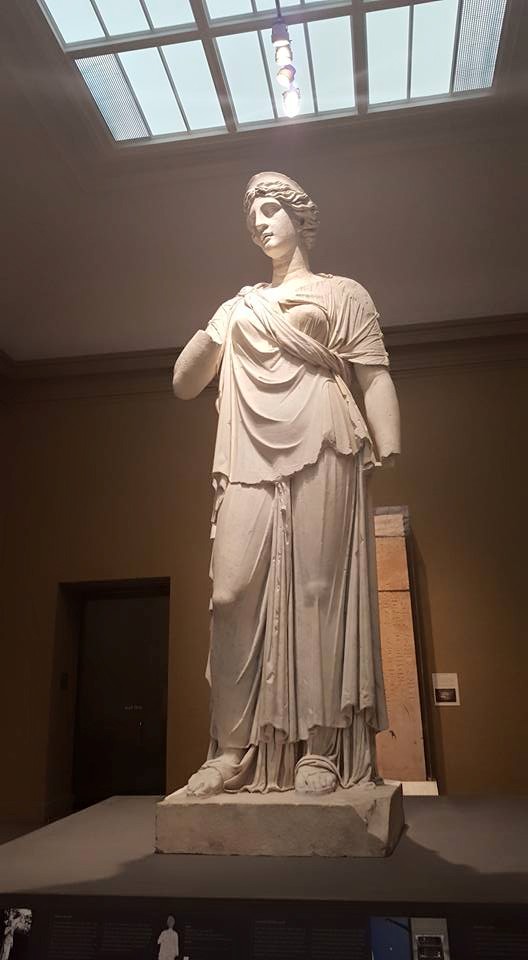
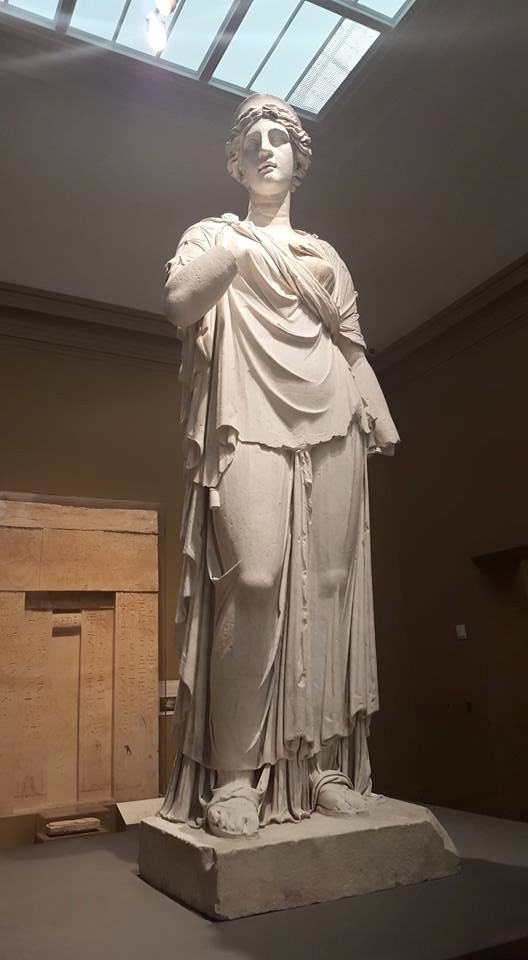
I finally got a chance to go back to the MFA yesterday and see Juno with a head on. When they acquired her in 2012, she was decapitated and needed a nose job.
Click for larger image.
When I went last year in 2014, she was blocked off because of a special event. So yesterday, finally yesterday, I got to take in her entire massive splendor, which I must admit, makes you want to drop to your knees in worship just because of her sheer size. This also meant that I finally got a chance to analyze what’s going on with her layers.
All photos were taken by me with my phone at the Museum of Fine Arts in Boston, MA. They can all be blown up to a larger size by clicking on them.
“Gee whiz, Mrs. Jupiter, you’re AWFULLY tall!”
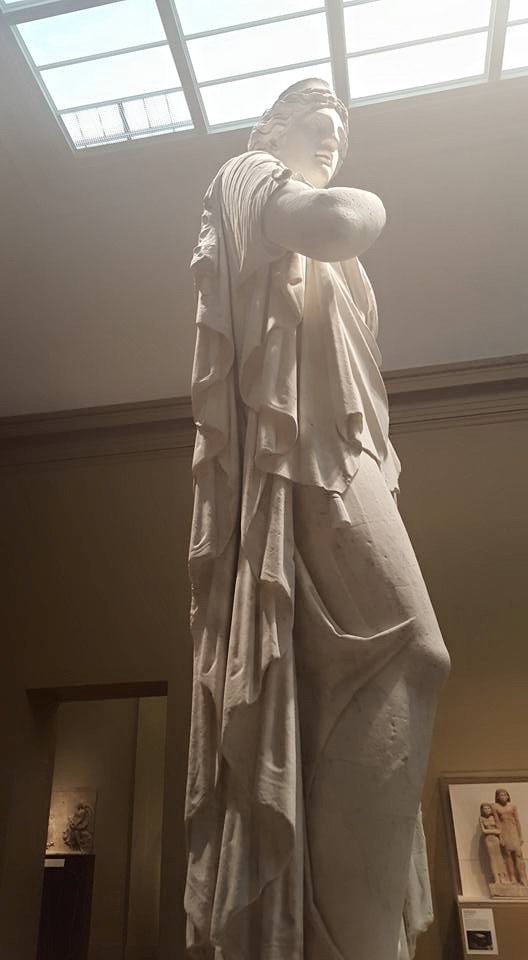
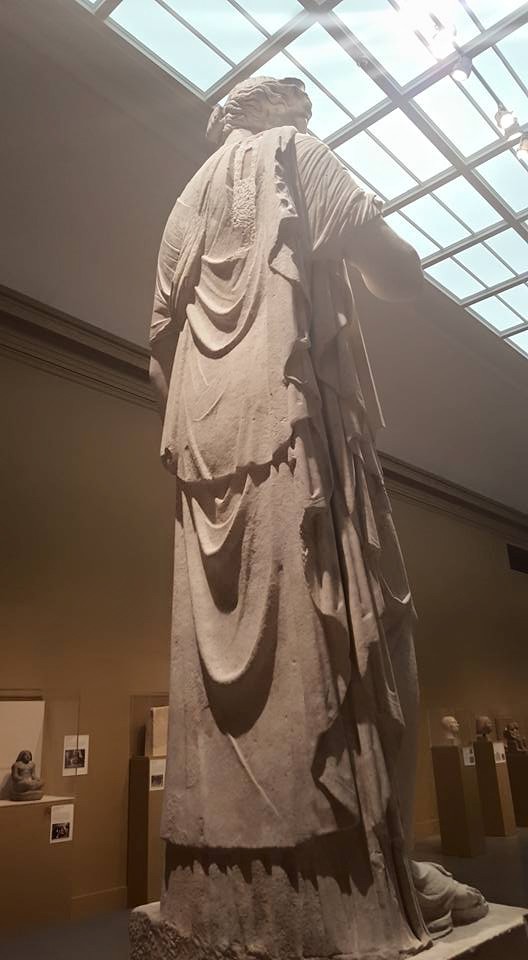
Before we get to the knitty gritty, here’s all the pictures I took of her. Isn’t she magnificent?
And now we get to talk about what we’re looking at. That’s a peplos over a chiton. (Remember, here at Anna’s Rome, we use the Greek terms for Roman clothing to better determine the difference between the two garments. For more information, please visit my Ancient Roman Garb page.) Now, my observation of this from 2012 apparently sent some folks into a minor tizzy on the internet, because that is what the internet is for. Clearly I meant stola, clearly I was wrong. Clearly I didn’t know what I was talking about.
THAT. IS. A. PEPLOS. OVER. A. CHITON. With the left shoulder unpinned and rolled down to reveal her breast, and the right side left unsewn to add to the really detailed open drapery the sculptor had a field day with.
The stola had its golden age in the Republic. This statue, at least the body of the statue, is dated to the 1st Century BC. (The head was a later addition in the 2nd Century AD.) So you’re looking at the early Empire. Now, some women did continue to wear the stola well into the Empire, it was popular in the Flavian court, which may have been more conservative than the Julio-Claudians. The concept of fashion and trends was just as alive then as it is today. But what this does is provide women with an alternative to the frumpy blimpy stola that allows them to maintain the modesty expected of a matron while being more mobile and less confined to layers upon layers of cumbersome material. (More info on stola can be found above in Ancient Roman Garb page.)
Now, sculpture always interprets the ideal, not the real. Gods and Goddesses will always be the ideal, no matter what, but it’s worth noting the way the material drapes against her body and allows for some clingy sexiness. This cannot be achieved with today’s linen. My assumption is that we’re looking at some really REALLY fine tropical weight wool gauze, which I HAVE seen occasionally at a premium, but that’s what was worn more often than linen. It was more colorfast and easier to weave versus the smelly process of retting and laundering flax. It also would have felt nicer against the skin than wool does today.
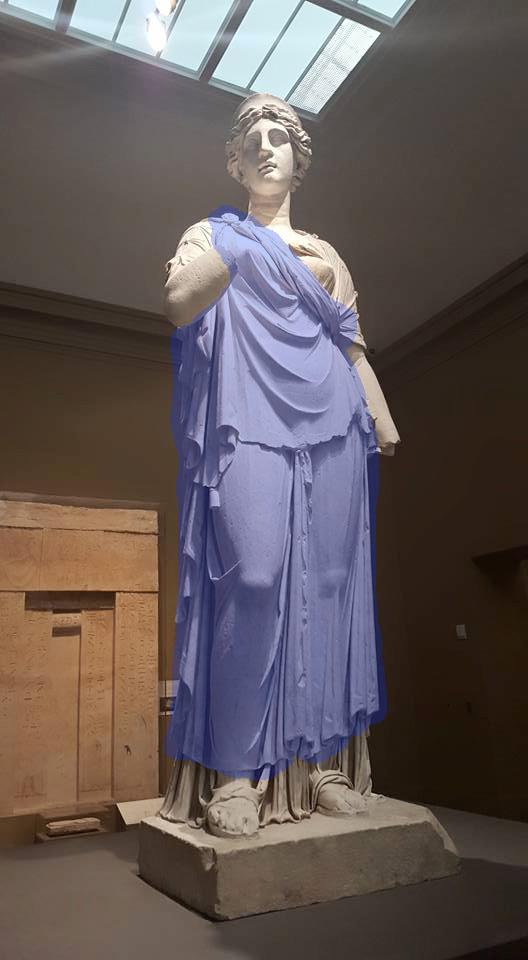
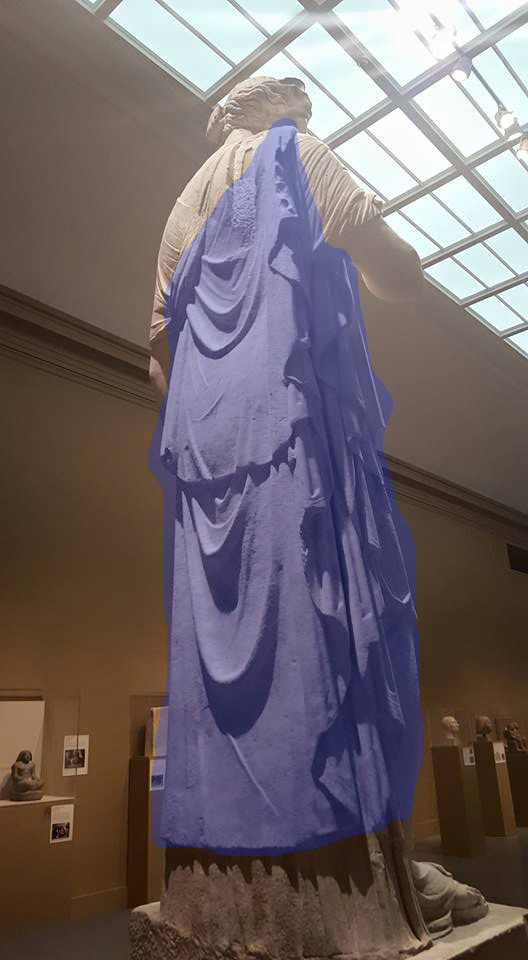
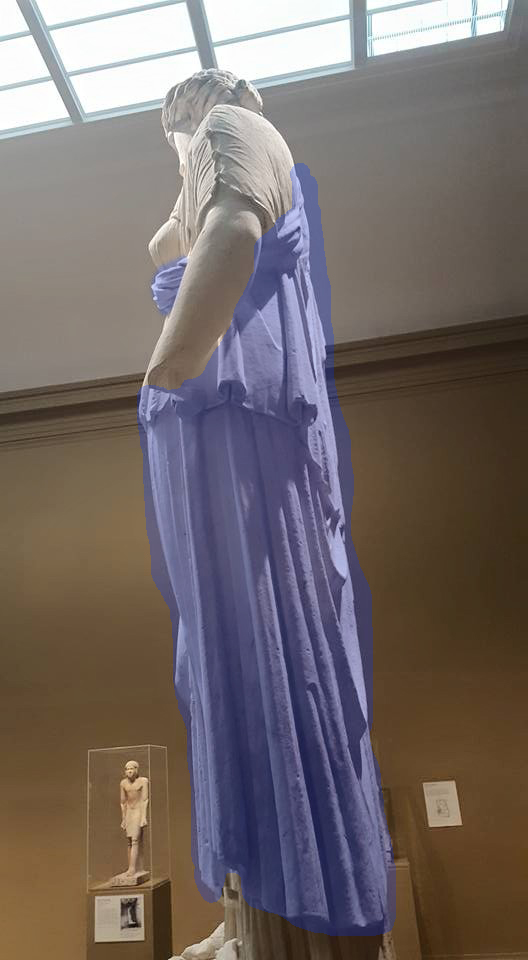
So let’s take a closer look, care of Photoshop and some bad transparent painting.
Now you can really see the separation of the layers from the front, which is where the sculptor would have paid the most attention to detail. The peplum (flappy bit) is clearly visible, and unlike a stola, the garment is shorter, and reveals the chiton underneath, rather than reaching to the floor and touching the wearer’s instep such as her chiton does. There is no visible sign of belting but one tassel on the side (we’ll get to that in a second.)
At first, I thought she was wearing a rolled palla or something over her shoulder, but now that I’ve been able to really circle the entire sculpture 17 times before my husband dragged me out of the gallery, it’s clear that it’s only pinned on her right shoulder, and that the garment is rolled down. The only idea I have regarding this is to pay attention to Juno’s sexuality. I’ve been mulling over the idea that the peplos as a sole garment with no under layer is the mark of a virgin, you see this with statuary of Athena/Minerva and Artemis/Diana. In this case, Juno (Hera) is the Queen of the Gods, she has children, and a sexual relationship with her husband, Jupiter (Zeus.) The peplos revealing the breast in such a manner could better facilitate breast feeding, but it also goes, “Hey, yeah I’m modest and married, but I’m still desireable.” As on the other side of the modesty spectrum, Aphrodite/Venus is often shown just wearing a chiton that is usually falling off, or nothing at all. So this bridges the rigid virginal appearance of some goddesses with the hypersexualized appearance of other. You have a modest, married woman, who has nursed her children, and is still revered as a mother to her worshipers. Juno herself had many, many roles as a Roman Goddess, ranging from being Queen of the Gods, a patron of Rome in the Capitoline Trio, an image of war, motherhood, childbirth, creation, etc. There’s no really good way to nail her down, so it would depend on the local cult. The provenance of this statue seemed shaky on the placard, but one could assume that in the particular shrine this sculpture was carved for, her motherhood and patron of childbirth probably took precedence, just because of the attention given to one breast, and her lack of armaments.
Here’s the side views. As you can see, little attention was given to her back, or pieces were sheered off to make way for a mounting mechanism at one point in time. I do want to pay attention to the open sides of the peplos in the first image. Traditionally, this garment was belted and overlapped to help conceal the body. Romans were more modest than Greeks in that regard, and they probably would have sewn it shut. This is left open and unbelted. There is one small tassel visible in that same image that shows the open side, which could be reference to an open girdle, or something hanging from the top. (I really couldn’t see. She’s tall!) In the case of the girdle being left open, that really lends to sexualization of the statue. The visible tassel likely belongs to the girdle of her chiton peeking out from the side of the open peplos, which would make sense, because her sleeves are nice and taut, signifying the garment being pulled against the body.
Overall, this style is pretty unique and the placard doesn’t state either way. It does pay attention to the open side of what they refer to as her mantle, *grumble*, but that’s really it. There’s only so much you can put down before people get bored at museums, anyway, unless you’re me, and you go, “BUT BUT BUT BUT BUT!” But I don’t work there. That’s what.
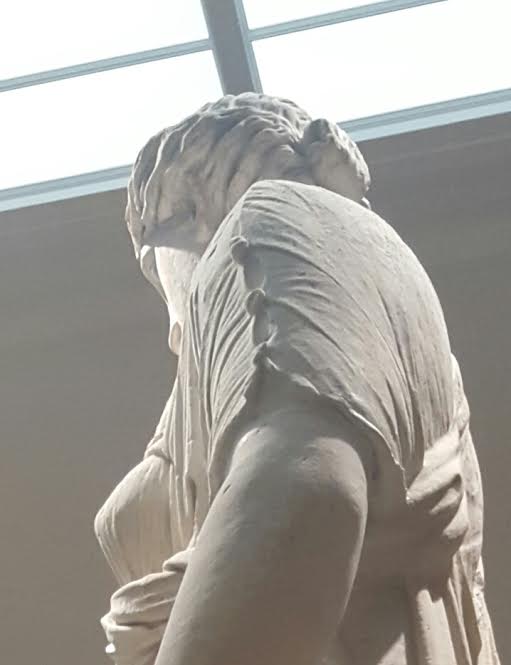
What I do really love though, is the amazing detail the sculptor gave to the sleeve treatments on the chiton in the last image that focuses on her left side. Those look like cloth buttons, rather than metal, and they’re a pretty good size in comparison to her dress. Which gives us reenactors and re-creators more ideas on how to embellish our garments. They also don’t go all the way to the neck, and just stay on the upper arm. Curiouser, and curiouser!
For those of us who want to emulate this look, I would advise against the one-shouldered thing. Leave that to the goddess, as that would not have been very proper for a Roman matron to wear, even in the house (unless you’re breastfeeding of course, when having functional buttons on the chiton is also a fantastic solution.) Other than that, now that we have concrete (eh, marble?) evidence of a peplos being worn in lieu of a stola for a Roman matron, the days of wearing eight yards of fabric over another four are over for women who actually like walking around events without tripping on their garb.
























 Anna's New Rome
You must be logged in to post a comment.