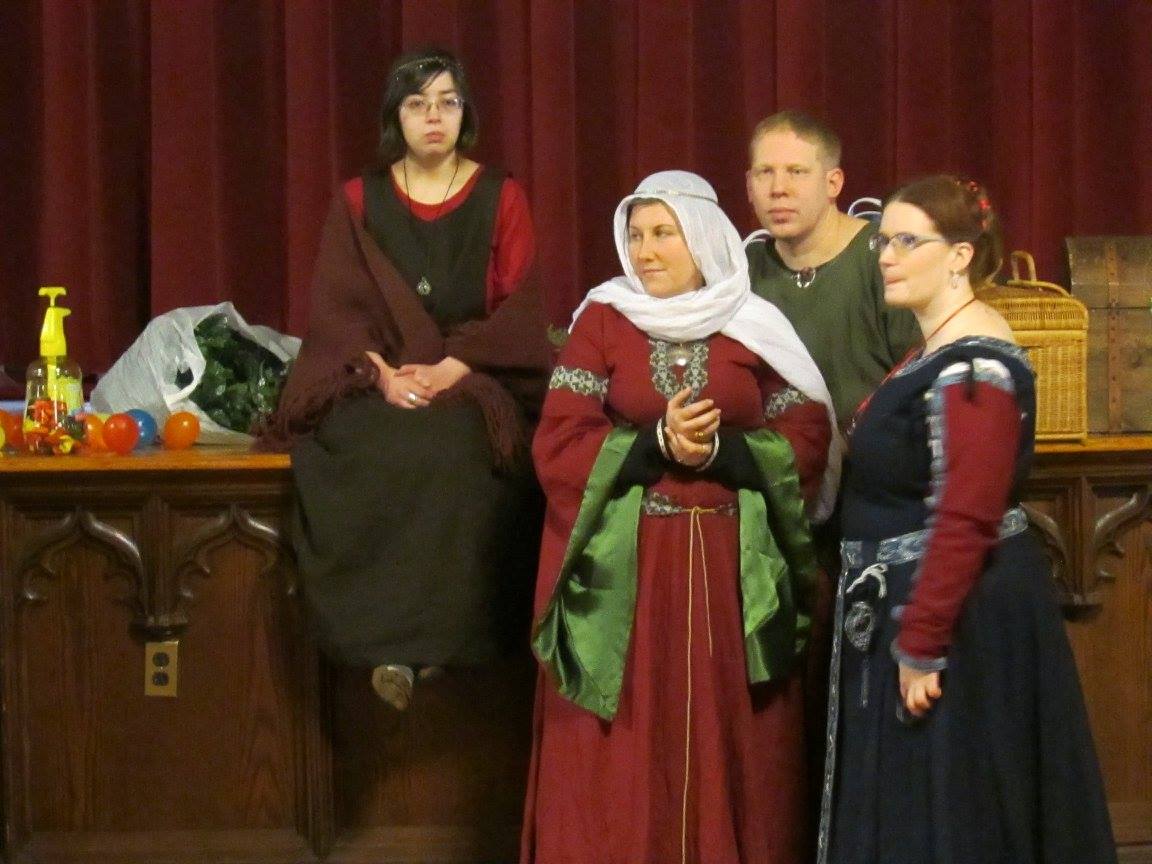
As I mentioned in my previous post, the Twelfth Night event in the Barony of Smoking Rocks (Southeastern Massachusetts) often has an early period theme. Typically 11th-12th Century. This year’s period was 1066, pre-conquest, so we went as my husband’s parents, Robert and Adelize de Tosny, looking to check out real estate on a plain called Hastings.
“Why the same thing we do every Twelfth Night in Angleland, Geoffrey, TRY TO TAKE OVER THE ISLAND!”For those experiencing instant site-envy, I give thee the Raspberry! Neener, neener!
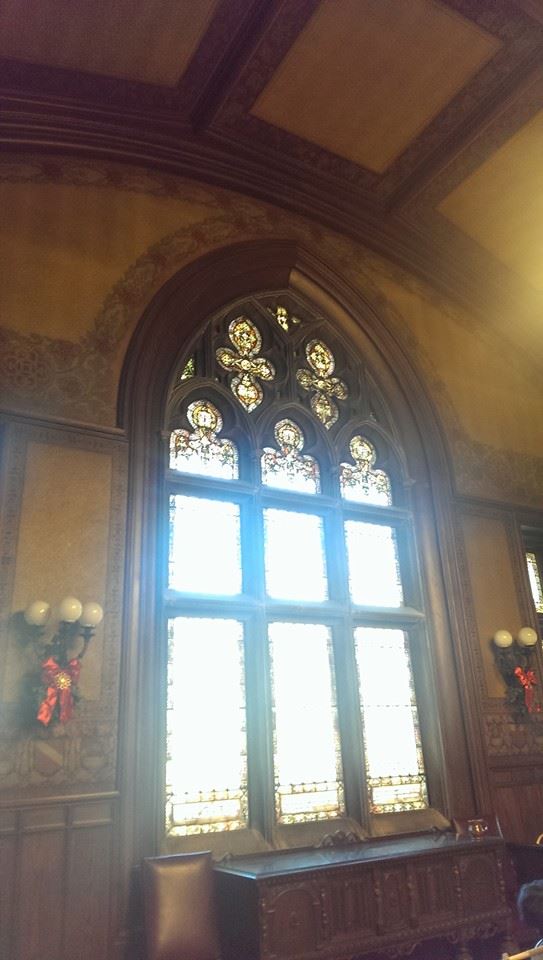
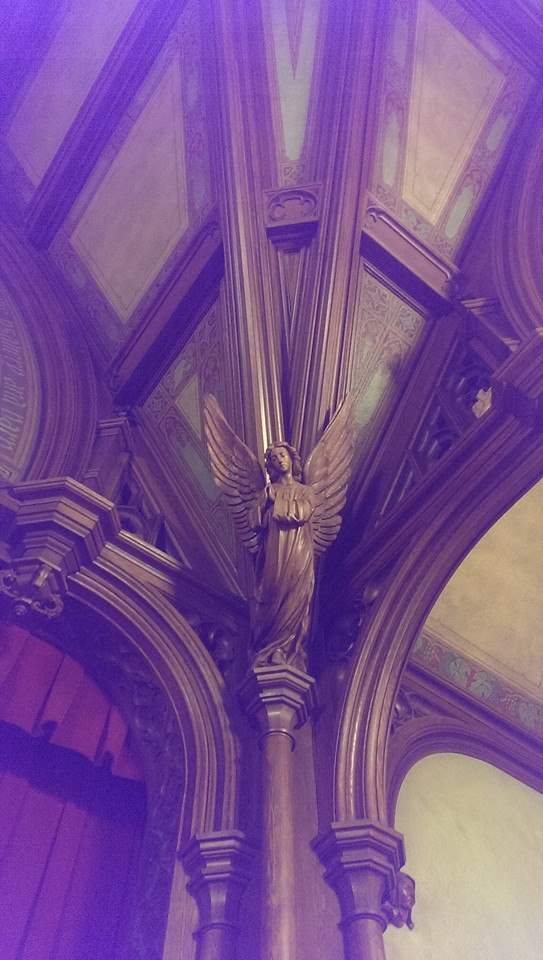
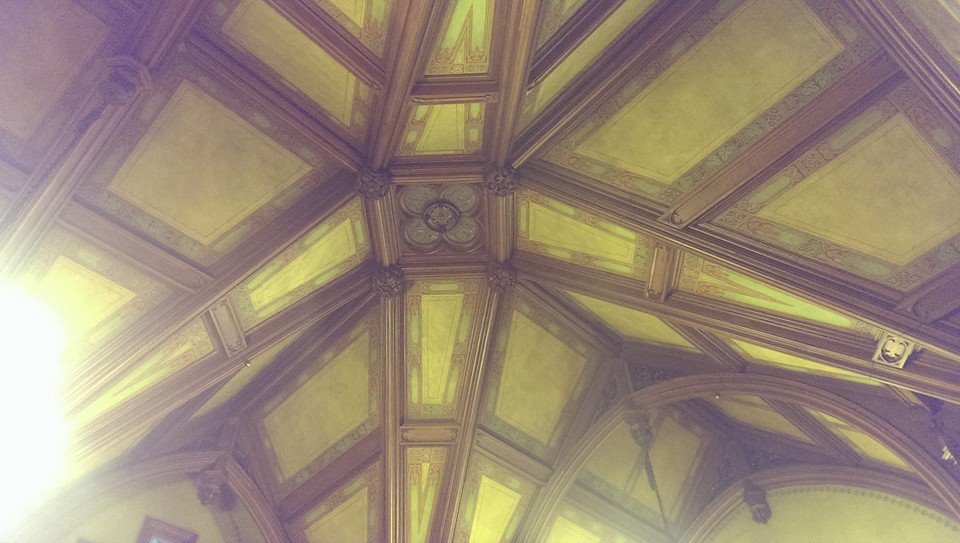
For the curious, the site is the Unitarian Universalist Society in Fairhaven, MA. Here’s some additional pictures of the site and event.
I need to confess that I name my nice garb. I do. If it hangs up in the closet and doesn’t get balled up and thrown in a tub for camping season, it has a name.
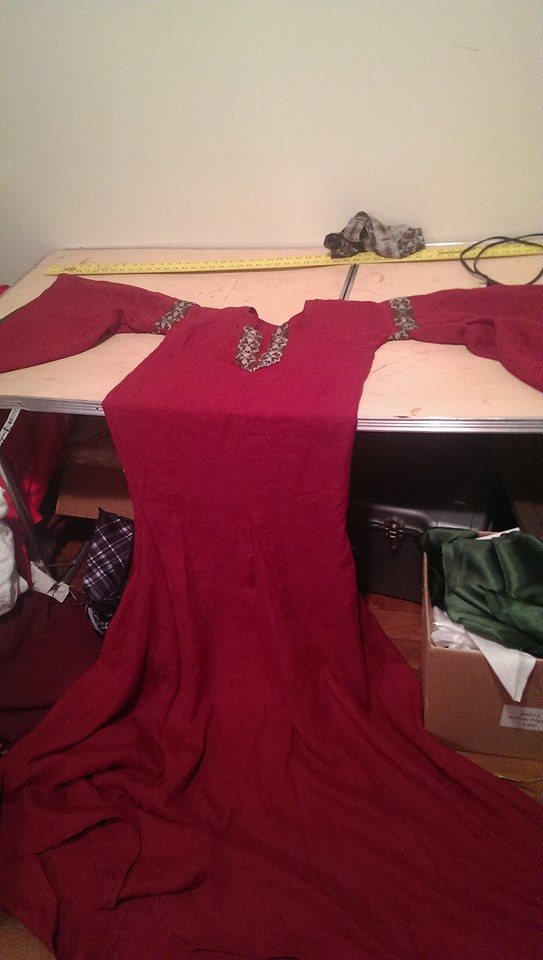
For example, my heavily pearled gold delmatikion is my Dalek Dress. I didn’t name it that, but it stuck, and I certainly did want to exterminate all the things by the time I was finished beading it the first time around. My Turkish fencing coat is the Portuguese Whirling Dervish, because of the colors, and my Buccaneers-inspired Elizabethan from last Birka is the Traffic Cone. My burgundy bliaut is the Norman Longdress, because long dress is long. Much like the longcat of internet yore.
Longcat is Long.
I didn’t fix it last year after I wore it to Smoking Rocks Baronial Investiture, and it’s been sitting in my closet since. Not that anything was terribly wrong with it, but I didn’t have a lacing up one side to create the ruching effect that Norman women found ever-so-sexy. So I simply made the dress tighter, and hoped for the best. It worked, but not that well.
Since the local 12th Night event that I attend in the Barony of Smoking Rocks is usually 11th Century Norman and/or Saxon, I figured that’s where I would get the most bang for my buck with this floor dragger. I didn’t wear it last year since we did a murder mystery in which Anna as a Byzantine needed to be present, so this year, I FINALLY get to wear it again. Time to get the lacings in.
Fortunately for myself, I had some sort of plan when I sewed the thing, and left the side seams unfinished so I could pop one for the lacings. This made me more happy that it probably should have. So I split the right side of the dress from the upper arm to the hip, hemmed it, and got to play with my machine’s buttonhole function 41 times. In theory and practice, yes, I should be doing eyelets by hand, but I assure you all that my machine does a way better job than I can do, and in a quarter of the time. Cheating? Yeah, probably. Utilitarian? Very yes.
So here’s the first look, before I put on the girdle. You can see how the lacing (spiraled, I should mention that) draws up the length of the dress to create the desired wrinkles. The “I’m so important I can afford extra fabric to just wrinkle around mah belly” look.
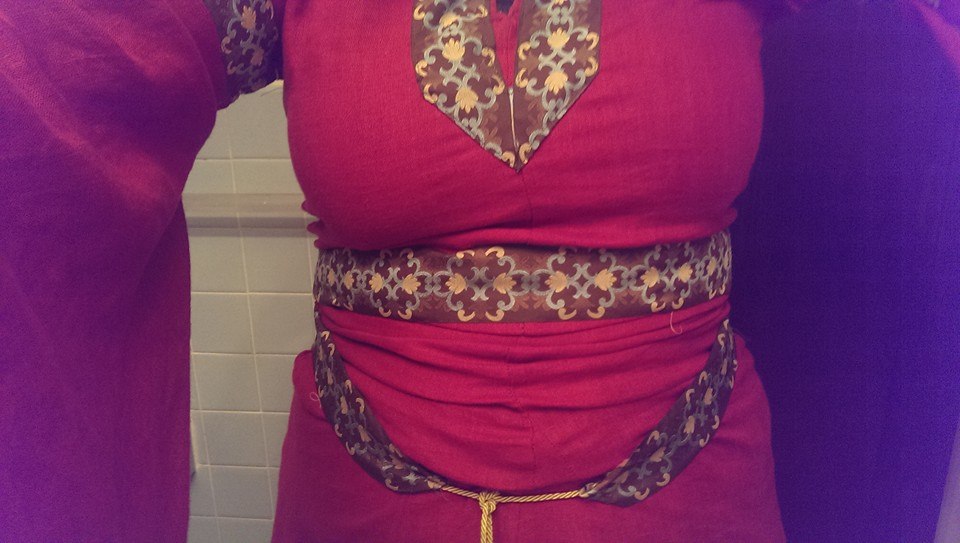
And here’s with the girdle, which after doing the requisite dancing around the house, is necessary. The design is not only decorative, but it holds the ruching in place in the front. Otherwise, you’re going to walk on your dress and faceplant. I wonder how many Norman women fell down the stairs before they figured this one out.
My husband didn’t even pull it as tight as it could go. I wonder if we really yanked it around my chest if it would draw up the fabric more. The torso is approximately a foot longer than my own to allow for this extra gathering. My underdress is tailored normally. Each have 4 gores instead of just on the sides to allow for very full skirting. It is HEAVY, and when I spin around I feel like a princess, and then try not to fall.
I do think that the bliaut itself would be far more beneficial in wool than linen. I can’t afford that much dress-weight wool right now, but the stretching and conforming to a shape with body heat versus the less pliability of linen would make a HUGE difference. So those reading this post to get ideas, I would recommend that if you can swing it. If not, linen is a perfectly fine choice.
I’m hoping to finally get REAL pictures of me in this dress next to my Lord in his Norman. So we’re finally in the same time period at the same time. Once I eventually make him real Byzantine on par with my own instead of the one tunic he occasionally wears when I order him to, we can have a set of good photos for things such as holiday cards, and gifts for our families who think us terribly weird. 😀
My lord had to go do Navy things for a few months, so when I should have been studying for school, I sewed things.
I also found out that Santa Claus can read heraldry! You see, we stayed home for the holidays this year when both of us usually travel, sometimes in opposite directions to keep both families happy, so we had no decorations. None. Zip. So I was shopping for the necessary trimmings, and found that they’re all way too expensive and I didn’t like them all anyway. So I went to Joann’s, dropped $60 in supplies, and went to work.
Here’s our heraldically (is word?) influenced tree skirt, hand appliqued, lined in horrible plaid with fringy fringe that was more of a pain in the butt than it probably should have been:
And our heraldically correct stockings, you know, instead of writing our names in puffy paint:
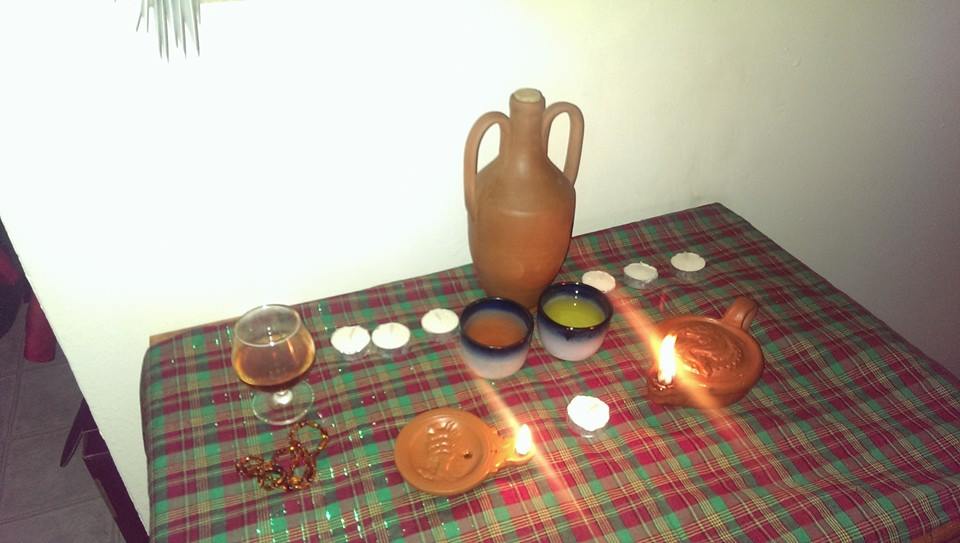
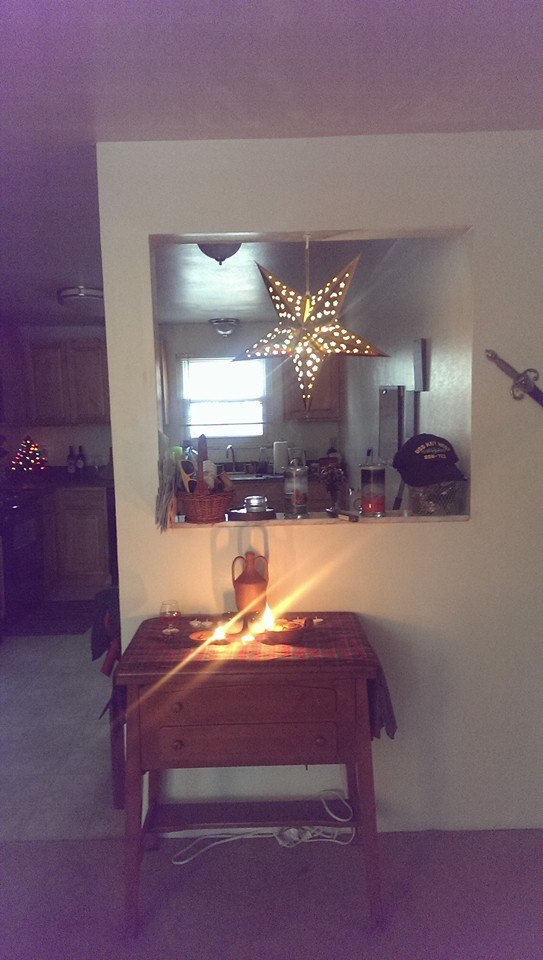
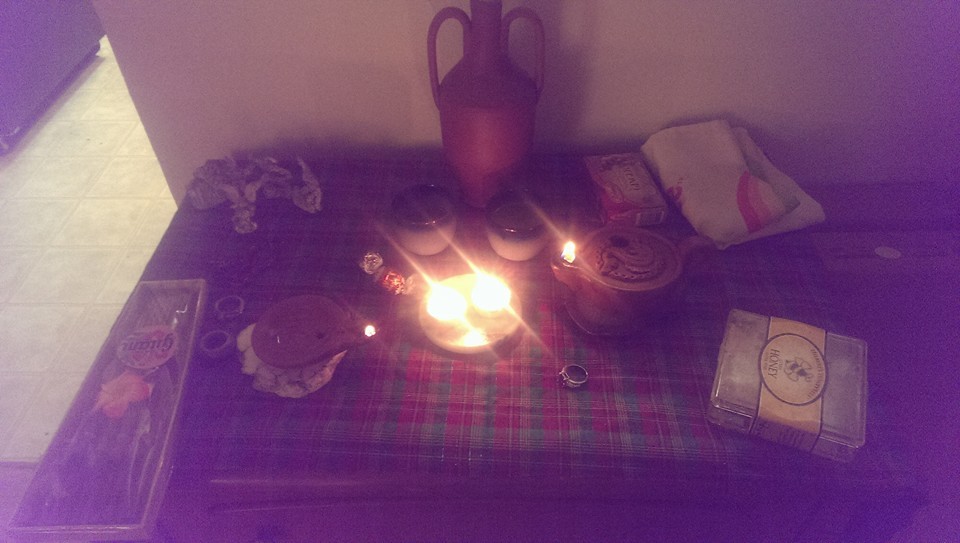
But modern Christmas is not terribly period ,but it sure is pretty. So, I decided to try Saturnalia from the 17th-23rd of December for the first time this year, and we definitely had fun! We set up a household altar with Roman goodies: an amphora, a cup of wine and a cup of olive oil, lamps, and I had a tea light for each night of the festival (how, uh, syncretic of me.) Each day the lord and I would make an “offering” to Saturn in the ways of whatever we had around. This varied from my actual Roman artifact rings, to a cheap rhinestone ring, amber necklace, chunk of shortbread, coffee, and Geoffrey’s Dungeons and Dragons Elementals. I am not even kidding.
The First Day of Saturnalia.The star lamp would have been very appealing to the Romans, who were fond of gilding all the things with gold suns and stars for the festival. I kept it lit the entire 7 days.The last night of the festival with all the goodies we offered! Rainbow Brite pillowcase from the 80s and chopsticks my husband brought me home from Guam. Why not?! I was burning some extra candles since we weren’t home for a couple of nights.The magnet on my car. Complete with some New Hampshire December ice and grime.
It was all in the spirit of the season, and trying to feel as the Romans would have felt. Every holiday in December has one thing in common: The solstice and the return of light at the darkest part of the year. So I’m a big fan of setting things on fire or putting a mere 1500 lights on my balcony and 400 lights on my tree.
And lawn flamingos. Nothing screams winter like pink plastic.
Most of all, we had FUN. I hope everyone else had fun with the holidays this week, also!
Felicem Dies Natalis Sol Invicti!
Καλά Χριστούγεννα!
Or as my friends say, “Happy Lights!”
I hope everyone has a Happy New Year, and I’ll catch you all on the flip side with some neat info on Byzantine outerwear, and the upcoming garb challenge at Birka!
On the 1st day of Saturnalia, dilectus meus gave to me: A Judean Date Palm Tree.
On the 2nd day of Saturnalia, dilectus meus gave to me: 2 Punic Wars, and a Judean Date Palm Tree.
On the 3rd day of Saturnalia, dilectus meus gave to me: 3 Gauls dead, 2 Punic Wars, and a Judean Date Palm Tree.
On the 4th day of Saturnalia, dilectus meus gave to me: 4 Aureii, 3 Gauls dead, 2 Punic Wars, and a Judean Date Palm Tree.
On the 5th day of Saturnalia, dilectus meus gave to me: 5 Good Emperors! 4 Aureii, 3 Gauls dead, 2 Punic Wars, and a Judean Date Palm Tree.
On the 6th day of Saturnalia, dilectus meus gave to me: 6 legions a slaying, 5 Good Emperors! 4 Aureii, 3 Gauls dead, 2 Punic Wars, and a Judean Date Palm Tree.
On the 7th day of Saturnalia, dilectus meus gave to me: 7 Hills of Rome, 6 legions a slaying, 5 Good Emperors! 4 Aureii, 3 Gauls dead, 2 Punic Wars, and a Judean Date Palm Tree!
The end.
You’re welcome, and Happy Holidays folks, no matter what edition of lamp burning or tree lighting you partake in.
I’ve had some questions about heraldry lately. As I’m not a herald, but my dear friend Konstantia Kaloethina out in Calontir is, I figured I would just re-blog a post of hers. Feel free to ask questions in the comments section, and we’ll see what we can do to help.
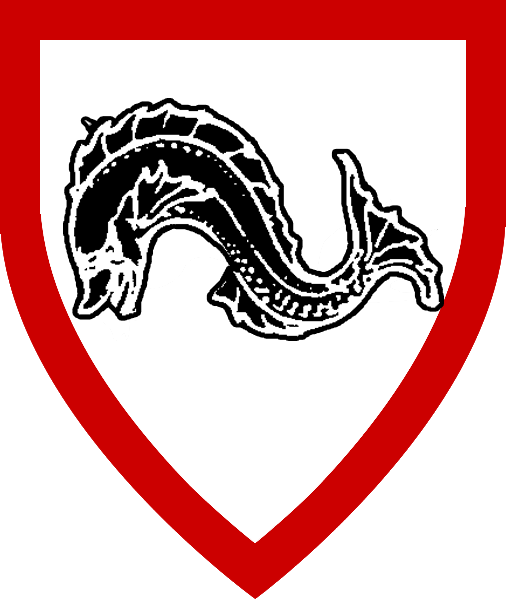
Here’s a picture of my heraldry, which I didn’t actually make while I had with my Byzantine persona, but it works.
As Principal Herald for Calontir, one of the many things I am excited to do with that role is assisting with names and devices. It is also one of the more frustrating things for early period personae or cultures that are not known for heraldry. It’s a bit of a balancing act, between actuality and the more creative parts of the Society for Creative Anachronism.
Azure, a standing seraph argent, a bordure gyronny argent and sable. Art by Kythera of Anevern (http://www.anevern.com/)
In my persona’s period (6th century Constantinople, around the time of Justinian and after the death of Theodora), the only person who would use heraldry would be the Emperor, and it would often be displayed on a labarum (a specific type of vexillium), or a banner that hung vertically. This labarum often featured a Chi Rho as part of the standard, while the vexillium would often be the…
I made a new Propoloma tonight for an upcoming A&S display here in the East. If you don’t know what I’m talking about, please see this informative earlier post.
Basically, I had a 60% off coupon for Joann’s, and decided I needed to spend money immediately, so I went in, paid less than $10 for 2 yards of white wool felt, and ran out giggling. I put on my car, and Alien Ant Farm’s cover of “Smooth Criminal” was on the radio. This is, ironically, how I got my persona name from an ex-boyfriend.
“Annie are you okay?”
NO! I’m about to make a funny looking hat!
So, for fast reference, here we have Irene Gabras to inspire my Flying Nunnery:
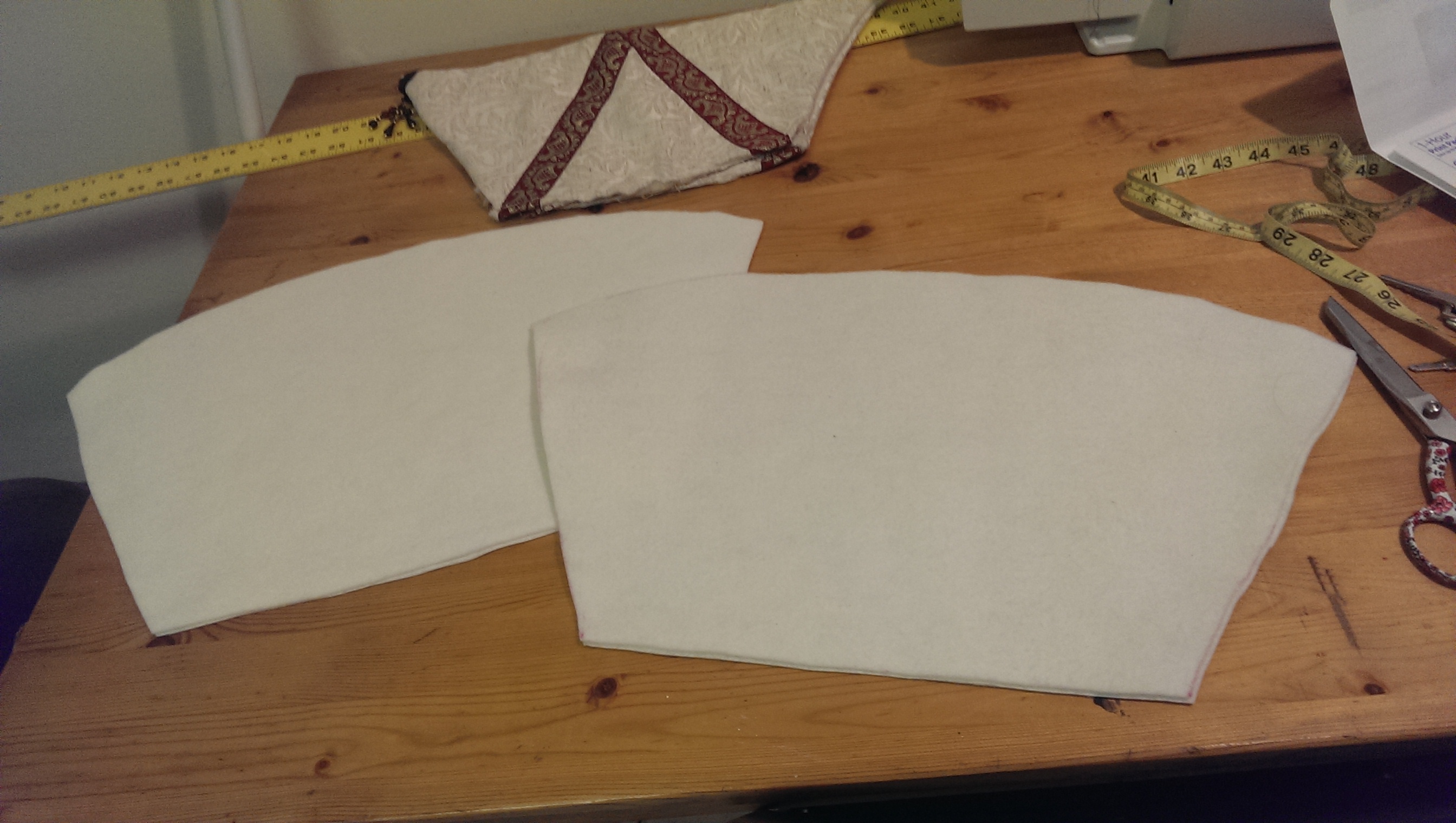
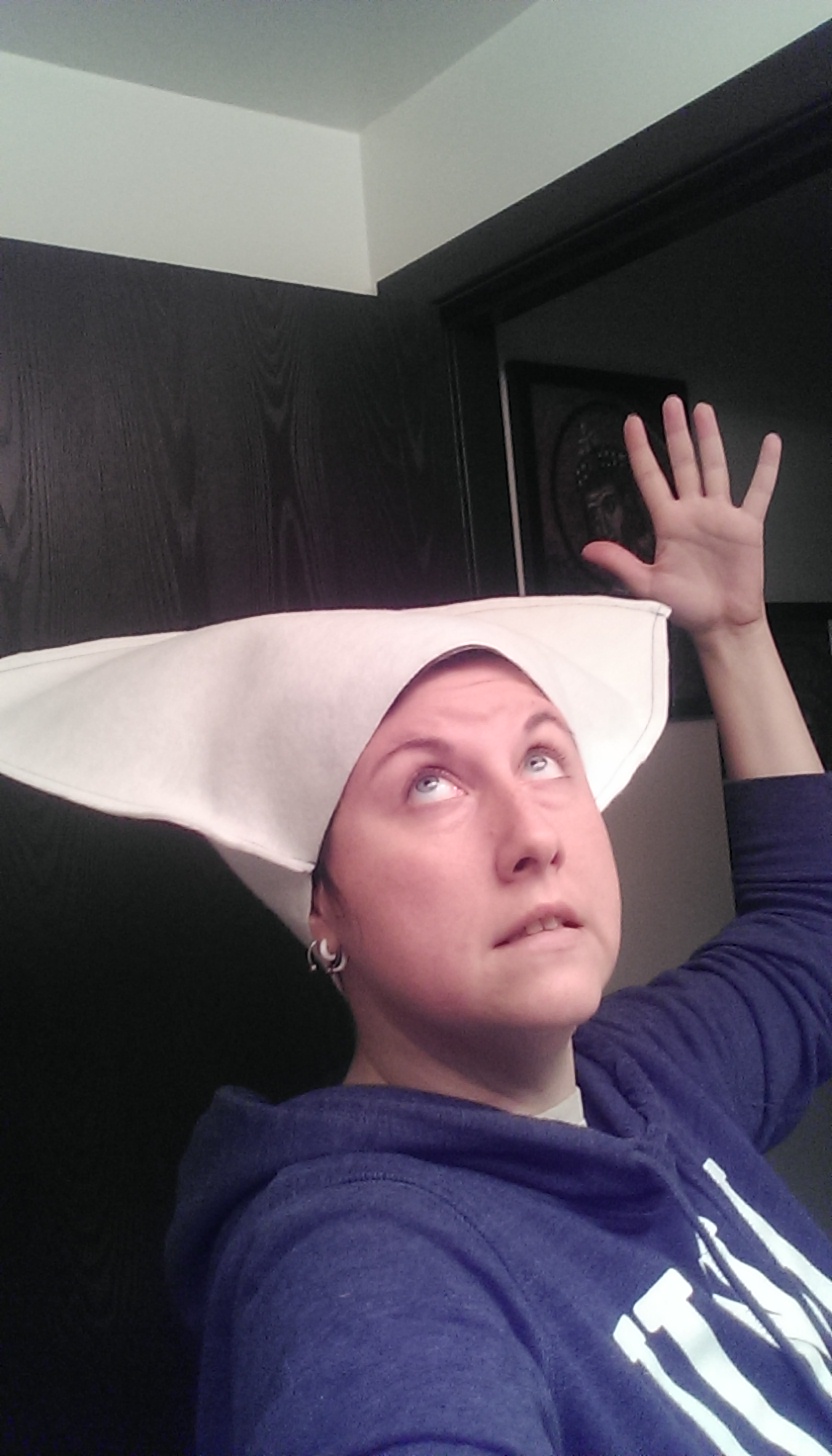
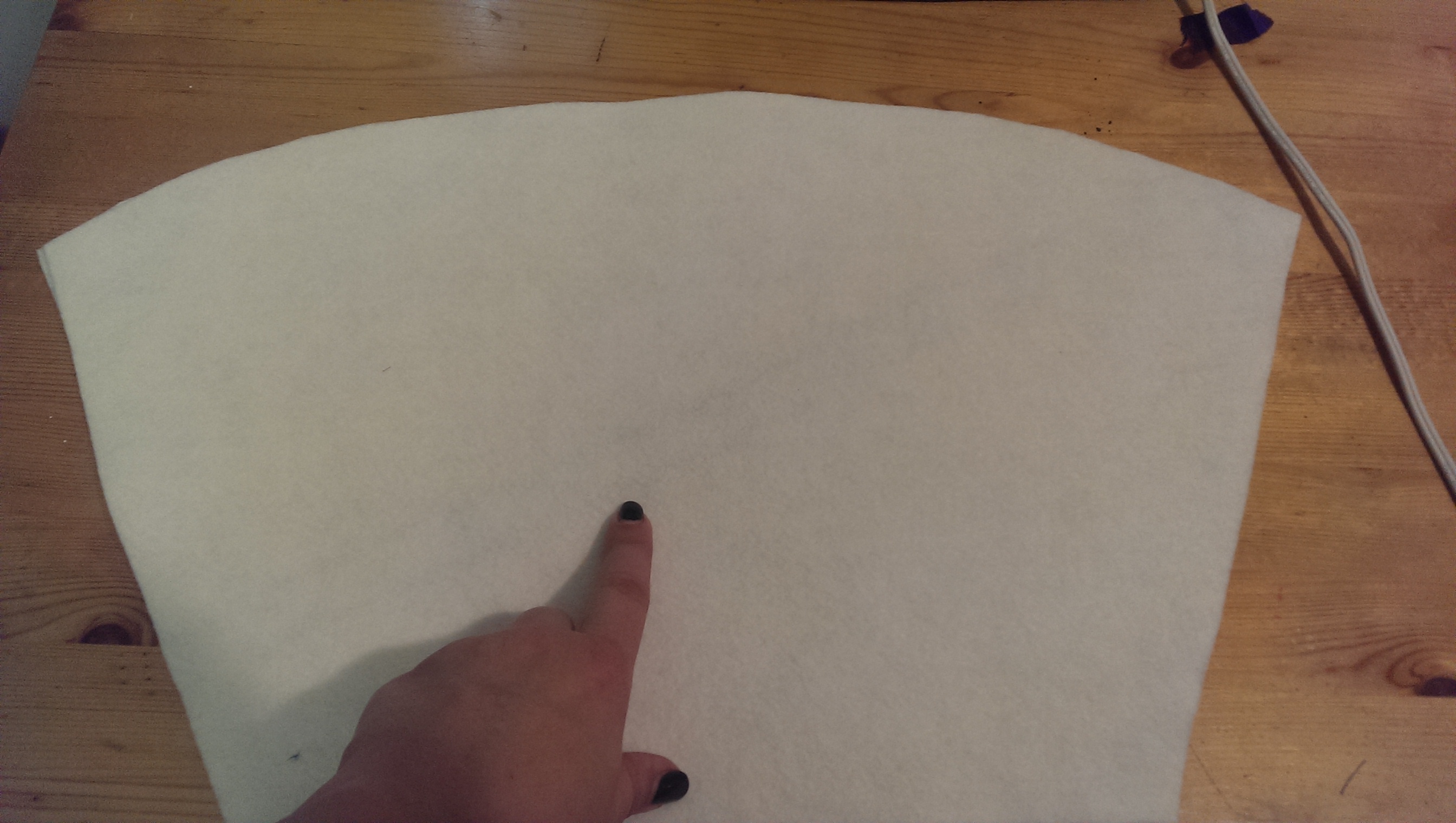
So, first, I cut the wool using my first version of the hat as a guide. I needed it bigger and rounder. I cut four pieces total, as I wanted a lining and a shell. I figured this would be full bodied enough to stand on its own without using buckram or other modern stiffening materials.
After that, I sewed the lining together, and tried it on.
Holy amazeballs, it’s Sally Field!
This, of course, resulted in all sorts of funny name calling on Facebook, which both amuses me and aggravates me at the same time. On one hand, I posted it, I deserve the jokes and I know my friends are jerks. It’s a thing. On the other hand, I am introducing this hat and style of dress to the SCA, and I’m met with joking. Way to make me want to actually wear it, guys. Not that I should ever expect constructive comments of any kind on a social network that devotes more time to political party bashing than…oh wait, that’s perfectly Byzantine. *Ahem* MOVING ON.
I used some silk remnants I had to make the stripey bit. I’m not good at this part. Irons and I don’t get along.
Meh, good enough.
Then I began to apply it to the shell, using the painting of Irene Gabras as a guide.
After sewing it down, I did the same for the other side, opposite directions so the ends would meet. I was able to barely see the stitches through the wool, so that made a nice guide.
Once both sides were sewn down, I went back and added a little bling with gold thread. I had considered using some of my embroidery stitches for more shiny, but I decided in the end that I need to 1: Lay off my embroidery stitches and start doing more hand work, 2: this is a statement hat in its own. It will speak for itself, and 3: I didn’t want to be presumptuous in persona.
Once the silk was sewn down, I finished the sides of the hat, and turned it right side out, and then made sure it was still equal to the lining.
Then I put the lining inside of the shell, and immediately felt like Rita Repulsa from the original Power Rangers series:
By this point, I was being compared to Yoda on Facebook, but I didn’t care. I was ready to wrap this up. A little whip stitchin’s for the opening:
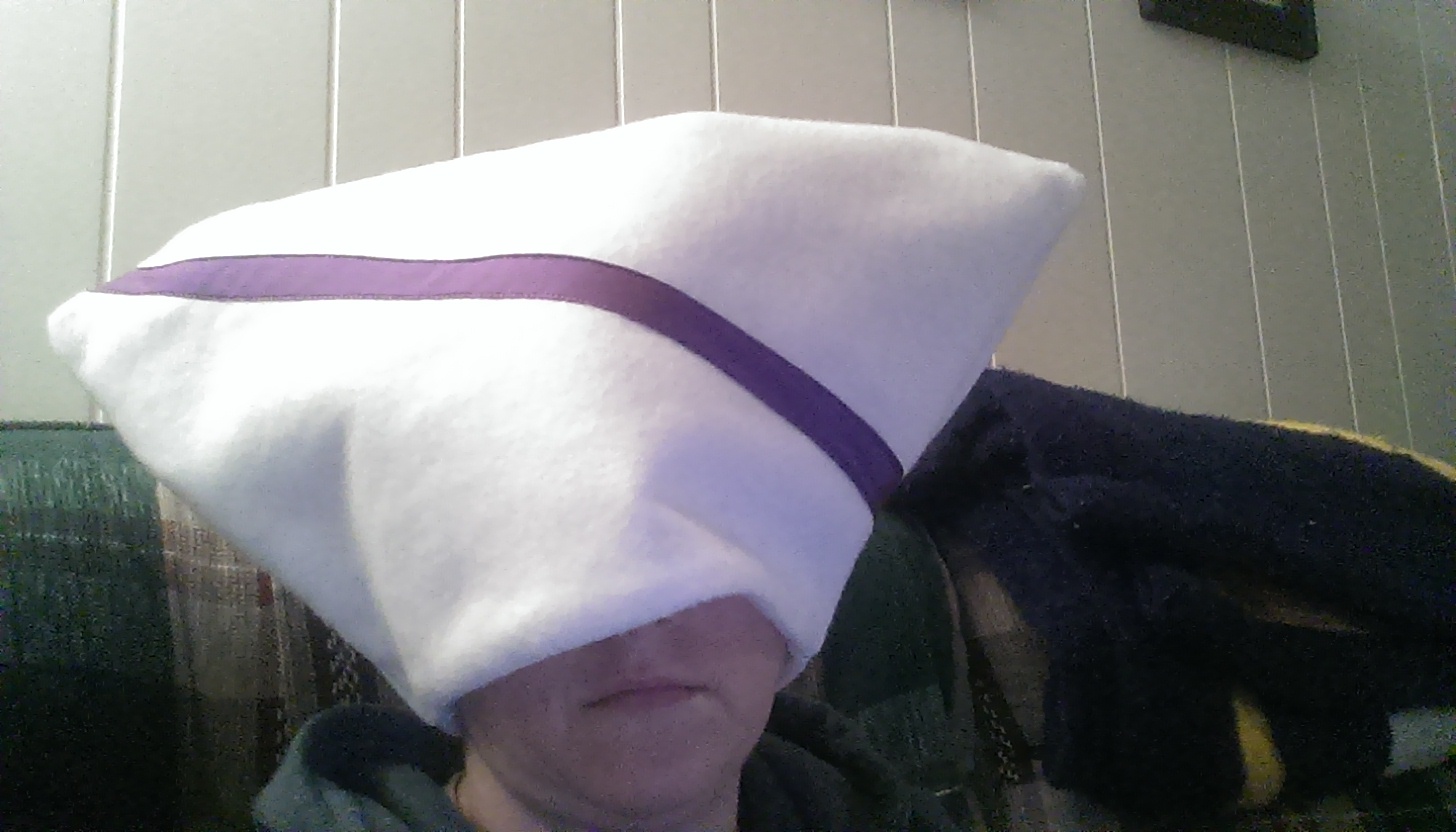
And Voi—-uh. Hmm…
But that’s okay, I have a notoriously small head, and I did it on purpose for veils and nets and such. So, naturally, I had to go play dress-up.
VOILA! ANNA ZOSTE PATRIKIA!
Putting the kohl on my eyes really makes it, I think, I mean, I practically just wrapped myself up in fabric like a Glamour Shot. :3 it also shut up the peanut gallery. Context is everything!
As you can see, the 2 layers of wool felt gives the hat enough body to stay up on it’s own, and it’s also nice and toasty, because I live in New Hampshire, where we are known best for our tropical winters.
Here’s a comparative shot of my first hat and my new one. What an improvement!
Readers of my blog will probably recall a post I made not long ago, well, six weeks ago to be exact, on my beginning of a course on FutureLearn. I reblogged a post “Who built the wall?” when the course started, and now I feel urged to share a poem by Rudyard Kipling, “The Roman Centurion’s Song”. It’s that feeling you get when you finish a good book, that emptiness that comes with completion. I guess I didn’t expect to feel this way, but that’s a good thing! That means that FutureLearn and Newcastle University have done their jobs. For a free online course, it was OUTSTANDING.
A little bit about the breakdown of the course:
Each week had about 20 short sections to complete. They ranged from short videos, to articles, and quizzes. The quizzes don’t count against your grade, they were just a learning tool. Every 2 weeks there was an actual test, culminating with the final test at the end of the 6th week (That one had some curveballs in it.) My favorite part were the little forensic challenges that happened every other week or so. You would be given an archaeological find of bones, and then try to determine cause of death, gender, etc from the clues given in an article. It was a great insight into the grim world of forensic archaeology.
The Vindolanda tablets were totally awesome. I had heard about them before, but never actively went seeking them. I really suggest taking a look at them here. Learning a bit more about the religious syncretism that occurred at the wall and methods of worship was also incredibly fascinating.
In addition, the discussions that were had were also great. Each section has a discussion area that functions like a social media platform, in which one could post an answer or topic of discussion and receive answers, sometimes even by the staff at the University, who was actively engaging with the MOOC the entire time.
I do believe you can still check out the course. Go to https://www.futurelearn.com/courses/hadrians-wall/ and see for yourself. I may have also totally taken the bait, but Newcastle University may be on the list of schools I look into for my PhD. But that’s a ways off yet, let me finish my MA first!
Thank you to the staff at Newcastle University and FutureLearn for offering this experience. I’ve already enrolled in an upcoming course, also through FutureLearn, on the archaeology of Portus which is being given by the University of Southampton, another UK school. I look forward to checking that out in January. 🙂
I started my MA degree this fall at the University of New Hampshire, and needless to say, it’s been keeping me a bit busy. I am doing what research I can, and hitting all sorts of amazing conferences, such as last weekend’s New England Renaissance Conference in which the topic was Credit and Debit in Medieval and Early Modern Europe. Totally a fascinating topic I never even thought to look into before.
In 2 weeks there is an event in the Barony of Carolingia, our neighbors to the south of Stonemarche, called Voyages of Discovery, and A&S Colloquium. It is a mundane clothes dress academic conference with Scadians in mind. I will be presenting my paper on Suetonius’ biography of Domitian, and my analysis using contemporary sources. It’s one of my undergraduate works, but it was my writing sample to get into graduate school, and apparently did the job.
I also plan to prepare my propoloma article from here on this blog for publishing in Ars Scientia Orientalis, the East Kingdom A&S Journal, much like my silk paper was. So yes, even though I haven’t been crafty, I’ve still been busy!
I do have some slow-coming work in progress on Byzantine outerwear. Look for that in the coming weeks.
I’ve signed up for a free online course on Hadrian’s Wall via FutureLearn, offered by Newcastle University in the UK. Not that I don’t already have enough to do with my own graduate studies at the University of New Hampshire, but I figured that I would reblog a site that came up on Twitter, and link to the course itself. It started Monday, but I believe there is still time to sign up. Please join me in learning about this really cool part of Roman History!
A legion was around 5,000 heavily armed and armoured men who were, by the 2nd century AD, even more of an anachronism than the rams that still adorned the prow of every Roman warship in their fleets. Organised into ten cohorts, each of around 480 men, they were extremely effective in open battle, especially when complemented by their attached auxiliaries. Legionaries (never, please, ‘legionnaires’) were nevertheless unsuitable for garrisoning a province and all-too-easily wrong-footed by even the most basic of insurgencies (as all technologically dependent armies tend to be).
Britannia was to turn out to be a troubled (and troubling) place. It needed four legions until the end of the AD 80s and right up until the beginning of the 2nd century AD it still had three (II Augusta, IX Hispana, and XX Valeria Victrix). Then something happened, and at some point between…





















 Anna's New Rome
You must be logged in to post a comment.